
Volume 5, Number 2, July 2002
Using the Strategy to Task Technique to Prioritise Technology Options
- 1 QinetiQ Ltd, Fort Halstead, Sevenoaks, Kent, TN14 7BP, UK.
Abstract
The Strategy to Task Technique (STT) is an approach used to develop low-level, often system-specific, requirements for a system or capability through a process of decomposition. The paper describes the use of STT as an enabling analytical tool to support technology investment decisions. The Strategy to Task technique was used to establish relative priorities for a number of defence system categories. These priorities were then used in a subsequent analysis to evaluate the relative contribution of a number of technology programmes to these defence system categories; the aim was to establish investment priorities for these technology programmes. Two Strategy to Task analyses were completed; one analysis used UK military doctrine material and sources, the other analysis used a UK military task list hierarchy. These analyses produced two independent sets of relative priorities associated with the defence system categories. There was reasonable consistency between these two sets of priorities. Further sensitivity analysis was completed to establish a greater degree of confidence in the outputs. The paper also assesses the method of implementation used and discusses the robustness of the Strategy to Task approach in this application.
Introduction
The Strategy to Task Technique (STT) is an approach used to develop low-level, often capability or system-specific requirements through a process of decomposition. The technique has several applications and includes assessments of possible system options to meet low level, high-resolution requirements. In this paper an application to help support technology investment decisions is described.
Strategy to task outline
The Strategy to Task technique was originated by the US Air Force and the RAND Corporation and was first widely aired in a paper published in 1989 [1]. It is also described, including a QFD-based worked example, in a paper by Bathe and Smith [2].
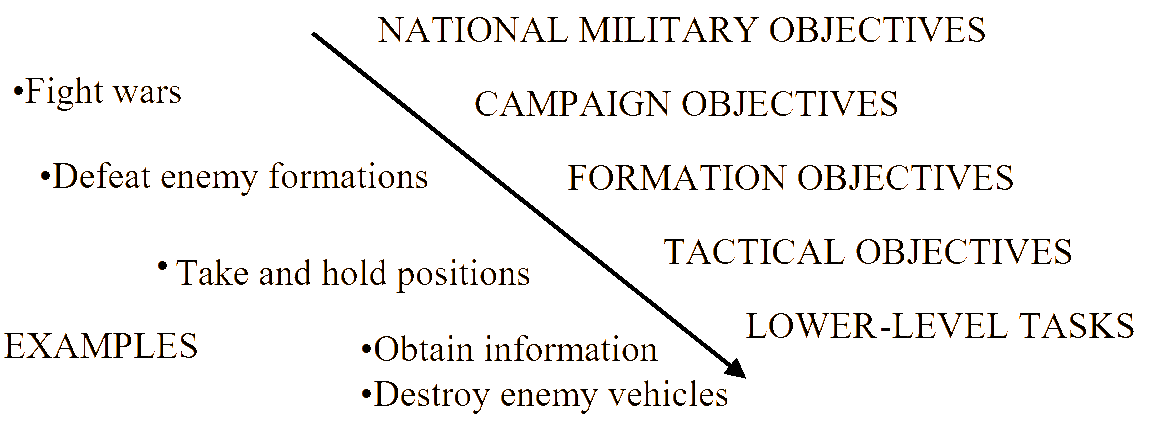
The STT process, illustrated in Figure 1, is a structured method for generating more specific lower level tasks from sequential decompositions of higher-level requirements. The highest-level requirements can often be from expressions of national military and/or political goals. The process, therefore, starts from expressions of high-level requirements and cascades through several structured layers to arrive at the lower-level tasks. Authoritative sources, for example Military Doctrine publications, can be used to prompt responses at each subsequent level as to how the previous next higher requirements can be met. The process is then followed until a lowest level appropriate to the specific application is reached.
As a more detailed example, Figure 2 shows the decomposition process used for an artillery requirements study and which was completed using the Quality
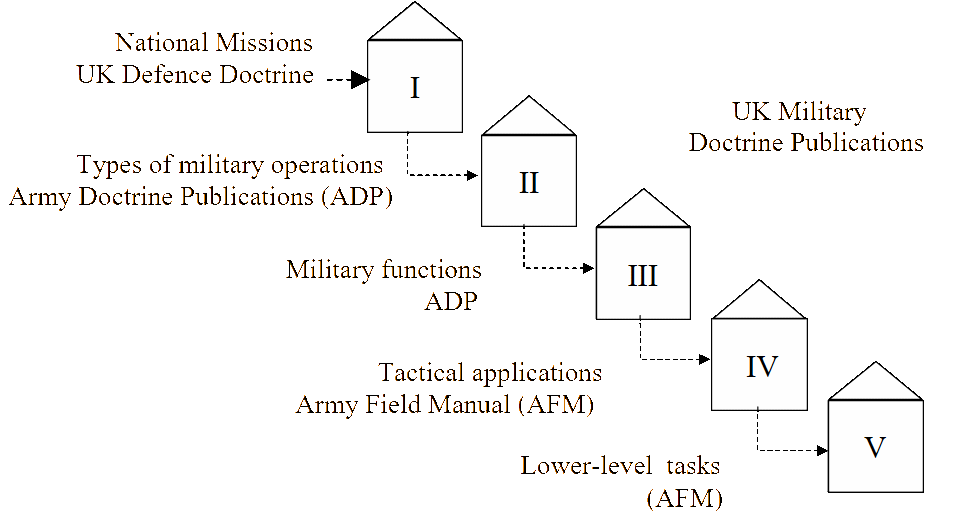
Function Deployment (QFD) technique as the structured cascading mechanism. Figure 2 shows the sources of information used for the study; in this case UK Military Doctrine publications.
Figure 2 shows that, in this case, the process was initiated by evaluating the National Missions of the UK Armed Forces. Next level activities were identified from British Army Doctrine Publications (used also for the subsequent next level in the hierarchy) until appropriate functions for the artillery systems under study were reached (these were then developed further from a lower level doctrine publication—the Army Field Manual—until artillery relevant tasks were defined). Each box or ‘house’ in Figure 2 is a Quality Function Deployment (QFD) matrix where a set of requirements (determined either from the initial top-level source for the first matrix of the hierarchy or cascaded down sequentially from the previous level in the hierarchy) is mapped against a set of responses generated from reviews of the source material.
The usual QFD scoring approach is used to link the strengths of responses to requirements; a non-linear scale 0, 1, 3, 9 is found to work well. The QFD approach used in conjunction with this cascade process generates weighted responses at each level—at the lowest task level the tasks are therefore weighted. The weights reflect how the tasks contribute to requirements or objectives emanating from higher levels in the hierarchy.
In the above artillery study the sources used to establish requirements and responses (at all but the lowest level) were UK Military Doctrine publications. However, the approach may use other authoritative sources, as appropriate to the study subject.
There is a range of applications for STT. Broadly, those applications of STT encountered by the authors have been to:
- derive requirements for military systems;
- assess system and subsystem options, often as technology options, against the identified requirements; and
- derive a prioritised set of the most appropriate system options that meet the requirements.
Use of STT for technology investment
One application of STT is as an enabling tool to help identify technologies that are robust to the needs of capabilities/ systems that best meet requirements evolved from high-level mission requirements. Such an approach is complementary to other methods used by defence industry, for example, to identify technologies for inclusion in a technology investment portfolio.
This paper describes how the STT process was applied for this purpose in a pilot study, the aim being to show how a structured analysis could complement alternative approaches to the identification of future technology requirements.
The overall approach adopted was to:
- identify the potential relative importance of a number of categories of defence systems, and
- undertake an analysis of how an existing set of technology investments maps to the prioritised systems identified from the initial activity above.
It is the first element of the study that is described in this paper.
The activity to identify priorities for categories of Defence Systems was completed using the Strategy to Task approach. Two separate approaches were used for the STT-based analysis: one using Military Doctrine Publications, the other using the MoD UK Joint Essential Task List (JETL). As a means of providing a further comparison the study undertook a third approach, based on a mapping of Defence Systems against defined scenario, which had been used previously. Figure 3 shows the overall approach, the scope of this paper being those aspects inside the dashed line.
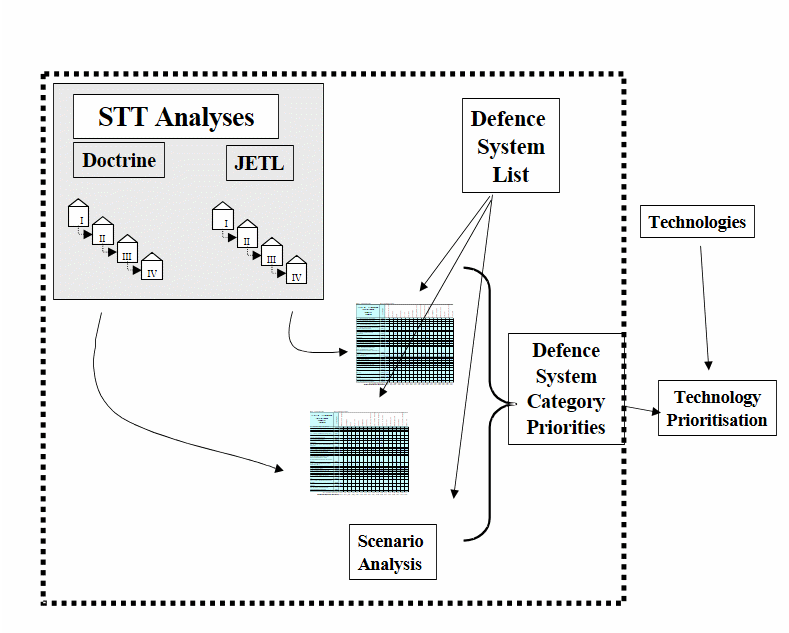
The aim of the pilot study was therefore to determine priorities for a set of major Defence Systems categories using STT and then to map these prioritised systems onto technology areas to derive, in turn, the relative strengths of relevance these each might have.
The STT process by its very nature is a subjective process both in the selection requirements/response elements and in the QFD scoring of responses to requirements. It is acknowledged as such and so in order to reduce the impacts of potentially misleading or narrow judgmental outputs, the analysis was completed using two different STT cascades (Doctrine and JETL based respectively).
Each of these produced independent sets of weighted priorities for requirements: that is a set of low-level tasks meaningful for relating against the categories of defence systems of interest. These were then mapped against the set of defence systems to produce two independently derived sets of priorities for the systems. In addition the scenario-based analysis was also undertaken as a third, non-STT related, approach.
The intent was to use all three sets of priorities emerging from these analyses and in turn to evaluate the technology priorities resulting from each. In addition priorities could be compared one to another to establish some measure of the variance between the approaches and the judgments that had driven the outcomes.
Broad defence system categories
The broad defence systems categories of interest for the pilot study were as follows:
- Battlefield Engineer Systems
- Air Systems
- ISTAR
- Support Helicopters
- Tactical UAVs
- Air-to-Air Missiles
- Attack Helicopters
- Air Delivered Missiles
- Close Combat Vehicles
- Armoured Reconnaissance Systems
- Command and Control and EW Systems
- Naval Vessels (Destroyers/Frigates)
- Air Defence Systems
- Battlefield Support Vehicles
- Infantry Systems
- Future Artillery Systems
- Infantry Guided Weapons
- Infantry Fighting Vehicles
These were adopted on the instruction of the defence system contractor as being of principal focus.
Overview of the scenario approach
The non-STT related scenario approach is described first. This scenario-based analysis used a single level cross impact matrix. This allowed mapping of the set of Defence System categories against a set of high-level scenarios. Each Defence System category was scored in terms of its potential utility in each of the scenarios. Scenarios were assumed equally weighted. This analysis was conducted relatively quickly in comparison with the STT analyses; the scoring process used was completed initially by a single analyst but was then reviewed by other analysts and subsequently by a group of serving military officers. The review process was informal but no major discrepancies in scoring outcomes arose. (There are other more complex variations that could have been taken with this analysis but it was deliberately kept simple to use minimal resources in its implementation.)
Figure 4 shows an output from the analysis: the overall relative utility scores for each of the Defence Systems across all scenarios.
It is stressed strongly that the relativities of these Defence Systems reflect the land battlefield emphasis of the scenarios; alternative air/naval scenarios would have obviously produced different outcomes and prioritisations.
Overview of STT approach (1) doctrine publication based
The first of the STT analyses was completed using UK published sources of Military Doctrine. The sources and levels used are shown in Figure 5.
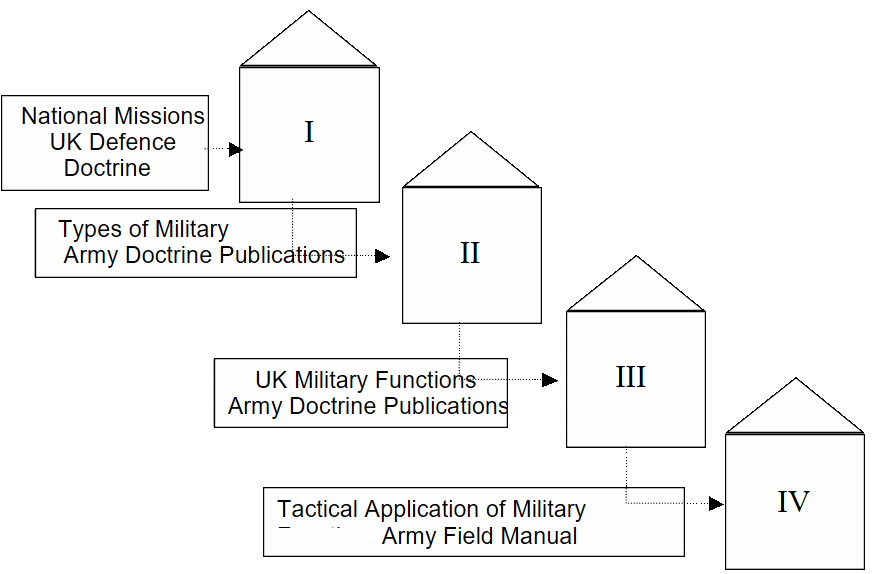
The top level used the UK National Defence Missions as a set of the top-level requirements. Responses to these were identified from the UK Army Doctrine Publication (ADP) Vol 1 Operations. These responses drove the requirements for the next level matrix. Responses at this level were then identified from further analysis of the ADP Vol 1 Operations publication. The next level used the Army Field Manual (an element of the UK MoD Military Doctrine publications) to identify the further responses as illustrated by Figure 5. The final output at the lowest matrix level was a set of ‘tasks’ with weightings derived from the sequential scores of the matrix hierarchy. It should be noted that the final set of tasks ran to some 60 in total.
The last stage was to score the perceived utility of the Defence Systems categories against each of these weighted tasks. The overall utility scores arising from this analysis are shown at Figure 6.
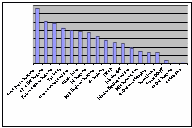
As previously, the scoring process for the STT hierarchy was completed initially by a single analyst but was then reviewed by other analysts and by a group of serving military officers. The scoring of Defence Systems categories against the weighted tasks resulting from the STT analysis was completed independently by an analyst and serving military officers. It is stressed again that the relativities for the systems reflect the focus on the land battlefield, Army related, aspects of Doctrine employed for the analysis – the required emphasis and relevance for this pilot study.
STT approach (2) joint essential task list (JETL) based
The second STT analysis used as source information the UK MoD Joint Essential Task List. This is a hierarchical set of military tasks developed by the UK Permanent Joint Headquarters (PJHQ). These tasks have an explicit lineage as illustrated in Figure 7 below.
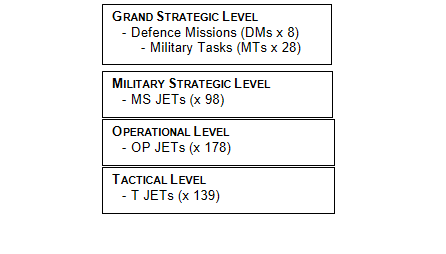
PJHQ state:
“Each JET has a number of linkages to policy and doctrine. This is a key element in establishing a requirements based, mission to task, systems approach to joint training. Every one of the 415 JETs is referenced to the Strategic Defence Review (SDR) Defence Missions (DM) and Military Tasks (MT). Every JET is underpinned by a reference to joint, and where applicable alliance, doctrine and to similar activities in the US and NATO task lists. Hence the JETs have a lineage to the SDR and current doctrine that produces an audit chain from policy to capability.”
One of the authors (Szalay) has completed an MSc project linking the JETs in a STT cascade matrix. This work was used as the source for this element of the study. Key points to note about this analysis are: the analyst was not the same as for the Doctrine based STT; the hierarchy is less prone to judgement in its derivation (the JETs are well defined by the JETL hierarchy) and also that the scores were generated using source material from PJHQ indicating the relevance of tasks at each level to the previous level. Judgment was still required but arguably less so than need for the Doctrine based analysis.
The final set of requirements in this STT cascade amounted to some 26 tactical level tasks. The same set of Defence Systems categories was then scored against these weighted tactical level tasks.
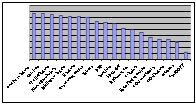
The resulting set of relative priority outputs is shown below in Figure 8. The previous caveats on the land battle emphasis should again be noted.
Comparison of priorities from the STT approaches
In comparing the outputs from the two STT approaches it can be observed that there is reasonable consistency. Although there are differences in the orders of priority the top groupings of Defence Systems categories are broadly the same, for example, and the overall order is broadly consistent between the approaches. One discrepancy lies in the Battlefield Engineer systems that move from 5th (in the case of the JETL analysis) to 8th (for the Doctrine analysis). Overall the Spearman Rank Correlation Coefficient arising between the two approaches is 0.89.
Comparison of STT with scenario analysis
Regarding the outputs from the scenario analysis the same broad comparisons can be made. The major difference here lies in the placing of ISTAR. This was investigated and it was subsequently determined that there was some difference in interpretation amongst the analysts in their understanding of the ISTAR category and that of C2&EW. For the purposes of the study (where the scenario analysis was used as a comparator only to the STT analyses) the discrepancy was simply noted. However, this does provide an important point for future reference: appropriate effort must be directed to ensuring confirmation of common understanding of definitions for interpretation of the source material used in the STT, and also for the judgmental scoring processes. (The Spearman Rank Correlation Coefficients between the Scenario and STT (Doctrine) and between the Scenario and STT (JETL) approaches were 0.78 and 0.68, respectively.)
Sensitivity analysis
A number of sensitivity analyses were undertaken to test robustness and to give confidence in the outputs. One aspect already noted in this paper was that matrices in the STT analyses were scored independently by several experts—chiefly for the scoring the Defence Systems categories against the prioritised requirements resulting from the lowest level of the STT analyses.
In addition sensitivity analyses on the weightings and scores derived from the STT were carried out to evaluate the sensitivity of the hierarchical cascade. Top level weightings (ie the input to the first matrix in the hierarchy) were varied to explore the effect on the final outcomes. Two extreme sets of initial weightings were used, one to reflect an emphasis with a more Peacetime-oriented focus versus one with a more Warfighting focus. The general finding from this analysis was that final outputs were quite stable. The Systems priority order was the same excepting changes between Artillery and UAV (which swapped places) and Support Helicopters and Air Delivered Systems (which swapped also). Actual utility scores did change with variations in the initial input conditions, but relative priorities remained reasonably stable.
Technology investment prioritisation
The results from the analyses described above were used as a basis by which to assess the potential relevance of a range of technology programmes in a technology portfolio each requiring investment. The approach was to map the perceived relevance of the technology programmes against the relatively prioritised Defence Systems categories. (A score was placed in a matrix indicating the strength of relevance which each technology has to each of the Defence Systems categories.) The process was carried out using each of the three sets of priority weightings for the Defence Systems categories; the two from the STT analysis and that from the scenario analysis. From each of these the relative importance of each of the technology programmes was evaluated. Results were generally consistent and, although relative scores changed, the order of priority of the technologies varied little providing useful viewpoints for contrasting with other non-related approaches for technology investment prioritisation.
Discussion
This analysis provided interesting outputs: results from all three aspects of the analysis (the two STT approaches and the scenario analysis) show broad consistency for priorities for the Defence Systems categories. More work is required to assess consistency of approaches, but the level of consistency achieved was reassuring. Such consistency in final weightings and priorities has been observed from previous STT experience. One of the authors (Smith) was involved in a UK/US weapon project that utilised STT. Two STT analyses were completed, one based on UK sources and the other on US sources. Final requirements sets, weightings and subsequent assessments of candidate solutions were pleasingly consistent.
The approach used in this work was to use a single analyst to complete elements of the exercise and then to seek reviews by subject matter experts at each stage. Modifications were made as a result of these reviews and where necessary meetings, or informal panels, convened to address any significant issues. These were reinforced by more detailed reviews and independent generation of scores at the lowest levels (that is, for systems mapping against the low-level requirements).
One key advantage of the STT approach is the use of published sources to drive the hierarchical matrices (that is, in derivation of responses). The reviewer is able to use the relevant manual and locate source text relatively easily—especially if well-known sources such as Doctrine manuals are used.
It is recognised that more work is needed on the sensitivity of matrix hierarchies to changes in embedded scores and to scoring scales. However, too much emphasis on ‘accuracy’ is perhaps misleading. The judgmental nature of the process will probably always militate against unique, comprehensive and definitive outputs. For this pilot study this was recognised and the outputs were taken principally as a broad set of pointers that provided guidance and direction rather than as an analysis providing highly accurate numerical outputs.
Summary
The STT method has been used as an enabling tool to develop systems priorities (in a well defined context) in support of an analysis of technology investment options. The approach taken attempted to ensure a robust set of conclusions could be achieved from what is essentially a subjective approach. The results of the two STT analyses indicate a broad consistency of output although generated from differing sets of source material, and were also broadly in agreement with a scenario based analysis. Overall it was concluded that the STT based analysis provided a useful complementary adjunct to other technology prioritisation processes.
References
[1] G. Kent, A Framework for Defense Planning, RAND Corporation Report No R-3721-AF/OSD, August 1989.
[2] M. Bathe and J. Smith, “A Description of The Strategy to Task Technique and Example Applications”, Journal of Battlefield Technology, Vol. 5, No. 1, March 2002.
[3] UK PJHQ, Joint Essential Task List, PJHQ, Version 4.1, 18 May 2000.