
Volume 5, Number 2, July 2002
'Who Knows, Wins?' Knowledge Management and Emerging Army Tactical Command and Control Concepts
- 1 Land Operations Division, DSTO Edinburgh, PO Box 1500, Edinburgh, Australia, 5111.
Abstract
Success on the land battlespace has traditionally been attributed to the leadership and skill of the commander. The introduction of the staff system and limitations of communications tended to isolate the commander from the sources of his information. Paradoxically, the capacity of modern communications and information systems may constrain the commander by overwhelming him with the volume of data. Recently, a concept known as ‘Network-Centric Warfare’ has made claims of being able to speed up command decision making and improve tactical command and control. This concept leans on technology and procedures being developed in the commercial world. At the same time, commercial management has explored a development known as ‘Knowledge Management’. This paper explores Knowledge Management concepts to consider what relevance they might have to Army tactical command and control specifically at formation and unit level. It particularly asks what parallels might exist between Knowledge Management concepts and those of Network-Centric Warfare. The paper argues that Network-Centric Warfare embraces only a sub-set of the concepts enunciated under Knowledge Management.
Where is the wisdom we have lost in knowledge?
Where is the knowledge we have lost in information?
T.S. Eliot, from Choruses for The Rock
Introduction
‘Knowledge Management’ is a relatively recent catchphrase in management circles. Such notable authors as Thomas Davenport, Laurence Prusak and Ikujiro Nonaka have written many books and articles to claim the value of managing a corporation’s knowledge to the same extent as managing other corporate resources. Knowledge management has an underlying aim of improving commercial practices so a company can become more competitive or more innovative. One might ask if there is anything to be learnt for command and control at the land tactical level, also whether there are some of these knowledge management techniques and attitudes already in place. Such questions are particularly pertinent in light of the current discussion on another cross-pollination from commercial management into military thinking, that of the Revolution in Military Affairs and specifically Network-Centric Warfare.
Tactical command and control—some aspects of the challenge
Historical perspective
Since the time of cavemen warriors, the role, tools and approaches of commanders have evolved. With the advent of modern communications, greater specialisation of forces and weapons of longer range and greater lethality, the battlefield became too physically large and too complex for the commander to expect to control as a single person. The traditional solution has been the development of a hierarchy of command and the concept of supporting staff. The commander became removed from the immediate battle and now needed to deal with intervening commanders as well as members of his immediate staff. The intervening commanders and the staff were the extended eyes and ears of the commander but inevitably filtered and distorted the information coming to the commander for his decision making process. Similarly, the directions of the commander in shaping the battle were subject to the interpretation of his subordinates and the vicissitudes of the complicated organisation that was his command.
Military philosophers since Clausewitz have cited as enduring lessons of the history of war that its conduct is dogged by the twin spectres of the ‘fog of war’ and the ‘friction of war’. The fog of war relates to the uncertainty and lack of command awareness of the battlespace situation. One can argue this is partly because of the constraints of communications and the turmoil of battle, but also because the commander must rely on relayed descriptions of the situation. There is also a strong argument that the modern ubiquity of communications, and the consequent flood of data and information, has added to the fog through information (or data) overload. The friction of war is created by the sophistication of the war machine under command, and in particular the complexity of interaction between the parts. This model also raises the potential that the breakdown of one element can bring large parts of the war machine to a complete halt. At best, the need for the commander to control the simultaneous action of these components, and for the components to coordinate with each other slows down the progress of the battle.
Revolution in military affairs—network-centric warfare
The past has seen a number of revolutionary changes to the conduct of war. The machine gun, tank and aircraft are all examples. There is now a case that a new revolution is upon us that might redress the fog and friction of war. The proponents of the Revolution in Military Affairs argue that the advent of the ‘Information Age’ is fundamentally changing the way wars will be fought. In discussing the Revolution in Military Affairs, the Australian Government’s 2000 Defence White Paper [1] re-affirms the need to move forward with technology (along with well trained staff) to maintain what it describes as a ‘Knowledge Edge’. The Knowledge Edge gives us an advantage over our potential adversaries due to superior knowledge. The White Paper also recognises the power of networking weapons systems platforms using communications and information technology.
Cebrowski and Garstka [2] have produced what will arguably be seen as the seminal work on what they entitled Network-Centric Warfare (NCW). Fundamental to their ideas were the lessons from new commercial practices and new market concepts. These leant upon emerging capabilities of highly networked computers and the implications of Metcalfe’s Law. (Metcalfe’s Law asserts that the ‘power’ of a network is proportional to the square of the number of nodes in the network.) The NCW concept proposes that warfare will move away from a platform-centric approach and embrace a network-centric approach. This network-centric approach operates over three conceptual information exchange ‘grids’ shown in Figure 1 (based on [2]).
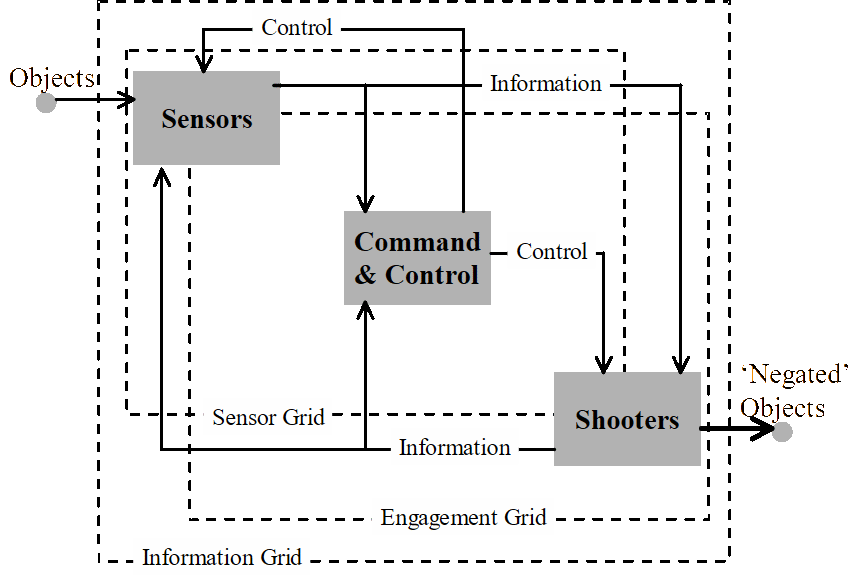
Underpinning the system is a high capability information grid acting as a high-performance information backplane that enables the formation of the specialist, but interconnected grids. Sensor grids (interconnection of many sensors) generate high levels of ‘battlespace awareness’ that is shared with other force elements. Engagement grids exploit this awareness to strike at the enemy. The concept is driven by the power of the underlying technology. The shared awareness is seen as enabling the force to ‘self-synchronise’, that is to organise itself and synchronise complex actions from the bottom up.
A working definition for knowledge
The Cebrowski and Garstka paper [2] hints at knowledge concepts: “the force achieves information superiority, having a dramatically better awareness or understanding of the battlespace rather than simply more raw data.” Alberts et al ([3] p. 71) go further and argue that the fog of war “has resulted in our inability to tap into our collective knowledge”. They describe ‘collective knowledge’ as “the ability to assemble existing information, reconcile differences, and construct a common picture”. How do these concepts of knowledge compare with those being considered in the context of commercial knowledge management developments?
A commonly argued approach to considering what knowledge might be is exemplified in Alberts et al ([3] pp. 127-128) that states that there is a hierarchy where data (the bald facts) become information through a process (“assembled, reconciled, fused, and placed in an operational context”). When this information is used to develop and employ a model to explain the situation then knowledge is the result.
One might suggest that such an understanding of the meaning of ‘knowledge’ still falls short. Nonaka and Takeuchi ([4] p. 20 onwards) seek to define what knowledge might be by delving back in history. The Western heritage of knowledge emerges from a belief in the ‘Cartesian split’ (from the philosopher Descartes) that discerned a difference between the subject (the knower) and objects (the known). This leads to the two great epistemological approaches of ‘rationalism’, where absolute truth can be deduced by rational arguments starting from universally agreed fundamental principles; and ‘empiricism’ where there is no a priori knowledge and knowledge is gathered by experience and experiment. Over the years there have been attempts at synthesising and merging these concepts as well as breaking down the dualism of subject and object, that is allowing that some knowledge may be inexorably bound in the knower. Nevertheless, even as recently as 1911, Frederick W. Taylor, and his ‘scientific management’ using time and motion studies, sought to find the ‘best method’ through formalising the worker’s experience and personal knowledge into objective and scientific knowledge. This contrasts with the concurrent rise of human relations theory that recognised that other factors, such as human motivation and beliefs, had an impact on human performance.
Recognising that both schools of thought have merit, most authors in the field of knowledge management recognise two general elements of knowledge. The first is ‘explicit knowledge’, that knowledge which we can express in reports, books and technical drawings. The second element is less obvious. ‘Tacit knowledge’ is innately linked to the knower and “tied to the senses, skills in body movement, individual perception, physical experiences, rules of thumb, and intuition” ([5] p. 6); “the know-how, the judgement, the intuition, the little tricks that may make the difference between failure and success” ([6] p. 19). This knowledge is context-specific, and generally the result of personal experience (personal empiricism).
Fundamental approaches to knowledge management
Knowledge management in commercial enterprise
Central to successful introduction of knowledge management initiatives to a company is the ‘value proposition’ – what benefits the financial investment and other changes will bring to the company. A commercial value proposition of ‘Product-to-Market Excellence’ has some parallels with tactical command and control. This proposition argues that if one is faster (and better) than the competitors then market leadership will be the result. Such a strategy calls for both the efficient generation of new ideas as well as the re-use of existing knowledge. O’Dell and Grayson [6] caution the reader not to become ‘The By-The-Book Company Inc’. This kind of company embraces knowledge sharing in that it “builds elaborate databases and implements distributed computing platforms that allow one and all to record and access documented knowledge” ([6] p. 19) but it neglects to support the transfer of tacit knowledge. Such an approach may also neglect to consider the human reaction to the initiative. The provision of technology provides the means for interaction and sharing of knowledge but, in and of itself, it does not ensure sharing occurs.
There are two fundamentally different underlying approaches to knowledge management. These are often called ‘codification’ and ‘personalisation’.
- The codification approach seeks to categorise and record all relevant knowledge within the organisation. These knowledge management initiatives relate to encouraging the development and maintenance of databases as well as providing for effective search and retrieval mechanisms. It is exemplified by databases of ‘lessons learnt’ and ‘best practices’. Clearly this approach would be a good match for explicit knowledge capture.
- The personalisation approach on the other hand recognises that tacit knowledge is difficult to codify and record. Instead, the knowledge management initiatives focus on the provision of tools to encourage and enable the interpersonal interaction that supports the exchange of tacit knowledge.
Hansen et al as a result of their case studies [7] argue that there is no single correct answer as to which approach is the best. Different industries and different purposes for using knowledge will find one or other of the different approaches as being more appropriate. They provide a comfortable argument that if an organisation is producing standardised or customised mature products then codification is best suited as it encourages re-use of ideas. By contrast, when organisations focus on one-off, innovative and creative products or services they would be better served by a personalisation approach, since their needs are more aligned to the sharing of tacit knowledge. Hansen et al argue that companies that employ the wrong approach fail in their initiatives. Moreover, they argue that companies that focus on one approach, even the right one, to the exclusion of the other will also fail. They suggest that both approaches must be implemented but that a heavy emphasis should be placed on the more appropriate model.
The role of people in these approaches, and one view of the process of knowledge management, has been conceived by Nonaka and Takeuchi ([4] p. 62 onwards) as a spiral model of knowledge conversion. The spiral describes four modes that are operating as knowledge is disseminated in an organisation and as new knowledge is created:
- Socialisation. This process transfers tacit knowledge in one person to tacit knowledge in another through shared experiences and mentoring. It creates shared mental models and technical skills.
- Externalisation. This process seeks to convert, as best as can be done, tacit knowledge into explicit. The knowledge is typically expressed as “metaphors, analogies, concepts, hypotheses, or models”. While the process is often inadequate it still helps promote interaction between individuals.
- Combination. This process takes explicit knowledge and develops new explicit knowledge through reconfiguration.
- Internalisation. This process takes explicit knowledge and converts it to tacit in the learner, typically via learning by doing.
The spiral aspect to the model is a consequence of stepping in turn through the four modes. Moreover, the process moves organisationally from operating within the individual, within the small team then up to the entire organisation.
There is much debate about what the company needs to put in place as enablers of the process of knowledge management. Common themes are culture, technology, organisation and team make-up.
- Culture. If knowledge sharing is to be successful (and manageable), the organisation must promote a culture that encourages the sharing of knowledge. This includes recognising the value of sharing one’s understanding through story telling and mentoring. An underlying common language (including jargon) and mutual trust are required for this to be effective. Incentives and support systems must encourage this transfer, though this often runs contrary to traditional mechanisms of promotion based on individual knowledge and skills. Many successful companies have actively encouraged an attitude of not being ashamed to use other’s ideas. Garvin (“Building a Learning Organization” in [8]) itemises a number of activities that an organisation must be skilled in to be able to learn. For knowledge management to be successful, the organisational culture must support its staff in experimentation with new approaches, learning from past experience and learning from best practices of others.
- Technology. While only part of knowledge management initiatives, information technology has a role in both generic approaches. In the case of the codification the role of technology is encompassed in the storage and retrieval of the codified knowledge. Whereas in the personalised approach, the technology is basically used to support personal interaction (collaborative software, telephones etc). O’Dell and Grayson ([6] p. 88) make an interesting and less than obvious observation that “the more ‘valuable’ the knowledge, the less sophisticated the technology that supports it”. Once highlighted, it becomes quite apparent that high value tacit knowledge transfer can be well supported by lower technology solutions. These entail assistance with personal interactions such as the provision of telephones, and at its most technical, via collaborative tools and groupware.
- Organisation. Both of the generic approaches, but particularly personalisation, benefit from operating within an organisation with rich and flexible linkages between staff rather than one based on a strict hierarchy. “Hierarchies – or more specifically, the politics that accompany hierarchies – hamper the free exchange of knowledge” [9]. While there is a wealth of discussion on networked and matrix structures for organisation, a very elegant proposal, which can be observed in use within armies, can be found with Nonaka and Takeuchi ([4] p. 166). This structure is described as a ‘Hypertext Organisation’ from the paradigm of a world wide web hypertext page. Such an organisation operates under its normal ‘business system’ hierarchy for day-to-day matters but has the ability to extract particular staff to form specific-to-task teams (task forces). These task forces are inter-networked across the organisation. Underpinning the lot is the ‘knowledge base layer’. This is not an organisational entity in itself but rather represents the cultural and technological support to knowledge management. In terms of the spiral model for knowledge management: the hierarchical structure operates best in the combination and internalisation modes; while the task-force structure favours for socialisation and externalisation modes. Over and above the macro of the organisational structure there is the issue of depth of the management hierarchy. Despite efficiency action to flatten organisations, there are still strong arguments for the retention of middle management. This layer intersects the detailed knowledge of front-line employees with the visionary ideals of top leadership. It is the role of middle management to conduct the knowledge generation process within the front-line.
- Team Make-up. Leonard and Straus (“Putting Your Company’s Whole Brain to Work” in [8]) and others raise the benefits in achieving innovation of bringing together a range of different thinking styles and knowledge sets. This is entitled creative abrasion (or requisite diversity) and often follows from having multi-disciplinary teams. Nevertheless, it is also argued that the organisation needs to retain redundancy in its knowledge holdings. Here redundancy is not meant to infer unnecessary duplication or waste, rather having staff with knowledge beyond that which they need for normal operations. Such redundancy assists in greater understanding when tacit information is being shared. It also offers potential for subordinates to take on leadership roles by understanding the larger context. Finally, redundancy helps to keep the organisation heading in a commonly understood direction. Redundancy can be achieved by not being prescriptive in allocating responsibilities to subordinates, through strategically planned staff rotations, and through employing matrixed team structures.
Knowledge management and the tactical army
Knowledge management outside the battlespace
Let us first briefly consider the situation outside the battlespace using the knowledge management enabler themes.
- Culture. Culturally one might argue that Army has a mixed position. It has many of the cultural features that encourage knowledge sharing. Army actively supports a learning process with its extensive career development program including structured personnel exchange programs, the ‘posting cycle’ of periodic transfers to new jobs and in-house training/schools including ‘all Corps’ training courses. It is universally renowned for its sharing of knowledge through the traditions of compulsory morning tea and associated Mess culture. Personal relationships (often disparagingly known as the ‘old boy’s network’) allow members a rich source of informal connections. A specialised military ‘language’ is shared within the Army. Indeed there is probably a germ of truth in the joke that soldiers from different countries find it easier to understand each other than civilians. However there are characteristics that can work against knowledge sharing, in particular if good natured inter-Corps rivalry bubbles over into a destructive attitude of superiority and refusal to recognise alternative knowledge sets (for instance between the combat and logistic support Corps). In addition, the current promotion scheme for personnel can work against the concept of sharing of information/insight by rewarding individuals for their personal skills and knowledge rather than their ability/willingness to share this knowledge.
- Technology (and Beyond). An emerging initiative in the Australian Army, well supported by technology, is its Centre for Army Lessons. This has as its mission “to collect, analyse, store and disseminate Army lessons in order to enhance capability”. The CAL vision is to “become the medium through which Army shares the knowledge of its people” (Cooper [10]). The centre has an aim to provide not only for the codification approach apparent in its mission, but also to support personalisation via provision of collaboration tools. One would hope that the CAL will provide the focal point so that real lessons might be fed back into the Army doctrine development process as an element of peace-time knowledge capture.
- Organisation. In barracks the current hierarchical organisation of the tactical elements of Army is well suited for its day-to-day preparations. In terms of the spiral model of knowledge, the Army training regime is particularly effective in the area of internalisation, while doctrine development seeks to conduct externalisation.
NCW as a knowledge management initiative in the land battlespace
A possible value proposition?
NCW seeks to leverage off modern technology to provide a faster and more aware command process. It is argued that this speed will enable the commander to ‘lock-out’ alternative enemy strategies and ‘lock-in’ success akin to the modern economic paradigm of increasing returns on investment. As well as the enemy, NCW would hope to overcome the threat of information overload that up until now has been the motivation for creation (and growth) of staff cells. A key benefit of NCW is seen to be the self-synchronisation of forces, ie the ability of subordinates to co-ordinate their actions with their peers through shared awareness rather than relying on centralised directive control.
Central to the question as to whether NCW incorporates knowledge management is whether the value proposition and NCW initiatives address both elements of knowledge (explicit and tacit) and all enabler themes.
What is needed – codification or personalisation?
It cannot be denied that there is a body of knowledge in the land tactical battlespace that can be considered explicit. Locations of the various units, weapon and system characteristics and terrain are examples. A codification approach is ideally suited to the commander’s needs in this regard. This is well aligned to the technology support that underpins NCW. It could be argued that NCW has its origins in naval and air operations that can be characterised by relatively sparse targets (though fast moving and of high value) faced by a richness of sensors and lack of terrain. This contrasts with the land environment with many dispersed relatively low value targets faced by relatively poor quality sensors. Also some of the sensors are in relatively large numbers (each soldier/vehicle as a potential observer) leading to increased fog of war from partial, contradictory and duplicative information.
Moreover combat, particularly on land, is a clash of humans. There is a collection of persuasive evidence (for instance [3] p. 127-128, [11], [12], [13] p. 108, [14] p. 226 and [15] p. 1) that points to tacit knowledge as being the larger component of the knowledge that must be shared. While codified ‘facts’ can be easily transferred (within the constraints of communications capacities) the underlying logic is tacit and requires a different approach to transfer—consider the challenge of explaining one’s strategy in a chess game.
The ‘Appreciation Process’ (similar to analytical hierarchy process) is enshrined in Australian Defence Force doctrine ([16]) and embraces an analytic approach using explicit knowledge. It seeks to enunciate and evaluate a number of possible courses of action to select the best course. However, criticism has been levelled at the perception that command decisions are made in such a fully rational process. A different view under the generic label of Naturalistic Decision Making (NDM) has underpinnings from Nobel Prize winning psychologist Herbert A. Simon and his theory of ‘bounded rationality’. This argues that in real life it is often impractical or impossible to calculate an optimal strategy. Simon believed that people use heuristics—simple rules of thumb based on their experience—to reach a ‘good enough’ decision in a process he called ‘satisficing’.
Furthermore, Klein has developed a body of work arguing that quick decisions are made through a process of pattern matching rather than through a true analytical approach. He calls this the Recognition-Primed Decision (RPD) model [17]. Klein particularly argues that decisions are not based on relative comparisons of a number of options. Instead, in the simplest situations the commander recognises the situation and knows the appropriate (single) response based on experience. More complex situations call for greater consideration including the building of stories and imagery as a mental model of the situation. This supports evaluation of the proposed response via a mental simulation. In the most complex situations the proposed solution will require modification, or for the commander to turn to another typical response. It is argued that the process is not seeking the best solution but a good, quick solution. Klein's ideas initially came from examination of the lowest tactical levels (firefighters). However, subsequent studies at US Army formation HQ level saw 96% of decisions being made using an RPD approach (see [18] p. 97).
In [18] Klein describes four mental strategies that effective decision-makers use when they are under pressure. He shows how we use intuition, metaphor, mental simulation, and storytelling to draw on our experience and to make instantaneous judgments about our present situation. Intuition helps us to size up a situation quickly. Metaphor draws on our experience by suggesting parallels between the present and the past. Simulation lets us mentally follow a series of steps to a conclusion before we actually carry them out. Storytelling helps us abstract and consolidate our experiences so that the lessons we’ve learned will be available to us and to others in the future.
Klein's explanation of tactical decision making sits well with the concept of situation awareness. As conceived by Endsley ([19]) situation awareness encompasses 3 layers that can be described as: ‘perception’, ‘understanding’ (identification and comprehension) and ‘projection’. ‘Perception of Elements in Current Situation’ embraces the gathering of environmental information examining the status, attributes and dynamics of relevant elements in the environment. Synthesis of this disjointed collection leads to ‘Comprehension of Current Situation’ through an understanding of the significance of what is seen. This recognition of patterns in a holistic picture internalises the information. ‘Projection of Future Status’ then seeks to predict possible future situations as part of the decision making process. The integrated picture is matched to prototypical situations that led to associated decisions.
From a historical perspective, Clausewitz argued that experience was the one factor that can help an army deal with friction. He likened it to “oil among the cogwheels of a machine” [13]. One might argue that experience allows the people who comprise the elements to have a greater innate understanding of their colleagues. Inevitably not everyone will have been part of the organisation’s core of experience, and the sharing of knowledge to such people is a personalisation activity.
Albeit at a higher command level than formation/unit, a pertinent quote from General Fred Franks (Commander VII Corps during Operation Desert Storm) is given in [20]. “The main thing was that I wanted to get my subordinate commander’s sense of what was happening, and then give them my own sense and tell them what I wanted them to do.” In socialising such tacit knowledge, it is important to understand and address the issue that it is a human process subject to human frailties. Lynch ([15] p. 10) cites a study conducted at the US Army’s National Training Center that indicates “subordinates only truly understand their higher commander’s intent 34% of the time”.
All of the previous emphasises the aspect of human perception of the battlespace situation and the role of past experience in developing command decisions. It is argued that the process of recalling and adapting past experience is an innovative and intuitive process using mental models and analogies. In doing so, the command process is using tacit rather than explicit knowledge. Processes and facilities using codification are required to bring the explicit knowledge (of force locations etc) to the commander. However, the author would argue that this is a lesser requirement to that of enabling the personalisation approach in support of command decision making. Such support is required for socialisation of the tacit knowledge of experienced commander’s with the subordinate commanders to achieve true common situational awareness. Such support would also assist in the transfer of this knowledge, the know-how to win battles, to less experienced commanders.
Cultural aspects—a human element of NCW?
Much of what was previously discussed on the cultural aspects of knowledge management outside the battlespace applies on the battlespace. At times the pace of operations will perhaps not permit some slower moving aspects. One would hope that in times of conflict some of the petty cultural politics would disappear and be replaced by a more collegiate attitude.
Dixon in his controversial analysis of military incompetence [21] offers a selection of failings of the command processes. Those with a knowledge management dimension are:
- A fundamental conservatism and clinging to outworn tradition, an inability to profit from past mistakes (owing in part to a refusal to admit past mistakes).
- A tendency to reject or ignore information which is unpalatable or which conflicts with preconceptions.
- A tendency to underestimate the enemy and overestimate the capabilities of one’s own side.
- An obstinate persistence in a given task despite strong contrary evidence.
- A failure to make adequate reconnaissance.
- An undue readiness to find scapegoats for military set-backs.
- A suppression or distortion of news from the front, usually rationalized as necessary for morale or security.
Fundamentally these faults go to the ability of commanders to accept and internalise or socialise knowledge that does not fit with their biases. Clearly during combat, the concept of ‘high risk of failure experimentation’ is unlikely to receive support. However, it is important that the results of our actions are energetically and critically examined so that the lessons can be drawn and internalised. A culture of openness to criticism will be required. The systems and processes that will emerge from the adoption of NCW will need to encourage such a culture and support the internalisation of knowledge even when it conflicts with incorrect perceptions.
Technology—dazzled by the display?
Modern information technology is a fundamental ingredient of both knowledge management and NCW. Nevertheless most knowledge management discussions caution the practitioner from over-investing in technology, both in dollar and trust terms. Maximum figures for technology investment in the order of one third of the total knowledge management resources (time, effort and money) are cited [22]. Any more and the other elements of content, culture, user support and leadership advocacy will be denied effort.
Concerns have been raised ([5], [11], [12], [14] p. 267 and [23]) that there is evidence of a belief, both in the military domain and commercial, that all knowledge is explicit. The inference is that knowledge management is merely information management, that the problem can be solved simply with machines and associated tools. As a human activity command requires human focussed assistance. There is a need to ensure person-to-person communications and group-working technologies are not ignored. The NCW-related technology with its graphical interchange will assist in comprehension of the explicit aspects of the commander’s intent. However, it must also have complementary support to human interchange to support the shared awareness of the implicit. Moreover, concerns are reasonably voiced that an overemphasis on technology leads to more formal/precise procedures that suppress the informal communications and redundancy required for knowledge generation. The time spent by commanders and staff operating these technology systems “significantly reduces the amount of time available for talking about the problems they are dealing with” [11].
Organisational impacts—the network in NCW?
One could be forgiven for assuming that the ‘network’ in NCW is made up only of the underpinning grids of technology. An alternative interpretation recognises that the grids allow the players in the battlespace to operate in a networked manner. The phrase ‘sensor to shooter’ embraces a revelation that subordinates are to be provided with a greater degree of autonomy not provided by the traditional hierarchy.
Even before the implementation of NCW, during the 1991 Gulf War, the US Central Command’s command structure embraced informal, ad hoc arrangements especially what has become known as ‘reach back’ (Davis in [23]). With the provision of communications not constrained to follow the formal hierarchical chain of command, there are increased opportunities for lateral connectivity and informal consultation/knowledge sharing. Moreover, there is a case that such opportunities can be used more officially (similar to the ‘hypertext organisation’) to maximise knowledge utility. As a bonus, there are credible claims that networked command systems are more resilient than hierarchical. The resilience in the last half century of guerrilla and terrorist command structures (such as the IRA ‘cell’-based organisation) as compared to the potential brittleness of strict hierarchies (such as Iraqi forces in the Gulf War) is studied in the general news and literature. Similar discussions in the military profession are leading to considerations of what might be the ultimate in networked organisation. This comprises ‘swarming’ by small (company-sized) manoeuvrable elements interconnected by networked cooperation. Knowledge management theory would support the value of such an approach backed up by a launching platform of a traditional hierarchical organisation.
Team make-up
The entire concept of Corps supports the formation of teams with ‘creative abrasion’ especially at formation HQ level, though not often at unit. It remains for the commander and his approach to using his staff whether this potential is realised through appropriate selection of staff for task focussed teams. NCW linkages offer the potential of greater opportunity for employing the concept.
Conclusions
This paper has sought to consider two recent innovations: knowledge management in the commercial sector and the Revolution in Military Affairs (or more specifically its concomitant concept of NCW). The purpose was to explain these concepts, but more importantly to explore whether the military Network-Centric Warfare concepts were well aligned to those of knowledge management.
NCW seeks to more quickly disseminate situational awareness and commander’s overall intent by leveraging the power of networked computing. In doing so, NCW seeks to overcome the fog and friction of war. The NCW initiatives seem to be biased to explicit knowledge that is appropriate to the maritime/air situation. In the land environment in particular, commanders cope with the partial, contradictory and duplicative information via processes described by Klein and his Recognition-Primed Decision model. Fundamental to success is tacit knowledge coming from experiential learning internal to the knower. One can argue that subordinate commanders need to be able to share their commander’s tacit knowledge in order to be able to properly understand their decision making and hence fully understand the commander’s intent. This leads to personalisation (upon which NCW is silent) rather than codification of knowledge (well provided by NCW). Personalisation would assist in supporting junior commanders, provided with greater autonomy by NCW but naturally still limited in their experience, to access the greater experience of more senior commanders/peers when needed. One might argue for the continued importance of voice communications to support the interchange of tacit knowledge, especially when contact with the enemy has been made.
If the NCW paradigm is silent on tacit knowledge, it cannot be expected to embrace the concept of Nonaka’s spiral model of knowledge conversion. One might argue that it is the pre-NCW land force that has embraced the knowledge management enablers of organisation and team make-up, though if Dixon is to be believed, not culture.
It would be reasonable to conclude that indeed Network-Centric Warfare embraces much of what is encompassed in knowledge management. The infrastructure fundamental to the conduct of this new style of warfare provides a capable base for knowledge management through storing and disseminating codified explicit knowledge. Also, the networked organisation will encourage the informal ad hoc interconnections that are the centre-piece of tacit knowledge transfer.
Nevertheless, there is an underlying concern that Network-Centric Warfare unduly concentrates on explicit knowledge. If not pursued with an appropriate manner NCW may not adequately support tacit knowledge exchange required to support the fast decision process. It may constrain army’s ability to be innovative and constrain the person-to-person nature of command.
References
Defence 2000: Our Future Defence Force, Commonwealth Government, Canberra, 2000. Available at http://www.defence.gov.au/whitepaper/docs/WPAPER.PDF
A. Cebrowski and J. Garstka, “Network-Centric Warfare: Its Origin and Future”, Naval Institute Proceedings, Vol 124/1/1,139, Jan 1998. Available at: http://www.usni.org/Proceedings/Articles98/PROcebrowski.htm
D. Alberts, J. Garstka and F. Stein, Network Centric Warfare: Developing and Leveraging Information Superiority, 2nd Edition (Revised), CCRP Publications, Washington, 1999.
I. Nonaka and H. Takeuchi, The Knowledge-Creating Company, Oxford University Press, New York, 1995.
G. von Krogh, K. Ichijo and I. Nonaka, Enabling Knowledge Creation, Oxford University Press, New York, 2000.
C. O’Dell and C. Grayson, If Only We Knew What We Know, The Free Press, New York, 1998.
M. Hansen, N. Nohria and T. Tierney, “What’s Your Strategy for Managing Knowledge?”, Harvard Business Review, Mar/Apr 1999.
Harvard Business Review on Knowledge Management, Harvard Business School Press, Boston, 1987.
S. Prokesch, “Unleash the Power of Learning: An Interview with British Petroleum’s John Browne”, Harvard Business Review, Sep/Oct 1997.
G. Cooper, Centre for Army Lessons Executive Overview, Available at Defence Intranet: http://lwdcwebs.sor.defence.gov.au/content_cal/
V. Kallmeier, et al, “Towards Better Knowledge: A Fusion of Information, Technology, and Human Aspects of Command and Control”, Journal of Battlefield Technology, Vol. 4, No. 1, Mar 2001.
A. Dekker, “Is Warfare an Art or a Science? Implications for Command and Control Information Technology”, Journal of Battlefield Technology, Vol. 4, No. 3, Nov 2001.
M. Van Creveld, The Transformation of War, The Free Press, New York, 1991.
M. Van Creveld, Command in War, Harvard University Press, Cambridge, 1985.
R. Lynch, Lessons Learnt: Command a Digital Brigade Combat Team, (IDA Paper P-3616), Institute of Defense Analyses, Alexandria, 2001.
Australian Defence Force Publication 9—Joint Planning, Available at Defence Intranet: http://defweb.cbr.defence.gov.au/home/documents/adfdocs/ADFP/ adfp9.htm
G. Klein, “A Recognition-Primed Decision (RPD) Model of Rapid Decision Making” in Gary Klein, J. Orasanu, R. Calderwood, and C.E. Zsambok (eds.), Decision Making in Action: Models and Methods. Ablex, Norwood, 1993.
G. Klein, Sources of Power. How People Make Decisions, MIT Press Cambridge, 1998.
M. Endsley, “Toward a Theory of Situation Awareness in Dynamic Systems”, Human Factors, Vol. 37, No. 1, Mar 1995.
T. Clancy and F. Franks Jnr, Into the Storm: A Study in Command, Sedgwick and Jackson, Berkley Books, New York, 1998.
N.F. Dixon, On the Psychology of Military Incompetence, Pimlico, London, 1994 (first published 1976).
T. Davenport and L. Prusak, Working Knowledge, Harvard Business School Press, Boston, first published 1998 (pbk 2000).
J. Arquilla and D. Ronfeldt (Ed), In Athena’s Camp – Preparing for Conflict in the Information Age, RAND, Santa Monica, 1997.