
Volume 3, Number 3, November 2000
Length Isn't Everything - Use of the Macedonian Sarissa in the Time of Alexander the Great
Abstract
Debate exists on the use of the Macedonian sarissa at the time of Alexander the Great. Although considered the weapon that enabled Alexander’s victories at the time of Polybius, the sarissa was considered to be an unwieldy weapon that was useable only under the most ideal of conditions. In this paper it is argued that, at the time of Alexander, the shorter sarissa 12 (Macedonian) cubits long (4.1m) was in use as it had greater manoeuvrability than later longer versions. Using an engineering analysis of the physical aspects of the each of the possible lengths of the sarissa, it is concluded that the increase in length from 4.1m was sufficient to remove the manoeuvrability of the sarissa-armed troops leading to the highly restricted conditions for its use related to us by Polybius. By considering tactical displays and individual combat it is shown that formations armed with the shorter sarissa were very manoeuvrable. The use of the sarissa is then considered in several incidents and major battles of Alexander’s campaigns. Finally the paper discusses the logic of extending the sarissa’s length and analyses the results of doing so.
Introduction
The continued use of the sarissa dominated warfare from the middle of the fourth century to the middle of the second century BC. Its use has been extrapolated with some controversy to the beginning of the reign of Philip II. The accepted historical position is that the Macedonian sarissa was about 3.4–7.5m long throughout the period with strong documentary evidence that shorter lengths were predominant in the earlier part of the period. By the end of the period, the standard counter measures to the Macedonian Phalanx were to outflank it and attack it from the undefended sides or rear (because the phalangites were unable to re-deploy their unwieldy sarissae)a. Such tactics were employed at the battles of (c197BC) and Pydna (c168BC) where the Romans, by engaging an unformed phalanx (former battle) and taking a phalanx by the flank/rear (both battles), revealed the lack of manoeuvrability of the sarissa-armed phalanx.
The question about the manoeuvrability of the sarissa (and hence the sarissa-armed phalanx) at the time of Alexander the Great is first documented about 150 years after his death when Polybius (c200–118BC) denigrated Callisthenes (of Olynthus c360–327BC) regarding the prolonged advance with sarissae at Issus. Polybius states that the ideal ground for a sarissa-armed phalanx was the same as that for a hoplite phalanx (flat and unbroken) and he considered that assaulting across broken ground was indicative of incompetence. By what authority does Polybius condemn the eyewitness account of Callisthenes? Callisthenes’ authority stems from his appointment to attend Alexander the Great as the historian of his Asiatic expedition thus providing an ‘eyewitness’ account. Polybius’ authority comes from his military background as well as his writings on military matters and military histories. He was a Hipparch in the Archaean Confederation. He was attendant to Scipio Aemilianus at the siege of (146BC) and probably was with him in and (151/149BC). He wrote on military matters in his lost book Tactics as well as the History of the Numatine War.
Disagreement on the use of the sarissa still exists. Adcock provides a good example of the accepted current view. He notes that the Macedonians “had longer spears than the Greek hoplites and smaller shields, and were not in deep formation, for they relied less on the charge and more on the steady advance, with a moving hedge of points to thrust back the enemy”.b He leaves in doubt his position on the ability of the phalanx to change flank and emphasises the use of the sarissa en masse rather than as an individual combat weapon. Markle provides the contrary view. He argues strongly and cogently against the use of the sarissa in extra combat missions and that the sarissa-armed infantry, when deployed, played only a minor role in Alexander’s battles. His arguments are based on the dual basis of a physical reconstruction of Macedonian sarissae and consideration of original historical sources. The understanding of the degree of manoeuvrability of the sarissa affects the tactical interpretation of the progress of Alexander’s battles. A more recent argument put forward by Manti argues that the sarissae started longer and were reduced in length. Manti’s argument is based on use in the ancient texts of the term cubit, a unit of linear measure. This is discussed in detail in the section on standard unit of measure below.
This paper considers the manoeuvrability of the sarissa. The engineering aspects of different lengths in both Attic and Macedonian units of length and holding styles are assessed. This is done by considering the effects that the different lengths and holding styles have on the torque acting on the sarissa. As a demonstration of the different efforts required an analogy is made in terms of the number of 3kg house bricks one would need to balance on a ‘see-saw’ at one metre from the centre. This assessment shows that the sarissa 12 Macedonian cubits long held four Macedonian cubits from the rear with the grip of the hand covering two Macedonian cubits was quite manoeuvrable. It also shows that the 14 Macedonian cubit long sarissa was significantly more difficult to handle and thus less manoeuvrable, while lengths longer than 14 Macedonian cubits would be very difficult to use. Some of the major conflicts and relevant significant incidents of Alexander the Great’s reign are then considered with regard to the use and manoeuvrability of the sarissa. This leads to the conclusion that the 12 Macedonian cubit sarissa was that in use at the time of Alexander the Great. Finally, the paper discusses the logic of extending the length and the results of doing so.
Engineering aspects
To calculate the forces acting on the sarissa a consideration of the engineering aspects is necessary. These forces are the result of the physical dimensions of the sarissa, the method of holding it and the location of the centre of mass.
Physical dimensions
The figures used in the calculations in Table 1 are from Andronicos’ paper on the sarissa. The initial discussion establishes the physical components of the sarissa. Andronicos notes the existence of an iron cylinder (Markle coupling sleeve, Manti foreshaftguard) but its weight is not stated and hence it is not factored into the following calculations.
| Sarissa part | Dimension |
|---|---|
| Head weight | 1.235kg |
| Head length | 0.51m |
| Butt spike weight | 1.07kg |
| Butt spike length | 0.45m |
| Iron cylinder length | 0.17m |
| Shaft cross-sectional area | 3.61cm |
| Shaft density | 0.76g/cc |
Standard unit of measure, macedonian and attic cubits
Measurements in classical sources are given in terms of the cubit. Two types of cubit are relevant to our discussion. The first is the Attic cubit of 18 inches (0.46m) and the second is the Macedonian cubit 13.5 inches (0.34m). The various lengths of the sarissae given by authors are 16, 14, 12 and 10 cubits long. Two ancient authors describe holding methods. Of these Polybius states that two cubits were covered by the holding method. Table 2 demonstrates the effects of the different type of cubits expressed in metres.
When discussing the effort required to hold a sarissa of any particular length, the correct length in modern metric units is important to give an understanding of the effort involved.
Consider the length of the sarissa covered in the holding grip. Allowing for a hand to be 10cm to 12cm wide and a spacing between the hands of approximately 50cm yields approximately 0.74m, which is 1.6 Attic cubits and 2.2 Macedonian cubits. The latter figure compares favourably with Polybius’ statement that there were two cubits between the phalangite’s hands. This indicates Polybius uses Macedonian cubits in his discussion of the sarissa.
| Measurement | Attic | Macedonian |
|---|---|---|
| 16c | 7.3m | 5.5m |
| 14c | 6.4m | 4.8m |
| 12c | 5.5m | 4.1m |
| 10c | 4.6m | 3.4m |
| 4c | 1.8m | 1.3m |
| 2c | 0.91m | 0.67m |
| 0.74m | 1.6c | 2.2c |
| 0.51m | 1.1c | 1.5c |
| 0.45m | 0.98c | 1.3c |
| 0.17m | 0.37c | 0.50c |
Polybius tells us that the sarissa of his day was 14 cubits long. When the length of the sarissa is considered the issue of whether Attic or Macedonian cubits were used has created some debate. For example Manti concludes that the sources are all in agreement regarding the length of the infantry sarissa being 4.8m to 5.5m. By harmonising the different lengths reported by the sources he deduces whether the authors were using Macedonian or Attic cubits. This leads him to conclude that the longer 5.5m sarissa was used by Phillip and Alexander and that it was gradually replaced in the subsequent Hellenic period by the handier (that is, more manoeuvrable) 4.8m sarissa. His argument, though, does not take into account Polybius’ criticism of Calisthenes account. Markle, assuming the use of the Attic cubit deduces longer, and thus more difficult to manoeuvre, sarissae from which he concludes that the sarissa was not used as frequently as is often accepted.
When expressing the length of the sarissa in metres there are two aspects to the debate. The first is an appeal to ancient sources on the length of the male cornel tree (cornelian dogwood or cherry, Latin: cornus mas). The second is the function of the iron cylinder reported by Andronicos. Manti notes that the contemporary cornel forests did not have trunks exceeding 18ft (5.5m). The statistical distribution of the length of the cornel tree is not given thus the average height and the deviation from this height are not known. Theophratus (c372 to c287BC) is quoted by modern authors as stating these trees grow to a maximum of 12 cubits. From Table 2 this can be either 5.5m or 4.1m. Manti argues that he was using the Attic cubit while later authors used the Macedonian cubit. As Table 2 shows and discussion on the spacing of the holding of the sarissa this argument is very attractive. Markle, for example, interprets lengths in terms of the Attic cubit.
Manti’s argument includes the unstated premise, and second aspect of the debate, that the shaft of the sarissa was a single piece of wood. Whether or not the shaft was a single piece of wood rests on the interpretation of the iron cylinder described by Andronicos. Consistent with his argument of a single piece for the shaft Manti argues this to be a foreshaftguard. Markle, though allows it to be a coupling sleevec thus enabling the lengths longer than the maximum length of the male cornel plant. Andronicos in his article in French describes it as a ‘douille’ the same term he uses to describe the socket sections of both the sarissa head and the butt spike. Accepting the maximum length of the cornel plant as 5.5m then one expects the average (hence more frequent) length to be significantly shorter. Thus the shorter (10 and 12 cubit/3.4m and 4.1m) sarissae would be more common. The occurrence of lengths of 5.5m can be expected to necessitate the use of a coupling sleeve. The modern use of a coupling sleeve on such items as military colours, standards, flagpoles and tent poles demonstrates the possibility. Literary, visual and archaeological sources are inadequate to resolve this issue of whether or not a coupling sleeve was used. To date, resolution of the question of the function of the iron cylinder rests on an assessment of the craftsmanship/technological ability of the ancients to manufacture such a device.
The arguments regarding which authors used the Attic cubit and which authors used the Macedonian cubit based on literary, ancient artwork/sculptures/mosaics and archaeology have been shown to be subject to interpretation. Consequently in the physical consideration below all permutations are considered.
Holding the sarissa
The two sources for the technique of holding the sarissa are Polybius and Aelian. To hold the 14 cubit sarissa, Polybius describes the foremost part of the gripping zone as extending four cubits from the rear and the front as protruding 10 cubits, with a two cubit separation between the hands. Aelian describes a similar gripping technique but with the rear hand on the end of the sarissa, that is the forward hand two cubits from the rear. Regardless of the location of the grip the infantry sarissa was carried horizontally in the assault, held with two hands positioned towards the rear of the shaft. The sarissae of the first five ranks projected beyond the first rank while the butts of the fifth projected into the sixth rank.
When the sarissa is carried in any position, the forces in operation must be in balance for it to be held in that position. As the point of holding, from now on referred to as the fulcrum, is not immediately under the centre of mass of the whole sarissa, an additional force must be applied by the phalangite. This force can be applied as a downward force to the rear of the fulcrum or an upward force forward of the fulcrum. In either case the grip would be under grasp for the forward hand and over grasp for the rear. As it is easier to push down rather than pull up, the forward hand would be the fulcrum and the rear would be the major method of applying the balancing force. Figure 1 illustrates these forces.
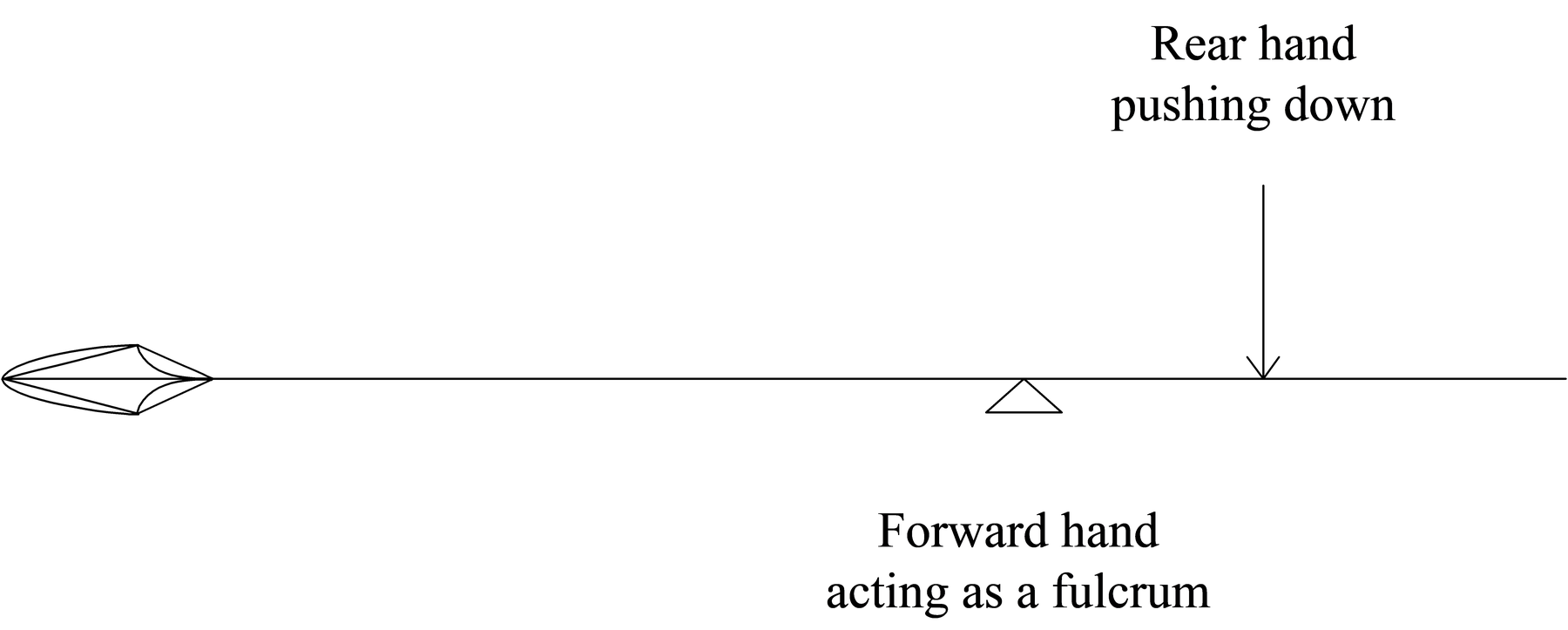
This analysis focuses on the relative magnitudes of the balancing forces required for the different lengths of the sarissa. A variation on the use of the rear to counter balance the weight of the sarissa forward of the fulcrum is to have it nestled firmly in the armpit. This is not considered significant in discussing the engineering aspects although it does affect the ergonomics of carrying the sarissa and the weapon handling ability.
The use of longer sarissae presents the question of whether or not the location of the forward grip was varied. In Polybius we have the description of phalangites in other than the first rank attempting to get the sarissa points of their ranks level with those of the first rank by pressing forward against the leading ranks. This affect could also be achieved by using longer sarissae. Although the changing of the location of the grip is considered unlikely, two variations consistent with Polybius’ description of the gripping method are considered. One is where the grip from the rear of the sarissa is not altered regardless of the length of the sarissa—it is always 4 cubits from the rear. The other is that the ratio of rear-to-front lengths of was maintained; hence for the 16-cubit sarissa the grip would be 4.6 cubits from the rear and 11.4 cubits from the front. If Aelian’s gripping technique is accepted then the forward grip remains two cubits from the rear for all sarissa lengths. All three methods of gripping in both Attic and Macedonian cubits (giving six variations) are considered in the analysis below.
Mechanistic aspects
The point at which the sarissa is held is a fulcrum about which two forces operate. Both these forces are downwards but vary in accordance with the length of the section of the sarissa from the fulcrum. The physical consideration of handling the sarissa has two aspects. The first is the consideration of the effort to maintain the sarissa at any particular angle, particularly the horizontal. In this case one treats each length of the sarissa as a system of rigid bodies rotating around an axis located at the fulcrum. The leverage applied to each side of the fulcrum would be in opposition to the other. The leverage from the forward section of the sarissa would be greater and downward pressure would need to have been applied by the phalangite’s rear hand to ensure the sarissa was held in any one position. In the second case one is interested in the effort taken to move the sarissa to different positions.
The point of the spearhead and point of the butt are always at a fixed distance from the fulcrum due to the sarissa being a rigid body (ignoring bending of the shaft). Therefore, any movement of the sarissa around the fulcrum (raising it from the horizontal, or lowering from the vertical) will prescribe a circle. In the case of circular movement one should consider the turning forces or torques acting in the system. The consideration of physical theory in this paper concerns the differences in torque of the forward and rear lengths of sarissa.
Physics theory
When a force is exerted on a rigid object pivoted about some axis, the object will tend to rotate about that axis. The tendency of a force to rotate a body about some axis is measured by torque (Γ). The underlining indicates we are dealing with an element (the magnitude of the force) that is applied in a specific direction (that is, a vector). It should also be noted that torque is defined only when a reference axis is specified. The directional (vector) equation for torque is:
Γ = Iα
where:
I is the moment of inertia defined as mr2; m being the mass of the object applying the force and r is the distance at which the force is applied (or effective mass located) from the pivot of rotation.
α is the angular acceleration representing the change of angular velocity with respect to time (dω/dt). It is governed by the relationship at = rα, at being the acceleration tangential (900) to the axis of rotation and r as already defined. For rigid objects angular acceleration is the same throughout the object.
For an acceleration a which is acting at an angle θ to the axis of rotation, at is the component of it which is acting at 900 to the axis of rotation and hence has magnitude:
at = a sinθ
The lack of an underline indicates a scalar (non-directional) value.
Since force is defined as mass multiplied by acceleration, (F=ma) torque can thus be expressed in terms of the force:
Γ = Ftr
where F is a force applied at an angle θ to the axis of rotation, and the subscript t indicates the part of the force applying tangential to the axis of rotation.
By trigonometry it can be shown that the magnitude of Ft is given by Ft = Fsinθ. Since Ft=mat then Ft = masinθ and the magnitude of Γ represented by Γ is given by:
Γ = rma sinθ
When the acceleration is gravity (a = g) then this equation becomes:
Γ = rmgsinθ
For a rigid object held horizontally (indicated by the subscript h) θ = π/2 and sinθ = 1 so:
Γh = rmg
If there are many forces acting on a rigid object then each has a tendency to produce rotation about the pivot, which we refer to as the fulcrum. The net torque acting on a rigid object with more than one torque acting on it is the sum of torques.
In the discussion so far mass has been treated as mass located at a mathematical point (that is, of infinitesimally small area), an exact distance from the pivot point. In rigid objects such as the sarissa the effect of the torque of each of these point in the object must be considered. For a rod of fixed diameter, length r and mass M rotating around a pivot point the use of integration and representing the mass in terms of density multiplied by volume the moment of inertia is derived to be:
I = (Mr2)/3
It is well established in physics that the behaviours of bodies can be represented by the behaviour of their centres of mass. The relationship between the rotational inertia I of a rigid object about any axis and rotational inertia Icm with respect to a parallel axis through the centre of mass can be shown by geometrical analysis to be:
I = Icm + Md2
where d is the distance from the axis through the centre of mass to that of the pivot and M is the mass.
For a rod of fixed diameter with centre of mass located rcm from the pivot and rotating around the pivot then d = 0 and the preceding equation becomes:
I = Icm + M02
= Icm
Hence the directional equation for torque in rigid cylinder being rotated around one of its ends becomes:
Γ = Icm αcm
The magnitude of the torque is given by:
Γ = rcmMgsinθ
Concerning the sarissa, the forward hand of the phalangite’s grip has been identified as the fulcrum. Treating the blade/spike of the sarissa head/butt spike as a cylinder of fixed diameter, and the socket shaft of each as a separate cylinder the sarissa sections can be treated as rods rotating around the fulcrum each contributing to the total torque. The parts of the sarissa on either side can be considered separate rigid bodies generating their own torques. These torques operate against each other with the phalangite having to provide the extra force to either hold the sarissa level or to change the angle at which it is held.
The next section discusses the force that the phalangite must apply for the different lengths of sarissa and the different methods of gripping.
Force to be applied by phalangite
Further to the detail of Table 1, Andronicos details the lengths of the socket sections of both the sarissa head and the butt spike. These are 0.24m and 0.18m respectively. In the calculations made, we assumed these sockets to be completely filled by the cornel wood shaft. The location of the centres of mass of the shafts from the fulcrum to the base of the socket is then the centre of the shaft. The location of the centre of mass of each socket is the centre of the socket. For simplicity both the blade and the spike of the butt-spike were treated as being of uniform shape allowing their centres of mass to be located at their centres as well. In the preceding section we expressed the magnitude of the torque on a rod rotating about a pivot was expressed in terms of the sums of the torques in each section. In the sarissa the torque forward of the fulcrum must be counter acted by a total torque acting downwards on the sarissa to the rear of the fulcrum. The mass of the rear section of the sarissa generates part of this torque and the phalangite applies the remainder. The following equation expresses this succinctly.
Γ = Γ b + Γ bs + Γ sf – ( Γ s + Γ ss + Γ sr )
The subscripts indicate the following: ‘b’ blade of the sarissa head, ‘bs’ socket of the sarissa head, ‘sf’ shaft forward of the fulcrum to the base of the socket, ‘s’ spike of the butt spike, ‘ss’ butt spike socket and ‘sr’ shaft rear of the fulcrum to the base of the socket.
The differences of torques on the forward and rear sections give the force to be applied by the phalangite’s rear hand. As angular velocity is the same throughout a rigid body and similarly the angular acceleration is the same through a rigid body, the magnitude of the torque can be expressed as the sum of the magnitudes of the component torques. Hence
Γ = Γ b + Γ bs + Γ sf – ( Γ s + Γ ss + Γ sr )
=(rbmb + rbsmb + rsfmsf - (rsms + rssmss + rsrmsr))gsinθ
Where ‘r’ is the distance of the relevant centre of mass from the axis of rotation and ‘m’ is the associated mass.
With regard to the socket components of both the sarissa head and the butt spike we allow the empty socket to constitute ¼ of the weight of the relevant part.
| 16 A | 14 A | 12 A 16M | 14M | 10 A | 12M | 10M | |
|---|---|---|---|---|---|---|---|
| 4:10 Attic Cubits | 2.6 | 2.2 | 1.7 | 1.5 | 1.4 | 1.2 | 0.9 |
| 4:10 Maced Cubits | 3.5 | 2.9 | 2.3 | 1.9 | 1.8 | 1.6 | 1.2 |
| 4 Attic Cubits From Rear | 3.0 | 2.2 | 1.4 | 0.9 | 0.7 | 0.4 | -.04 |
| 4 Maced Cubits From Rear | 4.9 | 3.6 | 2.7 | 1.9 | 1.7 | 1.3 | 0.6 |
| 2 Attic Cubits From Rear | 4.4 | 3.5 | 2.6 | 2.0 | 1.8 | 1.5 | 1.0 |
| 2 Maced Cubits From Rear | 7.6 | 6.3 | 4.9 | 3.8 | 3.7 | 2.9 | 2.0 |
From these equations and the data provided the torque can be calculated for each length and holding technique. Table 3 lists an easily demonstrable form of the effort required to manoeuvre each of the different lengths of the sarissa for each of the different holding techniques. The analogy used is that of manoeuvring a number of 3kg house bricks located one metre from the pivot point on a see-saw by applying the necessary force at one metre on the opposite length of the see-saw. In Table 3 the columns are for the different lengths of the sarissa with ‘A’ denoting lengths in Attic cubits and ‘M’ denoting lengths in Macedonian cubits.
The rows are the various holding styles, designating where on the sarissa the forward hand (fulcrum) would be located. The 4:10 notation indicates the sarissa is held 4/14ths of its length from the rear of the sarissa.
By applying this practical and easy demonstration, the effort required to maintain less than one-and-a-half bricks at the horizontal is considered feasible (F); up to two, difficult (D); up to two and a half, very difficult (V); up to three, extremely difficult (E); and more than three, infeasible (I). Table 4 repeats Table 3 but in accordance with these gradings.
From Table 4 the only two gripping methods that are rated as other than infeasible for the 16 Attic cubit sarissa are those of 4:10 rear to forward ratio with a hand separation of two Attic cubits and of four cubits from the rear. These have both been rated as extremely difficult. We note that the 16 Attic and 16 Macedonian cubit sarissae being held 4 Attic and 4 Macedonian cubits respectively from the rear are both rated as extremely difficult to handle, consistent with Polybius’ writings that a 16 cubit sarissa had been use at some time.
| 16 A | 14 A | 12 A 16M | 14M | 10 A | 12M | 10M | |
|---|---|---|---|---|---|---|---|
| 4:10 Attic Cubits | E | V | D | F | F | F | F |
| 4:10 Maced Cubits | I | I | V | D | D | D | F |
| 4 Attic Cubits From Rear | E | V | F | F | F | F | F |
| 4 Maced Cubits From Rear | I | I | E | D | D | F | F |
| 2 Attic Cubits From Rear | I | I | E | D | D | F | F |
| 2 Maced Cubits From Rear | I | I | I | I | I | E | D |
By applying the reasoning above regarding the practicality of the grip being two Macedonian cubits rather than two Attic cubits apart, the holding of a 16 Attic cubit sarissa is inconceivable using the former grip. The 4:10 ratio, while included for comparison, is not considered consistent with the standardisation of holding indicated by Polybius’ writings. Hence the use of the 16 Attic cubit sarissa is considered infeasible. This reinforces the conclusion that Polybius was using the Macedonian cubit further supporting Manti’s conclusions regarding the use of the Macedonian cubit by later ancient authors.
Comparative Effort to Change Angle Sarissa
Up to the moment we have only considered the effort in holding the sarissa horizontal. Of consideration in discussion of the tactical deployment of the sarissa is the effort required to change the angle of holding such that the sarissa-armed phalanx could change flanks or even change fronts. The magnitude of the torque on the sarrissa is given by:
Γ = (rbmb + rbsmb + rsfmsf - (rsms + rssmss + rsrmsr))gsinθ
where θ was the angle of the sarissa from the vertical (that is downward, in the direction of gravity). Note that when the sarissa is held vertical (θ = zero) the torque is zero. Hence the ratio of the magnitudes of the torques for different lengths and grips of the sarissa for any given angle θ (except θ = zero) is independent of the angle at which the sarissa is held. Hence the ratios of the torques for holding the sarissa horizontal apply to holding it at any angle other than the vertical. Table 3 can thus be modified to illustrate the increase in effort required relative to that of selected lengths of the sarissa. Tables 5 and 6 show the effort standardised against the 12 Attic cubit long and 12 Macedonian cubit long sarissa respectively.
For example from Table 5 the 16 Attic-cubic sarissa with the Attic cubit grip takes just over twice the effort to manoeuvre as the 12 Attic cubit sarissa held the same way.
| 16 A | 14 A | 12 A 16M | 14M | 10 A | 12M | 10M | |
|---|---|---|---|---|---|---|---|
| 4:10 Attic | 1.5 | 1.2 | 1.0 | 0.8 | 0.8 | 0.7 | 0.5 |
| 4:10 Maced | 1.5 | 1.2 | 1.0 | 0.8 | 0.8 | 0.7 | 0.5 |
| 4 Attic From Rear | 2.2 | 1.6 | 1.0 | 0.6 | 0.5 | 0.3 | -.03 |
| 4 Maced From Rear | 1.9 | 1.4 | 1.0 | 0.7 | 0.6 | 0.5 | 0.2 |
| 2 Attic Cubits Rear | 1.7 | 1.3 | 1.0 | 0.8 | 0.7 | 0.6 | 0.4 |
| 2 Maced From Rear | 1.5 | 1.3 | 1.0 | 0.8 | 0.7 | 0.6 | 0.4 |
From Table 5 and more easily from Table 6 the 12 Attic (16 Macedonian) cubit sarissa held with the Macedonian cubit grip takes just over twice as much effort to manoeuvre as the 12 Macedonian cubit sarissa held the same way.
Summary of Engineering Considerations
The discussion of engineering aspects has shown that a coupling sleeve is required to obtain lengths of the sarissa 12 Attic/16 Macedonian cubits long and longer. This function can be met by the ‘douille’ referred to by Andronicos. However, with longer lengths available utilising the coupling sleeve, the use of a 16 Attic cubit long sarissa is considered infeasible because of the effort taken to hold it in position as well as that to change the angle of holding. This supports the contention that lengths of sarissa reported by later ancient authors were measured in Macedonian cubits. We have also demonstrated that great difficulty could be expected in handling sarissae of lengths 14 Macedonian units and longer. Under these conditions, the difficulty in changing flanks while armed with sarissae 14 Macedonian cubits long or longer is understandable. Similarly, the difficulty of advancing over a long approach with such sarissae levelled would have been ludicrous, as Polybius quite correctly points out. The use of such long sarissae assists to explain the difficulty that the sarissa-armed phalanx had in the early part of the second century BC in changing flanks to face an attack from other than the front. The greater manoeuvrability of the shorter sarissa is thus implied and hence its use in situations previously disallowed in Polybius’ opinion. Finally, although Polybius gives no reason for the reduction, he states that the sarissa had reached 16 (Macedonian) cubits in length but had been reduced to 14 cubits. Considering the preceding argument, this reduction can be attributed to the unwieldy nature of the weapon. That sarissae of such length were attempted is indicative of the desire to capitalise on the advantage of the length by increasing it to the detriment of the manoeuvrability of the weapon.
| 16 A | 14 A | 12 A 16M | 14M | 10 A | 12M | 10M | |
|---|---|---|---|---|---|---|---|
| 4:10 Attic | 2.2 | 1.8 | 1.5 | 1.2 | 1.2 | 1.0 | 0.8 |
| 4:10 Maced | 2.2 | 1.8 | 1.5 | 1.2 | 1.2 | 1.0 | 0.8 |
| 4 Attic From Rear | 7.8 | 5.6 | 3.6 | 2.2 | 1.8 | 1.0 | -0.1 |
| 4 Maced From Rear | 3.9 | 3.0 | 2.1 | 1.5 | 1.4 | 1.0 | 0.5 |
| 2 Attic Cubits Rear | 3.0 | 2.3 | 1.8 | 1.4 | 1.2 | 1.0 | 0.7 |
| 2 Maced From Rear | 2.6 | 2.2 | 1.7 | 1.3 | 1.2 | 1.0 | 0.7 |
Documentary evidence
This section discusses evidence for the manoeuvrability of the sarissa at the time of Alexander and the reviews some of the significant battles of Alexander’s campaign regarding the use of the sarissa.
Terminology
Within the literature, two broad classifications of phalanxes provide a strong indication of the type of weapons used. Phalanxes are described as either Hoplite or Macedonian. There is no dispute regarding a Hoplite Phalanx, which was armed with the standard hoplite spear. However, the term Macedonian Phalanx has led to discussion as to whether an ethnic group or a method of armament is described. The Persian re-inforcements that arrived in India created discontent among the Macedonians. This was because the Persians were armed and trained in the Macedonian manner. The sources do not describe what being armed and trained in the Macedonian manner meant. When combined with the manoeuvrability of the shorter sarissae shown in the discussion above on the Torque on the Sarissa, the conclusion that the description refers to the method of armament is justified. They were not armed in the Greek/Hoplite manner but in the Macedonian manner and by extension with the sarissa.
The duel
Diodorus of Sicily and Quintus Curtius Rufus provide the sole references for an incident that appears to have occurred in India about 326/5BC. The occasion involved a duel between a Macedonian, one Coragus or Horratus depending on the source, and a Greek called Dioxippus. Curtius states that Coragus “had equipped himself with regular weapons: he held the bronze shield and a spear which they called a sarissa, in his left hand and a lance in his right, while he also had a sword at his side—as if he were going to fight a number of men simultaneously.” Diodorus states that he was “clad in his expensive armour” but in the description of the combat includes that Coragus “flung his javelin from the proper distance.... poised his long lance and charged ..... was reduced to continuing the battle with his sword” thus supporting Curtius description of Coragus’ arms. However, Curtius describes the combat by Coragus as “hurled his lance ... before Horratus could transfer the spear to his right hand ..... now started to draw his sword ...”.
In all this, both authors agree that, although Dioxippus was armed only with a club, he was able to avoid the thrown spear by nimbleness and get close enough to the sarissa. Presumably he was able to approach from the side of the sarissa rather than the head, break it with the club and then close with Coragus before he could draw his sword. Three aspects are of interest in this combat. First, the Macedonians thought the sarissa such a manoeuvrable weapon that they contemplated it being useful in single combat. Second, rather than drawing his sword on missing with the spear, Coragus tried to use the sarissa instead of discarding it in favour of the sword. If this story is true then the sarissa could not have been the unwieldy longer version referred to by Polybius.
Finally, Dioxippus’ victory was unexpected. The Macedonians supported Coragus. The Greeks and the non-Greek soldiery supported Dioxippus. Even Alexander seemed to have expected the Macedonian “equipped ... with regular (Macedonian) weapons” to win. Curtius states Alexander was dismayed, while Diodorus states he was plainly annoyed. Again it is unlikely that the sarissa would be shown this overwhelming confidence by the Macedonians if it was catastrophically unwieldy and blatantly unsuited for single combat as indicated by Polybius. Such confidence would not be given to a weapon that was only issued for battles that met very strict criteria. It indicates that the sarissa was a weapon in which the users had great confidence in many circumstances, and may have been considered the key to many victories.
The lack of earlier versions of this story may detract from its veracity but it may also represent a rendition of the events leading to the death of a historical figure—Dioxippus. The story included what was considered to be a one-sided duel with a Macedonian fully armed in the Macedonian manner. While the details of this story may vary, it is significant that Coragus tried to use the sarissa (including changing hands) and that he was expected to win by his compatriots. As the distinctive Macedonian offensive weapon was the sarissa, one must conclude that it was used in the duel and therefore must have been of the shorter variety and more manoeuvrable than that of Polybius’ day.
Pelium
Alexander’s display of tactical flexibility at Pelium c336BC and his ability to impress the forces of Cleitus and Glaucias indicate something unusual about the Macedonian forces. Arrian gives the sole account of this incident and does not specifically mention sarissae. Hammond argues that the sarissa was present, on the grounds that to be such an impressive and effective display the phalangites had to be armed with a weapon that was visible at some distance. For this the hoplite spear was inadequate while the sarissa would have been extremely effective. In Markle’s articles the argument seems to be predicated on Polybius’ description of the unwieldy nature of the sarissa. He follows the logic that as the sarissa was unwieldy due to its length and could not be used in this manner; therefore it could not have been used by the phalangites to create the display. However, as discussed earlier, the shorter sarissae are significantly more manoeuvrable than the longer sarissae and hence the use of sarissae cannot be ruled out. Whether these movements were carried out with sarissae horizontal, vertical or at the forward or rear slope is not definitely given and arguments about the possible entanglement of the phalanx are very subjective.
In Arrian the narrative appears to have been as follows. Alexander’s intention was to advance to and capture Pelium. At that time the opposing forces of Cleitus and Glaucias had not combined. The tactical situation as presented by Arrian is vague. It appears that Alexander was initially unable to assault the town due to Cleitus’ troops holding high ground that dominated the possible approaches. Of interest is Arrian’s mention of these heights being thickly wooded—an anathema to either Greek or Macedonian phalanx. Cleitus appears to have had defensive positions thrown forward outside of the town walls—whether or not these included positions on the heights is unclear. However, Alexander appears to have driven in the outposts without serious opposition—with Cleitus’ troops abandoning them somewhat in haste at the approach of the Macedonians. Before Alexander could invest the town, Glaucias arrived and established himself at Alexander’s rear, attempting to eliminate at least one of Alexander’s foraging parties.
Similar to the withdrawal of Cleitus’ forces into the town, Glaucias’ forces that threatened the foraging party were withdrawn on the appearance of Alexander and a rescue force. Alexander had the dilemma of fighting on two fronts with a force that was insufficient to both hold on to one and defeat the other. At the same time he was unable to withdraw. Cleitus and Glaucias apparently did not want to engage separately the Macedonians (withdrawing when such opportunities were offered). Instead they appear to have been waiting for Alexander to commit his forces to engaging one, and then the other would fall on Alexander’s rear or take Alexander from the flank as he withdrew. It was in this circumstance that Alexander chose to give an elaborate display of tactical prowess. This was the precursor to and part of the subsequent fighting partial withdrawal. However, the withdrawal was not as far as expected by his opponents, as indicated by the fact that Cleitus and Glaucias both encamped without adequate precautions. Alexander was able to launch a surprise night attack on the combined camp, which resulted in a Macedonian victory, abandonment and torching of Pelium by Cleitus and retreat by the main body of the Taulantians.
The question remains as to why, when the Taulantians had the tactical advantage, did such a display of drill and manoeuvrability not only cause consternation among Cleitus’ and Glaucias’ forces but that Alexander’s movement was hampered only by ineffectual demonstrations of Glaucias’ troops. Since Alexander was re-establishing his dynastic authority over them, they would have been in contact with the Greek world. Having this contact they would have experienced in combat the hoplite phalanx and by virtue of having deployed for combat at Pelium would expect to encounter such a formation. Hence they would have been singularly unimpressed by the manoeuvres of such a phalanx. The appearance of a ‘push of pikes’ from sketches and paintings of late medieval warfare indicate it would have been awesome sight particularly if not previously experienced by an opponentd.
To account for the Taulantians’ unwillingness to close with the Macedonians, I conclude, like Hammond that sarissae must have been in use. Other than wheeling, there is no detail what intricate movements were executed by Alexander’s phalanx. This impressive display of phalanx manoeuvrability and deployment of their weapons showed that, in the early days, the flanks and rear of the phalanx were not as vulnerable as at the time of Polybius. This was because the weapon the phalanx was armed with could be redeployed quickly and the phalanx could change formation easily. However, if, as argued in this paper, they were sarissa-armed then this indicates the additional torque from the greater weight of the longer sarissa of 170/169 BC may have rendered any tactical manoeuvres of the phalanx impossible by Polybius’ time.
Granicus
At the Granicus River, the Persian cavalry was on one bank with the Greek mercenary infantry at their rear. Persian infantry may also have been located in the Persian centre. Although their position denied the Persians of the opportunity of charging, it would have disordered the Macedonian heavy cavalry and broken up the infantry phalanx in the final stages of the assault. For this reason Parmenio may have recommended caution. All sources agree that Alexander’s main thrust was with his right. Alexander’s initial attempt was with his light infantry and his light cavalry, which was repulsed. His heavy cavalry, in an oblique assault (against the Persian centre left) and with the extra reach of their sarissae, was able to push the Persians back and mount the hostile bank. In the centre the infantry phalanx began to cross, possibly engaged some Persian infantry, and most certainly engaged their cavalry. Parmenio, on the left wing, met with and held the Persians opposite him. The Persian centre broke under Alexander’s cavalry assault and the Persian army withdrew. Arrian depicts this act as a desertion of their Greek mercenaries but it could also be interpreted as leaving the Greek mercenaries to cover the withdrawal by delaying Alexander. Not withstanding either interpretation, the Greek mercenaries did prevent a pursuit by Alexander. Devine argues that this initial assault drew the Persian cavalry into the riverbed. The cavalry then being disordered were vulnerable to the charge by the Macedonian heavy cavalry. The passage in Arrian can also be presented as the initial assault being met with missiles from the Persians. Following this the Macedonians pushed the Persians from their positions on the banks using, among other weapons, sarissae. While some Persian cavalry were stationed on a “comparatively flat strip right down to the water’s edge” the text is not clear if any Persian cavalry descended into the riverbed to engage the Macedonians. The main problem faced by the Macedonians during this struggle was not only that they had “an enemy in a strong position on the bank above them” but also that elite troops were present among the enemy.
Of note is that the sarissa-less infantry, light infantry and cavalry on both wings were unable to cross, while the length of the sarissa is emphasised as enabling the heavy cavalry to cross. Additionally we are told that the Persians held Parmenio’s wing, presumably in the riverbed or between its banks and the right wing infantry could cross, even though the heavy cavalry under Alexander’s personal control were held in the centre. In places the riverbank may have been easily accessible while in others it was higher or lower than 3m. These variations in access up the riverbank would have resulted in the breaking-up of the Macedonian phalanxes and the funnelling of the phalangites as they came out of the riverbed and up onto the riverbank. Possibly, like the heavy cavalry, they could clear the hostile three-metre riverbank with their sarissae.e Apparently the Persians did not descend the riverbank to engage Alexander’s heavy cavalry and infantry. Polybius gives the technique of holding the 14 Macedonian cubit (4.1m) sarissa. This would give a soldier holding such a sarissa at four Macedonian cubits from the rear a rear projection from the point of holding of 0.67m and a forward projection of 2.8m (allowing 0.67m for the hands). Assuming the same holding distance from the rear of the 5.5m sarissa this would give a rear projection of 1.9m and forward projection of 3.6m. Since the bank of the Granicus was up to three metres high then a sarissa held about waist height and thrust upwards would give a reach greater than the bank height and reaching at least the riders mount, hence giving discomfort to the rider. The shorter sarissa may have only reached the horse’s body but in a melee the phalangite would not have been too discriminating as to how he got rid of an inconvenient Persian cavalryman. Hence, while the sarissa was necessary to drive the Persian cavalry from the bank the length of the sarissa is not determined. Considering Polybius statement and the above discussion of the mechanics the use of the shorter sarissa is more likely. With the Persians remaining on the banks, the reforming of the phalanx was prevented, the massing of the sarissae would have been impossible, instead in the melee they would have to have been wielded like any other thrusting weapon or discarded in favour of the sword. Greek (hence Macedonian) sense of military honour indicates that the discarding of a weapon was an unlikely event.
Consequently, the Persian defensive position was selected to break-up the cohesiveness of the Macedonian cavalry and infantry phalanxes. It was successful in this, but the sarissa enabled the Macedonians to exit from the river, as it was the only weapon that could reach the Persians on the bank. The failure of the Persians to descend into the river and Alexander’s successful thrust at their centre enabled him to break the Persian line and win. The mechanistic consideration of the shorter sarissae removes the argument against its use due to lack of manoeuvrability.
Issus
The Battle of Issus was on a constricted front with Alexander’s approach broken by ravines and creek lines. Darius’ forces were behind the Pinarus River that, with its precipitous banks, would break up any phalanx assault. Darius massed his cavalry on the flatter terrain at his right wing to crush the Macedonian left. Of his infantry massed in the centre and on his left, Darius’ Greek mercenaries were in the centre flanked by Cardaces then archers. Alexander advanced in column to the battle extending into line as the terrain permitted, his cavalry being the last to take up position. With the transfer of the Thracian cavalry to Parmenio on the left, Alexander’s forces were evenly divided between the right and left wings. Both antagonists’ right wing cavalry charged the other’s left wing over the river. Parmenio’s wing held the Persian assault and maintained a steady advance. Alexander’s right wing advanced more quickly. Consequently, Alexander’s massed infantry front broke; the break exacerbated by their disorder while crossing the river. Darius’ Greek mercenaries duly charged the gap. The Macedonian centre appears to have been saved by Alexander’s victorious heavy cavalry attacking the mercenaries’ (shielded) left flank and the general disintegration of the Persian line.
The sources give no indication of the use of the sarissa at Issus. Polybius vigorously denigrated Callisthenes for suggesting that a phalanx armed with sarissae at the horizontal would have been able to advance across broken ground for the distance claimed. Presumably, the Companion cavalry on the right wing were armed with the sarissa and used it in their charges against the archers, Cardaces and shielded mercenary left flank. As at Granicus the length of the sarissa would have been advantageous in clearing the enemy from the bank top from below. While at the same time a disordered sarissa phalanx, though superior in numbers, would have provided a more tempting target for Darius’ hoplite-armed Greek mercenaries than would a hoplite-armed Macedonian phalanx. Important also is the effect of Alexander’s troop dispositions and arms on Darius’ battle plan. Alexander normally took up position on the right wing with his sarissa-armed heavy cavalry while the centre flanks of each wing were sarissa-armed/hoplite infantry phalanxes. Darius’ choice of the river to break-up the assault, with infantry to fix them there while his massed cavalry attempted to turn Alexander’s sarissa-less left flank shows Darius was seeking a decision away from Alexander’s sarissae. However, only one aspect of this plan succeeded—the disordering of the Macedonian massed infantry phalanx. Alexander’s cavalry broke through on the right while, on the narrow front on the left, Parmenio’s cavalry were able to hold the Persians until the rout was effected. Hence, at Issus, the Macedonian sarissa-armed cavalry and massed infantry phalanx in the centre greatly influenced Darius’ choice of battlefield and tactics while contributing significantly to Darius’ loss.
The Battle of Issus provides the setting for the challenge by Polybius (with his military expertise of the early second century BC) to the eyewitness account of Callisthenes regarding the prolonged advance with sarissae. Polybius asserted that no sarissa-armed phalanx could advance over such terrain with sarissae levelled, a point that is fully agreed with. Polybius does not seem to consider the possibility of the phalanx advancing with sarissae in a more relaxed position, for example at the rear slope, only being brought to the horizontal at sufficient time to enable the final charge. With the 14 Macedonian cubit (4.8m) sarissa of Polybius’ day such a drill may have been extremely difficult if not impossible, while being possible with the shorter 12 Macedonian cubit (4.1m) sarissa as discussed above in the Engineering Aspects section. A second factor was the nature of the terrain on the approach to Issus as well as the river itself and its banks. No natural feature is perfectly flat or regular or both. Consequently the terrain and the river would have broken up any phalanx whether sarissa armed or hoplite. That the Macedonians were sarissa-armed is supported by the willingness of the mercenary Greek hoplites to close with them to exploit the gap in the Macedonian phalanx. If they were facing a hoplite phalanx then the tactical advantage would have remained with them if they had held their phalanx intact and engaged the disordered Macedonians as they emerged out of the riverbed. Such an action would have offset the Macedonians’ numerical superiority. It would not make tactical sense for the mercenaries to break their own formation (sacrificing the preceding advantage), and engage a numerically superior, but similarly armed and disordered force. However, disordered sarissa-armed phalangites would be hampered by their weapons in the close-quarter fighting that such a melee would entail. The section on Torque on the Sarissa indicated that the 12 Macedonian cubit sarissa was sufficiently manoeuvrable to be used as indicated. Thus the sacrificing of one tactical advantage for a greater tactical advantage combined with the manoeuvrability of the sarissa supports this length sarissa being used at Issus.
Gaugamela
All authorities accept the use of the sarissa at Gaugamela. The terrain was ideal for the sarissa-armed Macedonian massed infantry phalanx. The size of the Persian army necessitated Alexander’s oblique advance across the front of the Persian army with both flanks refused. While the light infantry bore the brunt of Darius’ chariot charge, Darius attempted a double envelopment with his cavalry. In Alexander’s centre a gap developed at the junction of his two wings. Persian and Indian cavalry broke through but failed to attack the rear of the phalanx, going for the Macedonian baggage camp and being driven off by the Macedonians stationed in advance of the baggage train and to the rear of the main phalanx. The morale effect of the Macedonian infantry phalanx closing on the Persians was catastrophic. This combined with the Companion cavalry charge at the weakened internal flanks of the Persian centre and left wings created a direct threat to Darius and confusion in the centre. The Macedonian left under Parmenio was held by the Persians and threatened to break. Only Darius’ fleeing enabled Parmenio’s forces to win.
Although the only mention of the sarissa is the fear it inspired during the phalanx attack, its influence at Gaugamela was to oblige Darius to attempt a double envelopment, which weakened his centre-left. Darius had to wait until a gap developed in the infantry phalanxes before attacking them. Except for the cavalry, which was able to pass through, the phalanxes were able to hold the Persian centre while the Macedonian sarissa armed cavalry crushed the Persians against it. Again, it was the sarissa-less left flank that had problems. Of significance is that there is no indication of the sarissa-armed phalanx’s changing flanks nor of any melee in which the manoeuvrability of the sarissa could be assessed. Hence Gaugamela, considered in isolation, provides no indication as to the length of the sarissae employed.
Hydaspes
At the Hydaspes, Alexander faced two problems—an opposed crossing of a major river and elephants. From the Macedonian involvement, the main battle appears to have been fought in two stages. The first was a primarily cavalry battle as described by Hamilton. The second was primarily an infantry engagement. Having crossed the river and defeated Porus’ cavalry/chariot reconnaissance force, Alexander advanced against the reformed Indian line, he being stronger in cavalry but markedly weaker in infantry. The Indian formation lacked flexibility, which Alexander exploited by the use of his cavalry (to extend the front of the assault and to seek the Indian flank). Once the Indian line started to adjust to meet the cavalry threat to their left flank Alexander’s smaller number of infantry charged.
The weaponry used in the latter is of interest, particularly as according to Plutarch it was only with great difficulty that Alexander’s troops had defeated Porus’. Of the battle Plutarch’s account is brief—the flanks having fallen back upon the elephants and crowded into the centre rallied with stubborn hand-to-hand fighting ensuing. Arrian implies the elephants were engaged solely by missiles, “the Macedonian infantry, in its turn, advanced against them, shooting down the drivers, and pouring in a hail of missiles from every side upon the elephants themselves. ... the monster elephants plunged this way and that among the lines of infantry, dealing destruction in the solid mass of the Macedonian phalanx. ... The Macedonians could deal with these maddened creatures comfortably enough; .... and going for them with their javelins when they turned and lumbered back”.
Unless the Macedonian phalangites went into combat armed similarly to Coragus above with both the conventional spear and sarissa then the last reference to javelin can be taken to mean sarissa as easily as throwing spear. Diodorus does not seem to distinguish between sarissa and throwing spears nor between the users of them in his description—“they used their long spears to good effect against the Indians stationed beside the elephants, and kept the battle even. Then as javelins began to find their marks in the sides of the great beasts and they felt the pain of the wounds ...”. However the wounds need not have been caused only by missiles but by hand-held weapons as well. This possibly indicates Diodorous’ use of long spear and javelin interchangeably. Of interest is the further interpretation of separating the elephants from the supporting infantry, an interesting parallel to modern infantry/tank co-operation.
In this case the sarissa would have been used to drive the infantry back while shorter weapons were used for the close in action. This dual arming within the phalanx was apparently not unusual vis-a-vis Coragus. Curtius provides the most detailed description of the infantry fighting. Of interest is the possible reference to the sarissa in Alexander’s orders. “Our spears are long and sturdy; they can never serve us better than against these elephants and their riders. Dislodge the riders and stab the elephants”. Initially it appears that the Macedonian infantry was successful against Porus’ infantry. However, when Porus rallied his troops and advanced with the elephants, the Macedonians were shaken and Alexander stiffened them with the Agrianes and the lightly armed Thracians who released a “ thick barrage of missiles on both elephants and riders, and the phalanx also proceeded to exert relentless pressure on the animals.” Additionally, the Macedonians began using axes and sickle-like swords against the elephants. Overall, it was a very confused melee in which formations became confused and various weapons were used.
One can almost visualise the sarissa-armed phalanxes advancing on the line of elephants, forcing back the supporting infantry and causing some inconvenience to the elephants, mahouts and other riders. However, while the sarissae are used to dislodge some riders and stab the elephants they are not wholly effective and the Macedonians begin to falter. Being reinforced with (although diluted by) the more lightly armed troops, the phalanxes held and pushed forward. By the end of the fighting, troops were using whatever weapons came to hand. The possible sum of offensive weapons being carried by the phalangites being the long spear (sarissa), javelin (throwing spear) and either an axe or copide or both. In view of the comments on Coragus and Alexander’s need to deploy the Agrianes and Thracians, it is likely the Macedonian phalangites would have only carried two (at the most three) offensive weapons—the sarissa and throwing spear as well as either an axe or a copide. The optimism of Curtius’ quote of Alexander concerning use of the sarissa against the riders indicates a manoeuvrable weapon and, with the manoeuvrability of the shorter sarissa, supports its use. During the battle Craterus forced his way across the river and took over the pursuit. The battle ended with Porus’ capture.
At the Hydaspes, as the sources are written several centuries after the event, the use of the sarissa can also be deduced from indirect evidence; the strength of Alexander’s cavalry was such that it would have overwhelmed Porus’; the infantry phalanx, whether sarissa- or hoplite-armed, would have caused havoc amongst Porus’ disordered battle line. However, the impact of the phalanx would have been greatly enhanced by the sarissa, offsetting Alexander’s infantry’s numerical inferiority. The use of the sarissa is consistent with the demonstrated manoeuvrability of the shorter sarissa and the effect of the sarissa at the Hydaspes was to increase the shock action and fighting power of the Macedonian infantry phalanx and heavy cavalry rather than affecting the overall tactics.
Summary from the battles
Throughout the above battles the units in Alexander’s army appear to have had a normal station in the line, with specific units being associated with Alexander. The army was divided into two wings with the stronger right wing being under Alexander’s command. At Granicus, Issus and Gaugamela, the left held the Persians, while the right delivered the main weight of the assault, with Alexander and the attendant Companion cavalry administering the coup de grace. The important factor in each battle was that the phalanx obliged the Persians to attack Alexander’s flanks. At Granicus and Issus the phalanx also led to the choice of ground—designed to break up the Macedonian phalanx in the last stage of its charge. At Granicus the Persians failed to take advantage of the disorder, while at Issus, Darius’ Greek mercenaries were let down by the collapse of the Persian left wing. At Gaugamela the Persian/Indian cavalry failed to exploit properly the break in the line of the phalanx. These also show that Alexander was willing to take tactical risks in opposition to his more experienced and senior generals, and in taking these risks, Alexander was successful. Hydaspes was different as Alexander split his forces, taking what was normally the right wing and using it to outflank Porus’ right flank. Here, it is the charge of the infantry phalanx that completed the work of the cavalry.
The false premise
The sarissa, whether infantry or cavalry, was longer than the equivalent weapon of Alexander’s opponents and gave him a technological advantage. A length of 4.1m is consistent with the sources and provides a weapon manoeuvrable enough to account for the uses ascribed to it above. It enhanced the shock effect of the Macedonian cavalry and infantry. Not only was the extra length useful in the charge but examples at Granicus and Hydaspes show it was used by both the cavalry and the infantry to thrust vertically and in positions other than horizontal. With disorganised infantry phalanxes crossing obstacles at Granicus and Issus, the reach of the sarissa gave the advantage, which enabled the Macedonians to continue in their assault. The importance of the sarissa can be seen by its retention after Alexander’s death. With the advantage of length apparent, the increasing of this advantage by increasing the length of the sarissa is a logical conclusion.
When combined with Polybius’ other comments on the need for ideal terrain, the conclusion is inevitable that the 5.5m and 4.8m sarissae were unlikely to be used in the manner described for the campaigns, battles or incidents as discussed. Yet, from the above discussion, the sarissa was used. Since it could not be these longer sarissae, the evidence supports the use of a 4.1m sarissa. The discussion of the shorter sarissa in the Engineering Aspects section showed that it was manoeuvrable enough to satisfy the battlefield use. How such a valuable weapon gave rise to the unwieldy device of Polybius’ day over 150 years later is given by Polybius’ statement that phalangites used different length sarissae in an attempt to present a single line of spear points to an opponent as well as by closing up as much as possible on the first rank. The lengthening of the sarissa could have resulted from the philosophy that if long is good, longer is better. However, the extension to lengths over 5.5m must have produced an impractical weapon, which lead to the reversion to a 4.8m sarissa, sacrificing manoeuvrability for shock action. As the battles of Cynoscephalae (c197BC) and Pydna (c168BC) would show—length is not everything.
Conclusion
Engineering consideration of the difference in torque between the two lengths of sarissa shows that the 4.1m weapon was far more manoeuvrable than the 4.8m sarissa and Polybius’ comments on the use of the sarissa 150 years before his time must be interpreted in this light. Because of the manoeuvrability, it is quite feasible and most likely that the 4.1m sarissa was used at both Granicus and Issus; the descriptions of the battles are consistent with their use. Extrapolating this to Alexander’s campaigns means that the 4.1m and shorter-length sarissae were used in Alexander’s day and suitable for use in the battles. The empirical observation of the effect of the length of the weapon led to its being increased to unmanageable lengths, which led to the defeat of sarissa-armed forces when opposed by a force that had inherent tactical flexibility.
Notes
Notes
- I. Dupuy, The Evolution of Weapons and Warfare, London, 1980, pp. 10–15.
- F.E Adcock, The Greek and Macedonian Art of War, Berkeley, 1957, pp. 26-29. M. Markle, “Use of the Sarissa by Philip and Alexander of Macedon”, American Journal of Archaeology, No. 82, pp. 486-489, 1978. (Markle 1)
- M. Markle, “The Macedonian Sarissa, Spear and Related Armour”, American Journal of Archaeology, No. 81, 1977. (Markle 2) A. Devine, “Alexander the Great”, Warfare in the Ancient World, London, 1989, p.106.
- P. Connolly “The Roman Army in the Age of Polybius” Warfare in the Ancient World, London, 1989, pp. 149-152. N. Sekunda, “Hellenistic Warfare”, Warfare in the Ancient World, London, 1989, pp. 132–133.
- Polybius, XVIII, 29 (Loeb Classical Library, Tr W.R. Paton Cambridge Mass, reprinted 1960 (Loeb Vol V 149)).
- F. Walbank, “Polybius”, Encyclopedia Britannica, 15th Ed Vol. 9, pp. 576–77.
- Encyclopedia Britannica, 15th Ed, Vol. 2, p.750.
- Polybius XII.20.
- Adcock, op. cit. 26.
- Markle 1, op. cit.
- The archaeological data is from Andronicos. Markle 3 and Manti provide discussion on the physical interpretation of this data.
- M Andronicos, “Sarissa”, Bulletin de Correspondance Hellenique, XCIV – 1970, pp.91–107.
- M. Markle, “Macedonian Arms and Tactics under Alexander the Great”, Studies in the History of Art, Vol. 10, 1981. (Markle 3), p. 90.
- P. Manti, “The Sarissa of the Macedonian Infantry”, Warfare in Antiquity, Vol. XXXIII No. 2, 1992, p. 36.
- Polybius, XVIII, pp. 29-30.
- Manti, op. cit., pp.40-41.
- Markle 1, op. cit., pp. 90–91.
- Andronicus, op. cit., pp. 96,98.
- Manti, op. cit., p. 41
- For example: Markle 2, op. cit., p.323. Manti, op. cit., p. 32.
- ibid, pp. 36-37.
- Andronicus, op. cit., pp. 96,98.
- Markle 1, op. cit., p. 90.
- Polybius, XVIII. 29.
- Aelian Tact 14 referred to in Manti, op. cit., p. 38.
- Polybius, XVIII.29-30. Ascelpiodotus, Tacticus 5, Unpublished Translation, University of New England, Australia. Markle 2, op. cit., pp. 332–333. Manti, op. cit., pp. 32, 37-42.
- The theory of rotational forces as presented here is adapted from R. Ferway (Ed) Physics for Scientists and Engineers—with Modern Physics 3rd Ed Harcourt Brace College Publishers, Philadelphia, 1992.
- Andronicus op. cit., p. 98.
- Polybius, XVIII.29.
- Arrian, Anabasis (The Campaigns of Alexander, tr Aubrey De Selincourt, Hammondsworth, Rev Ed, 1971, p.356).
- Diodorus Siculus, Book XVII, (The Loeb Classical Library, Vol. VIIIb, London, 1963). Quintus Curtius Rufus, Book IX.7.16–23. (The History of Alexander tr J Yardley, Middlesex 1984 p. 229). The story may indeed be apocryphal.
- Arrian, op. cit., p. 54.
- N. Hammond “Training in the Use of the Sarissa and Its Effect in Battle, 359-333 BC”, Antichion, Vol. 14, 1980.
- Markle 3, op. cit.
- Arrian, op. cit.. 52. In this translation the word erect is used.
- Polybius XVIII. 30,
- Arrian, op. cit., p. 52.
- Ibid, p. 72.
- Plutarch, The Age of Alexander, Middlesex, 1986, p. 269. Diodorus, XVII.19. 1-4.
- J. Fuller, The Generalship of Alexander the Great, New Brunswick, 1960, p. 148.
- Arrian, op. cit., p. 70. Plutarch, op. cit., p.260. Markle 1, op. cit., p. 494
- Arrian, op. cit., pp. 72-73. A. Devine, “Demythologizing the Battle of Granicus”, Phoenix - Journal of the Classical Association of Canada, Vol. XL, 1986 pp. 272–273.
- Arrian, op. cit. pp. 72–74.
- Plutarch op. cit., p. 269.
- Diodorus XVII.19.1-4.
- Arrian, op. cit., p. 74.
- Ibid, p. 73.
- Markle 2, op. cit., p. 493.
- Polybius, XII.20. Fuller, op. cit., quoting Polybius XII 17.
- Polybius, XII.22.
- Arrian, op. cit., p. 116. Fuller, op. cit., p. 155.
- Arrian op. cit. pp. 116-119. Markle 1 op. cit., p. 494.
- See note 6.
- Quintus Curtius Rufus III.11.1 – 8.
- Polybius XVIII.31.
- Fuller, op. cit., pp. 167–168.
- G. Griffith, The Mercenaries of the Hellenistic World, Cambridge, 1935, p. 15.
- A. Burn, “The Generalship of Alexander”, Greece and Rome, No. 11, p. 151, 1965, p.151.
- Arrian, op. cit., pp. 167–171.
- Ibid, p.169.
- Fuller, op. cit., p. 186.
- J. Hamilton, “The Cavalry Battle at the Hydaspes”, Journal of Hellenic Studies, Vol. 76, 1956, p.26.
- Ibid, pp.26-31
- Burn, op. cit., pp. 151.
- Arrian, op. cit., pp. 278. Burn, op. cit., pp. 151.
- Plutarch, op. cit., pp. 318–319.
- Arrian, op. cit., pp. 278–279.
- Diodorus XVII. 87–88.
- Quintus Curtius Rufus VIII.14.9-45.
- Quintus Curtius Rufus VIII.14.29 as translated by J Yardley.
- Arrian, op. cit., pp. 277–281. Quintus Curtius Rufus VIII.14.
- Burn, op. cit.. At page 151 he gives a summary of the relative strengths of infantry and cavalry. A Devine “The battle of the Hydaspes”, The Ancient World 16, 1987 p.109 notes the use of the sarissa.
- W. Tarn, Alexander the Great, Pt 2, Cambridge, 1950, pp. 185–187.