
Volume 3, Number 3, November 2000
The Interchange Of Information And The Role Of The Command And Fire Control Systems In The Composite Reconnaissance System
Abstract
One of the main efforts in the process of the digitisation of the battlefield is to build up an integrated information system. The following article describes the approach of the German Army to integrate the Command, Control and Information System, the Battlefield Management System and the developing Command and Fire Control Systems to form an Army Integrated Information System. The Army Integrated Information System is then described as a highly complex integrated system of command and control means comprising information processing means and systems on the one hand and information transmission means and systems on the other. An assessment is then made of the contribution of the integrated system to the individual phases of the command and control process. Within this integrated system, the interchange of information and the impact on the command and control process are discussed and some aspects are indicated for further examination with respect to information management. Attention then focuses on the relationship between the Army Integrated Information System and the Composite Reconnaissance System. Finally, some comments are provided on the further development of the Army Integrated Information System and thus of the Army integrated system of command and control means.
Introduction
The rapid development of information technology with its staggering innovation cycles considerably affects Army command and control support. Today, its efficiency no longer depends on mounted messengers, carrier pigeons and signal towers but on (command and control) information systems integrated across all command levels. The increasing integration of data and audio, imagery and video information requires increasingly efficient transmission media, with a shift of emphasis from voice communication to data communication.
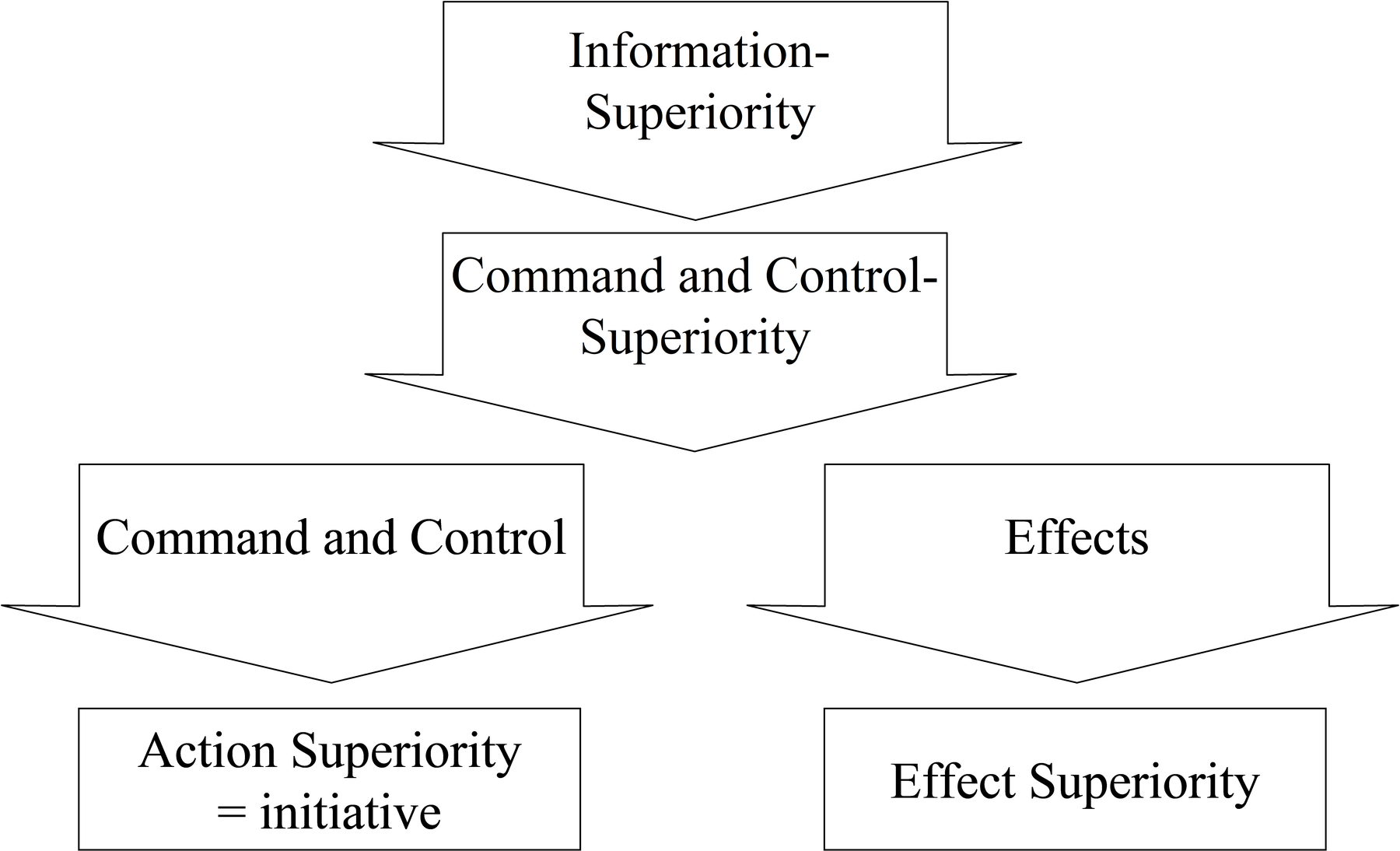
Implications of and prerequisites for information superiority
Information superiority
Information is constantly gaining in importance as a determining factor for the planning and conduct of operations as part of the military command and control process. Information helps commanders to employ the available forces efficiently. The battle for information superiority is therefore a responsibility of all command levels and all branches of service.
However, information superiority is not an end in itself but provides the basis for gaining command and control superiority. Depending on the context, command and control superiority has different effects (see Figure 1):
- From the perspective of command and control, command and control superiority creates the prerequisite for action superiority and thus for gaining the initiative in combat.
- From the perspective of effects—essentially weapon effects—command and control superiority leads to effect superiority.
The army integrated information system as a prerequisite for information superiority
Definition of the army integrated information system
I have pointed out that the battle for information superiority has to be conducted continuously and comprehensively, and where information superiority is leading. However, I have not yet talked about the prerequisites for information superiority.
Information superiority exists if:
- the information relevant for the planning, preparation and conduct of operations can be continuously and unimpeded collected, processed, distributed, evaluated and translated into decisions and effect, and
- the enemy's capability for collecting and evaluating information can be degraded and manipulated in support of one’s own objectives.
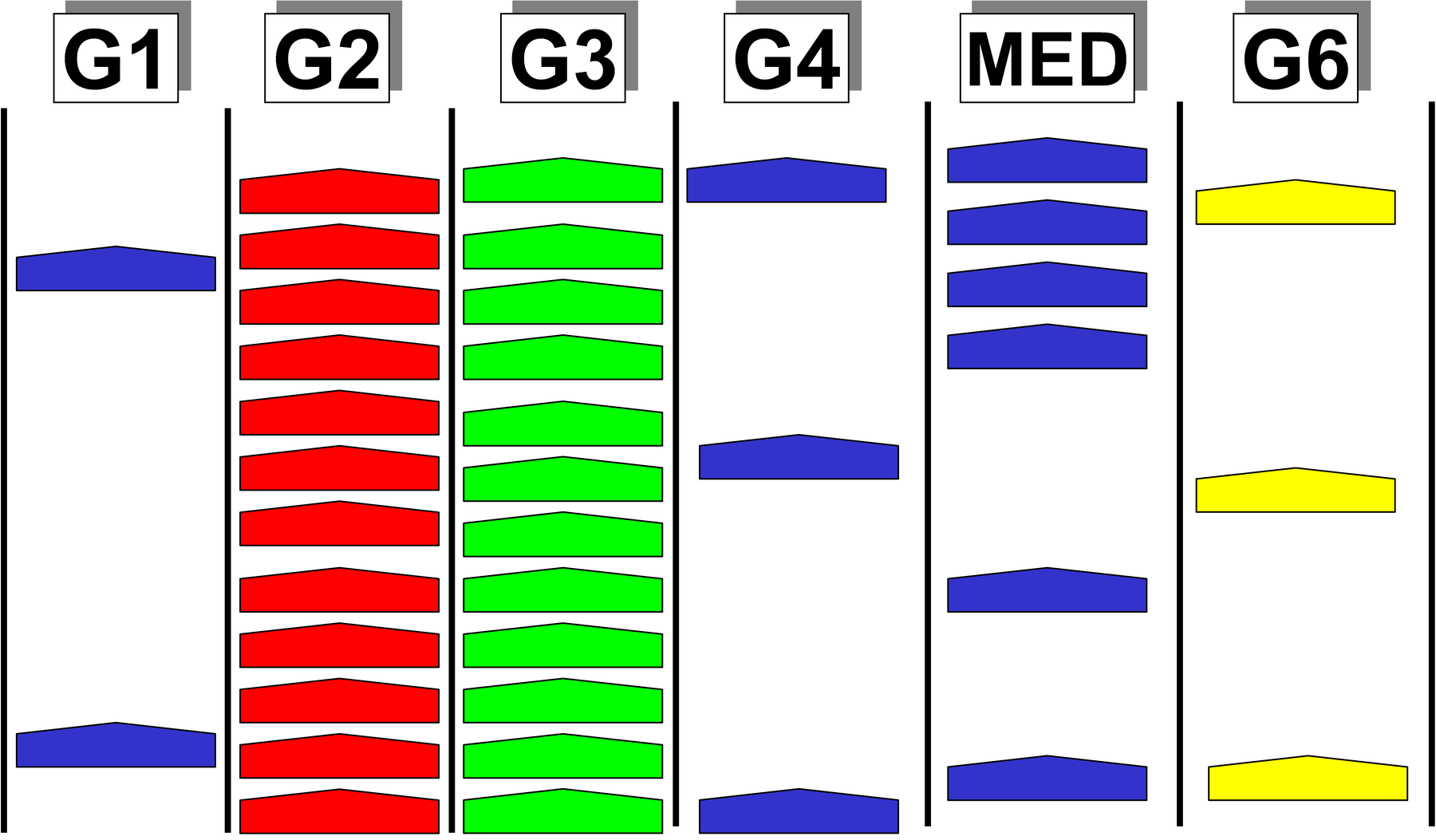
Intelligence and reconnaissance make an essential contribution to information superiority, which I will explain using the example of basic functional area 2. However, it must also be emphasised that the information superiority requirement always relates to all basic functional areas (see Figure 2).
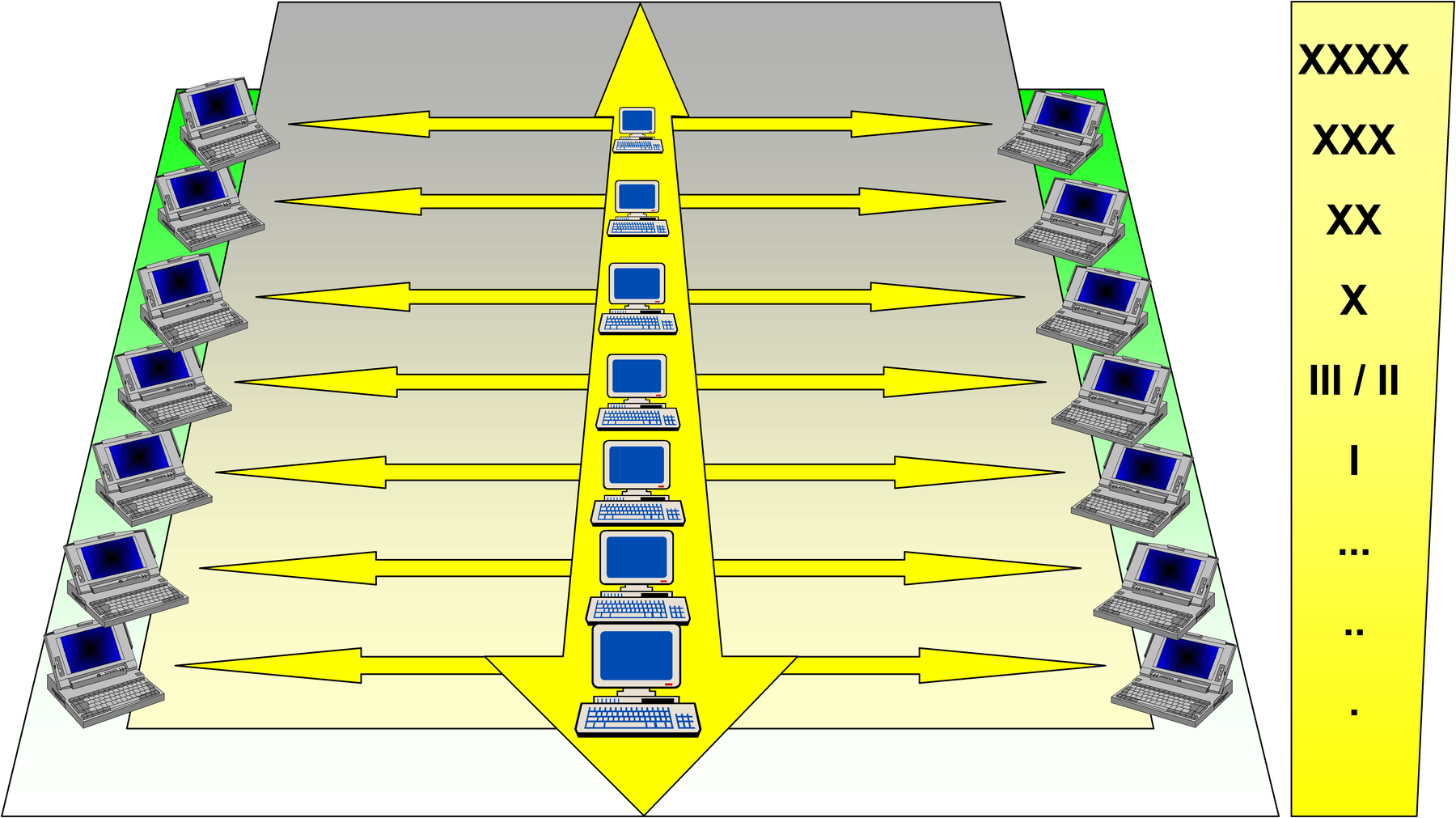
Seen by themselves, a single signal detected by the electronic warfare signal troops at the lowest level, a single detected minefield or a detected group of three main battle tanks are no information relevant for command and control. Only the combination of different single pieces of information—and their appropriate evaluation at the various command levels—will yield information relevant for command and control, which is to be made available to the top level of the decision-making hierarchy not in real time—which would of course be an utopian requirement—but at least on a near-real-time basis!
In this example, I have addressed the following information issues:
- information collection,
- information processing, and
- information transmission.
With regard to the requirement for near-real-time situational awareness, information warfare makes very great demands on exactly this last issue, that is information transmission across all command levels.
It is obvious that in the future real-time information transmission as a prerequisite for near-real-time situational awareness—not only in basic functional areas 2 and 3 with ENEMY SITUATION REPORTS and OWN SITUATION REPORTS—can only be ensured with an efficient, vertically and horizontally integrated information system linking all command levels.
In the process, we will definitely achieve an increase in performance of the information processing systems making up the interchange of information.
This integrated information system—if it is to be efficient, and if we are serious about the digitisation of the Army—will start from the sensor, from the platform, from the weapon system and, in special cases, from the individual soldier. It extends vertically along the Army chain of command up to the Army Forces Command and horizontally to the respective neighbouring units, to the other Services and to our allies.
As illustrated in Figure 3, only with a comprehensive integrated information system—which of course not only extends from the bottom to the top but also in the opposite direction—it will be possible to establish:
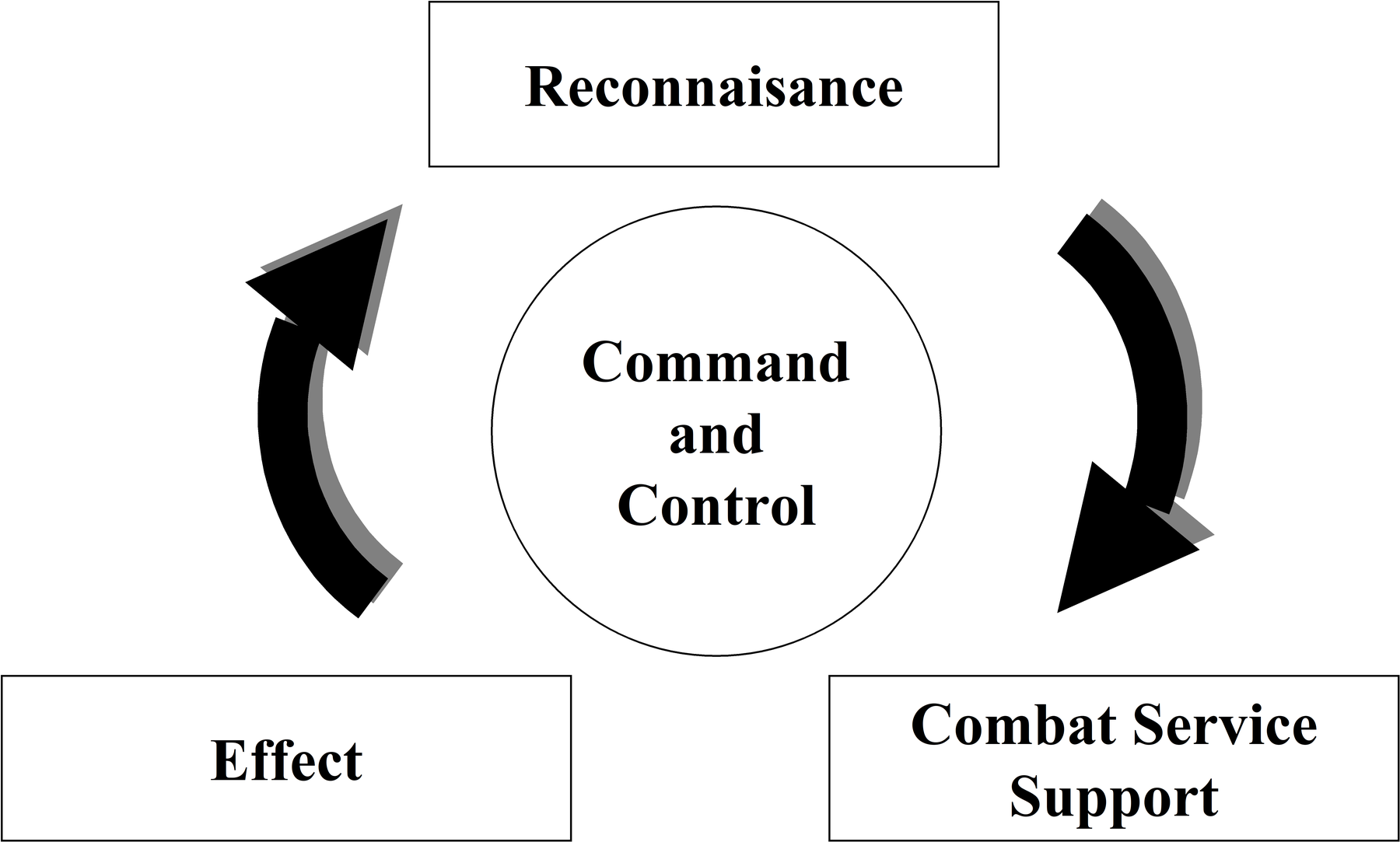
- based on the turntable of command and control/command and control support;
- a close, near-real-time link between reconnaissance and effect; and
- also including combat service support.
Materiel requirements of the army integrated information system
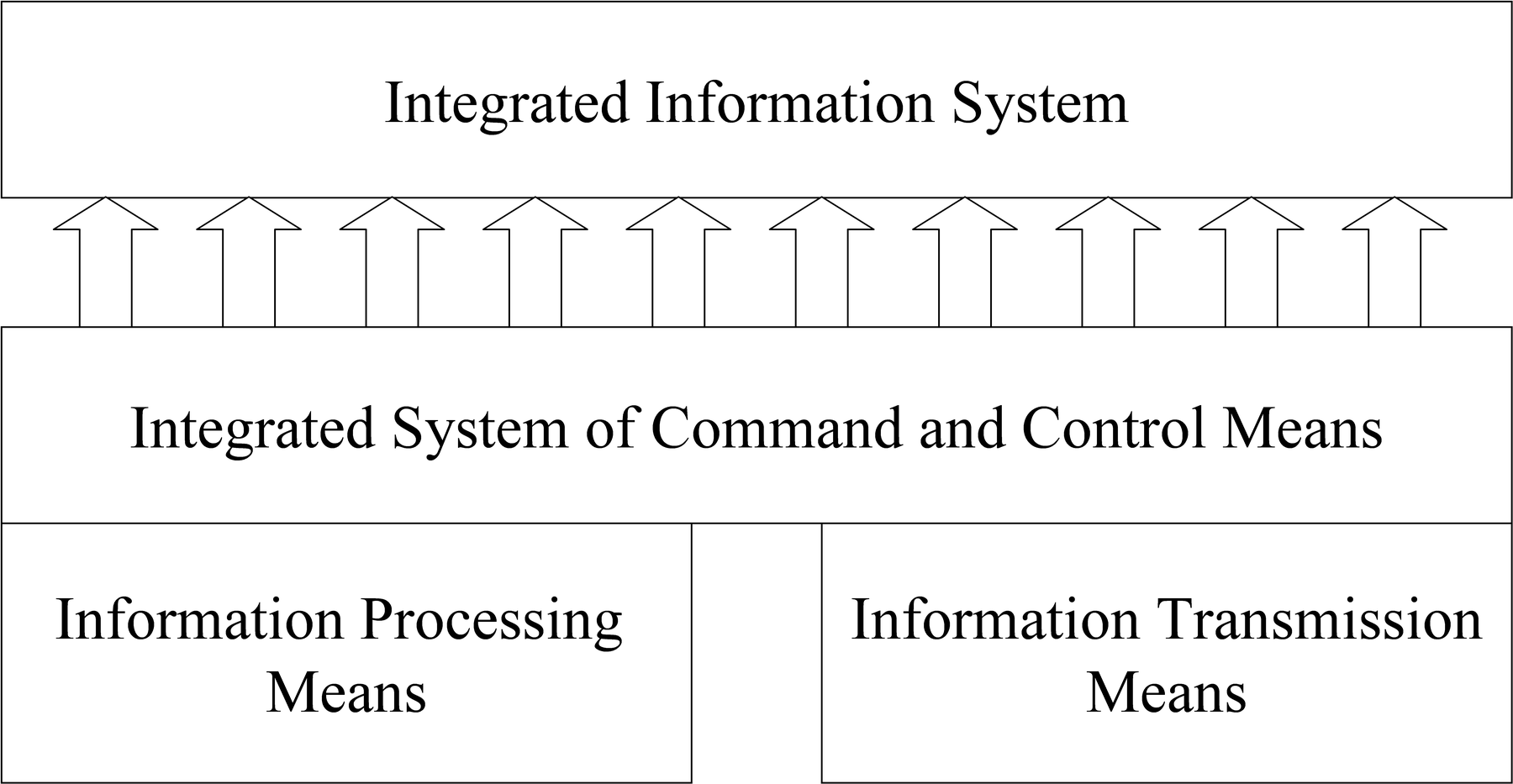
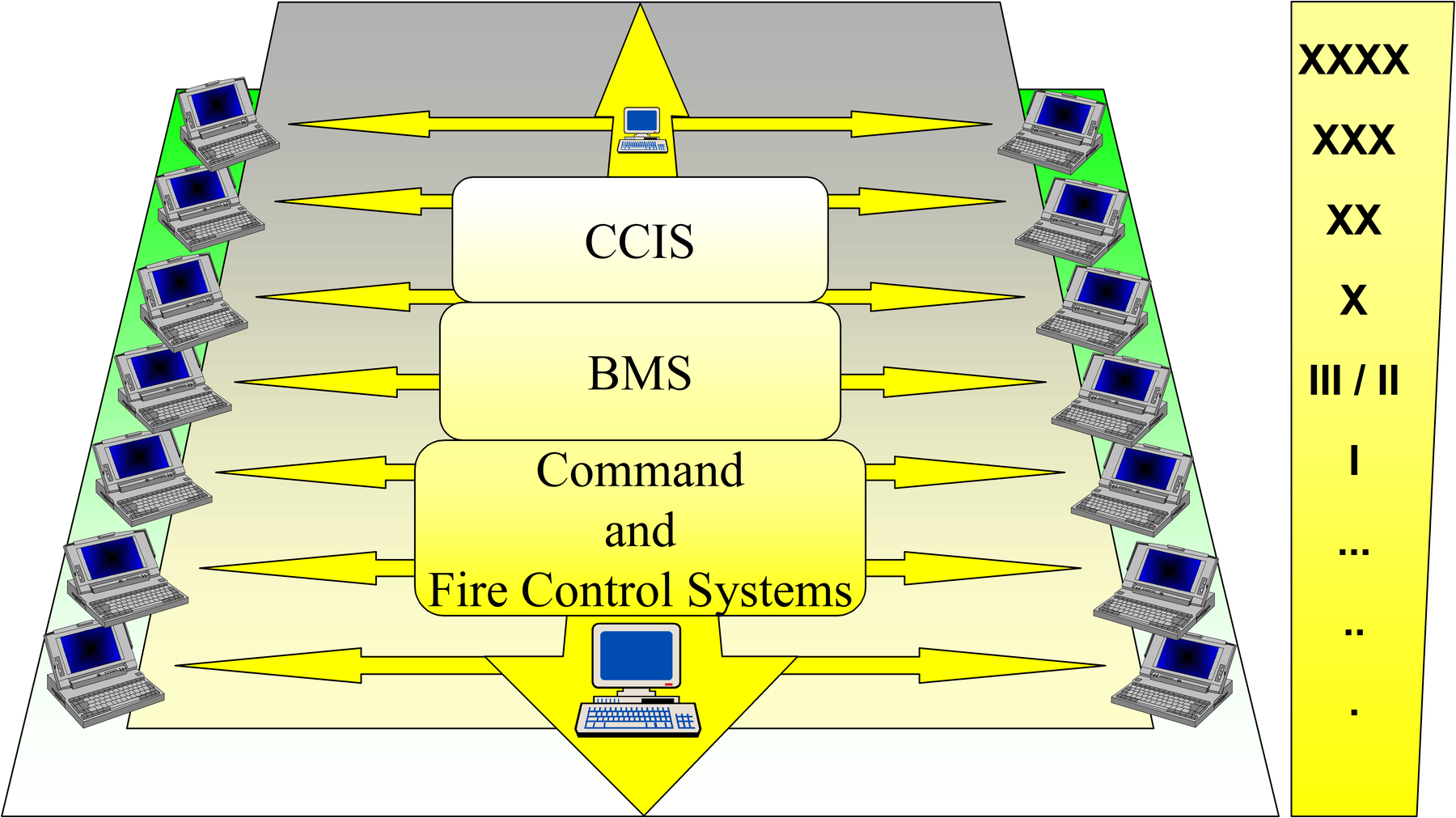
As illustrated in Figure 4, the materiel requirements of the Army integrated information system are a highly complex integrated system of command and control means comprising information processing means and systems on the one hand and information transmission means and systems on the other.
Information processing systems
Figure 5 shows the information processing systems are employed within the Army integrated information system.
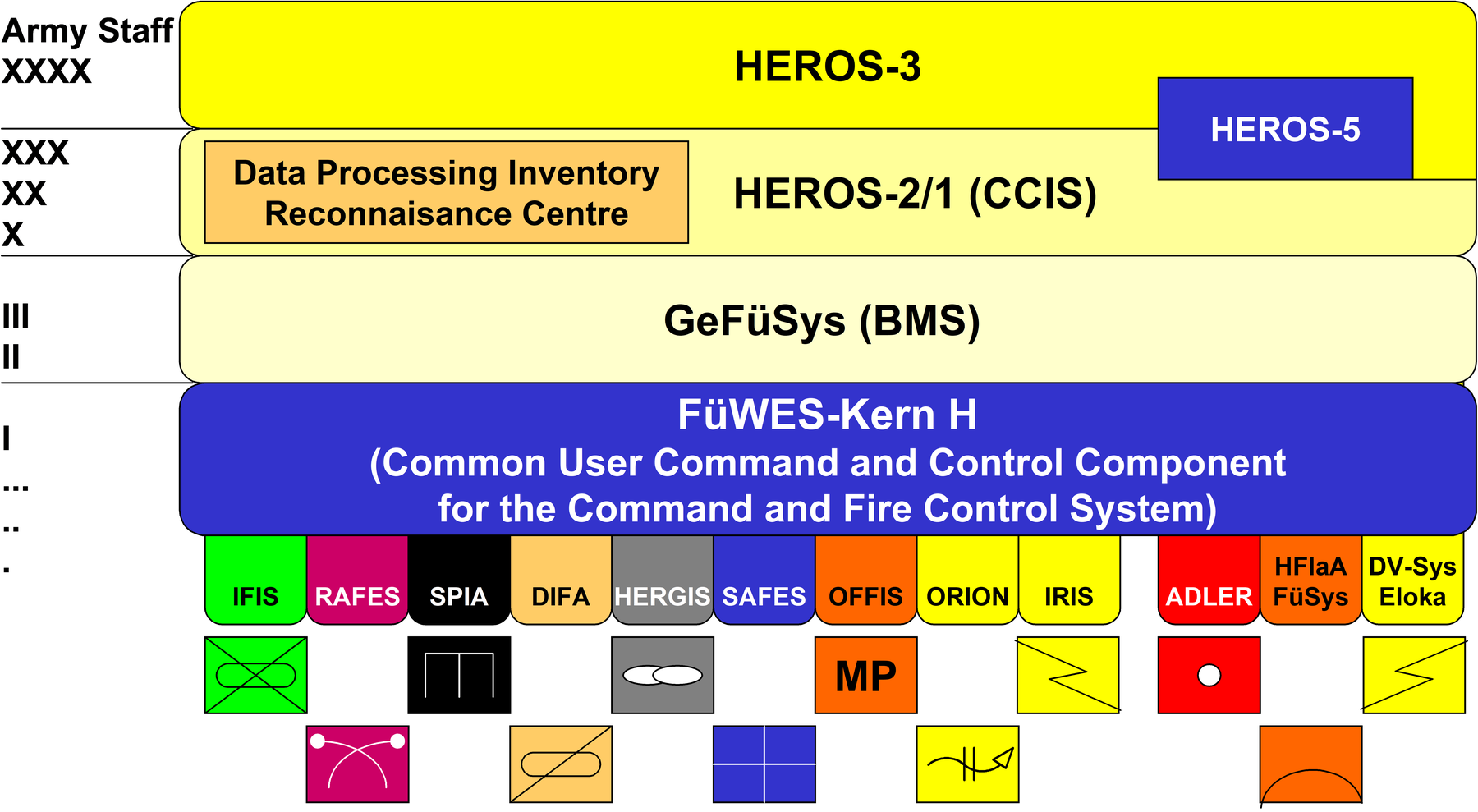
The HEROS-3 and HEROS-5/Movement Control systems are employed for peace-time staff work at the Army Staff and Army Forces Command levels and partly down to division level.
The first lot of the HEROS-2/1 command, control and information system, the operational system for the corps to brigade levels, was fielded in the Army in 1995. The second lot, which is much more efficient and user-friendly than the first lot, will probably be fielded from 2000.
Based on HEROS-2/1, second lot, the Army is planning to field a mission-related data processing inventory at the reconnaissance centres from 2003.
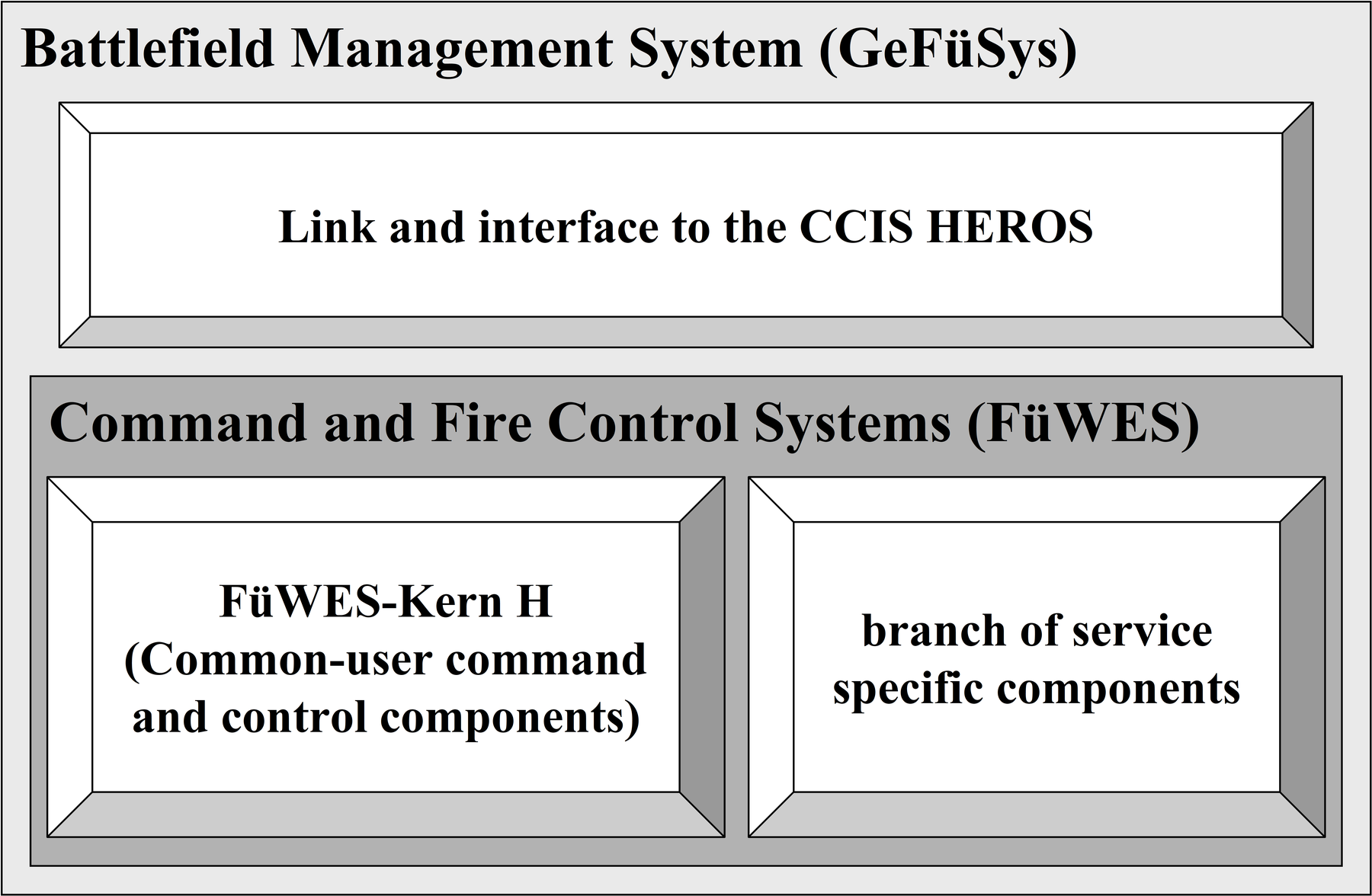
Below brigade level, the Battlefield Management System (BMS, GeFüSys) will be employed at the battalion and separate company levels. It will provide the required link and interface between the branches of services and HEROS.
Command and Fire Control Systems (FüWES/FüES) of the artillery, the Army air defence and the electronic warfare signal troops are already in service. These are the so-called old Command and Fire Control Systems, which are basically weapon employment systems and have to be "upgraded" in such a manner that these branches of service will also be adequately tied into the Army integrated information system.
The most Command and Fire Control Systems to be fielded for the various branches of service are still in the predefinition phase and have reached completely different stages of development. The first Command and Fire Control Systems, such as SPIA for the corps of engineers, RAFES for the NBC defence corps and DIFA for the armoured reconnaissance corps, will pass into the realisation phase in a few months upon approval of the respective organisational-technical requirements. Other service branches for which the production and deployment decision was only made early this year will have completed the definition phase in 2–3 years.
The new Command and Fire Control Systems, currently under development or still in the predefinition phase, have the following basic configuration. They have a common-user command and control component with functions required by all branches of service. This component is linked with the respective branch of service-specific component and the weapon employment system or operational system of the respective service branch. The Battlefield Management System employed at battalion/separate company level provides the link and interface between the Command and Fire Control Systems and HEROS.
According to the current plans, the Battlefield Management System and the first Command and Fire Control Systems will be fielded from 2003. As soon as the results of the field trial "Battlefield 2000" are available, the Army will decide on the number and type of BMS and Command and Fire Control to be procured for the individual service branches. In this field trial, about 100 systems of different configurations will be tested and further developed in a brigade scenario and with close cooperation between users, materiel developers and industry.
The information transmission means of the integrated information system
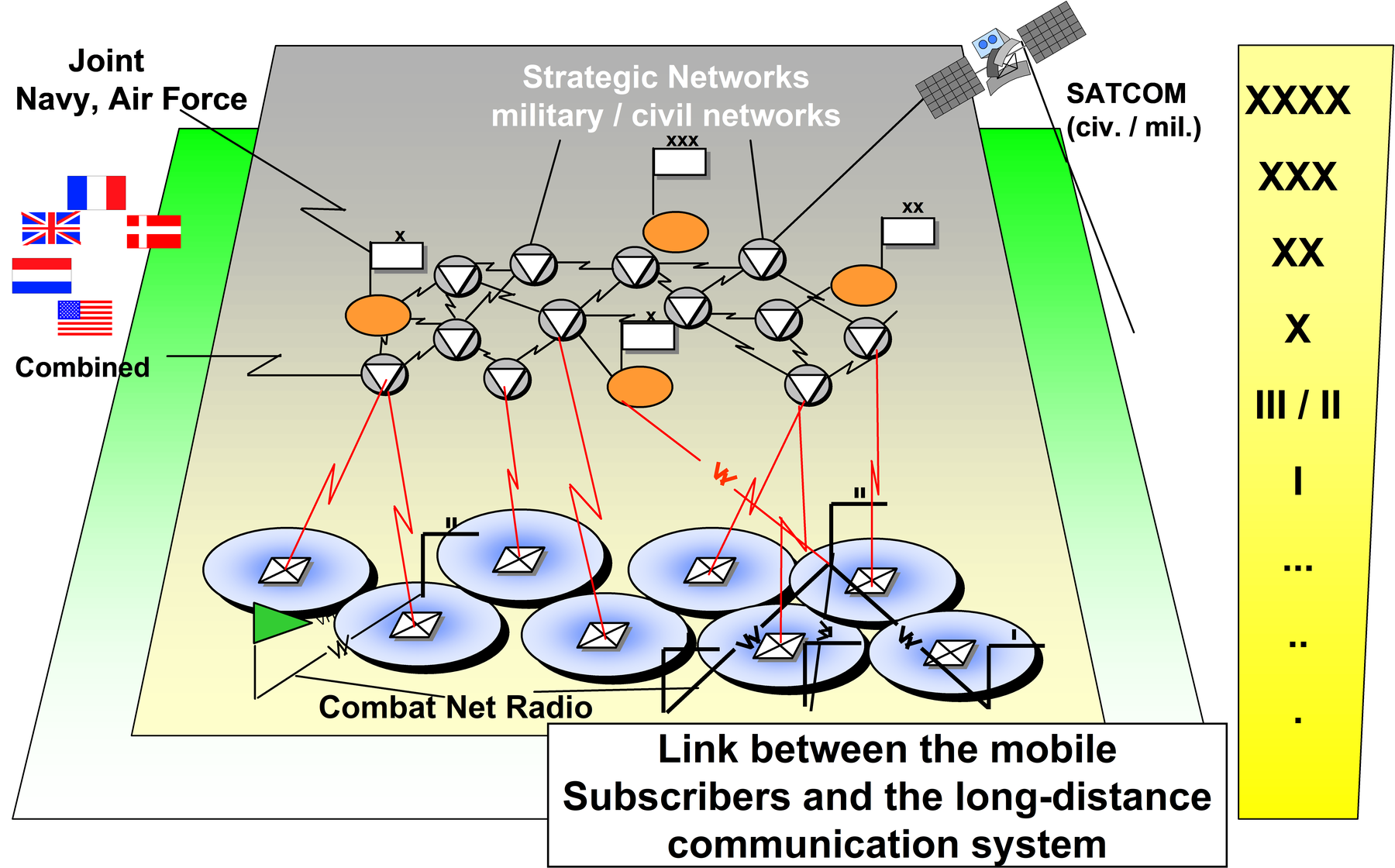
Now I would like to address the second part of the materiel requirements of the Army integrated information system, that is the information transmission systems (Figure 7).
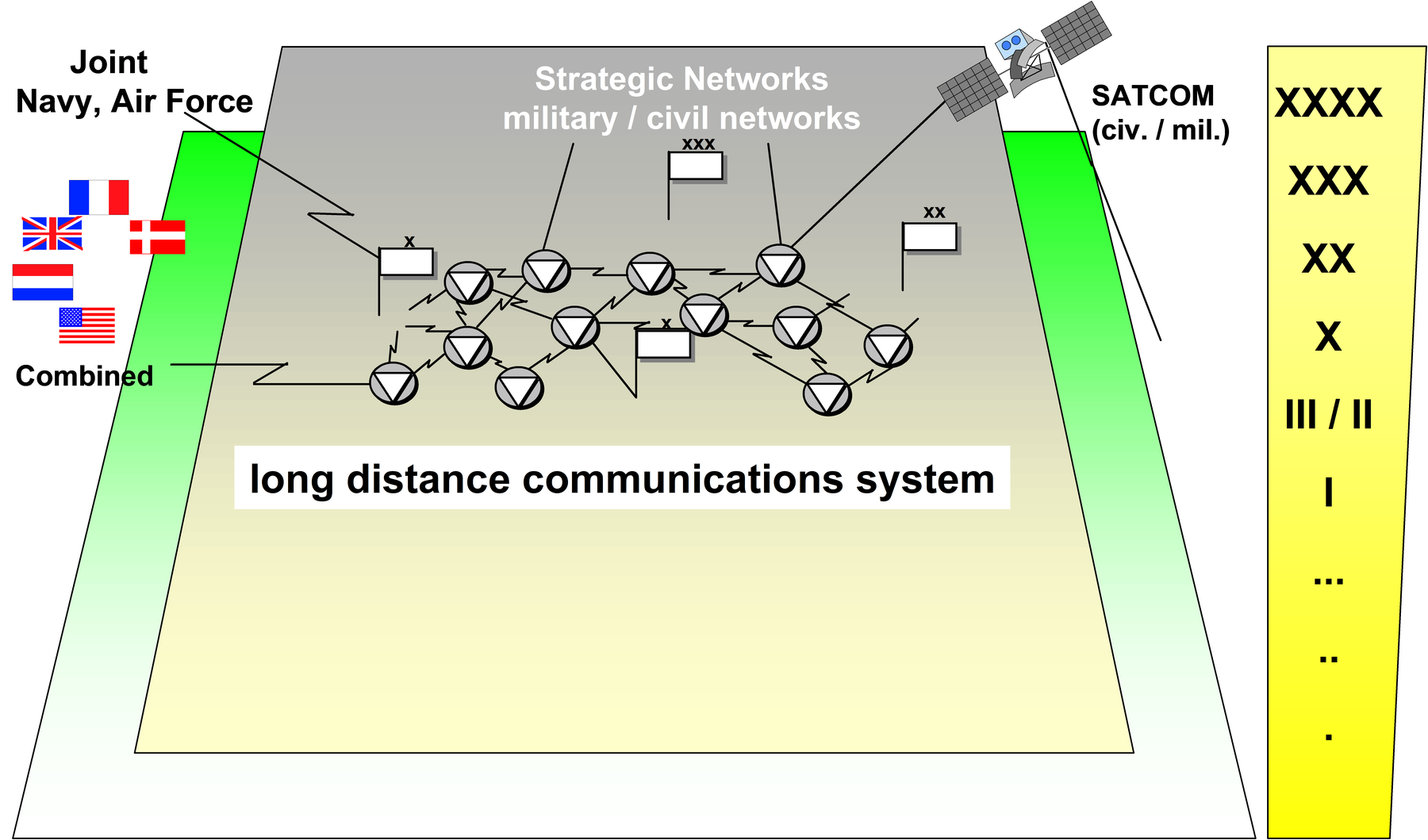
The information processing systems can only communicate with each other and convey information across the various command levels if they are interlinked through efficient information transmission means.
The information transmission of units from brigade to corps level will basically be supported by the AUTOKO 90 long-distance communications system with a long-distance transmission capacity of presently 1 Mbps, which is currently being fielded.
The HEROS users at the corps to brigade command posts will exchange information via a BIGSTAF network. The fibre optics BIGSTAF version with a transmission rate of 10 Mbps will be fielded throughout the Army. In order to enhance the mobility of the Reaction Forces command posts, they will be equipped with the radio link BIGSTAF version with a transmission rate of 2 Mbps.
The mobile subscribers forward of brigade will be indirectly linked with the integrated information system via combat net radio. The battalions with Battlefield Management Systems will be linked with the Army integrated information system via the brigade G3 data circuit using data radio-capable SEM 93 radio sets. Voice transmission will be realised through a parallel brigade G3 voice circuit. At this point, it must be emphasised that the Battlefield Management System is the link between HEROS and the Command and Fire Control Systems. The conceptual requirement of linking the combat net radio with the tactical long-distance communications system remains unchanged but according to the decision of the Chief of Staff, Army dated 5 December 1997, this project will be deferred until 2005. The SCRA (single-channel radio access) network project has recently been cancelled officially.
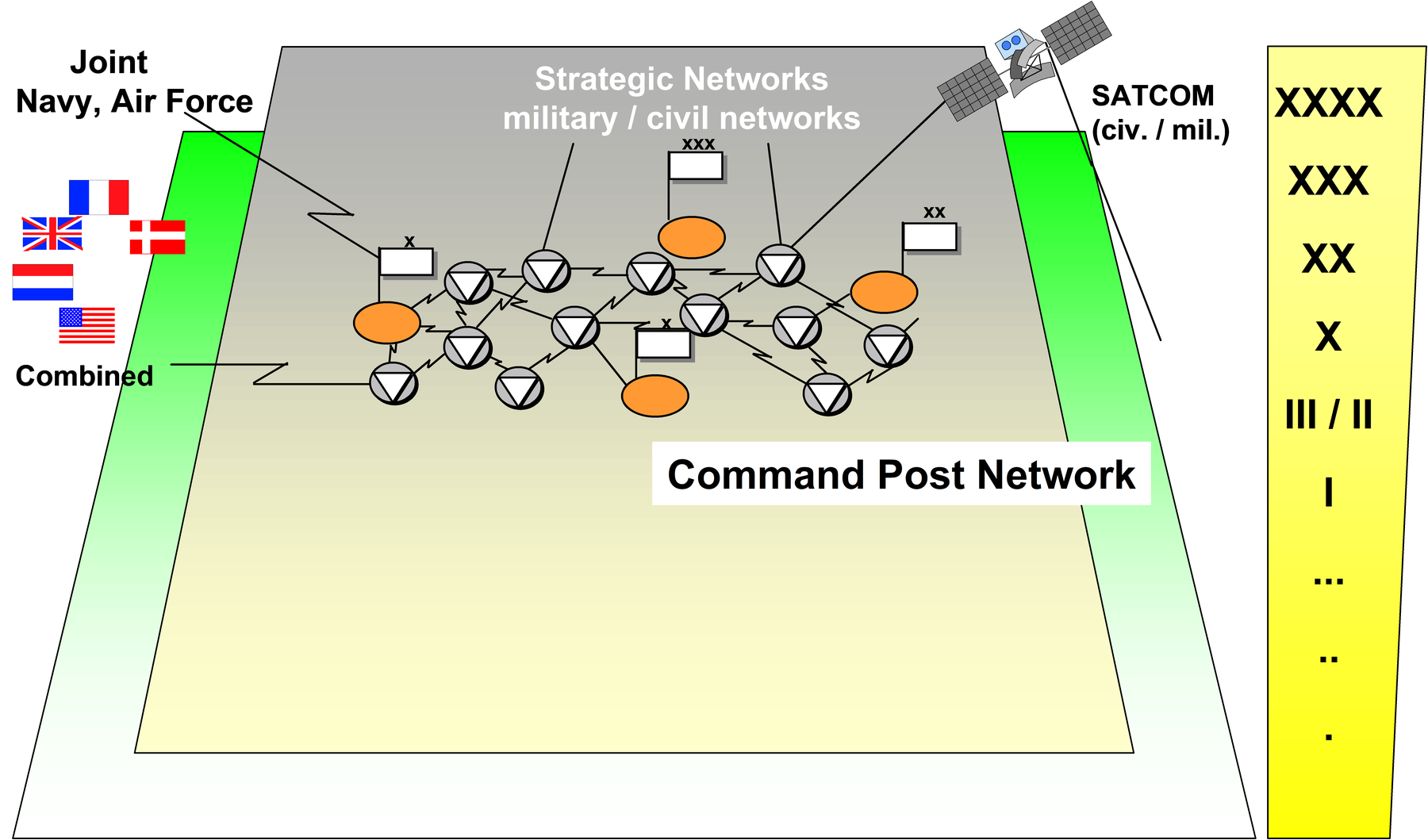
The mobile subscribers forward of battalion with their Command and Fire Control Systems will be linked into the Army integrated information system via radio circuits for both data and voice transmission. These Command and Fire Control Systems will employ SEM 80 and 90 radio sets with data radio adapters.
At present, experiences with the integrated information system are only available for the brigade to corps "section", where AUTOKO is used. The transmission capacity (voice and data) of this long-distance communications system is 1 Mbps. This is just about sufficient for the mere exchange of messages. However, as soon as multimedia services are required—and be it only for example a point-to-point video conference—considerable restrictions are to be expected.
Contribution of the army integrated information system to the individual phases of the command and control process
The previous implications of this Army integrated information system have clearly shown that it is a necessary prerequisite for a near-real-time assessment of the situation and for the desired information superiority and thus contributes to command and control superiority. In the following, I would like to briefly explain how the integrated information system with its information transmission and processing capacities contributes to the command and control process with a view to achieving the desired command and control superiority.
As to the assessment of the situation, an essential contribution to command and control superiority will be achieved:
- through minimisation of the time required for transmission
- from the sensor to the reconnaissance centre,
- from the digital platform (usually the team, and in some cases the individual soldier) to the next higher command level and across all command levels, and
- through automated and thus rapid information processing in the reconnaissance centre.
This can only be achieved through modification of the reporting cycles in the Army reporting system. The fixed reporting times from the past, which are still used sometimes, have to be replaced by event-driven messages. This implies that even very slight changes in the situation in all basic functional areas will be continuously entered into the database of the command, control and information system. Only this will enable a near-real-time assessment of the situation across all command levels.
A later section addresses the technological constraints of a near-real-time assessment of the situation associated with the fielded systems.
In the area of planning, a contribution to command and control superiority can be achieved
- through utilisation of planning- and decision support tools in preparing decisions,
- through the replacement of the conventional time-consuming—"by-the-book”—decision briefings by more time-efficient procedures where the whole expertise of the staff will still be considered in the decision-making process. Of special importance, in this context, will be the question how to provide the commander of the respective level with the decision-relevant visualised information within the system.
The visualisation of command and control-relevant information within the command, control and information system is currently one of the major issues which are investigated intensively by different member-nations of NATO (for example, by our American comrades in particular as part of the Battle Command Battle Lab effort at FORT LEAVENWORTH).
As part of the command process, a contribution to command and control superiority can be made:
- through efficient planning tools for the issuance of orders, (for example, largely autonomous computer-based deployment planning of brigades and battalions based on the input of appropriate basic data and standards); and
- through the digital transmission of orders, which will reduce the transmission time by several hours. The rather time-consuming, work-intensive duplication of the operation orders is no longer necessary. And the orders need no longer be physically carried to the command post of the subordinate level.
- In addition, the time required for transmitting orders and messages can be reduced through maximum possible compression of the data to be transmitted and through a higher transmission capacity within the communications system.
As part of the control process, a contribution to command and control superiority can be made through a near-real-time feedback on the consequences of orders in the form of situation reports.
Information flow within the army integrated information system
Information superiority has not yet been achieved if the staffs of higher command levels are capable of assessing the enemy situation (RED) and the friendly situation (BLUE) in near real time by means of the new command and control assets. Especially due to the reliance on combat service support and command and control support, it will be important that information superiority covers all basic functional areas. This includes the capability to aggregate the information collected at the lowest level and feed it to the technical information systems to enable for example the logistic forces to provide bulk supplies, such as ammunition and fuel, at the right time and place, or the capability of the G1 to supply personnel replacements with the required specialist qualifications as quickly as possible (see Figure 10).
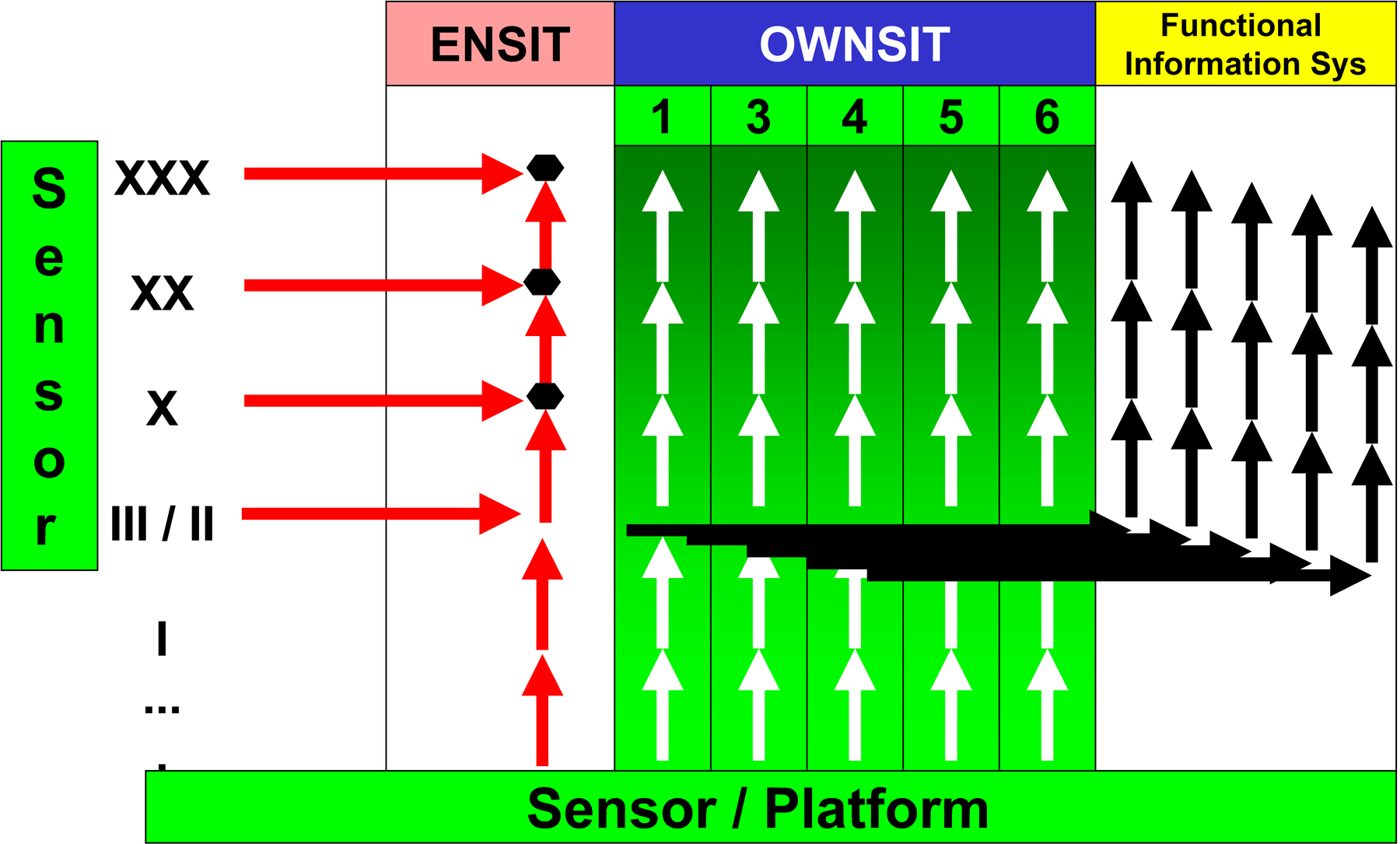
The command post of the higher command level will only receive a near-real-time situation picture, if the units of all branches of service have the required state-of-the-art command and control means which will feed this information from the lower level of the integrated information system, that is the branches of services level, to the higher levels in near real time. It is obvious that this aim can only be achieved if the branches of service are generally equipped with Command and Fire Control Systems down to the lowest possible level. Otherwise—and for financial reasons it is already obvious that not the whole Army can be fully "digitised" in this manner—messages from lower to higher command levels will be disseminated much more slowly, which will reduce the up-to-dateness of the situation picture available at the higher command levels. Apart from other factors, this will directly determine to what extent the objective of information superiority will be achieved.
As a matter of principle, the "information superiority" issue involves the question of how close to real-time the situation picture available at the higher command levels can be and must be. The requirement for near-real-time situation updating implies the necessity of a continuous information flow in all basic functional areas. The factor limiting this required vertical exchange of information is the transmission capacity of the tactical communications system. This applies in particular to the units at brigade level and below, which currently use the VHF combat net radio with SEM 90 for the Command and Fire Control Systems and SEM 93 for the Battlefield Management Systems. As I have mentioned earlier, the Battlefield Management System forward of brigade employs a special data circuit (G3 circuit 2/data); below battalion level, voice and data will be jointly transmitted via one single radio circuit. Whether this is feasible and where we will come up against performance limits will be revealed by the field trial "Battlefield 2000".
However, even today it is obvious that a very careful information management through the G6/S6 and an increased data compression prior to transmission will be required to solve the communication problems in the combat net radio with very low data transmission rates. So we will have to ask what maximum age what information from the basic functional areas may have to meet the requirement for near-real-time situation updating. The highest level of up-to-dateness will usually be required for the enemy situation and the friendly situation. For other basic functional areas, especially for the areas of personnel and logistics, a situation updating at 1 minute intervals does not seem necessary, and larger updating intervals for the purpose of reducing the load on the communications system would not involve any disadvantages. For tank ammunition, for instance, it would theoretically be possible to demand ammunition situation reports down to each single round, which would probably be of interest only at platoon level in very special situations. Therefore it is required to determine, as part of information management, which quantities of expended rounds of tank ammunition per command level need to be reported. The difference between the authorised and the actual fuel stocks changes constantly as long as the engines and aggregates are in operation. Here, we must therefore consider very carefully what amounts are "worth reporting" and what message load the tactical data transmission system can just cope with. If appropriate, the messages of the various basic functional areas will be prioritised as required by the situation.
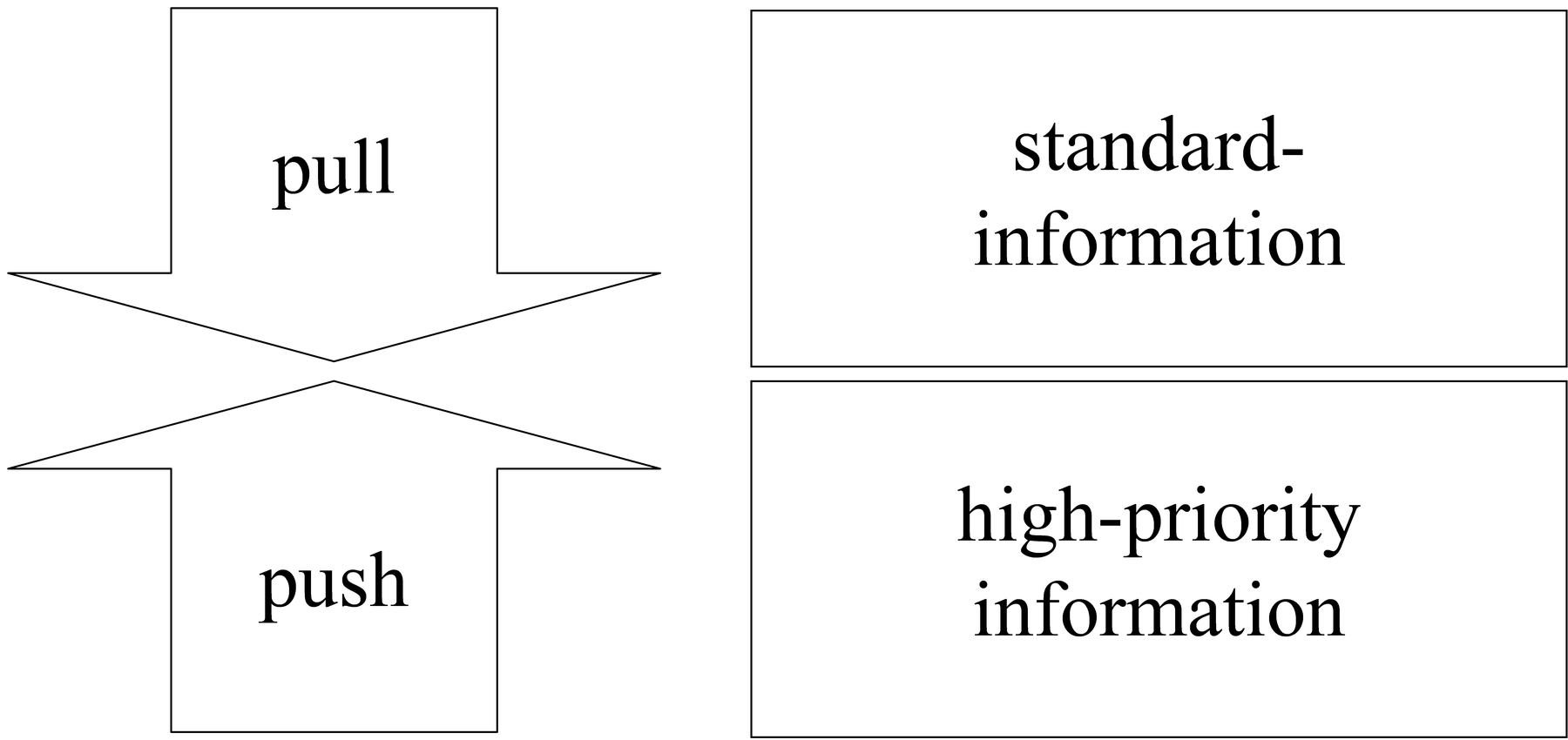
Currently, the Army reporting system is still based on the formatted ADatP-3 reporting system, which works on the PUSH principle. This is a very top-heavy procedure that considerably strains the already scarce transmission capacities.
In this context, the Army will have to examine to what extent other procedures can be used which will minimise the transmission requirements by retrieving mission-relevant information from the database of the subordinate command levels based on the PULL principle. While the PULL principle will rather be applied for standard information to be defined, the previous exclusive PUSH principle will still be confined to high-priority messages.
The army integrated information system and the composite reconnaissance system
Definitions
In some documents, the two terms:
- Army integrated information system, and
- Army integrated reconnaissance information system
are used side by side as if they were two different, maybe even competing integrated systems. This is not the case.
The Army integrated reconnaissance information system is based on the Army integrated information system consisting of the command and control means of the branches of service-specific and non-branch of service-specific (General Staff) command posts. Thus, in terms of hardware, the command and control means used are identical. Using a somewhat vague definition, one could say that the integrated reconnaissance information system is the G2 subset of the Army integrated information system. Considering the sensors of the integrated reconnaissance information system in concrete terms, one realises that this portion projects downwards out of the Army integrated information system. JASMIN constitutes the upward link or interface with the integrated intelligence and reconnaissance information system of the armed forces.
What are the differences, then?
Considering the information flows within the integrated system under the aspect of their main purpose, one can make the following simplified distinction, which is, however, not dogmatic.
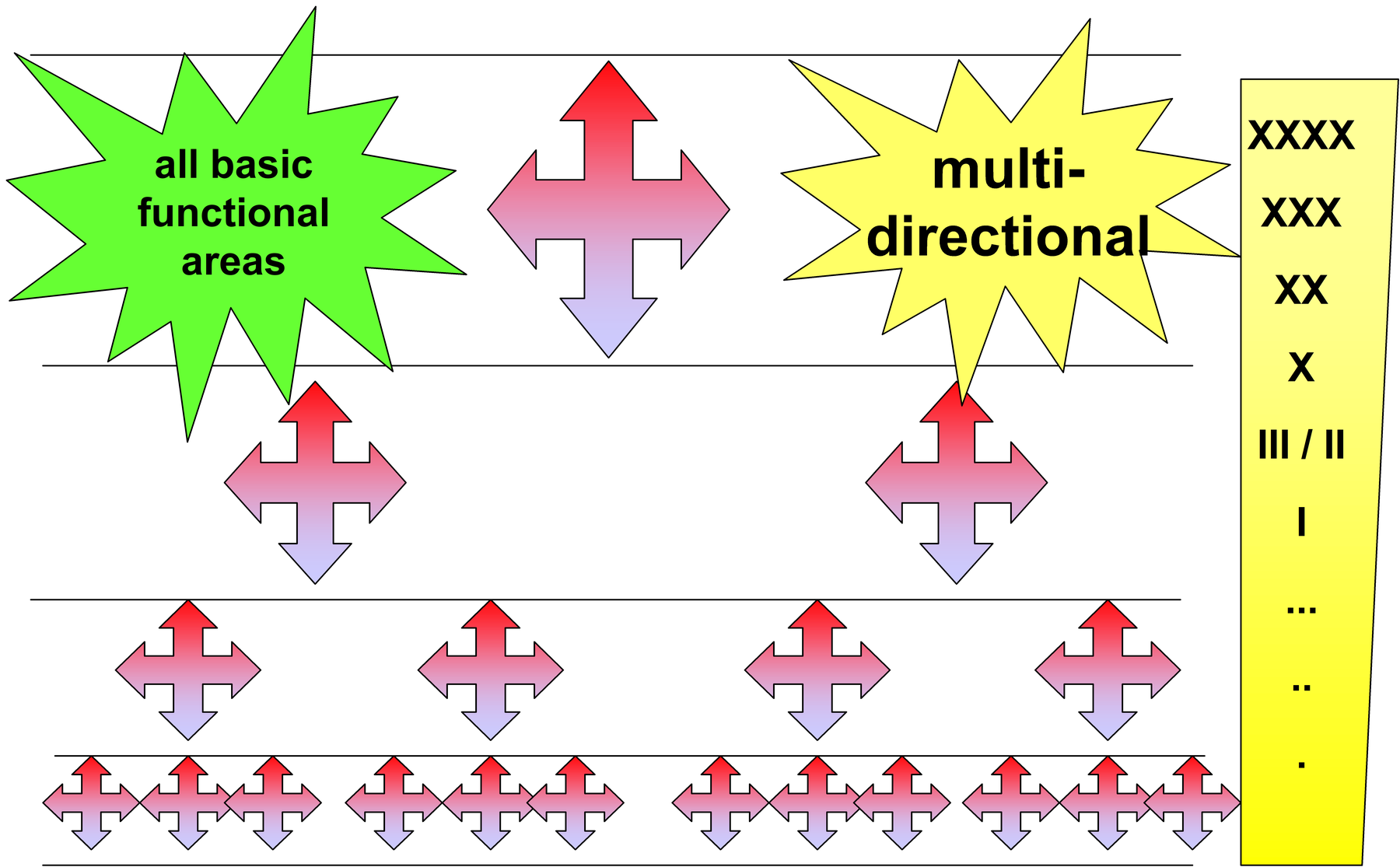
The Army integrated information system is not yet a tactical intranet, in which everybody can exchange information with everybody else—which, incidentally, is not required in this context. However, it ensures that the information collected by sensors, weapon systems and units from team to corps level can be exchanged between the individual command levels. This multidirectional information exchange encompasses all basic functional areas.
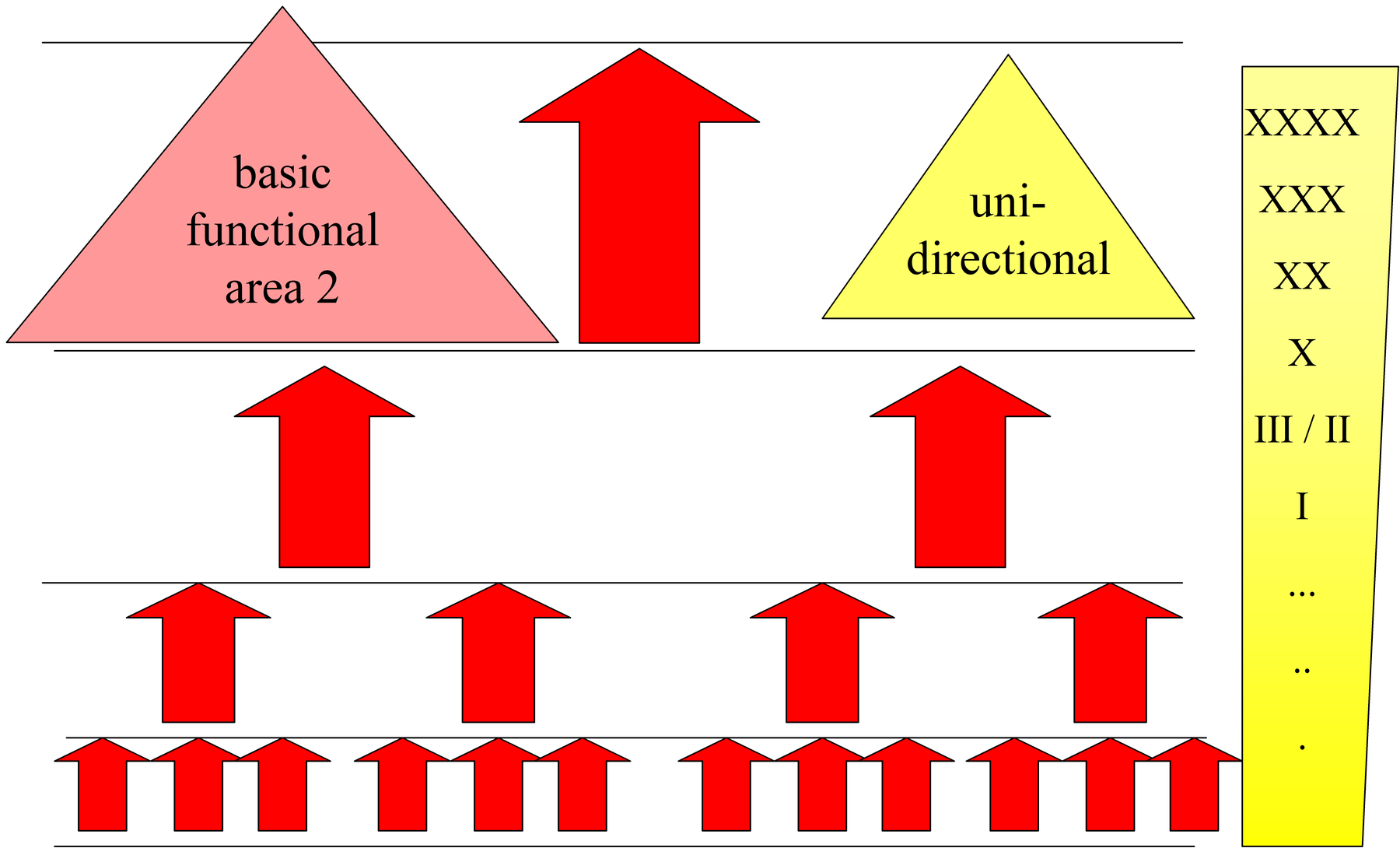
In contrast to this—in terms of the functions to be performed—the integrated reconnaissance information system focuses on basic functional area 2, where enemy information is essentially fed from lower to higher command levels - that is basically in one direction. Of course, there are also information flows in the opposite direction, especially if you think of the tasking of the reconnaissance systems, but the information flowing in the opposite direction only makes up a vanishing fraction of the information conveyed within the integrated system.
The major part of the information of the integrated reconnaissance information system is purposefully directed towards the reconnaissance centres at the division and corps levels and towards the brigade-level reconnaissance cell on a mission-oriented basis. This diagram is also intended to illustrate that these information flows are within and form part of the Army integrated information system.
Contribution of the command and fire control systems to the composite reconnaissance system
The required information from the subordinate units of all branches of service will be provided to the command posts of the major formations via the respective Command and Fire Control Systems.
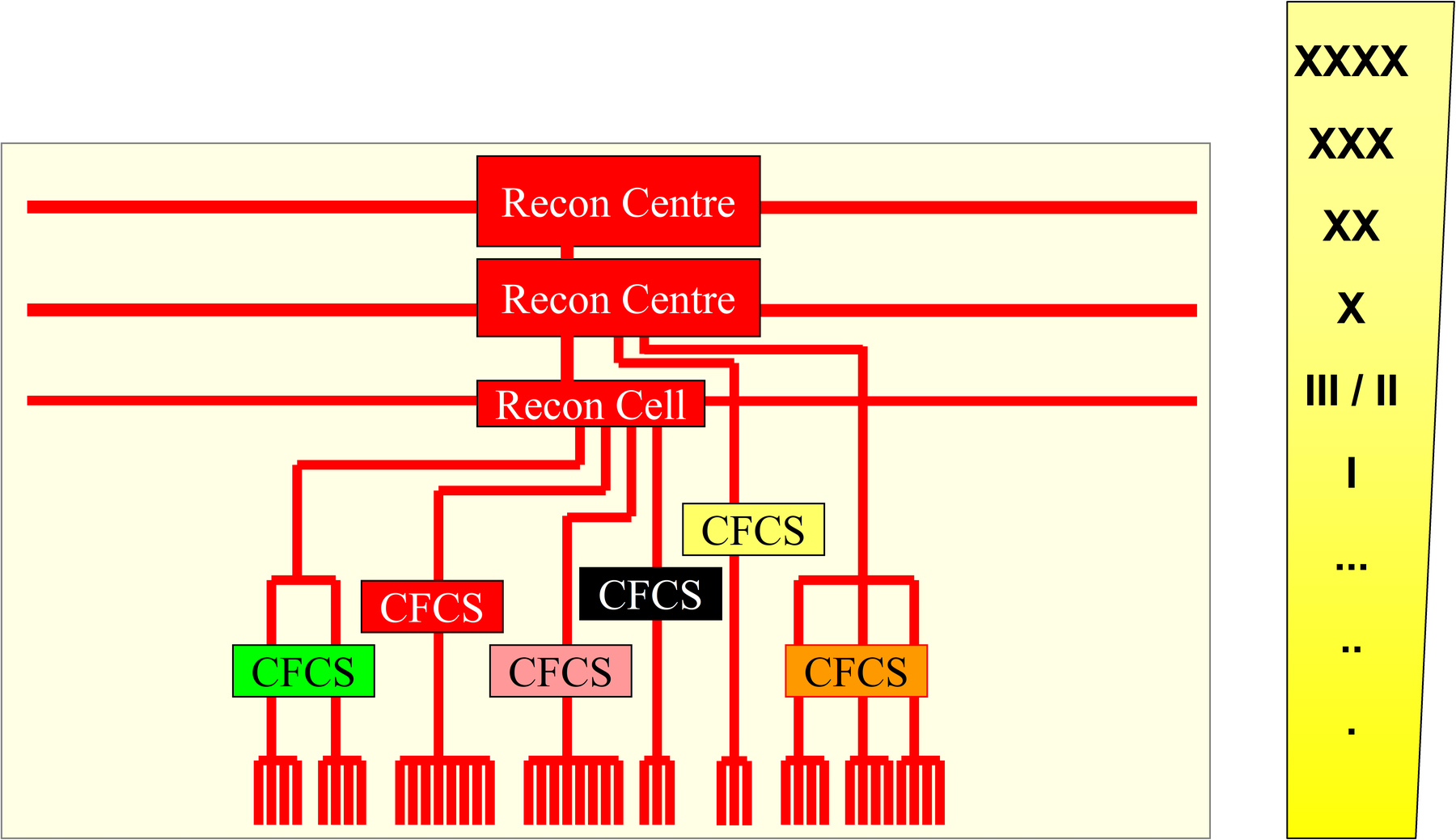
This information will be collected at the brigade-level reconnaissance cell and at the reconnaissance centre at division or corps level.
What Command and Fire Control Systems will be employed for this purpose?
At a quick glance, one might assume that it was only the Command and Fire Control Systems of branches of service which conduct reconnaissance operations virtually as their primary mission, namely the armoured reconnaissance corps, the electronic warfare signal troops and the artillery. But in fact, all the Command and Fire Control Systems of all branches of services make a joint reconnaissance-specific contribution to the Army integrated reconnaissance information system. This becomes particularly obvious, if we think of the corps rear area, where for example messages relating to an air landed enemy are transmitted to the reconnaissance centre by Command and Fire Control Systems of the supply corps, the maintenance corps or the military police corps.
Further development of the army integrated information system and thus of the army integrated system of command and control means
There is only sufficient space in this short paper to address very briefly the further development of the Army integrated system of command and control means, which will have a decisive impact on the efficiency of the Army integrated information system.
Information systems
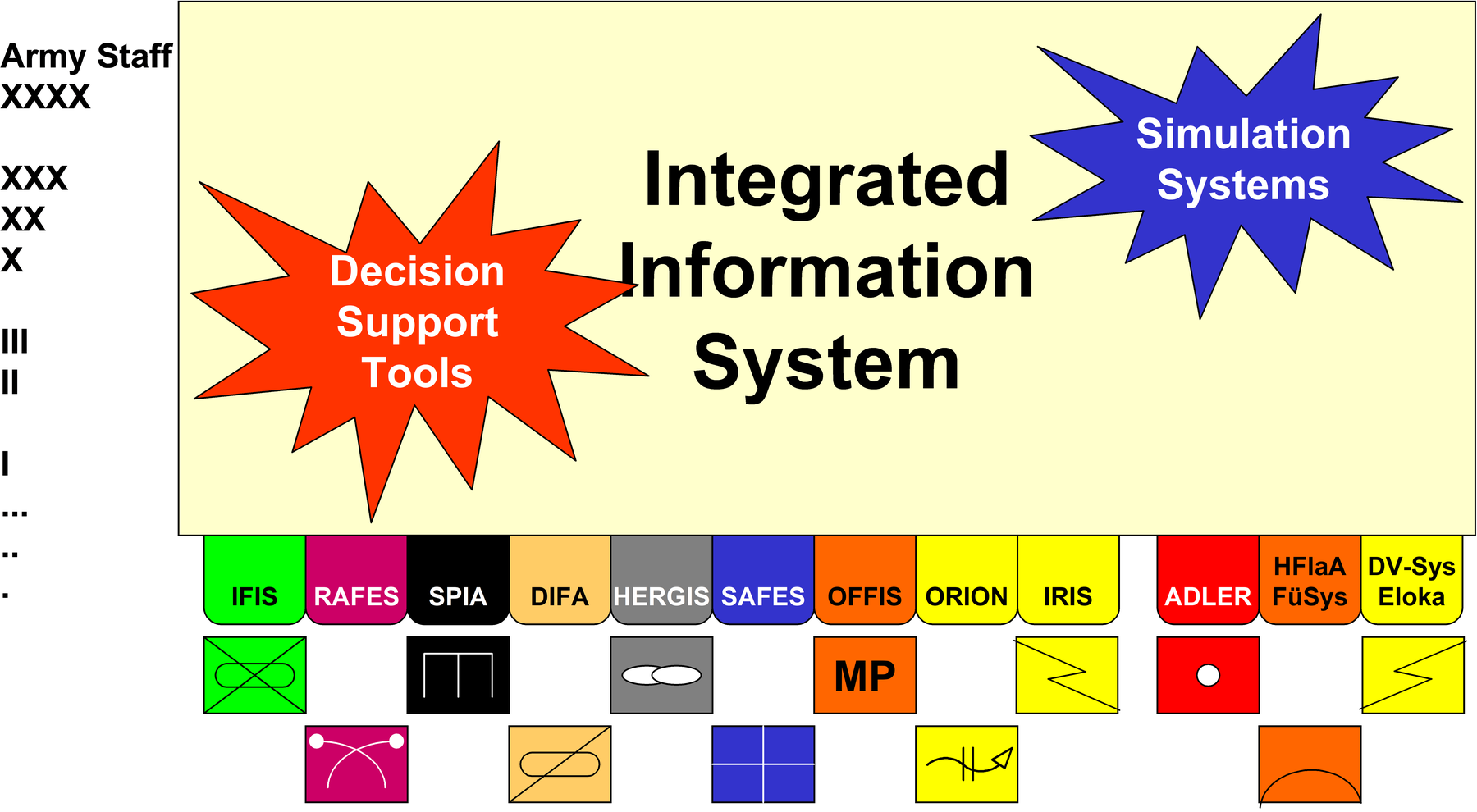
While according to the current short-term planning, HEROS takes precedence over the Battlefield Management Systems and the latter takes precedence over the Command and Fire Control Systems, the Army is planning on a medium to long-term basis to merge these systems into the Integrated Information System, which will be considerably enhanced through the integration of decision support tools and simulation systems and which will overcome the current approach of separate "islands" of systems existing side by side.
Communications systems
The requirement for a near-real-time situation picture in all basic functional areas as a prerequisite for information superiority and thus for the "transparent battle space" involves big challenges for the communications systems especially in terms of their data transmission capacity. While in the area of information processing the processor performances are increasing exponentially, there are only very limited opportunities for performance increases in the area of information transmission.
The development of a Multi-band Multi-role Radio nevertheless raises expectations that the data transmission capacity of the combat net radio will be multiplied by the factor 5 to 10 within the 2005 to 2007 time frame. Whether we will adopt the American approach of fielding a dedicated digital message device exclusively for pure data circuits will have to be decided as part of the field trial "Battlefield 2000".
The transmission rate of the AUTOKO long-distance communications system must be enhanced from currently 1 Mbps to initially at least 8 Mbps. When we will succeed in enhancing the transmission rate of our tactical systems to the current transmission rate of commercial systems of 34 Mbps remains to be seen.
Summary
With HEROS-2/1, the German Army has had a command, control and information system at the corps to brigade levels for several years. The comprehensive digitisation of the branches of service will be realised with the fielding of the Battlefield Management System and the Command and Fire Control Systems for all branches of services.
This provides the technical basis for a state-of-the-art integrated system of command and control means and thus for creating an integrated system of Army information systems as a prerequisite for achieving action superiority and effect superiority.