
Volume 3, Number 3, November 2000
A Comparison of the Performance of Various Light Armour Piercing Ammunition
Abstract
Four types of light-armour piercing ammunition were fired against mild steel, high hardness steel and ceramic faced composite armour targets. The ammunition included three types of 7.62×51 mm AP and the 30-06 APM2 (7.62×63 mm) projectile. The penetrative capability of the ammunition was assessed in terms of both the ballistic limit velocity and the ballistic limit energy. The 7.62×51 mm FFV projectile, which has a tungsten carbide core, had the lowest ballistic limit velocity against all target types. The three steel cored projectiles (Hirtenberger, P80 and 30-06) showed variation in their relative performance dependent upon target type. Examination of the ballistic limit energy showed that the sharper pointed projectiles performed better against strong targets. However, against weak targets, blunt projectiles performed better as they promoted plug formation and shear failure in the target. This was in agreement with the calculated loads to initiate penetration. For the ceramic-faced targets the Florence analysis [1] was found to produce reasonable agreement with the experimental results when the effects of both the projectile core and jacket where taken into account.
Inroduction
It is not always appreciated that within particular classes of ammunition such as 9 mm FMJ, 7.62 FMJ or 7.62 armour piercing (AP), there is considerable variation in performance due to detail differences in projectile design. Within broad classes of ammunition, such as typical military small arms ammunition, it has been shown [2] that performance may vary in both absolute terms and in the comparative rankings between specific projectiles for different types of target. In this paper the penetrative performance of four common varieties of light-armour piercing ammunition are compared when fired against a variety of target types. These four constructions represent a relatively narrow spread of design criteria in that they share a common purpose (light-armour piercing) and are of similar geometry and calibre.
Experimental
Ballistic tests were conducted on three target types using four types of ammunition on each. The ammunitions were 7.62×51 mm AP FFV manufactured by Bofors AB, 7.62×51 mm AP manufactured by Hirtenberger Patronfabrik, 7.62×51 mm AP P80 manufactured by Fabrique Nationale, and the 30-06 AP M2 (7.62×63 mm) manufactured by USA Government Arsenal at West Lake. All four projectiles consist of hard cores contained within a gilding metal jacket. The details of these rounds are given in Table 1, which also includes photographs of the complete projectiles and disassembled cores.
| Ammunition | 7.62×51 FFV Bofors AB | 7.62×51 Hirtenberger Patronfabrik | 7.62×51 AP Fabrique National | 30-06 AP M2 US Government Arsenal |
|---|---|---|---|---|
| Total weight (g) | 8.21 | 9.45 | 9.75 | 10.69 |
| Core weight (g) | 5.93 | 4.32 | 3.8 | 5.17 |
| Core diameter (mm) | 5.59 | 5.59 | 6.08 | 6.22 |
| Core nose angle (deg) | 58 | flat - 2.27mm | 45 | 54 |
| Core hardness (Hv) | 1450 | 750 | 870 | 785 |
| Core material | Tungsten carbide | Steel | Steel | Steel |
| Complete projectiles and disassembled cores |
The projectiles were each tested against three types of armour, mild steel, high-hardness steel, and ceramic faced composite. The mild-steel targets consisted of 300 mm × 300 mm × 12 mm with a hardness of Hv 135. The high-hardness steel panels were Compass B555 steel supplied by Sleaman Engineering Ltd, and measured 250 mm × 250 mm × 9.4 mm with a hardness of Hv 464. The ceramic-faced composite was ARMOURTEK™ 8.0 AS supplied by Aero Consultants UK Ltd. This consisted of a 95% alumina ceramic tile of 8.0 mm thickness bonded to a 14 layer aramid composite backing. The ceramic tile had a 0.25 mm glass-fibre reinforced-plastic spall shield bonded to its front face. Target details are summarised in Table 2.
| Armour Material | Total Thickness (mm) | Hardness (Hv) | Areal Density (kgm-2) |
|---|---|---|---|
| Mild Steel | 12 | 135 | 97.2 |
| High-hardness Steel | 9.4 | 464 | 76.6 |
| Ceramic-faced Composite | 14.5 | 1250 | 27.9 |
Ballistic tests were conducted in order to determine the V50 ballistic limit velocity of each armour/ammunition combination according to NATO STANAG 2920 [3]. Individual rounds were broken down and the propellant charge weight was adjusted in order to achieve the desired velocity. The tests were conducted at a range of 10 m using a rigidly mounted weapon equipped with a laser target-designator to achieve accurate shot placement. The projectile velocity was determined from a pair of optical gates 2 m and 6 m in front of the target. A minimum shot spacing of 25 mm was used in multiple strikes on the metallic targets whilst a new target was used for each shot on the ceramic-faced armour. In some tests a ballistic pendulum positioned immediately behind the target measured the residual momentum of penetrating rounds and debris. The V0 ballistic limit was determined for these tests by performing a linear regression analysis on the pendulum displacement versus impact velocity data.
Results
The results of the ballistic tests are presented in Table 3. The mild-steel target was perforated in a ductile manner and projectiles often perforated the target but jammed in place. Only those that fully exited the target were counted as having penetrated for the ballistic limit calculations. The FFV projectile produced the lowest ballistic limit by a margin of 71 ms-1 over the Hirtenberger which was the next lowest. The flat nose of the Hirtenberger core produced a plugging failure in the mild steel, which account for the relatively good performance of this projectile.
The high hardness steel target produced a wider range of results for the different projectiles. The ballistic limit for the FFV projectile was only marginally greater than for the mild steel target. The FFV round had a ballistic limit velocity more than 200 ms-1 lower than that of the next best (30-06) round. The Hirtenberger projectile could not penetrate the target even when fired at above the normal muzzle velocity. The Hirtenberger projectile was destroyed in all impacts whilst the other projectiles survived and produced ductile failures in the armour.
| Armour Material | Ammunition | V50 Ballistic Limit (ms-1) | V0 Ballistic Limit (ms-1) |
|---|---|---|---|
| Mild Steel | FFV | 487 | |
| Hirtenberger | 558 | 567 | |
| P80 | 590 | ||
| 30-06 | 650 | ||
| High Hardness Steel | FFV | 502 | 488 |
| Hirtenberger | >908 | ||
| P80 | 765 | ||
| 30-06 | 732 | 721 | |
| Ceramic Faced Composite | FFV | 744 | 729 |
| Hirtenberger | 844 | ||
| P80 | 884 | ||
| 30-06 | 887 |
The ceramic targets produced the lowest spread of results between the various projectiles. The FFV projectile had the lowest ballistic limit velocity, however both the Hirtenberger and P80 projectiles had lower ballistic limit energies.
Discussion
In all ballistic tests the FFV ammunition had the lowest ballistic limit velocity. This appears to be primarily a function of the harder and denser material used in the core, which allows a relatively high kinetic energy to be delivered at a relatively low velocity. However, both the absolute values of ballistic limit and the ranking of the various projectiles do not follow a simple pattern. This is in broad agreement with the results of Pageau and Bourget [2] who also compared, amongst others, the performance of FFV and APM2 projectiles. They showed that the ratio of ballistic limit velocity between the APM2 and FFV ammunition was in the range 1.1–1.2 for both metallic and ceramic targets. In the present study the ratio was somewhat greater, being 1.3–1.5 for the metallic targets and 1.2 for the ceramic targets.
In order to explain the variation in projectile performance on the metallic targets it is necessary to examine the loads produced between the projectile and target. Awerbuch and Bodner [4] have suggested a three-stage process for perforation of metallic armour. In the initial stage of the process the force resisting penetration is the sum of the compressive and inertial forces generated by the target. The compressive force (FC) is simply the compressive strength of the target material multiplied by the projected area of the projectile. The inertial force (FI) is that generated by the acceleration of target material in a radial direction away from the projectile and is given by:
(1)
where:
K = function of projectile nose shape (1 for flat nose, ½ for spherical nose, and sin2α for conical penetrators where α is the nose semi-angle);
ρ = target density;
A = projected area of the projectile;and
V = projectile velocity.
The compressive strength of the targets was estimated from their hardness by assuming an indenter constraint factor of 3 [5]. Thus the compressive strength is simply the hardness (in units of stress) multiplied by 3. From this it is possible to calculate the initial penetrator loads and compare these to the projectile strengths achieved by the same route. It should be noted that this approach ignores strain rate effects, however, this should be acceptable for a comparative case such as this.
It can be seen from the results in Table 4 that the loads imposed on the projectile are significantly less than the projectile strength in all cases except that of the Hirtenberger projectile against the high-hardness steel target. It seems probable that the flat nose on the Hirtenberger core produces such high contact loads that the penetrator fails before significant damage can be achieved in the armour. The high contact loads are a disadvantage against strong targets as they cause projectile failure but against weak targets these loads cause premature target failure. So against the mild-steel target the Hirtenberger projectile performed relatively well as a plugging failure was induced.
For the ceramic-faced targets the analysis proposed by Florence [1] assumes that the projectile energy is wholly absorbed by deformation of the backing layer. The ceramic layer simply acts to spread the contact loads imposed by the projectile on to a large area of the backing via a Hertzian conoid. The ballistic limit velocity is then given by:
(2)
where:
ε = failure strain of the backing (20%);
σ = ultimate tensile strength of the backing (280MPa);
h2 = backing thickness;
(3)
where:
MP = projectile mass;
h1 = ceramic plate thickness;
d1 = ceramic plate density;
d2 = backing density; and
a = conoid base radius given by where aP=projectile radius.
Figure 1 shows the calculated ballistic limit velocities based on the entire projectile or just the core. As the primary projectile variable in the equation is mass, the calculated values largely rank with this quantity. Consequently for whole projectiles the 30-06 has the lowest calculated ballistic limit velocity whilst for the cores only the FFV has the lowest calculated velocity. The ranking of the experimental result lies between the two calculated values. This might be expected as the core is likely to have a primary role in penetrative capability but the mass of the jacket cannot be disregarded. A good agreement is shown between the measured values and the mean of the two calculated values.
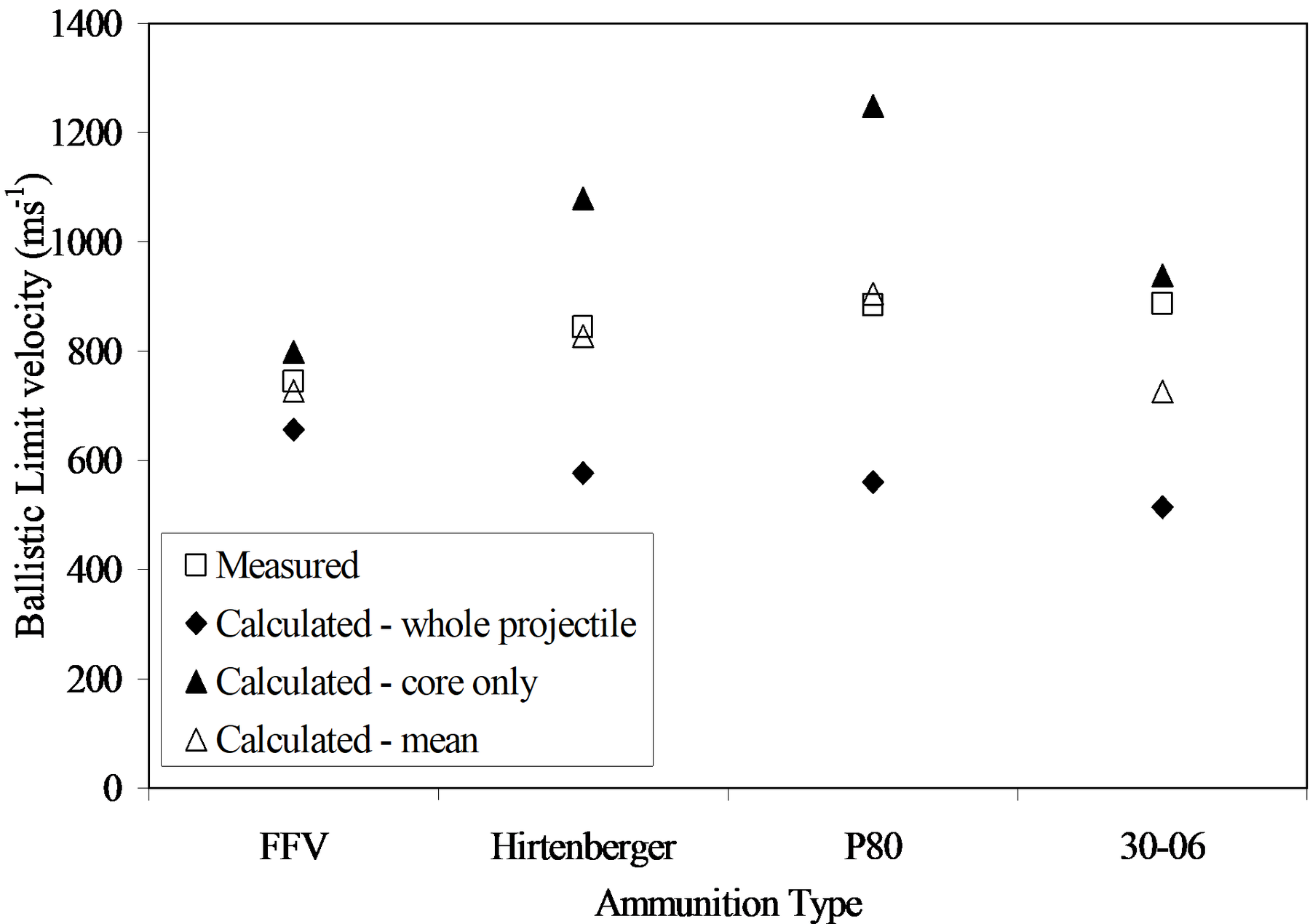
Although it is usual to analyse terminal ballistics in terms of ballistic limit velocities it is also useful to examine the ballistic limit energies. In Table 5 the ballistic limit energies are calculated based on both the total projectile mass and upon the core mass only. It can be seen that for the ceramic-faced target the ballistic limit energies for the core have a relatively small spread, which mirrors the relatively small spread of ballistic limit velocities.
It should be noted that whilst the P80 and 30-06 projectiles have similar geometry and materials, the P80 has a lower ballistic limit velocity against mild steel whilst the 30-06 has the lower limit velocity against high-hardness steel. When these two cores are compared, it can be seen that the P80, which has a longer and sharper ogive, has the lower ballistic limit energy against both types of steel.
| Armour Material | Projectile Type | Inertial Force (Equation 1) (N) | Compressive Force (N) | Total Force (N) | Total Stress over Projectile Cross Section (MPa) | Projectile Strength (MPa) |
|---|---|---|---|---|---|---|
| Mild Steel | FFV | 11.3 | 10.8 | 22.1 | 901 | 4742 |
| HP | 30.9 | 10.8 | 41.7 | 1702 | 2453 | |
| P80 | 15.2 | 12.8 | 28.0 | 967 | 2845 | |
| 30-06 | 21.3 | 13.4 | 34.7 | 1142 | 2567 | |
| High-hardness Steel | FFV | 12.0 | 37.2 | 49.2 | 2006 | 4742 |
| HP | 81.9 | 37.2 | 119.1 | 4856 | 2453 | |
| P80 | 25.6 | 44.0 | 69.7 | 2402 | 2845 | |
| 30-06 | 27.0 | 46.0 | 73.1 | 2407 | 2567 |
| Armour Material | Ammunition | V50 Ballistic Limit (ms-1) | Kinetic Energy of Core @V50 (J) | Kinetic Energy of Projectile @V50 (J) |
|---|---|---|---|---|
| Mild steel | FFV | 487 | 703 | 974 |
| Hirtenberger | 558 | 673 | 1471 | |
| P80 | 590 | 649 | 1697 | |
| 30-06 | 650 | 1092 | 2258 | |
| High-hardness steel | FFV | 502 | 747 | 1034 |
| Hirtenberger | >908 | >1780 | 3896 | |
| P80 | 765 | 1091 | 2853 | |
| 30-06 | 732 | 1385 | 2864 | |
| Ceramic-faced composite | FFV | 744 | 1641 | 2272 |
| Hirtenberger | 844 | 1538 | 3366 | |
| P80 | 884 | 1457 | 3810 | |
| 30-06 | 887 | 2033 | 4205 |
Conclusions
The penetrative performance of light-armour piercing ammunition is strongly influenced by detail design differences. These differences result in a variation of both absolute performance and even changes in the ranking of different projectiles against different target types.
The largest single factor in the penetrative performance of AP ammunition is the density of the core material. However, for a fixed impact energy, the nose shape is the primary factor, sharper noses tending to be more penetrative in all cases except for armour which fails by plugging.
Ceramic-faced armour is less sensitive to projectile construction and materials as it is sufficiently hard to cause partial or complete break up of the armour-piercing core in all cases.
References
[1] A. Florence, Interaction of Projectiles and Composite Armour, Parts I and II, Stanford Research Institute, Menlo Park CA, USA, 1969.
[2] G. Pageau and D. Bourget, “Influence of Target Material Configuration on the Relative Penetration Capability of Small Calibre Bullets”, XI European Small Arms Symposium, Shrivenham, 1997.
[3] Stanag 2920 (draft), Edition 1, AC/301-D/378, NATO 1992.
[4] J. Awebuch and S. Bodner, “Analysis of the Mechanics of Penetration of Projectiles in Metallic Plates”, International Journal of Solids and Structures, Vol. 10, pp. 671-684, 1974.
[5] H. Boyer (ed), Hardness Testing, ASM International, Ohio, 1987.
Ian Horsfall is a lecturer in the Engineering Systems Department of Cranfield University at the Royal Military College of Science, Shrivenham. His research interests include light armour systems and impact properties of engineering materials. He is also actively involved in proof testing and evaluation of light armour for military and police use.
Major Nadeem Ehsan of the Pakistan Army performed the work reported in this paper as part of his studies towards an MSc in explosive ordnance engineering at the Royal Military College of Science.
Wilf Bishop has been involved with the sales and marketing of aerospace materials for over 37 years and for the past five years has been responsible for the development of ceramic composite ballistic armour with Aero Consulatants (UK) Ltd.