
Volume 3, Number 1, March 2000
Command And Control Within The Land Component
Abstract
A recurrent theme in command and control (C2) concerns the most appropriate size of deployed HQs. Opinions vary, and the subject is clouded by the impending impact of digital battle management systems. However, the question is not directly related to digitization. HQs in the World War II were considerably smaller than at present. Their subsequent growth is attributed to the increasing complexity of modern war. But how much more complex is modern war? Is the attendant increase in HQ size justified? Indeed, how should one justify the size of an HQ? This paper discusses the role of an HQ in supporting command and control and suggests six linked premises: that the quantity of information used to make battlefield decisions is very small; that operation orders should be, can be, and have been very short; that very few staff are required to produce those orders; that there is significant advantage in making and disseminating decisions much faster than at present; that decisions do not have to be as good if they are produced significantly faster; and that there are significant advantages in deploying smaller HQs. These premises are considered using historical examples, apparent inconsistencies within doctrine and practice, and two novel models (of decision-making and organisational complexity). The paper then proposes a hypothesis that formations and units with small, closely integrated staffs can be significantly more effective than those with HQs of current dimensions. Discussion of the emergent hypothesis suggests a re-evaluation of the apparent complexity of modern war; of the nature of operational control; of decision-making methods; and of the impending effects of digitization. Future concepts for C2 organisations require further consideration, and perhaps experiment.
Introduction
Developments in military doctrine highlight several issues related to the command and control (C2) of land formations and units. A recurrent theme concerns the most appropriate size of deployed HQs. Opinions vary, and the subject is clouded by the impending impact of digital battle management systems. However, the question is not directly related to digitization. HQs in the Second World War (WWII) were considerably smaller than at present. Their subsequent growth is attributed to the increasing complexity of modern war. But how much more complex is modern war? Is the attendant increase in HQ size justified? Indeed, how should one justify the size of an HQ?
Experience tells us that C2 is a complex and difficult process which requires much near-real-time information and staff effort. However, such observations do not necessarily imply that such complexity and difficulty is inherent in the problem to hand. Within the British Army this issue is dominated by memories of an abandoned attempt to adopt smaller HQs as an economy measure in 1978 []. The fact that this single aspect continues to dominate the issue reflects a conceptual vacuum. There is no clear view of how to address the issue. Indeed it does not attract much discussion at all, despite observations such as that the HQ of an Israeli Brigade is the same size as that of a company [].
This paper explores this issue from first principles. It considers the purpose of an HQ, and from there identifies a number of premises. Consideration of those premises suggests a significant hypothesis.
Premises
The purpose of an HQ is to assist the commander in command and control []. A core activity is decision making. Decisions range from large, individual decisions taken as part of a formal command and staff estimate; to routine decisions taken by individual staff members in response to a query from a subordinate unit or HQ. HQs therefore perform three principal activities: producing major decisions (central to planning); producing minor decisions (related to control of assigned subordinates); and filtering information (for transmission elsewhere). The latter is clearly trivial by comparison: the core activity is making decisions. Strategies for identifying relevant information, and presenting it to decision makers within the HQ, should be a major factor in HQ design.
Thus the primary function [] of an HQ is the generation and dissemination of decisions. From this view point, six linked premises are proposed, which in turn suggest an hypothesis. The premises are:
- The quantity of information used by battlefield commanders to make battlefield decisions is in practice very small. As a corollary, the effort expended in collecting information is commonly out of all proportion to its utility.
- The primary output of a major decision is an operation order. The second premise is that operation orders should be, can be, and have been very short.
- That the number of staff required to produce those orders is very small. The remaining staff are employed either in moderately routine data processing, which may not be necessary; or in making minor decisions, which might be better left to subordinates' discretion.
- That there is significant battlefield advantage in making and disseminating decisions much faster than at present.
- That decisions, and operation orders, do not have to be as good if they are produced significantly faster.
- Finally, that there are significant advantages, in both operational and human factors terms, in deploying smaller battlefield HQs.
First premise: commanders’ use of information
The first premise is that the quantity of information used by battlefield commanders to make battlefield decisions is in practice very small. Much of the information gathered is not considered in the making of decisions for which it is requested []. As a corollary, the effort expended in collecting information is commonly out of proportion to its utility [].
There is compelling evidence that battlefield commanders do not in practice make decisions according to the highly structured methodologies (such as the Estimate Process) taught in Staff Colleges []; and even that such methodologies hinder expert decision makers []. Furthermore, it seems that the rigorous generation and consideration of alternative courses of action required by such methodologies is a charade []. However, in some manner, information is fed to commanders; and decisions are made [].
Most decision-making by battlefield commanders appears to be based on recognition of the problematic situation as being typical of a class of problem to which the decision-maker can perceive a satisfactory outcome []. Such real-life or ‘naturalistic’ decision making is quite different from ‘analytic’, structured methodologies favoured in business management courses and typified by the Estimate Process.
Experienced decision-makers appear to be able to make very good decisions with remarkably little information about the situation. The mental picture, or simulation, which decision-makers use is based on very few factors (typically no more than three) and a very small number of changes of state - five or six []. It appears that the brain rarely handles more than about five or six pieces of information simultaneously []. It is unlikely that the amount of information actually used in making a decision is any larger. Evidence to support this premise comes from an analysis of juries of murder trials [], who consider at most 10% of the facts presented during the trial in forming a verdict. However, the five to six pieces of information are usually high-level abstractions. For example, formation commanders would not generally make a decision based on a single report about an individual tank, or hundreds of reports about hundreds of individual tanks, but on a perception based on the movement of an enemy tank formation.
Such recognitional decision-making should not be seen as a substitute for structured, analytic procedures, but as an improvement on it []. Such decisions are more likely to have a positive outcome than the products of closely staffed estimates using highly mechanistic processes in many combat situations []. Thus it appears that battlefield commanders do, and should, make good major decisions using naturalistic processes, and require very little information with which to do so. However, the information used is entirely dependent on the particular situation. It is not that battlefield decision-making is information-intensive; it is information-sensitive []. The difference has major implications for the design of HQs, particularly in the way in which incoming data is fused, analysed and presented to the commander and staff.
SECOND PREMISE: THE OPTIMUM QUANTITY OF OPERATIONAL DIRECTION
The primary output of a major decision is an operation order. The second premise is that operation orders should be, can be, and have been very short. These three aspects can be considered separately.
If the information required to make a tactical decision is small, the information content of the decision itself can only be small. It is effectively no more than a template: a mental framework of how the required action should take place. Critically, it is based on the decision-maker’s understanding of the situation at the time that he made it. The decision’s validity is therefore time-limited. That validity expires soon after the situation changes in any significant way. Moltke the Elder stated that 'No plan reaches with certainty beyond the first contact with the enemy's main force.' [] ‘First contact’ is both a necessary consequence of most significant battlefield decisions, and necessarily a significant change. If this was the case in the days of Moltke, in the last few decades of close-order drill and collective musketry on the battlefield, it should be even more true on today's more complex battlefield.
Conceptually, the number of possible outcomes resulting from enemy contact is huge, and probably beyond our capacity to comprehend. Every single interaction - of infantryman, tank and gun - could have several results. The possible permutations of all such interactions are innumerable. The probability of anticipating the precise outcome of the first significant enemy contact is vanishingly small. First contact is in practice a planning horizon. Less so, if the contact is deliberate; but even then only up to the point at which the enemy reacts in any significant way.
Trying to expand the basic decision into a closely synchronised plan is a fundamental error [] and a pervading weakness - one of attempting to foresee the future rather than impose one’s will on the enemy []. Combat is an astonishingly complex environment; attempting to impose a coordinated schedule on such complexity is folly. Methodologies based on prediction and control will inevitably be second best []. The conceptual basis for Mission Command is decentralised decision making within the framework of a superior commander’s intent []. This requires commanders on the spot to be allowed to make and execute decisions based on the real situation, not on a closely synchronised plan made in advance []. Furthermore, it appears that over-control tends to de-motivate subordinates, to the extent that collective performance decreases [].
In information terms, the difference lies in the information content of the resultant order. Thus if the quantity of information used to make battlefield decisions is small, the resulting operation order should have very little information content. Operation orders should be very short. However, their meaning should be both considerable and highly significant. By analogy, a poem may contain relatively little apparent information content, but convey highly significant meaning.
The German Colonel Helmuth von Spohn wrote in 1907 that every instruction within an order is a constraint on the subordinate commander’s freedom of action. It follows that there should be as few of these as possible []. It may be that the inclusion of numerous control measures into operation orders (normally as 'coordinating instructions') reflects a continuing failure to convey the commander’s intent accurately or precisely within operation orders. Whatever the reason, copious orders are inconsistent with mission command []. Operation orders therefore should be very short.
This Premise also suggests that operation orders can be very short. In 1992 the HQ of the United Kingdom Mobile Force [] attended the Brigade and Battlegroup Trainer (North) []. After due battle procedure, the Operation Order was produced and presented to subordinate commanders at an Orders (‘O’) Group. The Order was about eight pages long with a number of annexes. The O Group took about an hour. As an experiment, the Order was condensed to give the situation, mission, tasks and critical coordinating instructions on one side of A4 paper, supported by a small number of annexes. A battlegroup commander [] was asked to comment on the product. He was completely satisfied with the top page alone, as a basis for planning his battlegroup’s part in the operation, on the understanding that the Annexes would follow in due course.
A similar exercise was subsequently conducted with all 28 Operation Orders produced by the Directing Staff to support the 1994 British Army Staff College Course. Almost without exception, they could be reduced to one side of A4. The few exceptions occurred where a wordy Concept of Operations could not be significantly condensed. In each of those few cases the enemy’s response to first contact was assumed in later stages of the operation. According to Moltke’s dictum, those plans were invalid. Thus Operation Orders can be very short.
The key appears to be precise use of language. Interestingly, the German Army has two contrasting expressions to reflect this issue []. The term ‘Telegramstil’ (the style used in writing telegrams) is used to describe the appropriate form of brevity. Conversely ‘Gefechtsfeldlyrik’ (literally ‘battlefield lyricism’) is used to describe an officer who is unable to master such linguistic precision. Similarly, poetry can convey considerable meaning with very few words. Imprecise language tends to be verbose, unclear and ambiguous. Given appropriate standards of linguistic precision, operation orders can be very short.
Orders have been very short. The critical operation of the fall of in 1940 was XIX Panzer Korps' assault crossing of the River Meuse at . The Corps warning order was 11 sentences long. The warning orders of two assigned divisions were 14 and 8 sentences long. The Corps operation order ran to 36 sentences (88 lines) on 2¼ pages. Divisional orders were 33 and 52 sentences each. The shorter divisional order had a 2½-page divisional fireplan as an annex. The other ran to 52 sentences because it included a 19-line task organisation chart - including details of assault boat allocation! There were no other annexes or appendices [].
Having rolled up the British, Belgian and northern French Armies and defeated them at Dunkirk, the German Army turned through 90 degrees, conducted an Army Group passage of lines, and completed the conquest of France within six weeks. The OKH (Supreme Headquarters of the Army) Directive for this operation, dated 31 May 1940 [], was five pages long with three annexes - Task Organisation, Distribution of Army Troops and Command and Signal. An Army Group C Order of ran to 1¼ pages. Perhaps the acme of such operational brevity relates to a divisional-level counterattack on the Russian Front in 1941. Corps HQ ordered a division to move so as to cross the Line of Departure at dawn. The Division attacked, defeated a superior enemy, and recovered to its previous concentration area within 24 hours. The corps order ran to 11 lines. The divisional order ran to nine lines and the longest order written, by one of the regiments, ran to all of 13 lines.
All of these operations relate to complex, high tempo operations using all arms and, normally, significant air support. They were successful; yet were characterised by astonishingly brief operation orders. Operation Orders for some highly successful real operations have been very short. As Aristotle put it, ‘It is the mark of an educated mind to rest satisfied with the degree of precision that the nature of the subject admits, and not seek exactness when only an approximation is possible.’ []
Third premise: staff numbers
The third Premise is that staffs required to produce those orders are very small. The remaining staff within a deployed HQ are employed in moderately routine data processing, which may not be necessary; or making minor decisions, which might be better left to subordinates' discretion.
The largest number of staff officers involved with the production of a divisional operation order of which the author is aware is 14 - that of the 3rd United Kingdom Division, as described to a visit in 1994. The number is invariably small; forming a planning team centred on the Chief of Staff and/or the head of the operations branch. The Wehrmacht practice seems to have been for those two officers to do it themselves. In the British example, representatives of the major staff branches are included by SOP. The Germans appear to have consulted staff branches only when necessary.
The two German officers represented less than 10% of a divisional staff of about 25 officers. The 14 British officers represented about 10% of a staff of about 150. In either case, 90% of the staff were not directly involved.
The other 90% are employed in routine tasks that are not directly related to making major decisions. Thus they are employed in filtering information for use by the decision-makers, by superior or subordinate units and formations; or in making routine decisions relating to the control of subordinates. Several observations can be made:
- If operation orders should be, can be and have been much shorter than at present, the German model in which two officers prepare them is the most appropriate. Thus the extra 12 planners required in the British example seem unnecessary. So also do most of the remaining 140 or so. The impact of these extra posts on the effectiveness of the HQ is discussed under the Sixth Premise.
- The pattern is repeated up and down the chain of command. Where all commanders and staffs write very short operation orders, the amount of information needed to be passed within and between HQs is very small. Hence the number of staff required in each HQ is very small. The 150 or so officers in a British Division reflects the fact that more than 11% of the British Army are officers. The Wehrmacht never had more than 4% [].
- The making of routine decisions related to the control of subordinates constrains their freedom of action. It may be that such continuing control (that is, real-time control beyond the specific content of the operation order) also reflects poor expression of intent []. Poor expression may reflect poor thinking, poor training, lack of linguistic precision, or elements of all three. The Author’s own experience of listening to German battalion command nets suggests that the Bundeswehr undertakes far less real-time control of subordinates than the British Army. The German nets were characterised mostly by silence.
- Definitions of ‘command’ and ‘control’ are interlinked [] and to some extent circular []. It appears that the term ‘control’ was applied at some time in the past to what staffs do that is different from their commanders. Subsequently, common usage of the terms ‘command and control’ appeared (to a tidy, military mind) to require that ‘control’ be defined. There seems to be no independent logical justification for the activity of 'control', particularly in a regime of mission command. If command is to be delegated to the lowest level, the number of decisions, particularly routine decisions, made by superior HQs should be minimised []. Hence the number of staff involved in such control should be minimal. British Doctrine defines control measures as being those required for coordination and deconfliction []. Practice in some western armies seems to produce far more of those than is necessary or in the spirit of mission command.
The provision of relevant staff expertise is a legitimate concern. It is suggested that during operational planning advice is needed from a wide range of sources. This is supported by the concept of requisite variety in management []. However, given that operation orders should be very short and not contain much detail, only a limited knowledge of a wide variety of disciplines is required, not a deep knowledge of every individual discipline (except in highly unusual circumstances, when an appropriate expert can be drawn from elsewhere in the staff) []. An adequate depth of knowledge for most operational planning is probably no more than that achieved in junior and senior staff colleges.
Hence very few staff are required to make major tactical decisions; few are required to filter information for them; and very few, if any, staff, should be making minor decisions (which should be delegated to subordinates).
Fourth premise: the speed of decision making
The fourth premise is that there is significant battlefield advantage in making and disseminating decisions much faster than at present. To understand why requires the introduction of a very simple model of an adversarial activity such as combat.
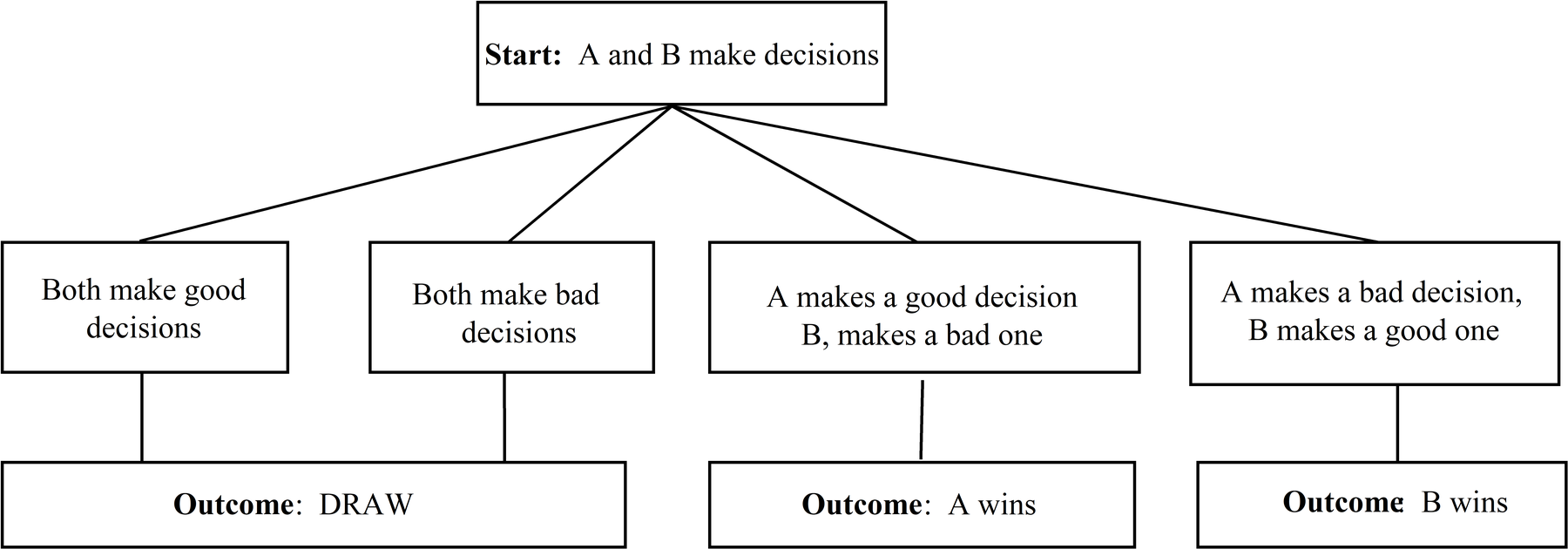
Imagine two opponents, A and B. Assume, firstly, that both are equally likely to make good battlefield decisions; and secondly that both take equally as long to do so. Both start their decision-making at the same time. There are 4 possible outcomes:
- Both A and B make good decisions. Their decision-making gives neither an advantage.
- Both make poor decisions, with similar results.
- A makes a good decision, and B makes a poor decision; or
- Vice versa.
In either of the latter two cases there will be a clear advantage. However, since they are equally likely to make a good decision, the chance of A or B winning is equal. Overall, their decision-making gives neither a clear advantage, other than by chance. These outcomes are illustrated by the decision tree at Figure 1.
The outcome is dominated by the likelihood of a draw, and this is relatively insensitive to A and B's decision making abilities. To illustrate this, consider that both A and B have an 80% chance of making a good decision. The probabilities of either A or B winning are 16% whilst the probability of a draw is 68%. However, if A has only a 60% chance of making a good decision and B a 95% chance, the overall probability of A winning is 3%; of B winning is 38%; but the chance of a draw is still 59%. These are summarised in Table 1.
| Decision Making: | A wins | B wins | Draw |
|---|---|---|---|
| Both 80% | 16% | 16% | 68% |
| A 60%; B 95% | 3% | 38% | 59% |
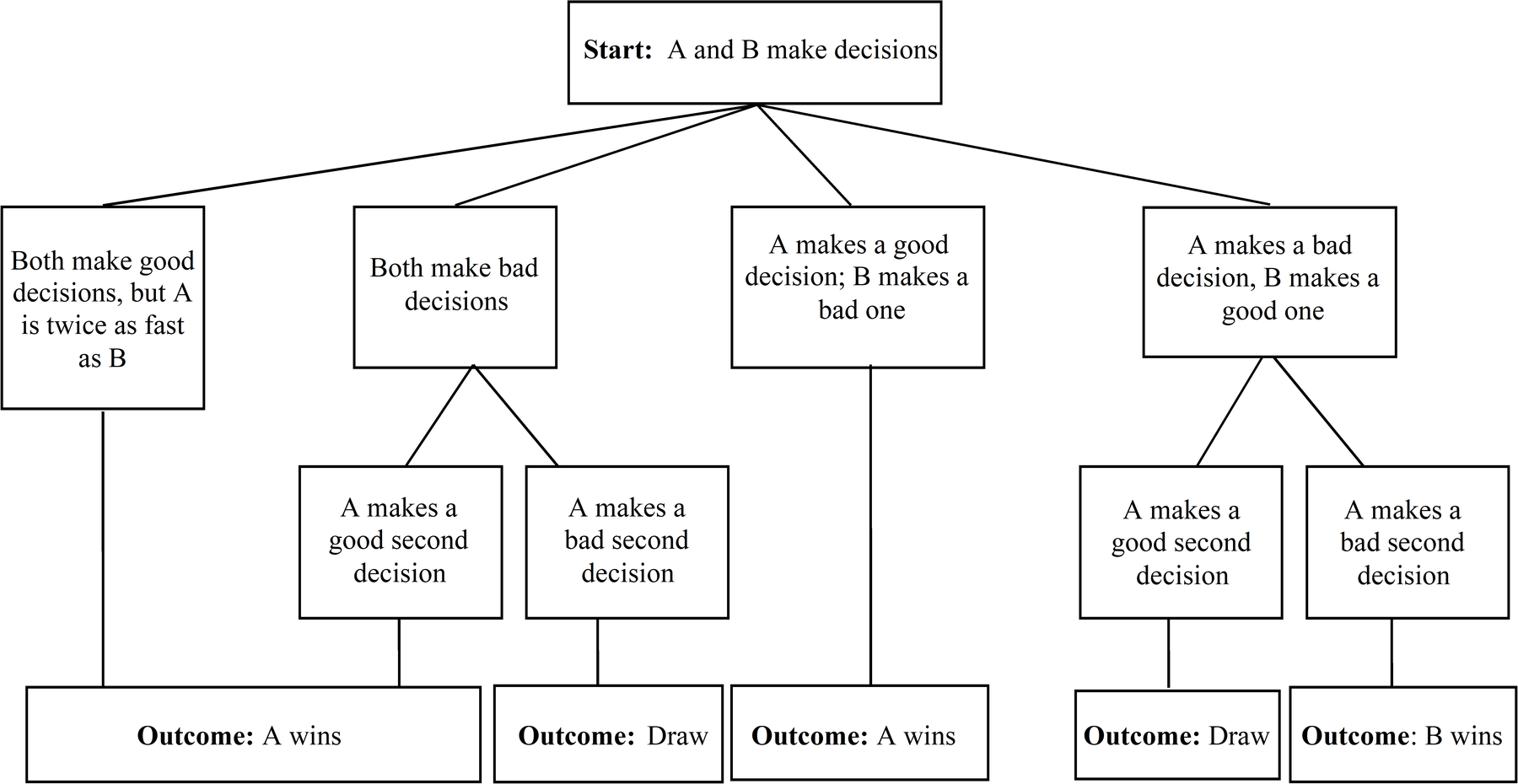
Now consider the case where B has the capacity to make a very good decision - one with a high probability of creating a battle-winning advantage. However, A can make a decision (and turn it into action) twice as fast. Here there are again four initial possibilities:
- B makes a good decision. However, A made one in half the time, preempted B and won the engagement. A’s decision making created a battle-winning advantage.
- B again makes a good decision, but A makes a bad one in half the time. There are then two subordinate outcomes: If A then makes a good second decision, the result will be a draw. However, if A makes a bad second decision, B will win.
- A makes a bad decision, but so does B. A gets a second chance. If he decides well, he wins. If not, neither does (that is, a draw).
- B makes a bad decision but A makes a good one. A wins.
There is a total of six possibilities. These are shown on the decision tree at Figure 2.
However, the probabilities depend entirely on how good A and B are relative too each other. As an illustration, if A has a 80% chance of making a good decision but B, taking twice as long, has a 95% chance, the respective probabilities are given in Table 2.
That is to say, despite being relatively less likely to make a good decision, A’s ability to make decisions twice as fast has created a clear advantage.
| Decision Making | A wins | B wins | Draw |
|---|---|---|---|
| A 80%; B 95%, but A twice as fast as B. | 80.8% | 3.8% | 15.4% |
Compare these with Table 1. The likelihood of A winning is almost exactly equal to the probability he will make a good decision - whereas the chance of B winning is almost nil! Clearly this result depends on an arbitrary selection of parameters. The effects of varying those parameters is considered under the next Premise.
This simple model hides two second-order effects. First, where A makes an initial poor decision, he can learn from the situation, and there is probably a better chance of him making a good second decision, thus improving his chances overall. Second, B will perceive that A has preempted him. The situation for which he is planning is changing; he may be demoralised by A’s success, therefore the chance of him providing effective direction is probably reduced.
The model is simple in that it only represents decision-making at one level. In combat many commanders, at many different levels, make interlocking decision on both sides. War is a highly complex interaction of both physical and psychological factors. Psychological aspects are far more complex than the two second-order effects (learning and preemption) mentioned above. Shock, surprise and stress are all major factors. Nor does the model suggest what a ‘good’ decision is, other than it is one that is likely to lead to the enemy’s defeat if he (the enemy) does not make one. Nor does it consider the possibility that the effect of a wrong first decision by A could be catastrophic. However, accepting those limitations, it does suggest some advantage to an army that systematically makes decisions faster than its opposition.
There does appear to be an advantage in making major decisions twice as fast as the opponent. ‘Twice as fast’ is chosen simply to make the computation simple, but the figures correspond well with the Soviet finding that an Army that can react twice as fast can defeat one five times as large. This statistic originated in analysis of the Great Patriotic War and, although not expressly admitted, was used to explain why the Wehrmacht could repeatedly (and, even late in the War, routinely did) defeat numerically superior Russian formations. It also explains the Soviet emphasis on speed of decision making.
The Soviet norm for a reinforced tank or motor rifle battalion mounting an attack from first contact was 25-60 minutes []. A German battalion in the Second World War was expected to conduct an attack from the march within 40 minutes of first contact. Figures for performance at formation level are hard to come by. One German divisional commander estimated that a divisional combat estimate took 5 minutes. Certainly the 2nd SS Panzer Corps Order to counter the landings was released two hours and 55 minutes after the first British paratroopers landed. The operation order was never changed, and from the German perspective the outcome was entirely successful - the defeat of 1st British Airborne Division and the elimination of a pocket on the East bank of the River Rhine.
Nowadays, the ‘going rate’ for a trained British battlegroup is an hour - fifty percent longer than the Wehrmacht or Soviet examples. The HQ of the 3rd UK Division, visited in 1994, estimated 12 hours for the production of an operation order on change of mission. The US Army's FM 101-5 quoted nine hours []. War is more complex today than in WWII. But how much more complex? In WWII, formations of all arms and services were controlled in near-real time; with formation HQs commanding three to four major subordinates (units or formations); and typically interacting with similarly-organised enemy. That has not changed. We should be doubtful that any increase in the complexity of modern war is justified by the increase in staff numbers, or that it justifies the decreased operational tempo that has resulted.
There is advantage in making and effecting decisions considerably faster than the enemy, and the time required to make decisions has been much faster than current practice suggests. It appears that there is significant battlefield advantage in making and disseminating decisions much faster than at present.
Fifth premise: the quality of decision making
The fifth premise is that decisions, and operation orders, do not have to be as good if they are produced significantly faster. This premise follows from the simple model introduced above.
Under Premise 4, it was postulated that A had an 80% likelihood of making a good decision, in half the time that B needed to have a 95% chance of making a good decision. Consider what happens if A makes a poorer decision - say, only 70% likely to be good; or 60%. Figure 3 shows how the three outcomes (A wins, B wins, or a draw) vary with A’s chance of making a good decision.
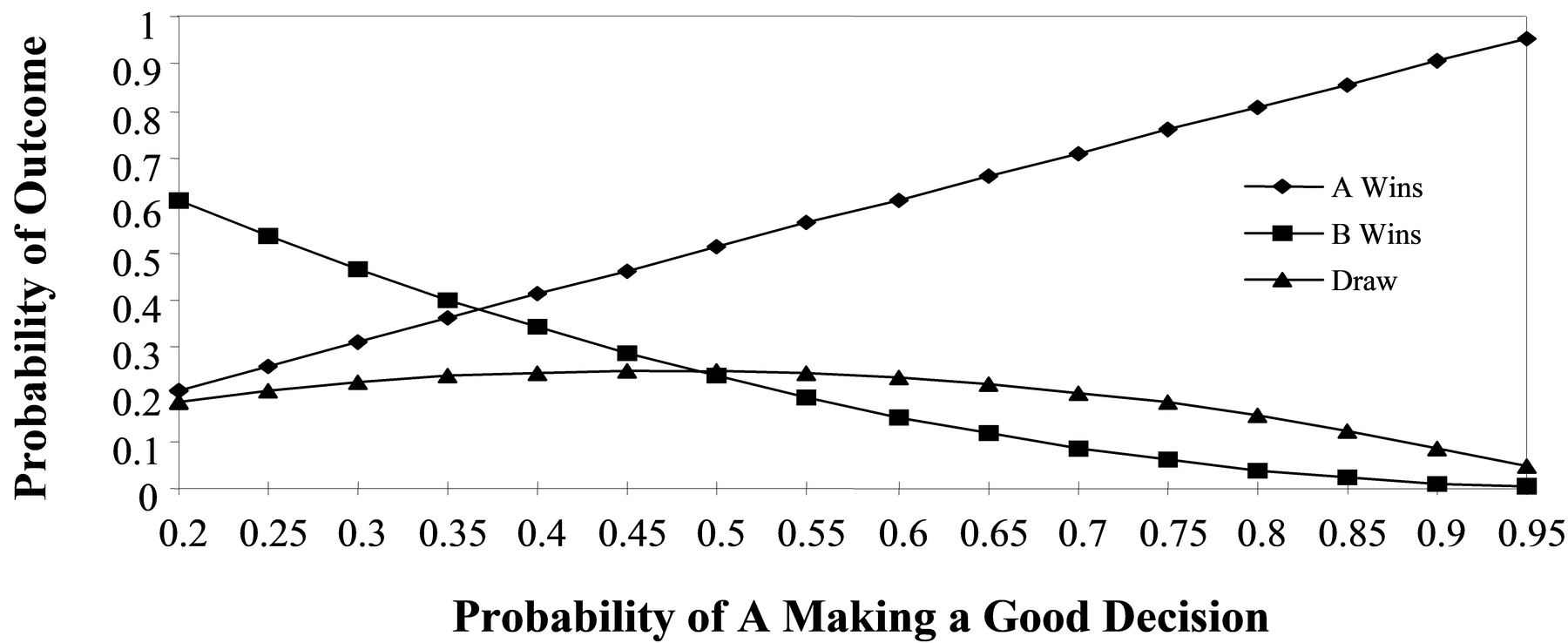
The graph assumes that B has the same high chance of making a good decision as in Premise 4 (95%). Even ignoring the second-order factors discussed previously, A can afford to make decisions that are objectively quite poor. Even if he has only a 40% chance of being correct, he can still create some advantage over B. If he has only a 50% chance, he is still over twice as likely as B to win (51% versus 23%)!
The driving factor is the probability of A making a good decision (with a correlation of almost exactly 1:1). The more likely that A will make a good decision, the more likely he will win; the less likely B will win; and, at higher probabilities (55% and above), the less likely that the a draw will result. However, this is only the case where A is deciding twice as fast as B.
Clearly this is only illustrative. The overall model is naive, for the reasons given under Premise 4. The figures for A deciding, say, three times as fast would be even more marked. The key is not the objective quality of decision making. There is currently an implicit assumption that a good operation order, reflecting a good tactical decision, is a detailed one. This is not the case. A better decision is one which is ‘about right’, but made and turned into action much faster than the opposition. Objectively that is much faster than at present.
Sixth premise: the size of battlefield HQs
The sixth premise is that there are significant advantages, both in operational and human factors terms, in deploying smaller battlefield HQs. Premises 2 to 5 suggest that HQs should make and execute decisions very quickly; that those decisions should be communicated in very short operation orders; that few staff are needed to make those decisions, and few staff are needed to man the HQs that create and effect them - throughout the chain of command. Smaller staffs would not need such large deployed HQs.
There are two further reasons why deployed HQs should be very small. The first is tactical. Smaller HQs, with fewer vehicles and radios, can be more readily concealed and moved. They are less of a target, more easily removed from danger if targeted, and constrain the commander’s freedom of operation less.
The second, and far more insidious, reason is organisational complexity. The size of any group involved in cooperative activity is one of the three main factors that dictate its internal complexity, and hence the effort needed to manage it []. Modelling such complexity is itself complex, but some broad observations can be made. In the first instance, the internal complexity of an HQ can be represented by the total number of possible links between members. For two people there is one such link; between three people, three links; between four, six links. However the number of links rises roughly in proportion to the square of the number of people involved []. Thus an HQ of 150 staff is at first sight over 1100 times more internally complex than one of five staff.
This view is clearly simplistic. The staff is divided into groups (cells), which is a typical managerial response to such complexity. However, the number of such cells becomes significant. If the 150 staff were divided into (say) cells of five or 10 members, the result would still be about 470 times more complex than the group of five. This is illustrated in Figure 4. Note the logarithmic scale.
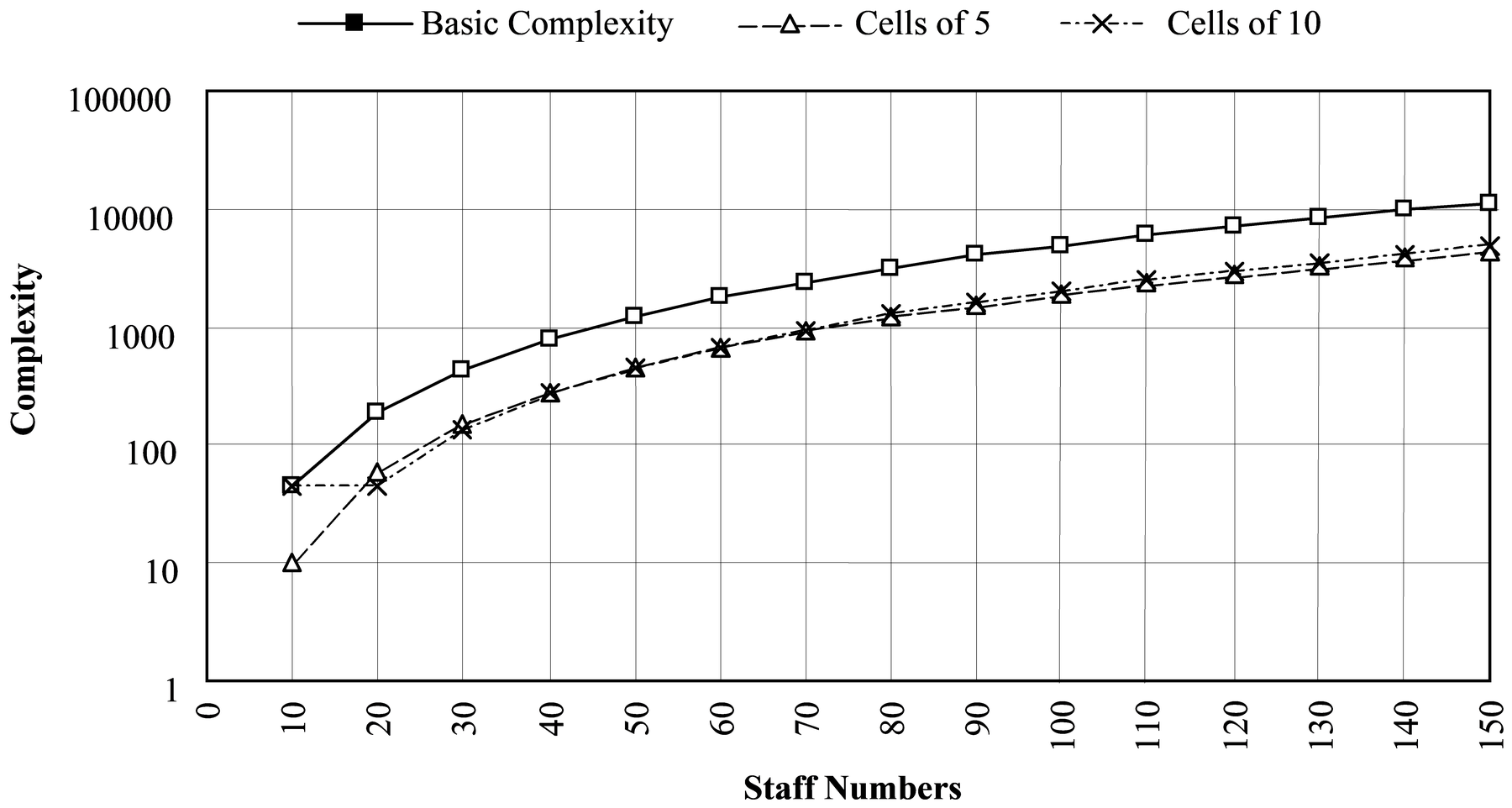
A British Armoured Divisional HQ in 1944 was established for 27 staff officers []. Now the figure is 159 []. Figure 4 suggests that the HQ is about 50 times more internally complex now than 50 years ago. That is, about 50 times more difficult to manage. The increase in numbers is apparently due to the complexity of modern war. However, we must now severely doubt that the complexity of modern HQs is justified. Indeed, we should seek some mechanism by which to escape such organisational complexity.
The rise in staff numbers has been gradual; almost continuous since WWII []; and appears to be never-ending. One reason is the effect of job division. Consider a job that requires 100 man-hours to complete. One man would take 100 hours, or two men 50. Every additional man added reduces the overall time taken, as per Table 3. At every point the addition of an extra man can increase speed of output. In addition, in a working day each man can work as many hours as each of his colleagues. The overall work capacity of the HQ increases, and the time taken to do jobs reduces. Thus at every point the effect of adding another member appears beneficial.
However, column (c) of the table shows that after six or seven men the benefit of adding an extra man becomes small. In fact, it is possible that there is no net benefit at all in adding extra people to the HQ, due the burden of extra complexity that they impose.
| Staff Numbers | Time Taken (hrs) | Incremental Benefit (hrs) |
|---|---|---|
| (a) | (b) | (c) |
| 1 | 100 | - |
| 2 | 50 | 50 |
| 3 | 33.33 | 16.66 |
| 4 | 25 | 8.33 |
| 5 | 20 | 5 |
| 6 | 16.66 | 3.33 |
| 7 | 14.49 | 2.17 |
| 8 | 12.5 | 1.99 |
| 9 | 11.1 | 1.4 |
| 10 | 10 | 1.1 |
Figure 5 illustrates this, by assuming a certain amount of time required per team member for briefing and coordination. It is based on a task that requires 100 man-hours to complete and 12-hour shifts. The straight line shows the total man-hours available. The lowest curved line shows the effect of job division, assuming that no briefing of cell members is required. The three other curved lines show the sum of the time required to complete the task, plus an element of time to brief them which is directly proportional to the complexity of the group. The three cases assume successively more briefing. Whenever a curved line lies above the straight line, the task cannot be achieved: more time is needed to do the job and brief and coordinate the team than is available. For complex tasks where staff have to interact to a high degree (that is, the upper curve), adding manpower does not get the job done faster.
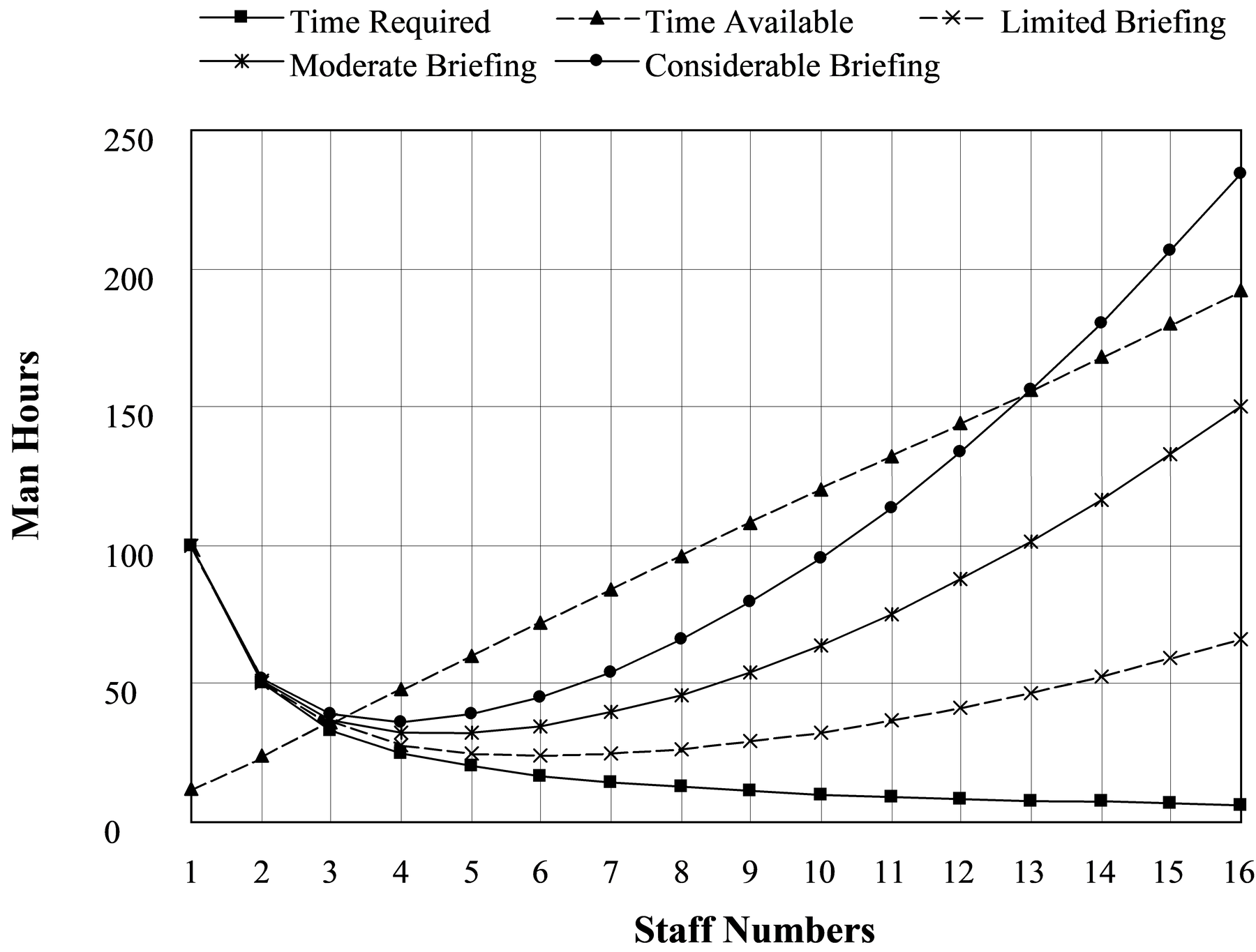
Once again, the model is naive but illustrative. In practice the amount of time available can never become negative. A more detailed model would probably have the amount of time available for constructive work approach zero asymptotically. However, the present model does correlate with observations of large HQs being exceptionally busy, with multiple and repetitious briefing, information pockets, and (on occasions) whole areas of the staff effectively being ignored. Similarly there are observed real-world phenomena to be considered, such as 'social loafing': the more people pulling on a rope, the less hard each person pulls. Maintaining high levels of commitment and motivation throughout large HQs presents novel difficulties.
The fact that each extra man can contribute to the overall work done within the HQ is significant. When the internal briefing bill becomes large, the extra man’s extra effort may contribute little of use to the HQ’s output. He will not be one of the core decision-making team, so he will not contribute directly to major decisions. However he adds to the HQ’s ability to handle information and control subordinate units and formations. As discussed previously, that is undesirable.
In summary, more people require more briefing, produce longer operations orders, control subordinates to a greater extent, and require physically bigger HQs. All four aspects are undesirable.
Hypothesis
The previous sections suggested that that the quantity of information used by battlefield commanders to make battlefield decisions is very small. The operation orders that result from those decisions should be, can be, and have been very short. The number of staff required to produce those orders is very small. The remainder are employed either in routine data processing (much of which is not necessary), or in making minor decisions which are better left to subordinates. Making and disseminating decisions much faster than at present produces significant advantages. Decisions, and operation orders, do not have to be as good if they are produced significantly faster. Indeed 'faster' is better; 'more detailed' is not. There are significant advantages in deploying smaller battlefield HQs.
The emphasis should be on producing very short operation orders (of perhaps four or five pages in total), very quickly, to give minimal direction to subordinates. The very small staffs required to do this should conduct a superficial surveillance of the overall situation, seeking clues, patterns and inferences which will prompt major decisions. Those decisions should be made rapidly and naturalistically by key decision makers. The interval from event to promulgation should be extremely short - less than two hours for a corps, for example []. Such rapidity of decision making would create a warfighting advantage far greater than the current penchant for thoroughly-considered, closely-synchronised plans which are irrelevant in the real conditions of combat, and do not survive first contact with the enemy. By this analysis, the size of a modern British Divisional HQ (one major general, one brigadier, five or six colonels and a total of about 150 other staff) seems Byzantine in its complexity.
Thus the emerging hypothesis is that formations and units with small, closely integrated staffs can be significantly more effective than those with HQs of current dimensions.
Discussion
What might 'small' and 'more effective' imply? ‘Small’ might refer to the size of a German divisional HQ in WWII: 25 officers ‘including the staff of the divisional artillery.’ At divisional level, four or five staff might be needed to supervise current operations (possibly one each for deep, close, rear, and air operations; and intelligence). Two shifts would be needed. With the commander and a planning staff of perhaps two or three more, plus a small number of specialists, the total might reach 20. HQs at division, brigade and battlegroup level would be much smaller than at present, and there would be a reduced requirement to feed corps HQ with tactical data
By ‘more effective’ one can envisage HQs making decisions that are very quick but ‘about right’ at all levels, and turning the commander’s intent into action equally quickly. That is, faster than the enemy; and before the situation changes appreciably. Shorter operation orders would impose fewer constraints on subordinates’ freedom of operation, which doctrine requires. Such small HQs would constrain the commander’s plan less. Thus there are several interrelated reasons why smaller HQs might be more effective than those of present dimensions.
The growth of HQs since WW2 is attributed to the ever-increasing complexity of modern war. We must reconsider what this means. Some issues such as the 24-hour battle, integrated AD and EW systems complicate it to some extent. But it now appears that the perception of increasing complexity of modern war is mostly due to the real complexity of modern HQs. Therefore, it is of our making; and we can do something about it.
C2 is just ‘Command’. There should be a serious re-appraisal of terminology. By identifying a seemingly separate activity of control, we have persuaded generations of staff that hands-on control and numerous interlinked control measures are desirable. They are not. They are contrary to mission command. There must be also be a revision of the hackneyed phrase ‘command at the highest level, control at the lowest’. If the concept of ‘control’ is hollow, and effective decision making should be devolved to lower levels, then one must reconsider what the phrase is really meant to imply, and what its logical justification is. This has huge implication for the plethora of ‘command states’ (OPCOM, OPCON, TACOM, TACON) espoused in doctrine. What do they actually imply and, more importantly, are they robust enough to survive first contact with an enemy who is not OPCON?
Shortening planning horizons is significant. Currently, operation orders attempt to describe how the whole operation will take place. This is flawed. At best, all they can describe is how the commander sees them taking place, assuming every single one of his planning assumptions is correct. There will be thousands of these, mostly implicit. Such a plan also assumes that both the enemy’s reaction, and the outcome of combat, is exactly as the commander predicts at the time of making the initiating decision. Attempting to ensure all these events occur is not how to impose one’s will on the enemy. Imposing one’s will is about taking the enemy as he is, not as you thought he is, and making him conform to your intent. It is not reasonable to expect him to conform to the last detail of a plan made in advance.
Shortening planning horizons will require significant changes to the way western armies do their business. One should not attempt to describe the whole sequence of an engagement, using tools such as a closely-coordinated synchronisation matrix. One should instead create the greatest possible advantage in the first major contact with the enemy; with a robust force mix and appropriate reserves; and fight the battle through rapid decision making and action from there. Having an end-state in mind does not imply a detailed plan for every step towards it.
Naturalistic decision making appears to be appropriate to warfighting, where a good decision is one that is 'about right, but very quick'. This needs further thought in relation to operations other than war, where the consequence of a decision that is wrong in any particular may be operationally critical. However, this does not necessarily invalidate the whole hypothesis. It may be that the information pathologies inherent in large HQs render them worse at making large decisions, particularly where computers are harnessed to the decision-making process.
Naturalistic decision-making should not be mandatory. It should be the preferred mode for experienced commanders and staffs when well appraised of the situation. They might conduct a formal, structured estimate at the beginning of a campaign, and thereafter only in major pauses between operations.
How, then, should HQs function? Pro-forma statements relating to commander’s information requirements are entirely inadequate. The least efficient strategy for informing decision making is the routine ‘hoovering’ of all available information under a standing collection plan, followed by analysis. The most efficient strategy appears to be a superficial monitoring of the overall situation by expert staff, who have learnt (probably subconsciously) which patterns and inferences indicate problem situations. They then focus rapidly and precisely on the critical details of the situation, and present the facts concisely to the relevant decision maker.
The way ahead is not to go continue adding to data-handling capacity. That leads to increased internal complexity and more difficult management. The first Premise suggested that much of the information gathered is not considered in the making of decisions for which it is requested. As a corollary, the effort expended (and hence the structure and process required) in collecting information is commonly out of proportion to its utility. The real issue is to consider how much information (or, in fact, how little) is required for decision making at each echelon of command, and to provide a minimalist organisation, and set of procedures, that can pass that information to decision makers. Those decision makers require very little information, but they require it very quickly, and they need it to be abstracted precisely. That requires skill, education and mental capacity - not increasingly complex procedures and ever-increasing quantities of information and staff.
Bulk data is needed at some points on and behind the battlefield. Much of this is the detailed personnel and logistic data required to sustain the force. But it is critical to differentiate, far more clearly than at present, between ‘bulk data’ moving backwards through the logistic echelons, and command-related data moving upwards through the command echelons. This requires a decentralisation of logistic decision making - allowing relatively junior logisticians farther back to make decisions currently made by senior logistic commanders farther up. Similarly, intelligence data is often bulky, particularly where it includes imagery. There needs to be a thorough analysis of how to reduce the bulk of such data without reducing, or in fact adding to, its meaning or value.
The issue of HQ organisations is not directly related to Digitization, but Digitization is a factor. When we overlay Digitization on modern HQs we have two broad options:
- To introduce more data capability, more staff to manage that data; hence more complexity, larger HQs, larger signatures etc. Digitization will allow efficiencies in data handling, but we should be very sceptical as to whether it will produce significant operational benefit; or
- To revise structures and procedures in order to allow junior staff to rapidly isolate critical information and pass it rapidly to experienced senior decision makers. That precise abstract of the situation could then be passed automatically to superior, subordinate and flanking HQs. It would enable them to make decisions rapidly and highly effectively, and translate those decisions into action much faster than at present.
With or without Digitization, this paper suggests a paradigm shift. We currently perceive C2 as a complex, difficult task requiring dozens or even hundreds of staff in highly structured processes which, contrary to espoused doctrine, result in long, complex and highly synchronised plans. We must be highly sceptical that this works at all well. Instead, we should see C2 as an essentially human and expert process involving very small numbers of expert decision makers. They should be assisted by only slightly larger numbers of educated and intelligent staff who can rapidly and intuitively identify the indicators of a problem situation, and express them precisely in a minimum of words. They can thus gain effective direction from decision makers, and direct subordinates with an absolute minimum of hands-on control.
A useful analogy can be made. A modern automobile is an highly complex machine, but drivers use very few controls to drive safely in traffic. In fact that number has not increased materially since the Model T Ford. Much of the detailed control of the vehicle (such as electronic engine management systems) is done beyond the driver's immediate input. Similarly a formation HQ need only drive the formation as a whole, not every single part in detail. The process of commanding the formation need not be particularly complex, although the complexity of the whole organisation may be immeasurable.
The subject clearly requires far more detailed study, and indeed experiment. A secondary objective of forming an hypothesis is to enable experimentation. It would, however, be simple to nullify the hypothesis. Any experiment that attempted to pass current quantities of data through a smaller HQ would of course find that the smaller HQ has reduced ability to handle information. Each additional staff member adds a measurable increment of data handling capacity. He also contributes directly to the internal complexity and hence management overhead of the HQ; and indirectly to increased size, slower and poorer decision making, and less effective C2.
Closure
This paper has considered formation HQs as primarily decision-making entities. It has considered a series of linked premises and formed an hypothesis, then made some resulting observations. It is clearly beyond the scope of a paper such as this to be able to prove, or disprove, such an hypothesis. But it can suggest a structured view of the problem, and perhaps illuminate the issues at hand.