
C.4 THE VALUE OF DECIBELS
The logarithmic form of the decibel allows engineers to represent very large or small ratios compactly and to perform multiplicative operations (e.g., cascading amplifiers or attenuators) using simple addition and subtraction of dB values—a convenience that underpins most link budget and signal-path analyses.
Consider for example the simple link budget in Figure C.1 expressed in ratios in (a) and in decibels in (b).
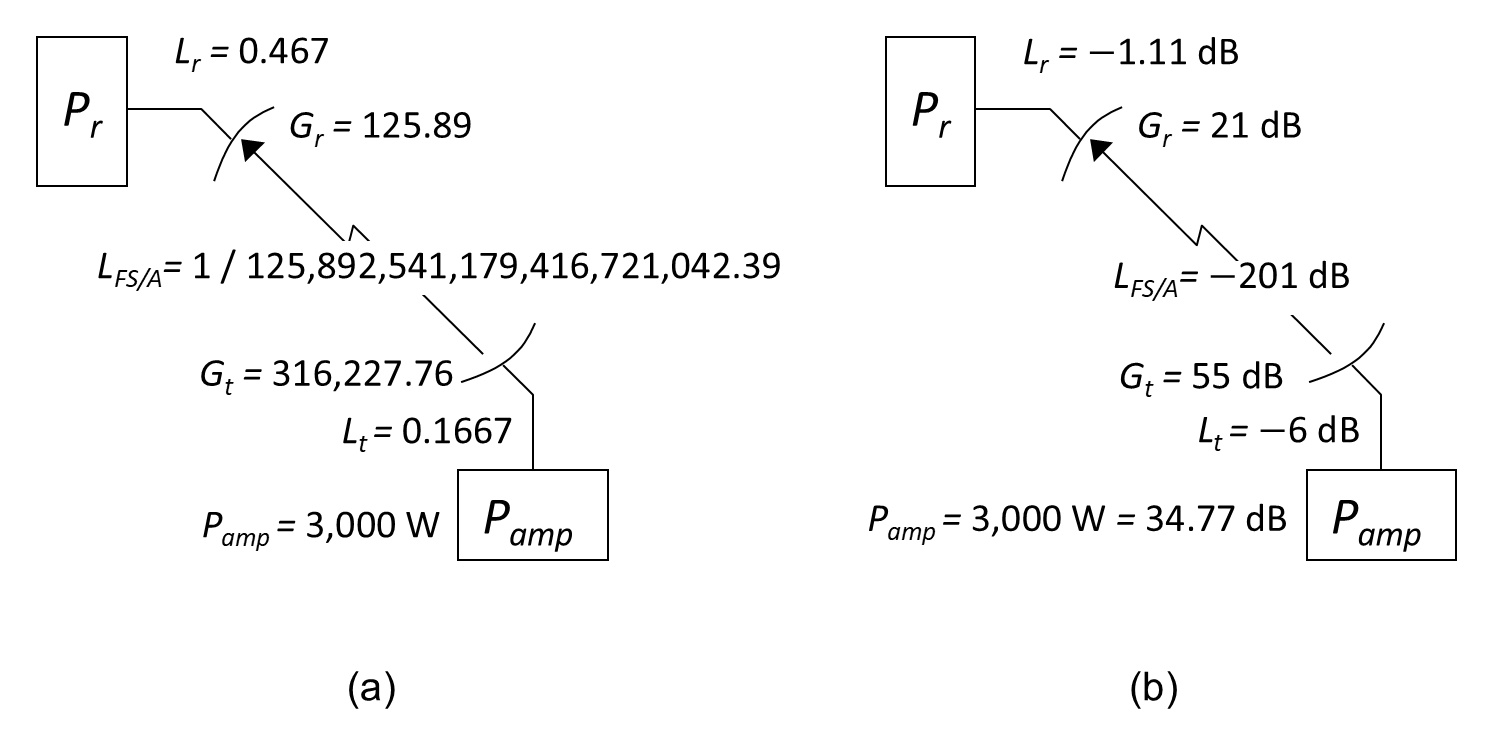
In Figure C.1(a) the received power would be calculated in the following manner:
(C.11)
(C.12)
(C.13)
Alternatively, in decibels in Figure C.1(b), the calculation is not only of values with a smaller range, but the calculation can almost be done mentally because of the addition and subtraction rather than the multiplication and division:
(C.14)
(C.15)
(C.16)