
Volume 18, Number 3, November 2015
The Impact Of Monotony And Secondary Task Complexity On Individual And Crew Performance In A Simulated Military Land Vehicle
- 1 Monash University Accident Research Centre, Building 70, Monash University VIC 3800, Australia.
- 2 Land Division, Defence Science and Technology Group, PO Box 1500, Edinburgh SA 5111, Australia.
Abstract
Introduction
The provision of personnel, materiel, and supplies is crucial to maintaining the effectiveness of any military force. Ground-based logistic operations, which mainly involve wheeled vehicles transporting supplies from distribution centres to forward operating bases or other logistical elements, form the backbone of these efforts. However, contemporary military forces are commonly faced with the challenge of operating within hostile environments occupied by insurgent forces, where the security of road networks may not be assured. Given their importance and limited defensive capabilities, transport vehicles and convoys operating in such areas are at considerable risk of attack [1].
While the Australian Army currently employs a fleet of almost 8,000 logistics field vehicles, these vehicle are mostly unprotected and unequipped to operate in high-risk areas. As such, the Army is updating its fleet with current-generation vehicles, many of which will offer improved mobility and protection, under Project LAND 121 [2,3]. This not only includes physical protection, but advanced in-vehicle information and communication technologies, including battle management systems (BMS), digital radios, sensors and electronic countermeasures. One of the primary goals of these technologies is to enhance connectivity and information flow between units [4]. This has the potential to multiply the operational effectiveness and survivability of forces by facilitating greater shared tactical awareness and more efficient communication and decision-making.
Civilian research indicates that the demands of in-vehicle information systems have the potential to impair driver performance and awareness [5]. In high-threat military environments, where a driver’s awareness and ability to respond quickly and accurately are critical, such impairments may prove lethal; as such, many modern military field vehicles, such as those of LAND 121, require multi-person crews in place of single driver-operators to assist with vehicle systems [6]. For example, a vehicle commander or co-driver may be tasked with monitoring tactical and navigational information sources and providing guidance to the driver [7]. While potentially addressing in-vehicle operator workload, the addition of personnel introduces challenges with regards to coordination of communication and actions within crews. Also, operators will likely still be required to balance performance of one or more secondary tasks in addition to their primary task. For example, situations may arise where the co-driver has to act as gunner on a weapons station, requiring the driver to take over simultaneously operating the vehicle, navigating, and monitoring communications [8].
Field vehicle crews in operational areas can face a wide variety of workload scenarios, from the particularly low demands of prolonged monotonous driving, to acute overload in engaging opposing forces, sometimes transitioning rapidly from one extreme to the other [9]. Research of in-vehicle tasks, and their analogues, has shown individuals’ performance can be detrimentally impacted by both increased and decreased demands. For example, particularly low demands can lead to deterioration in driving performance [10,11], as well as declining vigilance and slower response to irregular events (e.g., potential threats, warning signals) [12,13]. Conversely, increased demands can also lead to poorer driving performance [14] and BMS use [15], as well as constraining within-vehicle communication [16,17].
Little research has examined crew performance under varying demands within military field vehicle operations. However, research in related contexts, such as airliners and control rooms, has shown that crews and teams may also operate at less than optimal levels at either end of the workload spectrum. This can manifest in a variety of ways, such as operating errors or loss of situation awareness under high demands [18,19], or through inattention, boredom and loss of vigilance when under lower demand conditions, such as those associated with the use of automated systems [20,21].
To support human-systems integration within LAND 121, the Defence Science and Technology (DST) Group has commenced a mixed-methods research program examining the impact of performance-shaping factors on the state and functioning of crews and operators in military field vehicles [22]. Given the range of workload scenarios field vehicle crews may face, a key area of interest is how crews are impacted by different levels of task demand. This may provide insight into issues such as operator role and task differences, task prioritisation and performance trade-offs.
The current study represents an exploratory phase of the aforementioned DST Group research program. A dual-tasking paradigm was used to develop a broad characterisation of individual operators and crews operating simulated military field vehicles. Two-person crews performed individual and dyadic in-vehicle tasks broadly analogous to those required in real-world field vehicles, while the complexity level of an auditory secondary task was systematically manipulated. While a range of outcomes (e.g., cognitive capacity, physiological state) were evaluated by different research groups, this paper focuses specifically on operator and crew task performance outcomes.
METHODS
Participants
Study participants were 16 male Australian Army infantry personnel aged 19–31 years (M = 23 years, SD = 3), with 1.4–5.8 years of military experience (M = 3.3 years, SD = 1.4). Participants were from the same unit and well known to one another. The study was approved by the DST Group Low Risk Human Research Ethics Review Panel, and all personnel completed an informed consent form before participating.
Materials
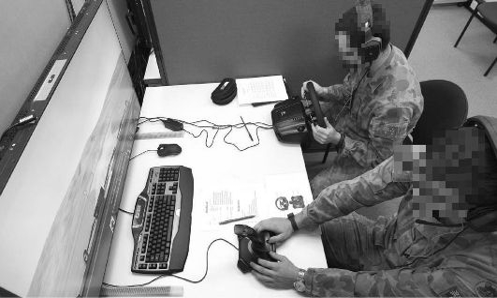
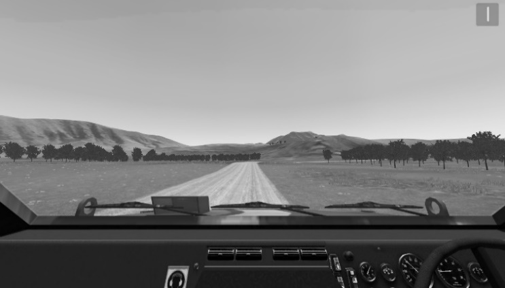
Simulators were of low fidelity and were driven by PC-based Virtual BattleSpace 2 software (VBS2; Bohemia Interactive). Each simulator, comprising a single 46-inch flat panel screen mounted approximately 1 m from participants, represented a ‘Bushmaster’ protected mobility vehicle with two static crew positions. As shown in Figure 1, the right-side ‘driver’ had a Logitech steering wheel and Logitech accelerator and brake pedals, while the left-side ‘co-driver’ had a Logitech joystick input device. Both positions included over-ear audio headsets with attached microphones to convey auditory stimuli and allow voice communication between crew members. Simulators were separated by high partitions, allowing all crews to take part simultaneously. Data was collected from simulators via networked equipment. As shown in Figure 2, a relatively featureless extra-urban VBS2 environment, 50×50 km in size, was selected to provide a setting representative of those experienced in recent Australian Army operations in the Middle East.
Procedure
Participants were tasked with the continuous and concurrent performance of primary, secondary and crew-based in-vehicle tasks. They were instructed to maintain performance as best as possible on all tasks for the duration of each session, and were discouraged from communicating with one another outside of completing the crew task.
Tasks
Primary task (driver). Drivers followed a fixed route on a single-lane road with realistic characteristics (e.g., varied corners, undulations). Participants were to maintain a constant speed of 40 km/h and as steady a central position in the lane as possible. This was considered analogous to the discipline expected when driving within a military convoy.
Primary task (co-driver). Co-drivers performed a visual N-back task, a continuous sequential memory task requiring comparison of each stimulus to the stimulus presented n steps prior, responding to matches [23]. At 2.5–6.5 s intervals a 2×3 cm letter on a translucent 4×4 cm square was presented randomly in one of eight areas on the screen perimeter (i.e., top, bottom, left and right edges, all four corners) for 3.0 s; an example is shown in Figure 2. An n = 1 was chosen after piloting, with co-drivers responding via corresponding joystick button press when the presented letter was a repeat of the preceding letter. Letters repeated at a rate of 20–33%. The N-back was considered analogous to maintaining visual vigilance, an important military task and a requirement for co-drivers in real-world field vehicles when not operating in-vehicle systems.
Secondary task (both crew). Both crew members performed a secondary task, monitoring and responding to auditory tones. Two tones designated as ‘laser’ and ‘electronic warfare’ warnings required separate corresponding button press responses on the steering wheel (driver) or joystick (co-driver), while a third tone required no response. Tones were 2.0 s in duration, with an inter-stimulus interval of 10.0 s. Only one crew position (i.e., driver or co-driver) received each presentation, with the position of presentation randomised. This task involved two levels of complexity: the low complexity condition used only one tone (i.e., laser warning tone), while the high complexity condition used all three tones presented randomly. This task was considered analogous to monitoring and responding to warnings or alerts from in-vehicle systems.
Crew communication task (both crew). Crews also performed a communication-response task based on the secondary task. In the event of an auditory warning tone, the warning type was to be verbally communicated to the other crew member. The recipient acknowledged the communication via separate designated button press responses on their steering wheel or joystick. This enabled the calculation of crew performance measures, as well as analysis of order effects based on the crew member initiating the communication-response sequence. A driver-initiated sequence was as follows:
- Driver hears an auditory stimulus in headset.
- If stimulus is a warning tone, driver presses the appropriate response button on steering wheel to register processing the warning (i.e., secondary task).
- Driver verbalises the warning tone heard (e.g., "laser" for the laser tone sound).
- Co-driver hears the driver’s verbalisation in headset.
- Co-driver presses the appropriate response button on joystick to register processing the verbal communication (i.e., crew communication task).
Design
The experiment utilised a within-subject, repeated measures design. Data was collected on four consecutive days between 1:30 pm and 4:00 pm, with each day comprising two 45-min simulator sessions separated by a 5-min rest period. Participants were paired randomly into eight two-person crews, which they remained in throughout the experiment. Within each crew, participants were randomly assigned to the driver or co-driver role for the first day, moved to the other role for the second and third day, and returned to their initial role on the fourth day. The complexity level of the auditory secondary task was alternated each day (i.e., low-high-low-high), ensuring that participants completed each combination of role and complexity. The day prior to the experiment, all participants received 10 min of instructed training in both roles, followed by 45 min of practice in their first-day role.
Data Analysis
Performance measures were averaged within 5-min blocks which represented time-on-task epochs. The dependent variable for drivers’ primary task was standard deviation (SD) of lateral position, a typical measure of vehicle control representing lateral weaving. Dependent variables for co-drivers’ primary task, as well as the secondary and crew communication tasks, were response accuracy and speed (reciprocal of response time); the reciprocal transformation offered the advantage of normalising the otherwise positively-skewed distribution. Accuracy was computed as the proportion of target stimuli reported correctly. Response time for crews were calculated from warning tone presentation to the button-press response by the second crew member. All responses more than 5.0 s after a presentation were deemed incorrect. Response speed is reported for correct responses only.
Analyses were conducted in SPSS 20 (IBM Corp) with generalised linear mixed effects models (GLMM). These models incorporate both fixed effects (i.e., regression coefficients describing the systematic relationships between key variables in the model) and random effects (i.e., latent factors with variances and covariances accounting for the effects of individual subjects). GLMM can account for issues such as correlation between repeated measurements, unbalanced observations amongst participants and non-normal data, and have been used previously to describe relationships between fatigue, monotony, and human performance [24,25].
Development of GLMM structures was informed by the recommendations of West, Welch and Gałecki [26]. SD of lane position and response speed were analysed as linear models. Response accuracy was analysed as a binomial distribution (i.e., correct responses as the numerator, required responses as the denominator) with logit link. All models incorporated secondary task complexity, time-on-task and their interaction as fixed effects. Crew performance models controlled for the impact of the sequence initiator by including their speed or accuracy performance on the auditory task as a fixed factor. The interaction of session number and time-on-task, grouped by day, was classified as a repeated measure, with first-order autoregressive covariance specified due to the equal spacing of measurements. Participants were included with random intercepts to allow for subject-to-subject performance variation. Satterthwaite's approximation was used to determine denominator degrees of freedom in all models.
Estimates of coefficients (β) and their standard errors (SE) are reported for all fixed factors. The intercept represents the outcome value at session start (i.e., time-on-task = 0) under the reference condition (i.e., low secondary task complexity). Time-on-task, derived from the aforementioned 5 minute blocks of performance data, represents change in the outcome variable per minute under the reference group condition. Secondary task complexity represents the outcome variable under the high complexity condition at session start, while its interactions with time-on-task represents change in the outcome variable per minute under the high complexity condition. Each coefficient has a corresponding SE estimating the degree of variation around the coefficient value, and a t-value indicating whether the coefficient is statistically different from zero.
RESULTS
Equipment issues led to some loss of data: for one driver and one co-driver, their individual and crew performance under high task complexity was not logged by the system; for three other co-drivers, secondary task performance under high task complexity was not logged due to joystick button failure.
Individual Task Performance
Performance results on individual tasks are presented in Table 1. Starting with the secondary auditory task, for which demand was manipulated, results show that increasing the complexity of the task had a significantly detrimental impact on the overall response speed and accuracy of drivers (p < .001 and p < .001) and co-drivers (p < .001 and p = .015) alike.
Time-on-task impacted the auditory task performance of the two crew positions in different ways. With no significant effects of time-on-task observed, drivers’ response speed on the task remained stable over sessions under both levels of task complexity. With respect to accuracy, the main effect of time-on-task, without a significant interaction effect, showed that drivers experienced significant and comparable performance declines over time under both levels of complexity (p = .023). Co-drivers’ auditory task response speed slowed significantly with time-on-task under the low complexity condition (p < .001); however, the significant positive interaction with complexity suggests this decline was mitigated under the higher complexity condition (p = .001). The same pattern of performance decline under low complexity (p < .001) with mitigation under higher complexity (p = .024) was also found for co-drivers’ response accuracy.
Similar patterns were found with regards to primary task performance. Drivers maintained steady lane-keeping performance, with secondary auditory task complexity, time-on-task and their interaction found to have no significant impact. Conversely, co-drivers’ performance on the visual N-back task was varyingly impacted by those factors. Their response speed declined significantly with time-on-task under the lower complexity auditory task condition (p = .006), and while the higher complexity condition mitigated the performance decline over time (p = .005), it led to slower performance overall (p = .025). With regards to N-back task accuracy, the significant main effect of time-on-task, without a significant interaction, revealed a performance decline over time under both levels of auditory task complexity (p = .002). Interestingly, N-back task accuracy was better overall under the more complex auditory task condition (p < .001).
Crew Performance
Crew communication task results are presented in Table 2, controlling for the performance of the sequence initiator. As was found for individual task performance, an increase in secondary task complexity led to significantly worse performance in terms of crew task response speed and accuracy for drivers and co-drivers (p < .001 in all cases). Time-on-task and its interaction with task complexity had the same impact on the accuracy of both crew positions. Drivers and co-drivers showed significant declines in accuracy over time under lower complexity conditions (p < .001 for both cases), with these declines mitigated under the higher complexity condition, as evidenced by significant interaction effects (p < .001 and p = .025, respectively).
Different effects of time-on-task were found for crew task response speed. Drivers maintained consistent response speed over time under both levels of complexity, with time-on-task and its interaction with complexity having no significant impact. Co-drivers’ crew task response speed decreased over time under both complexity conditions, evidenced by the significant main effect of time-on-task (p = .027) and lack of significant interaction with complexity.
DISCUSSION
This simulation-based study represents an exploration of how task demand manipulations may impact on the operators and crews of military field vehicles. The complexity of an auditory secondary task was systematically altered from a simple-response task (lower complexity) to a choice-response task (higher complexity), with the impact on performance of primary tasks and a dyadic crew communication task investigated. While differences in performance on the secondary task under the two levels of complexity provide some validation that the manipulation led to genuine differences in task demand, the demands produced under the higher complexity condition did not reach the level of those potentially faced by field vehicle crews in operational environments. The findings offer greater insight into the potential impact that the monotony and tedium of real-world operations may have on crews and their performance.
| Intercept | Time-on-task | Complexity | Time-on-task × Complexity | |||||||||||||
|---|---|---|---|---|---|---|---|---|---|---|---|---|---|---|---|---|
| β | SE | t | β | SE | t | β | SE | t | β | SE | t | |||||
| Driving task | ||||||||||||||||
| SD of lane position (cm) | 40.154 | 1.910 | 21.03 | *** | 0.064 | 0.038 | 1.68 | ns | 0.553 | 1.882 | 0.30 | ns | 0.013 | 0.058 | 0.22 | ns |
| Co-driver visual vigilance task | ||||||||||||||||
| Speed | 0.824 | 0.042 | 19.83 | *** | -0.002 | 0.001 | -2.76 | ** | -0.066 | 0.029 | -2.25 | * | 0.003 | 0.001 | 2.82 | ** |
| Accuracy | 1.122 | 0.247 | 4.55 | *** | -0.015 | 0.005 | -3.23 | ** | 0.880 | 0.222 | 3.97 | *** | -0.003 | 0.007 | -0.47 | ns |
| Secondary auditory task | ||||||||||||||||
| Drivers | ||||||||||||||||
| Speed | 0.959 | 0.051 | 18.85 | *** | -0.001 | 0.001 | -1.71 | ns | -0.292 | 0.023 | -12.45 | *** | 0.001 | 0.001 | 1.84 | ns |
| Accuracy | 8.365 | 1.186 | 7.06 | *** | -0.072 | 0.031 | -2.31 | * | -4.769 | 1.187 | -4.02 | *** | 0.048 | 0.032 | 1.51 | ns |
| Co-drivers | ||||||||||||||||
| Speed | 0.912 | 0.053 | 17.33 | *** | -0.003 | 0.001 | -5.40 | *** | -0.227 | 0.023 | -10.09 | *** | 0.002 | 0.001 | 3.39 | ** |
| Accuracy | 5.076 | 0.453 | 11.21 | *** | -0.062 | 0.010 | -5.99 | *** | -1.073 | 0.436 | -2.46 | * | 0.029 | 0.013 | 2.27 | * |
Note: ns = non‐significant, *p < .05, **p < .01, ***p < .001. Reference group: low secondary task complexity. Speed reported as reciprocal of response time. Accuracy reported as log-odds of a correct response.
| Intercept | Time-on-task | Complexity | Time-on-task × Complexity | |||||||||||||
|---|---|---|---|---|---|---|---|---|---|---|---|---|---|---|---|---|
| β | SE | t | β | SE | t | β | SE | t | β | SE | t | |||||
| Driver-recipient sequences | ||||||||||||||||
| Speed | 0.257 | 0.025 | 10.13 | *** | -0.000 | 0.000 | -0.47 | ns | -0.072 | 0.012 | -6.19 | *** | -0.000 | 0.000 | -0.94 | ns |
| Accuracy | 2.177 | 0.480 | 4.54 | *** | -0.061 | 0.007 | -9.07 | *** | -2.908 | 0.316 | -9.20 | *** | 0.053 | 0.010 | 5.38 | *** |
| Co-driver-recipient sequences | ||||||||||||||||
| Speed | 0.270 | 0.022 | 12.04 | *** | -0.000 | 0.000 | -2.23 | * | -0.062 | 0.010 | -6.27 | *** | 0.000 | 0.000 | 0.86 | ns |
| Accuracy | -2.070 | 0.688 | -3.01 | ** | -0.039 | 0.007 | -5.83 | *** | -1.580 | 0.284 | -5.56 | *** | 0.019 | 0.009 | 2.26 | * |
Note: ns = non‐significant, *p < .05, **p < .01, ***p < .001. Reference group: low secondary task complexity. Speed reported as reciprocal of response time. Accuracy reported as log-odds of a correct response. Performance of initiator of communication sequence controlled for.
Patterns of performance on the secondary task were fairly similar to those found across the study. As mentioned, drivers and co-drivers both showed better overall performance when responding to auditory warning tones under the less complex condition, in terms of both speed and accuracy. However, differences between crew roles were found in the effect of time-on-task. Co-drivers’ performance changes over time on the secondary task were sensitive to task complexity. Their response speed and accuracy declined at a greater rate under the less complex condition, while increased task complexity mostly mitigated those declines. Secondary task complexity had little effect on drivers’ performance on the task, as under both conditions they were able to maintain stable response speed, although their accuracy declined with time.
Secondary task complexity appeared to impact considerably on co-drivers’ performance on their primary task, maintaining visual vigilance on the N-back task. Their response speed slowed significantly with time under less complex conditions, while increased secondary task complexity significantly mitigated this decline. Interestingly, their response accuracy was significantly better under the more complex condition, although their response speed was slower overall. This suggests that after co-drivers were given a secondary task that required greater attention and deliberation, they also employed a more thorough approach to their primary task.
In contrast, the secondary task had little impact on drivers’ primary task performance. While cognitive load may reduce SD of lane position, as drivers protect and prioritise lane-keeping [27], the comparable lane-keeping performance shown by drivers across secondary task conditions suggests the two levels differed insufficiently in cognitive demand to elicit variations. In addition, drivers did not experience the primary task performance declines over time shown by co-drivers, maintaining relatively stable performance across both levels of secondary task complexity.
With the likelihood that more modern military field vehicles will require additional operators, this study offered some novelty within the field vehicle research space by incorporating a dyadic crew communication-response task. As was found for secondary task performance, drivers and co-drivers showed consistently better speed and accuracy in their responses to their fellow crew members’ warnings under the lower complexity condition. Both crew roles also showed a decline in their response accuracy over time under the less complex condition, in both cases mitigated by the more complex condition. The main difference between roles on the crew task was that drivers maintained consistent speed of response to co-drivers’ verbal warnings throughout the course of each session under both complexity conditions, while co-drivers’ responses slowed with time-on-task under both levels of complexity. For drivers, this pattern of declining accuracy under the low complexity condition was not consistent with their performance on the primary and secondary tasks; this was likely a by-product of co-drivers’ increasing latency in initiating verbal warnings under low complexity, which would have given drivers less time to record valid crew task responses as the session progressed.
To summarise, performance deterioration with time-on-task was particularly apparent in the co-driver role, which combined the monotonous tasks of visual vigilance, auditory monitoring and simple crew communication, when demands were lowest. These declines were mitigated, and accuracy on the visual vigilance task improved, by a small increase in complexity of the secondary task, although at some cost to performance on the secondary and crew tasks. By comparison, drivers’ performance showed little decline with time-on-task, and increasing secondary task complexity only decreased performance on the secondary and crew tasks.
These findings may be explained within the context of effort regulation theory, which states that effort is used adaptively to recruit resources to maintain performance, albeit at a behavioural and physiological cost. When sufficient resources are not available, individuals may select lower-effort strategies or lower their performance standards [28]. While initially used to explain performance mechanisms under high demands, effort may also play a role during undemanding ‘underload’ conditions, when individuals perceive that maintaining performance requires little active control. Under such conditions they may underestimate the need to monitor their performance, and be unaware of performance declines and the need to recruit additional effort [10]; this is relevant to the current study, as participants received no explicit feedback on their performance. Under the combination of the visual N-back task and low complexity secondary task condition, requiring simple responses rather than deciding between multiple options, co-drivers may not have been aware of performance declines over time (e.g., more missed responses) and the need to compensate with additional effort. In contrast, the nature of the driving task may have given drivers more awareness of changes in performance (e.g., more lane departures) and the need to employ greater effort across tasks, regardless of secondary task complexity.
In addition, the passive fatigue induced by monotonous tasks may detrimentally affect willingness or ability to summon compensatory effort [10]. A similar explanation from a resource perspective is that during underload conditions, an individuals’ pool of attentional and performance resources contract in line with reductions in task demand, as described by the malleable attentional resources theory [29]. Under this paradigm, the underload conditions of the visual vigilance task in combination with the low complexity secondary task may have caused co-drivers’ attentional resources to shrink over time, reducing their capacity and thus their response performance; the additional stimulation of the higher complexity condition may have lessened this shrinkage. For drivers, the demands of the driving, auditory and crew tasks appeared sufficient for maintenance of engagement and performance throughout sessions, without any substantial loss of attentional resources.
Personnel in military field vehicles are commonly required to maintain task engagement and performance for extended periods while operating under monotonous conditions. Our results suggest that under such conditions they are vulnerable to losing vital situation awareness and vigilance, while possibly losing awareness of performance impairment and their capacity to mobilise resources to counteract those effects. This reduces their ability to detect critical events, such as threats, and respond rapidly to such events or in-vehicle signals, such as communications or auditory alerts. Similar findings have been reported in long-haul road and rail transportation [10,11,30] and military sentry duty [12,31], with these studies also noting that a small increase in task demands can buffer against underload effects. Within these contexts it was suggested that monotony and underload effects may be interrupted via regular breaks and rotation of crew roles [12,32]. However, the operational needs faced by military field vehicle crews, such as sustained continuous operations, or driving for extended periods in potentially hostile areas, means that they do not always have the luxury to do so. Therefore, in-vehicle countermeasures may prove valuable to vehicle crews in operational environments.
Although numerous technical solutions to monitor vehicle operators and alert them to fatigue have been proposed across various modes of transportation [33], few directly mitigate the underlying effects of monotony. For example, the rail industry’s ‘dead-man’s switch’, which requires drivers to regularly respond to a stimulus (e.g., light, buzzer), can be monotonous in itself [30,33]. Task-relevant processes requiring increased cognitive demands and interaction for responses are more likely to increase alertness and engagement and diffuse boredom. As an example, in-car trivia games have been shown to be a potentially viable countermeasure to driver underload [34,35]. While there is potential for their integration into in-vehicle systems (e.g., BMS, radio), the form that these tasks should take for relevance to the context of a military field vehicle is currently uncertain. It may be more pragmatic to promote interest and engagement through interface design and information modality. For example, under monotonous conditions the in-vehicle systems may present navigational or other relevant information in an auditory, rather than visual, format [36]. Similarly, research suggests that strategic engagement with a verbal secondary task has the potential to mitigate passive fatigue when driving [34,37], and that verbal conversation may be at least as good as interactive cognitive tasks at countering monotony [34]. Indeed, military truck drivers have been shown to perceive that conversations with a passenger and, to a lesser extent, over a cellular phone can act as a useful countermeasure to monotony [38]. It is possible that the underload effects seen in this study would have been lessened if participants were able to communicate freely with their crew partner. However, the aforementioned studies of cognitive and verbal secondary tasks reference their potential to interfere with primary tasks, and the need for such tasks to be employed strategically. It will be important to determine if and how their benefits to ongoing engagement and readiness outweigh the potential for overload or distraction that could compromise operators’ awareness and performance, and how they may best be configured or presented.
Our results suggest crews may benefit from adaptive vehicle systems. Such a system may monitor performance in real-time, evaluate and display operators’ workloads, and prompt or trigger redistribution of potentially shared tasks (e.g., communications, navigation, system monitoring) amongst operators according to functional state and capacity [39]. For example, operators might hand off tasks during periods of high workload or when situation awareness requirements are elevated, or receive increased task loads when a decline consistent with underload is detected. Similar systems (drawing on brain activity instead of performance) have been proposed for flight crews [40]. While adaptive systems have the potential to better optimise crew effort, engagement and performance, issues such as system calibration, monitoring of continuous performance changes, and task migration processes require consideration [41]. As such, their appropriate design and implementation for use in military crews is likely to be a key direction for future research.
With respect to study limitations, equipment issues and the overarching data collection considerations of this study required compromises in the experimental tasks used. While providing objective, quantifiable measures of participants’ performance, they were simplistic by comparison to those of real-world vehicles. Levels of task demand achieved were not as high as desirable, although they revealed that operator performance may be sensitive to relatively small changes in task difficulty. The crew communication task lacked complexity, requiring little processing of shared information, limiting the generalisability of our findings to real-world crew performance. Combined with the low-fidelity nature of the simulation environment (e.g., limited field of view, no motion, no vehicles or ‘threats’ presented), there was insufficient immersion in the scenario for military personnel with combat experience, which may have potentially reduced their levels of motivation and effort. And while mitigated somewhat by the repeated measures design, the small sample size suggests some caution in interpreting these study findings is required.
Future DST Group simulation studies of field vehicle crews will strive to maximise participant immersion within the simulation environment. This may occur through more ecologically valid scenarios that better represent real-world operational environments and tasks that better represent the physical and cognitive complexities of operating a military field vehicle (e.g., navigation, radio communications, BMS operation). This includes crew tasks requiring greater shared information processing and coordination between operators (e.g., solving tactical problems). Improved measures of key processes and outcomes shared or distributed within crews (e.g., performance, situation awareness, workload, decision-making) will be sought, and embedded within scenarios and tasks as best as possible to avoid participant interruption.
To conclude, this study highlighted potentially detrimental effects of monotony and underload on military field vehicle operators’ ability to maintain vigilance and response performance over extended periods, while suggesting some possible strategies to mitigate these effects. Further research examining these effects within the context of more realistic in-vehicle tasks and crew roles, as well as an examination of the characteristics that provide individuals with a resilience to monotony and underload effects, may prove informative.
ACKNOWLEDGEMENTS
This program was funded via a research partnership between DST Group and the Monash University Accident Research Centre (MUARC). We wish to thank Glen Pearce and John Stewien for their major contributions regarding simulator setup and data processing, and all of the Australian Army personnel who participated for their time and effort.
References
[1] C. Hatcher, Logistics Operations in Combat Operations against an Insurgent Force. 2007, U.S. Army War College: Carlisle, Pennsylvania.
[2] Australian Army. Project Land 121. 2015 [cited 2015, 29 Jan]; Available from: http://www.army.gov.au/Our-future/Projects/Project-LAND-121.
[3] B. Wylie, "Supplying and Supporting Australia's Military Capability", CEDA Growth, Vol. 57, 2006, pp. 50–63.
[4] J. Carroll and J.J. Fidock, "Embedding ICT Into the Mobile Land Battlespace", Journal of Battlefield Technology, Vol. 15, No. 1, 2012, pp. 5–10.
[5] T.A. Ranney, Driver Distraction: A Review of the Current State-of-Knowledge (HS 810 787). 2008, NHTSA: East Liberty, OH.
[6] K. Davies, "Who Should Drive in the Motorised Battalion?", Australian Army Journal, Vol. 7, No. 2, 2010, pp. 35–44.
[7] S.J. Whitney, J.J. Fidock and J. Gassdorf, Simulation-Based Development of Safe Operating Procedures for the Australian Army’s Future Land Vehicles, in Occupational Safety in Transport Conference. 2012, Gold Coast, Australia.
[8] K.R. Dixon, K. Hagemann, J. Basilico, C. Forsythe, S. Rothe, M. Schrauf and W.E. Kincses, Improved Team Performance Using EEG-and Context-Based Cognitive-State Classifications for a Vehicle Crew, in D.D. Schmorrow, I.V. Estabrooke and M. Grootjen (Eds.), Foundations of Augmented Cognition: Neuroergonomics and Operational Neuroscience, 2009, Springer: Berlin-Heidelberg. pp. 365–372.
[9] P.A. Hancock and G.P. Krueger, Hours of Boredom, Moments of Terror: Temporal Desynchrony in Military and Security Force Operations. 2010, National Defense University: Washington, DC.
[10] G. Matthews and P.A. Desmond, "Task-Induced Fatigue States and Simulated Driving Performance", The Quarterly Journal of Experimental Psychology, Vol. 55, No. 2, 2002, pp. 659-686.
[11] P. Thiffault and J. Bergeron, "Monotony of Road Environment and Driver Fatigue: A Simulator Study", Accident Analysis and Prevention, Vol. 35, No. 3, 2003, pp. 381–391.
[12] S.A. McBride, D.J. Merullo, R.F. Johnson, L.E. Banderet and R.T. Robinson, "Performance During a 3-Hour Simulated Sentry Duty Task under Varied Work Rates and Secondary Task Demands", Military Psychology, Vol. 19, No. 2, 2007, pp. 103–117.
[13] T. Paus, R.J. Zatorre, N. Hofle, Z. Caramanos, J. Gotman, M. Petrides and A. Evans, "Time-Related Changes in Neural Systems Underlying Attention and Arousal During the Performance of an Auditory Vigilance Task", Journal of Cognitive Neuroscience, Vol. 9, No. 3, 1997, pp. 392–408.
[14] D. de Waard, The Measurement of Drivers' Mental Workload. 1996, Traffic Research Centre VSC, University of Groningen: Groningen, Netherlands.
[15] N. Goode, M.G. Lenné and P.M. Salmon, "The Impact of on-Road Motion on BMS Touch Screen Device Operation", Ergonomics, Vol. 55, No. 9, 2012, pp. 986–996.
[16] F.A. Drews, M. Pasupathi and D.L. Strayer, "Passenger and Cell Phone Conversations in Simulated Driving", Journal of Experimental Psychology: Applied, Vol. 14, No. 4, 2008, pp. 392–400.
[17] D. Crundall, M. Bains, P. Chapman and G. Underwood, "Regulating Conversation During Driving: A Problem for Mobile Telephones?", Transportation Research Part F, Vol. 8, No. 3, 2005, pp. 197–211.
[18] B.P. Hallbert, Situation Awareness and Operator Performance: Results from Simulator-Based Studies, in IEEE Sixth Annual Human Factors Meeting. 1997, IEEE: Orlando, FL.
[19] H.P. Ruffell-Smith, A Simulator Study of the Interaction of Pilot Workload with Errors, Vigilance, and Decisions (NASA TM-78482). 1979, NASA: Moffett Field, CA.
[20] C.R. Paris, E. Salas and J.A. Cannon-Bowers, "Teamwork in Multi-Person Systems: A Review and Analysis", Ergonomics, Vol. 43, No. 8, 2000, pp. 1052–1075.
[21] N.A. Stanton and P. Marsden, "From Fly-by-Wire to Drive-by-Wire: Safety Implications of Automation in Vehicles", Safety Science, Vol. 24, No. 1, 1996, pp. 35–49.
[22] J. Fidock, E. Aidman, V. Demczuk, C. Chadunow, K. Johnson and G. Coombs, Operator Fatigue in Army Personnel: A Multi-Method Research Program, in 2013 IEEE Intelligent Vehicles Symposium (IV). 2013, IEEE: Gold Coast, Australia. pp. 1319–1323.
[23] K.M. Miller, C.C. Price, M.S. Okun, H. Montijo and D. Bowers, "Is the N-Back Task a Valid Neuropsychological Measure for Assessing Working Memory?", Archives of Clinical Neuropsychology, Vol. 24, No. 7, 2009, pp. 711–717.
[24] M. Ingre, T. Åkerstedt, B. Peters, A. Anund, G. Kecklund and A. Pickles, "Subjective Sleepiness and Accident Risk: Avoiding the Ecological Fallacy", Journal of Sleep Research, Vol. 15, No. 2, 2006, pp. 142–148.
[25] G.S. Larue, A. Rakotonirainy and A.N. Pettitt, "Real-Time Performance Modelling of a Sustained Attention to Response Task", Ergonomics, Vol. 53, No. 10, 2010, pp. 1205–1216.
[26] B.T. West, K.B. Welch and A.T. Gałecki, Linear Mixed Models: A Practical Guide Using Statistical Software (2nd ed.). 2015, CRC Press: Boca Raton, FL.
[27] J. He, J.S. McCarley and A.F. Kramer, "Lane Keeping under Cognitive Load: Performance Changes and Mechanisms", Human Factors, Vol. 56, No. 2, 2014, pp. 414–426.
[28] G.R.J. Hockey, "Compensatory Control in the Regulation of Human Performance under Stress and High Workload: A Cognitive-Energetical Framework", Biological Physiology, Vol. 45, No. 1–3, 1997, pp. 73–93.
[29] M.S. Young and N.A. Stanton, "Malleable Attentional Resources Theory: A New Explanation for the Effects of Mental Underload on Performance", Human Factors, Vol. 44, No. 3, 2002, pp. 365–375.
[30] N. Dunn and A. Williamson, "Driving Monotonous Routes in a Train Simulator: The Effect of Task Demand on Driving Performance and Subjective Experience", Ergonomics, Vol. 55, No. 9, 2012, pp. 997–1008.
[31] G.E. Adam and D. Merullo, "Sentry Performance Is Robust under High Cognitive Load", Proceedings of the Human Factors and Ergonomics Society Annual Meeting, Vol. 50, No. 3, 2006, pp. 424–426.
[32] J.E. Driskell and B. Mullen, "The Efficacy of Naps as a Fatigue Countermeasure: A Meta-Analytic Integration", Human Factors, Vol. 47, No. 2, 2005, pp. 360–377.
[33] A. Anund, C. Fors, G. Kecklund, W. van Leeuwen and T. Åkerstedt, Countermeasures for Fatigue in Transportation – A Review of Existing Methods for Drivers on Road, Rail, Sea and in Aviation (VTI Report 852A). 2015, Swedish National Road and Transport Research Institute (VTI): Linköping, Sweden.
[34] C. Neubauer, G. Matthews and D. Saxby, "Fatigue in the Automated Vehicle: Do Games and Conversation Distract or Energize the Driver?", Proceedings of the Human Factors and Ergonomics Society Annual Meeting, Vol. 58, No. 1, 2014, pp. 2053–2057.
[35] T. Oron-Gilad, A. Ronen and D. Shinar, "Alertness Maintaining Tasks (AMTs) While Driving", Accident Analysis & Prevention, Vol. 40, No. 3, 2008, pp. 851–860.
[36] P.A. Desmond and G. Matthews, "Implications of Task-Induced Fatigue Effects for In-Vehicle Countermeasures to Driver Fatigue", Accident Analysis & Prevention, Vol. 29, No. 4, 1997, pp. 515–523.
[37] P. Atchley and M. Chan, "A Strategically Timed Verbal Task Improves Performance and Neurophysiological Alertness During Fatiguing Drives", Human Factors, Vol. 56, No. 3, 2014, pp. 453–462.
[38] T. Oron-Gilad and D. Shinar, "Driver Fatigue Among Military Truck Drivers", Transportation Research Part F, Vol. 3, No. 4, 2000, pp. 195–209.
[39] A.W. Johnson, C.M. Oman, T.B. Sheridan and K.R. Duda, Dynamic Task Allocation in Operational Systems: Issues, Gaps, and Recommendations, in 2014 IEEE Aerospace Conference. 2014, IEEE: Big Sky, MT. pp. 1–15.
[40] G. Borghini, L. Astolfi, G. Vecchiato, D. Mattia and F. Babiloni, "Measuring Neurophysiological Signals in Aircraft Pilots and Car Drivers for the Assessment of Mental Workload, Fatigue and Drowsiness", Neuroscience & Biobehavioral Reviews, Vol. 44, 2014, pp. 58–75.
[41] T.J. Balkin, W.J. Horrey, R.C. Graeber, C.A. Czeisler and D.F. Dinges, "The Challenges and Opportunities of Technological Approaches to Fatigue Management", Accident Analysis & Prevention, Vol. 43, No. 2, 2011, pp. 565–572.