
Volume 18, Number 3, November 2015
A Method Of Risk Analysis And Threat Management Using Analytic Hierarchy Process: An Application To Air Defence
- 1 Institute for Systems Studies and Analyses, Metcalfe House Complex, DRDO, Delhi-110054, INDIA.
Abstract
Efficient risk analysis and threat management are essential requirements of modern air defence (AD) systems. The paper combines the analytic hierarchy process (AHP) and the practical reasoning to model and analyse the risk and threat related to military AD applications. The models are applied for decision-making tasks of AD command and control (C2) for assessing and prioritizing the threat from hostile targets for efficient risk management. The paper presents a method for threat assessment using the fuzzy set theory, the AHP and the Technique for Order Preference by Similarity To Ideal Solution (TOPSIS). The target’s threat attributes are first represented using fuzzy set theory. The subjective opinions of the experts about different alternatives are quantified and ranked following the AHP process. These AHP solutions are obtained through TOPSIS for prioritization. The models are implemented in a simulated environment. The simulated system runs without any human intervention, and represents the state-of-the-art model for a C2 system. The use of the fuzzy set theory, AHP and TOPSIS for the decision-making task is particularly useful from the point of view of the futuristic risk and threat management in the battlefield. This method is easy to implement in practice and performs wells in real-time application.
Introduction
In recent times, information sharing and collaborative decision making over defence networks have completely revolutionized air combat operations. Modern offensive forces are equipped with sophisticated electronic attack (EA) or electronic counter measure (ECM) devices (for electronic jamming against radar and communications), airborne warning and controlling system (AWACS) aircrafts, high precision air-to-air, air-to-surface missiles, high-speed fighters, bombers, unmanned air vehicles (UAV) etc. To respond to these, defensive forces rely on early warning surveillance or tracking radar that has electronic counter-counter measures (ECCM) anti-jamming technologies, high-technology command and control (C2) that robustly assess the threats and efficiently allocates the correct weapons for engaging appropriate targets. Risk analysis and threat management of such decision-making C2 is of utmost importance to survive with such technological advancement.
Literature Review
Usually, the decision-making processes of C2 involve an OODA (Observe-Orient-Decide-Act) loop or variants of it (Bolderheij et al., 2006). Recently, in support of the OODA loop, Analytic Hierarchy Process (AHP) architectures (Saaty, 1980) of multiple-attribute decision making (MADM) are also becoming popular because of its enhanced capability of practical reasoning for developing intelligent systems. It has advantages from the user perspective in terms of both speed and ease of development of models.
Any air defence (AD) system is highly dependent on the ability to accurately classify targets, doing intent recognition, threat assessment (TA), and weapon allocation (WA). Several multidisciplinary studies have been performed to solve such problems. The MADM has been applied for threat assessment (TA) by Changwen and You (2002).
Looking at the real applications of AHP technologies starting from the research proposal evaluation (Beynon, 2005) to military resource allocation to examine judgment consistency (Jeonghwan et al. 2010) or batch plant design (Aguilar, 2009), one can think of applying these technologies to C2 processes of AD system.
The Technique for Order Preference by Similarity to Ideal Solution (TOPSIS), one of the classic MADM methods, was first developed by Hwang and Yoon (1981) and is based on the idea that the chosen alternative should have the shortest distance from the positive ideal solution (PIS) and, on the other side, the farthest distance of the negative ideal solution (NIS). Abo-sinna and Amer (2005) extend the TOPSIS approach to solve multi-objective nonlinear programming problems. Jahanshahloo et al. (2005) extends the concept of TOPSIS to develop a methodology for solving MADM problems with interval data.
Objectives
The paper is mainly focused on two aspects, firstly on the modelling the C2 of AD system in terms of AHP architectures, and secondly, evaluating the system on the basis of correct decisions in a simulated environment and by the opinion of human operators. The proposed approach is based on two-step AHP and TOPSIS methodology for prioritizing the threats. The problem is designed as single participant MADM. Different targets attributes are considered as criteria and the different targets with different flying status are considered as alternatives.
Methodology
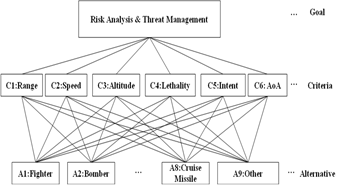
An AHP hierarchy of the proposed system is shown in Figure 1. Different target characteristics such as range, speed, altitude, lethality, intent and angle of attack are considered as the criterions for determining the threat. Different targets such as fighter, bomber, a group of fighter, a group of bomber, electronic aircraft, airborne warning and controlling system (AWACS) aircrafts, etc. are considered as the different alternatives of the system. The goal or objective of the decision-making process is placed at the top level of the hierarchy. The goal or objective of the AHP in this work is the risk analysis and threat management. The criteria and decision alternatives come in the subsequent descending levels.
Data AND Model Analysis
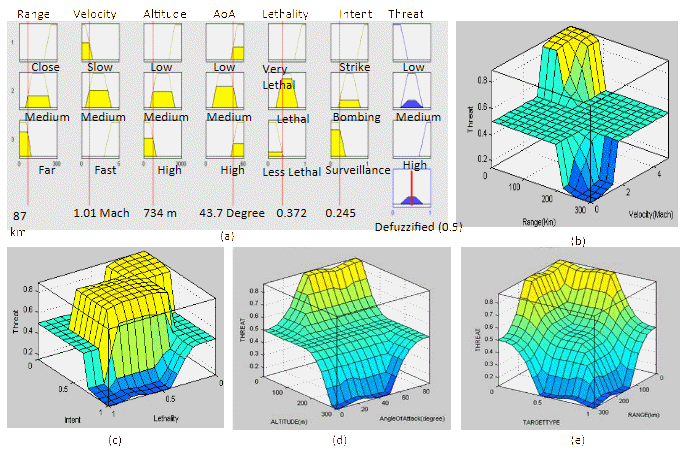
The training data used in this study for weight estimation are taken from fuzzy inference system (FIS), the details of the model can be found in Das (2014). Table 1 shows the rules used for generation of decision matrix. These rules are written on the basis of intuitive and expert considerations and then tuned by simulation tests. A Mamdani approach is followed. The input/output fuzzy sets are defined using trapezoidal and semi-trapezoidal membership functions (see Figure 2 (a)). The ‘and’ operator and the implication methods are the product, and the defuzzification method is the weighted average. A sample decision matrix under the rules defined in Table 1 is given in the Table 2. The weights are determined using geometric mean technique (Saaty, 1996). The TOPSIS is used on this data set and the result is shown in Table 3. The steps of TOPSIS model are as follows:
- Formulation of normalized decision matrix (as shown in Table 1).
- Formulation of the weighted normalized decision matrix (as shown in Table 2).
- Determination of the PIS (Cmax in Table 3) and NIS (Cmin in Table 3).
- Calculation of the separation measures for each alternative from the PIS (Smax in Table 3) and NIS (Smin in Table 3).
- Calculation of the relative closeness to the ideal solution (Gi in Table 3) for each alternative.
- Prioritization of threat after ranking the Gi.
The result obtained from the TOPSIS and the FIS are compared on another set of testing data and found that the proposed method performs satisfactorily.
Results and Discussion
An air combat scenario of smaller scale (200 km × 200 km) is simulated where offensive force has one ground-attack aviation regiment composed of one squadron (10 aircrafts) of high speed fighter (e.g. A-10 Thunderbolts) and bomber (such as F-117) each, 10 air-to-surface missiles (Maverick), 15 cruise missiles (such as Tomahawk), 50 smart bombs, one UAV and one AWACS aircraft. The force is using electro-optical jammer (like directed energy into the enemy’s search radar) for EA. Each unit of this force is approaching from different directions (with different speeds, altitudes and ranges), simultaneously towards a vulnerable area or vulnerable point (VAVP) (such as a runway and aircraft shelters), which is protected by one squadron of integrated AD system comprising of one surveillance radar (capable of ECCM), one tracking radar, interceptor aircrafts two batteries (each with three units) of long (e.g. Patriot), medium (such as Hawk XXI) and small (such as NASAMS) range SAMs and Anti-Aircraft Artillery and one AHP based C2 system.
The C2 starts prioritizing once the targets reach within 200 km range from the VAVP. Principal findings of the simulation results suggest that if a fast-moving very-lethal target type (a group of fighter A-10 Thunderbolts with speed 2.5 Mach) is very close to (within 100 km of) the VAVP, its priority is very high as compared to a relatively slow moving target (Tomahawk missile with speed 0.7 Mach) which is quite far away (beyond 200 km) (Figure 2(b)). Also, if a lethal target (a group of bomber F-117) is coming with strike intention then its priority is more than a relatively less lethal target (EA aircraft) is coming with reconnaissance intention (Figure 2(c)). Also a target in a very low altitude (Su-27 in a SEAD (Suppression of Enemy AD) mission) and high angle of attack is very dangerous than a target in high altitude moving in low angle of attack (UAV) (Figure 2(d)). Similarly, the threat of a low-lethal target type (cargo aircraft) with the intention of attacking the VAVP (asymmetric warfare) at a very close distance is much higher than a very lethal target at far range (Su-27) (Figure 2(e)).
Limitations
Inclusion of soft-kill or non-lethal, options like decoys, chaffs, relocation of AD forces, deterrence measures, jamming etc. are left for future considerations. Further tests are to be done in future using two or more C2 system to see how they may negotiate for optimal utilization of their resources.
Conclusions
In this paper, modelling of C2 for an AD system is presented using the concept of AHP architectures. The C2-system takes decisions of TA and WA. The system’s logic is first formulated in the form of AHP architectures and then implemented using the TOPSIS. The behavioural patterns of the C2 system in different simulated environments are also presented.
| Sl. No. (Alternatives) | C1: Range | C2: Velocity | C3: Altitude | C4: AoA | C5: Lethality | C6: Intent | O: Threat |
|---|---|---|---|---|---|---|---|
| A1 (Fighter) | Close | Fast | Low | High | Very Lethal | Strike | High |
| A2 (Bomber) | Close | Medium | Medium | Low | Very Lethal | Bombing | High |
| A3 (A group of Fighter) | Far | Fast | High | Low | Lethal | Strike | High |
| A4(A group of Bomber) | Medium | Medium | Medium | High | Very Lethal | Bombing | High |
| A5 (Electronic Attack) | Far | Slow | High | Low | Less Lethal | Electronic | Medium |
| A6 (AWACS) | Far | Slow | High | Low | Less Lethal | Surveillance | Low |
| A7 (Tactical Ballistic Missile) | Far | Fast | High | Medium | Very Lethal | Tac bombing | Medium |
| A8 (Cruise Missile ) | Medium | Medium | Low | Low | Lethal | Tac bombing | Medium |
| A9 (Other) | Slow | Slow | High | Low | Less Lethal | Surveillance | Low |
| Sl. No. (Alternatives) | C1: Range | C2: Velocity | C3: Altitude | C4: AoA | C5: Lethality | C6: Intent | O: Threat |
|---|---|---|---|---|---|---|---|
| A1 (Fighter) | 0.0896 | 0.0858 | 0.0974 | 0.1100 | 0.0922 | 0.1407 | 0.0936 |
| A2 (Bomber) | 0.1226 | 0.1081 | 0.0845 | 0.0997 | 0.0859 | 0.0889 | 0.1135 |
| A3 (A group of Fighter) | 0.0818 | 0.1286 | 0.0960 | 0.1085 | 0.1574 | 0.0948 | 0.0794 |
| A4(A group of Bomber) | 0.1509 | 0.0875 | 0.1375 | 0.1246 | 0.1256 | 0.1304 | 0.1078 |
| A5 (Electronic Attack) | 0.0833 | 0.0875 | 0.0917 | 0.1056 | 0.1463 | 0.1333 | 0.1021 |
| A6 (AWACS) | 0.1006 | 0.0995 | 0.1347 | 0.1378 | 0.0938 | 0.1081 | 0.1234 |
| A7 (Tactical Ballistic Missile) | 0.1195 | 0.1475 | 0.1304 | 0.0762 | 0.0938 | 0.0948 | 0.0993 |
| A8 (Cruise Missile ) | 0.1368 | 0.1046 | 0.1160 | 0.1129 | 0.0954 | 0.0815 | 0.1418 |
| A9 (Other) | 0.1148 | 0.1509 | 0.1117 | 0.1246 | 0.1097 | 0.1274 | 0.1390 |
| Weights | 0.2076 | 0.1478 | 0.1223 | 0.3842 | 0.1296 | 0.0085 |
| Sl. No. (Alternatives) | Cmax | Cmin | Smax | Smin | Gi = Smin / (Smax+Smin) | Priority |
|---|---|---|---|---|---|---|
| A1 (Fighter) | 0.0422 | 0.0012 | 0.0050 | 0.0024 | 0.3217 | 8 |
| A2 (Bomber) | 0.0383 | 0.0008 | 0.0036 | 0.0025 | 0.4055 | 2 |
| A3 (A group of Fighter) | 0.0417 | 0.0008 | 0.0041 | 0.0028 | 0.4004 | 4 |
| A4(A group of Bomber) | 0.0479 | 0.0011 | 0.0056 | 0.0037 | 0.3971 | 5 |
| A5 (Electronic Attack) | 0.0406 | 0.0011 | 0.0042 | 0.0024 | 0.3620 | 7 |
| A6 (AWACS) | 0.0529 | 0.0009 | 0.0082 | 0.0037 | 0.3091 | 9 |
| A7 (Tactical Ballistic Missile) | 0.0293 | 0.0008 | 0.0014 | 0.0022 | 0.6167 | 1 |
| A8 (Cruise Missile ) | 0.0434 | 0.0007 | 0.0046 | 0.0031 | 0.4027 | 3 |
| A9 (Other) | 0.0479 | 0.0011 | 0.0057 | 0.0035 | 0.3787 | 6 |
References
Abo-Sinna, M.A. and Amer, A.H. (2005). “Extensions of TOPSIS for multi-objective large-scale nonlinear programming problems”. Applied Mathematics and Computation. 162, 243–256.
Aguilar-Lasserre, A., Bautista Bautista, M.A., Ponsich, A., and Gonz´alez Huerta, M. A. (2009). “An AHP-based decision-making tool for the solution of multiproduct batch plant design problem under imprecise demand”. Computer Operation Research, 36, 711–736.
Bolderheij, F., et al. (2005). “Risk-based Object-Oriented Approach to Sensor Management”. Proceedings of the 8th International. Conference on Information Fusion, Philadelphia (PA), 25–29.
Beynon M.J. (2005). “Understanding local ignorance and non-specificity within the DS/AHP method of multi-criteria decision making”. European Journal of Operational Research. 163, 403–417.
Changwen, Q. & You, H. (2002). “A Method of Threat Assessment Using Multiple Attribute Decision Making”, Proceedings of 6th International Conference on Signal Processing, 2, 1091–1095.
Das, S.K. (2014). “Modeling intelligent decision making command and control agents: an application to air defense”. IEEE Intelligent Systems, 99, doi. 10.1109/MIS. 2013.71.
Jahanshahloo, G.R., Hosseinzadeh Lotfi, F., and Izadikhah, M. (2005). “An algorithmic method to extend TOPSIS for decision-making problems with interval data”. Applied Mathematics and Computation.
Jeonghwan, J., Rothrock, L., McDermott, P.L. and Barnes, M. (2010). “Using the analytic hierarchy process to examine judgement consistency in a complex multi-attribute task”. IEEE Transactions of Systems, Man and Cybernetics-A, 40 (5), 1105–1115.
Saaty, T.L. (1980). The Analytic Hierarchy Process, McGraw-Hill, New York.
Saaty, T.L. (1996) Decision Making for Leaders: The Analytical Hierarchy Process for Decisions in a Complex World, The Analytical Hierarchy Process Series, 2, 71–74.