
Volume 18, Number 2, July 2015
Survivability For Deployable Protected Land Vehicles: Concepts, Models And Applications
- 1 Ambrose Logistics Consulting Pty Ltd, 7 Henry Street, Payneham, SA 5070, Australia.
- 2 DSTO – Land Division, Building 81, West Avenue, Edinburgh, SA 5111, Australia.
Abstract
The widely accepted survivability layers onion model is extended for deployable protected land vehicles by considering separately the aspects of the vehicle and the crew. The survivability layers are subsequently re-defined in the new construct to provide greater distinction between the protection concepts contributing to each layer and each aspect. These protection concepts are used to focus the consideration of applicable protection systems, taking into account the vulnerabilities of the capability system of vehicle and crew, as well as other relevant environmental factors. A framework is introduced to provide a consistent approach to the survivability assessment of deployable protected land vehicles; it can be tailored to fit the required level of decision making. The framework features a one-page double-sided tabular tool, which can be used for any military activities from capability acquisition, doctrine development to training and operations on the battlefield.
Introduction
Australia, like other nations, places a high priority on the survivability and manoeuvrability of its land forces. Current strategic guidance [1] states that “the Government is committed to acquiring deployable protected [emphasis added by authors] and armoured vehicles offering improved firepower, protection and mobility compared to existing systems”. The future Protected Mobility Vehicle—Light (PMV-L) is designated to fill the gap between the PMV [2], which has been deployed on operations since 2000, and the capability provided by the recently introduced unprotected G-Wagon. The Australian Defence Force (ADF) is also in the process of procuring a new generation of medium-weight, medium and heavy vehicles for transporting cargo and personnel, some of which have protected cabins.
The current conceptual views of survivability predominantly revolve around the “onion layers” model [3] (one version exhibited in Figure 1) and its platform focus. While this commonly used model is a useful reference image, it can also portray an overly simplistic view of the complexity of the role of protection within the required comprehensive approach to attaining a system’s survivability. For example, a much deeper consideration of the elements contributing generally to survivability is essential, rather than of vehicle protection alone.
![The Survivability Onion Model [4].](/journals/journal-of-battlefield-technology/volume-18/issue-02/assets/18-2-2-burgess/figures/figure01.gif)
This article aims to develop an understanding of the importance of and the differences between the crew and vehicle views of survivability and protection as a means to achieving it. Through this, a novel construct is provided for considering, both in theory and practice, the survivability for the deployable protected land vehicles. This framework may be tested against current doctrine and future land warfare concepts as well as contribute to a better understanding of these concepts in capability definition, development and acquisition, doctrine, training and operations.
A holistic systems approach is applied, discussing various aspects of protection and their interactions, aimed at achieving a common purpose – the survivability of the crew and vehicle. Any protection-focused system is ultimately a socio-technical system that performs as a whole, not as a set of hardware components. The approach adopts the definitions of protection and survivability considered in publication [5], which together with this one constitutes a pair of articles dedicated to the survivability of ADF’s deployed protected land vehicles.
The implementation of the approach is based mainly on the application of qualitative research methods and follows the guidance in [6]; it involves a broad spectrum of stakeholders, military vehicle experts and technology specialists. Their extracted world-views, opinions, comments, suggestions and judgements have been incorporated in the intermediate and final results discussed in this article. Each component needed for the development of the survivability framework and the actual construct has been subjected to a panel attestation of relevant experts.
SURVIVABILITY FRAMEWORK DEVELOPMENT
Following publication [5], protection and survivability reflect on two different aspects of any military capability system. Ultimately, one (survivability) describes an attribute of the system while the other (protection) comprises the measures by which the attribute is attained. Thus, protection and survivability are defined henceforth as:
- Protection is all measures and means to minimise the vulnerability of personnel, facilities, equipment and operations to any threat and in all situations, to preserve freedom of action and the operational effectiveness of the force [7] in general and of a capability system specifically.
- Survivability is the capability of a system and crew to avoid or withstand a hostile environment without suffering an abortive impairment of its ability to accomplish its designated mission. [8]
Australia’s Primary Operating Environment is representative of a complex environment; “largely littoral, with a combination of open, coastal and riverine waters, coastal plains and jungle, mountain and urban terrain” [9]. More importantly, the current and future operating environment features no separation line between any of the various actors on the battlefield. Therefore, in the context of these circumstances, a threat can cover not only openly hostile sources but it can be also of anyone’s own making or the product of the natural environment. Thus, any threat taxonomy for deployable protected land vehicles ought to include formally or informally organised threats, with or without intent, human-made/operated/caused or not, and so on.
The definitions of survivability and protection, coupled with the potential operating environment of deployable protected land vehicles, set the foundations for the development of the survivability framework described next. The development starts with the “onion layer” model, which although first introduced in the air domain [3], is also widely accepted for exploring land vehicle survivability. If a land vehicle is required to be in an area of threat then, in this model, survivability will next depend on the ability of the system to avoid detection; avoiding detection comprises avoiding the vehicle being seen and if seen by an adversary, avoiding being engaged; etc. However, each new measure has to be part of a coordinated effort to achieve a balanced result without cancelling previously implemented solutions to provide total vehicle protection. [10]
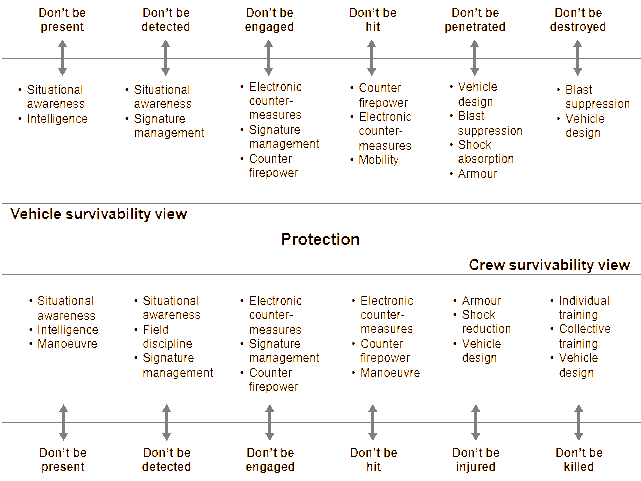
A more advanced version of the model, especially in relation to deployable protected land vehicles, should include consideration of both the survivability of the vehicle and the survivability of the crew. These two views require different, yet connected, enablers for effective protection of the system of vehicle and crew. Thus, the traditional survivability model has been reconsidered by firstly separating the vehicle and the crew aspects of survivability, and secondly populating the model with corresponding protection concepts, which enable the different layers as shown in Figure 2. The two aspects feature divergent labels for the survivability layers, whilst the corresponding protection concepts in each layer of the vehicle and crew views may differ in nature and level of contribution and influence that is reflected in their ordering. Some of these concepts comprise several sub-concepts [5] which, in turn, can contribute to more than one layer.
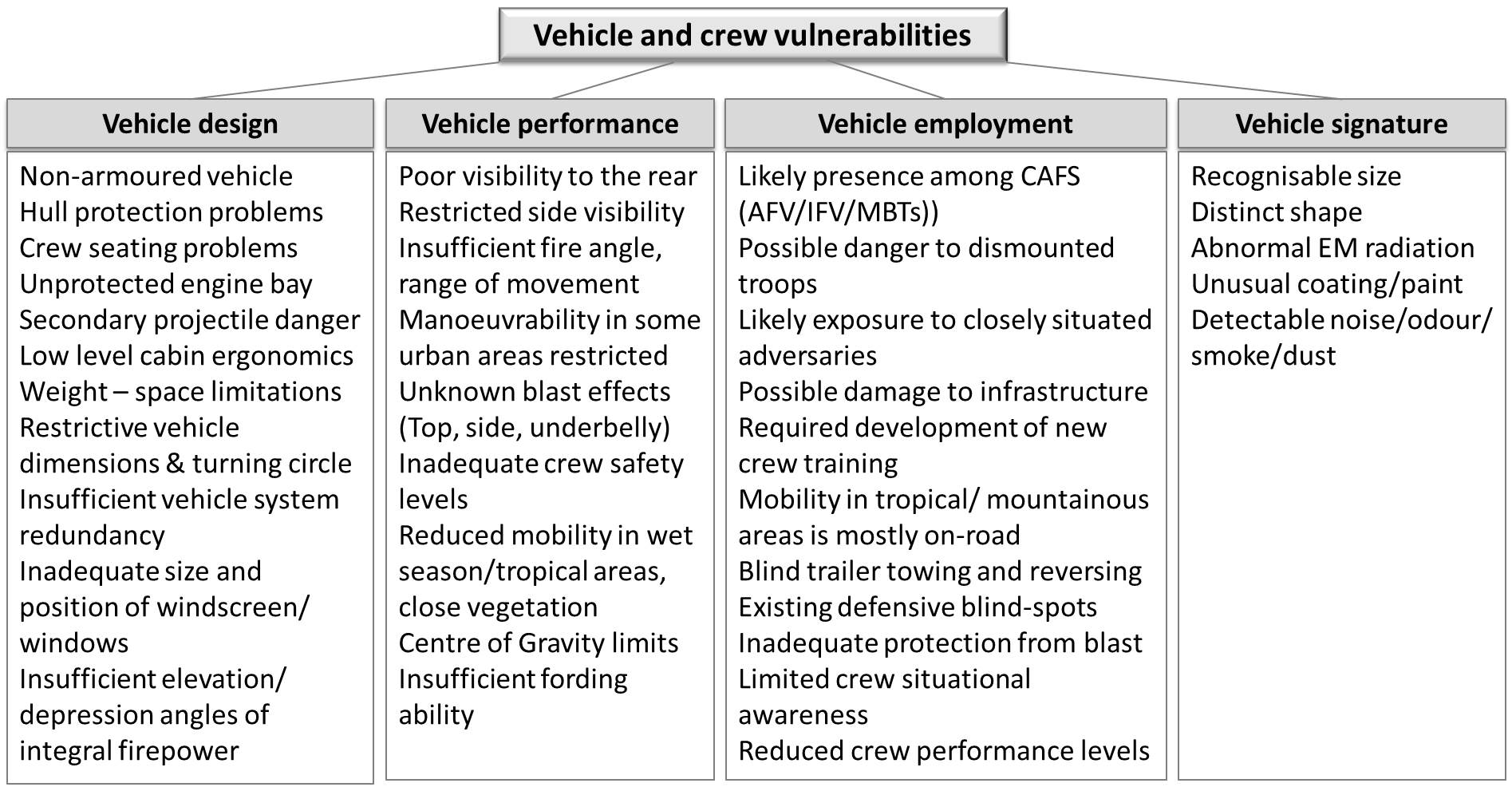
These protection contributing concepts, together with a taxonomy accounting for the actual or potential threats, provide the basis for analysing potential vulnerabilities of the protected land vehicles. The vulnerabilities are intrinsic properties of the vehicle-crew capability system, resulting in its susceptibility to exploitation by particular instantiations of the threat. A taxonomy of the vehicle and crew vulnerabilities is illustrated in Figure 3. The following grouping for these vulnerabilities has been introduced:
- Vehicle design—the result of decisions made when producing the engineering design for the vehicle variants, given their function and performance specification and the need to take into account inevitable trade-offs;
- Vehicle signature—underpinned by the physical characteristics of the vehicles such as dimensions, shape, EM radiation, noise, smell and/or smoke produced, and external coatings;
- Vehicle performance in terms of manoeuvrability, mobility, firepower, front, side and rear visibility, crew safety, vehicle resilience to top-down and bottom-up blasts and side strikes; and
- Vehicle employment in various hostile environments, against a broad spectrum of threats, in different challenging terrains, and incorporating restrictions to crew performance.
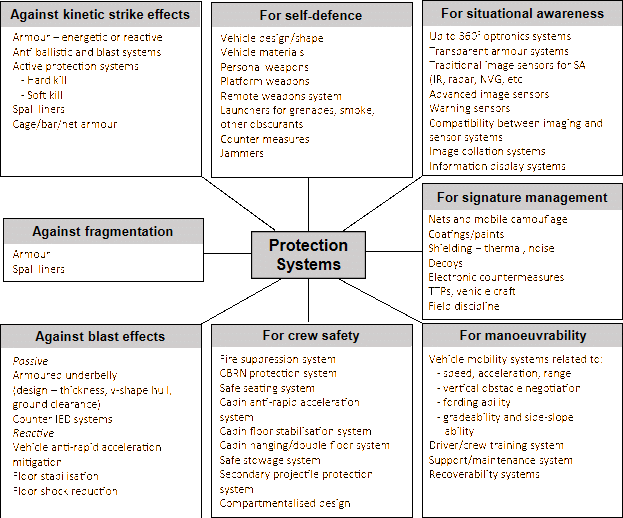
The vulnerabilities for deployable protected land vehicles must be considered in conjunction with the description of the actual threat and against the background of the protection concepts related to the management of the threat, in order to identify appropriate protection systems for the vehicle and its crew. These protection systems may be considered as elements of three main groups:
- Protection systems against weapon effects such as kinetic strikes, fragmentation and blasts;
- Protection systems for preserving mainly the human element—that is, for self-defence and crew safety; and
- Protection systems related to the operation of the capability system—for example, for its functions of situational awareness, signature management, and manoeuvrability.
These groupings provide structure for the taxonomy of protection systems in Figure 4.
As a result of the combined consideration of the protection concepts and survivability layers (the extended ‘onion layers’ model), as well as the taxonomies for vulnerabilities and protection systems, Table 1 and Table 2 form a new framework for exploring the survivability of deployable protected land vehicles. This new framework is drawn from extensive research of existing literature sources, expert judgements, project documentation and lessons learnt from operations, as were the threats, protection contributing concepts, vulnerabilities, and applicable protection systems.
FRAMEWORK DESCRIPTION AND ANALYSIS
The survivability framework concisely encapsulates the major elements of the survivability layers, the threat (both its objective and means), protection (both the overarching concept and the means by which it can be achieved) and lessons learned through battle damage assessment (BDA) reports. This allows recent relevant information to be added to each table as applicable, for the different vehicles or scenarios. The new framework considers survivability from both the vehicle and crew perspective and has also divided the traditional final layers into two: penetrated and destroyed (for vehicles) and injury and death (for the crew). Additionally, each table now spells out, explicitly, by what means the threat may be executed across the different layers (row 4 in the table); which then enables the controls – the protection systems required to match or defeat specific threats – to be developed for each deployable protected land vehicle. The new survivability framework now considers:
- the survivability layers (row 1)
- the objective to be achieved against a threat (row 2)
- options available to enable the achievement of the objective (row 3)
- methods, devices and sensors by which the threat may be realised (row 4)
- protection concepts related to the management of the threat (row 5)
- means and measures through which the protection may be achieved (row 6).
Any lessons learnt about a survivability layer for future capability improvements, based on battle damage assessments, could also be included in row 7 for each table.
Through consideration of the threat (rows 3 and 4) against potential protection solution options (rows 5 and 6), and in comparison with protection systems already available on a vehicle and crew system, the gaps in protection become more readily apparent. Indeed, by reviewing protection systems which appear across different layers, those which contribute more broadly or have greater effect, become more evident. These may then be attributed levels of importance and assist in determining trade-offs if required.
These tables reflect two different views of the analysis conducted. puts the focus on the vehicle whilst the crew is simply operating the vehicle. In the roles are reversed: the crew is the main focus whilst the vehicle is part of the means enabling the crew to perform its mission.
There are some identical entries in the tables, however they may relate to different survivability layers, or have different interpretations for the vehicle compared to the crew. The tables, while not exhaustive, allow for a more comprehensive gap analysis and consequently enable the development of suggested solution options for deployable protected land vehicles.
Concluding remarks
The layers construct of the survivability onion is extended in the case of deployable protected land vehicles by considering separately the survivability of the vehicle and the crew. More significantly, the survivability layers have been re-defined to provide greater distinction between the necessary protection concepts which are vehicle focused and those which are crew focused. These protection concepts facilitate the identification of appropriate protection systems to be applied; however the justification of their choice also takes into account the critical properties and the vulnerabilities of the capability system of vehicle and crew, and any other relevant environmental factors. As a result, a framework is constructed for exploring the survivability of ADF’s deployable protected vehicles.
This newly developed framework features a two-table format that corresponds to the crew aspect and the vehicle aspect of the capability system. Each of the tables presents a single aspect snap-shot of the major elements of the threat (in terms of objective and means to achieve it) and protection (in terms of concepts and systems to be applied) for every survivability layer. A comparison of the protection against the threat elements can then lead to revealing the potential gaps in protection for a specific system of crew and vehicle. Just as the influence of a threat may also be felt across different layers, protection systems may also be applied to multiple layers with improved effectiveness against various threats. Such information may be beneficial to a more thorough protection gap analysis, determining remediation priorities, developing targeted solution options and dealing with trade-offs.
The framework provides for detailed consideration of the relationship between protection concepts and systems and the resulting survivability for deployed protected land vehicles. Given its scalability and relevance to decision making, the framework provides a consistent approach applicable in doctrine development, training and especially in planning and conducting operations on the battlefield.
Disclaimer
The views expressed in this article are the authors’ only and do not necessarily reflect the views of the Department of Defence or the Australian Government more broadly.
Acknowledgements
The authors acknowledge the support of their colleagues in DSTO and specifically the Land Division. The authors express their gratitude to the editorial staff and anonymous reviewers of the Journal of Battlefield Technology for the meticulous work, insightful comments and suggestions.
References
[1] Department of Defence, Defence White Paper 2013, Commonwealth of Australia, 2013.
[2] Department of Defence, Land 116 Phase 3—Bushmaster Infantry Mobility Vehicles, Defence Materiel Organisation. Last accessed 10 December 2014 at http://www.defence.gov.au/dmo/EquippingDefence/Land116PH3-Bushmaster.
[3] R. Ball, The Fundamentals of Aircraft Combat Survivability: Analysis and Design, American Institute of Aeronautics and Astronautics, Reston, VA, 1985; second edition 2003.
[4] G. Guzie, “Integrated Survivability Assessment”, ARL-TR-3186, Army Research Laboratory, White Sands, NM, 2004.
[5] M. Burgess and S. Gaidow, “Conceptual Modelling and Analysis of Protection, Signature Management and Survivability: Considerations for Deployable Protected Land Vehicles”, Journal of Battlefield Technology, Vol. 18, No. 2, pp. 1–6, July 2015.
[6] NATO Guide for Judgement-Based Operational Analysis in Defence Decision Making; NATO RTO TR-SAS-087, 2012.
[7] Allied Joint Doctrine 3.14—Force Protection; NATO AAP-6, 2011.
[8] Defense Acquisition Guidebook (US), production date 16 September 2013; last accessed 6 May 2014 at https://acc.dau.mil/docs/dag_pdf/dag_complete.pdf.
[9] Department of Defence—Australian Army, The Army Objective Force 2030: Primer, Version 2.0, Land Warfare Development Centre, 2011.
[10] J. Rapanotti, A. Cantin and R. Dickinson, “Preliminary Study of Defensive Aid Suite Technology for the Armour Combat Vehicle Programme”, DRDC Valcartier TM 2003-274, Defence R&D Canada, February 2007.