
Volume 18, Number 2, July 2015
Conceptual Modelling And Analysis Of Protection, Signature Management And Survivability: Considerations For Deployable Protected Land Vehicles
- 1 Ambrose Logistics Consulting Pty Ltd, 28 Fort Avenue, Kensington, SA 5068, Australia.
- 2 DSTO – Land Division, Building 81, West Avenue, Edinburgh, SA 5111, Australia.
Abstract
Protection, signature management and survivability are considered fundamental for any military capability system. These three concepts must be clearly defined and the dependencies among them well understood due to their importance to equipment acquisition, operational planning, training and doctrine development. The unambiguous interpretation of their intent is essential for the operation and successful integration of capability systems up to joint task force level. Such considerations apply equally to the deployable protected vehicles of the Australian Defence Force, especially the soon to be acquired Protected Mobility Vehicle—Light (PMV-L) fleet. In this article deficiencies in the existing definitions of the three concepts are overcome and their relationships are analysed using system and process modelling in support of the considerations.
Introduction
The Australian Defence Glossary lists the following currently accepted definitions of survivability and protection:
Survivability refers to all aspects of protecting personnel, weapons, and supplies while simultaneously deceiving the enemy. [1]
Protection is the preservation of the effectiveness and survivability of mission related military and non-military personnel, equipment, facilities, information, and infrastructure deployed or located within or outside the boundaries of a given operational area. [2]
A definition is a formal statement of the meaning of a term that specifies its essential attributes. The definition explains the unique nature of that term and allows for its unambiguous interpretation in view of other similar terms. This is especially important for developing the necessary situational awareness and following the correct orders in a military environment. The above definitions contain statements that are reciprocal by nature and as a result they do not clearly identify the differences between the two concepts. In particular, which concept represents the desired effect and which depicts the means to achieve that effect. In some defence publications protection is also described in terms of signature management elements and survivability aspects. In turn, survivability itself is often viewed as a broad and sophisticated concept often covering other concepts such as firepower, mobility, protection and signature management.
Furthermore, the Australian Defence Glossary does not list a definition for signature management. Instead, it introduces target signature as “the characteristic pattern of a target displayed by detection and identification equipment” [3], or the “characteristic radiated electromagnetic energy or sonic pattern of the target” [4]. Signature management is commonly referred to as the range of techniques used for/with military equipment to make them less detectable due to their usually recognisable size, distinctive shape, their visibility across the electromagnetic spectrum, and their noise, smell, smoke and dust emissions. Thus signature management encompasses concepts such as camouflage, concealment and counter-surveillance.
This article suggests alternative definitions of protection and survivability that enable a clear explanation of their meaning and the differences between them. For this purpose a new application is introduced of the classic transformation process from the discipline of control system engineering. In this process model: survivability is the desired end-state; the controls are the measures and means that protection is made of; and the transformation relates to the likely changes undergone by the system as a result of encountering a potential or actual threat.
These definitions are then followed by the establishment of two-tier taxonomy of protection contributing concepts for the PMV-L. The taxonomy reveals the complexity of the protection problem space associated with this specific fleet and thus with any deployable protected land vehicles. As an illustration, the article discusses the place and role of signature management—one of the protection contributing concepts. Not surprisingly, signature management is also found to be a sophisticated concept by nature.
Bringing “order in the house” of survivability, protection and signature management can lead to a better understanding of the relationships between these fundamental concepts. In turn and if the need arises, this can help solve further problems involving the three concepts; for example problems related to their application in various warfare domains or in exploring the role of specific technologies in military capability systems. Greater clarity in relation to protection, signature management and survivability can also help put into context their relationships with other relevant concepts such as manoeuvrability, and sustainability.
The considerations in this article involve a critical reading of existing military publications, robust discussions with military personnel and researchers, and are also based on conceptual system and process models from the disciplines of systems analysis and systems engineering. The results presented here have been subjected to judgement-informed validation by subject matter experts engaged in land vehicle capability development.
protection and survivability
A military capability system, like any other system, exists for a purpose. For example, a vehicle-based system is a combination of interacting components such as crew, platform, weapons, electronic devices, organised to accomplish missions. These components, individually or in concert, contribute to the achievement of defined objectives; either way their interdependencies and interactions determine the outcome from the effort. Thus, a Protected Mobility Vehicle (PMV)—a “Bushmaster” [5], or a PMV-L is not just a vehicle; its performance as a capability system depends on all components, including the military personnel involved, their training, the available “tools of the trade”, their situational awareness and knowledge of the platform’s limitations.
Military capability systems operate essentially in hostile environments (human-made or natural)—that is, in the likely presence of a threat, although other adverse factors and circumstances must also be considered as part of that threat. Any such capability system is expected to outlive a potential encounter with the threat—direct or indirect, and remain to exist as a system, preferably without major changes to its operational effectiveness. However, as a result of the encounter a transformation may occur that can be described using the classic input-process-output model (Figure 1), in which the capability system—the input to the process may undergo a change.
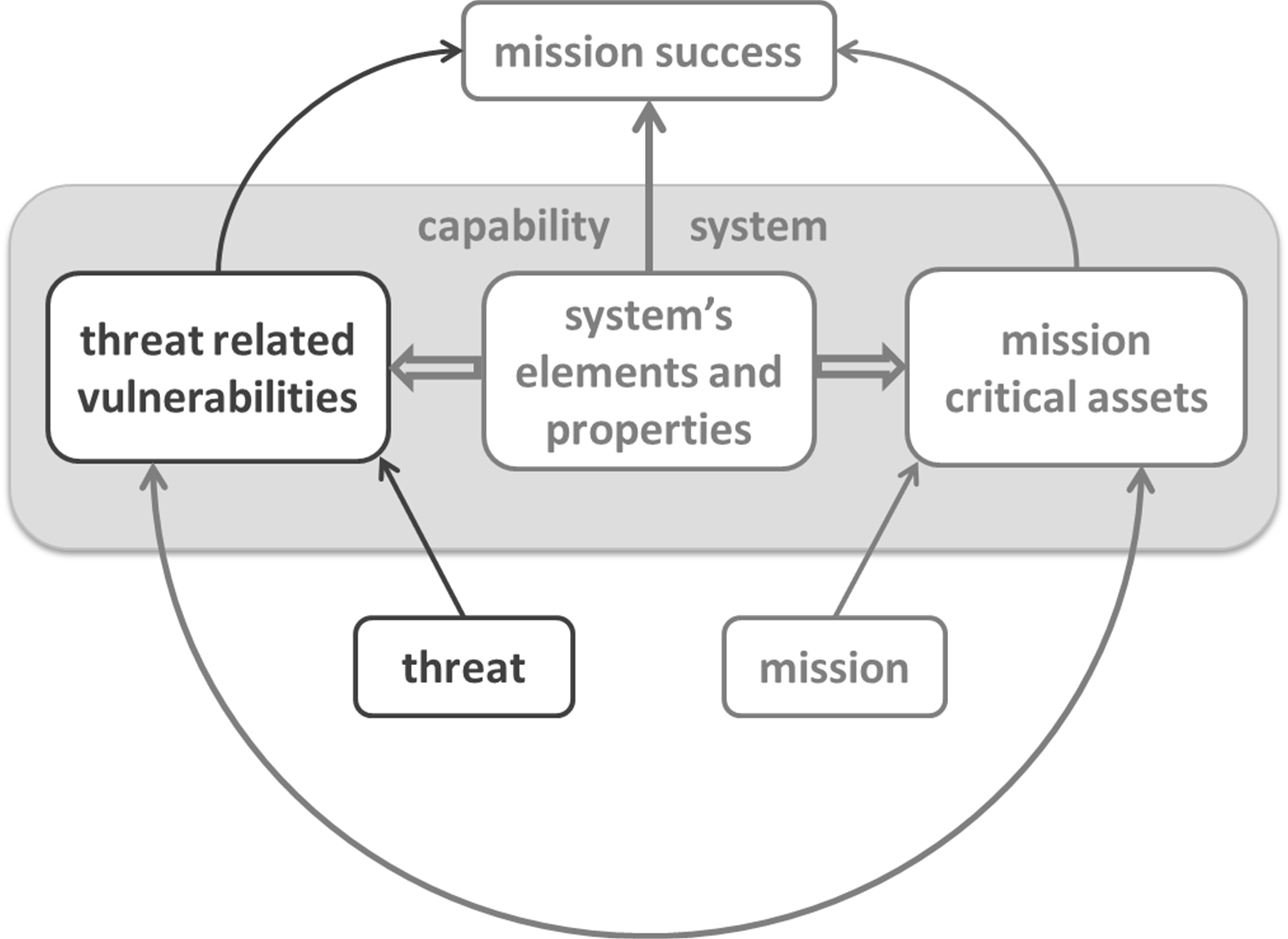
As already acknowledged, the transformation is primarily influenced by the threat and hence may lead to a reduction in the performance of the capability system, or even loss of specific functions. At the very least, there may be a depletion of resources such as fuel, ammunition or crew fatigue and minor injuries. The likely end state describes the outcome from this threat-driven transformation of the capability system and marks the level of its survival, which does not exclude its destruction as a possibility.
The mechanics of the process remains beyond the scope of the consideration; however the diagram shown in Figure 2 illustrates the relationships among the components of the system involved in the transformation. In principle, the system’s elements and properties are fundamental for the continued existence of the system and ultimately the success of its missions. In the case of a vehicle-based system for example, these components relate to vehicle design; vehicle signature; vehicle performance in terms of mobility, firepower, situational awareness, maneuverability, crew safety and platform resilience to blasts and strikes; and vehicle employment in different environments and terrains depending on crew performance. They can contribute to the accomplishment of a particular mission, be susceptible to the influence of a specific threat, or often both. The former are usually known as critical assets (criticalities) for that mission whilst the latter constitute the vulnerabilities related to the threat. The criticalities and the vulnerabilities are involved in a two-way relationship; mission critical assets may become attractive to a potential threat, just as threat related vulnerabilities may also be vital to the success of a mission.
In warfare, survivability is a property that traditionally refers to the ability of a military capability system to withstand the impacts of the transformation. In this context, survivability focuses more on the output of the transformation, rather than on the means and ways to influence the process. Thus, generally, survivability describes an attribute of the system and will be therefore defined hereafter as follows:
Survivability is the property of a military capability system that stands for the system’s ability to avoid or withstand a hostile environment without suffering an abortive impairment of its ability to accomplish its designated mission. [7]
The above simplified diagram captures a potentially passive attitude exhibited by the capability system in its encounter with the threat. A more realistic transformation model is needed that includes measures aimed at influencing the process and thus underpinning the break with the passive attitude of the system. This change in the input-process-output model can be described as the introduction of controls—shown in Figure 3.
![Input-process-output model [6].](/journals/journal-of-battlefield-technology/volume-18/issue-02/assets/18-2-1-burgess/figures/figure01.gif)
![Input-process-output model with controls [6].](/journals/journal-of-battlefield-technology/volume-18/issue-02/assets/18-2-1-burgess/figures/figure03.gif)
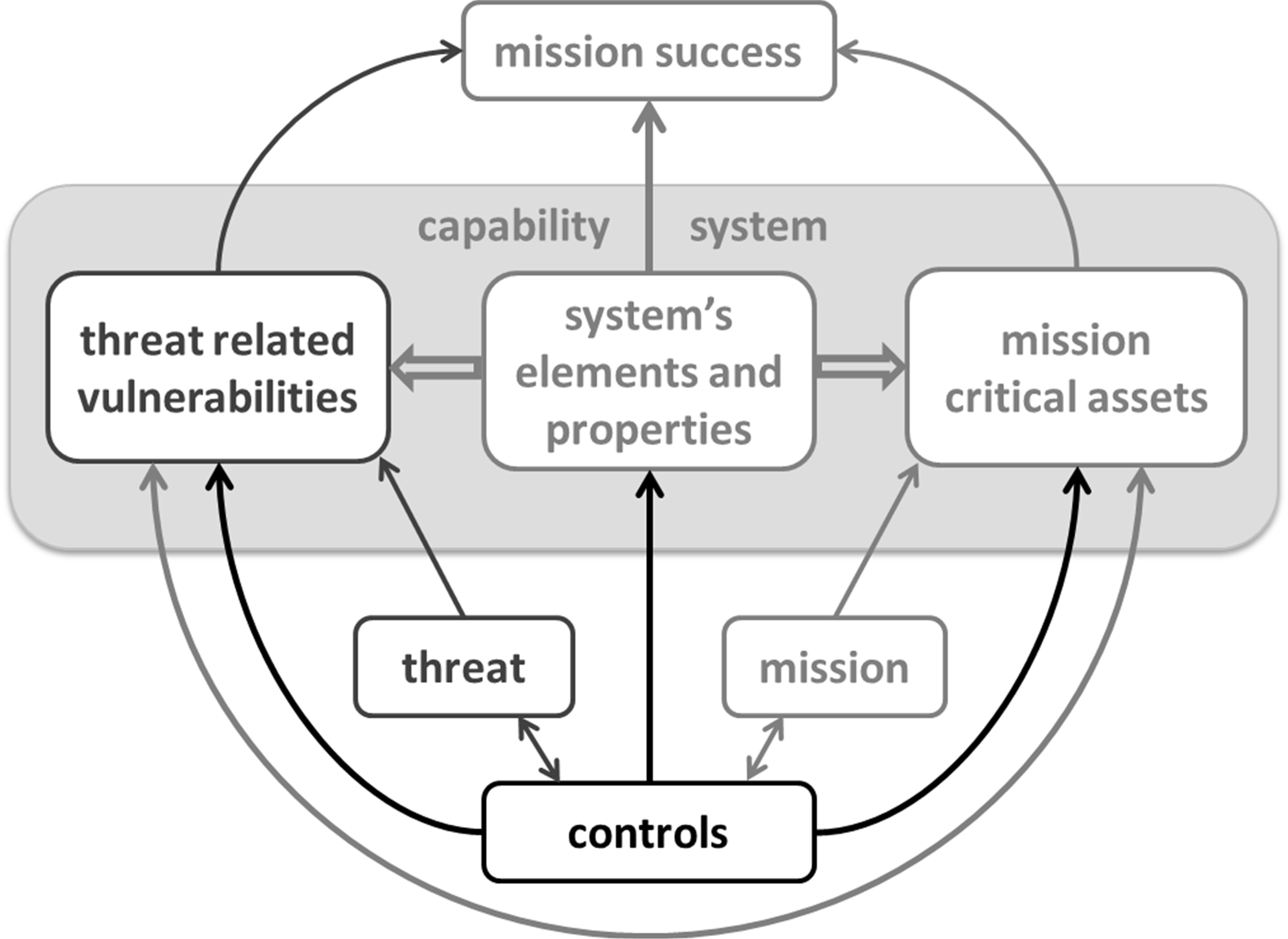
The controls can be developed and applied in advance of the potential transformation based on projections about the future encounter and lessons learnt from previous encounters, or during the actual transformation. The introduction of controls in the interaction with the threat also requires the establishment of a link with the system’s mission. Indeed, the controls are interventions with the purpose of positively influencing the threat-driven transformation process in favour of the capability system and must be determined in the context of the mission as shown by the diagram in Figure 4.
The controls must address the specific elements and properties of the capability system that form its critical assets for that mission. They also aim at minimising the effects on the threat related vulnerabilities so that the capability system can preserve itself and its capacity to accomplish its mission. These controls determine the actual measures, which together with the necessary means to attain the system’s survivability, make up the protection of the system. Thus, protection conceptually stands for the controls that relate to the ability of a military capability system to survive as an entity and preserve its operational effectiveness. As a result, protection will be henceforth defined (based on [8]) as follows:
Protection is all measures and means to minimise the vulnerability of personnel, facilities, equipment and operations to any threat and in all situations, to preserve freedom of action and the operational effectiveness of the force in general and of any capability system specifically.
The suggested definitions of protection and survivability clearly differentiate between the two concepts reflecting on complementary but different aspects of any military capability. Ultimately, one (survivability) describes an attribute of the capability while the other (protection) comprises the measures and means by which the attribute is attained. These definitions apply to the broad considerations of both concepts for any military system, including land vehicle systems.
protection and signature management
If the capability provided by the system of vehicle platform (including weapons systems) and crew personnel (including training and support) is the focus of what needs to survive in order to complete a mission, then that capability is also the focus of what needs to be protected. Conceptually, effective protection of land vehicle systems can be achieved through the concerted effort of several concepts, such as:
- Signature management;
- Situational awareness;
- Manoeuvrability;
- Vehicle design;
- Self-defence;
- Chemical biological, radiological and nuclear (CBRN) measures (access to);
- Crew training; and
- Field discipline.
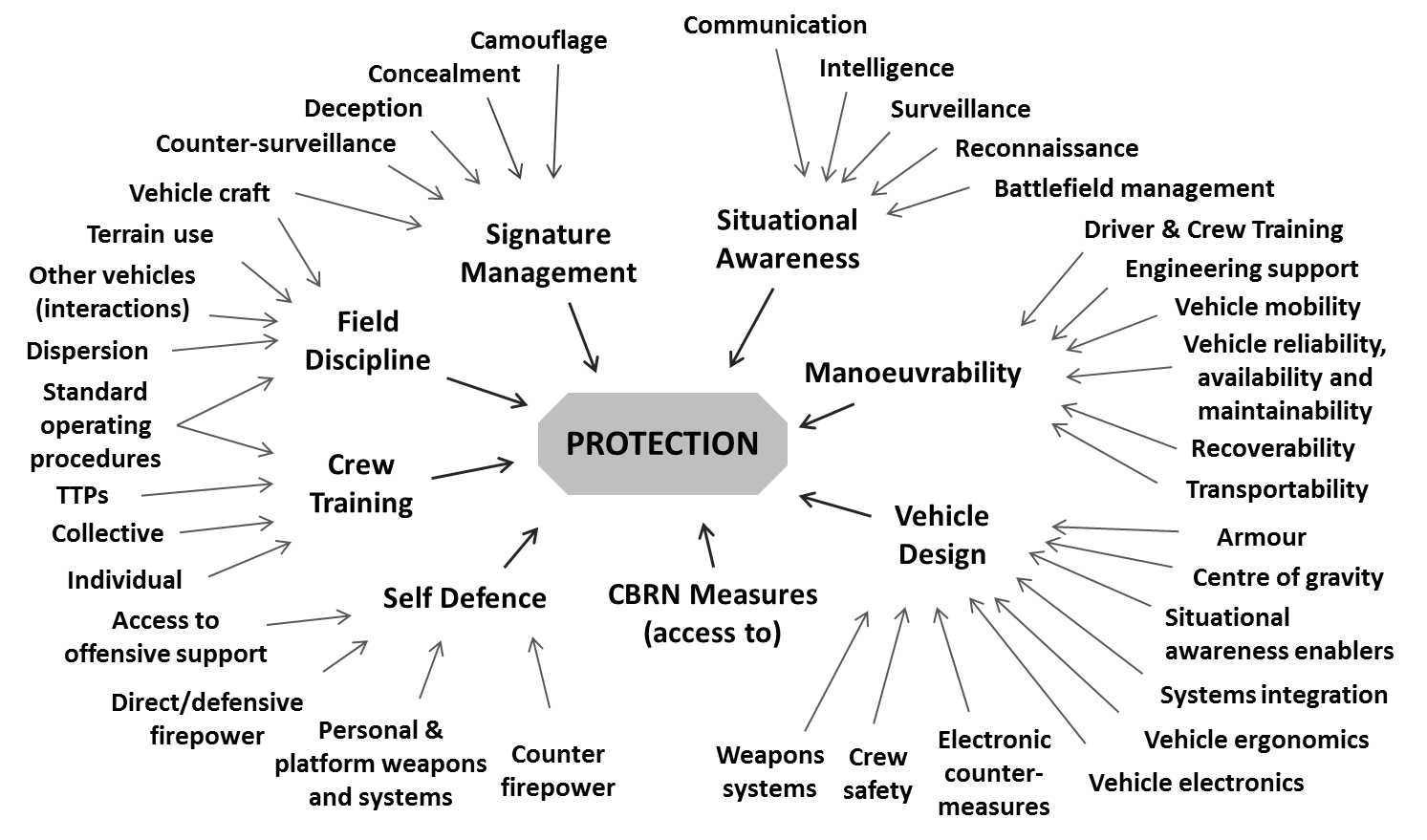
These have been identified from functional performance specifications and occupational concept documents for deployable land vehicles, consultations with subject matter experts, open sources and discussions with major stakeholders of capability development projects. They can, in turn, headline the contributions of second tier concepts which mark a further level of detail. Some of these concepts may influence more than one of the first tier concepts. Thus, a more thorough picture of the place and role of each concept contributing to the overall vehicle protection is able to be drawn, as shown in Figure 5.
The application of these first- and second-tier concepts result in defensive aspects of survivability for vehicle-based capability systems. For example, if the platform is required to be in the vicinity of a threat, then its survivability will depend on the ability of the system of vehicle and crew to apply detection avoidance measures. These measures, which include signature management, can minimise the contrast between the platform and its background in the visible, infrared, electronic, acoustic and magnetic domains, thus degrading the threat sensor's ability to resolve the vehicle as a target [9]. Therefore, an appropriate definition for signature management may be:
Signature management is the measures taken to hide, minimise or disguise friendly assets and disrupt, deceive or distract threat sensors. These measures may be material or behavioural, active or passive, and require the application of technology and operational procedures.
Signature management needs to be coordinated to achieve a balanced result in avoiding detection for comprehensive vehicle protection [10]; new measures must avoid the cancellation of previous solutions as well as complement any Defensive Aide Suites.
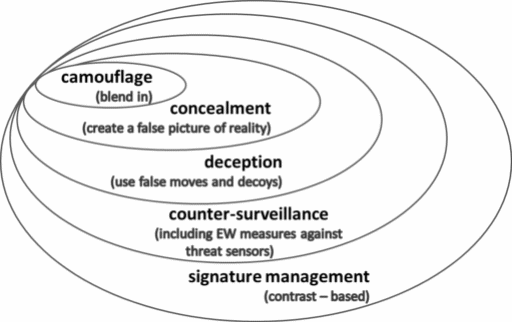
Detection avoidance measures include camouflage, concealment, deception and specific electronic warfare measures against the enemy’s sensors. However, these concepts are often misinterpreted or their inter-relationships are ill-defined. Understanding these relationships will assist in their application for a more effective overall result. The relationships are illustrated in Figure 6.
The Australian Defence Glossary defines camouflage as “the use of natural or artificial material on personnel, objects or tactical positions with the aim of confusing, misleading or evading the enemy” [11]. Since camouflage is, in principle, about making a person or an object blend in with its environment and concealment is about mitigation against systematic observation, then camouflage is to be viewed as part of concealment. In turn, concealment is a way to deceive the enemy because it attempts also to create a false picture of reality in the mind of the enemy. Deception is usually accomplished using false information, demonstration attacks, diversions, dummy means and works (decoys), etc. Deception therefore sits within the broader methods of counter-surveillance; the use of all measures, active or passive, taken to counteract hostile surveillance. Thus, not being detected is a desired outcome from the application of camouflage in conjunction with concealment, deception, counter-surveillance—an increasing sequence of broader embedded concepts that reveals the compound structure of signature management.
Concepts and relationships
Protection and signature management have been recognised as complex concepts that either integrate the contributions of other concepts or are structurally built up by them. Two diagrams have been used to illustrate this—the protection centripetal shown in Figure 5 and the nested signature management shown in Figure 6.
The centripetal diagram requires the coordination and thus the concerted effort of multiple concepts, whilst the nested diagram follows the natural structural hierarchy among the concepts. These diagrams provide useful visualisations which can assist in establishing the nature of interactions among the multitude of protection contributing concepts and their relationships with any other concepts of relevance to the survivability of land vehicle systems. For example, signature management has been identified in the previous section as a protection contributing concept, but it is also a sub-concept of protection since it embodies the detection avoidance measures. However, signature management must not be considered an element of survivability, although its application helps achieve the survivability of a capability system.
Survivability is a vastly more complex concept than both protection and signature management. Any modelling of survivability aspiring for completeness will have to include the components of these diagrams as well as additional components related to concepts such as manoeuvrability, lethality, and sustainability. This will make the resultant survivability diagram unwieldy and unable to reflect the true nature of the concept and the multiple interrelationships between its components. Modelling at such complexity level may lack the required utility and thus remains beyond the scope of this consideration. Conversely, models that oversimplify survivability, such as the onion layer model [12,13], can appear also to be of limited use. One option for improving the onion layer model for deployable protected land vehicles is to separate the considerations of the vehicle and crew aspects of survivability and populate the corresponding layers with protection contributing concepts.
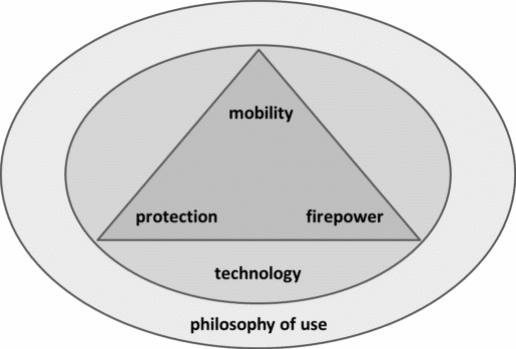
Protection is often considered in conjunction with mobility and firepower; the “three characteristics common to all manoeuvre forces”. This “iron triangle”—or “design trinity”—of mobility, firepower and protection also provides the context of how these three concepts interact as design considerations and the way in which trade-offs are required to achieve a vehicle’s requirements to meet its intended use [14]. These are shown in Figure 7, encompassed in the philosophy of use for the land vehicle-based capability system and available technology. However, the inclusion of these additional aspects illustrates that the “iron triangle” is also a simplistic representation and there is a need to be extended further by involving higher level concepts. Furthermore, such modelling does not sufficiently account for the existing hierarchies and interdependencies among the concepts.
Other conceptual models have sought to illustrate the interdependence of higher level concepts such as manoeuvrability, lethality and survivability in a similar triangle; however such simplification is hard to achieve since these relationships become increasingly complex. Moreover, many models fail to consider other essential requirements for land vehicle-based capability systems, such as integration and sustainability [15], knowledge hardware, communications, logistics management, and reconfiguration or upgrades [14].
Conclusions
The acquisition, doctrine and training development, operation (especially on deployment), and sustainment of capability systems require shared understanding of concepts and principles and appropriate exchange of information. Clearly defined terms allowing for unambiguous interpretation are needed to describe the relationships among the concepts. A review is therefore required of the definitions for protection, signature management and survivability, as well as the need for consistency throughout doctrinal publications. The outcomes of the review will contribute to a better understanding of the use of these terms for: current doctrine; future land warfare concepts; capability development and acquisition processes. Definitions of these concepts are proposed in this article for consideration and adoption in the Australian Defence Glossary.
The choice of the proposed definitions of survivability and protection is justified on the basis of the transformation diagram capturing the main features of the encounter of a military capability and a threat—purposely built and utilised for clarifying these definitions. The diagram helps describe the essence of these two concepts and helps identify their relationship with signature management and thus its corresponding definition. Further diagrams are then introduced that reveal the complex natures of protection, signature management and survivability, the interactions among themselves and the interactions with other relevant concepts. As a result, signature management is viewed as a subset of protection and thus the two contribute to the attainment of survivability, but they are not elements of survivability per se. The considerations also warn against oversimplification of any approaches employed to explore the complex relationships between these concepts.
This article acknowledges past and recent attempts to capture broad concepts which have inter-relationships with protection, signature management and survivability. While many are applicable to the design requirements for a deployable protected land vehicle some, specifically manoeuvre and lethality, are more applicable to armoured vehicles designed for survivability through the engagement of adversaries in combat. As protected land vehicles are designed for self-protection rather than as a fighting vehicle, these related concepts and broader relationships have not been explored within this article. Protection, signature management and survivability of armoured vehicles and their interactions with non-armoured vehicles remain a topic for further considerations and a potential avenue for future research.
The considerations in this article are conducted at the level of an individual capability system—a deployable protected land vehicle. Their scope can be extended from individual to collective level—to the level of a team, formation or force. In particular, when applying whole-of-force protection, signature management and survivability, dealing with conceptual differences may be a significant challenge to overcome. This will necessitate exploring the applicability of the concepts across domains—land, maritime, air and space, and joint. The potential transferability of the article’s results may also provide a start to informing future doctrines.
This article lays the conceptual foundations for the development of a framework for considering, both in theory and practice, the survivability of vehicle-based military capability systems.
acknowledgements
The authors acknowledge the collaboration of many colleagues from DSTO and specifically the Land Division. The authors thank the editorial staff of the Journal of Battlefield Technology and the anonymous reviewers for their meticulous work, insightful comments and helpful suggestions.
disclaimer
The views expressed in this article are those of the authors, and do not necessarily reflect the views of the Department of Defence or the Australian Government more broadly.
References
[1] US JP 1-02 (2012) [Australian Defence Glossary ID 59230] (Authorised for Australian usage).
[2] ADDP 3.0 Campaigns and Operations, Ed 2, 12 July 2012.
[3] Australian Defence Glossary ID 26113.
[4] Australian Defence Glossary ID 38634.
[5] Department of Defence, Land 116 Phase 3—Bushmaster Infantry Mobility Vehicles, Defence Materiel Organisation. Last accessed 10 December 2014 at http://www.defence.gov
.au/dmo/EquippingDefence/Land116PH3-Bushmaster.
[6] D. Blockley and P. Godfrey, Doing It Differently: Systems for Rethinking Construction, Thomas Telford Publishing, 1 Heron Quay, London E14 4JD, p. 31, 2000.
[7] Defense Acquisition Guidebook (US), production date 16 September 2013; last accessed 6 May 2014 at https://acc.dau.mil/docs/dag_pdf/dag_complete.pdf.
[8] Allied Joint Doctrine 3.14—Force Protection; NATO AAP-6, 2011.
[9] J. Rapanotti and M. Palmarinit, “ModSAF-based development of DAS for light armoured vehicles”, ADA 459530 Proceedings of the Ground Target Modeling and Validation Conference [13th], Houghton, MI, 5–8 August 2002, Defence R&D Canada, 2002.
[10] J. Rapanotti, A. Cantin and R. Dickinson, “Preliminary Study of Defensive Aid Suite Technology for the Armour Combat Vehicle Programme”, DRDC Valcartier TM 2003-274, Defence R&D Canada, February 2007.
[11] Australian Defence Glossary ID 20264.
[12] R. Ball, The Fundamentals of Aircraft Combat Survivability: Analysis and Design, American Institute of Aeronautics and Astronautics, Reston, VA, 1985; second edition 2003.
[13] G. Guzie, “Integrated Survivability Assessment”, ARL-TR-3186, Army Research Laboratory, White Sands, NM, 2004.
[14] J. Haub, M. Unewisse and G. Akhurst, “Capability Options Studies in Support of the Future Combat Vehicle System (FCVS)”, Projected Forces: Protected Forces—Proceedings of Land Warfare Conference 2003, DSTO, pp. 155–166, 2003.
[15] T. Muir, “The Challenge with Land 400”, Australian Defence Magazine, Vol. 22, No. 4, pp. 30–33, April 2014.