
Volume 18, Number 1, March 2015
The Effect Of Accumulated Sleep Loss On Usability Of Digital Command And Control Technology
- 1 School of Psychology, University of Adelaide, Level 4 Hughes Building, Adelaide SA 5005, Australia.
- 2 Land Division, Defence Science and Technology Organisation, PO Box 1500, Edinburgh SA 5111, Australia.
Abstract
This study investigates the effect of different levels of accumulated sleep loss on usability of an emulator of digital Command and Control (C2) technology. Three components of usability (efficiency, effectiveness and satisfaction) were explored. A sample of 13 military participants performed digital C2 tasks over four sessions. Sleep loss was induced by an additive combination of one night of sleep deprivation followed by two nights of sleep restricted to five hours. Neither effectiveness nor user satisfaction with the technology changed during accumulated sleep loss. When compared with baseline performance, there was a significant decrease in efficiency associated with accumulated sleep loss. There was also a slight recovery in efficiency after the second night of sleep restricted to five hours but levels did not return to baseline. Implications of these findings regarding use of the technology during military operations are discussed.
Introduction
The Australian Defence Force (ADF) has invested in digital Command and Control (C2) technology to aid the successful exchange of information during mobile field operations. The technology is intended to replace traditional paper-based approaches to planning and circulating information during battle. Expected outcomes of these devices are a reduction in time taken to communicate information between units, enhanced accuracy of distributed information and improved awareness of where allied, friendly and enemy units are positioned . The extent to which digital C2 technology will be usable is dependent on whether human factors and limitations have been incorporated into the procedures of use and the design of the hardware and software.
Considering usability is important because a user-centered system design can reduce costs , increase safety , reduce the amount of effort required to operate a system and contribute to user acceptance of the product . The International Organisation for Standardization (ISO) defines usability as “the extent to which a product can be used by specified users to achieve effectiveness, efficiency and satisfaction in a specified context of use” ( p.2). Effectiveness is defined as how well a task is performed by users; efficiency refers to how much time and effort is required to achieve system goals; and satisfaction is the attitude of the user towards the system and the extent to which they are free from discomfort during use . The term context of use encompasses the users of the product, the tasks performed, the product itself and the environment in which it is used. Defining characteristics of the context of use for digital C2 technology are that users will be trained military personnel, specific tasks will be performed and the product will have unique hardware and software. Further, it will be used in a mobile vehicle environment during continuous operations, which involve missions conducted on a constant schedule for an extended period of time .
Prior studies have explored the usability of digital C2 technology both generally and under the specific effect of vehicular motion. These studies have focused on real and emulated versions of a Battle Management (BMS), a type of digital C2 device which includes a mounted computer and digitised interface unit installed within a land vehicle. Key software functionality includes route navigation, mission planning and communication with other parties via a short messaging function analogous to instant messaging.
An operational field trial which analysed the BMS identified a number of usability issues . The BMS was found to lack standardised user conventions, have convoluted processes, problematic menu structures, a lack of consistency across interfaces and a lack of interface clarity. These issues resulted in an increase in the time taken to complete tasks and an increase in user errors (that is, reduced efficiency and effectiveness) despite prior user training .
Regarding the effect of motion, three studies have investigated usability of a BMS emulator (BMS-e) under different motion levels (the emulator replicated the core hardware and software of the BMS ). All three studies yielded similar results. Compared to static or mild motion (characteristic of driving on a sealed road), high motion (characteristic of driving on an unsealed road) was found in all studies to reduce the effectiveness and efficiency with which information was entered into the BMS-e . Tasks which required participants to extract information (such as reading information from a screen) were not significantly affected. High levels of motion also reduced satisfaction regarding the usability of the system . Therefore, a high level of motion is a factor found to limit all three elements of usability (that is, effectiveness, efficiency and satisfaction) of the BMS-e.
This prior research indicates that these examples of digital C2 technology lack usability both in terms of general design and when used in the presence of high vehicular motion, a specific operational constraint. Consideration of additional potential constraints is important as they may exacerbate the pre-existing usability issues with digital C2 products. As research regarding usability of digital C2 devices is limited, research regarding similar technologies used in comparable environments, such as in-vehicle information systems (IVIS) and flight management systems (FMS), may be used to contribute to an understanding of other usability limitations.
IVIS are digital technologies embedded in vehicles through which drivers interact, perform navigation tasks and adjust in-car controls . FMS are interactive computers situated within an aircraft to perform flight control, navigation and communicate with air traffic control . Both are complex systems which perform similar functions to digital C2 products and are used in similar environments. Factors commonly discussed in the literature that impact usability of these systems are operator experience , training and physical environmental constraints such as temperature and lighting .
Also identified to impact usability are factors that occur within the user, such as their perceptual (visual and auditory) and cognitive limitations (such as attentional resources and working memory capabilities ). A factor occurring with the user that has been given little explicit attention regarding its impact on the operation of automated systems is sleep loss and its associated effects . This study will focus on exploring the impact of accumulated sleep loss on the ability of users to successfully operate digital C2 technologies such as the BMS. Sleep loss is an important usability consideration for this technology as it is intended to be used during continuous operations which may result in personnel working for an extended period of time without opportunity for respite .
Accumulated sleep loss as a usability consideration
The functions of sleep are to restore and sustain normal waking brain activity and prevent fatigue . Approximately seven to eight hours of sleep is typically considered the optimal amount to achieve these functions . When the amount of sleep obtained is below this amount, an associated level of sleep loss is accumulated.
An accumulation of sleep loss has been found to impair a wide range of human functions, many of which are necessary to execute the tasks associated with the digital C2 technology. Empirical studies have linked sleep loss with decreased vigilance resulting in slowed reaction times, reduced task speed and a decline in task accuracy . Therefore, it is considered likely that sleep loss experienced by users of this type of technology could lead to an increase in the time taken to perform tasks (that is, decreased efficiency) and a decline in the accuracy of information communicated (that is, reduced effectiveness).
Sleep can be lost via total sleep deprivation, the removal of sleep for an extended period of time greater than one whole night , or sleep restriction, a reduction in sleep below an individual’s habitual amount. A period of sleep is required to restore functioning after sleep has been lost and the amount of time taken to recover functioning can differ depending on the way in which the loss was accumulated. Individuals who experience sleep deprivation have been found to recover after one to two full nights of sleep, whereas those who lost the same quantity of sleep over a greater number of days via a schedule of sleep restriction tend to require an additional two to three nights of sleep to fully restore functioning . While these quantities of sleep are required to return functioning to regular levels, there is some evidence to suggest that the brain is capable of adapting to sleep loss in order to maintain a consistent but reduced level of functioning until the loss has been recovered .
The ADF has acknowledged that sleep loss can “disrupt operational effectiveness and jeopardise safety in the military” ( p.22) but situations may arise during field operations that necessitate that personnel work while experiencing this impairment. Military specific guidelines are available to direct the sleep loss management practices of ADF personnel under these circumstances. These suggest that four to six hours of uninterrupted sleep is required for “adequate recovery” following 36 to 48 hours of working during a continuous operation (, p.86), a period of time substantially shorter than what has been found to be necessary in the civilian literature following a similar period of continuous wakefulness. This may be due to the guidelines focusing primarily on the recovery of physical performance, whereas civilian studies have investigated the performance of cognitive tasks . The guidelines acknowledge that four to six hours of sleep may be insufficient to recover adequate mental performance but do not suggest an alternative duration of sleep for personnel who may be required to successfully perform mental tasks.
Aims of the current study
The current study will extend prior research regarding usability of digital C2 technology by exploring the impact of accumulated sleep loss. The primary aim is to determine how differing levels of sleep loss affect the ability of individuals to perform C2 tasks in a context of use with similarities to actual field conditions. These conditions will be approximated by recruiting military participants; completing the tasks in a vehicle simulator; and using an emulator of a digital C2 product that has been used in prior research, a BMS-e. Given the link between sleep loss and decreased efficiency and effectiveness, it is hypothesised that these usability components will be compromised as levels of sleep loss increase. The effect of sleep loss on user satisfaction of the BMS-e will also be explored.
Method
Participants
Participants were 14 members of an infantry battalion of the Australian Defence Force. Participants were aged 20–30 years (M = 24.36 years, SD = 2.74 years) and all were male. Participants were recruited through Defence channels and volunteered to take part in the study while receiving their usual remuneration for being on duty. Participants were screened according to the ADF Medical Employment Classification and only those classified as “fully employable and deployable” or “employable and deployable with restrictions” were eligible for inclusion in this study. The study was approved by the University of Adelaide Human Research Ethics Committee and the DSTO Low Risk Human Research Ethics Review Panel. One participant withdrew from the sleep deprivation component of the study due to personal reasons. His results are excluded from analysis.
Design
A repeated measures design was utilised with accumulated sleep loss as the independent variable. This variable had three different levels experienced over three days (explained further in the Procedure section). Baseline data was also collected. The dependent variables were mean task completion time per session and accuracy for each of six C2 tasks, and subjective satisfaction ratings of the BMS-e.
Materials
Vehicle simulators
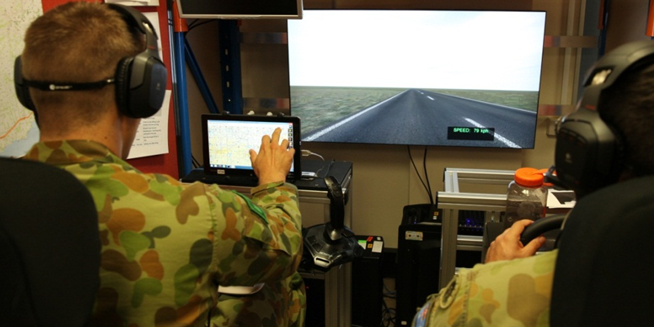
Vehicle simulators were comprised of two motion chairs facing a 46 inch screen. Motion was provided to chairs by D-BOX linear actuators. These chairs are capable of three types of motion; roll of approximately four degrees (left/right rotation), pitch of four degrees (forward-backward rotation) and heave (vertical movement) of approximately 40 mm. The level of motion was characteristic of driving along on a well-maintained, sealed road. The average motion produced by the simulation environment across the chairs was 0.08m/sec2 as calculated as the root mean square addition of the three axes of linear motion. The Australian Standard AS2670.1 categorises this level as not uncomfortable.
The screen depicted a sealed road in a flat rural environment with no other visual stimuli. Participants were seated on the left-hand side of a fellow participant performing a driving task. An 11.6 inch touchscreen tablet and standard QWERTY keyboard were used to perform the C2 tasks. The tablet was attached to a mount in front of the participant and the keyboard was affixed below the tablet. The vehicle simulator is depicted in Figure 1.
Digital C2 technology emulator (BMS-e)
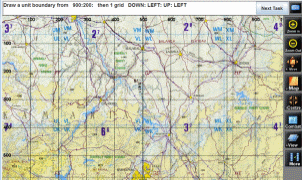
Digital C2 technology was emulated using a BMS-e which had software capable of performing basic information input and output functionality. It had interface similar to an actual digital C2 product, consisting of a window displaying a map and a vertical menu bar on the right-hand side of the screen (see Figure 2). This study involved the performance of six typical digital C2 tasks: reading text, writing text, detecting and reading military units, panning and zooming a map, creating a military unit and creating a boundary line. These same six tasks were used in the three previous studies that investigated usability of the BMS-e. They are representative of the core navigation and information exchange tasks for which digital C2 products are intended to be used. Participants were instructed to perform the following tasks:
- Read text: read aloud 10 randomly generated five-letter words (taken from a list of 1500).
- Write text: type five randomly generated five-letter words (taken from a list of 1500) into a text box.
- Read unit: read aloud the type, force size and location of a military unit icon presented on the map. Type was represented by one of five symbols within the icon, size was represented by one of three symbols above the icon and location was identified by X-Y map coordinates.
- Pan and zoom: pan the map up, down, left or right and then zoom in or out using buttons in the menu bar.
- Create unit: create a military unit at a specified location on the map. This involved pressing the screen at the desired location and selecting a unit from a pop-up list.
- Create line: create a four segment control line beginning at a specified location and then following instructions to move up, down, left or right one grid square from the current location.
Subjective satisfaction
The System Usability Scale (SUS) was used to measure subjective satisfaction with the technology . This 10-item scale captures an individual’s attitude towards a system and their perception of the ease with which it may be used. Participants were asked to rate their agreement to each item on a 5-point Likert scale ranging from strongly disagree to strongly agree. Scores on this scale range from 0-100, with higher scores indicating greater subjective satisfaction. Examples of items include “I think that I would like to use this system frequently” and “I thought the system was easy to use”. This scale has been found to have excellent internal consistency reliability (α = 0.91) and concurrent validity with other subjective usability scales .
Procedure
Data collection for this study occurred during a larger two-week project conducted at the Defence Science and Technology Organisation. During the first week, participants received extensive training to use the BMS-e (approximately five hours) to mitigate against potential practice effects. Upon completion of this training, the effectiveness and efficiency with which the participants used the BMS-e had stabilised. They also provided demographic information, gave their informed consent to participate in this study and completed a number of tasks related to other research. During the second week participants took part in a number of activities, including this study, while undergoing sleep deprivation and sleep restriction. The schedule of activities (that is, the type of activity and the approximate time it was completed) was consistent across each of the days.
Participants completed four testing sessions in this study. A baseline session was conducted after a night of at least eight hours sleep. The other three sessions were performed late each afternoon (16:00 to 17:30) over three consecutive days. The first occurred following a night of total sleep deprivation, after approximately 34 hours of continuous wakefulness (sleep loss Level 1). The remaining two sessions (sleep loss Level 2 and Level 3) were each completed after a night of sleep restricted to five hours (time in bed 01:00-06:00). This amount of sleep was selected as it is within the ADF guideline that suggests four to six hours of sleep is sufficient to recover performance after 36 to 48 hours of continuous wakefulness . All sessions were conducted at a time of day that was associated with similar levels of alertness due to the circadian rhythm . Participants were monitored during the day to ensure they did not nap.
The duration of each session was 30 minutes. Participants were instructed to work as quickly and as accurately as possible to complete 10 randomly generated items for each of the six task types (60 items total). Upon completion of the tasks, the SUS was administered.
RESULTS
Analysis of usability of the BMS-e
One-way repeated measures ANOVA analyses are provided for the three components of usability; effectiveness, efficiency and satisfaction. Each compares usability at baseline and the three levels of accumulated sleep loss: Level 1 (total sleep deprivation), Level 2 (sleep restriction one) and Level 3 (sleep restriction two).
Due to technical difficulties with the audio recording equipment, effectiveness data was missing for the Read Text and Read Unit tasks for three of the four testing sessions. These tasks were not included in the analysis.
Analysis of change of effectiveness
- It was hypothesised that digital C2 task effectiveness would decline as sleep loss accumulated. Means and standard deviations of effectiveness scores (measured in terms of percentage of tasks correct) for the Create Line, Create Text, Create Unit and Pan and Zoom tasks are presented in Table 1. Also presented are the F-ratios and associated degrees of freedom for each ANOVA. Mauchley’s test indicated that the assumption of sphericity had been violated for the Create Text, χ2 (5) = 15.93, p < .01; Create Unit, χ2 (5) = 12.72, p = .03; and Pan and Zoom tasks, χ2 (5) = 13.00, p = .02. Degrees of freedom were corrected using Greenhouse-Geisser estimates of sphericity for these three tasks (ε = .56, ε = .59 and ε = .57 respectively).
- The results indicate that there was no statistically significant difference in effectiveness scores between baseline and the three different levels of sleep loss for any of the four tasks. Therefore, the hypothesis that effectiveness would decline as sleep loss accumulated is not supported.
Analysis of change in efficiency
- It was hypothesised that digital C2 task efficiency would decline as sleep loss accumulated. Means and standard deviations of efficiency (measured in mean task completion time in seconds) for all tasks are presented in Table 2. Also presented are the F-ratios, associated degrees of freedom and effect sizes for each ANOVA. Mauchley’s test indicated that the assumption of sphericity had been violated for the Create Line, χ2 (5) = 17.55, p < 0.01; Create Text, χ2 (5) = 27.17, p < 0.001; Pan and Zoom, χ2 (5) = 40.96, p < 0.001; Read Text, χ2 (5) = 11.81, p = 0.04 and Read Unit tasks, χ2 (5) = 19.06, p < 0.01. Degrees of freedom were corrected using Greenhouse-Geisser estimates of sphericity for these tasks (ε = 0.52, ε = 0.44, ε = 0.38, ε = 0.71 and ε = 0.48 respectively).
Post hoc analyses for task efficiency
- Post hoc tests using the Bonferroni correction were conducted to explore the differences in task efficiency at baseline and the three different levels of sleep loss.
- For the Create Line task, the results suggest that task efficiency was significantly impaired by accumulated sleep loss after a night of total sleep deprivation and a subsequent night of restricted sleep. However, this trend did not continue after a second night of restricted sleep and instead, following this sleep, participants showed a significant improvement in efficiency.
- Results for the Create Text task indicate that efficiency was significantly impaired by sleep loss Level 2 and Level 3. The greatest decline in efficiency (in mean seconds) was from baseline to Level 1, but this decrease was not found to be statistically significant. This is likely due to the high variability in the data at Level 1.
- The Create Unit results indicate that efficiency for this task was impaired by all three levels of experimentally induced sleep loss when compared with baseline performance.
- For the Pan and Zoom task, the results indicate that efficiency was impaired at the two higher levels of accumulated sleep loss when compared with baseline performance. The greatest decline in efficiency (in mean seconds) was from baseline to Level 1, but this decrease was not found to be statistically significant. This is likely due to the high variability in the data at Level 1. The results also suggest that there was a significant improvement in efficiency after the second night of sleep restriction (Level 3) in comparison to efficiency after the first night of sleep restriction (Level 2).
- The post hoc analysis indicates that efficiency for the Read Text task was significantly impaired after a night of total sleep deprivation, but not at the other two levels of accumulated sleep loss.
- For the Read Unit task, the results suggest that efficiency was significantly impaired by accumulated sleep loss after a night of total sleep deprivation and a subsequent night of restricted sleep. This trend did not continue after a second night of restricted sleep.
- For all six tasks, there was a significant decrease in efficiency at one or more levels of accumulated sleep loss when compared with baseline performance, providing support for the hypothesis that efficiency would decline as sleep loss accumulated. One task, Create Unit, showed a decline in efficiency at all three levels of sleep loss. Both the Create Line and Read Unit tasks showed a significant decline in efficiency after a night of total sleep deprivation and a subsequent night of sleep restriction. The Create Text and Pan and Zoom tasks showed a significant decline at the two higher levels of sleep loss (i.e. after the first and second night of sleep restriction). The Read Text task only showed a significant impairment in efficiency after a night of total sleep deprivation.
- While there were impairments when efficiency was compared to baseline performance, none of the tasks showed a significant decline between the three levels of sleep loss. Further, two of the tasks, Create Line and Pan and Zoom, showed a significant increase in efficiency when the second night of sleep restriction was compared to the first night of sleep restriction. This result indicates that participants’ efficiency had improved following the two nights of five hours of sleep opportunity. For the Read Text and Read Unit tasks there was also no significant difference between baseline performance and the third level of sleep loss, supporting the idea that participants’ efficiency had improved following two nights of 5 hours sleep opportunity. Given the extensive amount of time provided to train participants in the operation of the technology prior to this study, it is considered unlikely that this finding may be attributed to a practice effect. Therefore, the hypothesis that efficiency would decline as sleep loss accumulated is supported, but to a limited extent.
Analysis of change of satisfaction
An aim of this study was to explore the effect of sleep loss on user satisfaction of the BMS-e. Means and standard deviations of satisfaction ratings are presented in Table 3. A one-way repeated measures ANOVA indicated that there was no statistically significant change in satisfaction between the different sleep loss levels, F (3, 36) < 1, p = 0.81.
Discussion
The present study aimed to determine how different levels of sleep loss affect the usability of C2 devices like the BMS in a context with similarities to actual field conditions (i.e. military personnel using a BMS emulator in a simulated vehicular environment). It was hypothesised that two components of usability, effectiveness and efficiency, would decline as sleep loss increased. The effect of sleep loss on a third component of usability, user satisfaction, was also explored. Neither effectiveness nor satisfaction were found to be significantly affected by any of the three levels of sleep loss. Accumulated sleep loss impaired efficiency to some extent for each of the six C2 tasks, providing support for the hypothesis. Efficiency did not significantly decline between the three increasing levels of sleep loss, instead stabilising at a level below baseline performance. Further, efficiency was found to significantly improve on two of the tasks following two nights of restricted sleep.
Contrary to the hypothesis, effectiveness was not found to be affected by sleep loss for any of the four tasks analysed. Perhaps this result was due to the tasks produced by the BMS-e being overly basic and thus not sensitive to the effects of sleep loss. Prior studies that investigated a similar BMS-e under different motion conditions found significant effectiveness decrements when participants experienced a high level of motion . This suggests the tasks are sufficiently sensitive to reductions in performance under certain conditions. Perhaps this is due to the tasks having a significant psychomotor component; requiring the user to reach and touch the screen at a specified location; which is more susceptible to the effects of motion than the effects of sleep loss.
The other usability component not found to be affected by sleep loss was user satisfaction with the BMS-e. A simple explanation for this finding is that the levels of accumulated sleep loss experienced in this study did not affect the attitude of the users towards this particular product or the extent to which they felt discomfort when using the technology.
As hypothesised, sleep loss accumulated by either one night of sleep deprivation or the additive combination of sleep deprivation and one or two nights of sleep restriction was associated with a decrease in task efficiency when compared with baseline performance. A likely explanation is that this result is due to decreased vigilance, manifesting in slow reaction times. This finding is supported by previous research linking sleep loss with a reduction in vigilance and reaction time . Given the maintenance of effectiveness at all levels of sleep loss, a second possible explanation is that the participants in this study chose to favour effectiveness over efficiency (that is, compromise speed for accuracy), despite being instructed to work as quickly and as accurately as possible.
An incremental impairment in efficiency between the increasing levels of sleep loss was not found, suggesting that sleep restricted to five hours’ time in bed was sufficient to stabilise the impairment at a level lower than baseline. It is unclear whether this effect would have been maintained after subsequent nights of restricted sleep. This finding is consistent with studies of sleep restriction which have found a similar levelling-off effect after an initial decline in performance . Further, the current findings are in line with research suggesting that this stabilisation effect occurs even when substantial prior sleep loss has been amassed due to a night of total sleep deprivation . It has been proposed that this effect is due to adaptive changes within the brain that allow for a consistent but reduced level of functioning during periods of restricted sleep .
Further to this lack of cumulative impairment, significant improvements in efficiency were found for two of the tasks while participants continued to accumulate sleep loss. These efficiency gains occurred between the first and second nights of five hours of sleep opportunity (that is, sleep loss Levels 2 and 3). This finding is contrary to prior research which has found a recovery in functioning after accumulating sleep loss due to sleep restriction to only occur between one to three nights of sleep of at least eight hours . As previously mentioned, it is considered unlikely that this may be due to a practice effect due to the substantial amount of time allocated to training participants in use of the technology and the fact that performance did not improve beyond baseline levels. Instead, the result may be due to a second night of restricted sleep being sufficient enough to allow some recovery of sleep loss, leading to an improvement in task completion time. The ADF sleep loss management guidelines advocate that “a block of at least six hours of sleep should be allowed for recovery” following 36 to 48 hours of involvement in a continuous field operation (, p.86). This finding instead suggests that at least two blocks of sleep are required to recover some functioning and an extended amount of sleep may be necessary to fully recover efficiency when performing digital C2 tasks following a period of accumulating sleep loss.
Limitations
A key limitation of this research is the use of a simplified emulator of digital C2 technology rather than an actual operational unit. While effectiveness and satisfaction were not found to be affected by sleep loss, the difference in complexity of the software of the BMS-e and the fully functional devices limits the extent to which these results can be generalised beyond usability of a digital C2 emulator. A second limitation arises from this study being performed in a laboratory rather than a field environment. While it has been suggested that a simulated motion environment is appropriate for investigating human factors issues associated with the use of C2 technology on the move , a number of factors may be present during field operations that were not replicated in this study. These factors could interact with the effects of sleep loss and may include enemy threat, physical discomfort, time pressure and cognitive or physical fatigue caused by features of the operation. Despite these limitations, the research adds insight into how accumulated sleep loss may affect the usability of digital C2 technology.
Implications and future research
The results yielded from this study may have implications for the use of digital C2 technology during future field operations. It has previously been found that the design of products like the BMS may increase the time taken to perform mission planning and information exchange tasks than what was previously required when using paper based methods . The present findings indicate that the exchange of information between units via digital means may be further slowed if military personnel using the technology have accumulated sleep loss. This potential delay could lead to a decline in responsiveness of field units to key battle events, an outcome contrary to one of the primary objectives of procuring and fielding this technology.
Future research should seek to validate the findings from this study by exploring the usability of an actual digital C2 unit during a schedule of sleep loss. This would provide a greater insight into whether sleep loss is a factor which exacerbates the usability issues previously identified with digital C2 technologies like the BMS. Research conducted in a field environment that replicates factors such as enemy threat may be useful to explore the generalisability of these findings to pressured battle situations during which the technology may need to be operated efficiently and effectively. Further, future research should be conducted to determine the effect of other patterns of accumulated sleep loss on usability. For example, longer periods of total sleep deprivation, sleep restriction with napping opportunities, a schedule of sleep restriction spanning a greater number of days or the experience of sleep restriction where opportunities for sleep are provided under the sub-optimal sleeping conditions often experienced during continuous operations (such as sleeping in a moving vehicle or on the ground). Research of this nature would help to explore how usability of digital C2 devices like the BMS may be affected during different operational scenarios.
Research conducted on the effect of accumulated sleep loss on the integration of humans with technology is limited and more research is needed to determine whether this factor affects the successful use of other products or systems. These may be military technologies or products used in civilian environments where users are likely to experience sleep loss, for example, in the healthcare and transport industries. Finally, future research should seek to validate and explore the finding that two nights of restricted sleep may be sufficient to allow limited recovery of performance that was impaired due to sleep loss.
Conclusion
The present study found that only one of the three components of usability, efficiency, was affected by accumulated sleep loss. During field operations, this may lead to an increase in the amount of time taken to exchange information using digital C2 technology. More research is needed to validate and extend these findings.
References
N.A. Stanton, D.P. Jenkins and P.M. Simon, Human Factors in Defence: Digitising Command and Control: A Human Factors and Ergonomics Analysis of Mission Planning and Battlespace Mangement, Ashgate Publishing Group, Surrey GBR, 2009.
A. Bruseberg, “Presenting the Value of Human Factors Integration: Guidance, Arguments and Evidence”, Cognition, Technology & Work, Vol. 10, No. 3, 2008, pp. 181–189.
C.D. Wickens et al., An Introduction to Human Factors Engineering (2nd Edition), Pearson Education, New Jersey USA, 2004.
J. Nielsen, Usability Engineering, Academic Press, Boston USA, 1993.
V. Venkatesh et al., “User Acceptance of Information Technology: Toward a Unified View. MIS Quarterly, Vol. 23, No. 3, 2003, pp. 425–478.
International Organization for Standardization, Ergonomic requirements for office work with visual display terminal (VDTs). Part 11: guidance on usability (ISO 9241), 1998.
P.J. Murphy, Fatigue Management During Operations: A Commander’s Guide, Department of Defence, Puckapunyal VIC, 2002.
P. M. Salmon et al., “Task and Error Analysis for Battlefield Technology Evaluation: A Battle Management System Case Study”, Journal of Battlefield Technology, Vol. 15, No. 1, 2012, pp. 19–26.
O. Abedin, V. Demczuk and G. Judd, Usability of a Battle Management System under Simulated Vehicular Motion, Defence Science and Technology Organisation, Land Operations Division, 2012.
N.Goode, M.G. Lenné and P. Salmon, “The Impact of On-road Motion on BMS Touch Screen Device Operation”, Ergonomics, Vol. 55, No. 9, 2012, pp. 986–996.
P.M. Salmon et al., “The Effects of Motion on In-vehicle Touch Screen System Operation: A Battle Management System Case Study”, Transportation Research Part F: Traffic Psychology and Behaviour, Vol. 14, No. 6, 2011, pp. 494–503.
C. Harvey and N.A. Stanton, Usability Evaluation for In-Vehicle Systems, CRC Press, Florida USA, 2013.
T.B. Sheridan, Humans and Automation: System Design and Research Issues, John Wiley & Sons Inc, California USA, 2002.
D.B. Kaber, J.M. Riley and K.W. Tan, “Improved Usability of Aviation Automation through Direct Manipulation and Graphical User Interface Design”, The Journal of Aviation Psychology, Vol. 12, No. 2, 2002, pp. 153–178.
C. Harvey et al., “A Usability Evaluation Toolkit for In-Vehicle Information Systems (IVISs)”, Applied Ergonomics, Vol. 42, No. 4, pp. 563–574
D. Harris, Human Performance on the Flight Deck, Ashgate Publishing Group, Surrey GBR, 2011.
N.A. Stanton et al., “To Twist, Roll, Stroke or Poke? A Study of Input Devices for Menu Navigation in the Cockpit”, Ergonomics, Vol. 56, No. 4, 2013, pp. 590–611.
G.A. Boy, Introduction: A Human-Centred Design Approach in The Handbook of Human-Machine Interaction: A Human-Centred Design Approach, G. A. Boy (Ed.), Ashgate Publishing Group, Surrey GBR, pp. 1–20.
Australian Army, Army’s Future Land Operating Concept, Canberra ACT, 2009.
M. Thomas et al., “Neural Basis of Alertness and Cognitive Performance Impairments During Sleepiness. I. Effects of 24 h of Sleep Deprivation on Waking Human Regional Brain Activity”, Journal of Sleep Research, Vol. 9. No. 4, 2000, pp. 335–352.
S. Banks and D.F. Dinges, Chapter 6 - Chronic Sleep Deprivation, in Principles and Practice of Sleep Medicine (Fifth Edition), In M.H. Kryger, T. Roth, and W.C. Dement (Eds.), W.B. Saunders, Philadelphia, pp. 67–75.
G. Belenky et al., “Patterns of Performance Degradation and Restoration During Sleep Restriction and Subsequent Recovery: A Sleep Dose-Response Study”, Journal of Sleep Research, Vol. 12, No. 1, 2003, pp. 1–12.
C.L. Drake et al., “Effects of Rapid Versus Slow Accumulation of Eight Hours of Sleep Loss”, Psychophysiology, Vol. 38, No. 6, 2001, pp. 979–987.
D.F. Dinges et al., “Cumulative Sleepiness, Mood Disturbance, and Psychomotor Vigilance Performance Decrements during a Week of Sleep Restricted to 4-5 Hours per Night”, Sleep, Vol. 20, No. 4, 1997, pp. 267–277.
P. Philip et al., “Fatigue, Sleep Restriction, and Performance in Automobile Drivers: A Controlled Study in a Natural Environment, Sleep, Vol. 26, No. 3, pp. 277–280.
A.N. Vgontzas et al., “Adverse Effects of Modest Sleep Restriction on Sleepiness, Performance, and Inflammatory Cytokines”, The Journal of Clinical Endocrinology & Metabolism, Vol. 89, No. 5, 2004, pp. 2119–2126.
A.M. Williamson and A.M. Feyer, “Moderate Sleep Deprivation Produces Impairments in Cognitive and Motor Performance Equivalent to Legally Prescribed Levels of Alcohol Intoxication”, Occupational and Environmental Medicine, Vol. 57, No. 10, 2000, pp. 649–655.
M.G. Faletti et al., “Qualitative Similarities in Cognitive Impairment Associated with 24h of Sustained Wakefulness and a Blood Alcohol Concentration of 0.05%”, Journal of Sleep Research, Vol. 12, No. 4, 2003, pp. 265–274.
A. Muzur, E.F. Pace-Schott and J.A. Hobson, “The Prefrontal Cortex in Sleep”, Trends in Cognitive Sciences, Vol. 6, No. 11, 2002, pp. 475–481.
A.C. Reynolds and S. Banks, Total Sleep Deprivation, Chronic Sleep Restriction and Sleep Disruption in Progress in Brain Research, G. A. Kerkhof and H. P. A. van Dongen (Eds.), Elsevier, 2010, pp. 91–103.
T.J. Balkin et al., “Sleep Loss and Sleepiness: Current Issues”, CHEST Journal, Vol. 134, No. 3, pp. 653–660.
N. Lamond et al., “The Dynamics of Neurobehavioural Recovery Following Sleep Loss”, Journal of Sleep Research, Vol. 16, No. 1, 2008, pp. 653–660.
Standards Australia, Evaluation of Human Exposure to Whole-Body Vibration. Part 1: General Requirements, 2001.
J. Brooke, A "Quick and Dirty" Usability Scale, in Usability Evaluation in Industry, P. W. Jordan et al. (Eds.), Taylor & Francis, London UK, 1996, pp. 189–194.
A. Bangor, P.T. Kortum and J.T. Miller, “An Empirical Evaluation of the System Usability Scale”, International Journal of Human-Computer Interaction, Vol. 24, No. 6, 2008, pp. 574–594.
T.H. Monk, “The Post-Lunch Dip in Performance”, Clinics in Sports Medicine, Vol. 24, 2005, pp. 15–23.
H.P.A. van Dongen and D.F. Dinges, “Sleep, Circadian Rhythms and Psychomotor Vigilance”, Clinics in Sports Medicine, Vol. 24, 2005, pp. 237-249.
N. Goode, M.G. Lenné and P.M. Salmon, “Assessing the Effects of Motion on Touch Screen BMS Operation: A Comparison of On-Road and Simulation Study Data”, Journal of Battlefield Technology, Vol. 17, No. 2, 2014, pp.1–8.
Monica Stokes holds the degree of Bachelor of Psychology (Honours) from the University of Adelaide. She is a provisionally registered psychologist and at the time of publication was in the final year of a Master of Psychology (Organisational and Human Factors) at the University of Adelaide. She can be contacted by email at monicastokes02@gmail.com
Kayla Johnson is a registered psychologist and social sciences analyst within the Land Division at DSTO. She holds a Bachelor Degree (Honours) in psychology from Flinders University and a Master of Psychology (Organisational and Human Factors) from the Univeristy of Adelaide. She can be contacted by email at kayla.johnson@dsto.defence.gov.au
Dr Justin Fidock works as a senior cognitive scientist for the Defence Science and Technology Organisation. He has undertaken a number of studies aimed at facilitating improved implementation, user acceptance and integration of a variety of technologies in the Australian Defence Force, with a particular emphasis on information technologies and land vehicle systems. He has a PhD in business information systems with RMIT University and a Master of Psychology (Organisational) from the University of South Australia. He can be contacted by email at justin.fidock@dsto.defence.gov.au
Dr Paul Delfabbro is based in the School of Psychology at the University of Adelaide where he teaches learning theory, statistics and applied methodology. He has an extensive research record in applied psychology with a particular focus on gambling and decision making. He can be contacted by email at paul.delfabbro@adelaide.edu.au
| Table 1. ANOVA Summary Table for Effectiveness scores (% tasks correct) for the Create Line, Create Text, Create Unit and Pan and Zoom tasks at Baseline and Sleep Loss Levels 1 (total sleep deprivation), 2 (sleep restriction one) and 3 (sleep restriction two). N=13 | |||||||
|---|---|---|---|---|---|---|---|
| Baseline | Level 1 | Level 2 | Level 3 | ANOVA | |||
| Task | Mean (SD) | Mean (SD) | Mean (SD) | Mean (SD) | F | df | |
| Create Line | 93.85 (5.57) | 93.54 (6.20) | 91.38 (6.24) | 89.03 (9.35) | 2.01 | (3, 36) | |
| Create Text | 96.21 (5.78) | 97.64 (2.44) | 96.92 (4.85) | 96.51 (5.72) | <1 | (1.72, 20.69) | |
| Create Unit | 98.46 (3.99) | 98.46 (3.99) | 98.46 (2.92) | 96.92 (3.46) | <1 | (1.76, 21.12) | |
| Pan Zoom | 98.97 (2.85) | 98.97 (2.10) | 99.23 (1.46) | 98.72 (2.17) | <1 | (1.71, 20.47) |
| Table 2. ANOVA Summary Table for Task Efficiency (mean task completion time in seconds) for the BMS-e Tasks at Baseline and Sleep Loss Levels 1 (total sleep deprivation), 2 (sleep restriction one) and 3 (sleep restriction two). N = 13 | ||||||||
|---|---|---|---|---|---|---|---|---|
| Baseline | Level 1 | Level 2 | Level 3 | ANOVA | ||||
| Task | Mean (SD) | Mean (SD) | Mean (SD) | Mean (SD) | F | df | ω2 | |
| Create Line | 6.90 (1.18) | 8.60 (1.48) | 8.25 (1.17) | 7.44 (1.15) | 15.07** | (1.57, 18.84) | 0.21 | |
| Create Text | 13.40 (2.97) | 15.47 (3.62) | 14.83 (3.16) | 14.66 (3.14) | 4.56* | (1.32, 15.86) | 0.04 | |
| Create Unit | 5.76 (0.46) | 6.99 (1.11) | 6.64 (0.83) | 6.44 (0.85) | 10.88** | (3, 36) | 0.20 | |
| Pan Zoom | 2.82 (0.33) | 4.13 (1.72) | 3.60 (0.71) | 3.17 (0.49) | 4.74* | (1.15, 13.78) | 0.17 | |
| Read Text | 5.49 (1.08) | 6.59 (1.06) | 6.01 (0.82) | 5.87 (1.39) | 5.28* | (2.13, 25.52) | 0.09 | |
| Read Unit | 2.97 (0.30) | 3.95 (0.89) | 3.84 (0.62) | 3.72 (1.13) | 7.93* | (1.45, 17.40) | 0.17 | |
| *p < .05. ** p < .001. |
| Table 3. Mean Satisfaction Ratings at Baseline Sleep Loss Levels 1 (total sleep deprivation), 2 (sleep restriction one) and 3 (sleep restriction two). N= 13 | ||||||
|---|---|---|---|---|---|---|
| Baseline | Level 1 | Level 2 | Level 3 | |||
| Mean (SD) | Mean (SD) | Mean (SD) | Mean (SD) | |||
| Satisfaction | 67.88 (9.67) | 66.35 (10.83) | 67.40 (7.68) | 67.31 (11.29) |