
Volume 18, Number 1, March 2015
Group Capability Integrity Management (GCIM)
- 1 Vetronics Research Centre, University of Brighton, Cockcroft Building, Lewes Road, Brighton, BN24GJ, United Kingdom.
Abstract
Network integrity is a critical requirement for battlefield Mobile Ad-Hoc Networks (MANETs), but the inherent dynamicity and unpredictability of the wireless spectrum, as well as unintentional and intentional interference make wireless communications unreliable. Node mobility is commonly used to improve network Quality of Service (QoS) and restore connectivity in the case of a communication failure, however given that some nodes may be key to realising mission critical capabilities in a group, it is important that a node selection algorithm recognises the impact of the removal of a node from its group. We present Group Capability Integrity Management (GCIM), an application-aware node-selection algorithm which preserves mission critical group capabilities during network repair. We also present Coordinated Node Selection (CNS), a data-model-aware algorithm which enables disjointed node clusters to anticipate the node selection decisions made by other clusters in order to coordinate network repair efforts.
Introduction
Reliable communications is a critical capability of mobile assets in the battlefield . To fulfil this need, manned and unmanned vehicles in the battlefield, hereafter referred to as nodes, utilise multi-hop ad-hoc wireless networks, such as Mobile Ad-hoc Networks (MANET) . Seamless information exchange between nodes enables critical capabilities, such as improved situational awareness and increased survivability by being able to disseminate information gathered through advanced Command, Control, Communications, Computers, Intelligence and Interoperability (C4I2) technologies by members of the network.
The battlefield consists of a diverse range of nodes, all possessing unique abilities. To perform a given mission it is often necessary for multiple nodes to cooperate, providing specific capabilities and services to each other. This level of interaction is only possible by sharing information over a wireless network, often resulting in the shared information becoming critical to the mission at hand, while communication with the rest of the network is treated as optional.
The paradigm of Network Enabled Capability (NEC) encapsulates the notion that through strong interaction between mobile nodes, new capabilities emerge that are beyond the capability of any individual node—for example a main battle tank can achieve high accuracy through detailed targeting data supplied by a UAV, dismounted soldiers have a much higher survivability when supplemented by a UGV for building search. In NEC warfare, the creation of synergetic capabilities within these groups of appropriately selected nodes is one of the ways in which new functionality can be created from existing hardware and can be a significant asset.
Battlefield MANET are subjected to harsh environments, such as unintentional and intentional interference, as well as terrain obstacles, environmental attenuation and the constant threat of attack resulting in a highly dynamic pattern of availability and unpredictable Quality of Service (QoS) making it difficult to rely on wireless network and therefore hindering the adoption of MANET . A common approach to mitigate these problems is exploit and therefore directly influence node mobility and to vary the topology of the network itself.
A recent survey paper on the matter by Younis et al finds that existing topology management algorithms (TMA) do not consider the implications of relocating a node beyond the immediate importance of its current task. In an effort to improve overall QoS, traditional TMA may inadvertently re-task nodes which are engaged in a critical cooperation that provides a critical capability to its local group, significantly reducing the effectiveness of the fleet. It is important that a TMA recognises the importance of individual nodes in the context of their current cooperation, otherwise TMA may result in a capability defeating topology.
Data model (DM) approach
Data models (DM) are an efficient and reliable way to share information between node subsystems as well as nodes in the network. Using shared information from the DM to acquire mission data and node metrics has great potential protect the capability of the fleet as a whole and allows the network to be optimised while imparting minimum negative impact on group capability.
The UK MOD has multiple approaches currently under development in order to leverage the advantages of DMs in the battlefield and to manage the increasing complexity of military fleets. By increasing the use of modular systems, modules can be easily replaced and upgraded without a negative impact to the rest of the system. However providing interoperability between generations of subsystems becomes a challenge. On a node level the Generic Vehicle Architecture (GVA) DM approach solves this problem by enabling each subsystems to share a wide range of data with the use of publish and subscribe relationships. Each subsystem is required to publish current information about itself and when a subsystem requires this information it simply makes a subscribe request to the DM.
The same technique is exploited at the fleet level in the Land Open Systems Architectures (LOSA) . In addition to sub-systems being able to subscribe to data on the same platform, through LOSA these systems may also access data on other platforms (see Figure 1).
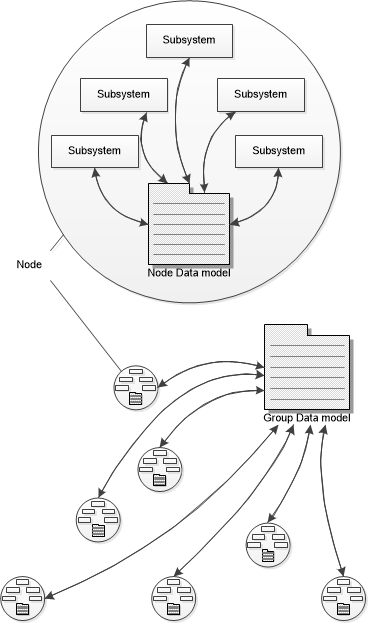
The NEC concept means that when grouping certain nodes together, the emerging capability is more effective than the sum of its parts, or new capabilities are created entirely. Examples of this include
- Increased safety in urban reconnaissance by dismounted soldiers through the use of lightweight UGV.
- Highly targeted long range strikes through accurate UAV targeting data.
- Long-range dismounted travelling enabled by an autonomous pack mule.
- Increased safety in convoy operations through early danger discovery by a scout UAV ahead of the convoy.
- Intelligence, Surveillance, Target Acquisition and Reconnaissance (ISTAR) requires a communications relay to transmit any gathered intelligence to where it is required.
Many of these beneficial group relationships emerge when pairing manned and unmanned nodes, since they have fundamentally different properties, strengths and weaknesses.
Capabilities have different requirements and constraints on node behaviour. In order for group capabilities to be leveraged, nodes are required to operate at specific waypoints or within certain distances to each other—that is, a targeting UAV needs to be on location in order to record relevant targeting data, an autonomous pack mule carrying ammunition needs to stay close to a group of dismounted soldiers in the event of an attack.
All this mission data—such as mission goal, waypoints, radius of permitted deviation from waypoint, and radius of permitted distance to a neighbour—is available to each node via the shared fleet DM.
Node versus group capability
Problem definition and overview
In battlefield scenarios nodes are routinely relocated in order to provide capability where it is needed. When a node is damaged or destroyed, its mission-critical tasks will be taken over by another node with a non-mission-critical task. A trade-off is made based on the importance of the capability. Similarly this node also has to take over the destroyed node’s place in the network topology. In order to relocate nodes within mission parameters, a number of other factors, such as physical security, support, recovery, etc. must be taken into account; however these requirements are outside the scope of this paper.
Node communication links and physical locations vary in criticality. It is important to recognise that the net effect of the loss of a node to the group is not the capability the individual node provides, but the capability that emerges as a result of cooperation within the group.
Assumptions
- Nodes are relocated in order to improve network topology
- High-level information is available from the fleet DM – nodes are mission data aware.
- Heterogeneous capabilities exist within the fleet producing increased cooperation when matched up appropriately
- Removal of a node from a group results in a loss of capability or usefulness, no node benefits the group through its absence.
GCIM: neighbourhood and mission awareness
A TMA treating all nodes and all connections equally, only optimizing overall performance of the network, at best will not optimize important segments as much as it could, and at worst weakens the performance of important segments of the network in an effort to distribute nodes throughout the network equally. It is important that topology management recognises local node relationships. Optimising overall QoS is not very useful; routes to the specific neighbours in the network have very different QoS requirements. Moreover, depending on the type of mission, some capabilities may be considered critical, while others are expendable. Maximising overall group capability as opposed to mission critical capabilities can therefore be just as detrimental to mission survivability as maximising overall network QoS. GCIM recognises these problems and hence optimises specific capabilities in an effort to preserve essential capabilities while sacrificing expendable ones.
Coordinated node selection (CNS)
When partitioning of the network occurs, it is common for one partition to be considerably larger than the other, or to consist of several clusters spread out over a large area. Since each partition will typically only send a single node for network repair, in some cases the repairing nodes can miss each other and therefore increase the time to reconnect and waste resources travelling in the wrong direction.
It is reasonable to assume that data model data is cached throughout the network and that any two separated parts can both interpolate the other partition’s mission data and thus the location of a node sent from the other cluster as a means of topology repair. CNS makes use of these facts and is therefore able to interpolate the other cluster’s node selection by running the same selection algorithm on the data of both partitions. This way, the two selected nodes can be instructed to travel directly towards each other for an effective minimum reconnection time with least movement cost.
Experimental modelling
A steady state, agent based simulation is developed using Java. Each mobile node is modelled as an agent in a 2D environment. For MANET communications, nodes use an 802.11 transceiver with a range of 250m. for routing, the nodes use the loop free distance vector routing protocol BABEL . This communication range was chosen both to represent MANET class transceivers as well as a fall-back case of a heavily saturated or jammed spectrum of longer range wireless battlefield technologies, such as BOWMAN. For long range communications, some nodes are equipped with a point to point transceiver with a range of 1,000m. The data rate of any of wireless communication links is assumed to be of sufficient capacity to not present a bottleneck.
To model the amount of value each node adds to the overall capabilities of a group in a scalable way, each node is assigned 5 capabilities, each of which is represented form by a random numerical value between 1 and 10. When a communication failure occurs and a node is tasked to leave its group, this capability value is used to represent the extent to which the group is now deprived of.
To measure the relative performance of GCIM, it will be compared to a similar algorithm. C2AM is an application aware recovery algorithm which also recognises variable requirements among different nodes. It balances the readiness and cost of a node to relocate based on several performance indexes, but fails to take into account the NEC factors involved in battlefield networks.
Scenario
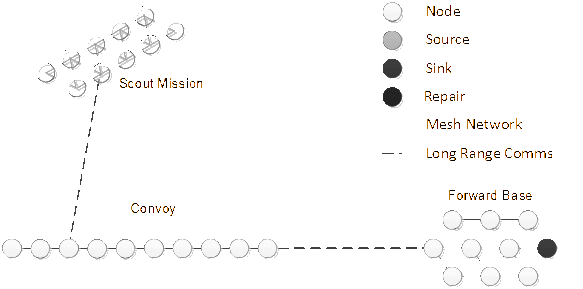
The scenario comprises three separate clusters each containing ten nodes. The first cluster represents a Convoy Mission delivering supplies to the second cluster, the Forward Base. The third cluster represents a Scout Mission (see Figure 2). A single node within each of the three clusters is equipped with a long range P2P transceiver allowing the three clusters to communicate and share a data model. Nodes travel at an average speed of 20kmph. See Table 1 for detailed simulation parameters.
| MANET Range | 250m |
|---|---|
| P2P Range | 1,000m |
| Mobility model | Reference point |
| Total number of Nodes | 30 |
| Node Speed | 20kmph |
| Number of Capabilities | 5 |
| Time to failure | 10s |
| Scenario duration | 300s |
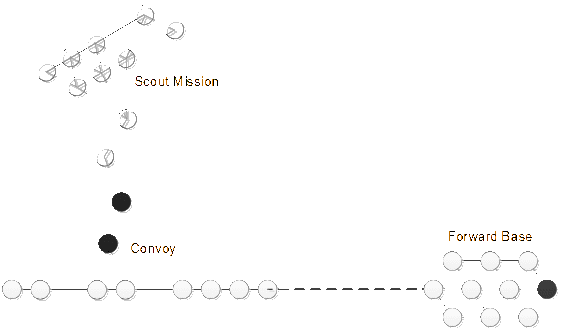
At t=10s the long range communication link of the Scout Mission fails, prompting the network repair process. Repair nodes are being selected from each partition based on the algorithm used, if a single node per partition cannot achieve reconnection with the other partition, further nodes form a chain to relay the information between the two partitions (see Figure 3). Nodes which are selected for the network repair process are no longer considered part of their original group and hence deprive it of their capability contribution.
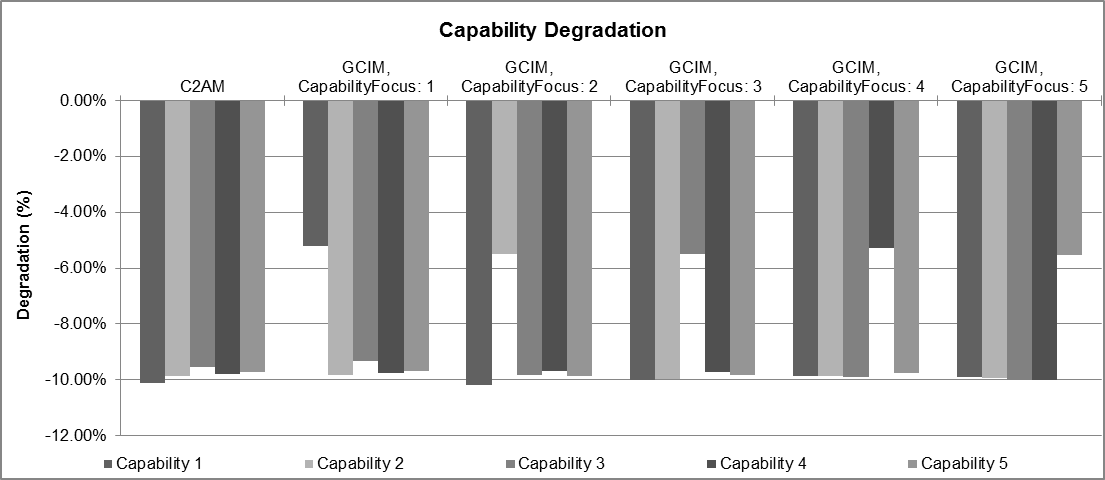
A total of six scenarios are simulated. The first scenario uses C2AM as a control, the remaining five scenarios use GCIM and CNS. Each of the latter five scenarios measures downtime incurred during link failure as well as the effect of choosing one of the five node capabilities as mission critical. Since dispatch of a node for network repair always results in a loss in capability, each time a node is chosen to repair the node, the loss in capability caused by this node is counted as total capability loss and compared to the other simulation scenarios.
Simulation results
CNS behaviour
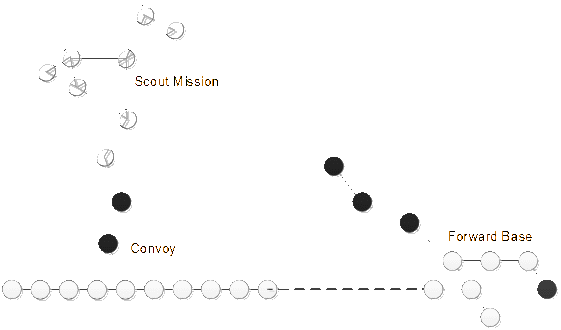
When nodes that are selected for network repair travel towards a random part of the other partition, in some cases significantly more nodes are being used as a result, since at least one set of repair nodes must bridge the complete distance between the partitions (see Figure 4). CNS, based on interpolation of the other partition’s choice of repair node, ensures that nodes always meet halfway between partitions (see Figure 3).
Downtime
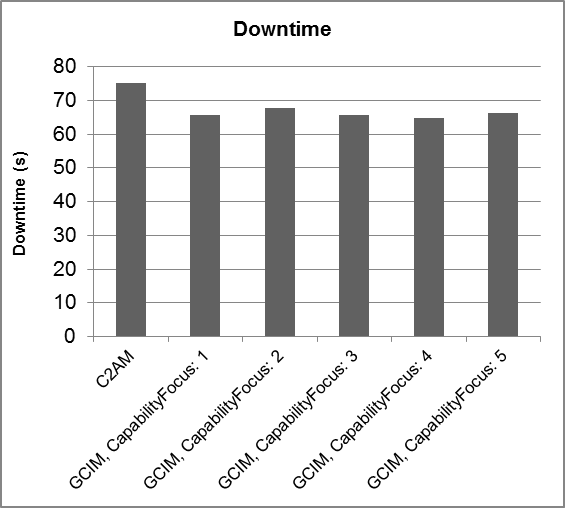
Between the failure of the long range communications link and the reconnection, the network experiences downtime. The three factors influencing the amount of downtime are node’s MANET communication range, the distance of the separated clusters and whether nodes pick the shortest path during network repair. CNS has a significant impact on the latter variable, ensuring that nodes meet in the middle of the two partitions and therefore always travel the shortest path given the choice of repair node. When compared to an algorithm unaware of the other partition’s location, CNS, on average, reduces the networks downtime by 13.6% (see Figure 5). The choice of mission critical capability has no effect on downtime.
Capability degradation
Capability degradation is the result of nodes leaving their respective groups. Every time a node is sent to repair the network, its group loses a certain amount of capability value depending on the node. By selecting the node which results in the least amount of loss of a certain capability, capability degradation can be minimised. Also, the longer the distance that needs to be bridged, the more nodes are required for repair, resulting in higher capability degradation. While C2AM determines node selection based on the importance of a node’s mobility readiness and movement cost, GCIM evaluates the overall capability loss of each node in the group and selects a node for network repair which results in the least degradation of a selected mission critical capability. Compared to C2AM, GCIM results in an average 54.9% reduction in capability degradation (see Figure 5).
Conclusions
In the battlefield there exist a variety of separate mission goals and asset capabilities across the network causing highly variable QoS requirements. In order to avoid unintentionally weakening critical parts of the network in an effort to maximise overall performance, it is necessary to manage the networks QoS between specific nodes rather than optimising QoS across the network equally.
Increasing fleet interoperability through information sharing not only provides relevant information to nodes in the network, but enables NEC in ways that provides entirely new capabilities to the fleet. Increasing vehicle heterogeneity in the battlefield with diverse requirements and capabilities amplifies this effect. Particularly in the case of cooperating manned and unmanned nodes, the complexity of capability management calls for an automated solution.
Considering these benefits, maintaining network availability within the fleet becomes a high priority, however a highly dynamic and unpredictable physical medium requires frequent network repair and thus nodes which utilise network and application aware algorithms.
Exploiting node mobility to reconnect disjointed network portions is an effective solution, but a TMA must consider the costs, and be aware of the effect which node relocation can have on the mission capabilities of a group.
To resolve these issues CNS and GCIM are proposed. CNS analyses cached data model information from all parts of the network, predicts disconnected partition’s node selection and dispatches its own network repair node in the appropriate direction, reducing reconnection time and movement cost. Compared to an algorithm dispatching repair nodes to a random part of the disconnected network partition, CNS reduced communication downtime by an average 13.6%. GCIM introduces application aware node selection which focuses on preserving mission critical capabilities within a group of nodes. Compared to a similar application aware algorithm, C2AM, which performs node selection on current node task and movement cost, GCIM reduced capability degradation of specific mission critical tasks by an average 54.9%.
Future work
Mobility in battlefield networks can be exploited to improve QoS, but it also poses a challenge for TMA, since topology map formation becomes a mixture of discovery and anticipation and may introduce errors due to incorrect movement prediction. More research is needed on measuring the reliability of mobility prediction.
CNS enables each separated partition to anticipate the decisions of the other cluster, thus it could also be applied to the repair node selection, prompting only a single repair node in the event of a communications failure.
In addition to repairing the network in the event of a failure, GCIM could be used to exchange nodes between clusters in an effort to maximise overall maximum capability. More research is needed on the feasibility and overhead of this approach.
References
[1] NATO, R.a.T.O., IST-083 Technical Evaluation Report, 2008.
[2] K. Lund, A. Eggen, D. Hadzic, T. Hafsoe, and F. Jonsen, “Using Web Services to Realize Service Oriented Architecture in Military Communication Networks” IEEE Communications Magazine, 45(10), 2007.
[3] Z. Ye, S. Krishnamurthy, and S. Tripathi, “A Framework for Reliable Routing in Mobile Ad Hoc Networks”, INFOCOM 2003, 2003, p. 270–280.
[4] J. Zhao and R. Govindan, “Understanding Packet Delivery Performance in Dense Wireless Sensor Networks”, Proceedings of the 1st International Conference on Embedded Networked Sensor Systems, ACM: Los Angeles, California, USA, 2003, p. 1–13
[5] E. Ngai et al, “A Delay-aware Reliable Event Reporting Framework for Wireless Sensor-actuator Networks”, Ad Hoc Networks, 2010, 8(7): p. 694–707.
[6] J. Shanshan and X. Yuan, “Optimal Wireless Network Restoration under Jamming Attack”, Proceedings of 18th International Conference on Computer Communications and Networks, ICCCN 2009, 2009.
[7] M. Younis, et al, “Topology Management Techniques for Tolerating Node Failures in Wireless Sensor Networks: A Survey”, Computer Networks, 2014.
[8] A. Abbasi, et al, “C2 AM: An Algorithm For Application-aware Movement-assisted Recovery in Wireless Sensor and Actor Networks”, Proceedings of the 2009 International Conference on Wireless Communications and Mobile Computing: Connecting the World Wirelessly, 2009.
[9] M. Imran, et al, “Partitioning Detection and Connectivity Restoration Algorithm for Wireless Sensor and Actor Networks”, Embedded and Ubiquitous Computing, 2010.
[10] K. Akkaya, et al, “Distributed Recovery of Actor Failures in Wireless Sensor and Actor Networks”, Wireless Communications and Networking Conference, 2008.
[11] K. Vaidya and M. Younis, “Efficient Failure Recovery in Wireless Sensor Networks through Active, Spare Designation”, Distributed Computing in Sensor Systems Workshops (DCOSSW), 2010.
[12] J. Tang, B. Hao, and A. Sen, “Relay node placement in Large Scale Wireless Sensor Networks”, Computer Communications, 2006.
[13] H. Bin, T. Jian, and X. Guoliang, “Fault-tolerant Relay Node Placement in Wireless Sensor Networks: Formulation and Approximation”, High Performance Switching and Routing, 2004.
[14] A. Nigam and Y. Agarwal, “Optimal Relay Node Placement in Delay Constrained Wireless Sensor Network Design”, European Journal of Operational Research, 2014.
[15] I. Senturk, K. Akkaya, and S. Yilmaz, “Relay Placement for Restoring Connectivity in Partitioned Wireless Sensor Networks Under Limited Information”, Ad Hoc Networks, 2014.
[16] MOD, Defence Standard 23-09, Generic Vehicle Architecture (GVA), 2010.
[17] MOD, Defence Standard 23-12, Generic Soldier Architecture (GSA), 2013.
[18] MOD, Defence Standard 23-13, Generic Base Architecture (GBA), 2012.
[19] J. Chroboczek, The Babel Routing Protocol, RFC 6126, http://tools.ietf.org/html/rfc6126, 2011.