
Volume 17, Number 2, July 2014
Measuring And Tracking The Consumption Of Combat Ration Packs
- 1 Food & Nutrition Group, Land Division, DSTO-Scottsdale, 74 George St, Scottsdale, Tasmania 7260, Australia.
Abstract
Measuring the consumption of combat ration packs (CRP) in a military field environment provides two important types of information: an individual’s food consumption and hence their nutritional intake, and the consumption of food items at individual and system level (product performance data), which is important for optimizing CRP consumption and reducing wastage. Established methods to determine nutritional intake or product performance in other settings are not well suited to such field work; firstly due to practical reasons associated with working in a military field environment, and secondly because they typically provide only one type of information sought. A ration tracker system (RTS) was thus developed to accurately track the consumption of CRP items during military field trials providing simultaneously the two types of information sought. The challenges in developing such a system are identified, results from the first trial of the RTS presented and future development opportunities discussed. A field trial of the prototype RTS demonstrated how the use of CRP can be better monitored. This information can then be used for continual product improvement (CPI) of CRP to meet the nutritional requirements of personnel and to ensure the CRP system is effective, efficient and economical.
Introduction
Where organized messing for troops is impractical fresh food is partly or completely replaced by Combat Ration Packs (CRP) designed to provide troops on the battlefield with enough sustenance to meet their daily nutritional requirements [1,2]. Such combat rations have improved to the point where soldiers are supplied pre-packed meals that meet their basic energy needs while satisfying a number of other constraints. These include the need for: ration packs to be light and readily transported, food and beverage items to be hygienically sealed, food items to be shelf-stable so they can be stored without refrigeration for two years or more; food items to require only minimal preparation in a military field setting, and a range of menus to reduce monotony and allow for individual tastes [3].
These design requirements are met by assembling and packaging combat rations using both commercial off-the-shelf and purpose-made food and beverage items that have been tested and found to be suitable for use in ration packs. Furthermore, the requirement to keep CRP as light and compact as possible results in them being designed to be eaten in their entirety in order to deliver an individual’s daily nutritional requirements. Further development of modern CRP thus tends to focus on two perennial issues: 1) ensuring that daily energy and macro- and micro-nutrient requirements of military personnel conducting moderate to vigorous physical work are met [4] within the constraints of providing food in a military field environment; and 2) reducing the discard rate of CRP items. This latter reduction is important from the perspectives of lessening the prospect of under-consumption and its attendant nutritional consequences, and ensuring that a CRP system is delivered effectively, efficiently and economically with minimal wastage of resources. In particular a high discard rate suggests that a food or beverage may need to be reformulated or replaced with something more likely to be consumed.
Despite ongoing product improvement of CRP, ration packs are frequently not eaten in their entirety with many personnel choosing to discard food and beverage items for a variety of reasons [5-7]. This leads to the following questions—‘Are they eating enough to satisfy their daily energy requirements?’ ‘Does what they eat supply the necessary macro- and micro-nutrients to sustain performance and prevent the development of any health issues?’ ‘Are there ways to improve ration packs so that they are more fully consumed?’
To answer these questions food consumption in a representative field environment must be accurately recorded. To be able to determine both the impact on soldiers’ nutrition when CRP items are discarded, and the components of CRP that need improvement, the data must show which items are discarded, and by whom. Once recorded, it can be combined with other systems or information such as nutritional composition data for the foods to determine energy, macro-nutrient and micro-nutrient intake for individuals and qualitative data (e.g. perceptions of acceptability, palatability and suitability) to determine which products are regularly consumed and which may need to be improved or replaced.
To ascertain the effectiveness of interventions undertaken to improve the consumption rates of CRP a means to accurately measure discard rates, the specific food items discarded and for tracking changes in consumption patterns is needed. This paper describes a prototype ration tracker system (RTS) that was developed to meet the need to accurately record food consumption in a military field environment and its application during an Australian military training exercise. Future development opportunities and challenges for the system are also discussed, along with implications for its future use.
Measuring CRP consumption
As mentioned, measuring food consumption in a military field environment serves two purposes; to quantify an individual’s food consumption (individual nutrition intake data) and to evaluate the consumption of individual products (product performance data).
Measuring an individual’s nutritional intake is important in that it facilitates assessment of whether nutritional requirements are met and the resultant implications for their performance and health.. Decreases in performance in the short term may be physical (loss of speed, power output, or strength) physiological (suppressed immune function), cognitive (increased confusion) or emotional (increased perceptions of fatigue, loss of vigor) [4]. Risks to health from inadequate intake of certain micro-nutrients in the short, medium or long term can also be identified [4]. The primary goal of measuring an individual’s nutritional intake is then to determine if a specific ration pack is delivering adequate nutrition in terms of energy and macro- and micro-nutrient intake and, if not, where corrective actions might be applied.
Product performance data allows identification of the food and beverage items which are widely consumed and those which are regularly discarded. Such an investigation thus occurs at a number of levels. At the individual product level—where a particular item may not be consumed, and the remedy may be substitution with another variety of that food item or a similar item from another manufacturer. For example, a salmon pasta meal might be regularly discarded; a suitable corrective action may then be substitution with a tuna meal. Product performance data can also be used at the category level—where all items in that category may have high discard rates, requiring consideration whether to continue providing items from that food category or find replacements from another product category. For example, a range of sweet biscuits may be found to be poorly consumed, and the chosen intervention could be to replace sweet biscuits with muesli bars. Product performance data is thus used to identify which food and beverage items are routinely consumed and which are regularly discarded resulting in them having a nugatory effect on an individual’s nutritional intake, and representing a waste of resources.
Existing approaches to determine nutrient intake
Nutritionists and dietitians have established three broad techniques for measuring nutritional intake: a dietary record, where participants record all the foods and beverages they consume along with the amount of each, usually for one to three days; a dietary recall, where a trained interviewer assists a participant to recall and report foods and beverages they have consumed in the 24 hours prior; and a food frequency questionnaire (FFQ), where a list of foods is provided and participants record how frequently they consume each, and the portion size they consume [8].
All three types of techniques are, however, based on self-reporting and share an inherent weakness. Specifically their accuracy depends on the participants’ compliance with the requirements of the instrument; relying on memory or prompt recording of each item of food and an accurate estimate of the amount. Results may also be biased by a change in behavior during the recording period—issues of self-consciousness of the foods being eaten or the inconvenience of having to record every food may alter consumption. Whilst the data recorded may be a true record, it does not reflect typical consumption. Results may also be biased by social desirability—participants may consciously or sub-consciously report their intake in a way that will be viewed more favorably by others, for example under reporting fatty foods, or over reporting healthy choices. Finally, these methods can be time consuming and demanding for participants [9].
Existing approaches for product evaluation
The commercial sector uses many measures as indicators of product performance, with most firms using a combination to determine product desirability and demand, hence likely commercial success or failure. These measures can be broadly grouped into three categories [10]: 1) those that relate to the customer, both subjective measures (such as customer satisfaction and customer acceptance), and objective measures (such as market share, number of sales); 2) measures related to financial goals (such as profit, return on investment); and 3) those measures related to technical performance (such as meeting quality specifications, production on budget and on time).
These measures require reaching out to the consumer for qualitative assessments of satisfaction and acceptance, and reaching inward to the company to analyze financial and production records. They also rely on access to a number of different types of data to undertake a comprehensive analysis and interpretation.
Challenges specific to data collection in the military field environment
Measuring dietary intake in a military field setting is challenging as field exercises do not schedule time for participants to fill out dietary records or questionnaires, nor are field environments favorable for doing so. As an example, in tropical conditions paper-based questionnaires can become damp, and difficult to write on. Technical solutions to fix such problems can then give rise to other problems. For example, when questionnaires printed on waterproof paper were used in a muddy environment and later scanned, errors occurred due to muddy fingerprints being recognized as participant responses [11]! Researcher-assisted methods can be equally challenging; often the only opportunity for undertaking them being immediately post-exercise. Data collection can be further exacerbated by a lack of sufficient time to undertake it and the effects of participants being physically and mentally exhausted.
It has thus not been practical to adopt standard product performance measures from the commercial world for ration packs consumed in a military field setting. Methods previously used in Australia concentrated on calculating discarded items either through self-report or by physically counting the items discarded, then combining that with surveys measuring the acceptance of the food product and its perceived field suitability.
Physically counting items discarded in a military field environment requires data on what ration packs are issued to a soldier (an itemized list of the foods given) and data on the food items used or discarded by that soldier (usually the collection of a bag of empty wrappers or uneaten items). Once the practicalities of issuing and collection are arranged, there remains the time-consuming and laborious process of counting wrappers and attributing that usage data to each participant. (An implicit assumption is that an empty wrapper signifies that the item has been consumed.)
Clearly, a method that does not interfere with the training schedule of the soldiers, but accurately records what is being consumed in the field would be useful. Such data can then be combined with other information to calculate nutritional intake and indicate areas for product improvement.
Ration tracker system (RTS)
A prototype Ration Tracker System (RTS) was designed for data collection during the trial of a newly designed ration pack. The principal objective during system design was the complete traceability of individual ration pack items from issue to a soldier (as part of a ration pack) to their end point (either consumption or discard). A secondary requirement was the ability to monitor ‘swaps’, that is, items that were issued to one soldier, but eventually consumed by another.
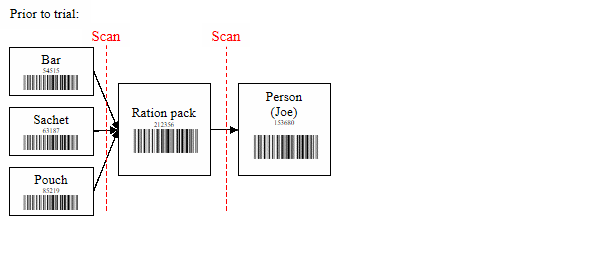
The RTS was based on a Microsoft Access database loaded onto three laptops with three hand-held scanners attached. To enable the level of traceability required, each individual food or beverage item (such as each muesli bar, drink sachet, sugar sachet, and main meal pouch) was labeled with a unique item barcode, and packed together to form an individual ration pack (also with a unique pack barcode). Built into the system was information about each product including product name, package size, food category, menu it belonged to, and nutritional information.
For the trial, each participant was assigned a unique barcode and, when the ration packs were issued, the appropriate pack barcodes were scanned and linked to that participant’s barcode. Figure 1 shows a flowchart of the scanning processes that took place before the trial began.
During the trial participants were instructed to retain all food packaging and uneaten items for collection by researchers. Each day, participants placed all their rubbish and unused items in a waste bag labelled with their name and gave it to the researchers. The barcodes on the collected items were then scanned into the ration tracker database against each participant’s barcode, which registered each item as either ‘returned full’, ‘partially used’ or ‘returned empty’. The RTS then populated the database with returned items, and the state in which they were returned. Queries were built into the system to determine which items were not yet returned, providing a means by which researchers could pursue completeness of data (e.g. by asking participants to check pockets or backpacks for missed wrappers). Figure 2 shows the processes that occurred during each day of the trial.
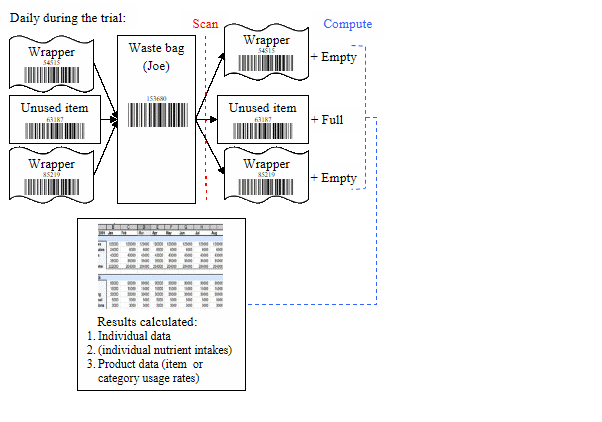
At the end of the trial, the following datasets had been assembled—individual product consumption rates (which were paired with acceptability survey data); category consumption rates (which allowed comparison of products within a product class); and individual nutrient intake (which allowed comparison with energy expenditure data).
RTS performance
The aim in developing a prototype RTS was to increase the accuracy of food consumption data in a military rationing setting. The trial of the prototype RTS involved 65 soldiers who were each issued six ration packs. Eleven participants left the trial prior to completion due to injury, illness or for personal reasons, and data from two others were removed due to poor compliance. Data from the remaining 52 participants—who each received an average of 35 food items in each of the six ration packs they were issued. A total of 11,656 items were tracked over the six days. At the end of the trial, only 73 items were unaccounted for, representing lost data of less than 1%. For comparison a previous field trial counting discarded items manually had a data loss rate of ~20% [12]. The prototype RTS thus represented a marked improvement on previous systems. It is worth noting that many of the 73 items unaccounted for were small (for example chewing gum, candy, sugar sachets) and could thus be inadvertently lost or dropped whilst in the field.
Data from this trial was combined with acceptability data for each item, allowing recommendations to be made regarding potential improvements to existing CRP [13]. The accuracy of the data allowed recommendations to be made at both a food item, and food category level. As data was collected on a daily basis, it could be used to calculate individual nutrient intake, allowing calculations of unacceptable, marginal or satisfactory intake for each participant [14].
The prototype RTS trialled solved many problems associated with other food consumption methods—it removed the requirement on participants to record information thus eliminating those problems associated with self-reporting approaches. Importantly, automating data collection and analysis vastly improved the accuracy of the measurement of the items discarded while providing a more efficient approach to the data collection.
Further development
Further development of the prototype RTS was undertaken by students from the Australian Defence Force Academy (ADFA) as a project for a third-year Information Technology (IT) subject. It was based on the Macintosh iOS system, and uploaded successfully to an iPhone, and an iPad. It also allowed the weight of partially consumed items to be entered into the database, further increasing the accuracy of the amounts consumed and the resultant calculations of nutrient intake. A new prototype based on this development is yet to be trialled in a military field environment. Further system development may include features that would produce a lightweight, robust system better tailored for use in military settings. Other options for further development include investigating how it could be used with other data collection systems (such as energy expenditure data collection systems, and food composition tables).
Some challenges remain. Tracking the CRP items using this system has greatly increased the accuracy of the food consumption data, but complete or accurate nutritional information for some products is not always available. This limits the overall accuracy of the individual dietary intake data. In terms of practicality, the individual labelling of CRP items is time consuming and must occur during the ration building phase. This is balanced, however, by a significant reduction in the time taken for data collection and analysis when undertaking such studies in demanding environments representative of military battlefields.
Conclusion
Assessment of consumption of ration pack food and beverage items during military exercises serves two important functions. Firstly, it provides essential information for CRP continual product improvement programs (by providing consumption patterns and therefore which items are likely to be eaten and which are discarded). Secondly, it can help identify potential health and performance issues (by providing individual consumption information for determining energy, macro- and micro-nutrient intake). The prototype RTS significantly improved data collection in challenging military field environments by providing an automated system with traceability of all items. The system developed reduced the data collection burden for both the researcher and the participant and provides a promising concept for further development.
References
[1] Australian Department of Defence, “Integrated Logistic Support Instruction (Version 3) for the In-Service Management of Combat Rations”, Army Logistic Instructions - Material Maintenance, 2009, Defence Materiel Organisation.
[2] IHS Jane’s, “Nurturing Nutrition: Feeding and Fuelling Fighting Forces", Jane’s International Defence Review, Vol. 45, April 2012, p. 69, UK.
[3] Australian Department of Defence, User Requirements for Combat Ration Packs, Issue 1.0 Dated October 2009.
[4] C.H. Forbes-Ewan, Australian Defence Force Nutritional Requirements in the 21st Century (Version 1), 2009, Defence Science and Technology Organisation, Australia.
[5] C.H. Forbes-Ewan, Acceptability and Service Suitability of the Combat Ration One Man during Operation Warden, 2001, Defence Science and Technology Organisation, Australia.
[6] J.E. Carins, The Acceptability of the Combat Ration One Man (CR1M) Ration Pack in the Field: A Survey, 2002, Defence Science and Technology Organisation, Australia.
[7] C.K. Booth, et al., “The Physiological and Psychological Effects of Combat Ration Feeding During a 12-day Training Exercise in the Tropics”, Military Medicine, 168(1), 2003, pp. 63–70.
[8] F.E. Thompson and A.F. Subar, “Dietary Assessment Methodology, in Nutrition in the Prevention and Treatment of Disease”, A.M. Coulston, C.J. Boushey, and M.G. Ferruzzi, Editors. 2001, Elsevier Inc, pp. 3–30.
[9] V. Deakin, “Measuring Nutritional Status of Athletes: Clinical and Research Perspectives”, Clinical Sports Nutrition, L. Burke and V. Deakin (eds), McGraw-Hill, Sydney2006.
[10] A. Griffin and A.L. Page, “PDMA Success Measurement Project: Recommended Measures for Product Development Success and Failure", Journal of Product Innovation Management, Vol. 13, 1996, pp. 478–496.
[11] J.E. Carins, Personal Comment, April 2013.
[12] DSTO, Internal field trial data, Acceptability field trial, 2007.
[13] J.E. Carins and C.J. Kullen, "Field acceptability and consumption of CR1M and potential new food items during the Hot Weather Ration trial", 2011, Defence Science and Technology Organisation, Melbourne, Australia.
[14] DSTO, Internal field trial data, Hot weather ration trial, 2008.