
Volume 17, Number 1, March 2014
A Neuro-Fuzzy Hybridization Approach To Model The Pilot Agent In Air Warfare Simulation Systems
- 1 Institute for Systems Studies and Analyses (ISSA), Defence Research and Development Organisation (DRDO), Metcalfe House, Delhi 110054, Delhi, India.
- 2 Faculty of Educational Sciences, Psychology and Social Sciences, University “Aurel Vlaicu”, Str. Nicola Alexici nr. 6, 310095 Arad, Romania.
Abstract
Intelligent military training simulators offer an economic, ecologically acceptable, training platform that approximates real-life situations, and facilitate perception and interaction in a relatively unconstrained situated-learning paradigm that supports a comprehensive learning strategy. Human factors such as skills, experience, situation awareness and pilot decision-making ability in the cockpit are critical factors that determine the decision processes, course of action, and results of the simulation. Air Warfare Simulation System, a virtual warfare analysis software has been developed for planning, analysis, and evaluation of mission effectiveness in air-tasking operations where human factors play a major role in training and learning. In this paper, we propose a Neuro-fuzzy hybridization technique, Adaptive Neuro-Fuzzy Inference System (ANFIS) to model the human factors of the pilot agent and behaviour characteristics in the warfare simulator. A pilot database has been developed in order to store the specific cognitive characteristics, skills, and training experience, which affect pilot decision making. Finally, their effect on the mission effectiveness obtained by the warfare simulation has been studied. The methodology of modelling human factors of pilots using ANFIS is illustrated with suitable examples, and lessons drawn from the virtual air warfare simulator are discussed.
Introduction
The escalating costs and resource constraints in the military worldwide, have led to greater reliance on innovative training technologies, new training methods, and evidence-based assessments as a means to maintain and enhance military preparedness. Human factors, advances in combat aircraft avionics and on-board automation, information from on-board and ground sensors and satellites cause data and cognitive overload conditions that pose a direct threat to pilot decision making.
Air Warfare Simulation System (AWSS) is virtual warfare analysis software that has been developed for operational planning, analysis and evaluation of air-tasking operations, operational effectiveness of weapon systems, campaign analysis and course of action evaluation [1,2]. In the design and development of such applications, modelling the complexity and battle dynamics, assessing and predicting quantitatively the outcomes of mission plans under various real-world conditions is a very difficult endeavour [3–5].
In most simulator designs, modelling human factors and pilot decision making based on cognitive attributes plays an important role in determining the outcome of any given situation [16,17,42,43]. Human factors, skills, and cognitive characteristics of pilots are considered and incorporated in designing the pilot agent so that the dynamic decisions based on enemy actions are also modelled. This forms the necessary basis for building a persona of pilot agents whose behaviour and plausible decisions are identified and simulated in the air warfare simulator.
An agent-based approach to designing the air warfare simulator and the modelling approach proposed in this paper using Adaptive Neuro-fuzzy Inference System (ANFIS) is discussed in Section 2. Section 3 discusses situation awareness factors and pilot skills’ attributes apart from information related to electronic sensors that are also modelled as agents. This is followed by a case study of two scenarios, related to the influence of human factors in decision making. In the final section, a discussion of the results is presented and future work is discussed.
Agent-based architecture to develop military training operations
Agent-oriented systems development has emerged as a powerful modelling technique that is more realistic in depicting dynamic warfare scenarios than the traditional methods that are either deterministic, stochastic, or based on differential equations. Conventional approaches provide a simple and intuitive approach to modelling warfare situations but are very limited in representing the complex interactions of real-world combat, the high degree of aggregation, multi-resolution modelling and their adaptability in the current network-centric scenarios. Agent-oriented models give each entity its own thread of execution, mimicking the real-world entities that affect military operations [4,19,20,23,24,31,32]. Conventionally, human factors such as pilot behaviour, cognitive abilities, and flying skills have either been ignored or implemented as a set of broad rules that do not have a significant bearing on the results of the war simulation [42], [43,32–34]. This has led to a large number of campaigns/missions planned by the trainees that are statistically valid and correct but not accepted realistically, as each trainee had a different story to add to the mission.
The pilot in the cockpit is modelled as an agent (Pi) that is implemented using adaptive neuro-fuzzy inference system (ANFIS), a soft computing paradigm that has been successfully used to model human factors for decision making [6,7]. The ANFIS model takes the specific persona of the pilot as inputs, environmental factors, inputs from sensors, (that form the situation awareness of the pilot) to generate the plausible course of actions (CoA). The persona of the selected pilot is used to choose the CoA in the AWSS that determines the mission effectiveness of the air tasking orders. Pi is a heavy-weight agent that determines the current environmental conditions over the area of operation selected for the mission—we define a heavy-weight agent as one that has its own decision-making ability and a built-in capability to generate the next plausible course of action(s) by inferring from a given situation (state). The situation is generated from information obtained and fed to the pilot agent by other agents based on which the pilot agent takes a reasoned decision and action.
As illustrated in Figure 1, the pilot agent (Pi) receives information from other agents such as weather, terrain, and deployment agents and provides an information service to the world agent after its own process of reasoning and actions. This information is then used by other agents such as Manual Observation Post (MOP), Unmanned Air Vehicle (UAV), Identification Friend/Foe (IFF), Radar Warning Receiver (RWR), Missile Warning Receiver (MWR), Laser Warning Receiver (LWR), Mission Planning, Sensor Performance, Target Acquisition and Damage Assessment and Computation. All these agents add to the information update in simulated real-time and generate the situation awareness for the pilot agent Pi.
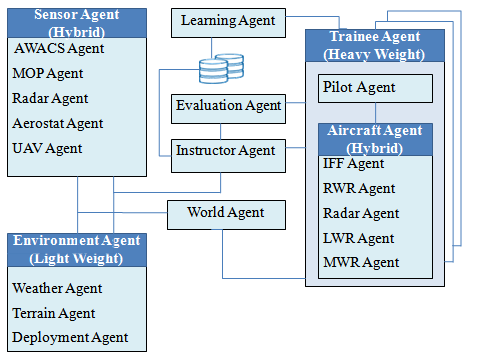
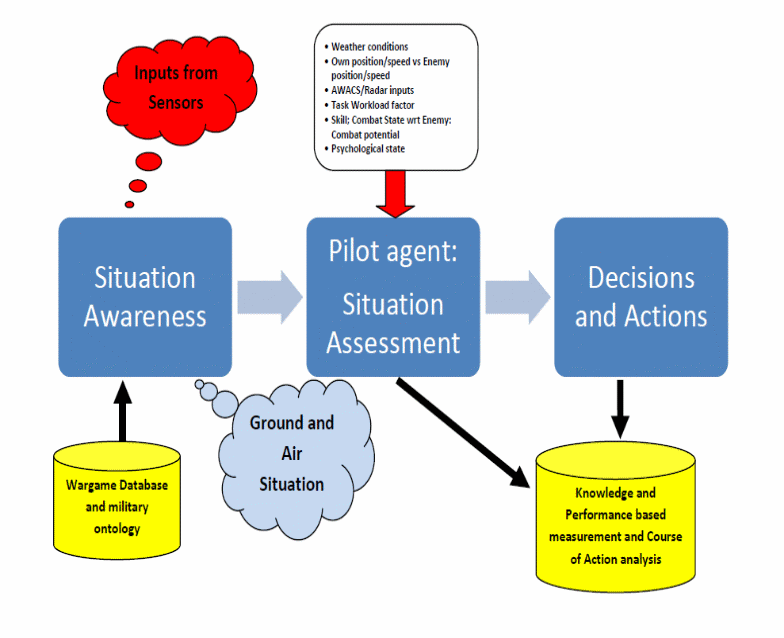
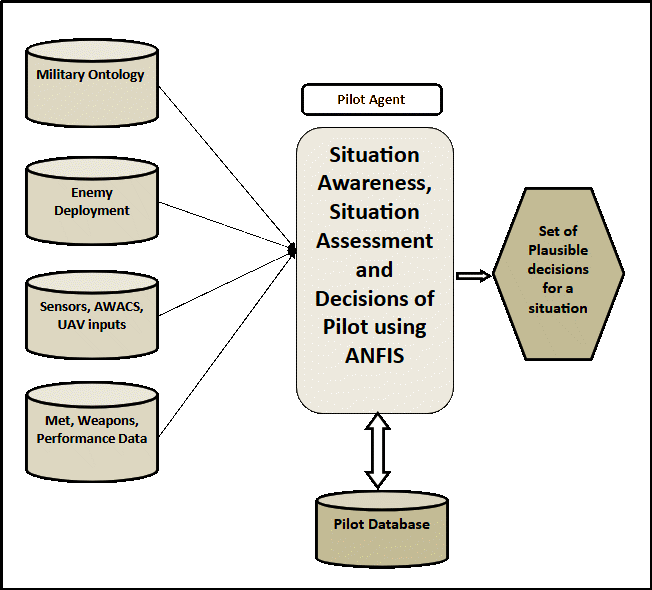
In this paper, we have designed the pilot agent using ANFIS [44–49] which is a neuro-fuzzy hybridization technique that accepts all of the human factors described in Table 1, as fuzzy linguistic variables as inputs and computes the combat potential utility of own pilot Pi and an assessment of the enemy, for any given situation. This is used to generate the dynamic decisions and the course of actions for a given situation of conflict or scenario, as opposed to the statistical approach to generating the rules for decision making. The results obtained by this methodology, which models the Pi, have proven to be better at generating realistic effects of pilot decisions and human factors involved in decision making. The analysis has brought out the nuances of decisions at every stage of the war game. Finally, the effects of various factors have been analyzed for identifying the causes of the predicted results.
Neuro-fuzzy hybridization to model the pilot agent
A number of approaches have been used to model the pilot’s decision making tasks depending upon the goal of study ranging from simple decision tables and numbers to depict the pilot skills, to a control theoretic notation to model the pilot behaviour [8,30,40]. Cybernetic influence diagrams and Decision networks have also been proposed in literature and have been successfully implemented in software systems [36,38]. Recently researchers have also successfully employed several soft computing approaches such as rule-based systems, intelligent agents, fuzzy rule based systems, game trees and case-bases to depict the various decisions taken by the pilots in the past, to decide the next course of actions in air combat scenarios [3,9,11,12,27,28].
In the literature, pilot models have been implemented using several approaches depending upon the purpose for which they have been built. One of the earliest approaches of implementation is related to the use of transfer functions in control theory with feedback to model the various operations of the pilot. Recent works using this approach used the Cessna aircraft to capture the data of trainees [36–38,41]. These approaches have a certain disadvantage that they mechanistically represent a pilot for representing their behaviour, but do not consider the cognitive aspects of the pilot for decision making. The other set of approach studied by researchers to represent the pilot is by representing the behaviour as a set of influence diagrams and decision networks. These are conventionally implemented as a set of rules of the form:
If <condition 1> then <action 1>
If <condition 2> then <action 2>
If <condition n> then <action n>
However, the number of rules required to represent the various situations that can plausibly be encountered in a warfare become very large. As part of this research work, we first implemented the pilot agent as a set of decision trees/rules that were statistically obtained from a large set of pilot data and decisions made by them in various situations. Interestingly, it was observed that these rules were statistically valid for large scale warfare simulations that are typically performed as part of the air campaign and strategic warfare analysis, but not good enough to learn lessons for individual campaigns/missions. This approach also did not divulge the various nuances of reasoning, inference and decision making which have a profound bearing on the outcomes of the warfare. In this work, we discuss the modelling of a pilot agent Pi using the adaptive neuro-fuzzy inference system (ANFIS), which is a hybridization of neural networks and fuzzy logic. We take into consideration various cognitive factors of the pilot’s decision making processes and situation assessment that was observed to be better and realistic in the pilot agents’ decision making in various warfare situations.
1 adaptive neuro-fuzzy inference system (anfis)
Both neural networks and fuzzy systems are dynamic, parallel processing systems that estimate input–output functions [7–9,44,45,49]. They estimate a function without any mathematical model and learn from experience with sample data. It has also been proven that 1) any rule-based fuzzy system may be approximated by a neural net and 2) any neural net (feed-forward, multilayered) may be approximated by a rule-based fuzzy system. Fuzzy systems can be broadly categorized into two families. The first includes linguistic models based on collections of IF–THEN rules, whose antecedents and consequents utilize fuzzy values. The Mamdani model falls in this group where the knowledge is represented as it is shown in the following expression:
The second category, which is used to model the Weather prediction problem is the Sugeno-type and it uses a rule structure that has fuzzy antecedent and functional consequent parts. This can be viewed as the expansion of piece-wise linear partition represented as shown in the rule below:
The fuzzy conjunction “And” operation between fuzzy sets known as Linguistics, for the implementation of the Mamdani rules is achieved by employing special fuzzy operators called T-Norms [6]. The ANFIS uses by default the Minimum T-Norm which is the case here and it can be seen in the following equation:
(1)
This approach approximates a nonlinear system with a combination of several linear systems, by decomposing the whole input space into several partial fuzzy spaces and representing each output space with a linear equation.
Such models are capable of representing both qualitative and quantitative information. They are capable of approximating any continuous real-valued function on a compact set to any degree of accuracy [44,49]. This type of knowledge representation does not allow the output variables to be described in linguistic terms and the parameter optimization is carried out iteratively using a nonlinear optimization method.
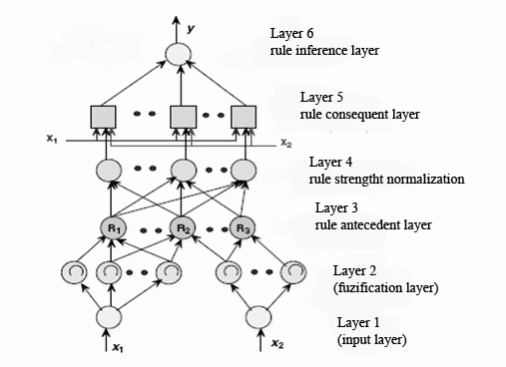
Fuzzy systems exhibit both symbolic and numeric features. Neuro-fuzzy computing [8,11] is a judicious integration of the merits of neural and fuzzy approaches, enables one to build more intelligent decision-making systems. Neuro-fuzzy hybridization is achieved broadly in two ways: a neural network equipped with the capability of handling fuzzy information (termed fuzzy-neural network) and a fuzzy system augmented by neural networks to enhance some of its characteristics like flexibility, speed, and adaptability [termed neural-fuzzy system]. ANFIS is an adaptive network that is functionally equivalent to a fuzzy inference system and referred to in literature as “adaptive network based fuzzy inference system” or “adaptive neuro-fuzzy inference system” (Figure 3) [9,10,13,14]. In the ANFIS model, crisp input series are converted to fuzzy inputs by developing triangular, trapezoidal and sigmoid membership functions for each input series. These fuzzy inputs are processed through a network of transfer functions at the nodes of different layers of the network to obtain fuzzy outputs. This is achieved with linear membership functions, giving a single crisp output that is related to the course of action, suggested by the pilot agent. Equations (2), (3), (4) correspond to triangular, trapezoidal and sigmoid membership functions respectively. These membership functions have been used to model the various cognitive factors data of the pilots that have been collected from experiments.
2 modelling human factors and pilot sa
Situation awareness is the perception of the elements in the environment within a volume of time and space, the comprehension of their meaning, and the projection of their status in the near future [15]. Situation awareness (SA) and human factors modelling are a predominant concern in system operation and dynamic decision making in an air warfare scenario. Maintaining a high level of SA is one of the most critical and challenging jobs of the combat pilot in these critical situations. Problems with SA were found to be the leading causal factors in a review of military aviation mishaps [15]. In a study of accidents among major airlines, 88% of those involving human error could be attributed to problems of SA as opposed to problems with decision making or flying skills [15].
Due to the important role that SA plays in the combat pilot’s decision-making processes, we designed a pilot’s database that captures the attributes representing the flying skills of pilots (from clinical/experiment tests) and these form an input to the pilots’ decision making during the air warfare simulation.
The errors in SA are summarized as follows [16,17]:
Workload/distraction (86%),
Communications/coordination (74%), I
Improper procedures (54%),
Time pressures (45%),
Equipment problems (43%),
Weather (32%),
Unfamiliarity (31%),
Fatigue (18%),
Night conditions (12%),
Emotion (7%), and
Other factors (37%).
Loss of Level 1 SA: Failure to correctly perceive the situation: 76%.
Loss of Level 2 SA: Failure to correctly comprehend the situation: 20%.
Loss of Level 3 SA: Failure to correctly project situation: 4%.
Several methods of testing situation awareness have been documented [16,17], notably the knowledge-based assessment and performance-based assessments. Several complex techniques exist which attempt to determine or model the pilot's knowledge of the situation at different times throughout the simulation runs. For example, the Situation Awareness Global Assessment Technique (SAGAT) freezes the simulator screens at random times during the runs, and queries the subjects about their knowledge of the environment. Such an approach has been designed to test the knowledge based measurement using the military ontology. This has been discussed in [6].This knowledge can be at several levels of cognition, from the most basic of facts to complicated predictions of future states. Several causal factors affect the actions of the subject, as shown in Figure 5.
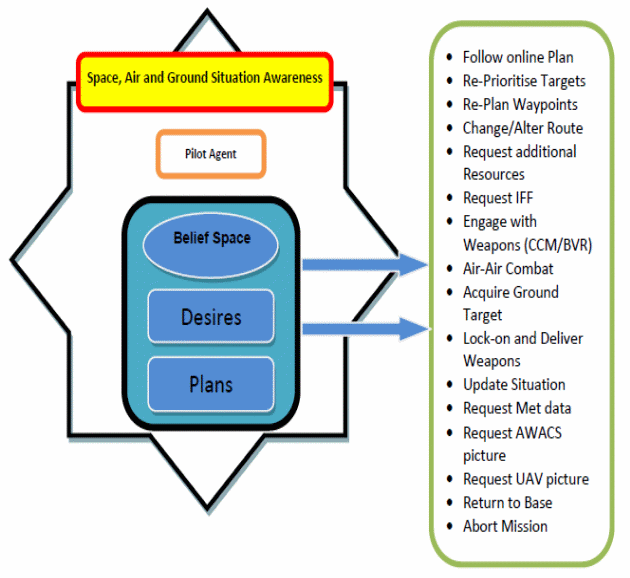
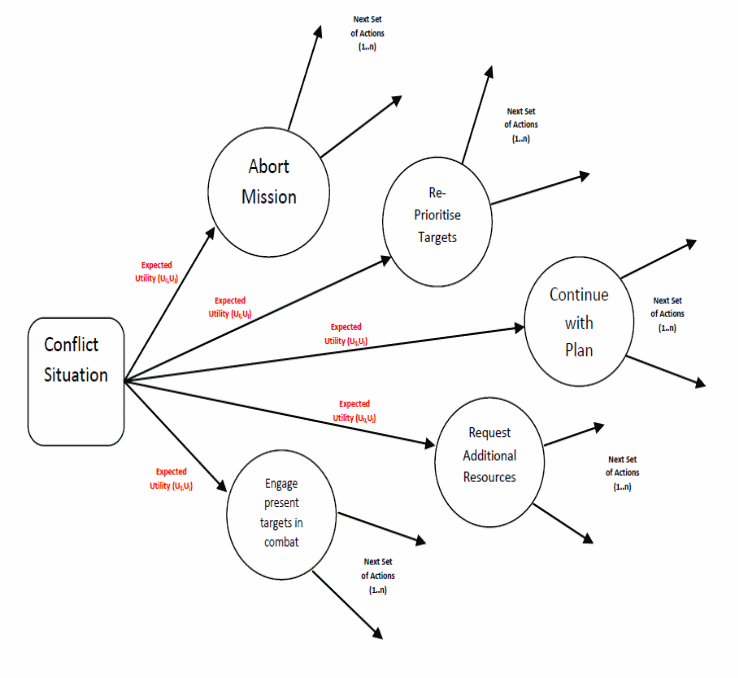
The scenario in AWSS considered these situations and used the pilot’s database depicting the cognitive/behavioural attributes using ANFIS in order to generate the appropriate decisions/actions of the pilots [1,9,10,13,15]. Each decision of the pilot during the conflict resolution phase of the simulator design asks the pilot for an action, and this leads to the next course of action. The entire lesson plan thus is represented as a network of decision nodes and actions. At the end of the training lesson, analysis of the pilot’s decisions and their actions are done by knowledge based measurement and performance based measurements. In the following section, we consider two scenarios/situations that demand an explicit action by the pilot under training where different pilots agree to disagree and take different actions.
Design of training situations and results analysis
In the design of training simulators, lessons plans are prepared with an inherent conflict situation that needs to be resolved and arrive at a decision to take the appropriate action. In this process, measurements are taken to evaluate the quality of decisions and lessons learnt. Two measurement based approaches based on the knowledge base and cognitive skills and performance-based measurement of assessing situation awareness were considered to study the effects of pilot decision making process and the end results of the mission effectiveness. Two situations that are commonly encountered in training lessons are highlighted in the following scenarios and the decisions/actions of the pilot are recorded.
Situation 1: In an air combat simulation where two opposing combat aircraft are engaging to kill, different pilots take different actions that are dependent upon the situation assessment and also on the actions performed by the opposing force. We simulate these situations with the characteristic profiles of two different pilots P1 and P2 that are stored in the pilot database.
Situation 2: When the combat pilot of a multi-role aircraft encounters bad weather and is unable to locate the target, various decisions can be taken based upon the pilots experience and ground picture that he is familiar with. Situation awareness and assessment of the pilot makes different pilots to take different decisions that lead to different mission effectiveness.
The results of both these situation analysis, decisions taken by the two pilots, and the mission effectiveness are summarized in Tables 2 and 3. A summary of the various factors that are considered to evaluate a combat effectiveness of a pilot are shown in Table 1. Several clinical psychometric tests used to measure all the intangible human factors are stored in the pilot’s database. For this study, we considered the factors shown in Table 2.
The factors identified in Table 2 are representative of the two pilots P1 and P2, who differ mainly in Information Processing and decision making, Risk taking and Reaction to stress which are typically identified personality traits. Data collected using clinical and psychometric tests for all the pilots are stored in the Pilot’s database. These attribute values from the pilot’s database are fuzzied and used to determine the pilot’s personality as one of the inputs to the ANFIS tool. The other inputs that are used for computing the Combat Utility factor are: Type of combat aircraft, Mission commander (pilot and skills as in Table 2), number of sorties flown on the day of mission, expected enemy air/ground defence threat, situation awareness of the pilot, entropy or uncertainty of the sensor fused information to the pilot, combat potential ratio (of own and enemy resources), pilot’s subjective mental workload measured using the NASA-TLX measurement scale, Combat Utility factor that measures the combat utility of the pilot in taking a decision and following a course of action as depicted in Figure 5 (a,b). These input factors of pilots play an important role in decision making which in turn affects the overall mission success. The output obtained from the ANFIS system is a measure called Combat Utility factor that depicts the utility of the pilot in achieving his objective. In a similar vein, we also compute the Combat Utility factor for the enemy.
Based on the values obtained from the ANFIS tool, the pilot agent takes a rational decision that is also depicted in Table 3. Decisions that are obtained from the ANFIS are used as the pilot’s decision and the mission effectiveness is computed in AWGSS. The ANFIS tool is developed in Matlab [17] and an interface with a VB application of the AWSS. Some typical results that are obtained using the ANFIS tool and AWSS that consider the human factors, situational awareness and assessment, and pilot skills are summarized in Table 3.
(a) (b)
| Biographical Data Life inventory Academic history Military history Military rank Risk Taking Willingness to take calculated risks Reactions to Stress Performance under stress Emotional control Ability to withstand psychological stress Anxiety Sensory-Motor Abilities Visual perception Motor coordination Spatial coordination Spatial-perceptual ability Perceptual speed | Aptitude Pilot composites Non-pilot composites General aptitude (intelligence) Numerical skills Verbal skills Mechanical skills Flight aptitude Personality Aggressiveness Self confidence Mental health Consideration for others Personality style Courage Personality-Leadership Responsibility for men in combat Physical and combat leadership Administrative skills Military bearing Social factors Teamwork Sociability Group loyalty Interpersonal rating | Motivation Determination/Desire Self discipline Satisfaction Medical/Physiological Good physical health Endurance Physical aptitude Ability to withstand psychological stress Decision Making/Information Processing Selective attention Decision time Quality of combat decisions Alertness Integrative decisions Aviator Skills, Knowledge and Tasks Equipment knowledge Flight skills Instrument reading Aerial gunnery BVR/CCM launch Stealth Air combat WVR combat |
|---|
- Table 2: Pilot’s attributes considered in the ANFIS.
| Pilot Id | Personality Type | Risk Taking | Info Processing and Risk taking | Aviator Skills | Firing skills / experience | Sensor-Motor abilities | Personality -Leadership | Motivation | Reaction to Stress | Physiological/Medical Health |
|---|---|---|---|---|---|---|---|---|---|---|
| P1 | A | High | High | V High | V High | High | Excellent | High | Composed | Cat 1 |
| P2 | B | Low | Low | High | High | High | Excellent | High | Stressed | Cat 1 |
| MissionID | Combat aircraft | Mission Comd | Sorties flown /day | Enemy Air/Ground defence Threat | Situation awareness | Entropy | Info Overload | Combat Potential Ratio (MAUT) (Own:En) | Combat Utility Factor (ANFIS) (Own:En) | Subjective Mental Workload NASA-TLX | Situational Decision of pilot (AWSS) | Mission Success Factor |
|---|---|---|---|---|---|---|---|---|---|---|---|---|
| #001 Sit 1 | Multi-Role | P1 | 3 | High | Very High | High | High | Static: 1:0.78 Dyn: 1:1.3 | 1: 1.4 | Low | Re-prioritize targets | 8.7 |
| #001 Sit 1 | Multi-Role | P2 | 3 | High | Very High | High | High | Static: 1:0.78 Dyn: 1:1.3 | 1:1.4 | High | Request additional resources | 4.3 |
| #002 Sit 2 | Multi-Role | P1 | 2 | Very Low | Low | Low | Low | Static: 1:0.44 Dyn: 1:0.65 | 1:-0.3 | Low | Lock-on and deliver weapons | 7.6 |
| #002 Sit 2 | Multi-Role | P2 | 2 | Very Low | Low | Low | Low | Static: 1:0.44 Dyn: 1:0.65 | 1:-0.3 | High | Look for secondary targets | 3.2 |
The situation 1 depicted as an air to air combat, commanded by pilot P1 with Very High Situation awareness and High uncertainty in this overloaded information has Low mental workload (NASA-TLX) and decides to “Re-Prioritize targets”. Thereby, by choosing the optimal combat utility factor a Mission success of 8.7 is obtained; whereas another pilot P2 with High mental workload decides to “Request Additional Resources”. This option seemed to yield a high combat utility for him and achieving a Mission success of 4.3. Similarly, in Situation 2, which depicts an air-to-ground targeting scenario with bad weather, pilot P1 decides to “Lock-on and Deliver Weapons” taking the appropriate risk and obtaining a mission success of 7.6, whereas pilot P2 decides to “Look for alternate targets” thereby achieving a mission success of 3.2.
Conclusion
A novel approach to design the pilot agent using ANFIS is presented in this research paper. More specifically, a neuro-fuzzy hybridization technique is employed to model the pilot skills factors and the operations of the pilot agent in a virtual warfare analysis system called AWSS that is designed using an agent-based architecture. The system is applied to compare the results obtained by considering the pilot decision factors to obtain a useful measure called Combat Utility in combat simulation exercises to take the next course of actions. The results that are predicted by the pilot agent after training exercises and the rules that are generated to predict the Mission_Success_Factor are found to be very satisfactory in predicting the mission’s performance in the presence of situations and pilots with different skill attributes.
This concept introduces a new approach to introduce human factors and their effects in the AWSS by using ANFIS as the reasoning and inference system. A future research effort will include working on ways for optimizing the rules for specific combat scenario and also on the improvement of the overall system’s performance in terms of execution time.
ACKNOWLEDGEMENTS
The authors would like to thank Dr K. Ramachandran, Director, Defence Institute of Psychological Research, Delhi, Dr Venugopal Duddu, NHS and the several combat pilots for interactions and discussions on the situation awareness and aptitude tests conducted for combat pilots.
References
[1] Basic Doctrine of the Indian Air Force, 2012. (http://www.scribd.com/doc/109721067/Basic-Doctrine-of-Indian-Air-Force-2012-PDF)
[2] D. Vijay Rao, The Design of Air Warfare Simulation System, Technical Report, Institute for Systems Studies and Analyses, Delhi, India, 2011.
[3] D. Vijay Rao and K. Jasleen, “A Fuzzy Rule-based Approach to Design Game Rules in a Mission Planning and Evaluation System”, 6th IFIP Conference on Artificial Intelligence Applications and Innovations, 2011.
[4] D. Vijay Rao and B. Saha, “An Agent-oriented Approach to Developing Intelligent Training Simulators”, SISO Euro-SIW Conference, Ontario, Canada, June 2010.
[5] D. Vijay Rao, L. Iliadis, S. Spartalis, and A. Papaleonidas, “Modelling Environmental Factors and Effects in Virtual Warfare Simulators by Using a Multi Agent Approach”, International Journal of Artificial Intelligence, Vol. 9, No. A12, pp. 172–185, 2012.
[6] D. Vijay Rao, L. Iliadis, and S. Spartalis, “A Neuro-Fuzzy Hybridization Approach to Model Weather Operations in a Virtual Warfare Analysis System”, Proceedings of the 12th Engineering Applications of Neural Networks (EANN), Springer LNCS AICT 363, Vol. 1, pp. 111–121, 2011.
[7] D. Vijay Rao, R. Shankar, L. Iliadis, and V.V.S. Sarma, “An Ontology-based Approach to Designing Adaptive Lesson Plans in Military Training Simulators”, Proceedings of the 13th Engineering Applications of Neural Networks (EANN), Springer LNCS AICT 363, Vol. 1, pp. 81–93, 2012.
[8] D.T. McRuer and E.S. Krendel, “Mathematical Models of Human Pilot Behavior”, AGARDograph No. 188, NATO Advisory Group on Aerospace Research and Development (AGARD), London, 1974.
[9] E.Y. Rodin and S.M. Amin, “Maneuver Prediction in Air Combat Via Artificial Neural Networks”, Computers & Mathematics with Applications, 24, pp. 95–112, 1992.
[10] C.D. Meier and R.O. Stenerson, “Recognition Networks for Tactical Air Combat Maneuvers”, Proceedings of the 4th Annual AAAI Conference, Dayton, OH, October 1988.
[11] R.R. Mitchell, “Expert Systems and Air-combat Simulation”, AI Expert, pp. 38–43, September 1989.
[12] C. Tran, A. Abraham, and L. Jain, “Adaptation of a Mamdani Fuzzy Inference System Using Neuro-genetic Approach for Tactical Air Combat Decision Support System”, AI 2002: Advances in Artificial Intelligence (2557), 15th Australian Joint Conference on Artificial Intelligence, Canberra, Australia, Springer Verlag, Proceedings, pp. 672–680, 2–6 December, 2002.
[13] Heinze, C., “Modelling Intention Recognition for Intelligent Agent Systems”, DSTO-RR-0286, DSTO Systems Sciences Laboratory, Edinburgh, South Australia, Australia, (ADA430005), 2004.
[14] M. Wooldridge and N.R. Jennings, “Intelligent Agents: Theory and Practice”, The Knowledge Engineering Review, Vol. 10, No. 12, pp. 115–152, 1995.
[15] A.S. Rao and M.P. Georgeff, “An Abstract Architecture for Rational Agents”, Proceedings of the Third International Conference on Principles of Knowledge Representation and Reasoning (KR’92), C. Rich, W. Swartout and B. Nebel (eds), Morgan Kaufmann Publishers, 1992.
[16] M. Endsley, “Toward a Theory of Situation Awareness in Dynamic Systems”, Human Factors, Vol. 31, No. l, pp. 32–64, 1995.
[17] M. Endsley, “The Role of Situation Awareness in Naturalistic Decision Making”, C.E. Zsambok and G. Klein (eds), Naturalistic Decision Making, Lawrence Erlbaum Associates Publishers, 1997.
[18] J.W. McManus and K.H. Goodrich, “Artificial Intelligence Based Tactical Guidance For Fighter Aircraft”, AIAA Guidance, Navigation, and Control Conference, Portland, Oregon, 20-22 August, 1990.
[19] C. Heinze, B. Smith, and M. Cross, “Thinking Quickly: Agents for Modeling Air Warfare”, Proceedings of the 9th Australian Joint Conference on Artificial Intelligence (AP98), Brisbane, Australia, 1998.
[20] A.S. Rao and G. Murray, “Multi-agent mental-state recognition and its application to air-combat modelling”, Proceedings of the 13th International Workshop on Distributed Artificial Intelligence (DAI-94), pp. 283–304, Seattle, WA, USA, 1994.
[21] A.S. Rao, “A Unified View of Plans as Recipes”, Technical Report 77, Australian Artificial Intelligence Institute, Melbourne, Australia, August 1997.
[22] A.S. Rao, “Means-end Plan Recognition—Towards a Theory of Reactive Recognition”, J. Doyle, E. Sandewall, and P. Torasso (eds), Proceedings of 4th International Conference on Principles of Knowledge Representation and Reasoning, pp. 497–508, Bonn, FRG, May 1994.
[23] A.S. Rao, and M.P. Georgeff, “Modeling Rational Agents Within a BDI-architecture”, Second International Conference on Principles of Knowledge Representation and Reasoning, San Mateo, CA, 1991.
[24] A.S. Rao, and M.P. Georgeff, “BDI-agents: From Theory to Practice”, Proceedings of the First International Conference on Multiagent Systems, San Francisco, 1995.
[25] D. Weerasooriya, A. Rao, and K. Ramamohanarao, “Design of a Concurrent Agent Oriented Language”, M. Wooldridge and N.R. Jennings (eds), Intelligent Agents: Theories, Architectures, and Languages (LNAI Volume 890), pp. 386–402. Springer-Verlag: Heidelberg, Germany, 1995.
[26] K.H. Goodrich and J.W. McManus, Development of a Tactical Guidance Research and Evaluation System (TGRES), AIAA Paper #89-3312, August 1989.
[27] J.W. McManus and K.H. Goodrich, Application of Artificial Intelligence (AI) Programming Techniques to Tactical Guidance for Fighter Aircraft, AIAA Paper #89-3525, August 1989.
[28] K.H. Goodrich and J.W. McManus, An Integrated Environment For Tactical Guidance Research and Evaluation, AIAA Paper #90-1287, May 1990.
[29] J.W. McManus, “A Parallel Distributed System for Aircraft Tactical Decision Generation”, Digital Avionics Systems Conference, October 1990.
[30] G.H. Burgin, et al., An Adaptive Maneuvering Logic Computer Program for the Simulation of One-on-One Air-to-Air Combat, Vol I and Vol II, NASA CR-2582, CR-2583, 1975.
[31] M. Wooldridge, “Intelligent Agents”, G. Weiss (ed), Multiagent Systems: A Modern Approach to Distributed Artificial Intelligence, The MIT Press, Cambridge, MA, USA, pp. 27-78, 1999.
[32] A. Lucas and S. Goss, “The Potential for Intelligent Software Agents in Defence Simulation”, Proceedings of Information Decision and Control, pp. 579–583, 1999.
[33] E.J. Norling, Modelling Human Behaviour with BDI Agents, PhD Thesis, Department of Computer Science and Engineering, University of Melbourne, June 2009.
[34] A. Lucas and S. Goss, “The Potential for Intelligent Software Agents in Defence Simulation”, Proceedings of Information Decision and Control, pp. 579–583, 1999.
[35] E.J. Norling, Modelling Human Behaviour with BDI Agents, PhD Thesis, Department of Computer Science and Engineering, University of Melbourne, June 2009.
[36] J. Boril, and R. Jalovecky, “Experimental Identification of Pilot Response Using Measured Data from a Flight Simulator”, Proceedings of the 13th Engineering Applications of Neural Networks (EANN), Springer LNCS AICT 363, Vol. 1, 2012.
[37] J. Boril and R. Jalovecky, “Response of the Mechatronic System, Pilot—Aircraft on Incurred Step Disturbance”, 53rd International Symposium ELMAR-2011, pp. 261–264. ITG, Zagreb, 2011.
[38] R. Jalovecky and P. Janu, “Human Pilot’s Features During Aircraft Flight Control from Automatic Regulation Viewpoint”, 4th International Symposium on Measurement, Analysis and Modeling of Human Functions, Czech Republic: Czech Technical University in Prague, Prague, pp. 119–123, 2010.
[39] R. Jalovecky, “Man in the Aircraft’s Flight Control System”, Advance in Military Technology – Journal of Science, Vol. 4, No. 1, pp. 49–57, 2009.
[40] N. Cameron, D.G. Thomson, and D.J. Murray-Smith, “Pilot Modelling and Inverse Simulation for Initial Handling Qualities Assessment”, The Aeronautical Journal, Vol. 107, No. 1744, pp. 511–520, 2003.
[41] J. Boril and R. Jalovecky, “Simulation of Mechatronic System Pilot-Aircraft-Oscillation Damper”, ICMT’11 International Conference on Military Technologies, pp. 591–597. University of Defence, Brno, 2011.
[42] L.A. Rafferty, N.A. Stanton, and G.H. Walker, The Human Factors of Fratricide, Ashgate Publishing Ltd, England, 2013.
[43] C. Best, G. Galanis, J. Kerry, and R. Sottilare, (eds.), Fundamental Issues in Defence Training and Simulation, Ashgate Publishing Ltd, England, 2013.
[44] E. Cox, The Fuzzy Systems Handbook, Academic Press, New York, 1999.
[45] J. Taher and A.Y. Zomaya, “Artificial Neural Networks”, A.Y. Zomaya (ed), Handbook of Nature-Inspired and Innovative Computing, Integrating Classical Models with Emerging Technologies, Springer USA, pp. 147–186, 2006.
[46] J.S.R. Jang, “ANFIS: Adaptive Network-based Fuzzy Inference Systems”, IEEE Transactions on Systems, Man and Cybernetics, Vol. 23, No. 3, May/June, pp. 665–685, 1993.
[47] J.S.R. Jang, C.T. Sun, and E. Mizutani, Neuro-Fuzzy and Soft Computing: A Computational Approach to Learning and Machine Intelligence, Prentice Hall, New Jersey, USA, 1997.
[48] S. Mitra, and H. Yoichi, “Neuro-Fuzzy Rule Generation: Survey in Soft Computing Framework”, IEEE Transactions on Neural Networks, Vol. 11, No.3, pp. 748–768, 2000.
[49] Mendel J.M., Uncertain Rule-Based Fuzzy Logic Systems-Introduction and New Directions, Prentice Hall, Upper Saddle River, NJ, USA, 2011.