
Volume 17, Number 1, March 2014
Modelling Of Ballistic Missile Defence From The Sea
Abstract
Ballistic missile warfare continues to present a significant threat in future conflicts due to its fast tempo and the ability to deliver weapons of mass destruction. The time for intercepting a hostile missile using ballistic missile defence is highly constrained, making workflow improvements necessary to compress the kill chain’s duration. Full-scale flight testing of realistic ballistic missile defence scenarios is difficult, if not impossible, and incurs prohibitive costs. This paper presents a process model of the missile defence sequence, consisting of searching, detecting, tracking, identifying targets, engaging, and damage assessment. The duty cycle of the task sequence executed by commanders and their staff is analysed by simulating the model to identify possible information-processing bottlenecks and overloads under different operational modes of control for battle management. We subjected the model to various tests to generate leakage rate, interceptor consumption rate, and duration as measures of effectiveness. This capability allows for “what-if” evaluations of numerous concepts for command and control or task reallocation, complementing live Exercises and experiments. Future work could incorporate human performance and missile trajectory modelling to improve simulation accuracy.
Introduction
Ballistic missiles can deliver high explosive, chemical, biological, or nuclear warheads over long distances, posing immediate threats in many regional conflicts. Some countries are developing ballistic missiles that can be used against moving targets. For instance, Iran has developed a ballistic missile capability that can strike seaborne targets. Travelling at Mach 3, this 300 km range missile would take only 5 minutes to hit its target [1]. In China, development of anti-ship ballistic missiles has progressed at a remarkable rate and is nearing an operational capability. When integrated with appropriate Command and Control (C2) systems, the 1,500 km range missile operating at Mach 10 is capable of attacking ships [2], including aircraft carriers.
The key to successful Ballistic Missile Defence (BMD) is the ability to negate threats either through destruction of the missiles or deception against guidance sensors of the re-entry vehicles. The ability to Observe, Orient, Decide, and Act (OODA) must be fast and ongoing to increase the chance that appropriate courses of action can suppress the threat.
Elements in bmd operations
The concept of deterrence has gained increased prominence as a military strategy using the threats of military retaliation effectively to preclude an attack. However, in the event of ballistic missile threat, the following three elements are essential in BMD operations [3]:
- Passive Defence involves measures to provide protection for friendly forces, population centres and critical assets, including early warning, counter-surveillance, deception, camouflage and concealment, and electronic warfare.
- Attack Operations are intended to destroy, disrupt, or neutralise enemy missile launch platforms and supporting capabilities before, during and after launch.
- Active Defence applies to operations initiated to protect against missile attacks by destroying possible airborne launch platforms [4] and/or missiles in flight when destruction of the ground-based launch platform prior to launch is not possible or successful. Active defence can also mitigate the effectiveness of targeting and delivery systems through electronic warfare against remote or onboard guidance systems. BMD interceptors are typically designed to intercept a missile in one or more phases of flight (that is, boost, midcourse, and terminal phases in Figure 1 [5]) from disparate locations.
BMC3I (Battle Management, Command, Control, Communications and Intelligence) combines these elements to form a strong, synergistic defence against ballistic missiles, seeking to overcome the greatest operational difficulties in terms of time and space by integrating focused intelligence, early warning, sensor cueing, defensive system response and operational assessment. BMC3I is a force multiplier that provides commanders with options on what, where, when, and how to intercept a threat.
While currently fielded weapons systems equipped with organic sensor elements are capable of acting independently, a robust BMD system needs to perform integrated missile defence from a suite of air-, space-, ground-, and sea-based sensors. Interoperability among disparate BMC3I entities promotes distributed engagements and enhanced with two new mission constructs: engage-on-remote (EOR) and launch-on-remote (LOR) [6]. With EOR systems, the interceptor uses tracks from off-board sensors of sufficient quality to destroy a threat. In contrast, with LOR, remote sensor data is used to initiate a missile launch while an organic track is provided to the interceptor as it closes on its target. Hence BMC3I substantially enhances effectiveness beyond using standalone BMD systems.
Focus and layout of the paper
This paper considers the influence of C2 constructs on overall BMD performance by modelling tasks within the ballistic missile kill chain. The duty cycle of the task sequence executed by commanders and their staffs is analysed by stimulating the model to identify possible information-processing bottlenecks and overloads under different operational modes of control for battle management. The model was subjected to various tests to generate leakage rate, interceptor consumption rate, and duration as measures of effectiveness. This capability allows for “what-if” evaluations of numerous concepts for C2 or task reallocation, complementing live exercises and experiments. The main purpose of this initial study is to understand the timing requirements and potential saturation points in executing the task sequence. The next iteration will include a sensitivity analysis in order to identify those variables having a major impact on the system’s overall performance.
The following section provides an overview of the missile defence kill chain. Section 3 focuses on the C2 arrangement for BMD, covering four types of control options. Section 4 discusses our BMD process model and the results from simulation, while the final section provides concluding remarks to this study and presents possible future work.
Missile defence kill chain
A robust missile defence system must be achieved through a construct of integrated and layered defence, with each layer targeting incoming missiles in a different stage of their flight. Synergies among disparate weapons systems such as Patriot, THAAD, and Aegis provide an interception capability in the midcourse and terminal phases of ballistic missile flight.
The BMD sequence (called the kill chain), is devised for intercepting hostile missiles. Once initiated, the sequence follows a time-compressed kill chain consisting of six distinct phases of Search, Detect, Track, Target, Engage and Assess (see Figure 2) [3]. The tasks involved are distributed across the missile defence system and evolve as the situation changes. Occasionally there is insufficient time to conduct these tasks effectively. To maximise the chance of successfully engaging a threat missile, the C2 mechanism needs to be fast and reliable.
The Search phase involves surveillance of the defended area for likely threats. When possible threats are sensed, the Detect phase begins to identify them and generate a common operating picture of the current air and space environment. The intelligence gathered is compared against a database of known missile characteristics in an effort to positively identify the type of missile.
The Track phase computes the target trajectory by deriving for the threat missile, information such as speed, altitude, range and heading. During the Target phase, an assessment is made to determine whether the track is hostile and what weapons are available to consummate an intercept. A decision to prosecute the track results in execution of a Fire Control Order to authorise a missile launch to intercept the threat. To maximise the probability of destruction, engagement of the threat missile could be allocated to a remote shooter using distributed engagement constructs.
The Engage phase executes the engagement against the incoming threat. The interceptor missile is coupled with guiding radar to enable in-flight communication for course correction. The Assess phase determines whether the engagement sequence was successful. If a kill assessment warrants re-engagement, another attempt may be made against the track using the same launcher or the target be assigned to another BMD system.
Command and control for ballistic missile defence
Ballistic missiles can be categorised according to their maximum striking distances: short-range (up to 1,000 km), medium-range (1,000 – 3,000 km), intermediate-range (3,000 – 5,500 km), and intercontinental-range (over 5,500 km) [7]. Since they have the range to cross multiple regions of responsibility in a defended area of operations, the kill chain needs to be cooperatively executed by a collection of BMD entities that are tasked to carry out parts of the overall objective. BMC3I has a pivotal role in bringing together sensor networks, track databases, and C2 systems to detect, track, identify, and target threat missiles in all phases of their flight, and to provide weapons systems with accurate and timely information required to achieve an interception.
The C2 structure of any BMD system must be in place to deconflict or enable coordination between regional combatant commanders and ensure efficient use of limited resources. As a missile transits from one detected field of view to another, BMC3I must ensure a timely and positive handover and cue other local, bordering nodes and command elements of the threat’s presence. In essence, BMC3I facilitates arbitration over areas of responsibility, providing commanders the ability to maintain real-time situational awareness and direct sensor and weapon systems during engagements.
A basic tenet of missile defence operations in joint environments is centralised planning and decentralised execution [3]. The Joint Force Commander will normally designate an Area Air Defence Commander (AADC) as the supported commander for counter-air and counter-missile operations, typically from the Service with a preponderance of the air defence assets within the joint operations area. The AADC is responsible for BMD active defence, while the Joint Forces Air Component Commander (JFACC) is responsible for BMD attack operations.
For threat missiles crossing multiple areas of responsibility, the seamless transition of BMD operations from one commander to another is essential. Decentralised execution permits component and functional commanders to react effectively even in extremely compressed timelines. There are a range of control options to facilitate effective decision making and transition of BMD operations: autonomous, decentralised (by negation), decentralised (by authorisation), and centralised [8]. These options span the spectrum from complete decentralisation (or autonomy) to full centralisation. Figure 3 is a generic representation of BMC3I arrangements.
- In Autonomous Control, each fire unit retains tactical control as an independent entity, and is responsible for mission accomplishment. Threat evaluation and weapon assignment are conducted locally for generating the unit’s own fire control orders. This control mode resembles the naval tradition of autonomy for a ship’s commanding officer, and his or her own responsibility to defend the ship. Note that BMD engagement timelines may dictate that engagement authority be held by a ship’s commanding officer for optimal employment of BMD-capable ships.
- Decentralised (by negation) Control: The concept of “command by negation” involves a subordinate following guidance from the supported commander and making decisions accordingly, with the potential for override from the superior commander. Adapting to a particular situation, lower echelons are empowered to make decisions and execute tasks on their own initiative, in accordance with the supported commander’s overall intent. This proactive mode of control reduces the amount of information necessary to control an engagement to what is absolutely necessary for a commander to understand. This considerable degree of autonomy reflects the nature of a high tempo situation, wherein a BMD-capable ship declares its intent to take specific actions (e.g., fire an interceptor) allowed by current policies and does so unless explicitly directed otherwise. In US Navy doctrine, once threat missiles launch, commanders at the lowest levels are authorised to take any action deemed necessary [8]. But they must inform their next superior commander who will generally accept their judgement, or negate it only if it is entirely against the interest of force engagement.
- Decentralised (by authorisation) Control: This reactive mode of control is a variation of the proactive mode above. The higher level commander receives engagement requests from subordinate fire units and appropriately responds by either granting or denying the request. Seeking authorisation will naturally induce delay as each fire unit waits for engagement approval. This control mode could become impractical since loss of, or delays in communications may inhibit the fire unit from effectively responding to a threat.
- Centralised Control: In some situations, political or strategic considerations require the highest level C2 node to hold engagement authority. Here, the strategic level command element closely monitors the status of each subordinate fire unit. It conducts theatre evaluation and weapon assignment by allocating targets to fire units based on its own internal understanding of all potential engagement opportunities. Under centralised control, a high-level commander maintains authority over interceptor engagements to prevent the possibility of fratricide and inefficient use of interceptors.
Decentralised and centralised control options are capable of intercepting threat missiles from remote detection. Launch-on-remote (LOR) and engage-on-remote (EOR) are two major types of collaborative control capabilities in which remote sensor data is used to initiate an interceptor launch, or even to support the entire engagement, respectively.
Modelling the ballistic missile defence process
This paper is focused on Anti-Ship BMD (ASBMD) as a specific example of BMD. We used constructive simulations in our evaluation of the BMD process due to the inability to conduct live exercises and the difficulty of human-in-the-loop simulations. In particular, a simulation and analysis tool called Command, Control, and Communications: Techniques for the Reliable Assessment of Concept Execution (C3TRACE) [9] was used to model the tasks and functions, and the communications patterns based on the four modes of control defined above. The missile defence kill chain was modelled based on publicly available information using the Design Reference Mission Profiles (DRMP) for ASBMD [6]. The DRMP specifies the best, expected and worst values for each of the operational capabilities of the system by defining the timing requirements and probability for the functions of the ASBMD system.
Timing analysis for ballistic missile defence
The duty cycle of ASBMD is all about timing information. Typically, the imposed upper bounds on decision times for assigning a weapon to intercept a threat range from approximately 30 seconds for short-range ballistic missiles to 30 minutes for long-range ballistic missiles [10]. However, there is a lower bound on the decision time to launch a weapon, because a commander cannot assign a weapon to engage an object until it has been classified as a threat missile. Further, the commander may require weapon release authority from the chain of command, coordinate the use of available weapons with other commanders, and plan crisis action before assigning a weapon.
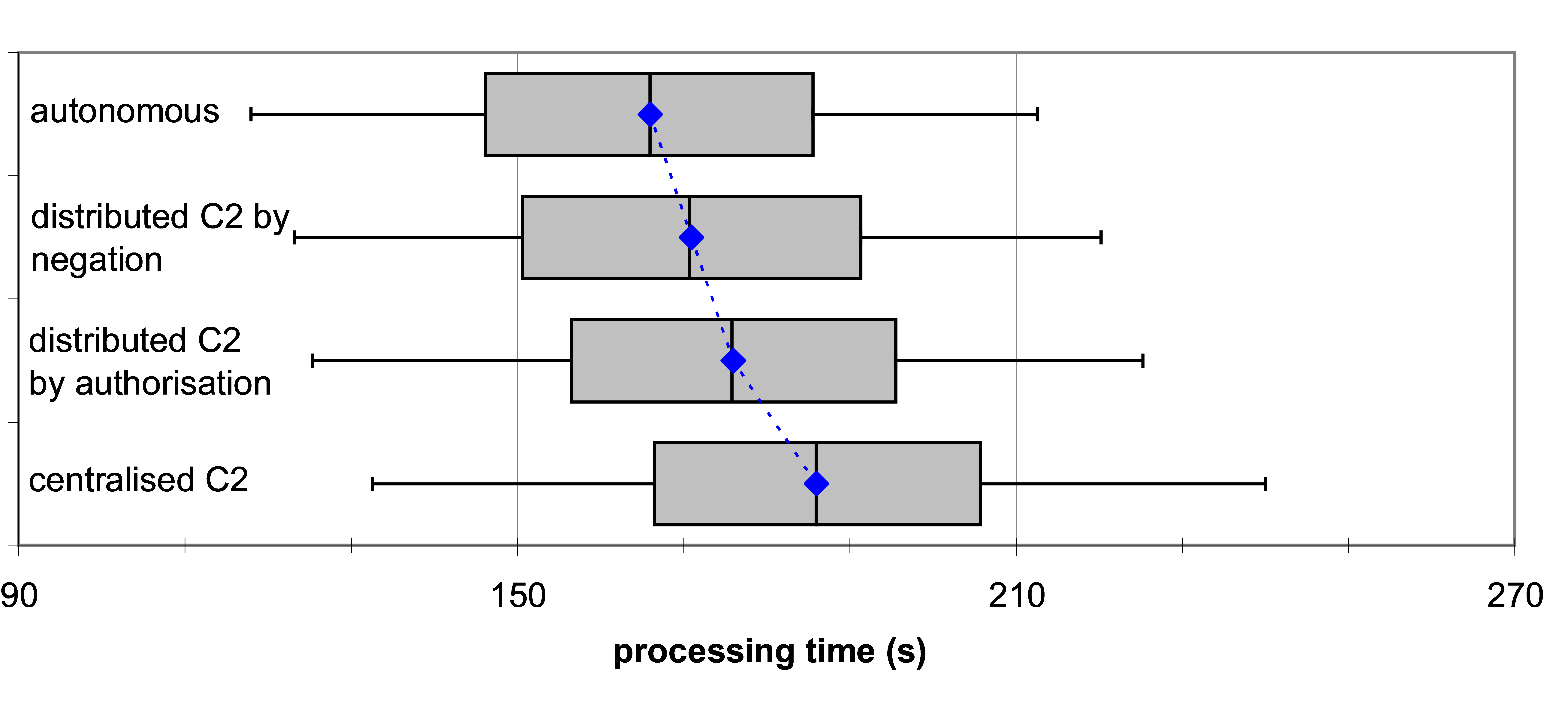
To investigate the timing required for a single BMD system to intercept a hostile missile, we simulated a range of control options for decision making. Figure 4 illustrates the time taken in box plots for the BMD process to achieve an interception. Autonomous control is the best option to compress the kill chain, followed by decentralised C2 by negation, decentralised C2 by authorisation, and lastly, centralised C2 which is the most inefficient option for BMC3I. The C2 overhead for BMC3I is noticeable, extending the kill chain up to 240 seconds (or 4 minutes) processing time in the worst case of centralised C2.
An example scenario
Throughput limitations can be identified in an attack scenario where a missile raid rapidly launches a salvo of ballistic missiles against multiple closely spaced targets. Unlike engaging a single threat, reacting to such a raid significantly strains the missile defence kill chain. Defending closely spaced targets requires coordination of BMD units through BMC3I to schedule multiple, nearly simultaneous engagements.
The functions of the workflow were encoded as a network of multiple tasks performed by different processing entities. During simulation, execution of the process model is controlled by a flow of tokens. If the required resources become unavailable, tokens queue for service and the corresponding tasks will be delayed. Simulation of the ASBMD sequence allows analysis of the timing and performance so that the combined effectiveness of a control option can be assessed. C3TRACE has been successfully used to understand the influence of technology on decision quality in an U.S. infantry company [11]. In our previous work [12], an executable dynamic targeting model was constructed to identify throughput limitations and human performance bottlenecks in an Air and Space Operations Centre (AOC).
While the unclassified nature of this dataset means that any conclusions based on the analytical results should be drawn with caution to avoid any over-interpretation, these observations could contribute to efforts to compare BMC3I arrangements of ASBMD.
Consider two AEGIS cruisers (denoted as Units A and B) in Figure 5 to defend against an enemy ballistic missile attack. This case illustrates part of a naval task group, composed of several ships with variable air defence capabilities typically arrayed into a formation defending high-value units against air attack [13,14]. Both Units A and B have identical resource capabilities in sensors, weapons, and communications. They are deployed to defend three assets. Since the attack distribution tends towards destroying a friendly high-value asset as Defended Asset 3, Units A and B are prepositioned to provide layered coverage with sufficient overlap to facilitate engagement cooperation.
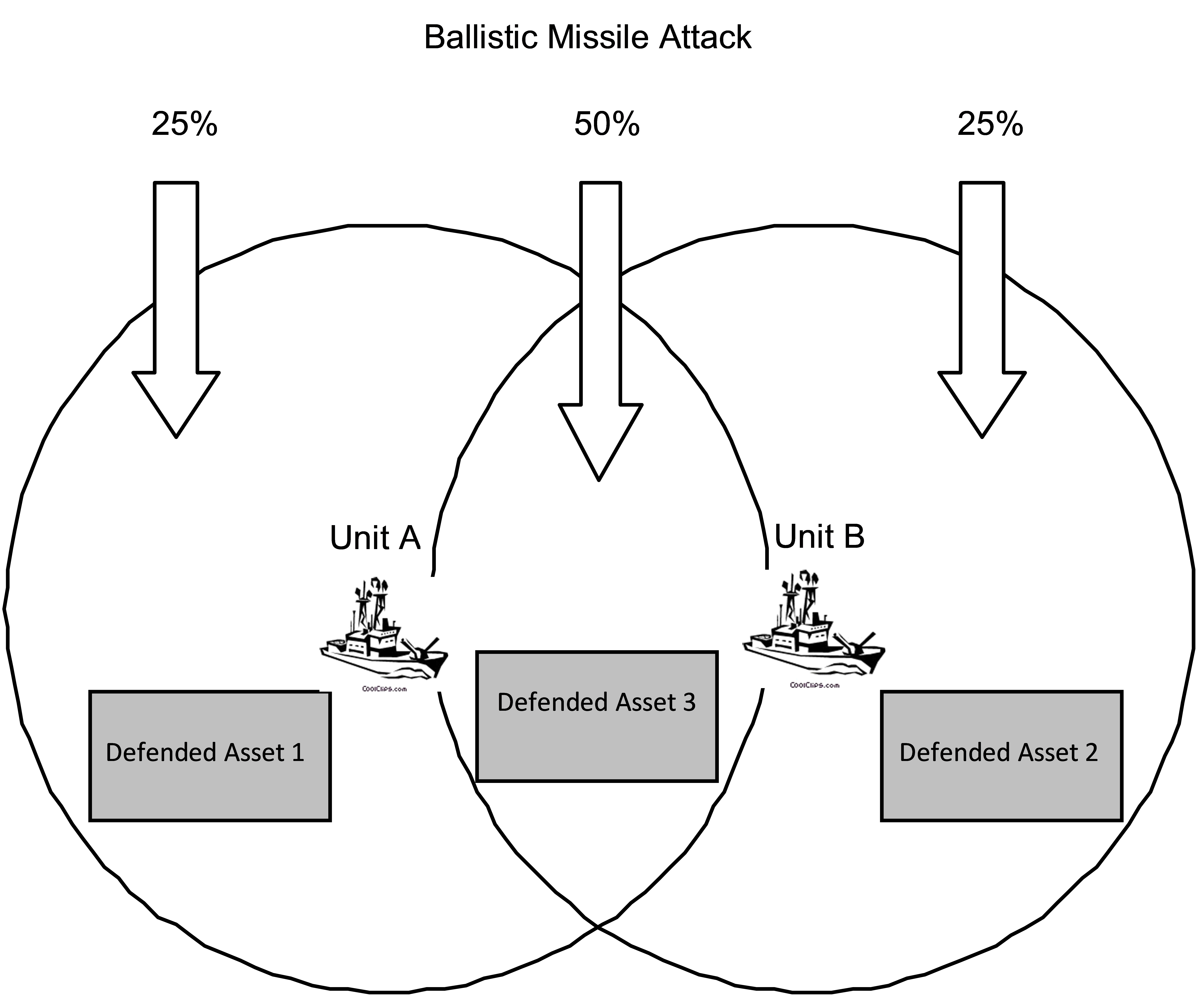
We assume a salvo of 1000 ballistic missiles to deliberately saturate the BMD process. The problem of interceptor inventory reduction is not considered in this scenario (with units possessing unlimited interceptors). The assumed attack distribution is specified by probabilities of 0.25, 0.25 and 0.5 aiming at Defended Assets 1, 2 and 3 respectively. Detection ranges of Units A and B are overlapped to protect the high-value asset, which will be subjected to frequent attack. The launch sites are capable of firing missiles at various rates.
Figure 4 portrays the performance of the missile defence kill chain against a range of firing rates defined by time interval between consecutive launches (from 1 second to 20 minutes). Each data point in Figure 4 denotes a single run through simulation for the 1000 missile attack. The single shot probability of kill, SSPk, for both BMD units is assumed to be 80% against missiles [15]. Other parameters are adopted from the functional requirements for ASBMD [6]. In particular, the maximum number of targets simultaneously tracked is 10 and the number of simultaneous engagements is 2. We assume a shoot-look-shoot doctrine is employed [16] with the interceptor firing at the earliest opportunity. The hit is evaluated and if unsuccessful, another interceptor is launched. With high probabilities of detection and discrimination, the kill probability, Pk, should be close to 96% theoretically if the system is not stressed.
Leakage rate and interceptor consumption rate are used as measures of effectiveness (MOE) to compare the four control options. Leakage rate defines the ratio of the number of hostile missiles that hit the defended assets to the total number fired. Interceptor consumption rate is the proportion of interceptors fired during the attack to the number of incoming missiles. Thus leakage rate is a measure of effectiveness of the BMD system while interceptor consumption rate measures its efficiency. So a consumption rate of 1.5 reflects a situation of three interceptors being used to engage two incoming missiles on average.
Figure 4(a) plots leakage rate against a range of inter-arrival time of missiles on a logarithmic scale. When the inter-arrival time of incoming missiles is beyond 200s (Region A), the performance of the kill chain is very stable, capable of intercepting enemy missiles firing infrequently, with leakage rate at a range of 0.07-0.08. With inter-arrival time between 30s and 200s (Region B), autonomous mode of control seems to be only marginally the best amongst all C2 arrangements. This is attributed to the autonomy of two units having the shortest kill chain, which may be independently intercepting the same missiles. However, leakage rate is deteriorating rapidly when firing rate is increased such that inter-arrival time is between 5s and 30s (Region C). Autonomous control is the first to yield to the salvo attack as shown by the rapidly increasing leakage rate. Without mutual cooperation, a ballistic missile attacking defended asset 3 could be intercepted simultaneously by both units reacting autonomously. This is a critical juncture at which wastage of duplicated processing effort is reducing overall cost effectiveness of missile defence operations.
In contrast, ballistic missile saturation requires about twice the arrival rate to defeat the other control modes. Any higher firing rate with inter-arrival time less than 5s (Region D) is sufficient to seriously handicap the two BMD units.
Figure 4(b) plots the interceptor consumption rate against a range of inter-arrival time of missiles on a logarithmic scale. When BMD systems operate within their limitations, autonomous control requires more interceptors and depletes interceptor inventory faster than the other control modes to successfully engage incoming missiles. Under autonomous control, two BMD units continue to operate independently to maximise engagement opportunities without coordination taking place between them. It is likely that both units may engage the same threat, thereby wasting interceptors, or simply fail to engage a missile. In contrast, centralised and decentralised modes of control engage incoming missiles with better coordination for interceptor inventory management. Fewer interceptors are required to engage the salvo of missiles, hence reducing wastage.
Sensor to shooter processing time is plotted in Figure 4(c) with 95% confidence intervals against a range of inter-arrival time of missiles in logarithmic scale. Under increasing rate of salvo attack, the missile defence kill chain is stable until overwhelmed at inter-arrival time of 30s. Throughout Region E, the process maintains maximum firing rate, managing to react immediately to incoming missiles. Beyond this point (Region F), saturation of missile defence continues to stretch sensor to shooter timelines, stressing the missile defence process and building up backlogs. Our simulation results indicate queuing of tasks in the Track phase causes the major delay, suggesting that it may be the cause of the bottleneck. Sensors are unable to track any incoming missiles once all ten possible tracks are occupied in the salvo attack. Further down the kill chain, engage and reengage functions are limited by the number of shooters for simultaneous engagements. Hostile missiles become leakers if not engaged within a specified reaction time. We assume the window of opportunity is 4 minutes to simulate medium-range ballistic missile attacks.
Clearly the worst scenario is that of an enemy firing all missiles so that they arrive almost simultaneously to saturate the missile defence capability. Autonomous control fails to establish combined effects of all available defence assets systemically to intercept incoming missiles. Centralised and decentralised modes of control facilitate coordination of missile defence capabilities through mutual cooperation. An appropriate decision could be made based on the relative position of the weapon systems. If one unit gets into trouble, the other can assist. The drawback is the necessary delay to seek engagement authorisation in time-critical situations. Decentralised modes of control (by authorisation and by negation) could compress the chain of command for seeking engagement approval. Removal of a layer of command could eliminate the time required to receive engagement orders from higher headquarters, thus marginally reducing the sensor to shooter timelines for interceptor launches.
Concluding remarks
This paper examines the C2 aspects of missile defence under four modes of control using C3TRACE. A configuration of two weapons systems was modelled as part of a naval task group to protect some assets from incoming missile threat. The limits of the BMD sequence were found by stress testing the associated processes over a range of firing rates of salvo attack.
With each fire unit retaining tactical control as an independent entity, autonomous control produces the shortest kill chain for mission accomplishment. Whilst resembling the naval tradition of autonomy for a ship’s commanding officer, this control mode however undermines collaboration on missile defence for efficient employment of weapon systems. Given that ballistic missiles have the range to cross multiple areas of responsibility, a single chain of command using centralised or decentralised control could prevent the possibilities of fratricide and ensure efficient use of limited resources.
The challenge of BMD is to use all available weapons systems in a collaborative manner. While a raid would overwhelm any individual units, an appropriate mode of control facilitates engagement coordination so that a preferred shooter is selected to engage each hostile missile. Our results indicate that centralised and decentralised control could strengthen the coordinated effects of disparate defence capabilities to better withstand ballistic missile saturation. Moreover, the cause of the performance bottlenecks correlates strongly with an overloaded Track function, and partly, the limited number of simultaneous shooters in the Engage function.
Collaboration on BMD enhances the degree of shared situational awareness between defence entities for improved battle management. Information exchange relating to sensor cues and weapons status could offer new capabilities including launch on remote (LOR) and engage on remote (EOR) [6], which can only be realised through improved coordination and performance from the BMC3I construct.
For future work, there is a need to build a more representative model by incorporating the human aspect in the workflow. Integrating limitations of human operators with process modelling is essential to develop BMD capability into a harmonious socio-technical system. A future model with accurate representation of missile trajectory and tactical environment should more fully account for operator workloads and subsequently provide more reliable results for measuring the performance of BMD.
References
[1] “Iran… Posing A Credible Threat to The U.S. Navy (Missile),” Satnews Daily, Feb 07, 2011, Satnews Publishers.
[2] M. Stokes, “China’s Evolving Conventional Strategic Strike Capability,” Project 2049 Institute, Sep 14, 2009.
[3] US Dept. of Defense, “Doctrine for Joint Theater Missile Defense,” Joint Pub 3-01.5, Feb 1996.
[4] M. Sarigul-Klijn and N. Sarigul-Klin, “A Study of Air Launch Methods for RLVs,” Doc No. AIAA-4619, American Institue of Aeronautics and Astronautics, 2001.
[5] “United States: The Future of Ballistic Missile Defence,” published on STRATFOR, Jul 2008.
[6] J. Hobgood, K. Madison, G. Pawlowski, S. Nedd, M. Roberts, and P. Rumberg, “System Architecture for Anti-Ship Ballistic Missile Defence (ASBMD)”, Report NPS-SE-09-014, Naval Postgraduate School, Monterey, California, Dec, 2009.
[7] J.D. Cox, “Theatre ballistic missile defence needs command and control, it needs assets, and it needs it all today,” Final Report, Joint Military Operations Department, Naval War College, Newport, R.I., 2007.
[8] N.J. Hatton, J.T. Watkins II, “The Role of BMC3I Simulation in Advancing the NATO ALTBMD Programme,” In The Effectiveness of Modelling and Simulation – From Anecdotal to Substantive Evidence. Meeting Proceedings RTO-MP-MSG-035, Paper 9. Neuilly-sur-Seine, France: RT, 2005.
[9] P.W. Kilduff, J.C. Woboda, and D.B. Barnette, “Command, Control, and Communications: Techniques for the Reliable Assessment of Concept Execution (C3TRACE) Modelling Environment: The Tool,” Technical Report ARL-MR-0617, Army Research Laboratory, Aberdeen Proving Ground, USA, 2005.
[11] P.W. Kilduff, J.C. Swoboda, and J. Katz, “A Platoon-level Model of Communication Flow and the Effects on Operator Performance,” Technical Report ARL-MR-0656, Army Research Laboratory, Aberdeen Proving Ground, USA, 2006.
[12] E.H.S Lo and T.A Au, “Improving the Kill Chain for Prosecution of Time Sensitive Targets,” Brito, A.V. (ed): Dynamic Modelling, pp. 93-110, Bukovar, Intech, Croatia, 2010.
[10] D. Wijesekera, J.B. Michael, and A. Nerode, “BMD Agents: An Agent-Based Framework to Model Ballistic Missile Defence Strategies,” 10th Command and Control Technology Symposium, 2005.
[13] J.F. Engler, B.L. Holub, and S. Moskowitz, “A scenario selection methodology supporting performance analysis of theatre ballistic missile defence engagement coordination concepts,” John Hopkins APL Technical Digest, Vol. 23, No. 2 & 3, 2002.
[14] O. Karasakal, N.E. Özdemirel, and L. Kandiller, “Anti-ship missile defence for a naval task group,” Naval Research Logistics, Vol. 58, Wiley, 2011.
[15] J. Menq, P. Tuan, and T. Liu, “Discrete Markov Ballistic Missile Defence System Modelling,” European Journal of Operational Research, Vol. 178, Elsevier, 2007.
[16] B.I. Kaminer and J.Z. Ben-Asher, “A Methodology for Estimating and Optimising Effectiveness of Non-Independent Layered Defence,” Systems Engineering, Vol. 13, No. 2, 2010.