
Volume 16, Number 3, November 2013
Human Factors Issues With Imaging Technology
- 1 Civil, Maritime, Environmental Engineering and Science Unit, Faculty of Engineering and the Environment, University of Southampton, Highfield, Southampton, SO17 1BJ, UK.
Abstract
Imaging technology has good potential in both security and defence applications due to its ability to present objects from long ranges in poor visibility. Imaging technology is used across the forces in a range of air, land and sea electro-optical sensor applications. In order to be fully aware of imaging technology capabilities it is necessary to understand how it will be affected by image degradation, which types it may be susceptible to, and how well it can support decision making during image recognition. The decision ladder method has previously been noted for its potential use and application in combat identification activities. Here it is used to integrate the literature and is discussed in relation to the task of image recognition, to demonstrate how the different components of recognition relate to the template and to illustrate how some of the different forms of degradation may impact on the constituent parts of the decision-making process.
Imaging processing
The aim of this paper is to review the literature and identify some of the issues which may compromise the effectiveness of imaging technology, particularly with respect to human decision making and reference to the decision ladder method. Imaging technology aims to enhance target identification capabilities across a range of military applications and support decision making. The best method for information presentation varies with the task at hand, it has been demonstrated that people can interpret information from images faster than information presented via other methods [30]. As such, using this method of presentation also enables reduced workloads for observers [30].
The process of image recognition has three component parts: detection, categorisation, and identification [9,26]. Detection can be defined as the moment when the observer notes an object to be present, categorisation as the observer recognising the object’s basic-level category [18] and identification as the observer recognising the object’s subordinate category [26]. An example of this would be “there is an object present” (detection), “it’s a dog” (categorisation), and “it is a Labrador” (identification).
The entire process of image recognition can be done by experts in under a second [9,18,26] but work has been undertaken to test whether these component stages are in fact performed simultaneously or in a specific order. Studies to investigate levels of accuracy for detection and identification over various presentation times have found that for very short presentation times (<50ms) detection and categorisation had greater accuracy than identification, a trend that continued until presentation times were 167 ms long [9]. Rosa et al [26] conducted a group of experiments to test the theory that the three components are separate, and occur one after the other during image recognition. They, like Grill-Spektor and Kanwisher [9], suggest that having the order of detection-categorisation-identification allows the observer to be more efficient by only focusing on the visual information of the target object rather than the entire visual array. By using very short presentation times in their experiments (500 ms) Rosa et al hoped to identify differences in the return times for detection, categorisation and identification. Their results showed that for very short presentation times, detection, categorisation and identification had varying levels of accuracy, suggesting that they take different amounts of time to process. Detection had the greatest accuracy, indicating the shortest time requirement, and identification the least accurate, suggesting more sensitivity to presentation time. Unlike Grill-Spektor and Kanwisher [9] however, they found different return times for detection and categorisation, suggesting they are also processed at different rates. Mack et al [18] found a similar result, concluding in their study that detection and categorisation are in fact separate parts of the overall process.
Research into image processing has shown that people prefer natural image subjects, rather than artificial ones [31]. When Tinio and Leder [31] asked participants in their study to rate the test stimuli from 1–7 according to how much they liked or disliked them. They found that in general participants preferred natural scenes as opposed to the man-made scenes. It has been suggested that people process images at different speeds depending upon the subject of the image, and that natural objects may be easier to process then artificial objects [31]. Human faces can often be detected and categorised faster than other images such as animal faces or inanimate objects [16]. However, it has been argued that this is the only case of image subject playing a significant role in the processing time [32] and that, in most cases, natural objects do not have any particular advantage over artificial objects in image processing. Van Rullen and Thorpe [32] found that both natural objects (animals) and artificial objects (modes of transport) produced equally short reaction times (<250 ms) and correct responses.
An alternative to the natural versus artificial argument is the theory of increased awareness of biological motion [23]. This theory argues that an observer should be able to identify a person’s intentions, crucially whether they are threatening or passive, judging by the way they move, a skill which can be vital for threat related surveillance. Parasuraman et al [23] suggested in their study that biological motion is detected automatically, and isn’t subject to performance decline over long periods of sustained observation. They came to this conclusion when a study which called for observers to detect up to 12 occurrences of “suspicious intent” from footage displayed on either 16 or 24 monitors showed no decline in performance over a one hour period of observation.
Holm et al [11] tested the theory that before a conscious recognition of a target is made an observer has already been inspecting the target. In their study participants were shown 20 images which each contained a target object (line drawing of an animal or bird) and a control object (mirror image of the target), they were asked to press a button to acknowledge recognition of the target and continue looking at the target until the picture was removed. Their eye movements were monitored to assess where they were looking. The results showed that the proportion of fixations that were focused on the target increased steadily in the build-up to recognition. Holm et al. suggested that these results indicate target information is “systematically selected prior to explicit recognition” [11]. In another experiment Holm et al. repeated their study but trained participants with the test images prior to the test. This produced the same results as the first test, with participants favouring the target prior to recognition, but produced a steeper increase in target fixations than the first, suggesting that familiarity with the target was speeding up the recognition process.
It has been suggested by a number of research studies that familiarity aids in the recognition process. It appears that whether the target is a familiar face or another object, familiarity with the subject shortens the necessary recognition time [9,29]. In another twist on familiarity it has also been shown that even when an observer cannot identify the change in a familiar image, their gaze will frequent the altered area more often than other areas of an image, suggesting that memory was influencing the eye movements without the observer being aware of the target [11]. Research has found that, even if a target object is partially obscured, an observer can still recognise it based upon the available information such as texture, colour, and visible contours [2]. The composition of visible components can give sufficient information to make a decision as to the nature of the object based upon a limited number of possibilities. Recognition-by-Components (RbC) is a bottom-up process which states that certain contours and components of an image are crucial to object recognition, and that the more of these components that are removed the harder image recognition becomes [2]. This theory describes difficulty with object recognition due to partial view obstruction and accidental viewpoints, when the object is viewed from an orientation which misrepresents the nature of the object and causes recognition to take longer or become less accurate. RbC is the explanation of how we can look at an object and conclude it is a table based on the composition of its parts even when we have never seen this particular model.
Image degradation
There are many forms of image degradation, influenced by the environmental conditions at the time of image capture, range and type of imager used etc., but all of them act to reduce the amount of visual information in the image [21]. Examples of degradation types include blurring (see Figure 1), speckle [5], under sampling, aliasing [34] temporal and fixed pattern noise [7], luminance degradation [21], spatial resolution [16], occlusion [2], and clutter [15]. Different types of imager will be susceptible to different types of degradation, in part this is due to having different pixel characteristics and image formation processes [10].
![Example of the effects of blur upon image quality [34]. Original shown on the left, with a blur affected image on the right.](/journals/journal-of-battlefield-technology/volume-16/issue-03/assets/16-3-3-stanton/figures/figure01.gif)
Environment can play a significant role in the extent to which degradation affects image quality. A study investigating the capabilities of humans using infrared sensors to detect swimmers found that time of day (sun light levels) had a heavy influence on how much degradation was experienced [15]. Krapels et al [15] found that the midwave clutter, which was primarily caused by the sunlight reflected off the waves, had a greater degrading effect then longwave clutter. This led to night time vision range being greater than during day light hours (832 m versus 193 m).
A study into the effects of sampling on image quality found that as low-frequency content was reduced, target identification performance fell [6]. This study did not, however, address the relative importance of different frequencies, and concluded that while reducing the amount of low-frequency information was degrading recognition performance, it may not be the most important factor, and suggested that high spatial frequencies may be as important to image quality, if not more, and may therefore have a greater impact upon identification performance [6].
Saunders et al [28] investigated the possible differences in the effect of different forms of degradation. They found that different methods of image degradation had different impacts upon the image quality. While decreasing the resolution of the images had little effect upon classification accuracy they found that increasing visual noise in the image decreased classification accuracy by a significant amount (21%) [28]. This demonstrates the varying effects of different manners of degradation.
A similar project found that two forms of aliasing had different effects upon image degradation [34]. Aliasing, sometimes referred to as a spurious response, is an artefact of sampling and occurs when different signals become confused and indistinguishable. Research found that in band aliasing had no effect on identification performance but when out-of-band aliasing was present identification performance was severely degraded [34]. Further investigation lead to the conclusion that the effect of the degradation was also linked to the task being performed: low-level discrimination tasks (such as point detection) were strongly influenced by in-band aliasing, and performance in high-level discrimination tasks (such as target identification) was significantly reduced by out-of-band aliasing [34]. Intermediate tasks were found to be affected by both in band and out-of-band aliasing, but only mildly. These results are theorised to be down to the way the different types of aliasing effect an image. An in-band spurious response results in minor target details being shifted or altering intensity, minor corruptions such as these do not affect high-level discrimination tasks. Out-of-band spurious responses, for instance image raster, on the other hand do affect the high-level discrimination tasks [34]. In-band aliasing could result in an object disappearing entirely, if it was small enough, resulting in it having a drastic effect upon the success of target detection, however, as the observer does not require high levels of target detail to merely detect its presence, out-of-band aliasing does not have the same effect. This work stands in contrast to that by DeVitt et al [3]. In this study observers were asked to categorise targets from three vehicle categories, but not to identify them to model level. They concluded that in-band aliasing had no significant effect upon target categorisation, but out-of-band aliasing did.
According to the earlier study [34], however, a discrimination task of intermediate difficulty such as this would be equally effected by both in band and out-of-band aliasing.
Another example of discrepancies between the effects of different forms of degradation is the differing effects of fixed-pattern noise and temporal noise. Fixed-pattern noise has been found to degrade identification performance more severely than temporal noise [7]. Fixed-pattern noise is noise which doesn’t vary over time and is caused by the use of many detectors which all have marginally different responsivity [7] while temporal noise does change with time. It is perhaps the different causes and presentation of the two types of noise which lead to the difference in effect.
Speckle (see Figure 2) is a form of image degradation which is caused by random intensity fluctuations [14]. Speckle is characteristic of laser-illuminated imaging systems such as infrared imaging and degrades the quality of images and target recognition performance [5]. In order to reduce degradation, averaging images is common practice and imagers have been developed in such a way as to minimise the level of speckle, including range-gating the imager according to the distance to the target, thus allowing the shutter to be opened at the correct return time for the target. It has also been suggested that personnel are trained with speckled images, to improve performance [5].
![A target board at three ranges demonstrating speckle degradation [5].](/journals/journal-of-battlefield-technology/volume-16/issue-03/assets/16-3-3-stanton/figures/figure02.png)
Having multiple forms of degradation affecting an image can have a greater impact than each form individually. A study by Nandakumar and Malik [21] found that applying two types of degradation to the same image resulted in a significant drop in performance, whilst each type of degradation applied alone had no significant impact. During the study observers were asked to identify which of a pair of images contained the target object, in this case an animal: they found that reducing luminance levels and increasing blur at the same time (see Figure 3) lead to a significant drop in observers’ performance [21], far greater than that experienced with blur or reduced luminance alone.
![Examples of multiple forms of degradation on image quality from Nandakumar and Malik [21] demonstrating the impact of blur and reduced luminance levels.](/journals/journal-of-battlefield-technology/volume-16/issue-03/assets/16-3-3-stanton/figures/figure03.gif)
It has been suggested that image degradation not only affects image quality but also the attentiveness of observers. Nuechterlein et al. [22] set out to test the theory that slightly degraded video footage would lead to high attentiveness due to the need to concentrate more. They in fact found the opposite, moderate degradation produced no change in attention, but highly degraded stimuli result in a decrease in perceptual sensitivity after just five minutes, a significant decrease from the times quoted for normal footage (30 to 45 minutes) [22]. Parasuraman et al [23] set out to test whether footage of “biological motion” retains its resilience to attentional changes over sustained viewing periods when the footage is also degraded. Noise and distortion were added to video footage at a range of degradation levels, and the results showed clear evidence of reduced vigilance and performance with time on task. This led Parasuraman et al [23] to conclude that footage of biological motion is susceptible to loss of attention when under poor conditions.
The ability to process a degraded image can vary depending on the image content and the type of degradation. Tinio and Leder [31] found that images of natural scenes were more tolerant to degradation than images of man-made scenes. In their study participants had to classify degraded human-made and natural scenes, and it was found that participants took longer to correctly classify the artificial images than the natural ones. Interestingly they also note that classification times for normal natural images were in fact longer than the degraded natural images as well. This theory was not, however, in keeping with the findings of VanRullen and Thorpe [32]. They set out to investigate whether “biologically relevant” stimuli, such animals, food and trees, would be quicker to process than non-biologically relevant objects. The study asked participants to categorise images presented to them, with animals and means-of-transport as the target stimuli in alternate tasks. The results found that categorisation had the same return times for animals and means-of transport, suggesting that “biologically relevant” objects are not processed any quicker than the non-biologically relevant [32].
In summary, it can be seen from the literature that there is a variety of ways in which image degradation may affect human image recognition performance, and that the exact effect of image degradation on the ability to process an image is dependent upon several factors: the image subject, the type of imager used, and the type and cause of degradation. It is therefore crucial to thoroughly test any imager with a range of conditions and target types in order to establish its capabilities and constraints with reference to the tasks it is likely to be required for.
Human decision making
Decision making is a well-researched area within human factors [12] and there are a number of decision-making models which have been developed over the years. The most relevant of these models will be described here: the Decision Ladder. The Decision Ladder has already had its military applications demonstrated and is largely applicable to all combat identification activities [12]. The decision ladder was developed by Rasmussen [25] after observing that expert users were relying on rule based behaviour to undertake familiar tasks [12] and is strictly speaking a template for information processing rather than a model [33]. Rasmussen [25] described the decision ladder as the steps which a novice would have to undertake in order to complete a task from the initial cue to the final execution [12]. The Decision Ladder encompasses a wide range of decision making situations and is applicable to experienced decision makers in familiar situations as well as experienced decision makers in novel situations and novice decision makers [12]. As can be observed in Figure 4, the ladder is made up of rectangular and circular nodes. The rectangular nodes indicate data processing activities while the circular nodes represent states of knowledge arising from the processing activities. The left side of the ladder relates to the decision maker interpreting the current system state from the information which is presented, while the right side represents the development and implementation of tasks and procedures necessary to achieve the desired system state [20]. Experienced decision makers may not need to follow the ladder and may skip stages of the Decision Ladder, jumping from one side to another and may not start at the beginning node but further up the ladder depending on the task, while novice users are expected to move through the stages sequentially [33]. The Decision Ladder has been noted for its potential use and application in combat identification activities within the MOD previously, examined by Jenkins et al [12] for its potential in tank-on-tank warfare, and is believed to be relevant regardless of platform. The steps of the Decision Ladder below as described by Jenkins et al [12] and Elix and Nikar [8]:
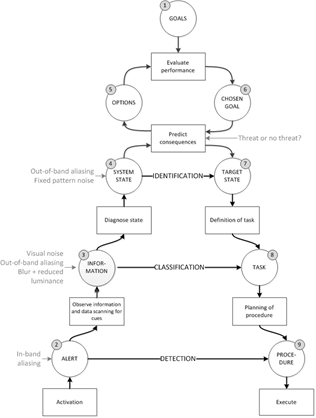
Determining the goal: The goal(s) of the Decision Ladder frames the rest of the decision making process, it is therefore the first step in using the Decision Ladder. The goal is normally a high order goal with a number of constraints to shape it. A goal is put into the frame of “to (insert goal) (insert constraints)” In the case of image recognition this could be stated as: identifying a target to a high degree of accuracy and confidence as quickly as possible.
Alerts: The state of knowledge which begins the process, what requires immediate attention—for example, an object detected in the field of view.
Information: What information characterises the current system state? Contains one form of information and can be informed by requirements to develop the system states, usually phrased in the questions “What is the (..…)?” “Where is the (…..)?” For example, what category does the object come under (vehicle, person, animal, aircraft, tree, building)? What are the object's orientation and/or direction of travel?
System states: What is the current state of the system? Contains different classes of information and is perceived understanding of the state of the system based upon the interpretation of these elements. For example, what is the objects identity (individual with a weapon, vehicle mounted weapon, tank, military aircraft)?
Options: What options are available for altering the current system state into one capable of satisfying the goal(s)? The type and number of possible options will be informed by the system state. Characterised by the question “Is it possible to (…)”. For example, in order to increase visibility is it possible to move closer, switch imagers, wait for object to move closer or change orientation, ask for confirmation from other sources (other friendly platforms, IFF systems).
Chosen goal: Which goal(s) has the highest priority in light of the system state? Determined by selecting the constraints with the highest priority. With respect to image recognition this will be dependent on the purpose of observation, and may be identifying the object with the greatest speed, accuracy or confidence.
Target states: Target state mirrors the available options: the selected option becomes the target state, “What is the desired state of the system?”. Dependent on the chosen goal.
Task: List of tasks required to achieve the new target state whist satisfying the chosen goal. Specific to situation.
Procedure: What steps are required to take place to achieve the tasks? Specific to situation.
With respect to these functions, each component of recognition (detection, categorisation and identification) involves the use of the decision ladder to a different extent, as indicated in Figure 4. As seen in the literature, different forms of degradation may affect the three components to a different extent, therefore certain forms of degradation can be applied to the ladder to demonstrate the areas in which they may have the greatest impact: an example of this can be seen in Figure 4.
Testing image quality
Two main metrics are to be considered for image quality analysis, Targeting Task Performance (TTP) and National Imagery Interpretation Rating System (NIIRS). TTP is built upon the Johnson criteria (a method of predicting target detection, orientation, recognition, and identification based on perceptual thresholds of human observers and the resolution of the image), but with greater accuracy and can be used to model a wider range imager features. Like the Johnson criteria the model assumes that range performance is proportional to image quality, but predicts image quality in a different manner to the Johnson criteria. NIIRS is a systematic approach to measuring the quality of photographic or digital imagery which assigns a number from 0–9 to an image, indicating its interpretability [4]. This number relates the quality of the image to the tasks it may be used for, ensuring the image meets the user’s requirements. NIIRS scales currently exist for a number of different imagers. It is by these metrics that the products of imaging will ultimately need to be compared and rated. Likewise, in order to assess the imager using TTP the sensor’s Modulation Transfer Function (MTF) is required.
A range of participant sample sizes has been used in image processing studies throughout the literature, from as little as 10 [16] or 12 [6] to higher numbers in the thirties and forties [1,18]. Most similar studies have used between 15 and 20 participants [11,21,31,32,34]. It should be noted however that in studies where multiple activities occur the participation sample is often split up, such as in VanRullen and Thorpe’s study [32], where 10 of the 16 participants took part in the first task, and 6 in the second.
Throughout the image processing literature many variables have been tested. Some studies have set out to test specific types of degradation and have therefore set independent variables such as level of blur [6], sampling artefacts [34] and types of spurious response [3]. Studies investigating the effect of subject matter have used that as their independent variable, using images with between two and eight subject categories [9,16,18,31]. The dependent variable is always accuracy and speed of either detection [15], categorisation [18,21,31] or identification [3], or in some cases a combination of some [34] or all of the above [9]. The studies mentioned were, however, all seeking to test a narrow range of influences, a specific type of degradation or subject matter, rather than the abilities of an imager across a wide range of situations. Standard practice in the area seems to be presentation of the images on an everyday computer screen. Holm et al [11], Bhatia et al [1] and Mack et al [18] all quote the use of 19-inch screens, while Driggers et al [6,7] use a slightly larger 20-inch screen. Most studies have the distance set between 50–60 cm [11,16,21] but some, such as VanRullen and Thorpe [32] use double that at 120 cm. In keeping with the literature and to simulate a normal viewing distance for everyday screen observation we recommend the participant be positioned 60 cm the screen.
An underlying assumption in most models for testing image quality is that the observer can perform the required task to 95% proficiency [19], so any study using non-expert participants will require a period of familiarisation with the target objects prior to the study. This has been carried out as a preceding task to a number of other studies [3,5,6,11,15,23,34] and can be done by showing participants sample images of the various targets and asking them to categorise or identify them until they reach the proficiency threshold. Efforts can be focused onto specific categories which are causing difficulties until all categories meet the proficiency threshold.
The presentation time for images is variable depending on the purpose of the study. For those wishing to distinguish necessary times for the different components of recognition, times are often kept as short as possible—for example, as little as 17–167 ms [9,32]. However, we are not trying to separate the components in this manner, so recommend a presentation time in line with studies of a more comparable nature. Most studies quote an image presentation time of 500ms [1,16,24] and this is seen as amply sufficient for all three components.
Conclusions
The two military imaging approaches are Target Acquisition and Surveillance and Reconnaissance [19] both of which require imaging over long ranges in all weather conditions. Imaging technology has good potential in both security and defence applications due to its ability to image objects over long ranges in poor visibility. It has some distinct advantages over existing technology such as its ability to see through panes of glass, which need to be fully assessed. Imaging technology could be used across the forces in a range of air, land and sea electro-optical sensor applications. In order to be fully aware of imaging technology capabilities it is necessary to understand how it will be affected by image degradation, which types it may be susceptible to and how well it can support decision making during image recognition.
The findings from these areas have been summarised below:
- The process of image recognition has three component parts: detection, categorisation and identification. These components are always performed in this order and are carried out at different speeds, with detection taking the shortest time and identification taking the longest. The entire image recognition process can be completed in less than one second.
- Image subject affects image processing: Research into image processing has shown that people prefer natural image subjects, rather than artificial ones and suggests that subjects such as human faces, animals, natural scenes or those containing biological motion may be processed quicker than artificial man-made subjects. Biological motion also appears to be resistant to performance decline over time.
- Familiarity aids in the recognition process: Familiar targets appear to require less time to process before complete recognition is possible.
- There are many forms of image degradation: These are influenced by the environmental conditions at the time of image capture, target range and type of imager used. Some appear to be specific to certain situations or imager types.
- Different forms of degradation have different effects: Some degradation types impact upon image quality more drastically than others. Certain forms of degradation only appear to degrade performance on individual components of image recognition, or affect some components more than others. A combination of forms of degradation may have more damaging effect than a single form of degradation alone.
- The decision ladder shows how the detection, classification and identification processes could go through different information processes and paths. It also suggests that these paths may be susceptible to different types of degradation.
- A methodology for testing image quality has been proposed based on best practice in the literature. This suggests a minimum of 20 participants using the TTP and NIIRS methods. An image presentation time of 500 ms is recommended with the participant sitting the normal distance from a large screen. An image familiarization should precede the experimental study.
References
[1] S.K. Bhatia, V. Laksminiayaanan, A. Samal, and G.V. Welland, “Human Face Perception in Degraded Images”, Journal of Visual Communication and Image Representation, Vol 6, No. 3, pp. 280–295, 1995.
[2] I. Bierderman, “Recognition-by-components: A Theory of Human Image Understanding”, Psychological Review, Vol 94, No. 2, pp. 115–147, 1987.
[3] N. Devitt, R.G. Driggers, R. Vollmerhausen, and S. Moyer, “Target Recognition Performance as a Function of Sampling”, Proceedings of SPIE, Vol. 4372, pp. 74–84, 2001.
[4] R.G. Driggers, P. Cox, and M. Kelley, “National Imagery Interpretation Rating System and the Probabilities of Detection, Recognition, and Identification”, Optical Engineering, Vol. 36, No. 7, pp. 1952–1959, 1997.
[5] R.G. Driggers, R.H. Vollmerhausen, N. Devitt, C. Halford, and K.J. Barnard, “Impact of speckle on Laser Range-gated Shortwave Infrared Imaging System Target Identification Performance”, Optical Engineering, Vol. 42, No. 3, pp. 738–746, 2003.
[6] R.G. Driggers, R.H. Vollmerhausen, and K. Krapels, “Target Identification Performance as a function of Low Spatial Frequency Image Content”, Optical Engineering, Vol. 39, No. 9, pp. 2458–2462, 2000.
[7] R.G. Driggers, R. Vollmerhausen, and K. Krapels, “Target Identification Performance as a Function of Temporal and Fixed Pattern Noise”, Optical Engineering, Vol. 40, No. 3, pp. 443–447, 2001.
[8] B. Elix and N. Naikar, “Designing Safe and Effective Future Systems: A New Approach for Modelling Decisions in Future Systems with Cognitive Work Analysis”, Proceedings of the 8th International Symposium of the Australian Aviation Psychology Association. Australian Aviation Psychology Association, Sydney, Australia, 2008.
[9] K. Grill-Spector, and N. Kanwisher, “Visual Recognition: As Soon as You Know it is There you Know What it is”, Psychological Science, Vol. 16, No. 2, pp. 152–160, 2005.
[10] J. Han, and B. Bhanu, “Human Activity Recognition in Thermal Infrared Imagery”, Proceedings of the EEE Computer Society Conference on Computer Vision and Pattern Recognition, San Diego, California, p. 17, 2005.
[11] L. Holm, J. Eriksson, and L. Andersson, “Looking as if you Know: Systematic Object Inspection Precedes Object Recognition”, Journal of Vision, Vol. 8, No. 4, pp. 1–7, 2008.
[12] D.P. Jenkins, N.A. Stanton, G.H. Walker, and P.M. Salmon, Cognitive Work Analysis: Coping with Complexity, Ashgate, Aldershot, 2009.
[13] G.A. Klein, “A Recognition-Primed Decision (RPD) Model of Rapid Decision Making”, G.A. Klein, J. Orasanu, R. Calderwood and C.E. Zsambok (eds) Decision Making in Action: Models and Methods. Ablex, Norwood, NJ, pp. 138–147, 1993.
[14] V.N. Korwar, Degradation of Picture Quality by Speckle in Coherent Mapping Systems, Dissertation (Ph.D.), California Institute of Technology, California, 1980.
[15] K. Krapels, R.G. Driggers, and J.F.I. Garcia, “Performance of Infrared Systems in Swimmer Detection for Maritime Security”, Optics Express, Vol. 15, No. 19, pp. 12296–12305, 2007.
[16] V. Lakshminarayanan, S.K. Bhatia, A. Samal, and G.V. Welland, “Reaction Times for Recognition of Degraded Facial Images”, Basic and Clinical Applications of Vision Science, Kluwer Academic Publishers, Dordrecht, The Netherlands, pp. 287–293, 1997.
[17] R. Lipshitz, and O. Strauss, “Coping with Uncertainty: A Naturalistic Decision-making Analysis”, Organizational Behaviour, Vol. 69, No. 2, pp. 149–163, 1997.
[18] M.L. Mack, I. Gauthier, J. Sadr, and T. Palmeri, “Object Detection and Basic-level Categorization: Sometimes You Know it is There Before you Know What it is”, Psychonomic Bulletin & Review, Vol. 15, No. 1, pp. 28–35, 2008.
[19] S. Moyer, J.G. Hixson, T.C Edwards, and K. Krapels, “Probability of Identification of Small Hand-held Objects for Electro-optic Forward-looking Infrared Systems”, Optical Engineering, Vol. 45, No. 6, 2006.
[20] N. Naikar and B. Pearce, “Analysing Activity for Future Systems”, Proceedings of the Human Factors and Ergonomics Society 47th Annual Meeting, October 13–17, 2003, Denver, Colorado, USA. pp. 1928–1932, 2003.
[21] C. Nandakumar and J. Malik, “Understanding Rapid Category Detection via Multiply Degraded Images” Journal of Vision, Vol. 9, No. 6, pp. 1–8, 2009.
[22] K.H. Nuechterlein, R. Parasuraman, and Q. Jiang, “Visual Sustained Attention: Degradation Produces Rapid Sensitivity Decrement Over Time”, Science, Vol. 220 No. 4594, pp. 327–329, 1983.
[23] R. Parasuraman, E. de Visser, E. Clarke, W.R. McGarry, E. Hussey, T. Shaw, and T.C. Thompson, “Detecting Threat-related Intentional Actions of Others: Effects of Image Quality, Response Mode and Target Cuing on Vigilance”, Journal of Experimental Psychology: Applied, Vol. 15, No. 4, pp. 275–290, 2009.
[24] D.M. Parker, R. Lishman, and J. Hughes, “Role of Coarse and Fine Spatial Information in Face and Object Processing”, Journal of Experimental Psychology, Vol. 22, No. 6, pp. 1448–1466, 1996.
[25] J. Rasmussen, “Outlines of a Hybrid Model of the Process Plant Operator”, T. Sheridan and G. Johannsen (eds) Monitoring Behaviour and Supervisory Control, Plenum, New York, pp. 371–384, 1976.
[26] S.D. Rosa, R.N. Choudhery, and A. Chatziastros, “Visual Object Detection, Categorization and Identification Tasks Are Associated With Different Time Courses and Sensitivities”, Journal of Experimental Psychology, Vol. 37, No. 1, pp. 38–47, 2011.
[27] K.G. Ross, G., Klein, P. Thunholm, J.F. Schmitt, and H.C. Baxter, “The Recognition-primed Decision Model, Military Review, 84(5), pp. 6–10, 2004.
[28] R.S. Saunders, J.A. Baker, D.M. Delong, J.P. Johnson, and E. Samei, “Does Image Quality Matter? Impact of Resolution and Noise on Mammographic Task Performance”, Medical Physics, Vol. 34, No. 10, pp. 3971–3981, 2007.
[29]P. Sinha, B. Balas, Y. Orstrovsky, and R. Russell, “Face Recognition by Humans: Nineteen Results all Computer Vision Researchers Should Know”, Proceedings of the IEEE, Vol. 94, No. 11, pp. 1948–1962, 2006.
[30] C. Speier, “The Influence of Information Presentation Formats on the Complex Task Decision-makiing Performance”, International Journal of Human-Computer Studies, Vol. 64, pp. 1115–1131, 2006.
[31] P.P. Tinio and H. Leder, “Natural Scenes are Indeed Preferred, but Image Quality Might have the last Word”, Psychology of Aesthetics, Creativity and the Arts, Vol. 3, No. 1, pp. 52–56, 2009.
[32] R. VanRullen and S.J. Thorpe, “Is it a Bird? Is it a Plane? Ultra-rapid Visual Categorisation of Natural and Artificial Objects”, Perception, Vol. 30, pp. 655–668, 2001.
[33] K.J. Vicente, Cognitive Work Analysis: Toward Safe, Productive and Healthy Computer-based Work, Lawrence Erlbaum Associates, Mahwah, 1999.
[34] R. Vollmerhausen, R.G., Driggers, and B.L. O’Kane, “Influence of Sampling on Target Recognition and Identification”, Optical Engineering, Vol. 38, No. 5, pp. 763–772, 1999.