
Volume 16, Number 1, March 2013
A Methodology To Evaluate Combat Potential And Military Force Effectiveness For Decision Support
Abstract
Combat potential evaluation and the relative effectiveness of military force against an adversary have been the focus of studies by analysts and defence planners for net assessment, military balance and formulating appropriate policies for acquisition. As the number and nature of variables and factors involved in the decision making process combine tangible and intangible measures and the criteria for defining success is predominantly scenario dependent, such analysis typically is classified under multi-criteria decision making methods. Existing methods of evaluations are classified as static or dynamic depending upon the approach taken by the analyst. Static approaches evaluate pre-combat force capability by simple arrays of numerical force elements at a given time or by index number aggregation of diverse force elements. Dynamic approaches employ a combat analysis model and input a value to each weapon system based upon its casualty producing / damage causing capability relative to that of other weapon systems, in a particular combat environment. In this paper, we propose a Multi-Attribute Utility Theory approach where the weights are given by Analytic Hierarchy Process method to evaluate the weapon system’s static combat potential and use a wargaming simulator to evaluate the dynamic combat potential. These values obtained for the army, navy and air force resources are then combined to obtain the joint force potentials for a given combat scenario.
Introduction
If recent wars are any indication, future wars will be more complex, intense, dangerous and yet may deliver limited outcome. In order to win these intense wars, military forces have to be prepared across the full spectrum of conflict and need to build up relative combat power and force employment capabilities. The wars in the last two decades have shown that positive asymmetry in terms of technology/force and its innovative employment will lead to victory. Historically this is nothing new, but the recent wars have also shown greater importance of jointness (particularly in the use of air power), and the use of space-based assets and the cyber world in winning a war especially in the face of negative asymmetry (capability to exploit the opponent’s vulnerability) [1,2,3]. The combat potential of a fighting force comprises both tangible and intangible assets within which the impact of human factors may be decisively more than the physical assets. Moreover the total combat power of a fighting element may be different from the aggregated combat potential of individual elements under synergistic environment provided by some other external contributors. Military choices, evaluation of alternatives, course of action analysis, and decisions analysis are a very subtle and complex matter in military systems analyses. At its heart, one generally finds crucial issues of criterion selection, values and intangibles, and of risk and uncertainty about nature, technology, and enemy reactions.
In recent years, efforts were made to quantify military worth, with developments in utility and probability theory. An early application of military worth was investigated at the RAND Corporation in the late 1940s, when Ed Paxson, the founder of the systems analysis division, used a formal measure to guide the design of strategic offense and defence capabilities [10,28,29]. Another use of ‘measure’ is to judge the ‘military balance’, where an analyst assesses the value of individual item and adds up the holdings in each side’s arsenal. Many automated war games use numerical rules to decide how to allocate forces, how much one side should sacrifice to eliminate some adversary units, or how to tabulate scores at the end of the session. Another example of the use of measures in military analysis involves the tenet of a defender’s innate advantage that the attacker typically needs three times the defender’s strength to win. It is observed in practice, however, that this force ratio could be as much as nine times in the case where the war is being fought in high altitude mountainous terrain. The claim presumes some way to calculate the force ratio. If the adversaries had only one type of weapon in two different amounts, calculating the ratio would be easy, but if they possess various sorts in different proportions an analyst must score individual items and add. Static approaches evaluate pre-combat force capability by simple arrays of numerical force elements at a given time or by index number aggregation of diverse force elements. Dynamic approaches employ a combat analysis model and input a value to each weapon system based upon its casualty-producing/damage-causing capability relative to that of other weapon systems, in a particular combat environment [21,30]. In this paper, we propose a Multi-Attribute Utility Theory (MAUT) approach and neural networks model, where the weights are given by the Analytic Hierarchy Process (AHP) method to evaluate the weapon system’s static combat potential and use a war-gaming simulator to evaluate the dynamic combat potential. These values obtained for the army, navy, and air force are then combined to obtain the joint-force potentials for a given combat scenario.
Multi-criteria decision making
Multi-attribute utility theory
MAUT is an extension of utility theory [23]. It is a basis for finding utility between alternatives that are characterized by multiple attributes. It is based on the axiom that the utility function U=U(g1,g2,…,gn) is being maximized. The utility function is an equation of all the estimated values of the attributes, gi. Multi-attribute utility theory has been widely used in situations where the decision making depends on multiple factors and the utility calculation of decision alternatives is based on multiple attributes [17,18,24,27]. The multi-attribute utility functions are used more often than general single attribute utility functions in complex environments where a decision maker needs to evaluate the alternatives with different attributes. MAUT allows for some interaction of attributes by decreasing the calculations within attributes. A two-attribute MAU function is defined as:
K is a normalizing factor equal to ((1 – k1 – k2)/k1k2), where ki is the weight of an attribute relative to the objective (ki = 1), and U is the utility on a scale of 0 to 1 [23]. Equation (1) calculates the total utility of an alternative which is equal to the sum of the utility of each individual attribute of the alternative times their respective weights plus any interaction of the attributes. When there is no interaction between attributes this equation becomes:
Analytic hierarchy process (ahp)
AHP was developed by Dr. Thomas Saaty in the late 1970’s. Most of the real-world complex decisions are based on a number of interacting factors having varying degrees of importance, and decision theories provide a way of organizing them into a more manageable process without losing their influence on the decision. Most statistical techniques developed in the past to help make decisions fail in real-world application because of their inability to derive weights of factors based on importance [17]. The AHP helps overcome this inability. The primary goal of the AHP is to select, from a set of alternatives, one that best satisfies a given set of criteria.
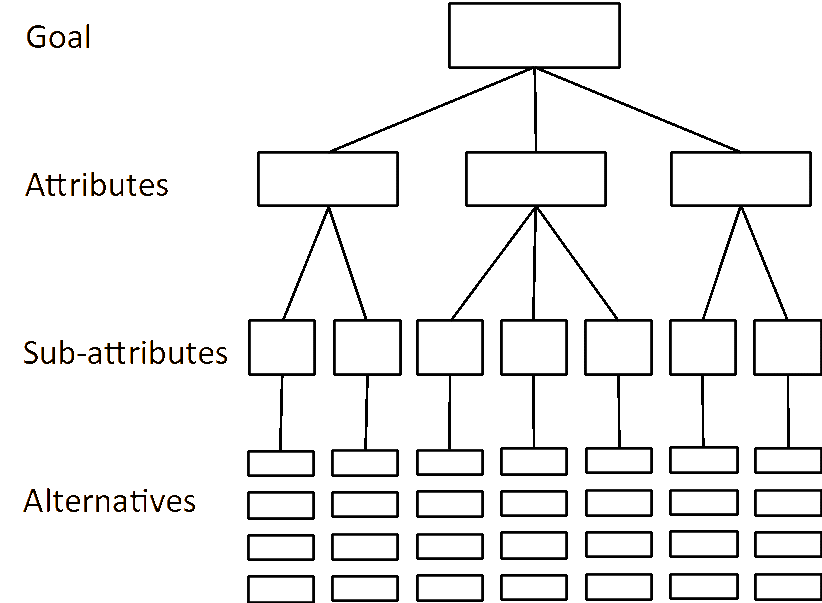
The purpose of AHP is to evaluate and prioritize the influence that alternatives have on satisfying the objective of the problem. The power of the AHP is that it can be applied in any type of decision problem. It can be considered an extension of our information processing capacity and our thought processes [21]. The advantage AHP has over other decision theories is that it better represents the way experts make decisions. It allows for relative judgments and uses the human tendency to organize attributes (criterion influencing the objective) and complex goals into a hierarchy structure (Figure 1). The hierarchy structure allows the decision maker to consider intangible attributes as well as tangible attributes by rank. This hierarchy also allows for attributes of the same class to be placed in weighted parent clusters and weighted within the parent cluster.
Combat potential evaluation: static and dynamic approaches
A variety of methodological approaches have been employed to evaluate both static and dynamic combat force potentials. Static approaches could include Bean Count, Weapon Effectiveness Index (WEI) / Weapon Unit Value (WUV), Potential Anti-Potential method, Force Potential using Operational Lethality Indices (OLIs) and ‘Situationally Modified Force Strength’ methodologies. Dynamic analysis includes Quantified Judgment Method of Analysis, Situational Force Scoring, Adaptive Dynamic Model, and Arms Race Models [21,30,31,32]. In static valuations, the primary question is how the force elements are valued and aggregated by weapon categories such as battle tanks, attack helicopters, sensors, communication systems, aircraft, weapon systems, unmanned air vehicles and land based systems. The naval resources consist of warships (platforms), sensors, anti-ship missiles, torpedoes, command, control, and communication systems, SONARS, maritime aircraft and helicopters. Air resources consist of aircraft, weapons, air-ground weapons, combat support elements and missiles (both surface-to-surface and surface-to-air). A military ontology of all these systems and performances has been built that also contains the combat potential factor. We now explain the methodology to calculate the Combat Potential for the various resources of the army, navy, and air force.
Army resources and warfare
The WEI/WUV method is based on the subjective evaluation of weapons using the Delphi method [21]. In this approach weapon systems are classified into seven categories: man-portable small arms, vehicle-mounted small arms, tanks, armoured reconnaissance vehicles, anti-tank weapons, tube artillery, and mortars. A list of predominant attributes of each weapon category is made and is assigned relative weights by various experts. The major components of each attribute are identified. These components are also assigned weights. A standard weapon is chosen in each category. The components of weapon category attributes are subjectively rated for all weapon systems in the category and compared with the components of the standard weapon to find the weapon effectiveness index. Various categories are then compared with each other. Following this procedure a score for all types of weapons can be calculated and normalized. Consider the WEI/WUV to evaluate three battle tanks of the army [21].
From Table 1, the WEI of a tank is given by WEITank = 0.5F + 0.2M + 0.3S where F, M and S are respectively the ratings for the fire power, mobility, and survivability of a battle tank.
| Attributes | Relative Weight | Evaluation of Tank 1 | Evaluation of Tank 2 | Evaluation of Tank 3 |
|---|---|---|---|---|
| Fire Power (F) | 0.5 | 1 | 0.98 | 1.2 |
| Mobility (M) | 0.2 | 1 | 0.89 | 1.04 |
| Survivability (S) | 0.3 | 1 | 0.98 | 1.09 |
Similarly, when we consider all the factors that affect the Fire Power (Main Gun system, Fire Control system, Munitions, and Secondary armament), and each factor is given an appropriate weight (0.2,0.4,0.3,0.1) then we can compute the Fire Power component of the battle tank as F = 0.2MG + 0.4 FCS + 0.3 N + 0.1 SA. The same procedure is followed for Mobility and Survivability. Assuming the values obtained for tanks 2 and 3 are F2=0.98; F3=1.20; M2=0.89; M3=1.04; S2=0.98; S3=1.09, we can calculate the WEI for tanks 2 and 3 as:
We are presently working with the methods at how the enhanced weight of each attribute is obtained when these battlefield elements are networked and supported by other elements such as ISR, UAVs, concentration of fire power, and force employment.
Naval warfare
Naval tactics and weapon systems can be categorized by the type of opposing force they are intended to fight. Anti-air warfare (AAW) involves action against aircraft and incoming missiles. Anti-surface warfare (ASuW) focuses on attacking and defending against surface warships. Anti-submarine warfare (ASW) deals with the detection and destruction of enemy submarines. The key threat in modern naval combat is the airborne sea-skimmer missile, which can be delivered from surface, subsurface, or airborne platforms [22]. With missile speeds ranging up to Mach 4, engagement time may be only seconds. The key to successful defence is therefore to destroy the launch platform before it fires, thus removing a number of missile threats at once. This is not always possible, so the anti-aircraft warfare (AAW) resources need to be balanced between the outer and inner air battles. Missile tactics are now mostly fire-and-forget or utilize over-the-horizon targeting. Close-range missile defence in the modern age depends heavily on close-in weapon systems (CIWS). Though travelling under water and at lower speeds, torpedoes present a similar threat. As is the case with missiles, torpedoes are self-propelled and can be launched from surface, subsurface, and air platforms. Modern versions of this weapon present a wide selection of homing technologies specially suited to their particular target.
Unlike missiles, however, there are far fewer means to destroy incoming torpedoes. Submarines, as subsurface launching platforms, present an important threat to conventional naval operations. Anechoic coatings and ultra-quiet pump-jets provide modern submarines with the advantage of stealth. The move towards shallow water operations has greatly increased this advantage. Mere suspicion of a submarine threat can force a fleet to commit resources to removing it, as the consequences of an undetected enemy submarine can prove to be lethal. Anti-submarine warfare is a branch of naval warfare that uses surface warships, aircraft, or other submarines to find, track and deter, damage or destroy enemy submarines. Like many forms of warfare, successful anti-submarine warfare depends on a mix of sensor and weapon technology, training, experience and luck. Sophisticated SONAR equipment for first detecting, then classifying, locating and tracking the target submarine is a key element of ASW. To destroy submarines, both the torpedo and mines are used that can be launched from air, surface, and underwater platforms.
Air warfare
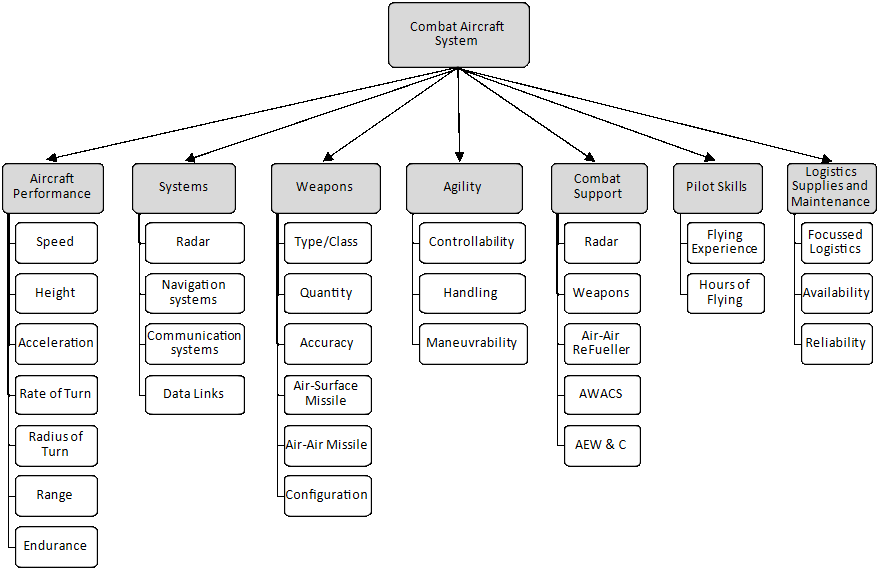
Air Warfare is neither limited to aircraft nor to the atmosphere but involves a combination of aircraft, combat support systems on ground, in air and in space [3]. For the purpose of illustration we have limited the discussion to the application of MAUT to combat aircraft. A well-balanced fighter aircraft design should uniquely combine vehicle performance, weapons performance and systems performance in a total package. Good characteristics of each offer the user greater versatility in applying tactics. Vehicle performance is necessary to carry the weapons to the point of battle, achieve an attack position and establish an optimum set of delivery criteria [15,16,28,29]. The aircraft must also use its performance to reposition itself for successive re-attacks and still have sufficient fuel left to return to base. Weapon performance determines the lethality of the missile, rocket and/or gun projectile that is intended to actually destroy the target. Systems performance dictates the ability to detect and track targets (radar, for example), the ability to evade being tracked by the opponent (electronic countermeasures, reduced observables) and determines the accuracy with which the weapons are delivered. The absence of any of these qualities is unacceptable and they therefore form a design triangle whose sides have to be well balanced and offer some advantages over the corresponding characteristics of the air-to-air opponent. There is, of course, a special relationship between the weapons performance and the vehicle performance: between the two, the ordnance must be brought to bear on the target. The two extremes are the simple gun that more or less shoots where it is pointed and the sophisticated, all aspect, fire and forget beyond visual range (BVR) missile that does all the final manoeuvring itself. But even with an ideal weapon, tactics are narrowly constrained without adequate vehicle/system performance, and reaching optimum weapon delivery criteria and maintaining a good defensive situation relative to an opponent may be difficult. The utility of attributes of a Combat Aircraft system and its affecting factors are shown in Figure 3.
![Aircraft and weapon configuration capability for air-air combat potential [3].](/journals/journal-of-battlefield-technology/volume-16/issue-01/assets/16-1-5-rao/figures/figure02.jpg)
The fundamental objective of an air-to-air battle is to reach an opportunity to fire a weapon at an opponent. With an ultimate weapon that required no aiming or consideration of position or relative motion, and with complete reliability, the need for superior airplane manoeuvring performance would be minimized. But even with all-aspect air-to-air missile capability, the attacker must satisfy some firing envelope criteria by manoeuvring his aircraft relative to the opponent. The greater success in reaching an optimum firing envelope, greater is the probability of kill of any weapon. The less capable a weapon delivery system is, the more valued the relative performance becomes since the airplane must be used to place the weapon in a position to be fired.
Repositioning and maintaining altitude and airspeed for subsequent attacks, the ability to keep vulnerable areas away from the opponent, and defensive disengagement all require some minimum level of persistence, agility and acceleration. Being directly behind an opponent at zero relative lateral motion (in fact, an overtake speed is better since it allows weapon to be launched from a greater distance) is the best situation to accomplish the dual objective of making the opponent most defenceless while simultaneously making the attacker least vulnerable. Of course, this is not necessarily required for a successful attack as evidenced by many actual air-to-air combat encounters. This criteria, however, is judged to be the most demanding for evaluating the aircraft performance dimension of air-to-air combat, and should therefore be the basis for a combat parameter aimed at that facet of the overall air-to-air superiority picture.
Combat force potential evaluation for joint operations
Ever since Air Power has emerged as a fighting element, the concept of Joint Operations has taken firm roots. This concept envisages the conduct of air land, air maritime and tri-service operations to achieve military and national security objectives. In fact, jointness has expanded in scope with the introduction of information warfare, use of space and a digitized battlefield. The main idea is to synergize the utility value that is obtained from jointly planning and executing the tasks in order to achieve the higher objectives. This form of warfare has also seen a paradigm shift in the way warfare is conducted: from platform-centric to network-centric and has assumed an integrated Command Control Communications Computers Intelligence Surveillance and Reconnaissance (C4ISR) system in place. Traditional techniques developed so far to calculate Combat potential, Force strength and Force Potential were all based on the premise of platform-centric warfare. We however need to evolve new methodologies to assess and evaluate the power of data, information, communication and social networks in the new forms of warfare called network-centric warfare (NCW).
Metcalfe’s law on the power of the network is very much applicable. The power of Networked Computing will depend upon the kind of accessibility, information sharing, cooperation and collaboration among the networked nodes. Other intangibles, which impact the conduct of NCW, could be situational awareness, speed of decision making, leadership, organisation, morale, analytical process, security, and reliability of networks.
This paper uses Neuro-Fuzzy computing approach to evaluate the combat potential in a NCW environment and study if the premises are truly valid and if synergy can be achieved. An enhanced weight of each attribute when networked and supported by other elements such as Intelligence Surveillance reconnaissance (ISR), Unmanned Air vehicles (UAVs), Air-Air Re-fuellers (AARs), Airborne Warning and Control Systems (AWACS), Airborne Early Warning and Control (AEW&C), concentration of fire power, and force employment is computed in the MAUT as well as Neuro-Fuzzy model [13,14,7,8] to calculate the static and dynamic force potentials. The Force Strength is calculated from the cumulative sum of the combat potentials of the individual force elements and the Environmental variables; and the Force Potential is calculated from the Force Strength along with the Operational factors in the scenario considered.
A neuro-fuzzy approach to evaluate combat potential
In the following section, the neuro-fuzzy hybridization approach to evaluate the combat potential will be discussed. Both neural networks and fuzzy systems are dynamic, parallel processing systems that estimate input–output functions [6,7,8]. They estimate a function without any mathematical model and learn from experience with sample data. It has also been proven that 1) any rule-based fuzzy system may be approximated by a neural net and 2) any neural net (feed-forward, multilayered) may be approximated by a rule-based fuzzy system. Fuzzy systems can be broadly categorized into two families. The first includes linguistic models based on collections of IF–THEN rules, whose antecedents and consequents utilize fuzzy values. The Mamdani model falls in this group where the knowledge is represented as shown in the following expression.
(4)
The second category, which is used to model the Weather prediction problem is the Sugeno-type and it uses a rule structure that has fuzzy antecedent and functional consequent parts. This can be viewed as the expansion of piece-wise linear partition represented as shown in the following rule.
(5)
The conjunction “and” operation between fuzzy sets known as Linguistics, for the implementation of the Mamdani rules is achieved by employing special Fuzzy Operators called T-Norms [6]. The ANFIS uses by default the Minimum T-Norm which is the case here and it can be seen in Equation (1). The approach approximates a nonlinear system with a combination of several linear systems, by decomposing the whole input space into several partial fuzzy spaces and representing each output space with a linear equation. Such models are capable of representing both qualitative and quantitative information and allow relatively easier application of powerful learning techniques for their identification from data. They are capable of approximating any continuous real-valued function on a compact set to any degree of accuracy [7,8]. This type of knowledge representation does not allow the output variables to be described in linguistic terms and the parameter optimization is carried out iteratively using a nonlinear optimization method.
Fuzzy systems exhibit both symbolic and numeric features. Neuro-fuzzy computing [11,12,13] is a judicious integration of the merits of neural and fuzzy approaches, enables one to build more intelligent decision-making systems. Neuro-fuzzy hybridization is done broadly in two ways: a neural network equipped with the capability of handling fuzzy information [termed fuzzy-neural network] and a fuzzy system augmented by neural networks to enhance some of its characteristics like flexibility, speed, and adaptability (termed neural-fuzzy system). ANFIS is an adaptive network that is functionally equivalent to a fuzzy inference system and referred to in literature as “adaptive network based fuzzy inference system” or “adaptive neuro-fuzzy inference system” (Figure 5) [7,8,12,13]. In the ANFIS model, crisp input Utility values series are converted to fuzzy inputs by developing triangular, trapezoidal and sigmoid membership functions for each input series. These fuzzy Utility value inputs are processed through a network of transfer functions at the nodes of different layers of the network to obtain fuzzy outputs with linear membership functions that are combined to obtain a single crisp output depicting the predicted Combat Potential (Table 4) of the individual/joint operations in a given scenario depicted as fuzzy antecedents (Tables 2 and 3), as the ANFIS method permits only one output in the model.
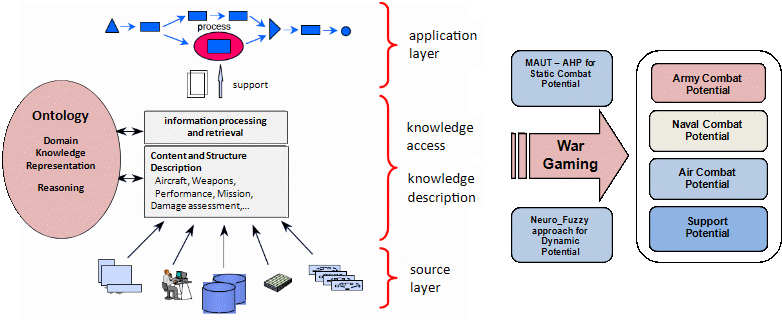

Consider a scenario that has the environmental and operational conditions as depicted in Tables 2 and 3. The Joint Operations Mission Objective is divided into a number of Tasks that are executed by the designated service (army, navy, air force) (Table 4). The individual missions are identified by the tasks to be performed and the specific characteristics of execution of the mission namely System’s Role Match, Weapon-Target Match, Support Elements (ISR, AWACS, AAR, AEW&C, UAV) available for the Mission are quantified by fuzzy linguistic variables. The MAUT approach is used to calculate the Static WEI/WUV values for the resources used for the Mission, and the Neuro-Fuzzy method ANFIS is used to evaluate the Joint force combat potential.
A war-gaming simulation [3,4,9] is also run using a discrete event simulations technique that incorporates all these variables and factors to calculate the Mission Success factor. We also simulate the same missions without the support elements and evaluate the different combat potential and Mission Success Factor. The utility values as identified in the military ontology knowledge base is used as reference values to fuzzify and give these as inputs to the ANFIS system to calculate the dynamic joint force potential. In the Table 4, five different operations involving different forces (army, navy, air force, joint army and air force) are used to assess the mission success factors. This evaluation is done after generating the FIS rule from Table 2 and 3 before arriving at the values shown in Table 4. We assess the Mission Success Factor for the Mission #001 - #004, by individual services using the static and wargaming methods. The values obtained using static MAUT and Wargaming are quite close to one another as shown in Table 4: {(7.32, 8.4), (8.63,7.2), (5.67,3.7) and (8.03,9.8)}. However, consider the Mission #005 that is executed as joint forces operation of the army and the air force and the Mission Success factor estimated using the static MAUT was 5.45, using the war-gaming method was 6.9 and using the ANFIS method was 16.88.
In order to study the effects of support elements on the Mission Success factor, we run the same scenario and obtain the static value using MAUT as 5.45 (this method does not consider the environmental dynamics and hence the value does not change), the Mission Success factor using the war-gaming method falls to 3.1 from 6.9 in the absence of any Support elements and using the ANFIS methodology falls from 16.88 to 7.63. This study indicates the role and dependence of the Support elements on the Mission Success factor.
Conclusions and discussion
Combat potential evaluation and military force strength assessment is an important area of military warfare analytics used by defence analysts for net assessment, military balance and identifying the gaps in force potentials. In this paper, we propose a multi-attribute utility approach where the weights are given by AHP method to evaluate the weapon system’s static combat potential and use a wargaming simulator to evaluate the dynamic combat potential. These values obtained for the army, navy and air force resources are then combined to obtain the joint force potentials for a given combat scenario.
In this generic framework designed to evaluate the combat force strength and force potentials, there are a large number of pitfalls. It is difficult to rank the entities as a system and on an absolute scale. As we apply the AHP to assess the ranking of entities with respect to a role, function or utility, and these weights are input to the MAUT, introduction of any new entity will require that we re-work all our calculations for a re-assessment (due to rank reversal). The exact model relationships between the input variables and the output are difficult to assess and hence an ANFIS model works more appropriately and the fuzzy inference system rules that are obtained, are used for building a decision support system. Thus, a hybrid approach that combines static, dynamic and wargaming techniques must be used to assess the combat potential and force strength of the various combat elements studies as a system and as a system-of-systems.
| Mission | Temperature | Fog-Haze | Wind Speed (m/s) | Clouds/ Base | Visibility | Turbulence | Storm/ Squalls | Resource Avl/Rel |
|---|---|---|---|---|---|---|---|---|
| #001 | Moderate | Clear | Low | Clear | Clear | Low | Clear | Yes-H |
| #002 | Very Low | Moderate | High | Low | Poor | High | Clear | Yes-H |
| #003 | Moderate | Clear | Moderate | Scattered | Clear | Low | Clear | Yes-L |
| #004 | Very High | Haze | High | Low | Poor | High | Squall | Yes-H |
| #005 | Very High | Haze | High | Low | Poor | High | Squall | Yes-H |
| Mission | Temperature | Fog-Haze | Wind Speed (m/s) | Clouds/ Base | Visibility | Turbulence | Storm/ Squalls | Enemy Ground Defence | Enemy Air Defence |
|---|---|---|---|---|---|---|---|---|---|
| #001 | Moderate | Clear | Low | Clear | Clear | Low | Clear | Yes-H | Yes-H |
| #002 | Very Low | Moderate | High | Low | Poor | High | Clear | Yes-H | Yes-H |
| #003 | Moderate | Clear | Moderate | Scattered | Clear | Low | Clear | Yes-H | Yes-L |
| #004 | Very High | Haze | High | Low | Poor | High | Squall | Yes-H | Yes-L |
| #005 | Very High | Haze | High | Low | Poor | High | Squall | Yes-H | Yes-L |
| Mission | Task | System’s Role Match | Weapon-Target Match | Support Elements (ISR, AWACS, AEW&C, AAR, UAV) | Mission Success Factor Sum of Static WEI/WUV MAUT | Mission Success Factor War Game | Mission Success factor Joint Combat Potential: Neuro-Fuzzy Model |
|---|---|---|---|---|---|---|---|
| # 001 (Army) | Mobilization Ground forces | 8 | 6 | 8 | 7.32 | 8.4 | |
| # 002 (Navy) | Incapacitate Port/Harbours | 9 | 8 | 9 | 8.63 | 7.2 | |
| #003 (Air Ops) | Suppression of Enemy Air defence | 7 | 6 | 6 | 5.67 | 3.7 | |
| # 004 (Air Ops) | Offensive Strike | 9 | 9 | 9 | 8.03 | 9.8 | |
| # 005 (Army and Air Ops) | Damage Assessment and Recce Missions | 7 | 8 | 7 | 5.45 | 6.9 | 16.88 |
| #001-#004 (No Support elements) | <as above> | <as above> | <as above> | <None> | 5.45 | 3.1 | 7.63 |
References
[1] Vijay Rao, D., Iliadis, L., Papaleonidas, A., and Spartalis, S., “Modelling Environmental Factors and Effects in Virtual Warfare Simulators by using a Multi Agent Approach”, International Journal of Artificial Intelligence, 2012.
[2] Vijay Rao, D., Iliadis, L., and Spartalis, S., “A Neuro-Fuzzy Hybridization Approach to Model Weather Operations in a Virtual Warfare Analysis System, 12th Engineering Applications of Neural Networks (EANN) (Eds.) Iliadis, L., Corfu, Greece, Springer, 2011.
[3] Vijay Rao, D., The Design of Air Warfare Simulation System, Technical Report, Institute for Systems Studies and Analyses, 2011.
[4] Vijay Rao, D. and Kaur Jaslee, “A Fuzzy Rule-based Approach to Design Game Rules in a Mission Planning and Evaluation System”, 6th IFIP Conference on Artificial Intelligence Applications and Innovations, (Eds.) Papadopoulos, H., Andreou, A. S., Cyprus Springer, October 2010.
[5] Vijay Rao, D. and Saha B., “An Agent Oriented Approach to Developing Intelligent Training Simulators”, SISO Euro-SIW Conference, Ontario, Canada, June 2010
[6] Cox, E., The Fuzzy Systems Handbook, Academic Press, New York, 1999.
[7] Jang, J.S.R., “ANFIS: Adaptive Network-based Fuzzy Inference Systems”, IEEE Transactions on Systems, Man and Cybernetics, Vol. 23, No.3, pp. 665–685, May/June 1993.
[8] Jang, J.S.R., Sun, C.T. and Mizutani, E., Neuro-Fuzzy and Soft Computing: A Computational approach to Learning and Machine Intelligence, Prentice Hall, New Jersey, 1997.
[9] Banks, J. (ed.), Handbook of Simulation: Principles, Methodology, Advances, Applications, and Practice, John Wiley and Sons, New York, 1998.
[10] http://www.rand.org/pubs/research_memoranda/RM37.html
[11] Taher, J. and Zomaya, A.Y., “Artificial Neural Networks”, Handbook of Nature-Inspired and Innovative Computing, Integrating Classical Models with Emerging Technologies, (Ed.) Albert Y. Zomaya, pp. 147–186, Springer USA, 2006.
[12] MATLAB Fuzzy Logic Toolbox.
[13] Mitra, S. and Hayashi Y., “Neuro-Fuzzy Rule Generation: Survey in Soft Computing Framework”, IEEE Transactions on Neural Networks, Vol. 11, No.3, pp. 748–768, 2000.
[14] Pedrycz, W., Computational Intelligence—An Introduction, CRC Press, USA, 1998.
[15] Nunn,W.R. and Oberle, R.A., Evaluating Air Combat Maneuvering Engagements, Vol. I, Methodology, Center for Naval Analyses, 1402 Wilson Boulevard, Arlington, Virginia 22209, USA, 1976.
[16] Parrott, E., Combat Performance Advantage: Method of Evaluating Air Combat Performance Effectiveness, Aerodynamics and Performance Branch, Technical Report ASD-TR-78-364,Aeronautical Systems Division, Air Force Systems Command, Wright-Patterson AFB, Ohio 45433, USA, 1978.
[17] Triantaphyllou, E. and Mann, S. H., “An Examination of the Effectiveness of Multi-Dimensional Decision-Making Methods: A Decision-Making Paradox”, Decision Support Systems, Vol. 5, pp. 303–312, North Holland, 1989.
[18] Antonio Jime´nez, Sixto Rı´os-Insua, and Alfonso Mateos, “A Decision Support System for Multi-Attribute Utility Evaluation Based on Imprecise Assignments”, Decision Support Systems, Vol. 36, pp. 65– 79, 2003.
[19] Smith, J.Q., Decision Analysis, A Bayesian Approach, Chapman and Hall, 1988.
[20] White, D.J., Decision Theory, George Allen and Unwin Ltd., London, 1969.
[21] Jaiswal, N.K., Military Operations Research: Quantitative Decision Making, Kluwer Academic Publishers, USA, 1997.
[22] Naval Operations Analysis, prepared by the Operations Committee, Naval Science Department, US Naval Academy, Annapolis, Maryland, (1968).
[23] von Neumann John, Morgenstern, Oskar, Theory of Games and Economic Behavior, Princeton University Press, 1944.
[24] Fishburn P. C, Decision and Value Theory, John Wiley and Sons, USA, 1964.
[25] French, S., Decision Theory, An Introduction to the Theory of Mathematics and Rationality, Ellis Horwood Ltd, England, 1986.
[26] Mustajoki, J., Interactive Multi-criteria Decision Support—New Tools and Processes for Practical Applications, Doctoral dissertation, Dept. of Engg Phyics and Mathematics, Systems Analysis Laboratory, Helsinki University of Technology, 2007.
[27] Markushostmanna, Bernauer, T. Hans-Joachimmosler, and Peterreichert, Bernhardtruffer, “Multi-Attribute Value Theory as a Framework for Conflict Resolution in River Rehabilitation”, Journal of Multi-Criteria Decision Analysis, Vol. 13, pp. 91–102, 2005.
[28] Davis, R.,G., Preference Structures and the Measurement of Military Worth, Econometric Research Program, research Memorandum No. 17, Princeton University, Princeton, N.J., 1960.
[29] Brewin, R.L., A Review of the Concept of Military Worth and its Application in Military Decision Making, Master’s Thesis in Management, U.S. Naval Postgraduate School, 1964.
[30] Dockery, J.T., and Woodcock, A.E.R., (Eds.), The Military Landscape: Mathematical Models of Combat, Woodhead Publishing, Cambridge, England, (1993).
[31] Keeney,R.L., and Howard Raïffa, Decisions With Multiple Objectives: Preferences and Value Tradeoffs, Cambridge University Press, 1993.
[32] Lee, Y.W., Ahn, B.H., Static Valuation of Combat Force Potential by the Analytical Hierarchy Process, IEEE Transactions on Engineering Management, Vol. 38, No. 3, pp. 237–244, August 1991.
[33] Tolk, A., Engineering Principles of Combat Modeling and Distributed Simulation, John Wiley and Sons, New jersey, USA, 2012.