
Volume 16, Number 1, March 2013
The Electro-Optical Multifunction Sensor Concept For Future Military Applications
Abstract
This paper introduces the electro-optic (EO) multifunction sensor concept for military applications and describes why it would be advantageous to merge several EO functionalities, possibly not as performance-oriented as single task sensors, into a unique system to create performance synergies by acting together. The paper conveys the concept of several known capabilities merged into a single-aperture sensor to enhance threat detection (TD), situational awareness (SA), and targeting capabilities. Sensors with tremendous sensitivity and dynamic range are currently available, and when coupled with properly engineered optics and processing techniques, additional synergies can be developed in order to provide a key technological advantage when exploited in a military context. In this paper, the drivers, basic concepts, and challenges are introduced to grasp the essence of EO multifunction sensors. The research fields that may present breakthroughs are presented in conjunction with examples. Finally, current work from the industry and government agencies is briefly discussed.
Introduction
Recent developments in electro-optical warfare (EOW) resulted in an array of specialized sensors deployed on military platforms. The current state-of-the-art EO sensors, such as missile warning system (MWS), thermal imager, laser beam rider (LBR) detector, targeting and situational awareness (SA) systems, among others, are often optimized to perform a single task in order to achieve the best performance possible. For instance, the newest MWS are able to accurately detect and track incoming missiles with a limited number of false alarms. However, their usefulness is reduced considerably when there is no incoming missile, as it does not provide SA for the crew. This paper brings a new vision for future combat systems by promoting the EO multifunction sensor, which would process the aggregate information from several electro-optical functionalities into a limited number, or ideally, into a single wide field-of-view (FOV) optical aperture. The capability to process and display efficiently the information from each function within the multifunction sensor would create a disruptive asset in the battlefield. It would be a capacity enabler for the air, sea, and land forces by allowing threat detection (TD) and SA information to merge into a cohesive decision-making process for the operators and the chain of command.
Drivers
In the aviation domain, maintaining a high level of SA is one of the most critical challenges of an aircrew [1]. The warfighters are in the need for improved SA and TD systems with reduced false alarm rates. In adverse conditions, aircrews still have difficulties in the detection, identification, and accurate tracking to perform precise battlefield damage assessment. It would be possible to improve such operations with the integration of a multifunction sensor that would perform advanced thermal imaging, target marking, and laser designation confirmation within a single piece of equipment. Advanced EOW techniques, currently out of reach, would also be possible with multi-functionality through single wide FOV aperture. For example, a laser and a gated camera could be synchronized with a micro-electro-mechanical system (MEMS) multi-motion micromirror to capture only the return from the laser illuminated area. Thus, increasing considerably target detection, while concurrently maintaining SA and TD capabilities for the multifunction sensor. Figure 1 shows an artist view of a multifunction sensor mounted on an unmanned aerial vehicle (UAV).

The multifunction sensor would reduce the space claim and the overall cost versus individual systems or sub-systems optimized to perform a single task, and lead to important economies in procurement, training, and maintenance throughout the product life cycle. The multifunction technology would also improve the integration requirements by reducing the number of optical apertures, power consumption, size, and improve the drag characteristics on aerial platforms.
Basic concepts
Currently, sensors with tremendous sensitivity and dynamic range are available [2,3] and when coupled with proper engineered optics and processing, an increased number of functionalities can be developed and exploited. The typical EO multifunction sensor shall provide wide FOV coverage through a single aperture covering the ultraviolet (UV) to the long-wave infrared (LWIR) regions using innovative optical materials and coatings that would maximize bandwidth and transmittance.
Optical components such as dichroic prisms, curved mirrors, and fibre bundles, among others, may be utilized to convey the scene information to the sensor, which may be based on a single or multiple detection units. The imaging sensors are of interest due to the added spatial information they provide while the single pixel sensors have advantages in threat detection with their large surface areas. The use of metamaterials and MEMS to support active and passive detection systems via the main optical aperture is an important aspect of the multifunction capability. Only the relevant information collected by each function shall be merged and displayed for a quick snapshot of the state of SA. In a case of a TD occurrence, the display could morph and reduce the SA information, by lowering the contrast or by applying a different colour scheme, to favour threat tracking and the resulting countermeasure effects.
Challenges
From a technological standpoint, the sensor ability to perform a given function of TD or SA is progressing well and follows new advances in materials, electronics, and fabrication techniques. However, the concept of integrating several EOW functionalities for a given system seems to be progressing at a slower pace. There is currently no evidence, to the authors’ knowledge, of highly integrated EO multifunction sensors on military platforms. The sensor concept is facing technological and philosophical challenges. The technological challenges include: 1) interference filter blue shift with angle of incidence that strongly affects filter performances [4], 2) wide FOV lenses compatibility with total internal reflection optical components, 3) capacity to maintain good cross-sensitivity across the range of functions and, 4) ability to reduce the dataset presented to the user, via advanced algorithmic development, signal processing, and data fusion. The data generated has the potential to be excessive and shall be parsed ingeniously in order not to overflow human decision capability. The philosophical challenge requires a mentality change in the conception that several optimal EO sensors, each designed to perform a specific task are required to protect a platform, instead of having an integrated portfolio of less performing EO sensors sharing and processing more efficiently the information. When the change occurs, the development of EO multifunction sensor will accelerate for military platforms.
New technologies
The development of metamaterials for sensing and the research in new processes to modify or improve existing materials [5,6] is fundamental for the advancement of the electro-optical multifunction sensors. Vanadium dioxide (VO2), which exhibit both a semiconductor and metallic structures, below and above the transition temperature, respectively, is considered a good candidate for EO switching applications, such as smart infrared optical windows, emissive coatings, and resonant cavities [7,8]. The advances in MEMS domain already led to the manufacturing of precise activators [9]. A precisely controlled array of multi-motion micromirrors could be used to direct a laser beam from within the multifunction sensor and illuminate a single target of interest within the FOV. Recent manufacturing developments have led to indium gallium arsenide (InGaAs) focal plane arrays that have a clear advantage in night vision applications [10]. The extended InGaAs, covering the 0.7 to 1.7 um wavelengths, is of interest to the defence industry as it allows the detection of specific lasers used in the battlefield. This material may provide the basis for a situational awareness multifunction sensor. The emergence of photonic integrated circuit (PIC) based on Er-doped and III-nitride materials is also an area of interest due to the potential of having small footprint electrically pumped optical signal amplification [11] stages for TD systems sensing emissions at specific wavelengths.
Maturity & current work
The current maturity of multifunction sensors depends largely on the definition that is attached to it. According to the authors, a multifunction sensor is defined as a collection of active and passive sensing technologies operating through a common aperture coupled with advanced signal processing that allows for multifunction capabilities. Basic multifunction capability, such as night vision coupled with laser detection on extended InGaAs material or dual-band thermal imaging using stacked detector arrays, already exist through single aperture. However, advanced capabilities that include TD and SA with active detection of localized targets still remain a challenge.
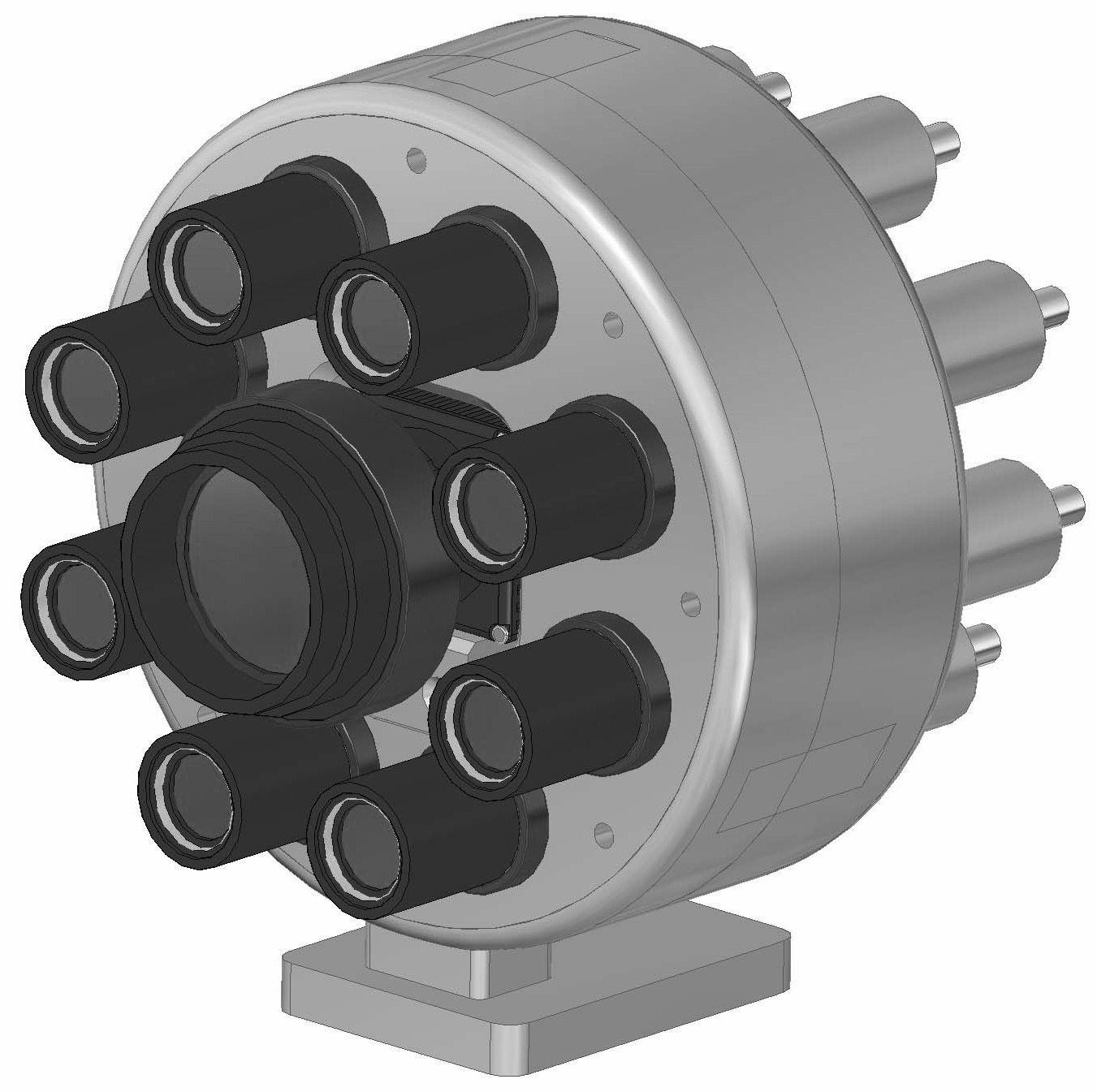
Military forces around the world are currently supporting innovative techniques to develop EO multifunction sensors. Several projects described in the open literature are looking at multi-functionality from different viewpoints. Northrop Grumman is working on an advanced threat warning (ATW) multifunction sensor that provides a four-in-one capability, including missile and laser warning, hostile fire indication (HFI), and video sensing [12]. The US Navy is working on a fundamental study with a plan to explore and develop the technologies required to combine a number of modular passive and active EO functions through a single aperture [13]. The Israeli Ministry of Defense (IMOD) is pursuing efforts on the development of an advanced multifunction sensor combining short-wave infrared (SWIR) and mid-wave infrared (MWIR) imaging, along with asynchronous laser pulse detection and laser range finder, with all four functions included on a single integrated circuit [14]. Defence R&D Canada is working on the development of a multifunction sensor that includes low-cost TD and discrimination capability coupled with a high resolution SWIR imager to provide SA and laser detection capabilities. The prototype, shown in Figure 2, currently uses multiple apertures with the intent of concentrating research efforts on threat discrimination algorithms rather than optical design. The cooled sensors consist of a blend of silicon (Si) and InGaAs photo-detectors filtered at wavelengths of interest for threat detection and discrimination. The SWIR imager allows for night vision, SA, LBR detection, and to support algorithms for TD. A future iteration shall converge towards single aperture operation. A second prototype combines a three charge-coupled devices (3-CCD) imager to evaluate low-cost imaging MWS with HFI capability in the visible and near infrared bands. The imager uses a single collecting optics and a Philips prism to separate the incoming light into three outputs. The outputs are then filtered for SA and TD and captured via synchronized imagers. One channel is mainly used to provide SA, while the other two operate at lower gains and integration times for threat detection. Investigation is currently underway to determine if the discrimination concepts used in the two-colour MWIR imagers can be applied to these low-cost systems.
Conclusion
In summary, there is a growing evidence [12–14] of the development of EO multifunction sensors for military applications. Challenges still remain in the development of innovative materials, wideband optical systems with large FOV, and advanced MEMS technologies such as fast multi-motion micromirrors. We believe that the coactions between the functions shall be highly considered at the expense of unique functions with optimal performance. With the synergies created from multifunction capabilities, along with the possibilities of data fusion for a cohesive presentation of the information, users will adopt the concept of EO multifunction sensors to address a significant capability gap for the next generation of military platforms.
References
[1] D.J. Garland and J.A. Wise, V.D. Hopkin, Handbook of Aviation Human Factors, Lawrence Erlbaum Associates, Mahwah, NJ, 1999.
[2] Y. Ni, B. Arion, Y. M. Zhu, P. Potet, O. Huet, J.L. Reverchon, J.P. Truffer, J.A. Robo, and E. Costard, “Toward a Single-chip TECless/NUCless InGaAs SWIR Camera With 120-Db Intrinsic Operation Dynamic Range”, Infrared Technology and Applications XXXVII, Proceedings of the SPIE, 8012, 80121W, 2011.
[3] S. Bisotto, E. de Borniol, L. Mollard, F. Guellec, A. Peizerat, M. Tchagaspanian, P. Castelein, and P. Maillart, “A 25µm Pitch LWIR Staring Focal Plane Array With Pixel-level 15-bit ADC ROIC Achieving 2mK NETD”, Electro-Optical and Infrared Systems: Technology and Applications VII, Proc. SPIE 7834, 78340J, 2010.
[4] I.H. Blifford Jr., “Factors Affecting the Performance of Commercial Interference Filters”, Applied Optics, Vol. 5, No. 1, January 1966, pp. 105–111.
[5] C.Y. Lin, Y. H. Wang, J.Y. Huang, Y. Liu, and Y. Zhao, “Impact of Electric Quadrupolar Coupling on the Optical Response of an Array of Nano-objects”, Journal of Physics: Condensed Matter, 22, 225301, 2010.
[6] N.I. Zheludev, “A Roadmap for Metamaterials”, OPN Optics & Photonics News, March 2011, pp. 31–35.
[7] F. Guinneton, L. Sauques, J-C. Valmalette, F. Cros, J-R. Gavarri, “Role of Surface Defects and Microstructure in Infrared Optical Properties Of Thermochromic VO2 Materials”, Journal of Physics and Chemistry of Solids, 66, 2005, pp. 63–73.
[8] Q. Cheng, S. Paradis, T. Bui, M. Almasri, “Design of Dual-Band Uncooled Infrared Microbolometer”, IEEE Sensors Journal, Vol. 11, No. 1, January 2011, pp. 167–175.
[9] S.T. Todd, A. Jain, H. Qu, and H. Xie, “A Multi-degree-of-Freedom Micromirror Utilizing Inverted-Series-Connected Bimorph Actuators”, Journal of Optics A: Pure and Applied Optics, Vol. 8, No. 7, 2006, pp. S352–S359.
[10] D.G. Turner, T.C. Bakker, P. Dixon, and M.H. Ettenberg, “The Development of, and Applications for, Extended Response (0.7 to 1.7µm) InGaAs Focal Plane Arrays”, Infrared Technology and Applications XXXIV, Proceedings of the SPIE, 6940, 694037, 2008.
[11] R. Dahal, J.Y. Lin, H.X. Jiang, and J.M. Zavada, “Near Infrared Photonic Devices Based on Er-doped GaN and InGaN”, Optical Materials, Vol. 33, Issue 7, 2011, pp. 1066–1070.
[12] Spacewar, “Northrop Grumman Selected to Provide Department of the Navy with Advance Threat Warning Sensors”, September 2011, http://www.spacewar.com.
[13] US Navy STTR FY2011A, “Development of an EO/IR Common Aperture Modular Multifunction Sensor”, February 2011, http://www.navysbir.com/n11_A/navst11-024.html.
[14] L. Langof, D. Nussinson, E. Ilan, S. Elkind, R. Dobromislin, I. Nevo, F. Khinich, M. Labilov, Z. Calahorra, S. Vaserman, T. Markovitz, O. Manela, D. Elooz, A. Tuitob, and D. Osterb, “Advanced Multi-function Infrared Detector with On-chip Processing”, Infrared Technology and Applications XXXVII, Proceedings of the SPIE, 8012, 80120F, 2011.