
Volume 15, Number 3, November 2012
Design Of A Reduced Lethality Artillery Round (REDLAR)
- * Address
- * Department of Chemistry and Chemical Engineering, Royal Military College of Canada, PO Box 17000, Station Forces, Kingston, ONTARIO K7K 7B4, CANADA.
Abstract
A design specification was written for a “non-lethal” artillery round, with the aim of mimicking the explosion characteristics of the M107 high-explosive round, while minimizing the lethal radius. An M107 round contains 6.95 kg of Composition B, with a 100% kill radius of roughly 20–30 m. The required explosive mass was reduced to 3.00 kg, to account for the fact that no explosive energy would be required to expand a steel shell and propel the resulting fragments. Since a lethal radius of 1–2 m exists due to blast overpressure, the round is referred to as a “reduced lethality artillery round” (REDLAR). Eight concepts for a REDLAR were developed, then screened and ranked on the basis of the design specification. Two concepts were selected and refined into detailed computer models: a base-ejecting charge round (BEC), and a 155 mm sabot round. Using the PRODAS© software package, simulations of the interior and exterior ballistic performance of each round were conducted. Results showed that the BEC was a close ballistic match to the M107, while the Sabot Round was gyroscopically unstable. The BEC round was also calculated to have a 50% probability of a lethality radius of 1 m or less.
Introduction
The purpose of this design exercise was to assess the feasibility of designing a special non-lethal artillery round, as requested by the Canadian Army’s Director of Land Requirements 2 (DLR 2). The aim of the round is to mimic the explosion characteristics of a [155 mm] high-explosive (HE) round, while minimizing the lethal radius. The stated goal is for the round to be non-lethal, but reduced-lethality may be the more likely result of trying to produce the same detonation characteristics of an HE round.
The idea of non-lethal artillery is a relatively new concept that has already caught the attention of the United States Army. Lieutenant-General Michael D. Maples, former U.S. Chief of Field Artillery has stated that,
“To achieve full-spectrum relevance, the Field Artillery must be able to coordinate and deliver a wide range of non-lethal effects. The ability to deliver non-lethal effects is particularly important in the urban environment where we may want to limit collateral damage or effects on non-combatants” [1].
As a result of the U.S. Army’s acknowledgement of the requirement for non-lethal rounds, some research into the development of a non-lethal artillery round has been conducted since as early as 2003. The U.S. Army Research Laboratory (ARL), Maryland, and the U.S. Army Armament Research Development and Engineering Center (ARDEC), New Jersey, combined efforts to design and produce a non-lethal artillery projectile [2]. However, as of late 2008, U.S. development of a non-lethal artillery round had stopped before the concept could be successfully proven [3].
Most prior research has focused on non-lethal shells, or delivering non-lethal payloads, with little work going into delivering less-lethal explosive effects at the target. In Canada, no research has been conducted into producing a reduced-lethality artillery round for operational use. Defence Research and Development Canada—Valcartier (DRDC Valcartier) has produced many reports on low-cost options for training/practice 105 mm and 155 mm rounds, but none of these studies addresses the design problems inherent in producing a non-lethal round for use in operations, such as how to reproduce the blast effects of an HE round while eliminating the lethality associated with fragmentation.
The design of an artillery round that will mimic the explosion characteristics of an M107 HE round was accomplished through an iterative design process, resulting in specifications for a product that fulfils the need expressed by DLR 2.
Problem definition
The M107 high-explosive-filled round is used primarily for blast, fragmentation, and cratering effects. The projectile is cast-filled with 6.95 kg of Composition B explosive. The projectile body is of forged steel construction [4]. Comp B is a castable 60/40 mixture of RDX/TNT, with a TNT equivalence of 1.148 [5].
Clearly, a steel shell filled with 6.95 kg of explosive is going to have a lethal effect when it reaches its target. For the purposes of this study, it was assumed that human fatalities occur via at least one of three mechanisms, listed here in order of probability, from what is assumed to be most likely to least likely due to:
- flying shrapnel from the exploding shell;
- blast overpressure from the detonation of the high-explosive; and
- kinetic energy from the direct impact of the round or its components (fuse, base plate, casing).
If it is assumed that the lethal radius of an M107 155 mm HE projectile is approximately 20–30 m, then that is the radius that needs to be minimized as much as possible for a non-lethal artillery round.
For a ground-burst round, it would appear that there are two options available to minimize the risk of lethal fragments: to select a material that will combust upon payload detonation, such as paper or cardboard; or to select a material that will still fragment upon detonation, but will fragment in such a way that the average fragment mass or velocity is so low as to not have the momentum required to penetrate a human target. This material could be similar to wood, in that it splinters readily, allowing pressure to escape the inside of the shell quickly before it can impart a large amount of energy to accelerating the fragments. It could also be a material such as cast iron, glass, or any other brittle material whose fragments are very small. It is imperative that the material is frangible, and produces fragments with small masses, travelling at low velocities. Eliminating dangerous shrapnel is fundamental to minimizing the lethal radius of the non-lethal artillery round.
With this in mind, it is important to understand that even if the shrapnel emitted from an artillery round is reduced to zero, there is still a danger due to blast overpressure. Work by Held provides relationships between distance from the blast and charge weight that can be used to approximate overpressure values for a given charge [6].
Work by Petras, Bauman, and Elsayed [7] describes the numerous methods of bodily injury for people exposed to blast overpressure from offensive weapons. The main foci of blast overpressure injury studies are the cardiac, pulmonary, gastrointestinal, and urinary systems. Other areas susceptible to damage are the lining of the airway, the trachea, the heart, and the brain. At higher overpressures, permanent hearing disability will be produced by the destruction of the cochlear apparatus.
As Cooper notes, “it has been found that both ear and lung responses are dependent not only on pressure but also upon impulse and body orientation. The shorter the pulse width, the higher the pressure the body can tolerate” [8]. Indeed, an examination of the lethality and injury curves contained within Cooper’s text [8] reveals that it is impulse that has the greatest lethal effect.
The lethality curves depend on the orientation of the person to the blast wave, and assume a blast outdoors, in free air. Note that for shorter pulse durations, the body can withstand a higher maximum overpressure. For indoor explosions, physiological effects are influenced by the reflection of blast waves off walls. This greatly increases the peak pressures and lengthens the pulse duration, resulting in increased lethality and injuries.
The injury figure in Cooper’s text [8] shows three curves, representing three different levels of cochlear injury. Level 1 refers to healable tears of the tympanic membrane. Level 2 consists of tearing of the membrane that will result in permanent hearing loss. Level 3 includes severe rupture of the membrane, with inner ear damage. For the purposes of this paper, 50% probability of Level 2 ear damage will be considered the threshold for serious physiological damage.
With an understanding of the effects of peak pressure on the human body, it is now possible to return to Held’s work, and examine the equations he has developed to help predict peak pressure. Held states that “there is no simple mathematical relationship between mass of the explosive charge, the distance of the explosive charge from the point of measurement, and the peak overpressure of the blast wave” [6].
This statement applies for impulse as well. Held provides the following relationships for peak pressure, Pmax [Pa] and impulse, I [Pa · ms]:
Above, A is a constant with a minimum value of 6×10⁵ Pa·m2·kg–2/3, a maximum value of 60×105 Pa·m2·kg–2/3 and an average value equal to 20×105 Pa·m2·kg–2/3. B is a constant with a minimum value of 1×10⁵ Pa·m2·kg–2/3·s, a maximum value of 10×105 Pa·m2·kg–2/3·s, and an average value equal to 3×10⁵ Pa·m2·kg–2/3·s. W is the charge mass in kilograms, and R is the distance from the blast in metres. The duration of the pulse in milliseconds can be determined by dividing the impulse by the peak pressure. Held stresses that these relationships do not give the exact peak pressure and impulse; they are merely an indication as to the order of magnitude that can be expected at a given distance from an energy release [6]. The relationships given by Held have been used because the maximum and minimum values for the constants A and B help account for differences in local topography where a blast will occur. The minimum values apply to blasts in open air, whereas the maximum values predict the impulse in built-up areas, where reflections will occur.
Using Held’s method of approximating the blast peak overpressure and the duration of the positive impulse, and comparing the resulting curves to the lethality curves provided by Cooper, the lethal radius from a free-air blast of 7 kg of Comp B can be estimated. Using this method, the potential lethal radius for a person with the long axis of the body perpendicular to the blast wave is approximately 1m to 3m, depending on the values used for the constants A and B. At this distance, the peak overpressure ranges from roughly 280 to 8400 kPa. The danger radius for a 50% probability of Level 2 ear damage is between 5.5 m and 14 m.
Simulating the blast effect
It is necessary to determine the amount of Comp B that contributes to the blast effects of the M107 round, so that it is possible to calculate the amount of explosive energy required to reproduce those effects in a non-lethal artillery round, regardless of what type of explosive is chosen. The steel casing of an M107 round has a mass of 36.14 kg. Upon detonation, the explosive energy of the Comp B is initially directed into two main functions: fragmenting the case, and propelling the fragments. The remaining explosive energy is then free to produce light, sound, heat, etc. If the fragmenting steel shell is removed from the design, less explosive energy will be required in order to produce a similar blast effect. The relationship may be expressed through an energy balance:
where is the explosive energy of the Comp B, represents the work done by the explosive in expanding the shell to failure, is the kinetic energy driving the shell fragments, and is an all-encompassing term for that fraction of the explosive energy producing the remainder of the blast effects (such as heat, sound, and light) and is found by subtraction. Using the value of 5190 kJ/kg [9] for the heat of detonation of Comp B, and knowing that an M107 shell contains 6.95 kg of Comp B, the explosive energy is:
In the relationship below, is the failure strength of the cylinder in MPa, L is the length of the cylinder, represents the inner radius of the cylinder, and represent the inner radius of the cylinder at failure. Assuming the shell is a cylinder with a radius of 0.5989 m, length of 0.6055 m, the shell expands to a 10% larger radius before fracture, and that the strength of the material can be represented by AISI 1030 steel in the normalized condition (UTS = 520.6 MPa [10]), then:
An empty M107 shell has a mass of 36.14 kg, and it assumed that the entire mass is converted into metal fragments. The velocity at which these fragments are propelled is approximated using the Gurney equation [8] for a cylinder packed with explosive, and is calculated to be roughly 1130 m/s. Therefore, the total kinetic energy of the fragments is estimated to be:
The entire energetic relationship as described above becomes:
It is evident at this point that the work of fragmenting the case is negligible compared to the kinetic energy of the fragments and the total energy available in the reaction. It can therefore be ignored. In terms of the total energy contained in the Comp B, the fraction imparted to the fragments is:
Therefore, the remaining 36% of the total energy is what provides the blast effect. In terms of mass, the amount of Comp B required to supply this amount of energy would be 2.5 kg. Twenty percent was added to this figure to account for any errors and to allow for any additional explosive requirement needed, such as gas/smoke effects; conversely, it also allows some explosive to be removed from the design if necessary. This extra twenty percent brings the amount of Comp B to include in the design to an even 3.0 kg.
Using Held’s equations for free-air blasts, the ear damage and lethality radii for 3.0 kg of Comp B can be estimated. For serious ear damage, the danger radius is between 4 m and 10 m, and the lethal radius is 2 m at maximum, and could be less than 1 m at minimum. Since the lethal radius is non-zero, it is misleading to call the round under development “non-lethal”. From this point forward, the round is referred to as the Reduced Lethality Artillery Round (REDLAR).
Several options are worth considering when it comes to reproducing the effects of detonation of 7 kg of Comp B. Figure 1 shows the different groups of explosives that could be used, graphed by their TNT equivalence versus detonation pressure. The options available would be to scale down the amount of HE used, or to switch to an advanced thermobaric explosive (TBE or TBX) or fuel-air explosive (FAE). The first option, to use a scaled down amount of Comp B, seems to be the simplest. It would involve nothing more than reducing the amount of Comp B in the round to 3.0 kg, as calculated above.
![The range of energetic materials available [11].](/journals/journal-of-battlefield-technology/volume-15/issue-03/assets/15-3-3-braden/figures/figure01.gif)
Both thermobaric and fuel-air explosives use a small initial charge to distribute a cloud of explosive that detonates either on contact with oxygen, or is initiated by a secondary explosive charge. Both types of explosive produce lower peak pressures, which is desirable for this application. However, making use of advanced TBE or FAE would require significant design modifications to the way the current 155 mm round functions. A dispersing charge would need to be incorporated, and potentially a secondary initiating charge as well. Given those design challenges, the most practical avenue of approach would be to reduce the amount of Comp B in the REDLAR. It is important to strike a balance between minimizing the lethal area and maintaining the detonation characteristics of an HE round.
Concept generation and evaluation
The first step in designing the REDLAR was to develop a number of different concepts that could potentially meet the goals and criteria required for the round. Ten different concepts initially came to the fore through the process of brainstorming. During this stage of the process, quantity trumped quality, with the goal being to create as many ideas as possible.
From that point, the concepts generated were examined to see if any were redundant, or if others could be combined if their working principles were similar. This was done, resulting in eight unique concepts that were categorized according to the type of design, as described by Ashby: original, adaptive, or variant [12]. The concepts are described in the following sections.
Original concepts
Frangible Polymer-Piece Body (FPP)—the FPP would incorporate the technologies explored by the Army Research Lab (ARL) in order to create a round with a body composed of frangible polymer pieces, held together by nano-layered bimetallics [2,13]. The round would either separate in mid-flight, allowing the charge to then proceed to the impact area, or the round may impact as a whole, with the frangible pieces flying harmlessly away from the point of detonation.
Parachute-Retarded Shell, Nose-Ejecting Charge (PRNE)—the PRNE would travel as one piece until after the round had reached the apex of its trajectory. At or after the apex, a parachute attached to the shell would deploy, slowing the shell’s velocity. Simultaneously, the inner explosive charge and fuse would be projected forward by a small rocket motor. The charge and fuse would then continue along the flight path until impact, while the body descends harmlessly to the ground.
Adaptive concepts
Case Combusts, Melts, or Shatters (CMOS)—the existing M107 design would be modified to incorporate a highly frangible casing material (such as glass and cast iron) that would create a very high number of extremely small fragments (<< 1g), or a paper or plastic-like material that would easily combust or melt upon detonation. Regardless of the case material, the aim would be to produce no fragments, or produce so many small fragments that they would not have the kinetic energy to be lethal or to be propelled very far from the point of detonation.
Small Number of Large Fragments (SNLF)—the existing M107 design would be modified such that the steel body would be pre-stressed in certain areas. When the round detonates, the aim would be to have the case separate into a small number of very large fragments. A small number of fragments would reduce the probability of a hit.
Base-Ejecting Charge - Air (BEC-A)—this concept would be an adaptation of existing 155 mm rounds which incorporate a base-ejecting payload. In this instance, the round would be equipped with a fuse that could detect when the round is a certain distance from the target and eject a bare charge that would proceed to the target. The charge would detonate without creating any fragments, and the steel case would fall to the ground in a single piece.
Base-Ejecting Charge - Ground (BEC-G)—the BEC-G would eject the bare payload charge once the round has impacted, with the charge detonating roughly a metre above the ground. This would eliminate any fragmentation, and leave the steel case implanted at the point of impact.
Variant concepts
155 mm Flashbang Round—the flashbang round would essentially be a scaling-up of a stun grenade, such as the M84. The round would consist of a magnesium/ammonium nitrate pyrotechnic mix, which would deflagrate instead of detonate, and would blind/deafen the target. The absence of blast or fragments would mean that the round would be truly non-lethal.
155 mm Sabot Round—the sabot round could take a number of different forms. One of the simplest would be to adapt for use in the M777 the 105 mm C74 Target Practice Discarding-Sabot (TPDS). The TPDS is currently used as a tank training round, but a scaling-up of this design would be a promising method of enclosing an explosive charge in a non-fragmenting case that could still withstand the rigours of launch.
The designs in each of the three categories were then screened, in order to produce a small number of workable concepts to be carried through to the stage of embodiment design. The goal was to have one original design, one variant design, and a maximum of two adaptive designs.
The screening in each category was conducted through a comparison based on absolute criteria, as described by Dieter [14]. This method is purely qualitative, and centres on evaluating each concept based on:
- judgement of the feasibility of the design;
- assessment of technology readiness; and
- whether or not the concept will meet the established requirements.
The concepts that met these criteria were kept, while the others were dropped from consideration. The original concept chosen for embodiment design was the Parachute-Retarded Shell, Nose-Ejecting Charge (PRNE). Of the adaptive concepts, the Base-Ejecting Charge - Ground (BEC-G) was chosen for embodiment design (referred to simply as “BEC” from this point forward, as there is no other base ejecting round under consideration). Finally, the variant concept that was carried forward was the 155 mm Sabot Round.
Embodiment design
The embodiment design phase is when design concepts are invested with physical form. Broadly speaking, embodiment design encompasses three aspects [14]:
- product architecture: the arrangement of physical elements to carry out the function;
- configuration design: preliminary selection of materials, and modelling/sizing of parts; and
- parametric design: development of robust design tolerances and final dimensions.
Product architecture was the main focus, as well as configuration design, in so far as it influenced the detailed design process. Parametric design was outside the scope of this project.
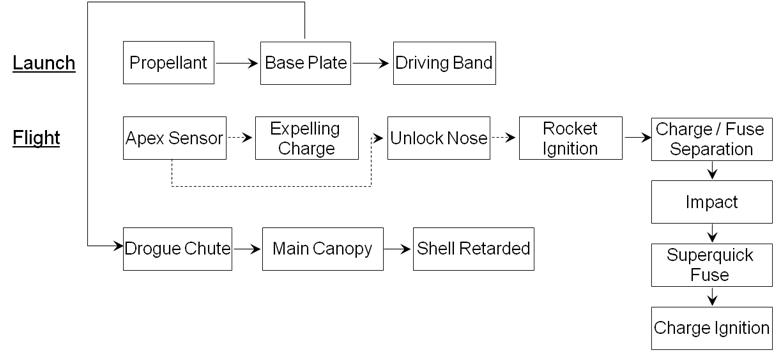
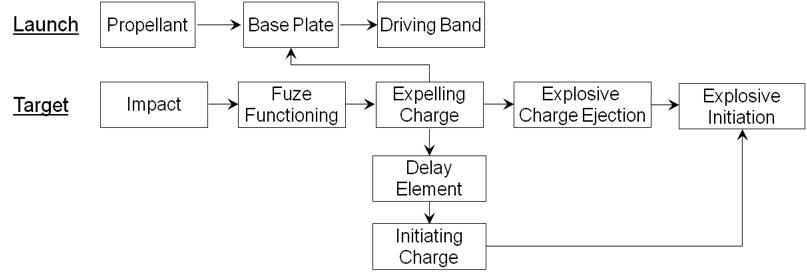
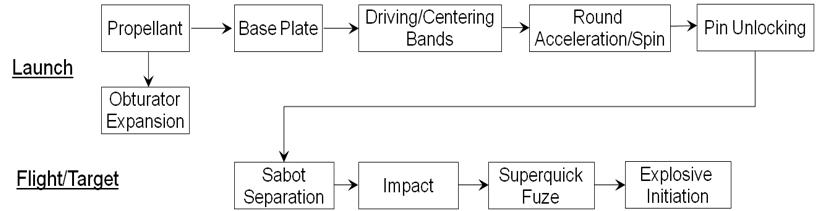
Developing the product architecture for each concept proved to be the most useful aspect of the embodiment design process. While it did not yield detailed schematics or precise numbers and figures, the challenges associated with each design quickly came to the fore and created a basis upon which the designs could be screened and ranked once more. The product architectures for each concept are shown below. Solid arrows indicate a transfer of force or energy and dotted lines between boxes show the transmission of a signal.
It can quickly be seen in Figure 2 that there are many steps involved in the functioning of the PRNE round. Of note is the fact that some sort of sensor would be required to detect when the round has passed the apex, in order to trigger parachute deployment and rocket ignition. While a rocket was the first concept for separating the explosive projectile from the main casing, it should be understood that this could also be an expelling charge.
Compared to the PRNE round, the BEC is less complex in terms of its product architecture and does not depend on as many fundamental interactions, as can be seen in Figure 3. The key interaction for the BEC round is the expelling charge: it must propel the charge out of the casing, and initiate the delay element, which will in turn activate the initiating charge.
The sabot round schematic in Figure 4 is more linear in nature and less complex than both the PRNE and BEC, with the functions along the top line occurring in the gun, and the vertical line of interactions occurring in flight.
In terms of geometry/layout, it is envisioned that the sabot round will closely resemble the round that served as its inspiration, the C74 TPDS.
Once product architectures for each design were established, it was necessary to analyze the product hierarchies and rank the concepts, in order to narrow the options.
A Weighted Decision Matrix was chosen as the method of ranking. Each design met the main requirements for a REDLAR, so it was possible to rank the designs on secondary aims such as risk and time requirements. The objective tree is shown in Figure 5, and was created to serve as a means of evaluation of the product architectures, where it is assumed that the greater number of fundamental interactions and total steps in an architecture will add to a design’s complexity, increasing risk (such as potential project failure, and prohibitive cost).
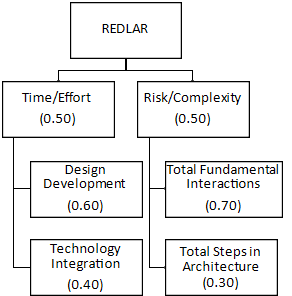
From the scores obtained, it became evident that the PRNE is the least feasible of the three designs in terms of time and complexity. Therefore, it was set aside from consideration in favour of the other two concepts. BEC and sabot were relatively close in score, so were both considered further.
The next step was to set out physical constraints on the designs and identify the best materials for use in each design. These constraints will provide guidance during the detailed design process, which will incorporate computer modelling to design each round and verify that each concept functions properly. The modelling will be accomplished through the use of PRODAS©.
Each concept was ranked from one (worst), to three (best), then the rank was multiplied by the weight factor, yielding the results shown in Table 1.
In both cases, BEC and Sabot, very few constraints apply. Spatially, each round must have a diameter of 155 mm, and should have a length no greater than 1 m. As discussed earlier, the charge weight should be 3.00 kg, and the overall mass of the round should fall between 40–50 kg, although that will not be a strict criterion for the sabot round. The limits of 1m and 40–50 kg are in keeping with the dimensions of most 155 mm artillery rounds currently in-service with the Canadian Forces.
In terms of materials, the BEC will be manufactured from steel, since that will ensure the round can tolerate the rigours of launch, and will hopefully help the round achieve a ballistic match with the M107. Since the charge will detonate outside the casing, fragmentation should not be an issue. The charge will be contained in a paper/cardboard tube. For the sabot round, the body material should burn, since the explosive charge will detonate inside the body, making it necessary to eliminate the chance of lethal fragments forming. The body material must also have a combination of high strength and high toughness in order to survive launch and flight. Although steels usually exhibit both of these qualities, they will form lethal fragments. Consequently, polymers were examined, with the help of CES Selector [15]. It was found that polyamide (nylon) possesses both of these characteristics, and was therefore chosen because it would likely produce fewer fragments upon detonation.
Detailed design
The Projectile Rocket Ordnance Design & Analysis System© (PRODAS©), created by Arrow Tech Associates, Inc., is a computer program used to model ammunition and perform internal, external, and terminal ballistics calculations. It is widely used within the ammunition engineering community. Instead of designing the BEC and sabot rounds from scratch, it was possible to create models using PRODAS© files for existing rounds. For the BEC, the 155 mm HE M483A1 grenade round, which also employs an ejecting base plug, was used as the initial model and was then modified. Since the sabot round is a scaled-up version of the C74 TPDS round, the PRODAS© file for the C74 was obtained from General Dynamics—Ordnance Tactical Systems Canada (GD-OTS Canada), and was subsequently scaled up from 105 mm to 155 mm. PRODAS© is also capable of producing cross-sectioned 3D visualizations of the models produced with the program, which are featured below.
For the BEC, modifying the M483A1 round required only a few additions to the overall design. The result was a round that had an overall mass of 41.44 kg, and a length of 703.44 mm (all lengths include the fuze). This is a very close match to the M107, which has a mass of 43.09 kg and is 697.10 mm long. Despite the thicker walls of the BEC’s steel body, weight savings were achieved through the base plug and nose assemblies, which on the M483A1 are made from aluminium. See Figure 8 for the PRODAS© representation of the BEC.
Despite shortening the M483A1 model and increasing the radius of the high explosive, there was still some void space in the body cavity. This was filled with wax, a low density material that will also allow the explosive charge to slide out of the shell. The booster, used to generate pressure in the nose, forcing the explosive charge out of the shell by pushing off the base plug, has been attached to a delay element. The delay will remain attached to the explosive charge as it exits the shell. For the purpose of computer representation, the booster and delay are taken to be black powder. It will put an extra step in the explosive train between the fuze and the initiator, allowing the Comp B to leave the shell before detonating. Also, a cardboard “pusher plate” has been inserted between the booster and explosive charge, along with a paper container around the charge.
The work of scaling the C74 round from 105 mm to 155 mm required each dimension from every element in the C74 model to be enlarged piece-by-piece, while maintaining the proper length-to-diameter ratios.
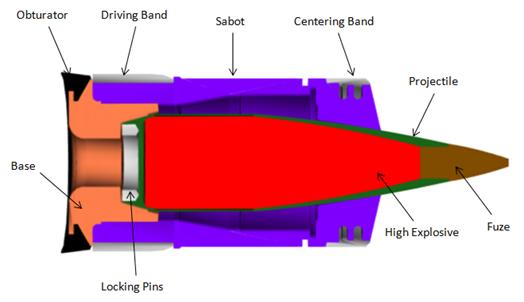
There are four major ways in which the REDLAR sabot round differs from the C74. First, the C74 has a tracer element that has been removed. Since the C74 is a tank round, a tracer makes sense in order to track a direct fire shot. The REDLAR sabot round would be used in an indirect fire role, negating the need for a tracer. Secondly, the C74 features a two-part body: a steel base with an aluminium nose. The REDLAR sabot round incorporates a single-piece polyamide body. Third, since the C74 is a target practice round, it has no fuze cavity. A fuze cavity was added to the REDLAR sabot round, and a fuze was sized to fit the round. Lastly, except for a small void space in the centre of the round, the C74 was mainly a solid steel/aluminium round. For use as a REDLAR, the body was completely redesigned, with thin walls that could accommodate a large amount of explosive. Figure 9 shows the PRODAS© representation of the sabot round.
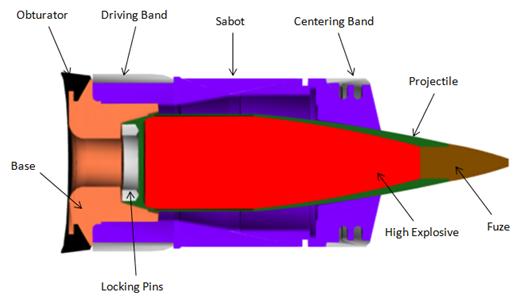
There is one immediate problem with the sabot round. It was discovered through the use of PRODAS© that the cavity for the high explosive could only accommodate 1.80 kg of Comp B. One way to correct this problem is to select a different secondary explosive, with a higher heat of detonation per kilogram. With a heat of detonation equal to 5680 kJ/kg, HMX is such an explosive [9]. The volume inside the sabot round can contain 1.99 kg of HMX, which has roughly the same energy as 2.18 kg of Comp B. 2.50 kg was the original estimation to reproduce the blast effects of the M107, before adding 20% to account for error. Therefore, 1.99 kg of HMX would have roughly 87% of the energy contained in 2.50 kg of Comp B. This does not completely correct the problem, but compensates for it somewhat.
The final design for the sabot round resulted in a projectile that has a mass of 2.88 kg or 8.93 kg with the sabot. The round has an overall length of 413.6 mm, with the projectile alone having a length of 357.1 mm. The projectile has a diameter of 90 mm, which highlights another drawback for this round. The fuze incorporated into the design is a scaled-down version of the fuze used in the BEC design. In reality though, it is unknown whether or not fuzing would exist for a 90 mm projectile. Some possible solutions would be to adapt the round such that it would be able to accept a fuze designed for 80 mm mortar rounds, or possibly 105 mm artillery shells. If this were not feasible, there would be a requirement to create a fuze customized for the REDLAR sabot round.
Simulation results
Now that two concepts have been modelled with a considerable degree of detail, and given that it has been shown that each round will have a reduced lethal radius when functioning properly, the only evaluation criterion left is external ballistic performance. The REDLAR must be able to fly to the target, and achieve ranges similar to that of the M107. While accuracy was not assessed, it assumed that the REDLAR will be no more or less accurate than the round after which it is modelled.
The first step in determining ballistic performance was to establish a baseline against which the two concepts can be measured, that baseline being the M107. In order to accomplish this, it was necessary to ensure that the internal ballistic conditions for the M107 were established, and that those conditions were applied to the two REDLAR designs so that reliable muzzle velocity calculations could be obtained. Since the REDLAR is to be fired from the M777, internal ballistic calculations were performed in PRODAS© using M777 gun tube data. The simulations were performed with M82 155 mm Howitzer Percussion Primer and M31A1 155 mm Zone 8S Hercules Multi-Perf propellant, parameters for both of which were taken from the reference material built into PRODAS©. Using the Baer-Frankle analysis (a lumped parameter model used in many internal ballistics codes), PRODAS© calculates the muzzle velocity of the M107 with a full M3A1 charge to be 800.2 m/s.
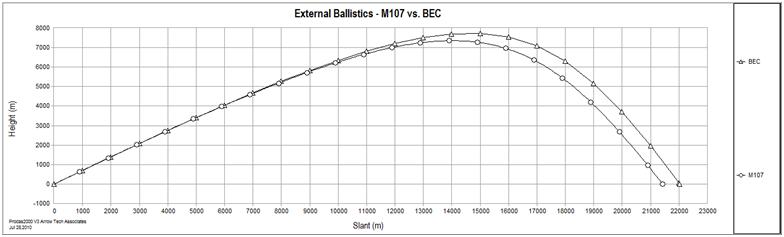
The next step in establishing the ballistic performance standard was to perform a six degree-of-freedom (6 D.O.F.) trajectory analysis with PRODAS©. The initial setup was a 45º quadrant elevation (QE), and standard metrological conditions. Using these conditions, it has been calculated that the M107 will fly to a slant range of 21.4 km.
Bec simulation
Since the BEC round is very similar to the M107 in terms of length and mass, it was expected that the round will have similar ballistic characteristics to the M107. This assumption turned out to be true, as shown in Table 2, where the trajectory data for the BEC is compared to the M107.
The two trajectories match up quite closely, which is a very promising result for the BEC round. It means that it would likely be possible to fire the BEC round from the M777 without much (if any) modification to the firing tables for the M107 round. Figure 10 shows a graphical comparison of the two trajectories, produced using PRODAS©.
155 sabot simulation
The results of modelling the external ballistics of the 155 mm sabot round immediately eliminated the sabot round from consideration. The round does not fly. The PRODAS© results suggest that the sabot round yaws off the trajectory angle significantly as soon as it exits the muzzle. The pitch is so pronounced that it continues along the flight path for only 49 meters before the conditions exceed the limitations of the software, at which point the simulation stops. What was found was that the gyroscopic stability factor for the Sabot Round prevented it from flying properly. The gyroscopic stability factor is a dimensionless number that determines if a spin stabilized projectile will be stabile in flight, and is directly proportional to spin rate, and inversely proportional to the round’s transverse moment of inertia [16]. The 155 mm sabot round only spins at half the rate of the C74, and due to differences in design and materials, has over four times the transverse moment of inertia of the C74. The gyroscopic stability factor of 0.23 is extremely low and therefore the round does not fly. Furthermore there are non-trivial design obstacles to overcome with regard to fuzing and the volume of explosive that can be contained within the shell which preclude the Sabot Round from being selected as the optimal solution.
Conclusion and recommendations
As described earlier, the aim of this project was to design an artillery round that will mimic the explosion characteristics of an M107 HE round. This design was accomplished through an iterative design process, resulting in specifications for a product that fulfils the requirement. This is the first artillery round of its kind to be considered in Canada.
Three factors were assumed to contribute to the lethality of the M107 HE round, including shrapnel, blast overpressure, and kinetic energy impact. These were the main factors driving the design of the REDLAR, as non-lethality was the primary criterion. In order to reduce lethality due to fragmentation, concepts were developed that incorporated non-lethal shell materials, or called for the explosive charge to detonate outside of the shell. A properly functioning REDLAR should be lethal only in terms of blast overpressure. It was calculated that with a 3.0 kg explosive charge, the lethal radius is less than one metre, with 50% kill probability. This is a significant reduction from the assumed M107 kill radius of 20–30 m. The risk of lethality due to kinetic energy impact was disregarded, as it could not be mitigated while still satisfying the requirement.
Now that the REDLAR has been modelled, the next step in its development should be to manufacture a prototype for testing and evaluation purposes. The first task would be to properly design the explosive train, including the proper delay. Second, it would be necessary to prove the technological concept that the explosive charge can be reliably and quickly ejected from the shell, as designed. Once these tasks have been accomplished, it would also be necessary to confirm the internal, external, and terminal ballistic performance of the round through test firings, and to confirm that the round suitably mimics the M107 HE round.
Other optional avenues for future work include revisiting the concept of the PRNE, with a view to determining if it could satisfy the need better than the BEC round. The 155 mm sabot round design could also be revisited in order to correct the design flaws that prevent it from being stable in flight. If the 155 mm sabot concept could be properly developed, it would open up many new possibilities for sub-munitions for use in the M777. Lastly, the possibility of modifying the BEC round for use in an air burst role should also be investigated.
Overall, the design and operational considerations raised at the outset have been addressed, and the final design meets the requirements identified by DLR 2. Moving forward, if there is still interest in a REDLAR amongst the operational community, a practical design now exists and awaits further development.
References
[1] M.D. Maples, “Lethal and Nonlethal Fires and Effects,” Field Artillery, March-April, 2003, p. 1.
[2] J.M. Garner, M. Maher, and M.A. Minnicino, Free Fall Experimental Data for Non-lethal Artillery Projectile Parts [Report Number ARL-MR-0596], Aberdeen, USA; Army Research Laboratory, 2004.
[3] M. Minnicino, Personal Communication, February 17, 2010.
[4] Jane’s Ammunition Handbook, 2009–2010, 18th edition, L.S. Ness and A.G. Williams, eds, IHS Janes, Surrey UK, 2009.
[5] W.E. Baker, P.A. Cox, J.J. Kulesz, E.L. Sevier, R.A. Strehlow, and P.S. Westine, “Explosion Hazards and Evaluation”, New York, NY, 1982, p. 110.
[6] M. Held, “Blast Waves in Free Air”, Propellants, Explosives, Pyrotechnics, 8, 1983, pp. 1–7.
[7] J.M. Petras, R.A. Bauman, and N.M. Elsayed, “Visual System Degeneration Induced by Blast Overpressure”, Toxicology, 121, 1997, pp. 41–49.
[8] P.W. Cooper, Explosives Engineering. Toronto, ON; Wiley-VCH, 1996.
[9] P.D. Smith and J.G. Hetherington, Blast and Ballistic Loading of Structures, New York, USA; Butterworth Heinemann, 1994.
[10] American Society for Metals, ASM Metals Reference Book, Metals Park, USA; American Society for Metals, 1983.
[11] F. Zhang, Scaling and Limits of Thermobaric Explosives—Phase I [Technical report 2005193]. Defence Research and Development Canada—Suffield, 2005.
[12] M.F. Ashby, Materials Selection in Mechanical Design, Boston, USA; Butterworth Heinemann, 1992.
[13] M.A. Minnicino, J.M. Sands, J. K. Hirvonen, and D. Demaree, Reactive Nano-layered Bimetallics for Non-Destructive Debonding of Munition Components, Aberdeen, USA; Army Research Laboratory, 2004.
[14] G.E. Dieter, Engineering Design, New York, USA; McGraw Hill, 1983.
[15] CES2009 [Computer software], Cambridge, Granta Design.
[16] D.E. Carlucci and S.S. Jacobson, Ballistics: Theory and Design of Guns and Ammunition, New York, CRC Press, 2008.