
Volume 14, Number 3, November 2011
The Utility Of Unmanned Combat Air Systems In Gaining Control Of The Air In Future Warfare In 2040: The Importance Of Situational Awareness
- * War Studies Department, King’s College London, WC2R 2LS.
Abstract
This paper examines the part Situational Awareness (SA) plays in counter-air operations, focusing on the utility of future Unmanned Combat Air Systems (UCAS) in gaining control of the air in 2040. Current UCAS development focuses on Intelligence, Surveillance, Targeting, Acquisition and Reconnaissance (ISTAR) and Suppression of Enemy Air Defence (SEAD) roles. If a UCAS cannot control the airspace in which it is operating in, and unless control can be gained by other means, then manned fighter aircraft will be required to achieve this task. This would seem somewhat perverse, largely negating the purpose of utilising UCAS in the first place. Could a UCAS gain control of the air in 2040? The author believes that such a system could; UCAS should not be viewed in isolation, but rather as part of a system of systems, that aid, it can be argued, the most critical component of warfare—SA. The importance that SA plays in warfare, particularly in control of the air, is not only vital, but will be the critical node in enabling this to be achieved.
Introduction
What does the future hold for manned aircraft? Warfare in the 20th Century demonstrated the potential and performance of air power. The 21st Century promises to be a period of military transformation, sometimes referred to as a Revolution in Military Affairs (RMA), with Networked Enabled Capability (NEC) and the utilisation of Unmanned Combat Air Systems (UCAS) coming to fruition. What constitutes a RMA? In 1993, the director of the US Office of Net Assessment, Andrew Marshall, began to use the term RMA, in place of the then current term Military-Technical Revolution (MTR). He did this to stress that, while technological advances were making current MTR possible, the revolution itself would only be realised when new operational concepts had been developed, along with new military organisations. [1] The current utilisation of Unmanned Aircraft Systems (UAS) and future potential use of UCAS could be viewed in this context, and should be regarded as a RMA, with the potential to bring a transformation to the way future battlespace is controlled and won. The attributes such a UCAS would require is important to any research undertaken, however, the technical aspects of UCAS are outside the scope of this article.
Control of the air is the foundation for all conventional military operations, against an adversary with an air defence capability. The more advanced this capability, the more important gaining and maintaining control of the air, and the more sophisticated a forces own counter-air capabilities needs to be. Having freedom from attack and freedom to attack are the fundamental principles of control of the air. The ability to conduct the full gamut of air operations, unhindered, against enemy forces is vital, enabling rapid, secure deployment and resupply, and protection of those forces and supplies once deployed. This concept of aerial warfare has been validated since WWI. In future warfare, will it be possible for an autonomous/semi-autonomous UCAS to conduct the combat roles and accept most of the risks that thus far have been the lot of military aviators, in particular, the counter-air role?
The term autonomous is generally used when referring to the operation of UAS/UCAS; this has caused some concern among certain sectors of the military and media, who believe that the use of autonomous UAS would not be acceptable in some scenarios. The debate over the meaning of autonomy is on-going. It can be argued that a high level of automation is the same as autonomy. This article uses the term ‘autonomous’, acknowledging that there is no clear agreement, and does not seek to make judgement. The UK’s MOD Defence Concepts and Doctrine Centre (DCDC), defines an automatic system as ‘A system, in response to one or more sensors, is programmed to logically follow a predefined set of rules in order to provide an outcome. Knowing the set of rules under which it is operating means that its output is predictable.’ [2] The Oxford English Dictionary (OED) defines it as, ‘Like the action of an automaton; unintelligent, merely mechanical; done without thought, unconscious; occurring as a matter of course without debate. Working by itself, without direct human involvement.’ [3] Autonomy is described by DCDC as, ‘A system that is capable of understanding higher intent; will be effective, self-aware and their response to inputs indistinguishable from or superior to, that of a manned aircraft. As such, they must be capable of achieving the same level of situational understanding as a human.’ [2] The OED defines autonomy as, ‘Freedom of the will. Independence, freedom from external control or influence; personal liberty. Self-governing. Free to act independently.’ [3] Whatever interpretation is used, automatic/autonomous systems are already in the inventory of most militaries. Cruise Missiles, Anti-Radiation Missiles, and Air-to-Air Missiles (AAM), are just some examples of weapons systems that once launched, use on- or off-board systems to continue to and/or find their target, independent of the launching platform.
Since the beginning of manned flight, pilots have been regarded as pivotal in the flying and operating of powered aircraft. The Wright brothers, initially bike makers, were the pioneers of powered flight. Other innovators added to the surge in aviation progress, with subsequent developments leading to aircraft capable of the full gamut of civil and military tasks, including transport, air-to-air refuelling, reconnaissance, bombing and air-to-air combat. Over time, other aircrew skills were required to help facilitate the ever-increasing complex requirements that flying, per se, required, particularly in military scenarios. These have included navigators, bomb aimers, observers, air engineers, air signallers, air electronic operators, radio operators, air gunners, and latterly, weapons systems operators (WSO). Many of these airborne trades are now redundant, at least in those air forces equipped with modern aircraft and systems. The RAF is an example, with the closure of its Air Navigation School in 2011 heralding a new era, where no new ab-initio WSO will be trained—an unthinkable situation even five years previously. Indeed, when the RAF’s Tornado GR4 goes out of service, the RAF will have no role for fast-jet qualified WSO. There are reasons for this—the main one being that, with the advent of the single-seat Typhoon, and the introduction of F-35 Joint Strike Fighter (JSF), there is no perceived requirement for fast-jet WSO.
The evolution of flying continues. Other than the actual act of flying an aircraft, historically, navigation has been deemed critical to mission success. For much of the history of flight accurate navigation has proven somewhat problematic, especially until the advent of inertial navigation systems, and, significantly, satellite-based navigation systems. As technology has developed, the role of the navigator, and other associated airborne professions, has become less crucial. The change of professional status from navigator to WSO was an attempt to capture the many functions for which a navigator, especially a fast-jet navigator, was responsible, with navigation being just one part. Now defunct, the role of an Air Defence (AD) navigator, for example, was always more of a battle manager, manipulating the air-to-air radar, the Link-16 based Joint Tactical Information Distribution System and other avionic systems, whilst directing the pilot of his aircraft, and other aircraft and crews in his formation, to a position where engagement of adversary aircraft could take place, hopefully with some advantage. This was, more often than not, much harder to achieve than one would suppose. First, the adversary had to be detected, which could be challenging, especially when airborne sensors, such as radar, were not capable of detecting adversary aircraft in a heavy clutter environment, created by ground returns and electronic warfare techniques. AD navigators required a certain skill in order to be able to operate these radars, allowing the required level of SA to be established. If an adversary was attempting to achieve the same aim, whilst utilising Electronic Attack (EA) techniques, such as Digital Radio Frequency Memory jammers, against detection systems to confuse the air picture, engagements could be prolonged affairs, not always resulting in mission success. In training scenarios, this produced battered egos, at best; in real-world operations, this could have catastrophic consequences at worst. With the demise of the two-seat fighter and the development of UCAS, capable of undertaking ISTAR and SEAD roles, considering their use in counter-air tasks seems a reasonable step.
The manned or unmanned debate
A current debate amongst academics and military specialists centres on unmanned versus manned aircraft. Previous debates have questioned the requirement for one-seat versus two-seat. This issue has divided air forces, on both sides of the Atlantic. Advocates of the single-seat fighter use cockpit confusion as a reason against two-seat operations; it is also advocated that it does not take two men to handle the workload. The cockpit confusion objection to a two-seat fighter rests on concern that the need to take votes between cockpits delays the decision-making process. This can be true, if two weak, or two dominant, aircrew are crewed together. However, good crew-cooperation training, latterly referred to as crew resource management by the RAF, has allowed the full benefits of two-crew operations to be realised. The author’s experience as a navigator on the Phantom F-4 and Tornado F-3 supports this argument. Another pro-single-seat argument is that, although there are many tasks, they do not all come at once; therefore, a fighter pilot should be able to do them. From the author’s own experience, while it is possible for one man to perform most tasks in a benign counter-air environment, it is an entirely different matter in poor weather, at night, when one’s own systems are being jammed by EA. This has certainly been the case until the relatively recent advent of avionic systems that are able to operate to an acceptable level of automation.
Improvements in radar and other sensor technology, aligned with increases in computer processing power, have meant more automation can be incorporated into weapon systems, particularly radars. This has allowed the better-designed fighters to dispense with the navigator / WSO. There have been concerns and problems along this developmental path, however. Nonetheless, Western fighters such as the F-22 Raptor, F-15 Eagle, F-16 Falcon, F-18 Hornet, Typhoon and Rafale, and Russian fighters such as the Su-27 Flanker and MiG-29 Fulcrum, are all predominantly single-seat. Where there are two-seat versions of these aircraft, they are designed for use in the air-to-surface role, concentrating on the SEAD task, against sophisticated Integrated Air Defence Systems (IADS). These missions have traditionally necessitated a heavier workload on aircrew, which, until quite recently, has meant two-seat fast-jets have been required to achieve the task. On the other hand, the single-seat F-15C has proven to be an immensely capable air superiority fighter. Flown by, amongst others, the US and Israel, it has achieved a kill ratio of 101:0 in conflicts in the Middle East. [4] The F-22 Raptor is acknowledged as the preeminent fighter flying today and the only fifth-generation fighter operational. The F-35 JSF is publicised as being capable of achieving all combat air power tasks. Whilst there is some quite passionate debate regarding this claim, the fact remains, both of these aircraft are flown and operated by a single pilot.
Along with the trend towards single-seat aircraft operations, doctrine and tactics have evolved to take advantage of the transformation evolution that technological advances have allowed manned flight to utilise. What advances in flight does the future hold? With the demise of non-pilot aircrew, will advances in aviation systems mean there will be fewer requirements for pilots? Is technology just following a natural trend that means computers and associated avionic systems will do the required task better? Are we now coming full circle, where navigation accuracy and the precision of weapon delivery is by far the predominant requirement for combat air power? Historically, the science, and some would say art, of navigation has taken precedence over many other aspects of warfare. Mastery of the sea required accurate navigation. The establishment of the Royal Observatory at Greenwich, and the fevered race to produce a timepiece allowing longitude to be calculated accurately, which was robust enough to withstand the rigours of sea voyage, were fundamental to the success that Britain enjoyed as the primary sea power through the 18th and 19th centuries. John Harrison’s H1 timepiece, developed in the 1730s, allowing for accurate calculation of longitude, can be described as revolutionary. The Gulf Wars of 1991 and 2003, and counter insurgency operations in Afghanistan and post-war Iraq, have demonstrated the vital role that precision weapon delivery plays in modern warfare. Russia and China have taken note of these advances in weaponry, and have been making steady advances in their development of comparable systems. The primacy of navigation, and all that the mastery of it brings, is now, arguably, firmly established as the priority of any nation that wishes to have, and use effectively, a military force. The fact that pilots have historically been required to fly aircraft that facilitate achieving the requisite military task should not be a driver for future doctrine, tactics or procurement. Technology now allows greater time, effort, and resources to be focused on systems that will not require a human interface in an aircraft. UAS are already being operated extremely effectively by many countries. Although these types of UAS are capable of conducting ISTAR and strike missions, they are not survivable in highly contested airspace. UCAS, capable of conducting these combat air tasks, whilst operating with a high degree of survivability, are being developed by the US, UK, France, Russia, China, and other nations. These systems will likely begin to enter the service of these nations within the next 10 years. Thus far, little rigorous investigation into the viability of UCAS carrying out the full gamut of counter-air roles, including gaining control of the air is being conducted by Western states. The US has at least indicated its intent to do so through its USAF Unmanned Aircraft Systems Flight Plan: 2009–2047. [5] There are, however, no known current programmes researching this area of capability.
The utility of ucas
UAS consist of the Unmanned Aerial Vehicle (UAV) itself, its sensors and weapons, its communications links, the Ground Control Station (GCS), the personnel involved in operating the system, and the logistics support required. There is no agreed standard definition of UCAS. Until there is, the author defines UCAS as a weaponised UAS, utilising a level of autonomy, which may also be capable of ISTAR tasks, designed to survive in highly contested airspace. This can be by utilisation of stealth features, or speed and manoeuvrability, or a combination of all three.
Before beginning to argue the case, for or against a UCAS capability to gain control of the air in 2040, it is important to ensure the research has some merit. In order to help remove bias, and to seek peer review, the author instigated a questionnaire; its function was to enable opinion from appropriate experts and knowledgeable individuals to be gathered, with the aim, ultimately, of facilitating analysis on the overarching aim of the question. A survey was conducted of RAF aircrew and officers, MOD scientists, and civilians, collecting views on whether a UCAS can gain control of the air in future warfare in 2040, and also, moral and motivational issues. The intention was to determine any emerging trends in thought, in particular, identifying divergence in interviewee’s views, dependent upon their experience and qualifications, both academic and military. The results of these findings have validated those areas of research that are central to the overall thesis, allowing these to be focused on, and help determine any bias towards full autonomy, semi-autonomy, or indeed, absence of autonomy. Valuable information has also been gained that will allow comment and recommendations to be made on what systems UCAS will require, and, also, the type of air vehicle necessary.
The background of interviewees has been collated, including: age groups, profession, flying experience, operational experience, academic and professional qualifications, military rank, and experience with NEC and AAM. It is difficult to give a particular value to an interviewee, however, by allowing sight of their background and experience, it can be seen that there is a wide range, both in their experience and professional roles. It is important that the interviewees have relevant experience of the questions being asked, whether that be military, scientific or aspirational based. Figure 1 details interviewee qualifications and experience.
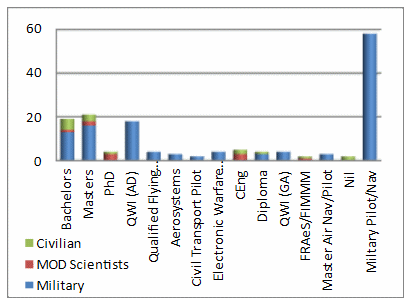
The number of interviewees totals 74. The sample size was a trade-off between the time available to conduct and collate the interviews, and the number of interviewees it was considered acceptable to allow proper analysis. For the type of research undertaken, a sample size of larger than 30 and less than 500 is considered appropriate. [6] A large proportion of the interviewees are RAF aircrew. This has been necessary because most of the questions are geared towards aircrew experience. That said, where the questions are more technical, the views of MOD scientists are just as pertinent. Finally, questions regarding the moral and political aspects of using UCAS, and future recruitment motivations, are equally relevant to civilians.
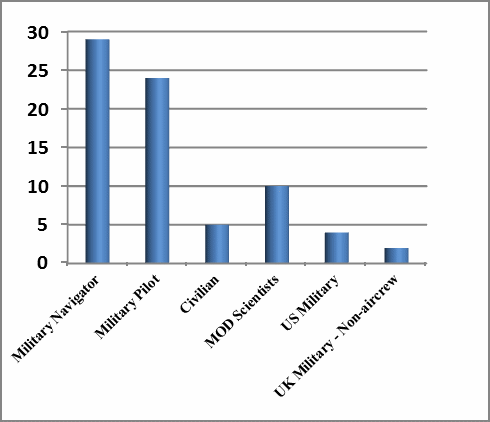
Fifty-eight military aviators were interviewed; most are either current or ex-fast jet (FJ) pilots or navigators; a few have experience on other aircraft, such as the maritime Nimrod and the Nimrod R1, intelligence gathering aircraft. The majority of the FJ crews have a background in air defence, with some dual qualified, having flown either multi/swing-role aircraft, or experienced both air defence and ground attack roles on various aircraft. The overall experience on different aircraft types is diverse, covering: F-3 Tornado, F-4 Phantom, F-14 Tomcat, F-15A/C/E Eagle, F-16 Falcon, F-22 Raptor, Harrier FA-2, GR-7/9, GR1/1A/4/4A Tornado, Jaguar, Predator / Reaper UAS, BAE Systems HERTI UAS, the Russian MiG-17 Fresco and MiG-21 Fishbed, Nimrod, C-130 Hercules, and Puma helicopter. A number of senior RAF commanders were interviewed. Although small in number, their views give weight to future MOD policy towards the use of UCAS. All MOD civilians and scientist have a working knowledge of air power, in particular, counter-air requirements. Figure 2 details interviewee professions.
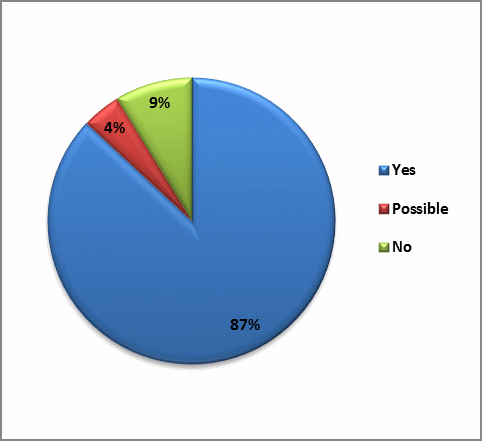
Eighteen questions were asked. For this article, the results of one are given as an example: ‘Would a UCAS Be Able to Effectively Conduct Air Dominance Missions, in 2040?’ Sixty-nine of the interviewees views were considered pertinent. The results are quite revealing: 87% of interviewees believe that UCAS will be capable, with another 4% believing it may be possible. 9% do not believe it will be possible. How significant is this? Essentially, those that are experienced in military operations and support believe, by a large margin, that a UCAS could conduct counter-air missions by 2040. This does not prove it can be done, but it does validate the author’s aim of researching its viability. Figure 3 gives a breakdown of answers.
The capability to operate longer than manned aircraft, and maintain persistence, are attributes that make UCAS every attractive. Although the preservation of aircrew is undoubtedly important, it is questionable whether this will be paramount. Principally, it is the economics and effectiveness of a system, including the training of aircrew and associated through-life costs (TLC), which are likely to affect decisions on procurement and capability. A UCAS may well offer a significant TLC advantage over a manned system. Notwithstanding that manpower will still be required to operate an autonomous system, taking aircrew out of the equation could mean substantial savings. The cost of training a RAF Typhoon Pilot to a point where he/she can start training on an operational squadron, for example, is £4 million, as of 2008. [7] Further training to actually become, and remain, capable of conducting operational tasks would be considerably more. The operating costs of the system would be greatly reduced as, essentially, the Unmanned Combat Aerial Vehicle (UCAV) remains on the ground, unless until it is actually required. Most of the training and currency requirements could be achieved through distributed mission training (DMT) systems. The USAF has been at the forefront of the development of DMT, with its Live, Virtual and Constructive (LVC) Integrating Architecture (LVC-IA) Plan. [8] LVC simulations allow aircrew and other warfighters to conduct training to an extremely high level of fidelity, at significant cost savings.
Current US led operations in Afghanistan utilise the advantages that UAS bring over manned aircraft, such as persistence and operating costs. Other nations have seen the force multiplier attributes of these systems. The momentum of UAS development is increasing worldwide. The next stage is the development and use of them in highly contested airspace. This will require a fundamental change in approach in a number of disciplines, including procurement, planning, doctrine, operations and the tactics used. This will not be easy—a thorough and robust understanding of the international environment over the coming decades is necessary to inform the debate. The types of situations in which any military system needs to operate, dictates that system’s requirement, which, in turn, is part of a system of systems.
There will also be questions as to whether future leaders of the military flying cadre will have the necessary qualities to lead if they have never flown a military aircraft, let alone flown in combat. Indeed, would it be necessary for any of the operators of a UCAS to be combat experienced aircrew? The once pilot centric command hierarchy in the RAF is changing. The current RAF Commander-in-Chief of Air Command, the second most senior officer in the RAF, is a navigator. The commander of the recently announced UK Joint Task Force is also a navigator. The 2nd edition of UK MOD’s AP3000: Air Power Doctrine emphasises the importance of leadership, stating ‘Leadership can take many forms and styles both in the air and on the ground, but invariably includes professional mastery and moral courage.’ [9] Professional mastery of what is the question. Would it be possible to have a Chief of the General Staff who has not led soldiers in the field, or a Chief of the Naval Staff who has not captained a ship, or a Chief of Air Staff who has no military flying experience? These are valid questions. However, they should not distract from frank discussions regarding the utility of UCAS in future warfare.
The debate over the future utility of UCAS is fierce, particularly within the US military hierarchy. General Norton Schwartz, the current USAF chief of staff, has apparently rejected the development of a completely unmanned long-range bomber, stating that he does not think armed, unmanned aircraft have evolved to the point at which they can operate effectively. In contrast, US Marine General James Cartwright, the vice chairman of the Joint Chiefs of Staff, has stated he believes unmanned bomber technology is ready for deployment. [10] Whoever is correct, it is a fact that the US has had a number of UCAS projects in development for a number of years, including a probable ‘Black Project’, run by Northrop Grumman; this programme is likely to be a demonstrator for the US requirement for the original Next Generation Long-Range Strike System (NGLRSS) programme, now referred to as the Long-Range Strike Platform (LRSP). [11] The US is not alone - the UK is also developing the ‘Taranis’, a UCAS demonstrator, whilst a European consortium is developing the ‘Neuron’ system. Russia unveiled the ‘Skat’ UCAV at the 2007 MAKS Airshow. China is also known to have its own UCAS programme, the ‘An Jian’.
Situational awareness in air warfare
If UCAS were to be extensively used, NEC would form a crucial part of the enabling capability. NEC, with all its facets included, enables commanders and operators to have SA. SA, the author contends, is the most important part of the kill-chain; it enables all other parts of the Find, Fix, Target, Track, Engage and Assess (F2T2EA) cycle to be conducted. While aircraft and sensor performance are crucial to the effectiveness of any counter-air system, SA facilitates their use; the importance of SA cannot be overstated. There are a number of interpretations of the meaning of SA. In warfare, SA generally means the view of the whole air, and ground, picture, including not only location but also likely future activity, of both friendly and enemy forces. Mica Endsley in Theoretical Underpinnings of Situation Awareness: A Critical Review, defines SA as ‘…a state of knowledge about a dynamic environment.’ [12] This explanation is succinct, and applies to both military and civilian situations; it has huge significance when applied to counter-air operations. Endsley’s three-level model of SA: Perception (what is happening), Comprehension (what does it mean), Projection (what should I do about it)—are all applicable to air warfare. According to John Stillion, a RAND analyst, SA ‘…is a most important aspect of air combat. The pilot, or group of pilots, who maintains the best understanding of where friends and foes are relative to their own position during the confusing, time compressed, air combat engagement will most likely emerge the victor.’ [12] While this interpretation of SA does not preclude exploiting advanced technology to facilitate being able to sustain an advantage over adversaries, specifically by the utilisation of NEC, it should not be considered a direct function of platform and system performance. It is basically a function of the aircrew flying and operating their aircraft and systems, with the ability to combine strands of information into a coherent air picture of what is taking place around them, often in a highly dynamic situation.
Statistical analysis
It can be argued that the absence of SA has been the cause of the majority of losses in actual air-to-air combat. Neither the introduction of advanced fighters, equipped with air intercept radars, nor the development of AAM have changed the fact that most air-to-air kills have been achieved without the targeted aircrew knowing the enemy was targeting them. This has been true for most air-to-air engagements since the introduction of fighters on the Western Front in World War I. What role does modern technology play in gaining SA, and therefore an advantage in gaining control of the air? Reviewing evidence from historical and test data on air-to-air engagements allows analysis of what the vital elements of gaining control of the air are.
Prior to the 1991 Gulf War, only the infrared (IR) AIM-9 Sidewinder AAM had much success in combat. Why was this? Was technology not the panacea that technocrats and military tacticians envisaged? Historical combat data and combat experience going at least back to World War II suggests that surprise in the form of the unseen attacker has been fundamental in 75% or more of the kills. For example, Lieutenant Colonel Mark Hubbard USAAF, a P-38 Lightening pilot, stated that, in his experience during World War II, ‘90% of all fighters shot down never saw the guy who hit them.’ [14] Likewise, the German Me-109 pilot Erich Hartmann, who achieved 352 kills against Soviet aircraft on the Eastern Front during World War II, has stated that he was ‘…sure that 80% of his kills … never knew he was there before he opened fire.’ [15]
Air-to-air engagements between US and opposing Vietnamese forces, using Russian built fighters in Southeast Asia from 1971 through 1973, offer further evidence that SA plays a major part. Barry Watts in Six Decades of Guided Munitions and Battle Networks: Progress and Prospects sights the experience of US aviators from December 1971 to January 1973, where there were 112 engagements resulting in a kill on either side. All these engagements were reconstructed and analysed by Project Red Baron, a US evaluation of air-to-air encounters enduring the Vietnam War. The 112 engagements resulted in the loss of 75 Vietnamese fighters and 37 US aircraft. Red Baron’s evaluation established that 60% (67 of 112) of all US and enemy aircraft lost in combat were apparently unaware of the attack. An additional 21% (24 of 112) became aware of the attack too late to initiate appropriate defensive actions. Overall, therefore, in 91 of 112 engagements, 81% of the aircrew shot down were either unaware of the attack, or else they only became aware when it was too late. SA was not a factor in only 21 of the 112 engagements (19%). [16]
Post-Vietnam statistics also offers evidence of the criticality of SA. Some of the data comes from US simulations of air combat, conducted either on instrumented ranges or in flight simulators, rather than actual air-to-air combat. Nevertheless, tests such as the Air Combat Evaluation (ACEVAL) and the Advanced Medium-Range Air-to-Air Missile (AMRAAM) AIM-120 Operational Utility Evaluation (OUE) were explicitly designed to gather statistics on engagement results. ACEVAL was conducted in 1977 using an Air Combat Manoeuvring Instrumentation (ACMI) range, which data-linked real-time information from all the aircraft involved to a ground monitoring system. Since then ACMI systems have been extensively used by the US and European air forces for decades, greatly enhancing training opportunities. The friendly force consisted of F-15 or F-14 fighters armed with guns, AIM-9L Sidewinder IR AAM, and AIM-7F Sparrow semi-active AAM; the opposing force flew F-5Es, simulating, to a degree, the Soviet MiG-21 in performance, with AIM-9L and a gun. The results showed that human factors had more than five times (84%) the effect on results, compared to variables such as force ratio or whether somebody did or didn’t have assistance from ground-based systems. [17] This correlation with earlier results in World War II and Southeast Asia regarding SA is significant.
The AMRAAM OUE, which was conducted in simulators, flown by operational aircrews during the early 1980s, confirmed the provenance of the ACEVAL results. ACEVAL had been a Within-Visual-Range (WVR) trial, because of the Rules of Engagement (ROE) requiring visual identification of the adversary prior to shooting. However, since the whole point of the ARMAAM OUE was to assess the utility of a medium-range AAM that could be launched Beyond- Visual-Range (BVR), BVR shots were permitted by the friendly forces. The expectation was that the AIM-120 AMRAAM, because of its advanced features and greater kinematic range, would enable the friendly fighters to dominate engagements in BVR scenarios. Most of those involved in this trial expected advanced technology to dominate outcomes. The results were somewhat different. When F-15s had AMRAAM on CAP missions as well as good SA, they were able to achieve loss rates roughly half the adversary side’s in more than five times as many of the engagements as in the baseline F-15 case without AMRAAM. However, according to Watts, when the F-15 pilots had poor SA, the F-5s side’s loss rate was half that of the F-15s in the baseline case across approximately 50% of the trials; adding AMRAAM was only able to reduce to 24% the portion of CAP engagements in which the F-5s had the same advantage. [18] The possession of AMRAAM did not seem to have a significant effect on loss rates, whether the SA was good or bad. The results confirmed that, even in the AMRAAM OUE, SA, rather than technology, dominated outcomes, as ACEVAL and Southeast Asia during 1971–73 had shown. While AAM will remain the primary means for destroying enemy aircraft for some time, gaining SA is still the primary driver in counter-air operations. Given that technological advances in NEC and sensors have expanded considerably during the last 10 years, it is not surprising that attaining SA is now seen as the primary factor in gaining control of the air.
In 2005 the Air Force’s fifth-generator fighter, the F-22 Raptor, completed its initial operational test and evaluation (IOT&E). The IOT&E included engagements flown on an ACMI range, as well as scenarios conducted in simulators. Although the official details of this evaluation are not in the public domain, open source reporting indicates that the Raptor was able to dominate opposing fighters for the vast majority of the time, even when outnumbered. The F-22 pilots were frequently able locate, track and kill opposing F-15s and F-16s BVR before being detected. [19] These results need to be examined in context. The Raptor’s stealth and speed, when aligned with appropriate tactics, and advanced avionics, sensors and sensor fusion, allowed the Raptor pilots to kill adversaries without being detected. The required SA would have been garnered through NEC, combining data fusion - using gateways, such as the Battlefield Airborne Communications Node (BACN) and the US Tactical Information Broadcast System (TIBS), a UHF line-of-sight or satellite-interactive network. The TIBS network is a continuous, secure broadcast of data which provides a near-real-time, multi-sensor, multi-source SA and threat warning information broadcast to the operator. BACN is an airborne communications relay and gateway and is part of the US Department of Defense’s Objective Gateway (OG) programme, which is developing a family of advanced gateway capabilities allowing real-time information exchanges between different tactical data link systems, providing decision-makers with critical information. [20] These advanced sensors, systems and OGs should be viewed as exploiting technology to give Raptor pilots the ability to achieve a huge advantage in SA. Seen in this light, the F-22’s apparent dominance in the IOT&E reiterates that SA most often determines the outcome of the counter-air battle, especially when technology is harnessed to enhance SA. [21]
Can the human factor input to SA be considered crucial, or can technology allow the required SA to be used by an autonomous/highly automated system? Computer programs exist that are capable of interpreting the information available, i.e. the SA, making decisions for the operator and the mission commander; there’s no reason why aircraft systems could not react as required using these programs. An example is SOAR software, which is a cognitive architecture program, giving both a view of what cognition is and an implementation of that view through a program for Artificial Intelligence (AI). Since its beginnings in 1983, it has been widely used by AI researchers to model different aspects of human behavior. Glen Taylor, et al, in a presentation at the 10th International Command and Control Research and Technology Symposium, describe the benefits of SOAR in a paper The Future of C2 Enabling Battlefield Visualization: An Agent-based Information Management Approach. This paper identifies the requirements of a system for enabling battlefield visualisation through automating the information management process. [22]
Trials with UCAS have been conducted under simulation, by the US, UK and others, to determine the levels of autonomy to which these systems can operate. These all require an intense level of SA. The more autonomous a system is required to be, the higher the level of SA required. Although currently classified, it is highly likely that software programs are used that allow for automatic responses by UCAS to real-world (simulated at the moment) conditions, for example, reacting to being targeted by surface-to-air missiles, or AAM. Available on the open market is a software program called ‘Fighter Interactive Tactical Evaluation’ (FITE), produced by a UK company. This program takes into account the dynamics of an adversary aircraft in all dimensions, as well as predicting what the aircraft is likely to do by measuring rates of change. Currently used to help train fighter pilots through simulation, it could be utilised in manned or unmanned aircraft. Sensor fusion systems, such as those used by the F-22, already allow a high-level of SA to be automatically attained. These systems are available now; future NEC will allow UCAS to operate autonomously, if required.
Conclusions
The era of manned flight is not yet over, and it is unlikely to be any time soon. UAS are currently, however, assuming roles in air power that, hitherto, have been undertaken by manned aircraft. Sceptics will always be found, similar to the advent of steam ships over sail, and the introduction of the tank into warfare. From WW I through to modern air warfare, SA has proven to be the key enabler to gaining control of the air. Could the same systems that give the F-22 Raptor and the future F-35 JSF operators SA be utilised by UCAS? Could UCAS properly see/sense what an adversary is doing now, not just where it is? This is a difficult technical challenge, but it is more about sensors than processing—it equates to Boyd’s ‘Observe’ in his Observe, Orient, Decide and Act (OODA) Loop. [23] Understanding what this means is critical. This is all about whether computers can work out meaning - where adversaries are and what they are doing—it equates to Boyd’s ‘Orient’; for example, the adversary turns away at 30 miles—is he aborting defensively or has he fired a ramjet AAM, and does not now need to give it any more information, which enables him to turn away? In reality, humans, even pilots, stick to a few key strategies; it should be possible to encode decision making in the form of a complex lookup table of all possible eventualities. In all but the most complex visual air-to-air engagements there would be a finite number of possible decisions, although these would have many permutations. It is debateable whether visual air combat, requiring highly manoeuvrable aircraft, will be required in 2040. Essentially, if SA is available and accurate, aligned with precise navigation systems, a system could make the same, if not better, decisions than those made by a human. Given the extreme stress that can be encountered by aircrew in counter-air scenarios, which creates an environment where human actions and reactions can be suboptimal, it is axiomatic that a system capable of making the correct decision 100% of the time, or close to it, is preferable to a human.
The available data does not support the assumption that technological superiority, in itself, drives outcomes in air-to-air encounters for the majority of engagements. It does support though the premise that the key enabler in warfare, particularly air warfare, is SA. This is gained by technology, allowing the employment of kinetic effects, such as AAM. These same systems used on modern and planned future manned aircraft, could be utilised on UCAS. With a high level of automation/autonomy, and SA, the ‘system,’ could make all the appropriate decisions on required tactics, leading to successful engagements. Churchill stated: ‘The only security upon which sound military principles will rely is that you should be master of your own air.’ This maxim is extant. The advantages of extended endurance/persistence, and TLC, that UCAS bring to the commander deserve to be investigated fully, including that of gaining control of the air.
References
[1] B.D. Watts, The Maturing of Revolution in Military Affairs, Center for Strategic Budgetary Assessments, Washington, D.C., http://www.csbaonline.org/wpcontent/uploads/2011/ 06/2011.06.02-Maturing-Revolution-In-Military-Affairs1.pdf, 2011, p. 3.
[2] UK Ministry of Defence. Joint Doctrine Note 3/10. Unmanned Aircraft Systems: Terminology, Definitions and Classification. Defence Concept and Doctrine Centre, 2011.
[3] Shorter Oxford English Dictionary. New York: Oxford University Press Inc, 2007.
[4] M. Charles, “F-15 Eagle”, The Global Aircraft Organization, http://www.globalaircraft.org/planes/f-15_eagle.pl.
[5] United States Air Force: Unmanned Aircraft Systems Flight Plan 2009–2047. http://www.airforce-technology.com/ downloads/whitepapers/electronic-warfare/file1050/type1042/ MediaFilesDownloadReg.aspx?ID=1042, p. 38.
[6] U. Sekaran and R. Bougie, Research Methods for Business: A Skill Building Approach, Wiley, 2010.
[7] Training costs obtained through the Freedom of Information Act. “Freedom of Information Act Response”, edited by RAF Headquarters Air Command. High Wycombe: UK MOD, Ref: 15-02-2011-093156-002, 9 March 2011.
[8] J.A. Ausnik, W.W. Taylor, J.H. Bigelow, and K. Brancato, “Investment Strategies for Improving Fifth-Generation Fighter Training”, http://www.rand.org/content/dam/rand/pubs/ technical_reports/2011/RAND_TR871.pdf
[9] UK Ministry of Defence. AP3000: Air Power Doctrine. 2nd ed. London: HMSO, 1993. See also AVM Professor R.A. Mason, Unmanned Aerial Vehicles–Progress and Challenge; p. 120.
[10] C.H. Lee, “Armed and Dangerous”, Jane's Defence Weekly, 10 August 2011, p. 27.
[11] D.A. Fulghum and W. Sweetman, “Future Isr: New Capabilities Collide with Shrinking Budgets”, Aviation Week & Space Technology, 29 August 2011, p. 47.
[12] M.R. Endsley, “Theoretical Underpinnings of Situation Awareness: A Critical Review”, Situation Awareness Analysis and Measurement, 2000, http://www.satechnologies.com/ Papers/pdf/SATheorychapter.pdf, p. 19
[13] J. Stillion, “The Impact of Peace Operations Deployments on USAF Fighter Crew Combat Skills”, RAND, 1999. Chap 6; pp. 84–85.
[14] M. Hubbard and W. Kepner The Long Reach: Deep Fighter Escort Tactics, United States Army Air Force, 1944, p. 10.
[15] R.F. Toliver, and T.J. Constable, The Blond Knight of Germany, New York: Ballantine, 1971.
[16] Project Red Baron II: Air-to-Air Encounters in Southeast Asia(U). June 1974. Vol. III, Part 1, Tactics, Command and Control, and Training; pp. 49–61.
[17] B.D. Watts, Six Decades of Guided Munitions and Battle Networks: Progress and Prospects. Washington, D.C.: Center for Budgetary Assessments, March 2007, p. 50. http://www.csbaonline.org/wp-content/uploads/2011/06/ 2007.03.01-Six-Decades-Of-Guided-Weapons.pdf.
[18] Ibid; pp. 51–52.
[19] Ibid; p. 53.
[20] RDT&E Budget Item Justification: Link 16 Support and Sustainment, http://www.dtic.mil/descriptivesum/Y2008/ AirForce/0207434F.pdf, p. 12.
[21] B.D. Watts Six Decades of Guided Munitions and Battle Networks: Progress and Prospects. Washington, D.C.: Center for Budgetary Assessments, March 2007, p. 50. http://www.csbaonline.org/wp-content/uploads/2011/06/ 2007.03.01-Six-Decades-Of-Guided-Weapons.pdf, pp. 53–54.
[22] G. Taylor, S. Wood, and K. Knudsen, “Enabling Battlefield Visualization: An Agent-Based Information Management Approach”, 10th International Command and Control Research and Technology Symposium: The Future of C2, Ann Arbor: SOARTEC.
[23] G.T. Hammond. The Mind of War. John Boyd and American Security, Washington: Smithsonian Press, 2001.