
Volume 14, Number 3, November 2011
Evaluation Of Energy-Attenuating Floor Mats For Protection Of Lower Limbs From Anti-Vehicular Landmines
- * Liburdi Biomechanics Laboratory, Department of Mechanical Engineering, McMaster University, 1280 Main Street West, Hamilton, Ontario, Canada, L8S4L8.
- ** Jack McBain Biomechanical Testing Laboratory, Departments of Mechanical and Materials Engineering, Medical Biophysics, and Surgery, The University of Western Ontario, 1151 Richmond Street, London, Ontario, Canada, N6A5B9.
Abstract
During an anti-vehicular landmine event, the lower legs are particularly vulnerable to injury. Energy-attenuating (EA) floor mats are appealing in their potential to protect against the high-rate loading associated with such events, while consuming minimal space within the vehicle. To examine the efficacy of these mats, five commercially-available EA products were subjected to loading in an impact testing machine against an Anthropomorphic Test Device (ATD) leg. Over a range of test velocities, the ability of the mats to reduce axial tibial force in the ATD leg was quantified. Several of the mats reduced the tibial force by approximately 75% at the highest impact speed tested; however, when the results were extrapolated to the level of previously reported floor velocities, the injury threshold would be exceeded for all materials. EA floor mats are able to dissipate much of the energy from a blast, but cannot mitigate all of the loading to the lower legs during a landmine blast event.
Introduction
During an anti-vehicular (AV) landmine event, a large impulse is applied to the underside of a vehicle, causing rapid deformation of the lower hull and floor. These deformations, as well as the global vehicle acceleration, have the potential to cause serious injuries to the vehicle’s occupants. In response to this injury risk, numerous protective systems such as shaped hulls and energy-attenuating (EA) seats have been implemented to increase occupant protection.
As the lower legs are often directly in contact with the floor, they are loaded rapidly, and are particularly vulnerable to injury. The current standard for evaluating risk of lower-leg injury is a maximum axial force of 5.4 kN, as measured in the lower (distal) tibia load cell of a midsize male Hybrid III Anthropomorphic Test Device (ATD) [1]. While lower-leg injuries are not typically life-threatening, they can lead to long-term impairment or require amputation. They can also be incapacitating for a soldier at the time of injury, impeding their ability to egress the vehicle or to protect themselves against further attack.
Localized floor accelerations and velocities have been reported to be upwards of 100 g and 12 m/s [2], which are greater than those previously shown to cause injury to the lower legs [3–5]. Due to the limited space available within armoured vehicles, adequate protection of the lower legs remains a challenge. Methods that have been previously considered include footrests or false floors [2]. These are advantageous in their ability to decouple the impact from the occupant, but are challenging to integrate within the limited space available without interfering with the operational requirements of the vehicle. A technology that provides the required level of protection for the lower legs while consuming the least amount of space within the vehicle would be desirable.
EA floor mats are one technology that offers the potential to reduce the loading applied to the lower legs while being space-efficient. They are also easily integrated into regions of the vehicle with challenging geometries, and do not dramatically impact the internal ergonomics of the vehicle. In order for these mats to be an acceptable protective measure, they must be able to mitigate the loading from floor motion to below the aforementioned injury threshold of the lower leg.
The purpose of this study was to evaluate several commercially-available EA floor mats for their ability to provide protection for the lower legs against loading consistent with AV landmine blasts.
Materials and methods
A pneumatic loading apparatus was used to perform the impact testing [6]. A 50th percentile male Hybrid III Anthropomorphic Test Device leg (Denton, Humanetics Innovative Solutions, Plymouth, MI, USA) was supported at the knee in a horizontal orientation using a proximal bracket on a linear rail and bearing system (Figure 1). The leg included a foot, which rested against a plate on the distal bracket (also on bearings). The ankle joint was adjusted before each test to ensure consistent alignment, with the foot in a neutral posture.
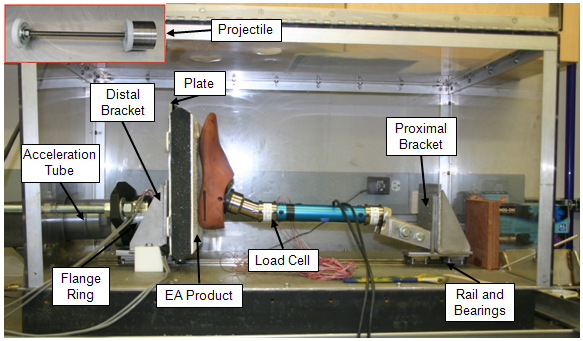
The impulse was applied by accelerating a projectile (6.8 kg) down a 7.6 cm diameter tube to strike the distal bracket, which was covered with a layer of urethane foam to attain the required load duration (3 to 10 ms). The projectile was 6.6 cm in diameter, and the front striking surface had a shallow curvature (radius = 10.2 cm) to ensure a consistent point of impact. The velocity of the projectile was measured immediately prior to impact. The axial load measured at the lower tibia load cell (Fz) was recorded at a sampling frequency of 15 kHz.
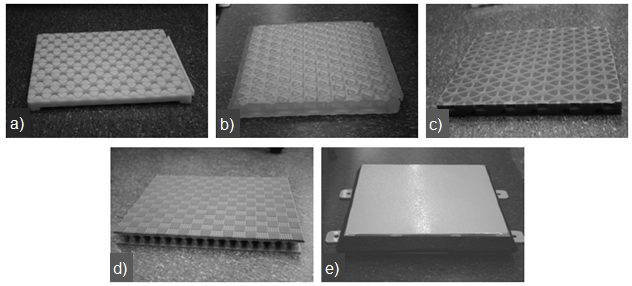
Five energy-attenuating floor mat materials were tested, all of which are marketed to protect against lower leg injuries in a military environment. These EA materials were: MitiGatorTM (SEA Systems Group, Clarksville, VA, USA) in three materials: uniprene, urethane, and monprene, Skydex® (Skydex Technologies, Centennial, CO, USA), and AV Foot Pad (Allen Vanguard, Ottawa, ON, Canada) (Figure 2). MitiGatorTM is made from a number of elastomeric materials, formed in a hexagonal cell structure with interconnecting air vents to dissipate vertical impact energy laterally. Skydex® consists of a double layer of hemispheres made by injection-moulded plastic that when loaded absorb shock. The AV Foot Pad is a single-use blast protection system that is filled with a stiff compressible foam centre. Each floor mat was approximately 25 cm × 25 cm, and was affixed between the foot and the distal bracket with the foot located in the centre of the test specimen (Figure 1). Testing was also conducted with the foot resting directly on the distal bracket (to establish the baseline).
The materials were tested in a random order over a wide range of impact levels, in which the velocity of the projectile was gradually increased until the limits of the impact apparatus and load cell (that is, 11.1 kN) were reached. For each impact, the peak axial force in the lower leg was measured for comparison to the current injury criterion used in the defence industry (that is, 5.4 kN) [1].
Data were analyzed to determine the percentage decrease in axial force as the result of each EA material. To assess the repeatability of the testing, each material was impacted five times at a medium impact velocity of 5 m/s.
Results
Axial load data were collected over a range of velocities (2.2–7.0 m/s). No damage was observed in any of the products except for the AV Foot Pad, which exhibited cracking at the corners after the numerous high-force impacts, but with no perceptible change in thickness.
The repeatability of the testing setup and material recovery was evaluated using five repeated trials. Standard deviations in force ranged from 2.3–5.8% of the mean, with the monprene MitiGatorTM having the lowest standard deviation and the AV Foot Pad having the highest. The repeatability of the test apparatus and protocol (quantified by tests with no EA material) showed a standard deviation of 3.6% of the mean force when tested at the same impact level.
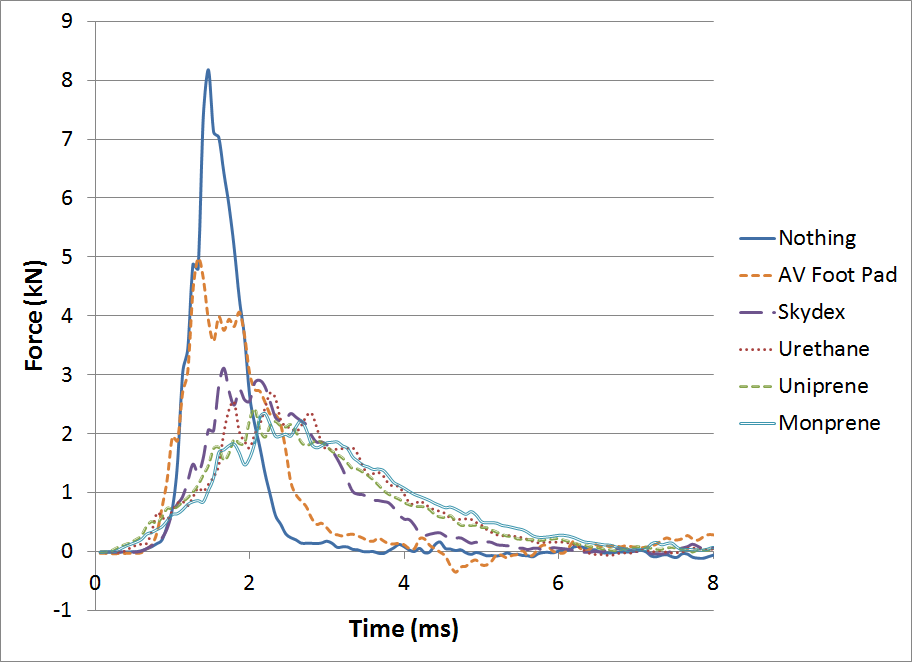
The impact durations ranged from 2–10 ms, depending on test conditions. The axial forces recorded at the distal tibia load cell during tests at an impact velocity of 4.7 m/s are shown in Figure 3. The peak axial forces recorded at the lower tibia load cell for each of the materials (and the baseline condition of no EA material) are presented in Figure 4. The three MitiGatorTM materials had linear force-velocity relationships (R2 = 0.96 – 0.98), as did the AV foot pad (R2 = 0.98). The Skydex® mat had a logarithmic force-velocity relationship (R2 = 0.98).
![Axial force values recorded in the lower tibia over the range of velocities tested for the baseline condition (Nothing) and the five energy attenuating products tested. The current injury standard of 5.4 kN is indicated by the horizontal dashed line [1, 7].](/journals/journal-of-battlefield-technology/volume-14/issue-03/assets/14-3-1-quenneville/figures/figure04.png)
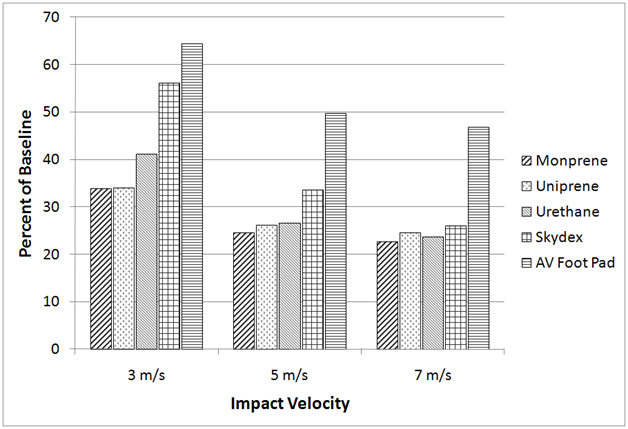
To evaluate the reduction in tibia load as the result of each EA material, the percentage decrease from baseline (that is, no EA material) is presented for impact speeds of 3, 5 and 7 m/s (Figure 5). While the baseline tests could only be conducted up to 5 m/s due to the limits of the load cells, the linear velocity-force relationship was extrapolated for comparison with tests at 7 m/s. This reduction ranged from 35% to 77%, depending on the EA material and impact severity. The AV Foot Pad demonstrated the least reduction from baseline at all impact velocities. The three MitiGatorTM products showed the greatest reduction in tibia force at all impact velocities, with the monprene performing slightly better than the other two materials (uniprene and urethane). Skydex® was not as effective at reducing the tibia force at lower impact velocities, but provided increased protection at higher speeds. Still, at the 7 m/s test, the force measured in the ATD tibia was 2.4% greater with Skydex® than the MitiGatorTM products (averaged).
Discussion
This study subjected a standard ATD leg to short-duration (<10 milliseconds) axial impact loading for the purpose of evaluating the protective capabilities of five commercially available EA floor mats. The mats were tested over a range of velocities representative of floor motion during an AV blast event, and the corresponding forces compared to the current injury threshold of 5.4 kN. This allowed the products with the best protection capabilities to be identified.
To the authors’ knowledge, no previous study has examined the protective potential of EA floor mats against AV blast conditions. According to its manufacturer, MitiGatorTM dissipates 30% of the force to the lower tibia, as tested in a drop tower configuration (www.seasgroup.com). This is less than found in the current study, which demonstrated a maximum reduction in force of 76%, and may be attributed to the differences in boundary conditions between a drop tower and the current impacting apparatus.
Skydex® has been demonstrated using scaled explosive tests (by the manufacturer) to reduce the tibia force by as much as 71%. This maximal protection was at the highest floor velocity (which agrees with the results from the present study); at an impact speed of 12 m/s it reduced the force by 53%, and at 6 m/s did not affect the force (www.skydex.com). The difference in results from this test to the current tests may also be attributed to the difference in experimental setup, particularly the use of boots.
No published material on the performance of AV Foot Pads could be found, and as such this study represents the first known assessment of this product.
The use of a pneumatic impacting apparatus allowed a controlled investigation of each material over numerous tests. By presenting the data as a percentage of baseline, a direct comparison could be made among the materials tested. Tests were conducted to a maximum speed of 7 m/s due to the limits of the impacting apparatus and load cells employed. This is on the lower end of the reported floor velocity during a blast [2], but is in line with previous lower leg injury assessment tests simulating AV blast loading [8,9]. Furthermore, with recent advances in hull design reducing the blast effects experienced within a vehicle, this may be a reasonable representation of crew floor velocity under blast. The test procedure and all materials were shown to be highly repeatable when assessed at a mid-range impact velocity, and no accumulated damage was noted in four of the five materials. The results of this study are limited to pure axial loading, but this is the primary loading mode for the lower leg in the AV landmine scenario. A boot was not used for this testing due to the inherent variation of boots available on the market, and to apply the highest impacts possible. The use of boots in blast testing has been shown to reduce the peak tibia axial force by 30% [10].
The ATD leg with no EA material demonstrated high forces at relatively low impact velocities. With no EA floor mat, the injury threshold of 5.4 kN was exceeded at an impact speed of 3.7 m/s. The AV Foot Pad provided protection up to a velocity of 5.4 m/s. The MitiGatorTM products increased the tolerable floor velocity to 9.0 m/s, 9.5 m/s and 9.7 m/s for the uniprene, urethane and monprene respectively. Through extrapolation, it is estimated that Skydex® would provide protection to velocities of approximately 10.7 m/s.
The AV Foot Pad and the MitiGatorTM mats showed substantial increases in protective capabilities between the 3 m/s and the 5 m/s tests (9–14% decrease in percentage of baseline force), but relatively minimal increases in protective capabilities between the 5 m/s and 7 m/s tests (2–3%). Skydex® showed a 22% decrease in percentage of baseline force between the 3 m/s and the 5 m/s trials, and showed a further increase in capacity for force mitigation between the 5 m/s and 7 m/s impacts (8%). This suggests that the AV Foot Pad and MitiGatorTM materials had reached their maximum force-reducing capabilities, whereas Skydex® may provide even greater protection at higher impact velocities. Unfortunately this was beyond the range of testing permitted by the apparatus and load cells, and as such could not be verified.
In summary, this study evaluated the protective capabilities of five commercially available EA foot mats under short-duration axial impact loading. At high impact velocities MitiGatorTM and Skydex® greatly reduce the loading in the tibia, but all products would be expected to fail to meet the injury threshold (5.4 kN) at the reported floor velocity of 12 m/s [2]. While these EA floor mats offer significant protection and ease of integration, the limits of their capabilities should be understood when used in a blast environment. Protection of the lower limbs from impact loading resulting from AV blast loading remains a significant challenge, and further research and development in the area of EA floor mats is needed to meet the required injury thresholds.
Acknowledgements
This research was supported with funding by General Dynamics Land Systems – Canada, Ontario Centres of Excellence, Canada Foundation for Innovation, Ontario Innovation Trust, and Natural Sciences and Engineering Research Council of Canada.
References
[1] North Atlantic Treaty Organization AEP-55, “Procedures for Evaluating the Protection Level of Logistic and Light Armoured Vehicle: for Mine Threat”, Allied Engineering Publication, Vol. 2, Ed. 1, 2006.
[2] Wang, J., Bird, B., Swinton, B., and Krstic, A., “Protection of Lower Limbs Against Floor Impact in Army Vehicles Experiencing Landmine Explosion”, Journal of Battlefield Technology, Vol. 4, No. 3, November 2001, pp. 8–12.
[3] McKay, B. and Bir, C., “Lower Extremity Injury Criteria for Evaluating Military Vehicle Occupant Injury in Underbelly Blast Events”, Stapp Car Crash Journal, Vol. 53, November 2009, pp. 229–249.
[4] Hirsch, A., “Man’s Response to Shock Motion”, Report 1797, David Taylor Bassin Model, 1964, Washington, D.C., USA.
[5] Quenneville, C., McLachlin, S., Greeley, G., and Dunning, C., “Injury Tolerance Criteria for Short-Duration Axial Impulse Loading of the Isolated Tibia”, Journal of Trauma, Vol. 70, No. 1, January 2011, pp. E13–E18.
[6] Quenneville, C., Fraser, G., and Dunning, C., “Development of an Apparatus to Produce Fractures from Short-Duration High-Impulse Loading with an Application in the Lower Leg”, Journal of Biomechanical Engineering, Vol. 132, January 2010, 014502.
[7] Yoganandan, N., Pintar, F., Boynton, M., Begeman, P., Prasad, P., Kuppa, S., Morgan, R., and Eppinger, R., “Dynamic Axial Tolerance of the Human Foot-Ankle Complex”, Society of Automotive Engineers, Paper 962426, 1996, Warrendale, PA, USA.
[8] Bir, C., Barbir, A., Dosquet, F., Wilhelm, M., van der Horst, M., and Wolfe, G., “Validation of Lower Limb Surrogates as Injury Assessment Tools in Floor Impacts due to Anti-Vehicular Land Mines”, Journal of Military Medicine, Vol. 173, No. 12, December 2008, pp. 1180–1184.
[9] Manseau, J. and Keown, M., “Evaluation of the Complex Lower Leg (CLL) for its Use in Anti-Vehicular Mine Testing Applications”, IRCOBI, Prague, Czech Republic, 2005.
[10] North Atlantic Treaty Organization TR-HFM-090, “Test Methodology for Protection of Vehicle Occupants Against Anti-Vehicular Landmine Effects”, Final Report of the Human Factors and Medicine Task Group 090 AC/323 (HFM-090) TP/72, April 2007.