
Volume 14, Number 1, March 2011
Agent-Based Decision Making For Integrated Air Defence Systems
- * Institute for Systems Studies and Analyses, Defence Research and Development Organization, Metcalfe House, Delhi-110054, India.
Abstract
This paper presents algorithms for decision-making agents for an integrated air defence (IAD) system. The advantage of using an agent-based system over a conventional decision-making system is its ability to detect and track targets automatically and, if required, allocate weapons to neutralize threats in an integrated manner. Such an approach is particularly useful for future network centric warfare applications. Two agents are presented here that perform the basic decision-making tasks of command and control (C2), such as detection and action against jamming, threat assessment, and weapons allocation. The belief-desire-intention (BDI) architectures provide the building blocks of these agents. These agents decide their actions by meta-level plan reasoning processes. The proposed agent-based IAD system runs without any manual inputs, and represents a state-of-art model for C2 autonomy.
Introduction
Conventional decision making for command and control (C2) for an integrated air defence (IAD) system is commonly performed by human decision makers. In an IAD, ‘integrated’ means that different tactical air defence services such as searching, detecting, tracking, identifying and engaging targets using air defence sensors (radars) and weapons (aircrafts and missiles) are performed in an integrated fashion. Network centric warfare (NCW) is a concept that facilitates successful IAD operations. The C2 of NCW is viewed as a collaborative decision-making process. With the advent of synchronous or asynchronous NCW in terms of both time and space [1], the conventional methods and modes of implementing the decision-making processes of C2 have become obsolete [2]. The modern networked-laid IAD systems demand advanced decision-making techniques that should be enriched with artificial intelligence (AI) techniques. At each level of service, execution decisions need to be taken autonomously by intelligent computational entities or agents. These agents should be capable of taking localized decisions and communicating with each other to achieve a collective goal.
The belief-desire-intention (BDI) architectures [3] are based on the philosophical tradition of understanding practical reasoning. Recently these architectures have been extended to develop autonomous agents drawing on concepts from a number of disciplines ranging from economics to cognitive psychology to mathematics. The BDI architectures are applied to the development of agents that behave deliberatively and reactively in a complex environment. In these architectures, the mental attitudes of the agent are represented by attributes such as beliefs, desires, and intentions. The belief is the knowledge of the agent about its world or environment. An agent’s desire or goal is the condition that an agent wants to satisfy. After satisfying the conditions, the agent has to perform certain actions (known as intentions) to achieve a goal. Agents have different courses of actions to achieve different desires or goals—these are stored in the plan repository or plan library. JACK [4] is the most widely used programming language for developing BDI agents.
Recently, several studies have been performed to understand and improve agent-based modelling in different application domains. The agent technologies have been successfully deployed for wireless battery powered sensor network in [5] for the graph colouring problem. Agent-based modelling and simulation tools are used for the implementation of an automated car driver [6]. Software agents can be embedded on the web as a replacement for some of the functions normally performed by the human user. In such situations, dynamic service composition is essential. In [7] work is presented where agents are evolving service semantics cooperatively in a consumer-driven approach. An application of distributed computation by a multi-agent system for traffic control is presented in [8]. Introducing learning capability in BDI architectures is studied by [9]. A new architecture is presented in that study as an extension of the BDI architectures in which learning process is described as plans. The manipulative abduction that reasons by experiences and exhibitions of behaviour to find some pattern in the environment is used for the learning process.
Search is an essential part of the agent’s model. Search is a sequence of actions that takes any agent from the initial state to the goal state. Search could be uninformed or informed (heuristic). Heuristic search is an essential action for agents that work in the real time. Two classes of heuristic search methods are common: real-time heuristic search and incremental heuristic search. A detailed comparison of these two methods along with their advantages and disadvantages is presented in [10].
The agent models are difficult to verify because there is always a gap of understanding between agent logic and agent programming. To overcome this problem, an operational semantics of agent programming language is presented in [11]. In that study, agent logic is first grounded by state-based semantics then denotational semantics is used to connect the agent logic with agent programming.
An agent may pursue multiple goals simultaneously. The inability to achieve multiple goals at the same time is known as a conflicting goals situation, the semantic representation of which is presented in [12]. Monitoring many agents in a multi-agent architecture, in which disagreements between different agents arise, is an open problem in agent development work.
In the present study, C2 agents that are capable of taking autonomous decisions are identified, designed, and implemented for an IAD system. The OODA (observe-orient-decide-act) approach [13] is assumed for modelling the tactical behaviour of these agents. This loop has long been used for understanding human participation in the complex C2 problem. Major roles of C2 of air defence systems are threat assessment (TA) and weapon allocation (WA).
The objective of this study is to apply the practical reasoning process of human decision makers to develop autonomous agents responsible for TA and WA. The BDI architectures are most suitable for implementing the philosophical tradition of understanding practical reasoning. These architectures are also suitable for developing a team of agents appropriate to the hierarchical structure of air defence system.
This paper is intended to contribute the application of BDI architectures, as an extension of the goal-based agent architecture, for developing the decision-making agents for an IAD system. The main concern is to formulate the mental attributes of a human decision maker in terms of beliefs, desires, and intentions. This is a novel methodological application of agent-based modelling for IAD systems, and a technology integration between agent-oriented programming and Java-based combat simulation models. Two decision making agents are proposed. The first is related to the identification of jamming of a surveillance radar in battlefield, and the second is related to TA and WA. A brief discussion is presented about the deployment status of these agents in a simulated air combat scenario along with the lessons learned from this study.
Iad system
Air defence systems have progressed steadily over recent years to include highly sophisticated mission planning tools and artificially intelligent capabilities [14,15]. The Air Force Mission Support System (AFMSS, [14]), Power Scene and Top Scene [14] all represent major advances in this field. Until now, most IAD operations consist of large teams of human operators that control actions within the IAD system.
The idea of using multi-agent system (MAS) for weapons and targets management in IAD is appropriate for distributed architectures. In cooperative MAS, agents work together to achieve one or more desired common goals. The overall system goal is achieved through interactions and coordination of the individual agents [3]. A distributed agent team has advantages over a single, complex agent in many applications [16]. For example, for search and rescue operations, multiple robots can forage far more effectively than a single, complex robot [17].
Command and control of iad system
This section identifies the possible information processing agents for performing the task of C2 in an IAD system. C2 of air defence systems in most countries follows a certain hierarchical structure with information exchanged between different levels of this structure. The Global Command and Control Centre (GCCC), Local Command and Control Centre (LCCC), Surveillance Radar (SRdr), Airbase Cadre (AB), Tracking Radar (TRdr), Surface-to-Air Missile (SAM), Aircraft Pilot (AP) are the different components of an IAD system. The main roles of these components are target detection and classification, threat assessment (TA), and weapons allocation (WA).
Figure 1 shows the hierarchical structure of a typical IAD system. The directions of flow of information between different levels are shown by arrows. The arrows with dashed lines are used to represent that command is passing from a higher to a lower level. At the top of the tree is the higher command unit which is known as the GCCC. Therefore in a MAS set-up it is identified as the first agent; namely the GCCC agent.
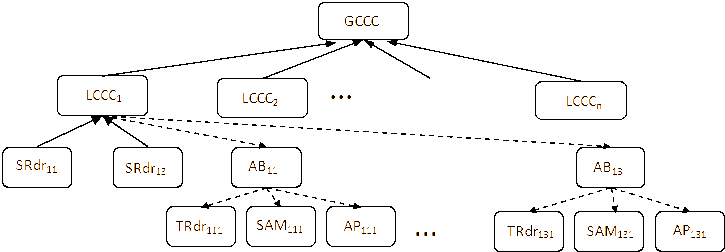
The GCCC agent first analyses the decisions given by the different LCCCs located at diverse locations, takes its own decision, and then passes it to the next level of the command units—that is, to AB. The LCCC unit is identified as the second agent. This agent analyses the information given by the different SRdr(s) at diverse locations and takes their own decision based on its perception and passes it to the GCCC agent. The SRdr is the third type of agent. The LCCC agents decide which target to engage and which weapon to allocate to that target. The AB is identified as the fourth type of agent. Based on the decisions given by the LCCC agent, the AB agent decides which TRdr to track which target and which SAM to engage which target. The TRdr and the SAM systems are considered to be the fifth type of agents. Based on the decisions given by the AB agent, TRdr and SAM agents engage targets. In this study only two agents (namely, SRdr and LCCC agent) are designed and implemented to show the paradigm shift of the agent-based decision making for an IAD system.
Bdi architectures of the C2 agents
Two main questions are answered while constructing the BDI architectures of the C2 agents. The first is what goals (options or desires) the agent decides to achieve with its current beliefs about the environment, and second is how it is going to achieve these chosen goals (intentions) by means of some actions. These issues are resolved from the practical reasoning applied by the human experts to the air defence domain.
Bdi architectures of the surveillance radar agent
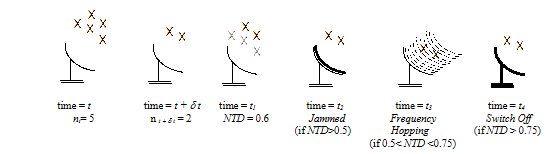
Surveillance radars are required to detect aircrafts or missiles flying towards them and are often misdirected or confused by the target’s use of noise jamming. Experienced radar operators can detect jamming and they generally decide to keep the radar switched off in such situations. The goal of the SRdr agent is to protect the radar from noise jamming. Based on the intensity of the jamming signal, this agent can decide which action will be suitable for the radar.
The SRdr agent measures the intensity of jamming from the difference between the numbers of targets detected at time t+1 and t. If the difference is significant, it is assumed that the radar is being jammed. The working principal of SRdr agent is shown in the Figure 2. The SRdr agent is assumed to be deployed in the simulated environment. It receives the information such as the numbers of targets (nt) detected at time t from its environment. On the basis of nt+1 and nt it identifies the presence of noise jamming. An index is defined for this purpose namely Normalized Target Difference (NTD = | ((nt-nt+1)/nt )|). On the basis of the NTD values it decides what action it should perform based on its belief. The main action of the SRdr agent is to perform target detection in a jamming free environment. Depending on the NTD values, the SRdr agent can stay either in any two of the four states namely “Sense Mode”, “Sleep Mode”, “Switch Off” and “Frequency Hopping”. If the “Jamming” is found then it can go either in “Switch Off” or in “Frequency Hopping” mode.
B. bdi architectures of the lccc agent
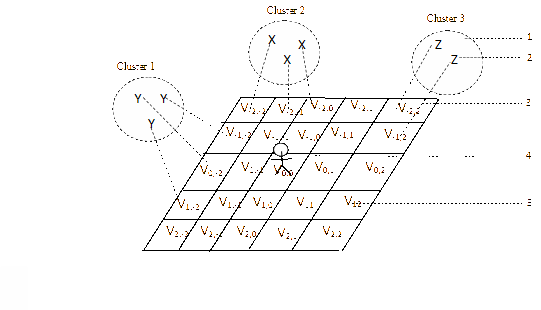
The LCCC agent is responsible for TA and WA. This agent gets inputs from the multisensory data fusion (MSDF) module. The MSDF groups the detected targets into different clusters and sends the cluster information (cluster identity and cluster location) along with the situational assessed inputs about the enemy’s intent (such as mission type—that is, strike or escort; and package size—that is, small or large). Based on this information and the LCCC agent’s own beliefs (such as VAVP (vulnerable area and vulnerable points) value), the LCCC agent prioritizes the clusters and allocates interceptor assets to the attacking aircraft. Figure 3 shows the LCCC agent residing in a grid environment, evaluating the threat and prioritizing targets along with target-interceptor pairing. In order to find the closest cluster, this agent uses the meta-level plan reasoning (MLPR) process based on a distance measure. The goal of the LCCC agent is to optimally engage the detected targets with its available interceptors subject to the restriction that no target is engaged by more than one interceptor.
Input: cluster id, package size, mission type, cluster locations, number or attacking aircraft. vavp locations, interceptor locations.output: target priority list, target-interceptor pairing.initialize clock = 0, simulation_time = 60, lccc agent a;while ( clock < simulation_time) a.distance () ; clock ++ ;endwhile3. a.distance ()start:3.1.compute distances (d1, d2) between clusters and vavp and clusters and interceptors;3.2.add the distances in a beliefset-1 and beliefset-2 respectively.3.3.add attacking aircraft ranking in a beliefset-3.3.4. add attacking aircraft and interceptor availability separately in beliefsets-4 and 5 respectively;3.5.post an event (ev1) confirming that all belief updating is complete;3.6. meta-level plan reasoning using beliefset-1 to find closest clusters;3.7. post the closet cluster information by an event ev2.3.8. meta level plan reasoning using beliefsets-2 and 5 to find closet interceptor.3.9.post the cluster-interceptor pairing with an event ev3.3.10. meta level plan reasoning using beliefsets-3 and 4 to find closet attacking aircraft in the cluster.3.11. update the beliefsets-4 and 5.endinput: cluster id, package size, mission type, cluster locations, number or attacking aircraft. vavp locations, interceptor locations.output: target priority list, target-interceptor pairing.initialize clock = 0, simulation_time = 60, lccc agent a;while ( clock < simulation_time) a.distance () ; clock ++ ;endwhile3. a.distance ()start:3.1.compute distances (d1, d2) between clusters and vavp and clusters and interceptors;3.2.add the distances in a beliefset-1 and beliefset-2 respectively.3.3.add attacking aircraft ranking in a beliefset-3.3.4. add attacking aircraft and interceptor availability separately in beliefsets-4 and 5 respectively;3.5.post an event (ev1) confirming that all belief updating is complete;3.6. meta-level plan reasoning using beliefset-1 to find closest clusters;3.7. post the closet cluster information by an event ev2.3.8. meta level plan reasoning using beliefsets-2 and 5 to find closet interceptor.3.9.post the cluster-interceptor pairing with an event ev3.3.10. meta level plan reasoning using beliefsets-3 and 4 to find closet attacking aircraft in the cluster.3.11. update the beliefsets-4 and 5.end
Meta-level plan reasoning
In this study, the concept of MLPR [3,4,9] is used extensively by the C2 agents for taking optimal decisions. MLPR is a method of selecting the appropriate plan from the plan library to satisfy the agent’s goal. This method is generally used for BDI agent implementation. The actions in MLPR are supposed to be optimal in some respect. Sometimes, MLPR can also be used to enable the agent to learn from the changing environment.
MLPR is implemented by using the getInstanceInfo() library function provided by the JACK [17]. The getInstanceInfo() method calculates the ranking of a plan by a PlanInstanceInfo object. The ranking is done by calculating one index which is a function of distance, mission type, and package size. Mission types and package sizes are assumed to be fuzzy set. The membership values of these variables are obtained by using a trapezoidal membership function. Each distance, package size and mission type generates a distinct plan (Figure 7). The plan with maximum ranking get selected by the getInstanceInfo() function. In this way MLPR capability is incorporated in the LCCC agent’s architectures. The events are posted either by the LCCC agent itself or by other plans. For example, the event ev2 (namely NewClusterPriorityEvents) is posted from the plan “NewClusterPlan” when this plan is selected by the agent. In the similar way, the interceptor aircraft of the defender force is allocated to the nearest aircraft. While allocating an interceptor to the aircraft the agent also checks its availability status so that multiple allocations do not take place.
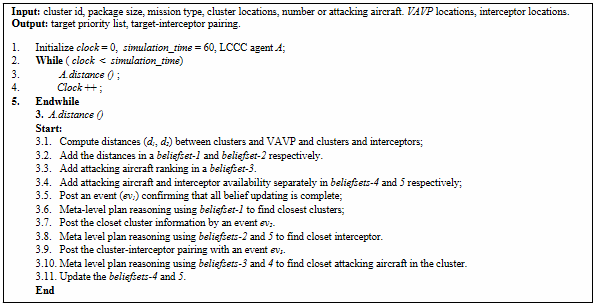
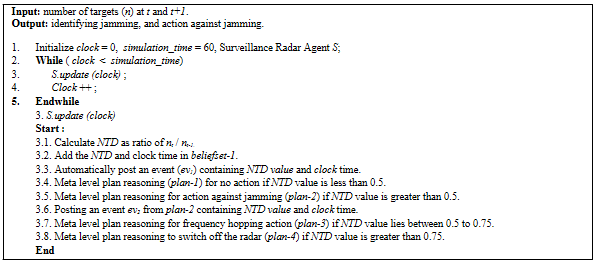
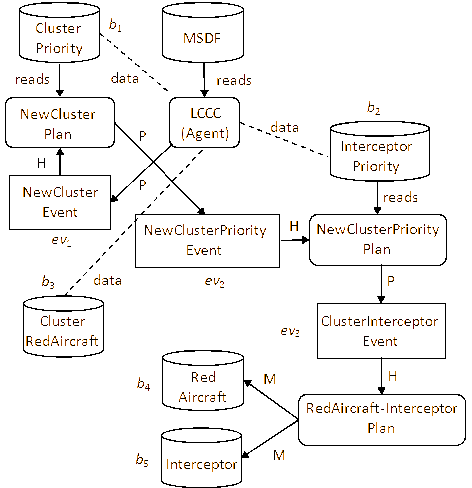
The agent’s algorithms are shown in the Figures 4 and 5 and implemented through the JACK agent programming language as shown in the Figure 6 (a and b).
Evaluation
Two approaches are used for evaluating the C2 agents. The first approach is the logical evaluation, and the second approach is the statistical evaluation. Although logical evaluation is the most widely used method for agent research, it cannot quantify the performance of the agents. A solution could be to use logical evaluation for identifying the deadlock situations and quantifying the performance by statistical measures. The logical verification rectifies the conflicting/multiple goal situations in the system. The statistical hypothesis testing measures the performance of the agents.
Logical evaluation
First approach is based on the logical verification of the agent’s model. In logical verification, the concept of goal inference rule (gir) is used for detecting the conflicting goals in the system ([12]). The girs’ for SRdr agents is defined as in the Figure 8. For example the gir:
![Goal inference rule (gir) [12] for logical verification of surveillance radar agent. G stands for goal.](/journals/journal-of-battlefield-technology/volume-14/issue-01/assets/14-1-5-das/figures/figure08.gif)
{Jammed} b,{Frequency Hopping}k- Þ Switch Off
represents that if the SRdr agent is Jammed (belief state denoted by b), it may derive the goal to go for the “Switch Off” plan (denoted by p1), but the goal to go for the “Frequency Hopping” (denoted by p2) is in conflict (denoted by k- ,where as k+ denotes non-conflicting goals)with the goal to go for the “Switch Off” plan (see Figure 8).
The girs are extended to default logic ([12]). The gir helps to find out any sort of conflicting goals present in the model. Consider that one wants to express that if a SRdr agent is found “Jammed”, it may go either for the “Switch Off” or “Frequency Hopping” mode, but should not simultaneously pursue these goals simultaneously—that is, the goals “Switch Off” and “Frequency Hopping” are conflicting. Moreover, if a SRdr agent has “Switch Off” mode, it wants to go “Sleep Mode” with it, if it is in the “Frequency Hopping” mode, it wants to remain in the “Sense Mode”. This could be modelled using the girs, as shown in the Figure 8.
Another form of logical evaluation adopted in the study is the representation of the entire mechanism in the form of operational semantics [11]. In this approach, the agent model is first grounded with state-based semantics, then denotational semantics are used to define the mathematical relation connecting agent logic and agent programming. The operational semantic, state-based semantic, and model semantic of the LCCC agent use a propositional language (L0) to represent their environment with the operators such as ∧ (conjunction), ∨ (disjunction) and ¬ (negation). The L0 is an infinite set of atomic propositions that uses the entailment ( |= ) relation. The operational semantic defines the input-output relation as a compositional function mapping from initial states to the final state reached upon termination. The state based semantic provides the ingredients for defining the operational semantic. The denotational semantic provides the semantics for a modal logic of agent programs [11].
Statistical evaluation
This evaluation is based on the classical approach of statistical hypothesis testing. The assumed hypothesis (also called Null hypothesis, H0) is that the output data of the agent model follows a certain perfect statistical distribution.
| No. of Targets Detected with parameters | Normalized Target Difference |
|---|---|
| Normal (20,10) | Student’s t (2) |
| Triangular (20,10,30) | Gamma (α=12.06, β=0.08) |
| Uniform (10,30) | Gamma (α=4.90, β=0.22) |
| Exponential (10,20) | Laplace (λ=185.71 ,µ=1.0) |
| Events | Number/ Percentage |
|---|---|
| Total Samples | 500 |
| Jamming | 231 (46.2%) |
| Frequency Hopping | 134 (26.8%) |
| Switch Off | 97 (19.4%) |
This test is used to decide if a sample comes from a hypothesized continuous distribution. It is based on the Empirical Cumulative Distribution (ECDF). Let x1, x2, ... xn be a random sample of size n from a CDF F(x). The ECDF is: Fn(x) =1/n[number of observations ≤ x] The performance measure (D) is the largest vertical difference between Fn(x) and F(x): Dn=supx(|Fn(x)–F(x)|) In this experiment: Dn=0.008564 (for Binomial) Dn=0.03164 (for Geometric) Dn=0.01773 (for Poisson)
The SRdr agent acts according to the distribution pattern of the number of targets detected (nt). The cut-off value of the NTD has a role in the performance measure of the SRdr agent. If the number of targets detected (nt) follows the Gaussian distribution then the NTD follows the Student’s-t distribution. Some other forms of transformations are given in the Table 1.
The decision of correct detection of jamming is a classical problem of finding a signal in a background of random noise. The Kolmogorov-Smirnov (KS) statistic is used to determine the underlying distribution pattern of NTD as given in the Figure 9. The probability of false alarm (Pf) plays a vital role in the correct detection of the presence of jamming. Although a single value of false alarm (that is, 5%) is taken in this study, the performance measure of the agent can be simulated for other values of Pf.
To test the SRdr agent performance, 500 random numbers were generated using the Gaussian distribution with mean and standard deviation equal to 20 and 10 respectively. On the generated data, the NTD index is calculated. It is found that after NTD transformation, the Gaussian random number transforms into another form of statistical distribution which is very similar to the Student’s-t distribution with parameter v = 2. If it is assumed that the nt follows some other statistical distribution then the resulting distributions of NTD would be of the form given in the Table 1.
The SRdr agent’s algorithm is applied to the generated data. The result of the simulation after applying the SRdr agent’s logic is shown in the Table 2. This table shows that, out of a total of 500 samples, 231 times (that is, 41%) the radar is found to be jammed. This statistic is close to the Jamming Factor (which was introduced in the simulation as random noise). It was found that 91 times the radar is found “Switch Off”. So it has saved around 19% of the energy. Although the simulation was started with Gaussian random data, after applying the agent’s logic the data transformed into statistical distribution which is very similar to the Binomial distribution (because the transformed data, the decisions, were either “Switch On” or “Switch Off”). The closeness of this distribution is measured by the KS statistic as shown in the Figure 9. This statistic is used for performance measure of this agent. This performance measure could be used to add the learning capability in the agents.
For the LCCC agent, experiments have been performed with three clusters, three types of cluster size (that is, large, medium and small) and two types of mission objectives (that is, strike and escort). So, a total of eighteen (3×3×2) possibilities of plans instances are generated. Therefore, the search space consists of eighteen combinations. Hence, it is obvious that, with the increase in search space, the computation time taken by the agent decreases. Similarly, the number of VAVP points also influences the agent’s performance. Although in this study only the VAVP points are considered in the agent’s beliefs, the number of interceptor also influences the agent’s performance, therefore, can be included in the beliefset. In general, the number of domains of the input parameters determines the performance of the agents. The search space will increase multiplicatively with the increase of the domain size. Computation time to take an optimal decision using MLPR is affected by these factors.
The input from the MSDF module influences the computation time required by the LCCC agent. It is found that the number of clusters has direct influence on the performance of the LCCC agents. In this study, only three clusters are considered. How the agent will perform with many clusters has not been studied. Similarly when the number of mission type and cluster size changes it directly influences the ranking of the plan instance.
Discussion and conclusions
The SRdr and LCCC agents are deployed in a simulated environment of air combat. The simulation is designed with several entities such as attacking aircrafts, defending interceptors, surveillance radars, air-to-air and surface-to-air missiles, and tracking radars. The simulated environment is created by the Java Netbeans IDE [18]. The agents are programmed by the JACK agent programming language [17]. The JACK supports the BDI architectures and MLPR. The data generated by this simulation are stored in the Oracle [19] database. The output actually contains the information about the states of the environment and agents. The agents analyse the environment and write their decisions again in this database. The initial belief of the SRdr agent is that no jamming has occurred. Over time this agent keeps on reading data from the database and adds it to its beliefset which automatically posts an event if it is greater than 0.5 (a threshold value decided by the experts) as an indication of noise jamming. The MSDF module collaboratively assesses the data obtained by different sensors and writes in the database. The LCCC agent receives inputs from the MSDF output through this database and decides accordingly. Based on these decisions, resources are allocated to the attacking aircrafts.
On each run of the simulation state situations of both the environment and the agents are observed. The agents are programmed in such a way that these can automatically detect any conflicting goal situation. For example, the SRdr agent checks its present states and if it finds any conflicting states situation as shown in the Figure 8 it throws an exception. In this way the agent model is validated logically. For statistical performance evaluation, the KS statistic is used. The KS statistic with a lower value is always preferable.
The main point emphasized in this work is the implementation details. Also, the MLPR is introduced so agents can choose the right plan for the plan-repository using a prioritizing mechanism. Such reasoning and the way it is implemented can be used for many different application domains. Main contribution of the paper is combining agent-oriented programming with a Java-based simulation environment and implementing this for an IAD domain. Main focus of the work is on how it is done and a significant effort has been put in implementing these ideas. Given the level of detail, it is certain that an advanced system may be developed for further research is this field.
The present approaches of design, implementation and testing of agent based system are found to be more suitable for hierarchical structure of C2 that works on the principle of practical reasoning. The way BDI architectures are used for developing the C2 agents can be extended to build higher-order team agents. This could be a general framework for implementing decision-making processes in an integrated mode. The traditional optimization techniques used for TA for an air defence system can be brought into this framework very easily. This is an integrated approach of decision making for selecting the optimal plan satisfying the agent’s beliefs to achieve desired goals. Usual methods of decision making do not integrate the decision maker’s beliefs and desires in a direct way, although these components are essential attributes. This approach is more suitable for future network centric warfare. The approach is novel in terms of both implementation (MLPR) and validation (logical as well as statistical).
Acknowledgement
The authors thankfully acknowledge the continuous support and help of Sh. H. V. Srinivasa Rao, Director, ISSA, DRDO, India, in conducting this research work. The authors are indebted to the editor-in-chief and reviewers for giving the critical and valuable comments that help in restructuring the paper in the present form.
References
[1] http://www.mindef.gov.sg/content/dam/ imindef_media_library/photos/scme/0015.res.
[2] http://www.dodccrp.org/events/12th_ICCRTS/Papers/010.pdf.
[3] G. Weiss, Multiagent Systems, A Modern Approach to Distributed Modern Approach to Artificial Intelligence, The MIT Press, Cambridge, Massachusetts, 1999, p. 585.
[4] R.H. Bordini, M. Dastani, J. Dix, A.E.F. Seghrouchni, Multi-agent Programming, Languages, Platforms and Applications, Springer, p. 313, 2005.
[5] A. Rogers et al., “Agent technologies for sensor networks,” IEEE Intelligent Systems, pp. 13-16, April, 2009.
[6] A. Pellecchia, C. Igel, J. Edelbrunner and G. Schoner, “Making Driver Modeling Attractive”, IEEE Intelligent Systems, pp. 8-12, 2005.
[7] M. Sensoy and P. Yolum, “Evolving Service Semantics Cooperatively: A Consumer -driven Approach”, Auton. Agent Multi-Agent Syst. 18, pp. 417-470, 2009.
[8] L.C. Bazzan, “Opportunities for Multiagent Systems and Multiagent Reinforcement Learning in Traffic Control”, Auton. Agent Multi-Agent Syst. 18, pp. 342-375, 2009.
[9] B. Subagdja, I. Sonenberg and I. Rahwan, “Intentional Learning Agent Architecture,” Auton. Agent Multi-Agent Syst. 18, pp. 417–470, 2009.
[10] S. Koenig and X. Sun, “Comparing Real-time and Incremental Heuristic Search for Real Time Situated Agents,” Auton. Agent Multi-Agent Syst., 18, pp. 313–341, 2009.
[11] K.V. Hindriks, J.J.C. Meyer, “Toward a Programming Theory for Rational Agents”, Auton. Agent Multi-Agent Syst. 19, pp. 4–29, 2009.
[12] M. Birna van Riemsdijk and M. Dastani, “Goals in Conflict: Semantic Foundations of Goals in Agent Programming”, Auton. Agent Multi-Agent Syst., 18, pp. 471–500, 2009.
[13] S. Karim, C. Heinze and S. Dunn, “Agent-based Mission Management for a UAV”, IEEE-ISSNIP 2004, pp. 481–486, 2004.
[14] D.S. Alberts, J.J. Garstka and F.P. Stein, Network Centric Warfare, Developing and Leveraging Information Superiority, CCRP publication series, 1999.
[15] L. Adelman, M. Christian, J. Gualtieri and T.A. Bresnick, ‘Examining the Effects of Communication Training and Team Composition on the Decision Making of Patriot Air Defense Teams’, IEEE Trans Sys. Man Cyb., A28, pp. 729–41, 1998.
[16] T. Balch, “The Impact of Diversity on Performance in Multi-robot Foraging”, Proceedings of the Third Annual Conference on Autonomous Agents, pp. 92–99, 1999.
[17] JACK®, Development Environment, Agent Oriented Software Pty. Ltd., P.O. Box 639, Carlton South, Victoria 3053, Australia.
[18] http://netbeans.org/
[19] http://www.oracle.com/in/index.html
[20] Q. Changwen and H. You, “A method of threat assessment using multiple attribute decision making”, IEEE, 2002 6th International Conference on Signal Processing, Vol. 2, pp. 1091–1095, August 2002.