
Volume 13, Number 2, July 2010
The Comparison Of Theoretical Detonation Properties Of New High Energetic Materials
- 1 Military University of Technology, Warsaw, Poland, S. Kaliskiego 2, 00-908.
Abstract
New thermochemical code ZMWNI has been used to predict the performance of ten new high explosives such as derivatives of furazan, furoxan, and tetrazines oxides. Parameters such as velocity, pressure, and temperature of detonation were calculated and compared with literature data for respective compounds.
Introduction
The development of new explosives is one of fundamental interest for both military and civilian areas. While the use of high energetic materials in the military is obvious, civil applications of such explosives have considerably increased in the last few years. Applications such as petroleum perforators and airbags in the automotive industry have greatly increased interest in compounds that are highly energetic with a high nitrogen content.
The design of new highly energetic materials requires the close cooperation of molecular physics and organic chemists. Contemporary science allows the design of energetic molecules and chemists since Elias Corey [1] are able to synthesize almost any compound. Advanced thermodynamical calculations can provide information about the predicted energetic and detonation properties of a designed molecule. These calculations are very important for chemists because, with this knowledge, they can focus on the synthesis of only a few selected compounds.
There are many papers containing calculations for potential high energetic compounds obtained by different thermochemical codes. Tiger [2], Cheetah [3], Explo [4], NEWPEP [5], EKVI [6], and ICT [7] codes are commonly used in the energetic materials community for numerical simulation of thermodynamic properties of explosives. A number of simple procedures also exist to evaluate performance of explosives without any experimental data [8].
In this paper we present a new thermochemical code which can be used to calculate detonation properties of molecular explosives and mixtures.
Detonation properties have been calculated for a number of new interesting explosives that have not yet been synthesized. Parameters predicted with the ZMWNI code have been recorded and compared with data from the literature.
Calculations
Calculations were made with new thermochemical code ZMWNI [9] developed at the Faculty of Advanced Technologies and Chemistry at the Military University of Technology in Poland. The ZMWNI code can calculate the parameters of combustion, explosion, and detonation of condensed energetic materials as well as determine the curve of expansion of detonation products in the form of JWL isentrope [10] and the energy of detonation [11]. Moreover, the ZMWNI code is able to determine the non-equilibrium states for frozen composition or for different temperatures of components on the reaction zone of detonation wave.
In the program ZMWNI, the method based on the minimization of chemical potential is applied to determine the equilibrium or non-equilibrium composition of a reactive system. Code is based on modified method of White, Johnson, Danzing, the final collection of components is obtained through solving the set of linear equations and the method of steepest descent ([9,12]). Physical properties of gasses are described by the BKW equation of state (Becker, Kistiakowsky, Wilson). For condensed components the OLD equation of state, applied in the thermochemical codes TIGER and CHEETACH, is used. To determine the equilibrium state for the combustion, explosion in a fixed volume, or detonation of an energetic material, the physical conditions appropriate for the given process are taken into account.
To determine detonation parameters, the relations resulting from the ideal detonation theory are usually used. From the equations of mass and momentum conservation one can obtain the relation combining the detonation velocity, pressure, and specific volume at the front of the detonation wave (the so-called Rayleigh line):
where p1 and v1 denote the pressure and specific volume of an explosive, p2 and v2 are the pressure and specific volume of the reacting composition at the front of the detonation wave, and D is the velocity of propagation of the wave. This equation denotes a detonation adiabate which connects p2 and v2 (the energy conservation equation). According to the Chapman-Jouguet hypothesis, the parameters p2, v2 at the point of tangency between the Rayleigh line and the detonation adiabate curve correspond to the steady-state detonation. For this point the detonation velocity D is at a minimum. This condition and the principle of minimum of the thermodynamic potential are used to determine the detonation pressure and the product’s composition. After determining p2 and v2, other parameters of the detonation wave are calculated on the basis of known relations at the Chapman-Jouguet point.
For theoretical deliberations ten molecules from four different chemical classes were chosen. They were high energetic and high density derivatives of: furazans, furoxans, 1,2,4,5-tetrazines, and 1,2,3,4-tetrazines (see Figure 1). Most of the compounds considered have relatively complicated systematic names, so useful and precise abbreviations have been used in the remainder of this article.
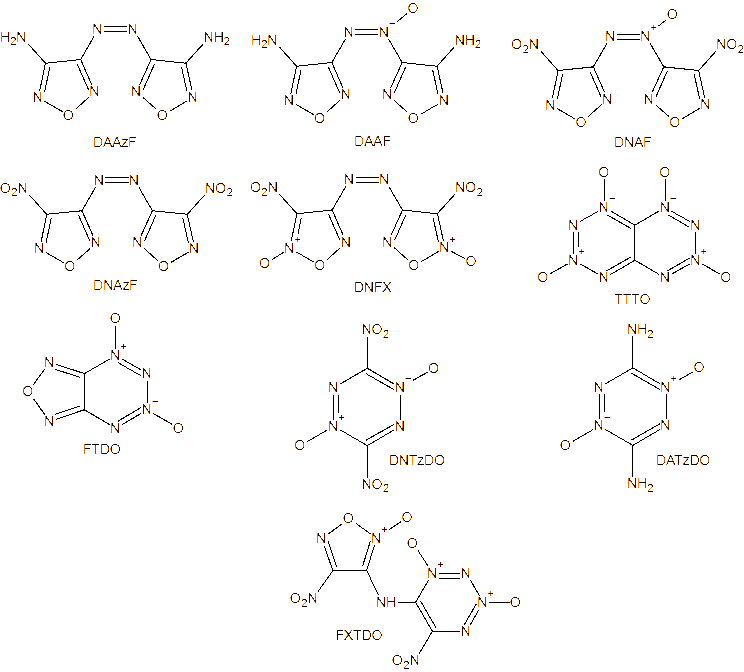
The data required for the calculations were taken from the literature (in accordance with the references shown in Table 1). All of the compounds listed in Table 1 were synthesized except for TTTO, DNTzDO, and FXTDO. TTTO is described in a couple of papers [13,14] as hypothetically an extremely high energetic material but currently, there is no preparative route to this compound, nor are there any physical properties of it described in the literature. FXTDO isn’t described but a similar compound where nitro groups are replaced by cyano groups is given in [15].
Detonation parameters were calculated for the Chapman-Jouguet point.
| Name | Abbreviation | Formula | Molecular Weight (g/mol) | ΔfHo (kJ/mol) | Density (g/cm3) |
|---|---|---|---|---|---|
| 3,3’-diamino-4,4’-azofurazan | DAAzF | C4H4N8O2 | 196.13 | + 535.5 | 1.73 [16] |
| 3,3’-diamino-4,4’-azoxyfurazan | DAAF | C4H4N8O3 | 212.13 | + 443.5 | 1.74 [16] |
| 3,3’-dinitro-4,4’-azoxyfurazan | DNAF | C4N8O7 | 272.09 | + 643.7 | 1.85; 1.91 [16] |
| 3,3’-dinitro-4,4’-azofurazan | DNAzF | C4N8O6 | 256.09 | + 703.9 | 1.73 [16] |
| 3,3’-dinitro-4,4’-azofuroxan | DNFX | C4N8O8 | 288.09 | + 667.1 | 2.00 [17] |
| [1,2,3,4]Tetrazino-[5,6-e]-[1,2,3,4]tetrazine-[1,3,5,7]tetraoxide | TTTO | C2N8O4 | 200.07 | + 750.3 | 2.10; 2.40 [18] |
| [1,2,5]oxadiazolo[3,4-e][1,2,3,4]tetrazine 4,6-dioxide | FTDO | C2N6O4 | 156.06 | + 537.5 | 2.10 [13] |
| 3,6-dinitro-1,2,4,5-tetrazine 1,4-dioxide | DNTzDO | C2N6O6 | 204.06 | + 200 | 1.90 |
| 3,6-diamino-1,2,4,5-tetrazine 1,4-dioxide | DATzDO | C2H4N6O2 | 144.09 | + 164.0 | 1.86 [13] |
| 5-nitro-6-(4-nitro-2-oxido-1,2,5-oxadiazol-3-yl)-1,2,3,4-tetrazine 2,4-dioxide | FXTDO | C4HN9O8 | 300.11 | + 500 | 2.00 [13] |
Method of determination of chemical potential minimum
The chemical potential of the i-th species can be determined by:
where ni is the molar quantity of species i, n is the total molar quantity of mixture, F is the Helmhotlz free energy of the mixture, and G is Gibbs energy. Equation (1) is the start point in the search for a reagent’s composition at the point of minimum chemical potential. The law of conservation of mass is an additional condition which limits the search area. This fundamental law when referred to molar quantity of atoms can be depicted by:
where bj is the molar quantity of j atoms in the mixture (j = 1, 2, ... m; m is the number of different atoms in mixture); and aji is quantity of atoms of element j in compound i.
The method for determining chemical potential minimum composition based on function minimum (1) with condition (2) was described in [19]. The most important elements of this method are described below.
The first step is a Taylor expansion of (1) and application of Lagrange multipliers, which results in a system of linear equations:
where Δi = ni’−ni, ni is the initial molar quantity of compound i, ni’ is the amount of compound i after the solution of the system of linear equations, and λj is the Lagrange multiplier (j = 1, 2, ... m). The system of linear equations can be presented in matrix form:
where ng’ is the sum of the gaseous components.
An iterative procedure was implemented to solve the system of equations above. The molar amount of components after each iteration must be positive and simultaneously shifted the investigated mixture of components in the direction of global minimum. To reach this goal, the steepest descent method is used [9].
The method of chemical potential minimisation is one of those methods in which the correct determination of the parameters of a process depends on the precise prediction of the mixture composition at equilibrium. In our program, the algorithm predicts many compositions of equilibrium mixture and chooses the final composition with the minimum value of chemical potential.
Results and discussion
The calculations results for the compounds in Table 1 are given in Table 2. Densities of explosives were taken from the literature for two compounds (DNAF, TTTO) calculations were done for two densities because the literature value of this parameter were very high, although realistic. The first column of Table 2 gives the abbreviations of the investigated compounds, and the remaining columns give the densities, in velocities of detonation, mass velocities of detonation products, detonation pressures, temperatures of detonation, and volume of gases generated from one gram of explosive for the literature density.
Only one compound theoretically can exceed VOD of 10 km/s for a density greater than 2.10 g/cm3. The theoretical maximum density (TMD) for TTTO is about 2.40 g/cm3 and VOD for this parameter value about 11.0 km/s but for organic compounds TMD is rarely attained. Best examples of this situation are heksanitroheksaazaisowurtzitane [20] and octanitrocubane [21].
DAAF is a serious candidate for insensitive high explosive. A relatively easy route of synthesis and a staple base independent of natural materials, make it very attractive for wide use. Predicted performance with ZMWNI is slightly better then literature data [17] but remains in good agreement.
Russian scientists informed that velocity of detonation of DNFX reached 10 km/s (d = 2.02 g/cm3) [17]. Our code predicted VOD for this explosive about 9400 km/s. Even if we add resonance energy effect and assume greater enthalpy of formation, as high VOD as declared by Russians will not be probable. Furazan and furoxan derivatives have relatively low detonation velocities, which is in obvious relation with their relatively small densities. Tetrazine-based compounds such as TTTO and FTDO have higher energetic characteristics because their densities are up to 2.00 g/cm3 and the molecule does not include hydrogen atoms.
The variation in mass velocity of detonation products is in good accordance with the variation in detonation velocity. In general when W rises, VOD will also rise. TTTO has the highest W value and the lowest values were calculated for DAAzF. A similar tendency is observed for detonation pressure. For a density of 2.40 g/cm3, TTTO has an extremely high detonation pressure of 72.8 GPa, which is about 200% of this parameter for 1,3,5,7-tetranitro-1,3,5,7-tetraazacyclooctane (HMX). Very similar predicted detonation properties for TTTO are published by Shechter et al. [13] and Song et al. [18].
Temperatures in C-J point for DAAzF, DAAF and DATzDO have typical values for explosives and varying from 3272 K to 3630 K. For the remainder of investigated compounds, detonation temperatures are very high and in an extreme case reach 6243 K (for TTTO). This effect occurs for a couple of reasons. Materials with higher values of T have a small amount of (or haven’t any) hydrogen atoms. Moreover, all of them have a high positive value (>500 kJ/mol) of enthalpy of formation. For DNAF and TTTO interesting phenomena are observed—for higher density, when detonation pressure and velocity increase, detonation temperature decreases. It can be explained by shifting of equilibrium in high pressures to solid state which caused a decrease of enthalpy and consequently lead to a decrease in temperature. Shifting of equilibrium to solid phase is also apparently shown in changes of volume of gases.
Conclusion
Thermochemical calculations made with new ZMWNI code for new high nitrogen explosives are realistic and in many cases correspond with results obtained with other thermochemical codes. Discrepancy of our predictions with measured properties for DNFX can result from not taking into account the resonance effect in the code or from extrapolation of experimental results to higher density of DNFX described by Pepekin et al. [17].
Calculations have confirmed that TTTO is the most perspective energetic molecule which was designed and in general derivatives of 1,2,3,4-tetrazine dioxides are more energetic than 1,2,4,5- analogues. For the first time in literature, we have shown predicted temperatures of detonation for new energetic compounds.
Acknowledgement
This work was supported by the Ministry of Science and High Education through the Institute of Chemistry, Military University of Technology under Grant No. O N204-000834.
| Abbreviation | Density (g/cm3) | VD (m/s) | W (m/s) | PD (GPa) | TD (K) | Volume (cm3/g) |
|---|---|---|---|---|---|---|
| DAAzF | 1.73 | 7814 | 1779 | 24.3 | 3415 | 0.436 |
| DAAF | 1.74 | 7999 | 1867 | 25.8 | 3630 | 0.438 |
| DNAF | 1.85 | 8704 | 2201 | 35.0 | 6152 | 0.404 |
| 1.91 | 8906 | 2217 | 37.2 | 6095 | 0.393 | |
| DNAzF | 1.73 | 8253 | 2152 | 30.3 | 6180 | 0.427 |
| DNFX | 2.00 | 9355 | 2302 | 42.5 | 6243 | 0.377 |
| TTTO | 2.10 | 9919 | 2397 | 49.3 | 6177 | 0.361 |
| 2.40 | 11063 | 2777 | 72.8 | 5879 | 0.312 | |
| FTDO | 2.10 | 9833 | 2376 | 48.4 | 6144 | 0.361 |
| DNTzDO | 1.90 | 7937 | 1813 | 27.0 | 4529 | 0.406 |
| DATzDO | 1.86 | 8675 | 1917 | 30.5 | 3272 | 0.419 |
| FXTDO | 2.00 | 9269 | 2198 | 40.2 | 5510 | 0.381 |
References
[1] E. Corey and X. Cheng, Logic of Chemical Synthesis, Wiley-Interscience, New York, 1995.
[2] M. Cowperthwaite and W. Zwisler, User's Guide For the TIGER computer program, Stanford Research Institute, Menlo Park, California, 1974.
[3] L. Fried, CHEETAH 1.39 Users Manual, UCRL-MA-11754 Rev. 3, Lawrence Livermore National Laboratory, Livermore 1996.
[4] M. Suceska, “Calculation of the Detonation Properties of C-H-N-O Explosives”, Propellants, Explosives, Pyrotechnics, Vol. 30, No. 16, pp. 197–198.
[5] L. Dobbs and C. Grubelich, Instructions and Changes to the NEWPEP Thermochemical Code, US Department of Energy, Technical Report No. SAND2001-1074, Livermore, 2001. 1, VI.
[6] B. Noläng, Ekvi System 3.2, BeN Systems, Balinge, Sweden, 2004.
[7] F. Volk and H. Bathelt, Rechenprogramm zur Ermittlung thermochemischer und innenballistischer Größen, sowie von Gasdetonationsparametern, ICT-Bericht 3/82,1982.
[8] M. Keshavarz, “Simple Determination of Performance of Explosives Without Using Any Experimental Data”, Journal of Hazardous Materials, Vol. 119, No. 2−3, pp. 25–29.
[9] S. Grys and W. Trzcinski, “Termodynamiczne Modelowanie Procesów Spalania i Detonacji Nieidealnych Układów Wybuchowych”, Biuletyn WAT, Vol. LXIII, No. 2, 2009. pp. 1–10.
[10] E.L. Lee, H.C. Horning, and J.W. Kury, Adiabatic Expansion of High Explosive Detonation Products, Lawrence Livermore National Laboratory, Report UCRL-50422, 1968.
[11] S.J. Jacobs, Energy of Detonation, United States Naval Ordnance Laboratory, Report NAVORD-4366, 1956.
[12] W.B. White, S.M. Johnson, and G.B. Danzig, “Chemical equilibrium in complex mixtures”, Journal of Chemical Physics, Vol. 28, 1958, pp. 751−755.
[13] H. Shechter, M. Venugopal, and D. Srinivasulu, “Synthesis of 1,2,3,4-Tetrazines, 1,2,3,4 Di-N-Oxides, Pentazole Derivatives, Pentazine Poly-N-oxides and Nitroacetylenes”, Helvetica Chimica Acta, Vol. 88, No. 3, 2005, pp. 354–405.
[14] A. Churakov and V. Tartakovsky, “Progress in 1,2,3,4-Tetrazine Chemistry”, Chemical Review, Vol. 104, No. 5, 2004, pp. 2601–2616.
[15] A. Tyurin et al., “Synthesis of First Nonannulated 1,2,3,4-Tetrazine 1,3-Oxides”, Russian Chemical Bulletin, International Edition, Vol. 55, No. 9, 2006, pp. 1648–1653.
[16] Z. Chaoyang et al., “Computational Investigation on HEDM of Azoic and Azoxy Derivatives of DAF, FOX-7, TATB, ANPZ and LLM-105”, Journal of Molecular Structure (Theochem), Vol. 728, No.1−3, 2005, pp. 129–134.
[17] V. Pepekin, B. Korsunskii, and Y. Matyushin, “Explosive Properties of Furoxanes”, Combustion, Explosion, Shock Waves, Vol. 44, No. 1, 2008, pp. 110–114.
[18] X. Song, H. Hou, and B. Wang, “Extensive Theoretical Studies of a New Energetic Material: Tetrazino-tetrazine-tetraoxide (TTTO)”, Journal of Computational Chemistry, Vol. 30, No. 12, 2009, pp. 1816–1820.
[19] W.B. White, S.M. Johnson, and G. B. Danzig, “Chemical Equilibrium in Complex Mixtures”, Journal of Chemical Physics, 28, 1958, pp. 751-755.
[20] A. Nielsen et al., “Synthesis of Polyazapolycyclic Caged Polynitramines”, Tetrahedron, Vol. 54, No. 39, 1998, pp. 11793–11812.
[21] P. Eaton, R. Gilardi, and M. Zhang, “Hepta- and Octanitrocubanes”, Angewandte Chemie International Edition, Vol. 39, No. 20, 2000, pp. 401–404.