
Volume 11, Number 3, November 2008
Knowledge Flows In A Highly Distributed Community Of Practice
- 1 The Richard Stockton College of New Jersey, P.O. Box 195, Jimmie Leeds Road, Pomona, NJ 08240, USA.
- 2 Oregon University System, University of Oregon, Eugene, Oregon 97403.
Abstract
This study describes the effects that knowledge flows had on a community of practice (CoP) that consisted of a highly distributed network of monitors tasked with maintaining a very large, dynamic, and complex communication network during Operation Iraqi Freedom. This communication network spanned hundreds of square miles and supported U.S. forces and coalition forces that went from 700 to over 80,000 personnel in four months. Prior to the commencement of Operation Iraqi Freedom, these network monitors were communicating and sharing information via different media in combination with an obsolete physical logbook-based knowledge management System (KMS). This caused the CoP to be reactive in maintaining this vast communication network. In addressing this problem, the First Marine Expeditionary Force communication Marines developed a virtual real-time KMS that collected over 8,000 log entries in 5 months. This KMS, called the MEL (Marine Air Ground Task Force Communication Control Center Event Log) was utilized in raising and troubleshooting network issues that are prevalent in maintaining any large communication network. Triangulation and analysis of the multiple interviews, audiovisual material, archival records, and documents formed the basis for the four findings of this study. First, the CoP utilized the MEL as an initial troubleshooting forum and as a starting point for sharing information and problem solving strategies regarding the operation of the network. Second, the CoP did not display social interactions in the use of the MEL throughout the study. Third, the CoP significantly relied on other media outside the use of the MEL, making the MEL one of a number of ways to communicate within the CoP. Fourth, the reliance on other forms of communications increased during the stress of combat operations..
Introduction
Communities of practice (CoPs) are common phenomena within the human experience. This paper investigates how interactions in a CoP change under periods of stress. One would theorize that communication would become more focused, more mission driven, and less social in nature. A battlefield is a classic environment to measure the effects of stress on communication within a networked community. Another factor affecting communication within a community is proximity. The CoP studied in this paper is a dynamic and dispersed organization of network monitors. This paper investigates knowledge flows within this system. It also investigates multiple metrics associated with the CoP. These metrics include utilization, problem solving, dialogue, multi-user communication, action prompts, disagreements and/or resolutions, and social interactions.
Knowledge flows and management systems
In an earlier article [1], Caro, Quinn, and Flournoy analyzed and described the MEL as a knowledge management system (KMS) using two lenses. The first lens involved analyzing how the system manages knowledge. The second lens analyzed the effect of this knowledge on the level of situational awareness (SA). The working components, as well as the use and rationale for each component of the MEL were delineated in that paper. That study found that the knowledge transferred within the MEL raised SA.
In this paper, a third lens is used to analyze the MEL. Studying the CoP associated with the MEL offers additional insights into the utility of this technology; in particular, how communication within the highly distributed CoP of network monitors was enhanced through the use of the MEL.
Community of practice
Understanding CoPs is the first step in identifying how people share information, learn, differentiate between novice and expert, and coordinate their efforts in being successful in their field. Whether we are talking about florists whose practice is to create arrangements or teachers whose practice is to educate, both are sharing information between each other and within their respective domains of knowledge and relevant to their practice.
Wenger, McDermott, and Snyder’s [2] conception of CoPs is grounded in social learning theory, and is a living structure of people in social communities that evolves and learns through a common practice. New knowledge is formed as a result of the synergy between participants in a community of practice. Not held to traditional hierarchies or boundaries, communities of practice can live and thrive or become extinct outside of the traditional order. They evolve in all communities to include the military community. Wenger et al [2] states:
A community of practice is a unique combination of three fundamental elements: a domain of knowledge, which defines a set of issues; a community of people who care about this domain; and the shared practice that they are developing to be effective in their domain.
CoPs offer the ability to share and learn as a community, as a nexus for the sharing of information. No matter what the job entails, people will create a practice to get that particular job accomplished. This case study describes the effect of the MEL KMS on a CoP.
CoPs connect to knowledge management because they “…cross boundaries created by workflow, functions, geography, and time. In the modern, knowledge-based, global organizations, communities create a channel for knowledge to flow across boundaries.” [3] Members of these communities share and distribute information through informal and formal conduits. Organizations that acknowledge and create avenues for members to communicate and share information will benefit by using a KMS to harness this shared knowledge and bridge the knowledge gaps between members in the community of practice.
KMS that support this sharing can have a positive effect on communities of practice. Wenger [4] states, “Communities of practice are … nodes for the dissemination, interpretation, and use of information. They are nodes of communication.” KMS connect the information with the people that can utilize it to the benefit of the organization. The American Productivity and Quality Center conducted a Managing Content and Knowledge Study [3] that found some key lessons to managing knowledge within a CoP:
1. Collaborative tools, e-mail, and face-to-face interactions are important to knowledge management initiatives
2. CoP members need to be able to communicate in real-time
3. Technology should be designed around CoP needs and not vice versa
4. Knowledge management issues within the community of practice should be addressed early on to counter the build up of too much information
These key lessons offer some insight on how a KMS benefits CoPs. In order for a CoP to evolve and continue on its trajectory, information must spread readily throughout the community of practice. In this sense, “…a new piece of information acquired by one member can quickly become everyone’s [sic].” [4] This sharing of information in Freidman’s flat world [5] between members of a community of practice is critically important to its existence, helping them to adapt to changing circumstances. In fact, it is of such importance that developing communication networks and implementing a KMS are essential for organizations that need to archive best practices and information to stay current and competitive.
Significant examples of CoPs have emerged in military contexts. These CoPs have been found to be very effective. Kilner [6] states, “Online CoPs are transforming. They reduce the stovepipes that inhibit communication among leaders, among organizations, and among leaders and their organizations by enabling and promoting knowledge sharing and integrative learning.” In fact, an informal online CoP emerged spontaneously among military professionals to share best practices in leadership called CompanyCommand.com. Daniels, Grove, and Mundt [7] state, “Beginning as a chat room prior to Operation Iraqi Freedom, CompanyCommand’s popularity grew, so the Army decided to officially endorse the project and create a place for it within its formal training arena.” In the Air Force, Fullhart [7] initiated a CoP for Air Force squadron commanders. In the literature, there are also examples that utilize concepts strikingly similar to the idea of CoPs within the military. Hall [8] talks about collaboration networks and communities of interest where groups of people with varying degrees of expertise come together physically or virtually to solve problems. “Quite literally hundreds or thousands of minds can come together in virtual space to solve problems and provide input to complex decision making regardless of their locations.” Ultimately, Hall reveals the importance of sharing information within the military and especially during wartime. His idea of a community of practice is acknowledged through collaboration networks and communities of interest.
In addition to Hall’s collaboration networks is the Army’s pioneered technique of swarming. Swarming facilitates peer-to-peer (P2P) networking in forming an attack.
Swarming was developed as a tactic by the US Army to enable separate units to come together for a particular attack. By enabling small forces to co-ordinate with each other directly, rather than through a central command post, the army has cut the time needed to plan military operations from 10 hours during the first Gulf war to just 10 minutes in Afghanistan . [9]
This Army tactic allows for collaboration among the participants most affected by the process of planning and executing an attack. Flattening the hierarchy to enable peers to connect, through virtual or face-to-face meetings, and develop troubleshooting solutions to problems substantially speeds up the process and shortens troubleshooting cycles. The concept of swarming is not particular to the Army, and is in congruence with the “how” a CoP can support problem solving by networking experts and novices as a unit. Whether soldiers are networking in forming an attack or network monitors of a network troubleshooting and maintaining a network, communities of practice are present and can be facilitated by a KMS.
Studies on the effects of knowledge management support these claims. Goodale [10] conducted a qualitative case study on elements that affect the transfer of best practices within an organization of 2,900 people. A purposive sample of eight to twelve people underwent in-depth interviews. The conclusions of the study support the notion that KMSs can affect CoPs. In particular, Goodale states, “knowledge management work can be used as a lever to move organizations toward more of a learning culture with flourishing CoPs.”
Raven [11] investigated the collection, creation, and sharing of knowledge between teams of people conducting knowledge intensive work face-to-face. Through a multiphase quantitative research design that utilized interviews and questionnaires, he found that “information technology support was shown to be important for Shared Knowledge Creation in teams.” This study contributed to the understanding of CoPs when members meet face-to-face, and also supports the notion that communities of practice can be improved by technology.
Community of practice of network monitors
Raven [11] states that more research is needed in looking at virtual teams and observing how they impact a CoP. The case study presented here is an example of how a KMS can support sharing of information when consistent face-to-face connection is not possible.
During Operation Iraqi Freedom, the First Marine Expeditionary Force created a vast communication network that spanned hundreds of square miles within and outside Iraq. This communication network was monitored by over 33 network monitors within seven major nodes distributed across the battlefield. These network monitors monitored the communication network 24 hours a day and were responsible for maintaining the communication network. This community of practice of over 33 network monitors was ultimately tasked with maintaining the vast communication network. In order to maintain a common operational picture of the health and status of the network, the network monitors started out using a physical logbook in combination with face-to-face, radio, phone, email, and teleconferences to ensure the network operability. In this case study, in learning the limitations of a logbook, a KMS called the MEL was created and offered the network monitors the ability to see and share significant health and status information of the communication network in real-time.
Major General Stalder [12], Deputy Commanding General for the First Marine Expeditionary Force, indicated that during Operation Iraqi Freedom the First Marine Expeditionary Force deployed the largest tactical communication network ever deployed by the United States Marine Corps in history. Monitored by a community of practice of over 33 network monitors, this communication network supported the Marines, Army, and coalition forces during Operation Iraqi Freedom. With nodes spread out over hundreds of square miles within the theatre of operations, the old KMS of annotating significant events within a physical logbook was quickly obsolesced as sharing the network health, status, and troubleshooting actions became more dynamic and complex. Coupled with the passive physical logbook was the numerous and time consuming phone calls and emails that were needed in order to share relevant network information with all the network monitors of the network. The KMS created to overcome barriers associated with the physical logbook was called the MEL (Marine Air Ground Task Force Communication Control Center Event Log).
Review of the MEL components
As described in an earlier work [1], soldiers involved in Operation Iraqi Freedom began with a physical logbook to document and communicate system information to its users. This logbook was inefficient, time consuming, and hindered the coordination of network maintenance issues. The CoP of network monitors needed a platform to create and share information in a timely manner, resulting in the creation of the MEL. The MEL utilized a web interface that informed network monitors on the real-time status of the network. This interface included: a list of points of contact, real-time network status, I MEF COMSTAT, daily list of network priorities, event log, and ask MEL.
Utilization and the community of practice (CoP)
The first measure for the effectiveness of an online CoP is the level of utilization for the website interface. The MEL was utilized before, during, and after major combat operations in Iraq. Figure 1 is a bar chart depicting the total number of entries entered into the MEL over time. In December 2002, there were 679 entries entered into the MEL. In January 2003 there were 707 entries entered into the MEL. The number of entries doubled to 1,429 entries in February 2003. During major combat operations, from 20 March to 1 May 2003, the greatest number of log entries was entered into the MEL. The significant utilization of the MEL during major combat operations corroborates the previous notion that the users may have found the MEL important in carrying out their mission. That mission being the sustainment of a vast communication network..
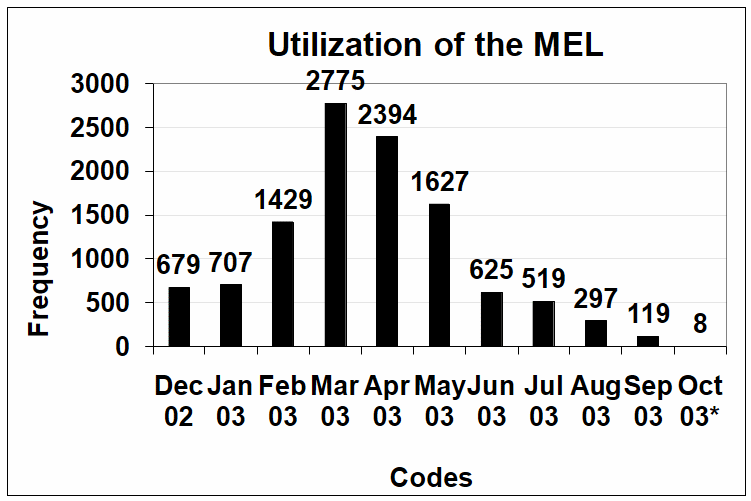
From June to early October 2003, the number of entries entered into the MEL dropped significantly and eventually stopped. This was due to the low operational tempo after major combat operations and the completion of the First Marine Expeditionary Force’s mission. Less monitoring of the network was needed as units were taking down part of their communication assets for redeployment.
Descriptive metrics for the CoP
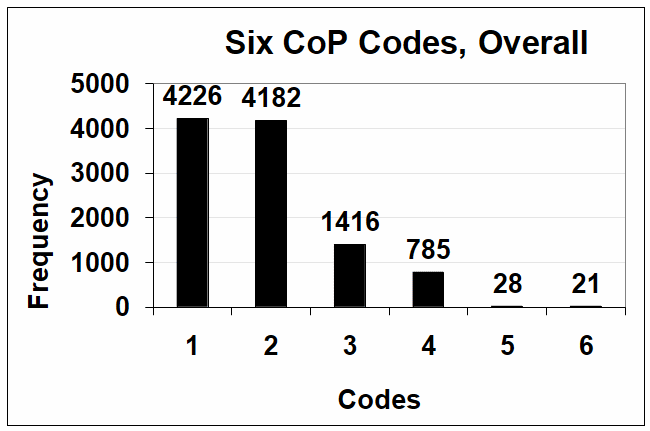
Six codes were utilized in documenting the descriptive metrics associated with a CoP. All six codes were very consistent in there rankings over the five months the MEL was used. Figure 2 is a Pareto chart ranking the frequencies of the six codes over the five months the MEL was used. These codes were ranked in order of frequency and are described below.
1. Dialogue that reflected any reference to the process of problem solving. This includes dialogue reflecting any steps of problem solving. This could be an entry reflecting the occurrence of a problem, or it could be an entry reflecting steps taken to solve the problem, or it could be an entry reflecting the resolution of a problem.
2. Dialogue that reflected past or future communication between two or more users/units via other media outside of the use of the MEL such as: face-to-face, video telephone conference, phone, radio, email, or paper.
3. Dialogue that reflected interactions between two or more users/units.
4. Dialogue that reflected the prompting of action or inaction.
5. Dialogue that reflected disagreement and/or resolution.
6. Dialogue that reflected social references/interactions unrelated to the goal of the MEL.
Overall Metrics for the Community of Practice (CoP)
The frequency of the six types of codes was assembled for the MEL from 3 December 2002 to 1 May 2003, which represents the duration of this case study of the MEL. The largest number of postings, over half, related to problem solving. Similarly the second largest number of postings, again over half of the log entries in the MEL, revealed that there was substantial communication outside of the use of the MEL. For example, a monitor reports that a phone call or an email was received indicating an outage of a particular piece of equipment, this kind of a posting would be coded 2. These two were by far the most common uses of the MEL. The first supports the notion that the MEL created a conduit or virtual forum in which the CoP could troubleshoot, share, and annotate significant problems of the network. These problem-solving entries indicate that users utilized the MEL to help solve problems as they were occurring. The second supports the notion that there were multiple modes of communication available to network monitors. The MEL seemed to be a popular complement for these kinds of communication.
| Code | Percent | Description |
|---|---|---|
| 1 | 52.3 | Dialogue that reflected problem solving steps |
| 2 | 51.8 | Communication outside of the use of the MEL |
| 3 | 17.5 | Interactions between two or more users/units |
| 4 | 9.7 | Dialogue that reflected the prompting of action |
| 5 | .35 | Dialogue that reflected disagreement/resolution |
| 6 | .26 | Dialogue unrelated to the goal of the MEL (social) |
Note. These categories are not mutually exclusive.
The third code was for multiple interactions. This phenomenon was found less frequently. The fourth represented requests of some kind. The fifth indicated a disagreement and the sixth represented socializing. We see that users had relatively few requests, disagreements and socializing. It is safe to say that the practice for this community was simply problem solving and mission oriented.
The MEL was an interface that allowed users to enter and share problems and significant events related to the network as an initial fact-revealing (baseline) communication tool. Once raised through the MEL, these problems and significant events could then be addressed through other media without the use of the MEL.
There were also entries in the MEL that reflected interactions between two or more users/units. These dialogues were important in allocating the correct personnel and resources to the problems. Many of these dialogues pointed people in a direction where they could solve their own problems. This again supports the notion that the MEL offered a focal point where members of the CoP could be linked together. An important characteristic of a CoP is identifying people with knowledge and linking the problem with the people that have the expertise to solve the problem.
Dialogue that reflected the prompting of action/inaction revealed that at times it was appropriate and accepted within the military culture to direct people towards a certain agenda. Log entries revealed these appropriate and accepted forms of dialogues within the CoP.
Interestingly, dialogue reflecting disagreement/resolution and social interactions were not significant in this study. An explanation could be that the military culture of mission first took precedence over the social aspect of a CoP. Furthermore, the military culture is sensitive to language and actions that are outside the scope of the mission. Finally, in late December 2002, the MEL was in mandatory use and the users were now held accountable for their entries.
Metrics for the community of practice (CoP) during major combat operations
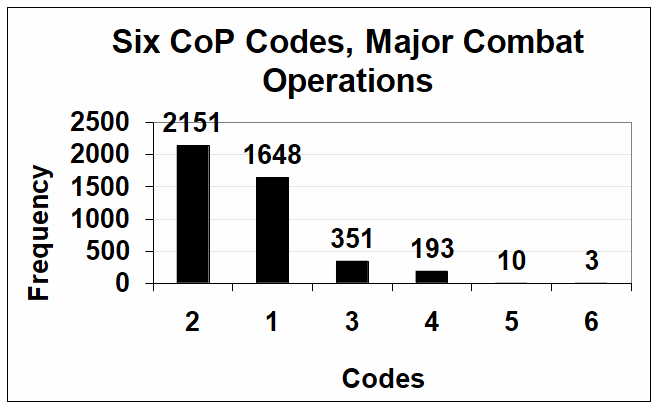
Next, focus was placed on this CoP during a time of stress, namely the period of time for Major Combat Operations for Operation Iraqi Freedom. Figure 3 is a Pareto chart ranking the frequencies of the six codes during major combat operations (3-20-03 thru 5-1-03). Table 2 lists the rankings, percents, and descriptions of the codes for Figure 3. Table 2 reveals that during major combat operations, there was a significant increase in the number of communications that took place outside the use of the MEL. There also was a decreases in the use of the other codes, especially communication associated with problem solving.
| Code | Percent | Description |
|---|---|---|
| 2 | 61.0 | Communication outside of the use of the MEL |
| 1 | 46.7 | Dialogue that reflected problem solving steps |
| 3 | 9.9 | Interactions between two or more users/units |
| 4 | 5.5 | Dialogue that reflected the prompting of action |
| 5 | .28 | Dialogue that reflected disagreement/resolution |
| 6 | .09 | Dialogue unrelated to the goal of the MEL (social) |
Note. These categories are not mutually exclusive.
The decrease in problem solving communication revealed that, under stress, the community did not devote energy in communicating problem solving steps and strategies, rather communication of pertinent information through the MEL and through other modalities. This phenomenon suggests that, under stress, the CoP moved to more streamlined modes of communication with much less time given to reflection.
Metrics of the community of practice (CoP) analyzed over time
The next approach investigated how the forms of communication within the CoP changed over time. Figure 4 is a line chart of the percentages of each CoP code over the five months the MEL was used. Figure 4 shows, except for a slight dip in February, a steady increase in communication especially during major combat operations, outside the use of the MEL. Also, the percentage of problem solving entries increased, declined and then leveled off during major combat operations. This is supported by the log entries. Numerous amounts of troubleshooting dialogue flowed through the MEL. Units getting ready for combat were busy troubleshooting and preparing for the beginning of the war.
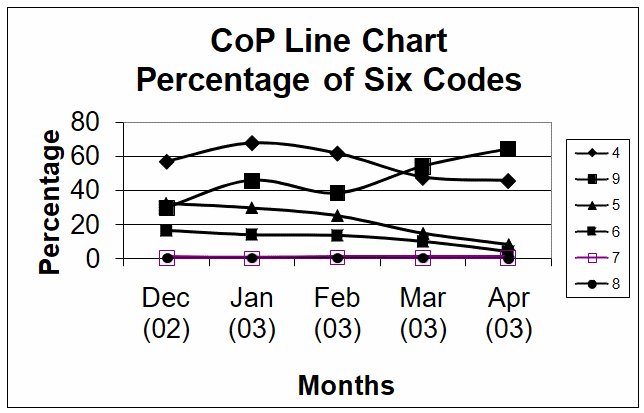
The slight downtrend in all entries between January and February was due to a decrease in operational activity prior to major combat operations. The uptrend in communication outside the MEL between February and April demonstrates the requirement for rapid and proactive network assessment during combat. In other words, the Senior Watch Officer could not wait for a web-based response but most likely called directly via telephone or sent a priority email to determine network status.
Findings
Four major findings came out of the study. First, the CoP utilized the MEL as an initial troubleshooting forum and as a starting point for sharing information and problem solving strategies regarding the operation of the network. Second, the CoP did not display social interactions in the use of the MEL throughout the study. Third, the CoP of users significantly relied on other media outside the use of the MEL, making the MEL one of a number of ways to communicate within the CoP. Fourth, the reliance on other forms of communications increased during the stress of combat operations.
Discussion
The MEL had a significant impact on the community of practice of network monitors. The MEL was originally created to take the place of a logbook-based knowledge management system that offered no proactive ability in readily sharing information. With the use of the logbook, multiple communications were needed to address the needs of the vast communication network. Major Flournoy was a Marine Corps Information Systems Officer in charge of system planning and engineering for voice, video, and data networks for the First Marine Expeditionary Force. He explains, “Although the MEL was originally meant as a way of pushing information to users, it quickly became a real-time conversational tool that increased information flow and situational awareness.” In particular, Major Flournoy explains the benefits of the system:
Two upsides were being able to have one view of the network from anywhere on the battlefield and having a searchable record of significant network events. We knew it was good when we could point people to the webpage [MEL] and after a few minutes of review one would have a good picture of key events that had transpired over the last 24 hours along with a current status of network health.
The MEL also helped the communication between members of the community of practice spread out across the battlefield. Users spent an enormous amount of time reacting to problems in the network through different media. The MEL facilitated the sharing of information critical to their practice. It centralized the community’s need to share current information regarding their practice. Each member of the community, through posting and reading the log, were able to see and share the language associated with their practice. This in turn led to numerous transactions and formation of new information. In sharing their information through the MEL, members of the community of practice solved problems and facilitated the building of trust.
Through the actual use of the MEL webpage, the 8,073 log entries from at least 16 different organizations between 3 December 2002 and 1 May 2003, and the virtual forum created by the utilization of the MEL, allowed the MEL to accomplish its goal of sustaining situational awareness through collaboration of members within a community of practice. Specifically, Major Flournoy explains:
The MEL helped us share a particular problem or a significant event with the entire geographically distributed team instantly. This was much faster and economical (time and manpower wise) than calling each individual on the phone or creating email updates.
The MEL’s virtual forum of annotating significant events and sharing of information in real-time raised the level of shared situational awareness of its users. Major Flournoy explains, “It [MEL] increased their [users’] ability to analyze and correct network problems. I knew from past experience (14 yrs in the Marine Corps) that normal troubleshooting through phone and email are very fragmented and take an excruciatingly long time.” The MEL helped speed up the process of troubleshooting, getting the right people talking to each other, and this in turn helped raise the level of shared situational awareness.
The information in the MEL also flowed horizontally among members of the community of practice. The literature suggests that information flow is critical to producing an effective community of practice. The MEL was heavily used in gaining and disseminating information regarding the situational awareness of the network. Wenger [4] and Hall [8] recommend this kind of information sharing, so that experts and novices collaborate on the practice at hand and learning takes place.
Social interactions (that is, small talk and communication that was not related to the task at hand) were at a minimum. No significant numbers of dialogue depicting informal conversations unrelated to the goal of the MEL were found within the MEL log database. One reason for this may be that the wartime environment in which the monitors were working affected their use of the MEL. Another reason for this may be that the posting of entries to the MEL were seen by all members of the community to include supervisors and subordinates. This may have been the motivation to make sure one’s entries were professional and directly related to the mission. Furthermore, there was a substantial amount of communication, outside the use of the MEL, which may have been a conduit for the informal type of social interaction seen within communities of practice. Since 52% of the MEL database log entries indicated that there was communication through other media outside of the use of the MEL, it may be assumed that some of the informal social interaction was evident through these other media. Wenger [4] states that distributed environments present obstacles to building and sustaining communities of practice. In particular, distributed environments are not conducive to informal networking, but can facilitate a forum for solving problems and talking shop.
In reading the log entries, there was a profound and legitimate concern for how entries were made. The entire database of log entries included pieces of information that should be shared to everyone in the CoP. The log entries had an expository, professional tone, which coupled with a focused and caring audience created accountability and mutual trust for the community. 86% of the log entries were directly related to the sharing of information regarding the maintenance of the network. Moreover, the MEL database of log entries, had several indicators that are associated with the existence of a CoP according to Wenger [4]: shared ways of engaging in doing things together, the rapid flow of information and propagation of innovation, the absence of introductory preambles, as if conversations and interactions were merely the continuation of an ongoing process, very quick setup of a problem to be discussed, knowing what others know, what they can do, and how they can contribute to an enterprise, the ability to assess the appropriateness of actions and products, specific tools, representations, and other artifacts, jargon and shortcuts to communication as well as the ease of producing new ones, a shared discourse reflecting a certain perspective on the world.
The users of the MEL were driven to succeed in their practice or mission. As a result, the database analysis showed that there was very little informal socialization. This was because all the members of the community were focused on the mission of keeping the network working. It was with this focus on their domain of knowledge that negated the redundancy and time consumption of sharing information and miscommunication that occurred before the utilization of the MEL. This community weaved together successfully as a result of the dovetailing between the domain of knowledge, the practice/mission, and the desire of its members to be successful in their CoP. The MEL performed as a conduit between these ingredients and helped the CoP share information in a timelier manner.
While this community was unique and separated by considerable geographic hurdles, the findings here show that the theoretical framework of communities of practice can be applied to this situation.
References
[1] R. Caro., J. Quinn, and M. Flournoy, “A Case Study: Flattening the Battlefield through a C4 Knowledge Management System”, Journal of Battlefield Technology, Vol 10, No 2, Jul 2007, pp. 21−27.
[2] E. Wenger, R. McDermott, and W. Snyder, M. Cultivating Communities of Practice, Harvard Business School Press, Boston, MA, 2002.
[3] F. Hasanali, , C. Hubert, , K. Lopez, , B. Newhouse, , C. O'Dell, , and W. Vestal, Communities of Practice: A Guide for Your Journey to Knowledge Management Best Practices, American Productivity & Quality Center, Houston, TX, 2002.
[4] E. Wenger, Communities of Practice: Learning, Meaning, and Identity, Cambridge University Press, New York 1998.
[5] T. Friedman, The World is Flat: A Brief History of the Twenty-first Century, Farrar, Straus and Giroux, New York, 2006.
[6] P. Kilner, “Transforming Army Learning Through Communities of Practice”, Military Review, May-June 2002, pp. 21−27.
[7] C. Daniels, D. Grove, and E. Mundt, “Command and Communities of Practice”, Air and Space Power Journal, Winter 2006, pp. 52−62.
[8] W. Hall, Stray Voltage: War in the Information Age, Naval Institute Press, Annapolis, MD, 2003.
[9] P. Rubens, “Army Tactics are the Business: Peer-to-Peer Computing: Businesses that Adopt 'Swarming' Can Imitate the Military and Avoid Management Over-Control”, Financial Times (London England). Retrieved February 6, 2008, from http://news.ft.com/home/uk, 2003, November 26.
[10] M. Goodale, Assessing Cultural Impact: A Case Study in Supporting a Knowledge Management Practice. Dissertation Abstracts International, 62 (12), 4025. (UMI No. 3036795) 2001.
[11] A. Raven, Knowledge Management for New Product Development Meetings: The Roles of Information Technology in Shared Knowledge Creation, Dissertation Abstracts International, 61 (09), 3654. (UMI No. 9987653). 1999.
[12] K. Stalder, Statement by Major General Stalder United States Marine Corps Deputy Commanding General for I MEF-before the House Armed Services Committee Subcommittee on Terrorism, Unconventional Treats and Capabilities-on October 21, 2003-Concerning I MEF C4I during Operation Iraqi Freedom. Retrieved February 6, 2008, from http://www.iwar.org.uk/rma /resources/c4i-interoperability/ 03-10-21-stalder.htm, 2003.