
Volume 11, Number 2, July 2008
Sharing Detections Among Networked Sonars—a Practical Way Forward For Anti-Submarine Warfare?
- 1 Maritime Operations Division, Defence Science and Technology Organisation, P.O. Box 1500, Edinburgh SA 5111, Australia.
Abstract
This paper presents an initial quantitative analysis of the extent to which networking multiple-monostatic active sonar systems can improve performance in detecting submarines. The improvement mechanism explored is the sharing of data on detections, with tracking being performed centrally. Our analysis indicates the conditions under which the improvement should be present and provides an estimate of its magnitude. This is achieved by focusing on the step of centralised track initiation, using sonar coverage area as the metric. We identify situations where coverage area at the 95% level can be more than a factor of 10 larger with centralised tracking compared with tracking by individual sonars. This is achieved solely by sharing detections, without any other modifications to the submarine kill chain. The results show that a 30% detection probability (P ) can be tactically useful provided that there are other sonars with a similar P for the target of interest that share information on detections. This result may provide a practical way around the great and continuing difficulty of obtaining acceptably high P values at tactically significant
Introduction—the ASW problem
Hypothesis and concept
We take the sonar mode as multiple monostatic active. Active sonar has a larger detection range against modern submarines than passive. Multistatic operation will probably give greater networking benefit than is revealed below, but we wish to highlight the size of the networking benefit even when operating multiple monostatic.
A first indication of advantage
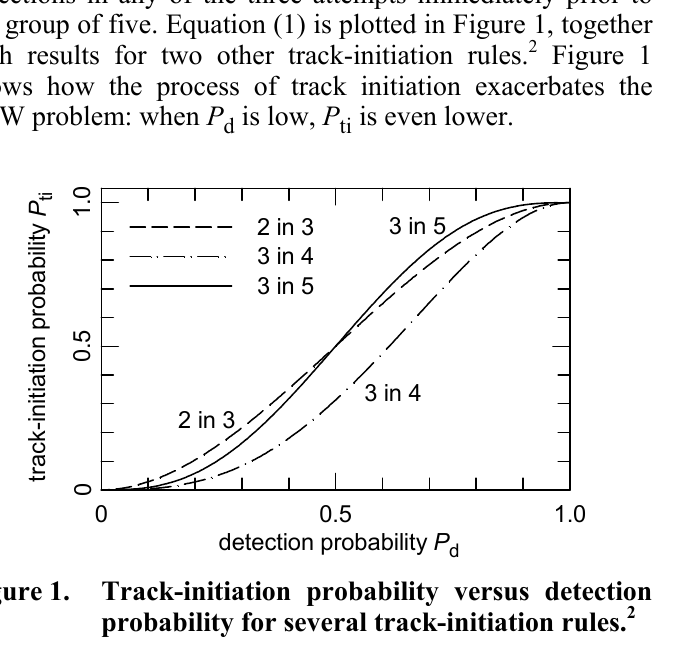
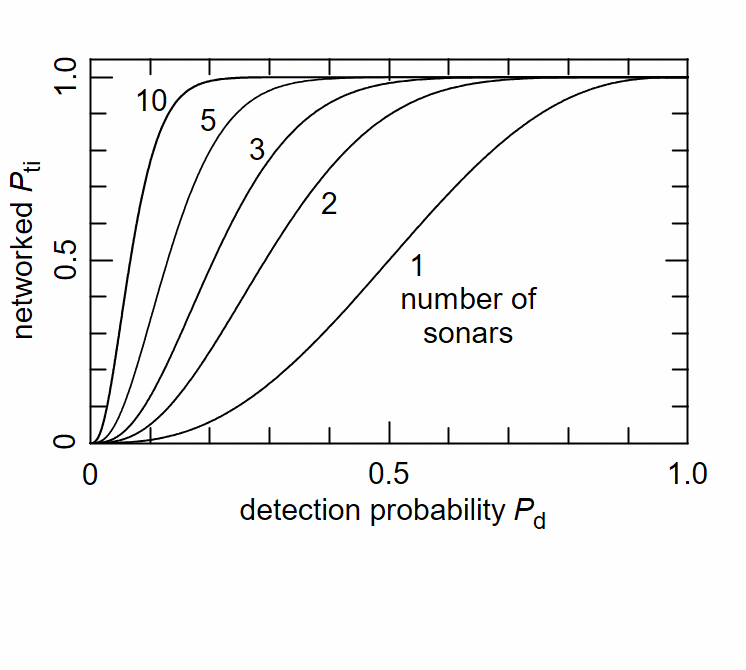
Tracks are typically initiated according to a rule of the form: ‘start a track if a contact is detected three or more times in five consecutive attempts’. If the detection probability P is known, then the track-initiation probability P is given by combinatorics and the usual rules for combining probabilities. For the three-in-five rule, the relationship is:2 P = P 3 ( 10 −15P + 6P 2 ) (1) ti d d d This is the probability that a track is initiated in any group of five consecutive attempts, provided that there were no detections in any of the three attempts immediately prior to the group of five. Equation (1) is plotted in Figure 1, together with results for two other track-initiation rules.2 Figure 1 shows how the process of track initiation exacerbates the ASW problem: when P is low, P is even lower. d ti Now suppose that several sonars are deployed, and that these pool their detections for the purpose of tracking. The result is shown in Figure 2 for the three-in-five rule and with the assumption that all sonars have the same value of P [6].
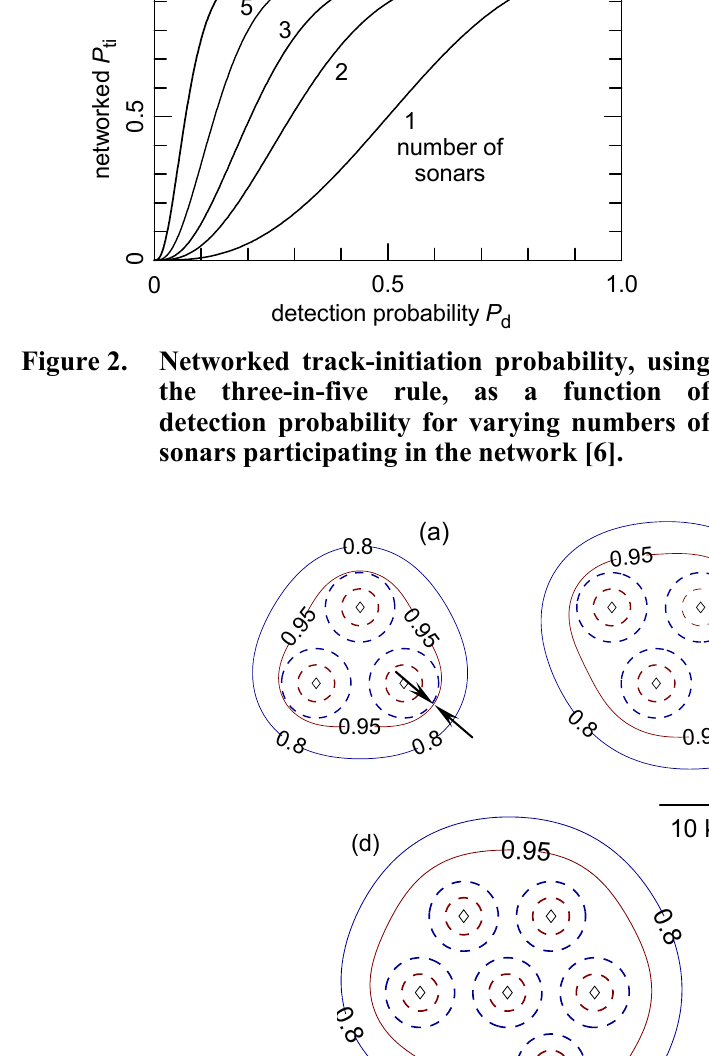
The key feature of Figure 2 is the manner in which networked P can attain large values at quite low detection probabilities. It is plain that a P value as low as 0.3 can be very useful in a networking context. Figure 2 also shows the significant gain available from networking as few as two sonars together. The greatest gain per added node is obtained with the mere establishment of the network.
The analysis depicted in Figure 2 is suggestive, but the assumption of equal P for all contributing sonars is so unrealistic that it must be dropped if networked track-initiation probability is to be turned into a useful metric. This is the subject of the next section.
The next level of analysis
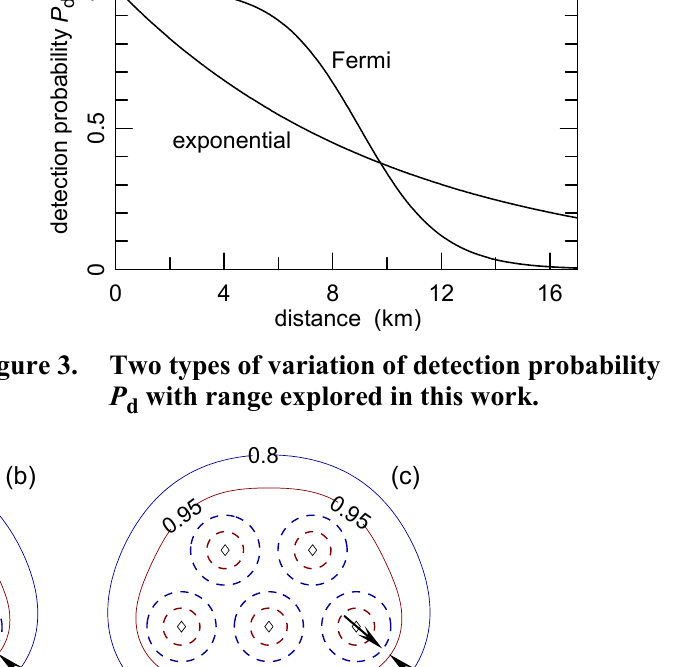
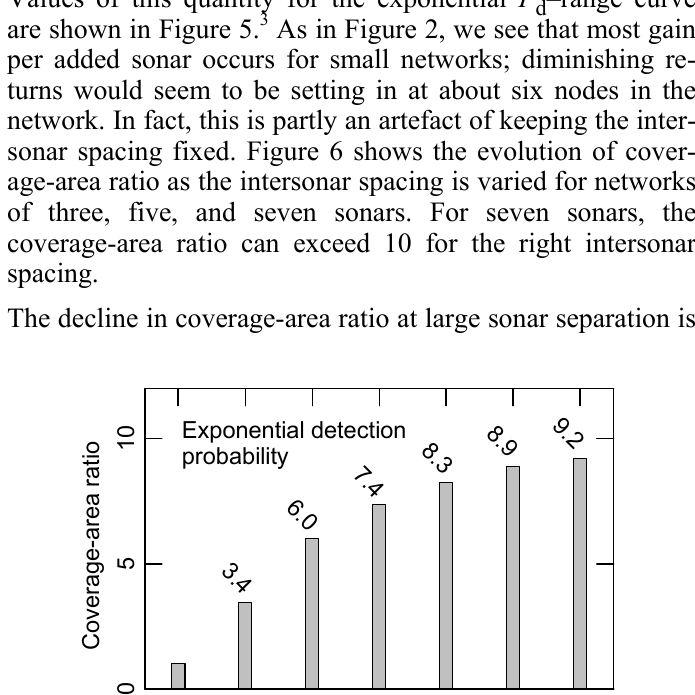
To go beyond the assumption of equal detection probability, we must specify the dependence of P on range and the disposition of the sonar systems that contribute to the network. One of the difficulties in undertaking sonar analysis is the complexity of the sonar detection curves for real sonar systems, which are normally very complicated, often with P varying non-monotonically with range. Details of the range dependence are heavily dependent on environmental conditions, which fluctuate in time, and also on the settings of the individual sonar processors. To isolate the key features of the range dependence that impact on networking benefit, we selected two representative P vs range curves, shown in Figure 3, that capture important characteristics of real P curves. The exponential curve has the feature of a low-P tail stretching out to large range, whereas the Fermi curve shows a sharper cut off, without being as extreme in this regard as the definite-range law (“cookie cutter” shape). As to sonar disposition, we arrange them close-packed on an equilateral-triangular grid with intersonar spacing of 10 km. Figure 4 shows the arrangement for networks of three to seven sonars. The pattern is similar to how sonobuoys might be deployed, but our analysis applies to any type of sonar. The choice of 10 km intersonar spacing is schematic. It should be compared with the range at which P has fallen to 50%, which is 6.9 km for the exponential characteristic and 9.0 km for the Fermi. In the following analysis, all sonars are taken to have the same dependence of P on range, either exponential or Fermi. Results with Exponential P Figure 4 also shows contours of track-initiation probability P calculated using the exponential curve in Figure 3. Full lines show contours for centralised tracking using pooled detections; broken lines show the contours obtained when each sonar conducts tracking independently using its own detections. A key point concerns the relative sizes of the singlesonar and networked contours: the arrows in Figure 4 highlight how the 95% networked contour almost coincides with the 80% single-sonar contour in the three-sonar case, but lies well outside it in the five-sonar case. This is suggestive of the non-linear networking gain promised by some proponents of NCW.
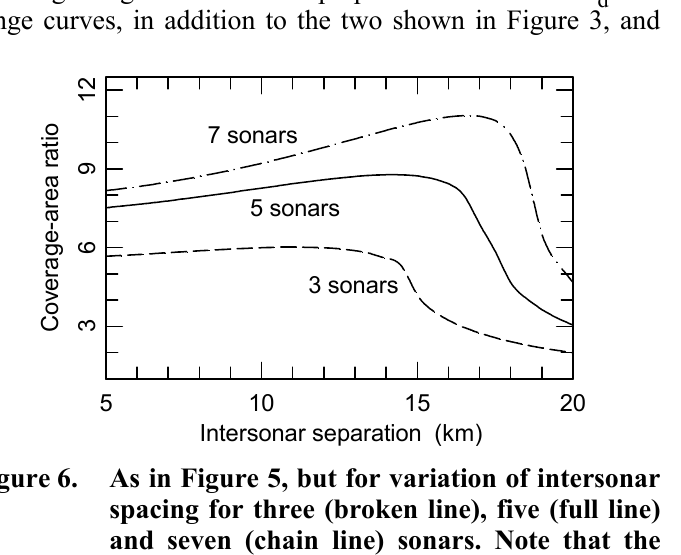
The degree of networking benefit can be quantified by “coverage area ratio”, which we define as: coverage area ratio = area enclosed by 95% networked P contour (2) net area enclosed by 95% single-sonar P contours Values of this quantity for the exponential P –range curve related to the break-up of the networked contour into disconnected pieces as the sonars are moved further apart [6]. At very large separations, coverage-area ratio approaches unity, which means zero networking benefit. Results with Fermi P Although some sonar systems have a P characteristic with features similar to the exponential, others have a much sharper cut-off at a certain range. To explore the extent to which the networking advantage shown in Figures 4–6 arises from the long low-probability tail of the exponential shape, this subsection repeats the calculation with a Fermi shape for P .
The Fermi P -vs-range curve shown in Figure 3 gives, for five sonars, the coverage diagram shown in Figure 7. Here, only a small additional coverage area is produced by sharing detections. It is clear that, in the extreme case of a definiterange law (‘cookie-cutter’, where P equals unity at close range and falls abruptly to zero at the detection range), there is no possible benefit, as regards track initiation, to be obtained from sharing detectionsions,.
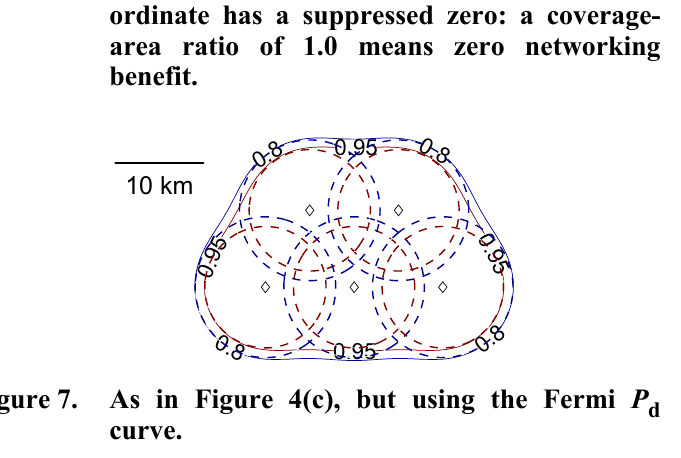
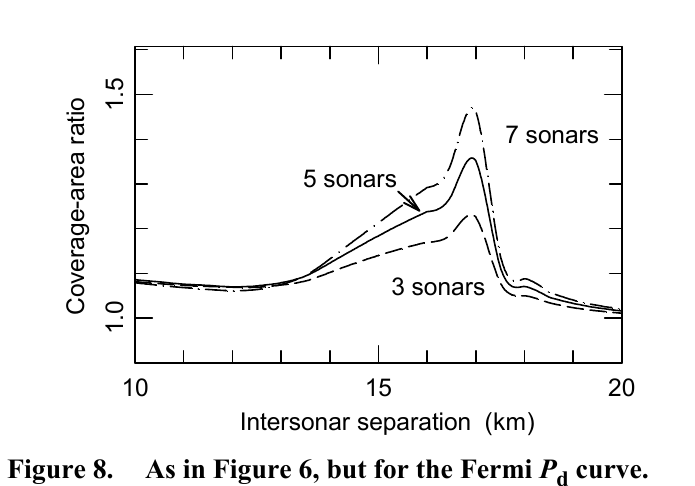
Figure 8 shows the effect of varying intersonar spacing. The minimum near 12 km separation is related to the sonar spacing beyond which there is no simultaneous overlap of three single-sonar 95% P contours. It is remarkable that, near this minimum, there can be a networking penalty rather than an advantage: the coverage-area ratio decreases (albeit it only slightly) in moving from five to seven sonars. also for complex realistic curves that have significant levels of non-monotonic behaviour [6]. Other metrics have also been explored [6], including metrics based on lineal rather than areal measures, which may be appropriate for scenarios involving a transiting task group. The other metrics tell essentially the same story as coverage-area ratio, though there are variations in the details of the relative behaviour with number of sonars and P -curve type.
Discussion
Assumptions Many of the assumptions of this analysis are listed, discussed and, in some cases, explored quantitatively elsewhere [6]. This subsection briefly considers four of the most important of them. False-Alarm Rate Perhaps the most significant of the assumptions is the setting aside of consideration of false-alarm rate. In the simplest implementation of the concept analysed here, detections are fused using the equivalent of a logical “or” rule: only one sonar need report a detection at a particular location for it to be passed to the centralised tracker. Other fusion rules are well known (e.g. [2,7,8]), but it is unclear how practical they are in the context of sonar [6]. The use of “or” fusion means that, if the network comprises m sonars all with the same false-alarm rate, then the field false-alarm rate is m times the single-sonar rate.
According to the standard engineering model of detection (e.g. §12.1–4 in [9]), a threshold is chosen that trades off false-alarm rate against detection probability. Suppose that this trade-off is conducted in the normal manner, and that the operator has selected a detection threshold to give a falsealarm rate with which he or she is comfortable.
The detection probability is thereby set and detections occur. This is the point of departure of our analysis, with Figure 3 representing possible types of resulting P curves. That is, we assume that every step in the ASW process up to and including detection remains as currently performed. Our focus is to explore the questions: What happens to a detection once it is made? Do sonar operators post it on the network immediately, or do they keep it to themselves and wait for three detections in five consecutive ensonifications before posting it? The argument leading from Figure 3 to Figures 4–8 assumes that thresholds are not altered from their platform-centric settings when detections are passed over a network for centralised tracking. This is plausible with automated detection and tracking, since the number m of networked sonars is unlikely in the foreseeable future to be more than a few tens at the very most (in the Australian context).
However, with a manual system, one may ask whether the operator performing the centralised tracking role would be willing to tolerate a false-alarm rate that is m times the rate from a single sonar. If the tracking operator is unable to cope with this and responds by asking individual sonar operators to raise their detection thresholds, then the individual P values in the networked case will be lower than in the single-sonar-tracking case, so reducing the coverage area ratio. That is, the networking advantage would be reduced. We show elsewhere how this situation can be analysed quantitatively [6]. “Instantaneous” versus “Cumulative” Probabilities The “detection probability” used in this paper is a probability per ensonification, and the track-initiation probability is per group of five consecutive ensonifications. These quantities are sometimes termed “instantaneous” probabilities, since they refer to relatively short intervals of time. However a target may be detectable for much longer than the time required for five ensonifications. If a track is not initiated by the fifth ensonification, perhaps the sixth will be sufficient; if not, perhaps the seventh will do it, and so on. A quantitative analysis of this concept is presented elsewhere [6]. Taken to the extreme, it leads to a cumulative probability that approaches unity as the number of ensonifications taken into account increases. Such a metric is only useful, if useful at all, for a scenario that is completely static.
Identifying the most appropriate measure of effectiveness in search problems like ASW remains an open question. The issue is the extent to which instantaneous probabilities should be accumulated. This inevitably depends on the nature of the mission and the response envisaged by the concept of operations (CONOPS). For example, a transiting task group may plan to avoid submarines rather than engaging them. In such a case, accurate localisation is less important than when the CONOPS calls for engagement. Low false-alarm rate is very important, however, so that the task group is not induced to take large unnecessary detours.
However, whatever measure of effectiveness (MOE) is used, it will be composed of “instantaneous” probabilities, so these stand as surrogate MOEs. It is therefore plausible that a comparison between instantaneous probabilities will give similar results to comparisons between more sophisticated MOEs. Monostatic versus Multistatic Processing To align our analysis with present operational practice, we assume multiple monostatic processing, in which each sonar responds only to returns from its own ensonifications.
It is likely that further networking benefit, in terms of increased coverage area, could be gained by multistatic processing, that is, by having sonars process returns from any ensonification, regardless of its source. However, if the sonar field consists of co-located sources and receivers, then it is clear that successful multistatic processing also requires a detection probability curve with an extended region where P ~ 0.3, like the exponential shape; in this case a ‘cookie-cutter’ P curve is of no more use for multistatic processing than it is for a networked monostatic system. Implications for Networking Benefit The contrast between Figures 4 and 7 indicates the conditions required to obtain benefit from sharing detections and centralising tracking. It is the low-probability tail of the exponential shape that creates the opportunity for networking advantage, through the combination of low-probability regions from several sensors. If the P curve has a sharp cut-off, with values close to 100% at short range, then the gain in coverage area is smaller, reducing to zero for a definite-range law. This result, however, depends on the P inside the detection range being 100%. If the value is lower, then the possibility re-emerges of gain in coverage area from sharing information on detections. For example, if P = 80% inside the detection range, then the single-sonar P does not reach 95% anywhere (for the three-in-five rule), but geometrical arrangements of several sonars can be found for which the networked P exceeds 95% over a sizeable area [6].
Even when P has a favourable range dependence, the magnitude of the networking benefit depends critically on the layout of the sonar field, as Figures 6 and 8 show. This sensitivity to details of the sonar disposition reflects a general feature of NCW, in our view. Networking has the potential to enhance operational flexibility and capability, but the price is additional design complexity. In the present examples, the wrong choice of intersonar spacing can negate networking benefit. In the worst case, it can even lead to performance degrading as the size of the network is increased.4 It indicates the severity of the potential performance decrement with a poor choice of CONOPS in a networked environment.
Much of the existing analysis concerning network-centric warfare (NCW) has been concerned with the operational and strategic warfare levels, with a focus on sharing and fusing tactical pictures from a variety of platforms, and providing force-wide access to reachback information. This concept focuses on a view that the chief gain to be obtained from NCW is the building and wide dissemination of a timely common relevant operating picture (CROP). Quantitative analysis of the higher levels of warfare is difficult, which may explain why there are so few studies exploring the benefits of NCW quantitatively. The present work gives a quantitative indication that NCW should be able to produce benefits at the tactical level also. Further Work Operations analysis is sometimes seen as a “layered” activity (e.g. [11]), where the early layers of a study involve significant assumptions and are used to indicate the validity of a concept. From this point of view, the present work comprises the first two layers in the evaluation of the potential benefits 4 It is true that the example of this presented above (the behaviour near 12 km intersonar separation in Figure 8) is very small, but it serves to show that one cannot assume that networking is only either beneficial or neutral to force effectiveness; and it would be unwise to infer from this one example that any networking decrement encountered will be small. Porsche and Wilson present another examavailable from sharing detections in a sensor network. Figure 2 is the outcome of the first layer: the level of assumption is extreme, but the result suggests that the concept may have potential. This impression survives the second layer of analysis in the form of Figures 6 and 8, which justifies proceeding further. Perhaps the assumption most demanding attention next concerns false alarms. We are in the process of exploring this by way of a MATLAB simulation in which false alarms are explicitly included. If this continues to indicate that the concept has merit, then it may be justified to expend the effort needed to conduct a study with a constructive simulation like JSAF [12]. The final layers of the study would involve sea trials, first with an experimental vessel, and finally with actual military equipment.
Conclusion
This paper presents a quantitative investigation of a mechanism for networking advantage in anti-submarine warfare (ASW). The mechanism consists of sharing pre-track-level data at the level of single detections, with a centralised tracking processor for the overall system, as opposed to each sonar system performing tracking on its own detections only and then sharing the track information. We focus on the step of track initiation, in particular the probability P that a track is initiated after five ensonifications from each sonar. As a metric for the magnitude of the networking benefit, we use the area enclosed by the 95% contour of P (‘coverage area’).
The results depend on the behaviour of detection probability P for each individual sonar system. If P rolls off slowly d d with range, then there is considerable advantage in sharing detections and performing tracking centrally (Figures 4–6); for five sonars each with exponentially shaped P curves, the coverage area is over eight times larger with centralised tracking than with individual tracking. This gain in coverage area is obtained with no changes to individual sonar performance: all steps up to the recognition of a contact are the same with both concepts of operation; the difference lies in how detections, once made, are handled.
An important consequence of the existence of networking benefit can be succinctly stated as:
• A 30% detection probability can be very useful in ASW; it can be made so by sharing detection-level data with neighbouring sonars that have similar P values for the target concerned.
This finding would seem to provide a practical way around the great and continuing difficulty in obtaining acceptably high P values at tactically useful distances from a single sonar. Further, it should be possible to obtain the improved performance with only relatively minor alterations to existing sonar systems.
References
[1] J.A. Roecker and C.D. McGillem, “Comparison of Two-Sensor Tracking Methods Based on State Vector Fusion and Measurement Fusion”, IEEE Transactions on Aerospace and Electronic Systems, Vol. 24, No. 4, July 1988, pp. 447–449.
[2] A. Ashraf Mambouh, “Multiple-Sensor Distributed Detection Systems with Data Fusion”, Proceedings of the 13th International Conference on Digital Signal Processing, 1997, pp. 1031–1034.
[3] H. Chen. T. Kirubarajan and Y. Bar-Shalom, “Comparison of Centralised and Distributed Tracking Algorithms using Air to Air Scenarios”, Proceedings of SPIE, Vol. 4048, 2000, pp. 440–451.
[4] H. Chen. T. Kirubarajan and Y. Bar-Shalom, “Performance Limits of Track-to-Track Fusion Versus Centralised Estimation: Theory and Application”, IEEE Transactions on Aerospace and Electronic Systems, Vol. 39, No. 2, April 2003, pp. 386–400.
[5] S. Coraluppi, “Analysis of Tracker Performance Models for Centralized and Distributed Tracking’, Proceedings of the 7th International. Conference on Information Fusion, 2005, pp. 1404–1411.
[6] M.P. Fewell, J.M. Thredgold and D.J. Kershaw, “Benefits of Sharing Detections for Networked Track Initiation in Anti-Submarine Warfare”, technical report DSTO-TR-2086 of the Defence Science and Technology Organisation, Jan. 2008.
[7] Z. Chair & P.K. Varshney, “Optimal Data Fusion in Multiple Sensor Detection Systems”, IEEE Transactions on Aerospace and Electronic Systems, Vol. AES-22, No. 1, Jan. 1986, pp. 98–101.
[8] S.C.A. Thomopoulos, R. Viswanathan & D.C. Bougoulias “Optimal Decision Fusion in Multiple Sensor Systems”, IEEE Transactions on Aerospace and Electronic Systems, Vol. AES-23, No. 5, Sept. 1987, pp. 644–653.
[9] R.J. Urick, Principles of Underwater Sound, 3rd edn, McGraw Hill, New York, 1983.
[10] I.R Porsche III & B. Wilson, “The Impact of Network Performance on Warfighter Effectiveness”, technical report of the RAND Arroyo Centre, 2006.
[11] M.G. Hazen, L. Booth, C. Davis, D. Gamble and T. Mansell, “The Place of Virtual Environments in a Layered Approach to OR Analysis: a Naval Perspective”, Proceedings of the 16th National Conference of the Australian Society for Operations Research, Sept. 2001.
[12] “Joint Semi-Automated Forces”, <www.jfcom.mil/about/fact_ jsaf.html>.