
Volume 11, Number 2, July 2008
Dynamic Analysis Of The Brigade Combat Team’s C2 Architecture
- 1 Department of Systems Engineering, United States Military Academy, West Point, NY 10997.
- 2 Massachusetts Institute of Technology, 77 Mass Ave, NE20-388, Cambridge, MA 02139.
Abstract
The current revolution in military affairs is centred largely on the integration of new information technologies into traditional military command and control (C2) structures. While many military leaders report that new information “tools” such as the U.S. Army’s Battle Command System (ABCS) give them an unprecedented level of situational awareness, others assert that the integration of this new digital technology comes with some unintended consequences that in some cases actually slows information flow. We studied the brigade combat team (BCT) with specific emphasis on the brigade’s ability to disseminate and process information within and between command posts, using system dynamics as a modelling tool to help to understand better the impact of various policy decisions. Our study concluded with five heuristics that could potentially have profound implications for future C2 architectures.
Introduction
As the US Army conducts transformation in the midst of an ongoing information-driven Revolution in Military Affairs (RMA) and the War on Terror, there has been an increasing emphasis placed on the need to develop leaner, more agile, versatile, and deployable forces. Much of this initial effort has focused on improving the “tooth-to-tail” ratio of Army forces and transferring from a Cold War “divisional” force structure to one focused around more deployable and sustainable brigade combat teams (BCTs). Ironically, this transformation to what is supposed to become a more lean and deployable force structure has produced larger and more heavily staffed battalion, brigade, and division command posts. Despite introduction of the Army Battle Command System (ABCS), a system of digital systems that are intended to help speed up the Army’s ability to transfer information, improve situational awareness, make decisions, and manoeuvre on the battlefield, in some aspects the Army may have actually taken a step backwards.
Unfortunately, these larger command posts are becoming more hierarchical and bureaucratic, and are often decreasing the Army’s ability to get ahead of the enemy’s decision cycle. Our research focused on the battalion tactical operations centre (TOC) and its interaction with its higher and subordinate headquarters within the BCT.
Background and context
In creating modular BCTs, Army leaders hope to create lighter, more deployable, and logistically sustainable units that can deploy anywhere around the world and conduct full-spectrum operations. The linchpin to the BCT’s operational concept is a family of digital information systems, similar to the ABCS, which is being developed and integrated into the BCT using a spiral development and integration model. Nevertheless, despite these new digital information tools, the BCT’s hierarchical C2 architecture and battalion TOC layout has not changed significantly from the traditional configuration. What has changed, however, is the size of the TOC and the amount of communications and computer equipment as well as personnel needed to operate this equipment; thus increasing the size of command posts tremendously.
Much of the focus in creation of the BCT, as well as discussion found among various authors within NCW and Effects Based Operations (EBO) literature, is centred on how new digital systems such as the ABCS will affect the interconnectivity and command relationships between units[1]. Central to this debate is discussion over whether a centralized or distributed (sometimes called network) command structure is optimal. To date, there have not been any revolutionary changes to the BCT’s C2 structure; other than that they are becoming larger and the time to transfer information between hierarchical levels within the brigade organization is often taking longer than desired.
System dynamics modelling
After conducting an extensive literature review and interviews with Army officers who have served at all levels in Iraq and Afghanistan, we began the modelling process. First we developed a conceptual system dynamics model and then a mathematical model that we could use to conduct simulations to see what might be learned about the system [2]. The conceptual model for this study is in Figure 1.
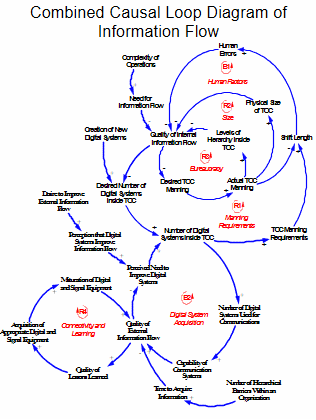
The system dynamics model in Figure 1 includes feedback loops that affect both internal and external command post communications. In our model, internal information flow measures how well a command post transfers data into information and shares information between combat functions inside the command post. In contrast, external information flow measures how well information (not data) is transferred between command posts.
Simulation results
After formulating our system dynamics model for this study, we then conducted a number of simulations to see what further insights could be learned from the model. We used a combination of both “one variable at a time” testing as well as using various arrays. In this short paper, we only cover the findings that were discovered from the “one variable at a time” approach; however, the simulations using arrays also corroborated our findings discussed below [3].
Impact of increasing complexity of operations on information flow
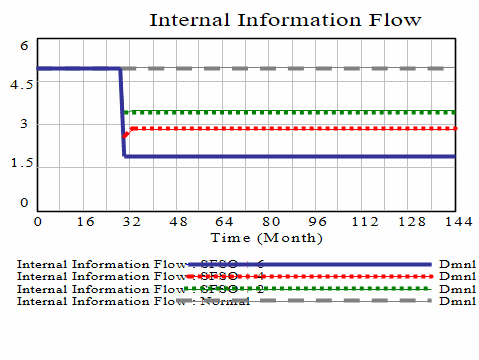
The first simulations that we conducted looked at the impact that increasing Complexity of Operations has on both Internal and External Information Flow. We called this variable Simultaneous Full Spectrum Operations (SFSO). SFSO measured the additional functional areas that are needed inside the TOC as mission sets become more diverse (that is, when Army units are expected to conduct multiple operations simultaneously as has been the case in Iraq and Afghanistan). The model considers a value of four additional functional areas to be normal. Experimental trials were conducted by raising the value of SFSO by 2 at a time for a total value of six, eight, and ten additional functional areas inside the TOC (the baseline functional areas considered are Operations, Intelligence, and Fire Support). Additional functional areas are considered to be specialties such as Civil Affairs, Psychological Operations (PSYOPS), Air Defence, Aviation, Information Operations, and Police Liaison Officers, Reconstruction Teams. The exogenous variable was changed at time = 30 months in the simulation. Figure 2 depicts the fairly significant negative impact that an increase in SFSO (or Operational Complexity) has on internal information flow and the lesser but not insignificant impact that SFSO has on external information flow.
Impact of increasing number of digital systems on information flow
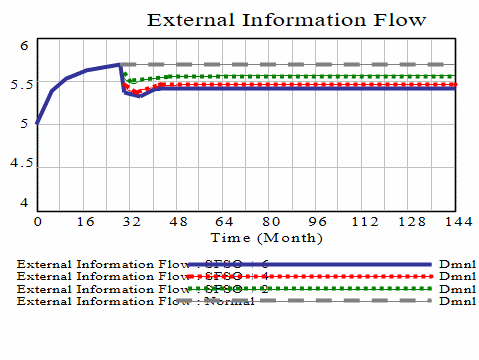
The next four simulations were conducted by manipulating the exogenous variable New Digital System Development. Increasing the New Digital System Development increases the Creation of New Digital Systems which increases the Digital Systems on the Market. In short, these variables represent the creation of new digital systems produced by both private and government industries. The model considers a value of zero to be normal, therefore representing the situation prior to 1995 when early digitalization of battalion TOCs began (note: the time horizon for the simulation is 12 years, thus simulating the time period from 1995 to 2007). Experimental trials were conducted by raising the value of New Digital System Development from zero, to one new system every six months, then to one new system every two months, and finally to one new system per month. Once again, the exogenous variable was changed at 30 months. Figure 3 shows the impact that increasing Digital Systems on the Market has on the system. As the graphs indicate, increased Digital Systems on the Market produces a significant decrease in Internal Information Flow and a very modest decrease in External Information Flow. This occurs because as more systems become available on the market and appear attractive for TOC use, more systems are purchased by the Army and added to the command post. This results in more personnel manning the TOC, and therefore increased bureaucracy and levels of command hierarchy inside the TOC.
Impact of number of hierarchical barriers on internal and external information flow
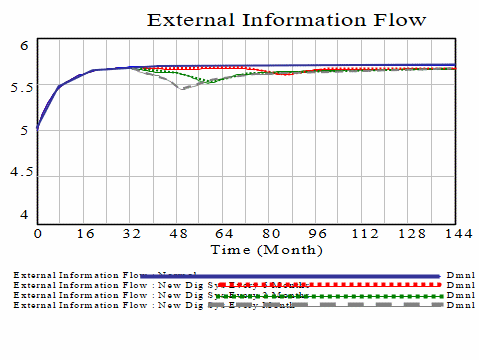
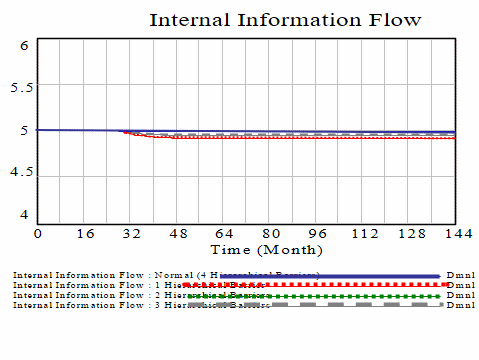
The next four simulations were conducted by manipulating the exogenous variable Number of Hierarchical Barriers. In short, this variable measures the number of hierarchical barriers involved with transmission of information between TOCs or between C2 nodes. For example, it is not normal practice for Army units to share information laterally, which places hierarchical barriers to information flow on the system. In the model, a value of four hierarchical barriers is normal. At the tactical level where platoons are the primary units of manoeuvre, these barriers are at company, battalion, brigade, and division levels. Simulations were conducted by decreasing the value of Number of Hierarchical Barriers from 4 to 3, then to 2 and 1. What this represents is moving from a stove-piped hierarchical reporting system to where information is shared laterally throughout the network of C2 nodes. The following graphs show the impact of changing the Number of Hierarchical Barriers on the system. The exogenous variable was changed at time = 30 months or t = 30. Figure 4 shows the impact that decreasing the Number of Hierarchical Barriers has on the system. As the graphs show, decreased Number of Hierarchical Barriers has an almost insignificant impact on Internal Information Flow, but has a tremendously positive impact on External Information Flow. Decreasing the Number of Hierarchical Barriers between command posts has little impact on internal information flow because it does not directly impact communication within command posts, but rather communication between command posts. This concept is different than the increased hierarchy within command posts caused by excessive TOC manning that was discussed previously.
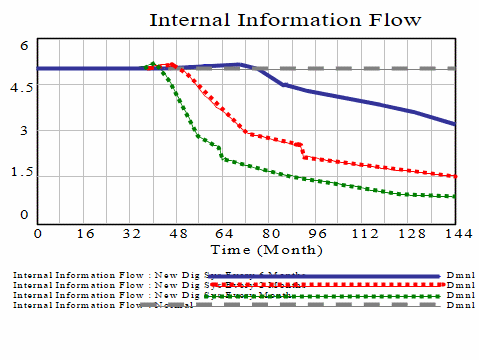
On the other hand, decreasing the Number of Hierarchical Barriers between command posts has a tremendously positive impact on increasing communication between command posts (external communication) because it allows information to be shared simultaneously among many units. The fewer the barriers, the more information that can be shared. This concept is explained by Metcalfe's Law which states that each node in a network is capable of creating N-1 interactions, and therefore increasing the number of nodes in a network increases the power of communication (external information flow) [4]. The power behind Metcalfe's Law can only be harnessed, however, once external hierarchical barriers have been eliminated. This accounts for the unintuitive behaviour seen in Figure 4 where information flow appears to increase linearly when barriers are reduced from 4 to 2 barriers, but exponentially when barriers are decreased from 2 to 1. A second factor that accounts for this unintuitive behaviour is the non-linear feedback involved throughout the system, which further amplifies the power of Metcalfe's Law.
Heuristics
The following five heuristics result from the synthesis of material discussed in both the literature review of our original study and findings from our analysis using the system dynamics model in Figure 1. These heuristics are intended to provide a concept for future design improvements of the BCT C2 architecture and the battalion TOC. While they do not completely support all tenets of current NCW theory, they do clearly support the majority, while also providing guidance to help avoid some of the potential pitfalls of NCW theory.
1) a flatter C2 architecture will lead to improved quality and timeliness of information flow.
This is clearly supported by both the findings of our system dynamics simulations (as seen in Figure 4), current NCW literature, as well as interviews with current US Army officers. This requires elimination of the stove-piped C2 structure, focusing on lateral reporting and transmittal of intelligence across the organization in lieu of stove-piped vertical reporting. It also includes a change from “push” to “pull” information flow. Figures 5 and 6 provide a visual depiction of this heuristic.
2) switching the locus of power control (the level at which critical decisions are made) by distributing authority within the organization will enable a flatter C2 architecture, enhance information flow between units, and improve decision making.
As evidenced by the latest conflicts such as Bosnia, Iraq, Afghanistan and even largely in Vietnam, platoons and companies are now the major manoeuvre units in battle. This means that perhaps more than ever before, lieutenants and captains are in critical positions on the battlefield where their decisions often have operational and sometimes strategic implications. New digital C2 capabilities give these platoons and companies an unprecedented real-time view of the battlefield and therefore an improved ability to make decisions while understanding the larger context. In order to expand the locus of power control, thereby empowering commanders at lower levels with increasing authority to make critical decisions, cultural change is required.
Currently, the Army’s least experienced people (lieutenants with no experience and captains with normally less than seven years experience) command these “edge” organizations [5]. In order to effectively transfer decision-making ability from centralized to distributed control, the Army should consider placing more experienced people in these positions (that is, senior lieutenants and junior captains with three to six years experience as platoon leaders and senior captains or junior majors with eight to twelve years experience as company commanders). This would require changes to the entire Army personnel manning system and therefore much study would be needed to determine how to best implement this system. But in the context of the contemporary operating environment and the information revolution, it no longer appears optimal to have the most-experienced people staffing brigade headquarters and above, while the least-experienced people are in a position to make timely and critical decisions on the battlefield.
3) applying lean thinking to help maintain smaller sized battalion and brigade tocs will improve the flexibility and agility of the organization by improving the quality and timeliness of information flow.
Lean thinking is an approach that focuses on creating value while eliminating waste. Originating from philosophies in the Toyota Production System, lean thinking has evolved and has been effectively applied at the enterprise level in military and defence organizations. Today, lean thinking includes (1) a focus on creating value; (2) implementing transformation change; (3) continuous learning and capability building; and (4) pushing the limits of the original core concepts of lean related to value creation and waste elimination [6].
The simulation results derived from the system dynamics model for this study clearly suggest the importance of applying lean thinking, as does the literature review section in the original thesis and interviews with Army officers [7]. In order to accomplish this, special attention should be paid to how many digital systems are needed in the TOC, and eliminating those that do not create sufficient value for the organization to justify an increase in equipment and manning. Critical to this endeavour is understanding that more does not necessarily mean better. Indeed, as seen in Figures 2-3, more equipment and people can produce inferior results. In addition, it is critical to minimize the manning of the digital systems that are added to the TOC. Also, as the contemporary operating environment and non-contiguity of the battlefield require more functions to be accomplished within the TOC, it is important to minimize the number of people who are added to the TOC to accomplish these functions by asking: Can one person accomplish two or more functions? Can a particular function be accomplished by one or two people in lieu of five or six?
4) switching from deliberate to more expedited decision making techniques and procedures will increase the speed of command and improve the flexibility and agility of the organization.
The current Military Decision Making Process (MDMP) is a very long and laborious process that is symptomatic of the current focus on objective-specific problem solving style of C2. Switching to a command focused system such as the mission-specific philosophy of C2 supports NCW theory and will improve the flow of information and the speed of command within the brigade and the battalion TOC. Figure 7 demonstrates some of the different C2 philosophies available. Also, switching from the lengthy MDMP to an expedited process such as Recognition Primed Decision Making (RPDM) should also be considered [8]. Indeed, our findings are very clear in support of this heuristic, as an expedited decision making process would result in fewer planners and therefore less people and equipment inside the TOC, therefore increasing the quality of internal information flow.
![Various C2 Philosophies (Note: HQRS stands for Headquarters) [9].](/journals/journal-of-battlefield-technology/volume-11/issue-02/assets/11-2-2-minami/figures/figure07.gif)
5) improved intelligence, surveillance and reconnaissance (isr) capability within the bct, and a switch from push to pull intelligence will improve information flow and the ability to act faster than the enemy.
As previously mentioned, the current stove-piped hierarchy focuses on reporting vertically within the organization. This translates to critical ISR information being stored and processed for lengthy periods of times at the highest levels of the organization (usually at levels above the BCT such as division and corps). As our system dynamics model showed, this unnecessary hierarchy within the information flow process produces a decrease in the timeliness and therefore quality of external information flow. By creating a database where all members within the hierarchy can access information, lower-level organizations can pull the intelligence they need from higher organizations in a timely manner. This will help them to make decisions and action target packages much faster than they have in the past. Ultimately, this will improve the BCT's ability to act faster than its adversaries, and achieve unprecedented dominance on the battlefield.
Implications
In light of the current changes to the contemporary operating environment, organizational and institutional change is undoubtedly necessary in order to ensure success in the future, as well as the contemporary battlefield. Indeed, history is full of examples of great armies and great nations that fell because of their inability to adapt to changes in technology and socio-political conditions.
Future C2 structures will need to allow for more flexibility than ever, as armies will need to be prepared to meet peer rivals on the battlefield, face asymmetric threats that still have not been created, and fight terrorist cells and insurgencies around the world. As if this were not enough, the proliferation of CBRN weapons will complicate this future battlefield even more, and will require even greater decentralization of the battlefield.
Therefore, a potentially revolutionary change to military organization and C2 structures is needed: one that allows for near total decentralization of the battlefield while simultaneously allowing all units to operate in harmony to fulfil a common purpose. A flat C2 architecture will assist in this effort, where adjacent unit communication is deemed just as important as hierarchical communication. In order to do this, however, the right leaders need to be in the right positions within the organization. This means moving more senior leaders to lower positions within. This effect will not only provide more experienced and capable leaders at the tip of the spear, but it will also assist with applying lean concepts to Army organizations by decreasing the enormous size and bureaucratic nature of current command posts. Lean thinking will assist in this effort by serving as a forcing function to get soldiers in the command post to work more efficiently by exploiting the maximum potential of new technological systems.
This will facilitate information sharing, and therefore assist with expediting the decision making process. One problem that will need to be worked out is what is to be done with junior lieutenants if they are not leading platoons on the battlefield, how will they get their experience? Several options are to have them serve on company staffs, as ISR detachment leaders, or as assistant platoon leaders. There will be an increased need to collect and process information at the platoon and company level, and therefore green lieutenants could be quite useful in these roles. In addition, multi-source intelligence collection capabilities with special emphasis on linguists and tactical interrogators will become increasingly important. It is important to note that none of these suggestions imply placing green lieutenants that need field experience in TOCs, which as previously discussed are already too big. On the contrary, our interviews with officers who served in Iraq and Afghanistan noted that it is often counterproductive to have a new lieutenant serve in a BN level or higher TOC, at least in the operations section, as they do not have the experience and understanding needed to contribute in a helpful manner to information flow and decision making at this level.
Conclusions
This study adds to the current literature by providing further examination of what type of command organizations and C2 architectures will be effective on the future battlefield. Specifically, it provides a set of heuristics that could be used to help guide future architectural enhancements to both the BCT C2 Architecture and to organization of the battalion TOC. Further study is needed to determine how to best implement each of these five heuristics, and to determine to what extent each of them should be implemented. This study also demonstrates the ability of system dynamics to be used as a tool to help better understand the complex nonlinear relationships and feedback loops involved with understanding military C2 problems.
In addition, this study demonstrates some of the strengths and weakness of both hierarchical C2 structures and network structures. Specifically, the system dynamics modelling process suggests that a network structure, as argued for by NCW theorists, is likely to lead to greatly enhanced external information flow, but with the unintended side effect of slowing internal information flow if care is not taken to limit the amount of people and digital systems added to the TOC. Perhaps one of the best areas for concentrating future study would be to help find the balance between a hierarchical and network structure, and between centralized and decentralized C2. Like many things in nature, the optimal solution is most likely not one system or the other, but a harmonious relationship somewhere between the two extremes.
References
[1] P.S. Meilinger, “The Origins of Effects-Based Operations”, Joint Forces Quarterly, Issue 35, October 2004. pp. 116−122.
[2] N.A. Minami and D.H. Rhodes, “Network Centric Operations and the Brigade Unit of Action”, Proceedings of the 2007 International System Dynamics Conference, August 2007, pp. 4−7.
[3] N.A. Minami, “Re-Architecting the Battalion Tactical Operations Center: Transitioning to Network Centric Operations”, MIT Master’s Thesis, February 2007, pp. 68–96.
[4] D.S. Alberts, J.J. Garstka, and F.P. Stein, Network Centric Warfare: Developing and Leveraging Information Superiority, DOD, Command and Control Research Program (CCRP), 5th Printing, October 2003, p. 31.
[5] D.S. Alberts and R.E. Hayes, Power to the Edge: Command Control in the Information Age, DOD, Command and Control Research Program (CCRP), June 2003.
[6] N.A. Minami, “Re-Architecting the Battalion Tactical Operations Center: Transitioning to Network Centric Operations”, MIT Master’s Thesis, February 2007. pp. 11–55.
[7] E. Murman, et al, Lean Enterprise Value, New York, Palgrave, 2002, p 114−116
[8] K.G. Ross, G.A. Klein, P. Thunholm, J.F. Schmitt, and H.C. Baxter, “The Recognition-Primed Decision Model”, Military Review, Jul–Aug 2005, pp. 6–10.
[9] D.S. Alberts, J.J. Garstka, R.E. Hayes, and D.T. Signori, Understanding Information Age Warfare, DOD, Command and Control Research Program (CCRP), 3rd Printing, October 2004, p. 170.