
Volume 11, Number 1, March 2008
The Development Of A Defence Concept Technology Demonstrator For Naval Tactical Trunk IP Communications
- 1 Thales Australia, Sydney, Australia.
Abstract
This paper describes the candidate technologies, processes and system engineering practices used by the Thales Australia Concept Technology Demonstrator (CTD SEA1660 project) on behalf of the Commonwealth of Australia for the investigation, design and testing of a broadband Naval Tactical Trunk (NTT) and report on progress to date. The objective is to enhance the capability of the Royal Australian Navy with mobile communications at speeds of greater than 2Mbps as high data-rate trunk communications accessible to military units operating within a littoral battlespace as well as in blue-water formation. We focus on the enhancement of high data-rate, mobile line-of-sight (LOS) communications available to military groups operating within the littoral zone, amphibious landings and deployments, naval task groups and mobile land forces considering the environmental, Defence spectrum management and link budget issues for both ship-to-ship and ship-to-shore scenarios. Although not intended for use as a capability system the NTT must satisfy all mandatory operational and safety requirements for testing and demonstration on board RAN ships. Three test terminals will demonstrate wideband communications channel technologies and algorithms for amphibious and at-sea communications and data capture within Thales’s Australian Transformation and Innovation Centre (ATiC) to provide a visual demonstration of the effectiveness of the NTT to support Network Centric Warfare operations.
Introduction
Modern naval battle groups increasingly share information between ships to improve and distribute situational awareness, targeting, tactical and administrative real-time data. Current line-of-sight (LOS) communications systems are designed for channels of limited bandwidth and this with inherent interference which limits the achievable information rate. This has led to a proliferation of operational systems with dedicated communications channels that are allocated within the defence RF spectrum which is shared by communications and radar sensors. Technological improvements during the last decades in advanced commercial radio communications systems have produced available candidate systems using IP protocols which have the potential to be used in UHF and L-bands as trunk links such that many operational systems could share fewer broadband communications channels by taking advantage of the time-multiplexed operation of the IP protocol stack. Current Wireless LAN, WLAN, communications standards such as IEEE802.11x specify both the protocol and the frequency of operation of the RF links. SEA1660 explored the options for using these new OTS RF systems and adapting them for use in defence spectrum as a basis for the demonstration and specification of the Naval Tactical Trunk.
To achieve an adequate Quality of Service (QoS), significant challenges must be addressed in the technology, availability of RF spectrum, propagation in the littoral/maritime environment, interference, and electromagnetic compatibility (EMC) with other systems. The benefits that this capability enhancement provide include high-data-rate communications accessible by RAN and mobile units; high-data-rate access independent of an overlaid satellite system, and the sovereignty issues often associated with these; reduction of risks associated with the introduction of IPv6 technologies, (IPv6 technologies will be necessary for future interoperability with allies); and greater understanding of the operation of future amphibious landing platforms.
Objective
The NTT addresses the need for high data-rate trunk communications accessible to military units operating within a littoral battlespace and demonstrates mobile UHF LOS communications at data rates of 2 Mbps accessible to military units participating in amphibious operations with modern commercial-off-the-shelf (COTS) RF subsystems to provide high-speed, LOS networking at technical readiness level 7.
Wideband data transmission between manned and/or unmanned ships is required for various future applications such as real-time sonar data transmission in mine-hunting systems or online video surveillance of unmanned marine platforms. For most of these applications, only a limited number of data communication units are required and systems design focused on solutions where COTS components can be used to significantly reduce development cost and time. A theoretical analysis of the propagation effects in the maritime mobile transmission channel at the 1375-MHz L band is provided with results confirmed by a measurement program. Based on the outcome of the channel analysis, a COTS-based system concept for a wideband maritime mobile transmission system is presented.
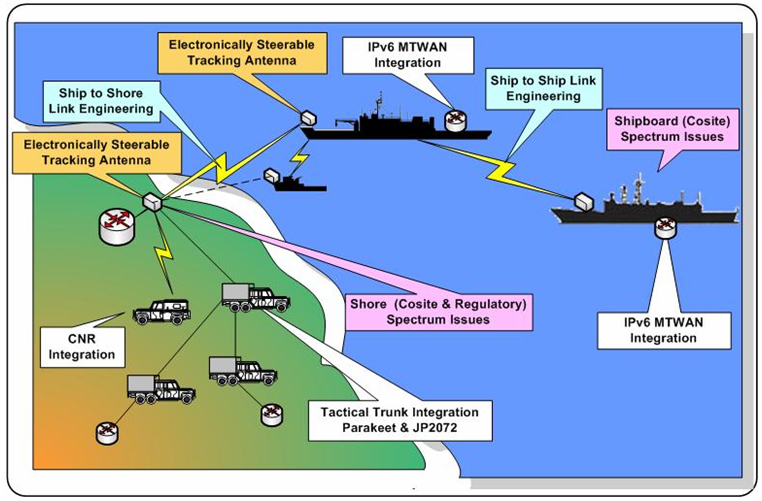
A demonstration package of three nodes, two ship-mounted and a mobile unit (Figure 1) demonstrates next generation technologies and algorithms providing wideband communications channels for amphibious and at-sea communications. The design of these new communications trunks considered environmental, spectrum management and link budget issues for both ship-to-ship and ship-to-shore scenarios. Detailed design activities addressed the evaluation and selection of electronically selectable/steerable antennas, modern UHF radios, modems and routers with option to integrate with header compression technologies for interconnection with IP networks and the exchange of VoIP, video and IP data services.
Key issues
Key technical issues which had a strong influence on the project are discussed:
- Architectural development of the NTT concept using the Defence Architecture Framework (DAF) and Thales Systems Engineering Practice.
- Development and testing of theoretical models for the propagation of radio waves in low-elevation flat-fading conditions.
- The development of simplified diversity techniques and AGC using advanced coding radio modems.
- The theoretical models which are needed to calculate the equivalent performance of a system in the Defence Communications band from the measured performance in the CTD experimental band.
- The techniques to trial new radio systems on board operational Navy vessels.
- Diversity of technology to enable the transition from channelised systems using agreed communications plans for the frequency multiplexing in the RF spectrum.
Wireless propagation effects and models
Propagation and absorption losses of LOS RF links are strongly affected by the frequency of operation of the link. The objective of the RF engineering design process is to achieve adequate link margin for UHF and microwave communications whilst accounting for environmental and technical issues such as weather, obstructions, fading, multi-pathing and directivity which is associated with gain antennas [1]. Naval communications place additional requirements on the system design including size and location of electronic equipment, safety, placement of antennas and EMC with other co-located systems. The VHF/UHF communications band is a convenient choice for Defence because the diffraction of radio waves is more pronounced at lower frequencies. Propagation is affected by several factors including:
- Dominant multipath surface reflection interference.
- Scattering from the surface sea waves.
- Scattering from the water droplets in spray, rain or fog.
- Ducting due to vertical gradients in the humidity over the sea surface. The ducts which form in coastal areas can contain the signal and extend the usable range.
- EM wave guiding by atmospheric refraction.
- Diffraction around obstacles, ships or islands.
- The curvature of the earth.
These effects are widely observed and have been reported both in communications systems [2] and in radar systems [3] where radar deep fades as well as extended range due to the presence of evaporative ducts have been observed anomalous propagation conditions [5], sub/super refractivity and ducting.
Transmitted radio signals are reflected off the surface of the sea as well as objects such as ships and land as well as being refracted by atmospheric effects. Such multipath effects lead to phase interference with the direct path such that the signal at the receiving antenna varies between constructive to destructive interference in a process known as flat fading.
Communication link modelling
For a hypothetical LOS link between two antennas at heights of h1 and h2 above sea level, the diffraction and refraction effects would be negligible and the effective LOS range would be limited to the local horizon.
Atmospheric refraction of radio signals causes the radio wave to curve around the earth to refracted range:
where K is the effective earth radius factor, generally taken to be 1.33. For links above 10 GHz, atmospheric absorption by water vapour and oxygen becomes a significant cause of attenuation. For a carrier of wavelength, λ, interference with a path difference of Δd between the primary path and reflected paths from the sea surface within the first Fresnel zone the RSSI is given by:
At long range for perfect reflection, α = –1, beyond the breakpoint this tends asymptotically to:
The quality of the NTT radio link is determined by the received signal-to-noise ratio (SNR). This is the measure of the ratio of the received signal strength (RSSI), to the noise spectral density caused by both thermal and interference. Sources of interference in the L-band spectrum is mainly caused by co-located radar signals, harmonics and other intermodulation products.
There has been ongoing interest within Defence for enhanced LOS radio communications between ships and amphibious units. Historically Navy has used narrowband LOS radio channels but with modern electronics there is a better prospect of using a wireless wideband waveform to support multiple capabilities [8]. This led to trials [6] of high-data-rate UHF radio for line-of-sight digital radio communication adaptation of the AN/WSC-3 radio. Channel measurements and comparison with the fading prediction were also collected by NASA in the Neah Bay WiFi tests for 2.4 GHz channel propagation [7].
The propagation model
To provide a rationale for a migration plan for use of the NTT within Defence UHF band a frequency-dependent propagation model was developed and used for the design characterisation and prediction of performance of the communications subsystems and its migration to the UHF band from previous work [9] and validated with the Refractive Effects Prediction System [2] (AREPS), for specific cases in order to predict the key parameters which are needed to design and to assess the performance of the NTT communications capabilities in the flat fading RF environment within the first Fresnel zone [13].
The choice of spectrum has a particular influence on the selection of RF components, especially those which cannot be formed using software defined radio (SDR), and digital signal processing (DSP), techniques such as high power components and filters, circulators, frequency transversion devices, reference frequency sources, [14]. The model provides the basis for selection of RF subsystems and devices when the NTT is relocated to a different RF band, such as UHF.
The selection and parameterisation of the equipment was guided by the theoretical model and as the performance measurement results were recorded these were iterated back into the model. In this way the model provided a performance indicator of how the system design should ultimately perform using the system models and the coding schemes for each of the NTT transmitter and the NTT receiver. The key measures which are needed are the SNR and RSSI of the communications channels from which the expected BER and PER are determined.
Because of the bi-path wireless propagation interference over water it is observed that for conditions at which destructive cancellation occur there are deep fades in the signal which are observed as reduction in the communications RSSI and as radar deep fades, RDF, for radar surveillance systems. The propagation loss and is influenced by antenna heights and the channel frequency and is combined with the system component losses, gains, receiver sensitivity and excess noise temperature to compute the dependence of the BER on range which is plotted logarithmically in Figure 2 where an artificial discontinuity is introduced at the radio horizon to account for the increased diffraction loss at ranges greater than Radio LOS. The depth of the fades is dependent on the signal wavelength, on the reflection coefficient of the surface of the sea and on the phase relationship of the interfering paths as determined by the distance between transmitter and receiver [4]. The RF fading effect is a physical effect and cannot be overcome easily by layer 2 signal processing alone.
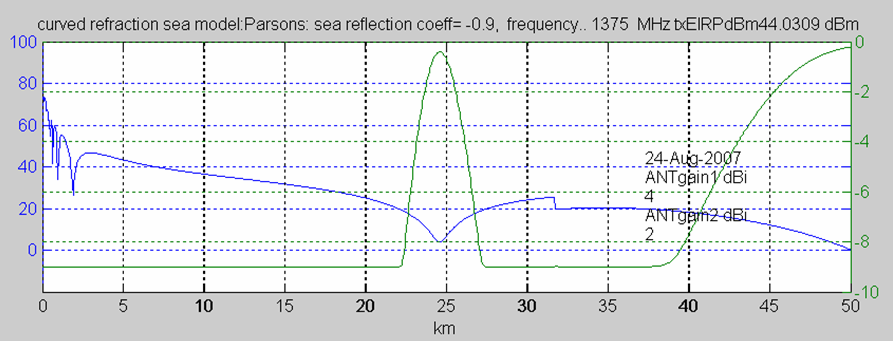
From the link budget, Figure 2, the excess noise due to radar pulse noise and the characteristics of 0-QPSK modulation the expected BER was calculated [15].
The choice of rf spectrum
Spectrum management is a combination of administrative and technical procedures which are necessary to ensure the efficient operation of radio communications, taking into account legal, economic, engineering, and scientific aspects for the use of the radio frequency spectrum. Usage of the RF spectrum is regulated internationally through the International Telecommunications Union (ITU), and by the Australian Communications and Media Authority (ACMA) in Australia to a plethora of categories of use including mobile, maritime, satellite, defence, radio-astronomy. Spectrum management is increasingly strained as public demand for wireless services grows and new spectrum-related technologies and applications emerge. The USA Federal Radar Spectrum Requirements, [10], illustrates the variety of RF band assignments related to radar usage.
The Defence L-band spectrum for demonstration of the NTT was chosen because of temporary availability and also to achieve acceptable antenna isolation in excess of 40 dB from the radar systems and other communications systems with adequate channel bandwidth for broadband NTT links of up to 5 MHz bandwidth. Internationally, significant portions of bandwidth have been allocated for commercial mobile users below 2 GHz, around 850 MHz and 1900 MHz, whereas Australian Defence is allocated segments of UHF and L-band for communications and some radar applications. Care is taken to separate the allocated channels for communications from radar and from the harmonics of radar signals.
Architecture of the NTT
Development of the NTT architecture used the methodology of the DAF with specific operational and business architecture descriptions for the concept capabilities. The Architecture framework provides systematic approaches to architecture development. Defence Enterprise Architecture consists of structures views of the operation, business or system being described which are either diagrams, lists or text and collectively the views define the design, structure and behaviour of the operation, business or system.
The architecture of the NTT is set out in five components to operate in Defence experimental RF spectrum with migration option to eventual usage in Defence communications RF spectrum:
- Functional, system and logical architecture.
- RF architecture.
- IP data network architecture.
- IP control network architecture.
- Security Architecture.
- Operational architecture and design interpretation.
- The system physical architecture.
- The system breakdown structure (SBS).
The NTT RF trunk architecture is designed using survivability and reliability principles and continuity of IP data transfer using:
- Vertical spatial diversity using suitably directional switched antennas.
- Spectrum diversity.
- IP packet aggregation and de-replication using:
- An integrated TCP/ IP routed network architecture.
- A separate IP control network architecture.
- IP header compression.
- Multi-technology RF waveforms for technology diversity.
To enhance the robustness of the NTT in the naval flat fading RF environment the system focus is to replicate IP waveforms as parallel paths in different parts of the RF spectrum and using antenna spatial diversity such that the IP packets can be combined and de-replicated by the layer-3 TCP/IP protocol stack and IP applications.
The SEA1660 architecture includes multiple radio sub-systems within the Systems View Architecture Data Element Relationship, SV.
- An OV1 scenario description of the NTT, Figure 1.
- Interfaces in the Systems Interface Description, SV-1.
- mapping to system data exchanges in the Systems Data Exchange Matrix, SV-6.
- System data I/O by system functions in the Systems Functionality Description, SV-4.
System design of the NTT
The system design of the NTT uses the properties of TCP/IP protocols to demonstrate the formation of a networking topology using the wireless link diversity and coding which is implemented without special development of the networking layer to transport all traffic types including time sensitive traffic. Latency and jitter were minimised to provide for real time traffic types, Voice over IP (VOIP) with defined Quality of Service (QoS) varying performance in a complete network.
The key issues in the development of the system architecture to achieve an acceptable availability relate to the following aspects of the fundamental physical issues of EM RF propagation at sea:
- Link engineering and link budget.
- Diversity using spatial, frequency and coding diversity.
- EMC with RAN ships’ radar and other systems.
- A suitable notch and band-filter plan.
- Broadband channel frequency transversion of international standards carriers for WiMAX 3.5 GHz and WiFi 2.4 GHz into Defence L-band spectrum.
- Signal acquisition of coded waveforms for link establishment, tracking and closure.
- A channel plan enhanced by a radio media access control (MAC) layer.
- IP stack resolution of replicated or lost IP packets.
- Suitable systems configuration control functionality.
Antenna issues
The NTT is a duplex directional link and relatively low power in comparison with radar signals so it is important to achieve a sufficient SNR in order to recover received packets from noise. The design considerations which influenced the antenna design included:
- Antenna isolation.
- Signal polarisation.
- Vertical spatial diversity.
- Antenna directivity with integrated low-noise amplifiers, LNA.
- Minimisation of the noise factor.
It was necessary to achieve 50 dB antenna isolation between the receiving antenna and sources of co-located ship-borne interference by using directional antennas and also by maintaining a suitable communications channel assignment plan and filtering to avoid co-site channel interference.
Vertical spatial diversity provides for two or more parallel alternate propagation paths from a single transmitter to two or more receiving antennas for continuity of IP packet transfer to the receiver even when one of the paths fades due to the marine channel fading characteristics. Because of the geometrical considerations of marine LOS propagation only one of the paths will fade at a time within the maximum range of evaporation-duct-free operation of the links.
Antenna directivity and minimisation of the noise factor to establish and maintain a point-to-point LOS link either using radio, millimeter or light a low cost two-axis antenna pointing system could be used with an integral gain element. However, the use of a dual-axis antenna pointing system also introduces complexities for both an adequate control system to acquire and track the link and of suitable mounting points on the ship’s mast.
Candidate sub-systems which were examined included Wireless Access Networking, 802.11b,c and 802.16, as well as steerable laser communication systems.
Spectrum efficiency through the MAC
Spectral efficiency can be achieved at the expense of overall data throughput by the use of a MAC which enables wireless networking by using wireless network addresses for each terminal/ship. Whereas a channel frequency plan allocation provides dedicated bandwidth for nominated links in the plan, the MAC provides ad-hoc but lower-rate connectivity between the ships with improved efficiency of usage of the available RF spectrum. The concept of wireless networking overlaid on channel plans for the case where more flexible access to spectrum is needed by diverse capability users during amphibious operations.
Coding for pulsed interference
Because the Naval RF environment is affected significantly by pulsed radar systems which cause blocks of burst errors in co-located communications systems the NTT includes the use of turbo product codes (TPC), block coding technique with sufficient depth of interleaving to process and correct burst errors which originate through this mechanism [11,12].
Choice of the MAC
Within the OSI seven-layer model data communication protocol sub-layer MAC is a part of the data link layer. It provides physical layer addressing and channel access control mechanisms that make it possible for several terminals or network nodes to communicate within a multipoint network, typically a local area network (LAN). A MAC protocol is not required in full-duplex point-to-point communication. In single channel point-to-point communications full-duplex can be emulated but provides the protocol and control mechanisms that are required for channel access methods to use as a multiple access protocol. This makes it possible for several nodes connected to share a wireless network.
Shipboard installation issues
The RF design for installation aboard Naval ships is more complex than fixed and strategic L-band and microwave communication trunks. The superstructure and mast of a modern Naval ship are fully populated with antennas with few opportunities for the placement of experimental antennas. Key issues considered for antenna placement are to:
- maximize range for the NTT link whilst minimizing co-site interference with communications and radar systems,
- minimize interaction and modification of directivity from other antennas,
- place for acceptable RF Radiation Hazard (RADHAZ) and crew safety, and
- compensate for the ship’s pitch and roll.
Performance criteria
To analyse the performance of the NTT links the tests collected the timestamps, packet data, and the Global Positioning System (GPS) location for both UDP and TCP/IP packets to calculate the distribution of the packet arrival rate and the loss probability, the time delay and the received packet error rate (PER).
Circuit Availability. The time to transmit messages from server to server is a measure of the availability of the circuit. In as much as the TCP protocol requires a positive acknowledgement of the correct receipt of each packet at the transmission layer, the successful delivery of a message implies the existence of a circuit of acceptable quality for a specific time period. The differential in the time stamps of sending and receiving servers is a measure of the amount of time required to effect routed inter-platform connectivity. For similar message sizes the larger the differential the longer the period of unavailability.
LAN availability. The difference in the time stamps of the sending client Ta and the sending server Tb is a weak comparative measure of the availability of the platform LAN Tcs. Since the in-port tests were conducted as stand-alone tests, there was no competing traffic on the LANs, so the Tcs transfer during those tests was instantaneous. The relative availability of the LAN during deployment can he established by comparing Tcs with that of the in-port tests.
Utilization of the system, P. P = λ / µ where the mean arrival rate, λ, is the value of the number of frames entering the RF link per unit time and the mean service rate, µ, is the reciprocal of the time required to transmit one frame and mean waiting time, Wq = λ/(µ - λ) .
Reliability. Reliability is the success rate with which all transmitted messages reached the addressees.
Accuracy. The TCP/IP protocol provides extensive error-checking facilities. It requires point-to-point communications in which a positive acknowledgement is made for the correct receipt of each data packet. If more than 20% of the packets are found to be in error, the connection is terminated. Thus, the successful transmission of a message implies that its contents are fully validated. Accordingly, these tests treat the accuracy of the system as the mirror of its reliability.
The UDP packet size is equal to the size of the data frame (estimated at 1500 bytes) plus 26 bytes overhead per frame. Approximately 25 bytes would be added when repackaging each frame to include wide area network (WAN), header and trailer, resulting in a frame size of 1551 bytes/frame.
Results of trials
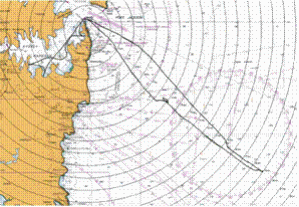
The technology diversity was tested in trials using both the interleaved L-band modems as well as L-band transverters for WiFi IEEE 802.11 and WiMAX IEEE 802.16d/e native standards and COFDM waveforms in the defence spectrum. An ongoing series of trials in and off Sydney harbour was used to collect the performance data, Figure 3, which extended to 19 km with full availability at a transmission power of 10 W before bad weather forced a return to harbour. Engineering completion of the system is nearing completion and a test program is being planned.
Conclusions
This paper addresses the significant technological issues to achieve a viable NTT with adequate QoS, of availability of RF spectrum, propagation in the littoral/maritime environment and interference and EMC. The project provides a significant advance in high data-rate communications available to military units undertaking amphibious or at-sea operations potential capability enhancement through:
- a universal, high data-rate, LOS trunk communications system that will enhance the Australian Defence Force (ADF) networking, command and control, and data exchange capabilities during littoral warfare;
- COTS-based design for providing high data-rate communications independent of an overlaid system;
- TCP/IP network routing which can be extended to Naval ad-hoc networking in a task force;
- frequency transversion of international standards carriers for WiMAX and WiFi into defence L-band spectrum;
- trunk communications to naval vessels and mobile land force units that do not have high bandwidth satellite communications capability, or when satellite coverage is masked or unavailable; and
- increased interoperability with allied forces, independent of sovereignty issues.
This CTD is assisting Defence understanding of RF NTT technologies and effectiveness with wideband waveforms which will be critical for assisting investment decisions to enhance the ADF’s future capability.
Acknowledgement
This work was supported by The Commonwealth of Australia as CTD SEA1660 DSTO contract C_102340 with the guidance of DSTO C3ID and to the many people in Thales Joint Systems who contributed to the project.
References
[1] W.C.Y. Lee, Mobile Communications Engineering, McGraw-Hill, NY, 1998.
[2] W.L. Patterson et al., Advanced Refractive Effects Prediction System Software, AREPS, NCCOSC Technical Document 2648, v3.0, San Diego, May 1994.
[3] E. Brookner, E.Ferraro and G. Ouderkirk, “Radar Performance During Propagation Fades In The Mid-Atlantic Region”, IEEE Transactions on Antennas and Propagation, Vol. 46, No. 7, pp. 1056–1064, Jul 1998.
[4] MW. Long, Radar Reflectivity Of Land And Sea, Artech House, Boston, 2001.
[5] B.J. Kachoyan and C.L. Morgan, Infrared Propagation in Radar Frequency Ducting Conditions, DSTO-TN-0068, 1997.
[6] R.C. North et al., Use of the AN/WSC-3 External Modem Interface for High-Data-Rate UHF Digital Communication: Experimental Results, NRaD TR 1701, 1995.
[7] W. Ivancic, Neah Bay Antenna Connectivity Tests and Analysis, TM-2002-211511, NASA, November 19, 2001.
[8] T. Schlosser, “Potentials for Navy Use of Microwave and Millimeter Line-of-Sight Communications”, NRaD Technical Report 1719, Sept 1996.
[9] R.M Schmalenberger and M.G Edrich., “Channel Modelling For Wideband Data Communication In A Maritime Mobile Environment”, EUROCOMM 2000. Information Systems for Enhanced Public Safety and Security, pp. 150–154, 2000.
[10] W.M. Daley, The 20–Year Federal Spectrum Requirement Forecast for Radar, Federal Radar Spectrum Requirements, U.S. Department of Commerce, May 2000.
[11] Changlong Xu,Yong L. Guan, Ying-Chang Liang and Wing S. Leon; “Turbo Product Code for Flat-Fading Channels with Pulse Jamming”, Thirty-Ninth Asilomar Conference on Signals, Systems and Computers, pp. 611–614, 2005.
[12] T.H. Lajos Hanzo, Liew, B.L. Yeap, Turbo Coding, Turbo Equalisation and SpaceTime Coding for Transmission over Fading Channels, Wiley, 2002.
[13] B. Sklar, “Rayleigh Fading Channels In Mobile Digital Communication Systems”, IEEE Communications Magazine, Vol 35, No. 7 pp. 90–100, Jul 1997.
[14] B Sklar, A Structured Overview Of Digital Communications--Tutorial Review--Part II, IEEE Communications Magazine, Vol. 21, No. 7, pp. 6–21, Oct 1983.
[15] B Sklar, Digital Communications: Fundamentals and Applications, Prentice Hall, NJ, 2001.