
Volume 10, Number 2, July 2007
A Case Study: Flattening The Battlefield Through A C4 Knowledge Management System
- 1 The Richard Stockton College of New Jersey, P.O. Box 195, Jimmie Leeds Road, Pomona, NJ 08240, USA.
- 2 Branch Chief for Contingency Operations, Special Operations Networks and Communication, J6, U.S. Special Operations Command, MacDill, FL, USA.
Abstract
The purpose of this study is to describe the effects that a C4 (command, control, communications, and computer) knowledge management system (KMS) had on increasing the situational awareness (SA) level of network monitors maintaining a very large, dynamic, and complex communication network during wartime. This case study utilized triangulation and analysis of the multiple interviews, audiovisual material, archival records, and documents that formed the basis for the findings of this study. During Operation Iraqi Freedom (OIF), the First Marine Expeditionary Force (I MEF) G6 developed an automated Marine Air Ground Task Force Communication Control Center Event Log (MEL), a web-based KMS that replaced the physical logbook to track communication network status for this large network that supported over 86,000 personnel over four months. The MEL enhanced SA, the sharing of information directly related to the operation of the communication network, as well as the sharing of tacit and explicit knowledge of system readiness. Limitations of the study revolved around collecting data in a real battlefield situation. Considering the unusual nature of the events, the results may or may not be replicated outside of simulations until there is another major military offensive. The findings reveal the practical benefits of automating physical logbooks. The results also shed light on behaviours of individuals within a network under situations of moderate and high stress. Overall behaviours of a community of practice under wartime conditions are revealed. This case study documents behaviours in the unusual context of an invasion of enemy territory. As such this research fills the gap between theoretical considerations of knowledge management and the practical and organic implementation of a KMS.
Introduction
Situational awareness (SA) has increasingly become a keyword in the knowledge age. Military leadership must progressively be made more aware of the condition of the existing battlefield communication systems and projecting its status in the near future. The need for sustaining SA with the latest information is paramount. With the bombardment of overwhelming amounts of information, knowledge management systems have begun to find their place in a variety of contexts.
Dekker [1] discusses the trend in military and civilian communication toward internal networks and the corresponding threats to that communication infrastructure. Alberts, et al [2] define the term network centric warfare (NCW) as follows
We define NCW as an information superiority-enabled concept of operations that generates increased combat power by networking sensors, decision makers, and shooters to achieve shared awareness, increased speed of command, higher tempo of operations, greater lethality, increased survivability, and a degree of self-synchronization. In essence, NCW translates information superiority into combat power by effectively linking knowledgeable entities in the battlespace.
This demand for robust battlefield communication architectures continues to grow. Dekker [3] asserts the following
The topic of C4ISR (Command, Control, Communications, Computers, Intelligence, Surveillance, Reconnaissance) architecture is of enduring importance for military operations.
In Freidman’s The World is flat [4], collaboration will be a hallmark of business and organizations that will increasingly deal with overwhelming amounts of information. To be successful, continued communication and common operational pictures will be needed to create accurate SA. According to Nofi [5], situational awareness (SA) is:
…the result of a dynamic process of perceiving and comprehending events in one’s environment, leading to reasonable projections as to possible ways that environment may change, and permitting predictions as to what the outcomes will be in terms of performing one’s mission. In effect, it is the development of a dynamic mental model of one’s environment.
and Lt. Gen. Paul J. Kern, Military Deputy to the Assistant Secretary of the Army for Research, Development, and Acquisition, and Lt. Gen. John N. Abrams, Deputy Commanding General, TRADOC, provided one such definition of shared SA as part of their testimony before the Senate Armed Services Committee in 1998 [5]:
Shared situational awareness…translates to a clear and accurate, common, relevant picture of the battlespace for leaders at all levels and a reduction in the potential for fratricide….The sharing of timely information enabled by digitalization improves significantly the ability of commanders and leaders to quickly make decisions, synchronize forces and fires, and increase the operational tempo.
Knowledge management
In the modern information age, battle commanders are overwhelmed with the volume of data to be processed. Good decisions require systems that can manage knowledge and attribute value or context to data. Blair [6] described the need as follows:
Success on the land battlespace has traditionally been attributed to the leadership and skill of the commander. The introduction of the staff system and limitations of communications tended to isolate the commander from the sources of his information. Paradoxically, the capacity of modern communications and information systems may constrain the commander by overwhelming him with the volume of data. Recently, a concept known as ‘network centric warfare’ has made claims of being able to speed up command decision making and improve tactical command and control. This concept leans on technology and procedures being developed in the commercial world. At the same time, commercial management has explored a development known as ‘knowledge management.’
Traditional knowledge management systems have focused on explicit knowledge and facts. Swan indicated that these data can be easily tabulated and codified [7]. Futrell [8], Davenport and Prusak [9], O’Dell et al [10] indicated that deeper understanding of processes and any associated opportunities for change and innovation necessitate capturing, processing, and transferring tacit knowledge. Brown and Duguid [11] and Orhuysen and Eisenhardt [12] indicated that these tasks are difficult in that the intention of the knower and the context surrounding the creation of the knowledge is essential to understanding its tacit elements.
Case studies
Kirby et al [13] simulated battlefield visualization and decision support systems utilizing an Information Management and Dissemination Architecture (IMDA) that builds upon the concept of a “virtual information space.” Utilized during two military exercises involving military personnel, the IMDA facilitated optimum decision-making through enhanced SA. Seymour, et al [14] utilized network centric warfare (NCW) concepts in the Prowling Pegasus experiment to enhance coordination and synchronization of Land-Air System-of systems (LAS). In research funded by United States Air Force, Kolek et al [15] studied the Battlefield Communication Network and Tactical Engagement Simulation (BCN/TES) program. In this case study, researchers sought to study wireless radio network architectures in militarily realistic scenarios. They concluded that methods need to be developed to improve the visualization of system performance.
Several other case studies investigate communications networks under the stress of battlefield situations including Scott’s study of combat search and rescue [16], Bai, Sadagopan, and Helmy’s study of routing protocols in ad-hoc networks [17], Fecko and Steinder’s study of combinatorial designs to correlate events in multiple network faults [18], and Durresi, Durresi, and Barolli analyzed a scalable and hierarchical communications protocol (HCP) on the battlefield to enable the optimization of routing processes [19]. In each of these studies the main focus is to investigate ways to implement stable and resilient communications architecture on the battlefield.
This study
This case study analyzes a real-world implementation of an impromptu C4 KMS in the context of the battlefield of Operation Iraqi Freedom (OIF). C4 includes the battlefield assets of command and control, communications, and computer. The deployments in Iraq and Afghanistan gave opportunities to observe these four assets in joint operation utilizing the latest innovations in each.
While this analysis looked at how additional tacit knowledge was captured in the process of documenting the real-time status of the communication network employed, the focus of the study was how this KMS affected the critical battlefield construct of SA. The idea of SA grew as a military term used in the aviation community. It involves the split-second decision making that occurs while flying an aircraft, especially in enemy territory, which raises the need for SA. Nofi [5] states that the consensus on this hard-to-define term has come to mean a mental picture of the environment, both real and potential.
Major General Stalder indicated that during Operation Iraqi Freedom (OIF) the First Marine Expeditionary Force (I MEF) deployed the largest tactical communication network ever deployed by the United States Marine Corps in history [20]. This network supported the Marines, Army, and coalition forces during OIF. With over seven major communication nodes spread out over hundreds of square miles within the theatre of operations, the old KMS of annotating significant events within a physical logbook was quickly obsolesced in sharing the network health, status, and troubleshooting actions needed in sustaining such a dynamic and complex network. Coupled with the passive physical logbook was the numerous and time consuming phone calls and emails that were needed in order to share relevant network information with all the monitors/watch officers of the network. The KMS created to overcome barriers associated with the physical logbook was called the Marine Air Ground Task Force Communication Control Center Event Log (MEL). This case study will describe the impact the MEL had on maintaining SA of I MEF’s communication network.
Situational awareness and network awareness
Endsley [21] indicated that SA has many definitions and research is still needed to develop a framework for measuring its dynamic nature. Nofi [5] agrees that a defined theory of SA is emerging. Shared SA involves the mutual understandings of the ‘common picture’ by several parties involved in a related activity. Again it is clear that such awareness is indispensable on the battlefield. Although research is needed in quantifying and determining factors that influence them, SA and shared SA are both process phenomena that have distinct characteristics in common. This awareness is critical to military commanders when critical changes are necessary for the communications network. The communications officer relies on a unique form of SA as it pertains to the entire communications network. Technology offers these Marines the ability to access real-time information and maintain an accurate mental picture of the network. This can raise their level of SA and thus help them to make quicker and more accurate decisions. For the purposes of this study, SA applied to the communication network has been designated as network awareness.
Endsley [21] states that perception, comprehension, projection, and prediction are critical factors in the development of SA, defining each as:
- Perception: acquiring the available facts [Level-1, lowest level, SA].
- Comprehension: understanding the facts in relation to one’s expert knowledge of such situations [Level-2, midlevel, SA].
- Projection: envisioning how the situation is likely to develop in the future provided it is not acted upon by any outside force. [Level-3, highest level, SA].
- Prediction: evaluation of how outside forces may act upon the situation to affect your projections Nofi [5].
Endsley [21] also states that each of these might in fact occur simultaneously and continuously in a dynamic process. Thereby, SA and shared SA evolve continuously. The Center for Naval Analysis (CNA) also conducted a research project to address the Defense Advanced Research Projects Agency’s (DARPA) interest in defining factors on how distributed teams of people develop shared SA. Part of the project performed a survey of the research on SA and shared SA and found some agreement on fundamental concepts: SA is a dynamic mental model of the operating environment and the participant’s place in it; participants build this model through situation assessment, involving perception, comprehension, projection, and prediction. Research is lacking on ways to measure SA or how it develops for individuals or groups. Perla et al [22] found that communications and shared visualization tools enhanced shared SA in distributed teams.
Interface design may also influence a person’s degree of SA. Endsley [21] lists some specific design guidelines for improving SA through an interface. The following are several hypothesized interface design features that will positively affect a person’s SA:
- Displays that provide information that are attended through comprehension and projection. For example, “directly portraying the amount of time and distance available on the fuel remaining in an aircraft would be preferable to requiring the pilot to calculate this information.”
- Displaying salient collocated information that is relevant to the person’s major goals.
- Prominent design features should be reserved for critical cues in relation to the operator’s goals and not for non-critical cues.
- Displaying filter-free information. Allowing operators to see an overview of the situation in relation to their goals and the major goals of the organization.
- Countering information overload. Allowing the user to filter out extraneous information (information not related to the situational needs or goals of the user).
- Displaying information that will help project future states of the system.
- A user-centred interface that allows for the dynamic nature of shifting priorities and multiple goals.
- An interface design that focuses on providing users information versus just data.
The MEL interface
The MEL interface (see Figure 1) informed the monitors on the status of the network. The MEL interface was a webpage that resided on a network that could be accessed from terminals on the battlefield. Each of these components is listed below along with the rationale for the component.
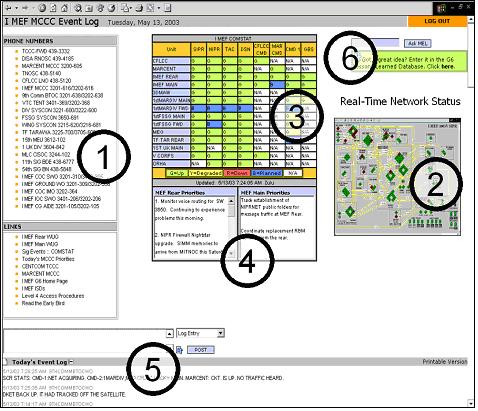
Component 1: List of Key Points of Contact—phone numbers and key links, enabling monitors of the network to contact relevant personnel.
Rationale: This component gave network monitors a common reference point and an understanding of the community involved. This served as an online phone book, but also served to illustrate the overall structure of the leadership. This component made it very easy for network monitors/watch officers to contact key personnel that are subordinate, adjacent, and higher. Finally, the links gave monitors key information such as tactical information, plans, and orders.
Component 2: Real-time Network Status—an embedded network topology page pulled from a server running a network monitoring tool. This graphical topology network status chart allowed monitors to see the near real-time status (updated every 60 seconds) of major network devices such as servers, routers, switches as icons and their corresponding locations and units throughout the theatre of operations utilizing the ping function.
Rationale: This component offered the monitors essentially real-time information on the health of the connectivity paths of the data networks in the communication system. This timely information enabled a network manager to make decisions regarding the health of system devices. This component also allowed the network administrator to know pre-emptively when a network path was down, which was preferable to waiting for personnel to communicate system outages. Therefore, a network administrator was able to send out information that there is an outage and a team is working on it.
Component 3: I MEF COMSTAT (First Marine Expeditionary Force Communication Status)—also referred to as the Status Chart. The Status Chart gave a stop light presentation of phone, radio, and satellite status; green for up, yellow for degraded, red denoted a system or network outage, and blue denoted a planned non-operational status. The Status Chart tracked Internet, telephone, and radio connectivity of all I MEF higher, subordinate and adjacent units.
Rationale: This component shared the communication network capability status for I MEF higher, subordinate, and adjacent units. Watch officers updated this component regularly and the system refreshed every 30 minutes. This component was different from the Real-Time Network Status component in that it shared information regarding a unit’s communication capability versus the health of a specific hardware device. This component shared the communication capabilities of all units on the network.
Component 4: Daily List of Network Priorities—housed the network of daily operational priorities in maintaining the whole network. Included in this list were general and specific directives that needed to be addressed according to the operational tempo. This included priorities associated with the upgrading and maintenance of systems as well as specific directives to all or specific monitors of the network.
Rationale: This component allowed the G6 to disseminate regular priorities to the entire communications staff throughout all the subordinate and adjacent units at once. This permitted all to know the focus of main effort (FOME) for that day. Subordinate units could also monitor the extent to which their priorities were included. This gave all units SA of current priorities and major problems for all units.
Component 5: Event Log—where the monitors were able to post entries in real-time to be seen by all users monitoring the network. This part of the MEL is synonymous with the physical logbook. A watch officer’s posting of a log entry was synonymous with a person posting an entry to a newsgroup, virtual forum, or blog. Once the watch officer making the entry clicked on the post button, the un-alterable entry would immediately post to the Event Log and all the watch officers would see the log entry. The Event Log contained the past 24 hours worth of log entries. Each entry was separate and denoted the date, time, and unit posting the entry. The log entries were posted by time of entry with the most recent entry on the top of the Event Log.
Rationale: This component provided tacit knowledge about the network and context for all communications staff and commanding officers. Here, personnel had the opportunity to react to priorities, network status postings, outages, actions for past outages, problem solving, and status of the movements of nodes and forces. This gave personnel further awareness of the various problems in the network and the actions being taken to remedy those problems. It also gave perspective for individual problems within the overall picture of I MEF’s challenges. It also allowed network administrators to compare problems today with the problems and the fix actions that occurred in the past.
Component 6: Ask MEL—a search function that allowed the monitors/watch officers of the network to search the log entry database of the MEL by key words.
Rationale: This component allowed the users to search through postings for context clues, fix actions, history, and best practices. This allowed network administrators the opportunity to look through similar situations to find how they were addressed by other units or previous attempts. This component allowed commanding officers to conduct longitudinal analysis or comparative analysis on how subordinate units were problem solving.
The MEL interface complied with many of Endsley’s recommendations for an effective interface for enhanced user SA [14]. The MEL interface was a webpage that resided on a network that could be accessed from terminals on the battlefield. The List of Key Contacts enabled monitors to easily contact relevant personnel. Real-time Network Status topology of the data network and I MEF COMSTAT allowed monitors to see at-a-glance which portions of the phone, radio, and satellite network that were operation and which were not, as well as the nature of any degradation. These components of the webpage followed Shneiderman’s [23] colour recommendations that state that colour-coding should be consistent throughout an interface (that is the colour red denoted a system or network outage). The Daily List of Priorities raised the level of SA of the watch officers by facilitating their understanding of why certain courses of actions were implemented. It also gave the watch officers the ability to strategically allocate the correct resources in completing the priorities. The Event Log replaced the passiveness of the paper logbook entries, which was typically viewed by a few monitors. The new Log contained near real-time postings through the use of a dialogue box and posting button. This allowed the monitors to look at any specific log entries and monitor them for patterns. These characteristics were crucial in sustaining shared SA of the network.
MEL utilization
The MEL offered near real-time and real-time sharing of information between the watch officers monitoring the communication network. The following scenario is typical of what took place in the utilization of the MEL:
While monitoring the MEL webpage, a chief watch officer (CWO) at the 1st MARDIV MAIN (First Marine Division Main Body) had just found out that his/her DSN (Defense Switched Telephone Network) was not operational. After verifying the DSN was “down,” the CWO then posted the following log entry to the MEL:
3/13/03 1:49:33 AM 1st MARDIV MAIN CWO
DSN Down, no inbound or outbound capabilities, troubleshooting
Figure 2 is a partial replica of the I MEF COMSTAT (third major component of MEL interface) in Figure 1. In Figure 2, the CWO then changed the 1st MARDIV MAIN cell under the DSN from Green Status (operational) to Red Status (non-operational). Five minutes later the CWO posted another log entry to the MEL and shared more information on the outage and what plan is being put into place to rectify the outage:
3/13/03 1:54:53 AM 1st MARDIV MAIN CWO
DSN still Down, sending a tech team out to troubleshoot. Will update within hour.
Since the MEL was being monitored by all the watch officers tasked with maintaining the network, all the watch officers found out in real-time that 1st MARDIV MAIN could not communicate via DSN. The MEL made it possible for all the watch officers to immediately be updated with pertinent information regarding an important part of the network at a specific unit. In communicating the outage using the logbook, a disproportionate amount of time would have been spent coordinating the outage to other units and coordinating a solution to the problem.
This scenario illustrated how the MEL operated and how it increased the shared SA of the monitors of the network.
| I MEF COMSTAT | |||
|---|---|---|---|
| UNIT | TAC | DSN | CFLCC CMD |
| I MEF REAR | G | G | G |
| 1st MARDIV MAIN | G | R | G |
| 3rd MAW | G | G | G |
| 1st FSSG FWD | G | G | G |
Results
MEL effects on SA
The analysis of the MEL interface database of log entries showed that a high percentage of posted entries were related to raising the SA level of the network monitors/watch officers. The MEL interface was used from 3 December 2002 to 1 May 2003 (approximately 5 months or 150 days). These dates correspond to the MEL’s commencement date and its usage through the end of Major Combat Operations, respectively. The MEL database of log entries contained 8,073 log entries. These entries ranged from one sentence entries to multiple paragraphs. The four codes used to analyze the MEL database were indicators, supported from the literature review, associated with SA. One or more codes were used in the coding of the 8,073 log entries. 14,720 codes were assigned. All the codes were developed in order to measure the SA level of each log entry of the MEL database. The following were the codes utilized in analyzing the MEL database:
1n: Dialogue that reflected an increase in perception directly related to the operation of the communication network: Perception is the acquiring of available facts. (Level 1 SA)
1u: Dialogue that reflected an increase in perception in relation to the user(s)/unit(s) of the communication network: Perception is the acquiring of available facts. (Level 1 SA)
2: Dialogue that reflected an increase in comprehension: Comprehension is the understanding of the facts in relation to one’s situation. (Level 2 SA)
3: Dialogue that reflected an increase in projection of future events: Projection is envisioning how the situation is likely to develop in the future. (Level 3 SA)
Most postings (60%) were coded as indicating perception (1n = 6,928; 1u = 1,878). 3,248 log entries were coded as denoting comprehension (22%). Only 2,666 log entries (18%) were coded as denoting projection of future events (see Figure 3).
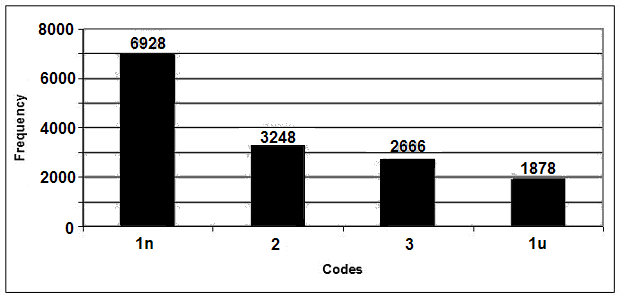
These results reveal that the entries made into the database were frequently entries that raised the level of SA with regards to facts associated with the direct operation of the network. These entries were numerous and rapidly flowed within the MEL, filled with the language and cultural symbols that were understood by all who utilized the MEL. This supports the notion that the MEL was developed to annotate significant events of the network operation. It also reveals that the MEL was used to share information directly related to the operation of the network. Comprehension is the next level higher than perception in terms of SA. It follows that there would be more facts and informative entries and less comprehension type entries. Similarly, one would expect fewer entries reflecting the highest level of SA. Projection type entries were entered at a lower rate because it depends on the first two levels of SA. About a third of the database had entries reflecting projected future events.
Finally, dialogues reflecting the perception of monitors were not as numerous. These types of entries were not directly related to the operation of the network. This illustrates that the MEL was predominantly used to raise the shared SA with respect to the operation of the network and not necessarily with regard to the monitors. This showed that the MEL was primarily a central point for raising the shared SA directly related to the operation of the network.
Major combat operations
During major combat operations (20 March 2003 to 1 May 2003), perception coded postings led, followed by comprehension and projection, as it did for the entire monitoring period. However, it was apparent that during major combat operations the MEL system was under stress. For this time period, most postings (92%) were coded as indicating perception (1n = 3,235; 1u = 520). 1,148 log entries were coded as denoting comprehension (33%). Only 556 log entries (16%) were coded as denoting projection of future events (see Figure 4).
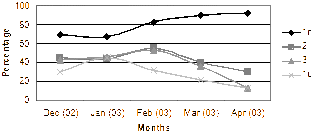
The pressure to get the mission accomplished within the least amount of time is reflected in the relatively high percentage of fact-oriented entries. The added pressure of being in a combat environment is reflected in the monitors brevity and conciseness in making entries into the MEL. The monitors were in a fact-sharing mode with little need or time for rhetorical explanations. The dialogue during this time was briefer and focused. During the months leading up to major combat operations, there were more dialogues that were richer and filled with explanations, comprehension, and future oriented comments.
The drop off in the number of level three SA (projection) entries supports the idea that the monitors were under pressure and may have been concerned only with attaining needed facts associated directly with the network operation. Because of mission responsibilities and/or time, the monitors may not have been as concerned with projecting what may occur in the future; they were concerned with sharing the present network health with others. The 50% decline in projection also reveals a decline in attention on how things will develop in the future versus knowing what the facts of the situation currently are. The many short status reports given during this time period reflect the high percentage of entries denoting a focus on acquiring facts directly related to the current network operation.
A month-by-month analysis revealed a continuous increase, beginning in January, in the percentage of postings involving perception among those directly linked to the operation of the network (1n). This analysis indicated that the relative frequency of comprehension (2) and projection (3) postings peaked in February, just prior to major combat operations. These postings fell at a relatively constant rate after February. Postings by those not directly linked to the operation of the network (1u) peaked in January and fell consistently throughout the remaining months.
Discussion
The automation of the physical logbook into the MEL interface increased SA and sharing of information directly related to the operation of the communication network. By automating the old logbook pen-and-paper technology, information became centralized and accessible to all the monitors of the network. The automation of the logbook augmented the monitors’ capacity to share information in a timelier and more accurate manner.
A study by Perla et al [22] supports this conclusion. Perla et al conducted an experiment to explore the effects communications and shared visualization tools had on shared SA of distributed teams. The findings support the importance that communications and shared visualization has on developing shared SA between distributed members. The MEL interface was used as a communication and visualization tool to enhance shared SA between the distributed monitors/watch officers.
O’Dell et al [10] state that a KMS can be measured according to its level of utilization. The MEL was overwhelmingly utilized in raising the shared SA of its users. The following percentages reflect categories that were not mutually exclusive. 86% of the entire MEL database of log entries was linked to raising the SA level (level 1 SA) of the MEL users with respect to operating the network. Moreover, over 40% of the MEL database of log entries was linked to raising the comprehension level (level 2 SA) of the MEL users with respect to operating the network. Finally, 33% of the MEL database of log entries was linked to raising the projection level (level 3 SA) of the MEL users with respect to operating the network.
Lessons learned from the case study
This knowledge management system (MEL) was developed for this communication system out of necessity. It was tested under unusual stress: that of an advancing force into enemy territory. It exemplified the training that Marines receive to improvise and get the job done. Several lessons emerged.
Organic knowledge management has great potential for authenticity. The great strengths of the MEL were that the system was developed and implemented by practitioners and communication network users. The interfaces contained authentic data that was useful to practitioners because it was designed by practitioners. The data that seem reasonable to the theorists in a lab may or may not have been useful to those in the battle. But these personnel knew what was essential to carrying out the mission. The proof of the usefulness of this system was the thousands of postings made in the six month monitoring period.
Human behaviours affect even technology-based knowledge management systems. As the environment changed, those using the network shifted behaviour. The relative number of postings shifted from thoughtful projection toward perception of facts and system information. The urgency of warfare caused participants to honker down to facts. Time for reflection, projection, and generally higher-order thinking was curtailed. The stress of battle conditions caused users to be less proactive. Regardless of how valuable this activity proved to be leading up to combat operations, users under stress neglected these consideration. There is a positive and a negative message to be taken from these results. On the positive side, planners of knowledge management systems need to design and make accommodations for the system under stress. Expected outcomes may need to be realistically adjusted in accordance with environmental variables. Other managers might build in times of reflection after periods of stress to ask participants to do higher order thinking, e.g., projection, about processes.
Tacit knowledge was captured through synchronous postings. Real-time postings to MEL supplemented normal data reports (system up, system down) with text to explain why it was down, what was wrong, how long did they expect to be down, and projections of future events. This tacit knowledge helped other users of the system to better understand system failures and make decisions and contingencies. In knowledge management networks, designers always need to consider real-time synchronous postings that are linked with processes as they are occurring. Capturing these postings also captures informal communication that has a higher probability of containing tacit knowledge associated with various processes.
Network awareness enhanced by graphical and textual interfaces. The key feature of the MEL was based on six components that married real-time data with tacit knowledge of the users and transparent communications. Processes that demand rapid responses demand graphical and textual interfaces that capture the essence of the data at-a-glance. If users must click on layers of links, they will be less likely to use the system or find it useful and efficient. The battlefield designer became a hero in his unit because he captured the essential processes and data elements in one place.
Conclusions
The advantages of the MEL implementation are obvious. This use of this system enhanced SA, presented authentic data that was useful for personnel, allowed network managers to exchange valuable tacit knowledge on the battlefield, and enhanced network awareness. The fact that combat and its associated stress caused personnel to use the MEL more for exchanging lower order facts and less for comprehension and presenting solutions suggests interesting insights into how personnel react on the battlefield. It is common for military experts to describe the battlefield theatre in terms of the fog of war. In fact, maintaining SA and being able to critically think about solutions to problems is a key attribute of successful campaigns. It seems clear that as combat operations ensued that operators became less focused on critical thinking. This suggests that knowledge management systems such as the MEL must be field-tested in battle simulating conditions. This will train personnel to experience the stress of battle situations, while remaining critical in their problem solving. It is not that the need for higher order problem solving disappeared when the battles began, but users abandoned those processes for more basic and quicker ways of interacting. New training regimens could also help develop efficient strategies for problem solving and SA algorithms that can be applied quickly, accurately, and critically in battle conditions.
References
[1] A. Dekker, “Simulating Network Robustness: Two Perspectives on Reality”, Proceedings of SimTecT 2004, National Convention Centre, Canberra, Australia, 2004.
[2] D. Alberts, J. Garstka and F. Stein, Network Centric Warfare: Developing and Leveraging Information Superiority, C4ISR Cooperative Research Program Publications Series, Department of Defense, USA, 1999. Available electronically at www.dodccrp.org/Publications/pdf/new_2nd.pdf.
[3] A. Dekker, “Centralisation and Decentralisation in Network Centric Warfare” Journal of Battlefield Technology, Vol. 6, No. 2, March, pp. 23–28, 2003.
[4] T.L. Friedman, The World is Flat: a Brief History of the Twenty-first Century,NY: Farrar, Straus and Giroux, 2006.
[5] A.A. Nofi, Defining and Measuring Shared Situational Awareness, 2001. Retrieved 9 July 2003, from the Center for Naval Analyses Web site: http://www.cna.org/newsevents/ images/crmd2895final.pdf
[6] W. Blair, () “ ‘Who Knows, Wins?’ Knowledge Management and Emerging Army Tactical Command and Control Concepts” Journal of Battlefield Technology, Vol. 5, No. 2, July 2002.
[7] J. Swan, S. Newell, and M. Robertson, “Limits of IT-driven Knowledge Management Initiatives for Interactive Innovation Processes: Towards a Community-based Approach”, Proceedings of the 33rd Hawaii International Conference on System Sciences. Maui, Hawaii, January 2000.
[8] K.R. Futrell, “A Historical Study of Pilot Training at United Airlines, 1931-1996”, Dissertation Abstracts International, 59 (09), 3334, (UMI No. 9907844), 1998.
[9] T. Davenport and L. Prusak, Working Knowledge: How Organizations Manage What They Know. Boston, MA: Harvard Business School Press, 2000.
[10] C. O’Dell, S. Elliott, and C. Hubert, Knowledge Management: A Guide For Your Journey To Best-practice Processes. Houston, TX: American Productivity & Quality Center, 2000.
[11] J. Brown and P. Duguid, The Social Life Of Information, Boston, MA: Harvard Business School Press, 2000.
[12] G. Orkuysen and K. Eisenhardt, “Integrating Knowledge In Groups: How Formal Interventions Enable Flexibility”, Organization Science, Vol. 13, No. 4, pp. 370–86, 2002.
[13] B. Kirby, J. Krieg, S. Fry, B. Seymour, M. Unewisse, D. Sands, and W. Johnson, Interfacing Constructive and Virtual Simulations to Battlespace Visualisation and Decision Support Aids, Land Operations Division, Defence Science and Technology Organisation, Salisbury, SA, 2000.
[14] R. Seymour, D. Sands, A. Grisogono, M. Unewisse, J. Vaughan, and R. Baumgart, Application of Network Centric Warfare Concepts to Land-Air System—An Experimentation Approach, Land Operations Division, Defence Science and Technology Organisation, Salisbury, SA, 2001.
[15] S. Kolek, S. Rak, and P. Christensen, “Battlefield Communication Network Modelling”, In Simulation Interoperability Workshop, SISO, Orlando, FL, 98F, pp. 143, 1998.
[16] W. Scott, “Combat Search And Rescue: Model For Transformation?; Innovation And New Thinking Are Converting CSAR Helicopters And Crews Into Powerful Forces On The Integrated Battlefield”, Aviation Week & Space Technology, New York, NY, Vol. 156, No. 10, p. 60, 2002.
[17] F. Bai, N. Sadagopan, and A. Helmy, “BRICS: A Building-Block Approach For Analyzing Routing Protocols In Ad Hoc Networks—A Case Study Of Reactive Routing Protocols”, 2004 IEEE International Conference on Communications, Vol. 6, pp. 3818–3822, 2004.
[18] M. Fecko and M. Steinder, “Combinatorial Design In Multiple Faults Localization For Battlefield Networks”, Military Communications Conference, MILCOM 2001, Vol. 2, pp. 938–942, 2001.
[19] M. Durresi, A. Durresi, and L. Barolli, “Hierarchical Communications for Battlefields”, 21st International Conference on Advanced Information Networking and Applications Workshop, pp. 690–695, 2007.
[20] K.J. Stalder, Statement by Major General Stalder, United States Marine Corps Deputy Commanding General for I MEF before the House Armed Services Committee Subcommittee on Terrorism, Unconventional Treats and Capabilities, on 21 October 2003, concerning I MEF C4I during Operation Iraqi Freedom. Retrieved 14 July 2004 from http://www.iwar.org.uk/rma/resources/c4i-interoperability/03-10-21-stalder.htm.
[21] M.R. Endsley, “Toward a Theory of Situation Awareness in Dynamic Systems”, Human Factors, Vol. 37, No. 1, pp. 32–64, 1995.
[22] P.P. Perla, M. Markowitz, A.A. Nofi, and C. Weuve, “Gaming and Shared Situational Awareness”, 2001. Retrieved August 10, 2003, from the Center for Naval Analyses Web site: http://www.cna.org/newsevents/images/crmd2722final.pdf.
[23] B. Shneiderman, Designing The User Interface: Strategies For Effective Human-Computer Interaction, (3rd ed), Reading, MA: Addison-Wesley, 1998.