
Volume 10, Number 1, March 2007
Command, Control, And Communications: Systems And Structures Towards An ADF Capability In 2016
- 1 Defence Science and Technology Organisation, Russell Offices, Canberra, Australia.
Abstract
Command, control, and communications (C3) are essential to the conduct of military actions: embodying the legal authority to direct forces; facilitating the administration and management of resources; and enabling the coordination of efforts towards achieving purposeful effects. This paper investigates past, present, and proposed C3 systems and structures enabling the Australian Defence Force (ADF) to develop, operate, and evolve a C3 capability for service in the 2016 timeframe. Results of this study will inform the development of a future integrated C3 capability for the ADF.
Introduction
Military actions conducted by the Australian Defence Force (ADF) originate from the lawful direction of government, strategic guidance, and national intent. Australia’s current strategic policy establishes roles for the ADF spanning a spectrum of military and non-military oriented activities varying in scale, duration, and intensity, with multinational contingent forces of differing objectives, across a range of geographical locations. In this capacity, influencing all levels from strategic to tactical, the ADF command, control, and communications (C3) system is essential to the successful resolution of military operations: enabling the ADF to administer and manage military forces, and to coordinate and synchronise military efforts towards achieving purposeful effects.
Over the course of Australia’s military history, ADF C3 has developed and evolved in response to changes in Australian strategic relationships with nation states across the world, the global strategic environment, and in response to Australia’s wider commitment to security at home and abroad. Therein, the ADF must possess the C3 capacity to meet the demands of the Australian government, both existing and future, for military activities in maintaining the security and prosperity of Australia in defence of its national interests.
Looking toward 2016, the delivery of enhanced capabilities to the ADF, the integration and uptake of emerging technologies, and the advent of network centric warfare all pose challenges and opportunities to the ADF in its ability to service a functional C3 capability. This paper aims to inform decision makers on current and future C3 structures to enable the ADF to develop, operate, and evolve its C3 capability to meet these future challenges and leverage from available opportunities.
What is command, control, and communications?
Command and control (C2) is a term deriving from the military services, with a plethora of interpretations, originating from the 1940s [31]. This problem is compounded by, or perhaps a symptom of, the worlds nations’ inclinations to adopt uniquely sovereign definitions. Furthermore, the interpretations of these definitionsa are contextualised in the socio-political cultures of each nation’s military forces. In practice, what each nation understands of the term C2 differs subtly from every other.
The ADF defines C2 in terms of the enabling system which empowers a commander with lawful authority over assigned forces and enables that authority to be exercised. In essence, a C2 system encompasses all legal powers invested in the commander to govern, direct, and manage forces in accordance with approved doctrine and all of the supporting processes [9, para. 1,6,7]. Underpinning this interpretation of C2 as a system are its supporting elements: personnel, equipment, communications, facilities, procedures, and training. C2 and its supporting elements are, however, only meaningful when linked to the notion of the C2 system supporting a purpose or higher intent, that being to bring into effect some desired action or event [32, §3-5].
The ADF distinguishes strongly between the two components of C2, the former covering intent and authority and the latter process and execution. In effect, command focuses on the intention to employ, direct, and coordinate forces and the authority necessary to accomplish objectives, while control focuses on the processes and structures by which the Command intent is delivered and resources are managed to achieve that intent. Command is synonymous with the will or intent of a commander expressed for the purpose of bringing about a desired action. Control is the means by which the specified action is brought to fruition.
If command embodies intention and authority, and control is the process by which command is exercised, then communications is the instrument bridging the two. Communication is the act or process by which information or data is exchanged [20, p. 4]. It is, therefore, an enabler for command and control integrating both. The concept of command, control, and communications (C3) notionally embodies all of the associations of its three component parts as well as C2 as an enabling system.
The future of C2
There is broad consensus among military theorists that future military operations will be multinational in participation, joint in force composition, and conducted across the spectrum of operations from humanitarian assistance and peacekeeping to conventional warfighting and asymmetric warfare [8, p. 267]. This section discusses the four main types of C2 systems available to support such operations in the future:
- centralised,
- decentralised,
- distributed, and
- collective.
Centralised
Centralisation is defined as the consolidation or concentration of power in a single governing or authoritative body. Interpreted in context to C2, this term takes on specific nuances of a system which invests responsibility and authority for planning, directing, and coordinating military operations in a single commander. Subtly, this also includes the deliberate retention of authority by commanders rather than delegating responsibility.
Command is often labelled an art, and control and communications a science [15]. This has led some to associate centralised C2 with the era of heroic leadership where armies are directed by the personalities and styles of great individual military leaders. Historically, such battles are typified by an environment of comparatively low complexity where an individual could coordinate and direct forces in a coherent rational manner. [1, p. 64–66]
Modern warfare has since evolved and is becoming increasingly complex [5]. Subsequently, it is no longer efficient, effective, or practical for individuals to command and control forces centrally. The ADF recognises this in the notion of span of command [11, para. 7.16] which acknowledges the fundamental limits in the ability of an individual to direct arbitrarily large forces. In contrast, information technology is providing more information, of better quality, and faster than ever before to commanders. Additionally, modern battles involve fewer personnel producing the same effect, with greater certainty and precision. It is therefore not inconceivable that future battles be fought by reachback to commanders outside the area of operations, who would be better informed than operational or tactical entities, better placed to direct military efforts, who utilise advisory support staff, and access sophisticated decision-making and planning tools.b
The downfall of the Soviet Union is a case in point that illustrates the inability of centralised systems to endure inappropriate environmental contexts, particularly those of increasing complexity subject to external force or pressure. Bar-Yam [6] remarks that in the 1980s the Soviet Union adopted an extreme form of centralised governance in the distribution and management of consumer staple goods which ultimately led to its downfall.c In this sense, a centralised system that fails can be expected to do so in spectacular fashion with catastrophic outcomes. This is particularly apt in military operations, which necessarily involve active, adverse, and adversarial conditions.
Centralised systems also exhibit a critical vulnerability in that the destruction of C2 nodes has the potential to disrupt the entire C2 structure. This vulnerability is indirectly associated with the ADF principle of command redundancy [11, para. 7.16]. In essence, critical C2 nodes must have contingency back-up systems in place to mitigate risk. However, in exploiting this critical vulnerability it is assumed that an adversary possesses the necessary power to both create and subsequently take advantage of any disruptions in C2.d
The US Air Force (USAF) is argued by Dekker [14, §2.1] to be an example of a modern centralised C2 system at the strategic and operational levels. He quotes the US Air operations in the Gulf War as an example in which the USAF exercised air superiority in support of joint operations utilising centralisation based around the US Air Tasking Order. Certainly, airpower is best employed by one commander [28, p. 24]—the Joint Force Air and Space Component Commander in this case—and, compared to the other services, the USAF is highly centralised in conducting joint operations. Even at the tactical level, higher echelons monitor the actions of individual platforms to exert control when necessary to ensure proper fire distributions or to prevent engagement of friendly aircraft. The USAF thus adopts an interventionist model which retains partial, but not full control at the lower levels.
Future operating concepts, such as the US NCW concept, leveraging from information and communications networks, suggest a flattening of C2 structures and place more responsibility on the soldier at the tactical level [7].e However, for assets to be available to tactical entities, for the provision of timely effects, control of those assets should be at the joint level. For example, it has been suggested that the US C2 system for networked fires should be completely flattened with direct communications links across sensor and engagement systems to a central processing and decision-making coordination centre [34, pp. 5,12]. This centralised control permits flexibility in providing support to the force both as a whole and to its subordinate units [36, pp. 1–6]. The ADF also recognises that centrality as necessary in the control of significant resources [11, para. 7.16]. Assets that are highly utilised, of great value, scarce or rarely available, or that require specialised training or experience to manage, are shared or made available at the strategic level.
Decentralised
Decentralisation is the division of roles or responsibilities amongst several local entities. Decentralised C2 is then defined as the delegation of appropriate authority to subordinate commanders to accomplish designated tasks. The measure of appropriate authority here is strongly linked with the concept of execution, administration, and control. In comparison, centralised C2 is tied to intent, purpose, and command. The literature commonly refers to centralised Command and decentralised Control as complementary processes. This combination is identified as an ADF principle of command under delegation of command [11, para. 7.16].
The development of decentralised C2 is usually credited to the Germans in World War II, who realised that a system enabling their officers to take independent action in line with command intent would provide a mechanism to increase operational tempo and force effectiveness. Without the burden of centralised C2, a new form of manoeuvre warfare was created [1, pp. 64,66]. Officers were provided the flexibility to take the initiative in the battlefield and therein exploit adversaries’ critical vulnerabilities as opportunities arose. This form of warfare was called Blitzkrieg or lightning war. This C2 system was oriented towards the accomplishment of mission objectives, within the boundaries defined by doctrine and in line with higher guidance and intent. This philosophy endures in the ADF states of command as mission command and underpins the Australian NCW concept as a core tenet for future warfighting [13].
Decentralised C2 offers a level of autonomous and innovative action not available under centralisation. However, the degree of autonomy is strongly regulated by doctrine enforceable in law. Further, actions taken by subordinate commanders must align with the commander’s intent. This establishes a strong hierarchical C2 structure and ensures that the ADF principle of C2 clarity [11, para. 7.16]. Unambiguous levels of authority are defined across all levels of C2. Personnel respond to lawful direction from higher command and issue directions to subordinates in line with the responsibilities of their appointment and within the authority invested in them.
Emphasis on clear lines of authority and responsibility in the ideal decentralised C2 structure maintains unity of command [11, para. 7.16]. In the ideal situation, operational intent is invested in a single authority. However, in coalition operations this cannot always be assumed. A parallel coalition command structure is an example where unity of command is not achieved. This represents an extreme form of decentralised C2 where operational intent itself is decentralised. A coordination centre is then necessary to maintain unity of purpose and resolve differences in command intent.
Distributed
Distribution of C2 refers to the apportioning of function or powers amongst several authorities. The difference between this concept and that of a decentralised system is that distribution need not be local and, therefore, does not naturally lend itself to hierarchical structures (although such structures may be purposely enforced). In the distributed (and centralised) structures authority, purpose, and intent flowed from the strategic level to the operational and tactical levels; command was centralised, control divested from the upper echelons down. The distributed C2 structure devolves authority and command responsibility to the lower ranks. Thus both operational intent and action surface not from higher authority but from the common soldier at the tactical level; a strategic corporal [22].
The strategic corporal is founded upon the concept of a three-block war, released to the public on 10 October 1997 by General Charles Krulak. This concept is a prediction for the future tactical environment building on the experiences of the US Marine Corps (USMC). It highlights the major trends in the battlespace of the future as becoming increasingly complex in nature, with a faster tempo of operations, encompassing a wider range of non-traditional protagonists and blurring the boundaries between operations other than war and warfighting.
In one moment in time, our service members will be feeding and clothing displaced refugees—providing humanitarian assistance. In the next moment, they will be holding two warring tribes apart—conducting peace-keeping operations. Finally, they will be fighting a highly lethal mid-intensity battle. All on the same day, all within three city blocks. It will be what we call the three-block war. [23]f
Under a philosophy of emptying of the battlespaceg and NCW’s recon-strikeh, the ability to exploit pervasive situational awareness and to exert decisive force from standoff range will compel adversaries to retreat to complex terrain (whether urban or other), to impede the reconnaissance, manoeuvre, and strike capabilities of an NCW-enabled force, and to adopt non-traditional asymmetric tactics in that terrain. The three-block war concept also encompasses the idea that the urban environmenti will become increasingly important. The ADF also appreciates the complexity of the future battlespace [5] (including the urban) and places emphasis on the littoral environment. Krulak’s concept is backed by statistics for global urbanisation [35] and the argument that the predominance of the urban cityscape will lead to collocation of different social, cultural, religious, and economic factions [8]. This in turn engenders the conditions for civil unrest.j
Increase in battlefield complexity, the retreat into the urban and asymmetric non-traditional tactics, necessarily mean that the strategic corporal is required to make complex tactical and operational decisions before an ever-present media presence where mistakes might have an effect at the strategic level [8]. The ADF recognises this as The CNN Effect [10, p. 13]. This implies that the least-experienced leaders, lacking maturity in decision making, will face the most demanding and difficult decisions with a potential for disastrous consequences [21]. Soldiers will require more diverse and thorough training and education, particularly in the laws of armed conflict, media relations, cultural awareness, and the use of specialised technologies [8, p. 269]. This is highlighted for the ADF in the idea of professional mastery [12, p. 30] as supporting the Australian concept of NCW.
To support the greater responsibilities of the strategic corporal, operational entities may take on an advisory role, possibly including limited monitoring and interventionist powers. The blurring of boundaries between civilian and military domains further implies that reachback to the operational level includes all relevant advisory bodies, civilian and military. The ADF embraces a similar idea in the whole-of-nation approach to warfighting, which leverages from Australia’s collective warfighting capabilities and the unique skills and specialisations of its people. At the tactical level, C2 relationships, and communications systems are utilised to attain synergistic efforts from the operation of numerous small units. The future C2 system unifies small combat teams while offering flexibility of independent action. This facilitates an amorphous segmentation of units and permits teams to form and disaggregate based on battlefield conditions.
Amorphous segmentation of units is the focus of most swarming C2 structures. In the extreme, swarming C2 is the ultimate distributed system, with absolute devolution of C2 to tactical entities, localised C2, and flat lateral communications. RAND’s studies [2;3;4;16] into the network structure of new-age crime and civil unrest present a basis for the study of the C2 structures behind swarming behaviour. This work has been coined Netwars, and covers the spectrum of cyber-crime, activism, terrorism, and militancy across networks.
Netwar refers to an emerging mode of conflict and crime at societal levels, involving measures short of traditional war in which the protagonists are likely to consist of dispersed, small groups who communicate, coordinate, and conduct their campaigns in an internetted manner, without a precise central command. [40, p. 30]
In Netwars, there is no single, central leader, command or headquarters. Muslim Shi’a can choose which Grand Ayatollah to follow, their level of compliance with the religious edicts and change that preference at any time, and the terrorist group Hizbollah has no central leadership in defensive operations against Israeli commando raids, instead adopting distributed self-organising guerrilla tactics [4, p. 52]. There may then be many leaders in distributed networks, or none. Individuals are decoupled from hierarchical bureaucracy and administration so that local initiative and autonomy has greatest influence and impact on the system rather than established authorities [3, p. 9]. In Al-Qaeda, Osama bin Laden directly leads operations and exerts significant influence as an icon and status figure. However, the terror network itself conducts many more operations without his involvement and will continue to do so in the event of his capture or death [40, p. 34]. In this sense, no individual in the network is any more important or critical to the integrity of the network as a whole. There is no single point of failure or centre of gravity that can be attacked or exploited and the system is robust in the sense that it degrades gracefully as its constituent elements are suppressed, negated, or destroyed.
The network structure is more flexible than archetypal fixed C2 structures. Freedom and autonomy imply that communication and coordination are not formally specified [40, p. 31]. Mutual trust and respect, shared understanding, or united intent establish a basis for working relationships so that network structure is constantly changing according to social factors and emerging human interactions [38, p. 70]. Riots at sporting events are not coordinated efforts, nor are invitations to political demonstrations sent to attendees individually. Further, individuals are free to choose whether to participate. Cohesive subsets or clusters of individuals and tacit informal relationships provide the mechanism for self-organisation across such networks. Environmental conditions and triggering events over long and short timeframes spur small groups into action, therein holistically affecting the entire system.
Swarming is one of the ways to leverage from the utility of distributed networks. Netwars proposes that the swarming works through the deployment of a multitude of small, dispersed, and networked manoeuvre units and enables those units to strike from all directions by sustained pulsing of force, directly or from a stand-off position [4, p. vii]. In the military, there is no longer a front line in the battlefield. Force elements across the area of operations coalesce to form agile joint task groups and respond to threat situations as required. Once the threat is neutralised, the groups disperse once more [4, p. 45].
Force protection and sustainment are both concerns in swarming operations as smaller force elements and their disposition as dispersed over the battlespace are vulnerable to attack. Further, the loss of human life in the ADF is becoming less politically, socially, and culturally acceptable. Hence, this concept of operation is best suited to unmanned vehicle systems [19] as outlined by the previous Minister for Defence Senator Robert Hill under the Automation of the Battlespace Initiative. This aims to reduce the dependency of the ADF on human resources, eliminate attrition and fratricide and reduce the cost of operations. Trials and experimentation undertaken by the DSTO, in collaboration with industry partners Aerosonde, Saab, Nautronix, and Tenix, is exploring the application of expendable autonomous vehicle systems. These will be easy to repair, rapidly deployable, cheap, and disposable when required, and will carry integrated communications and other engagement capabilities [18].
Collective
A collective is an accumulation or collection of individuals or entities forming an aggregated unit making decisions in concert. Like the distributed system models, collective C2 also promotes dissolution of authority. As in a distributed system, network structure and network interactions are at the foundation of the concept. Communications, cultural, and social factors are key drivers in collective C2 and the behaviour of the system again emerges from the interactions of its constituent members. In all aspects, the network structure for collective C2 aligns with the distributed model. However, the decision-making processes in collective C2 and distributed C2 are fundamentally and profoundly different. In distributed C2, decision making lies with the individual but in collective C2, decision making is the responsibility of the system. In a sense, distributed C2 embodies individual autonomy and liberty, while collective C2 embodies arbitration, negotiation, and group consensus.
Current thinking asserts that C2 is a property of intelligence; that is, it is a notion that applies only to human beings. This is partly due to the arguably philosophical stance that direction, purpose, and intent (with military connotations particularly) can only exist or be appreciated in a human-oriented system, and partly due to the perception that only humans possess the characteristics or traits required for C2 (that being the properties of adaptivity, creativity, innovation, intuition, leadership, motivation, and responsibility to name a few) [29]. Collective C2 systems have different interpretation of what it means to be intelligent. The collective C2 system extends the idea of human participation in C2 to the meta-level of an aggregate holistic system. Intelligence, direction, intent, purpose, and other human traits no longer reside with the individual but are properties of the system as a whole [37]. Decisions made by individuals in the collective are subjected to collective critique by all other members of the force in a form of egalitarian communitarianism. This promotes the idea that values and beliefs belong to the public domain and that individuality is expressed by stating an opinion or taking a position on the issues of the day. By process of debate, a mutual understanding of the perspectives of all parties and the issues impacting any decisions is established. With that understanding a form of group consensus, communal principle or collective judgement is reached.
Under collective C2, the very nature of leadership is re-evaluated. Rank in mainstream C2 structures represents the recognition of achievement or ability and also reflection of experience and training. If a class or rank system, hierarchical or otherwise, is to exist in a collective C2 structure it will be based on democratic principles. Leadership will be impossible without the support of the majority, however that is determined. Peers are established and appointed through a communal acknowledgement of worth and are likewise demoted based on loss of face within that community. Leaders might also announce their appointment, knowing innately when they have attained a sufficient level of acceptance within the community. Such a system exists in the Muslim Shi’a. Grand Ayatollahs in that religion are self-proclaimed rather than appointed to their position.
In a collective system commonality, shared identity and consistency in understanding are unnecessary. Diverse opinions, views, and intentions of all elements of the collective are valuable but not all views are equally practical or actionable and a means to resolve or reconcile differences between parties is necessary for effects or tasks to be accomplished in a timely fashion. With such a premise, the function of leadership can be redefined as possessing the authority to mediate, intercede, arbitrate and negotiate socially binding contracts. Hence, leadership is not an attribute of command and all leaders hold power only as a mechanism of social coordination. Control is then associated with the protocols, regulations, procedures and contractual basis upon which agreement between parties is reached.k
Overview of models
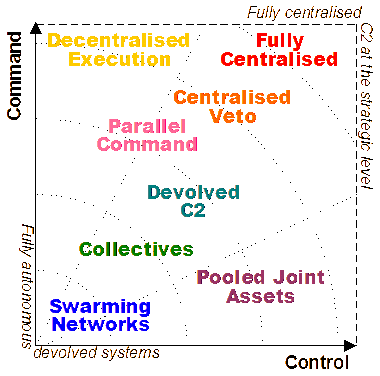
Options and possibilities for past, current and future C2 structures have been explored in previous subsections. These options are presented as nine potential models for C2 in Table 1. In this table, no specific single model or concept of operation is recommended for the ADF. All models are indicative or past, current and future possibilities. A combination of models is likely to represent a best solution to how C2 is conducted in the future.
The range of C2 in these nine models is depicted in Figure 1, which illustrates systems from fully autonomous systems to fully centralised. In this figure, both the Egalitarian communitarianism and Contractual arbitration models are represented by the label ‘Collectives’. Note also that the position in two-dimensional space of the models is not precise and is then illustrative rather than exact. In reality, the levels of C2 across the models are not clear-cut and vary according to interpretation.
Conclusion
The strategic environment is changing and will continue to change into the future. The concepts for C2 explored in this paper have not yet been subjected to rigorous critique or testing in the future strategic environment and are thus not proven to be practical in 2016.l It is not logical, however, to deduce automatically that C2 structures will or must also change. In reality, a combination of all of the models with a core system lying somewhere between centralised veto and decentralised execution has been and will continue to be one of the most robust, practical, and effective C2 structures.
We conclude that no panacea of C2 exists. Instead of focusing on major transformations in C2 structure, a balanced evolutionary approach must be identified for the ADF. The path towards establishing this flexible system of C2 systems must necessarily address the milestones in ADF capability development in a mature and structured manner inline with strategic policy and government guidance. One must also accept fundamental limitations in defence funding, current limits in the ability to deliver capability and implement change and also that the NCW force to be delivered in 2016 is already largely fixed in structure and composition. There is little leeway to deviate from the current Order of Battle in a ten year period. Thus there is little scope to implement radically new models of C2. However, an evolutionary path be identified from the current modus operandi, encompassing the uptake of digitisation and automation using existing practices and doctrine, to the integration of distributed C2 and ultimately collective C2 systems. This evolutionary path establishes the requirement for multiple modes of operation for C2, as the situation demands, concurrently or in sequence. Forces can then seamlessly transition between alternative modes of C2 to meet the complexities of the future operating environment.
| Model | Description | |
|---|---|---|
| 1 | Fully centralised | Absolute consolidation of power in a single governing or authoritative body directly managing and directing all activities. |
| 2 | Centralised veto | Partially decentralised control, subjected to continuous pervasive monitoring by a centralised authority holding veto privileges. |
| 3 | Pooled joint assets | Centralisation of control over a pool of shared assets at the joint level, responsive to requests for resources from all levels. |
| 4 | Decentralised execution | Power to utilise resources and exercise duly invested authority to accomplish objectives in line with higher guidance and intent. |
| 5 | Parallel command | Federated system with authority and intent invested in multiple commands maintaining unity of purpose via a coordination centre. |
| 6 | Devolved C2 | Devolution of C2 to the lowest levels, distribution of authority to tactical entities with reachback to operational support centres. |
| 7 | Swarming networks | Fully autonomous system with emergent C2 structures arising from social networks and ad hock teaming. |
| 8 | Egalitarian communit-arianism | Governance of C2 by means of consensus decision, reached by process of communal discussion and debate. |
| 9 | Contractual arbitration | C2 by means of negotiation in a self-regulating environment, utilising arbitration as a mechanism for socially binding contracts. |
Endnotes
a. Such as in the North Atlantic Treaty Organisation [27] NATO Glossary of Terms and Definitions.
b. McMaster et al [26] observe that technologically enabled centralised information systems work well in civilian operations and emergency response systems, citing the United Kingdom’s police operations as an example. The Joint Control Centre embedded within Australia’s proposed jointly manned integrated Headquarters Joint Operations Command [39] will provide a ‘24/7’ centralised response centre for ADF operations.
c. Mikhail Gorbachev, who rose to the position of General Secretary of the Soviet Union in 1985, developed a five-year plan utilising optimised management processes whereby the price of materials, products, and labour was decreed on the authority of government fiat. The resulting system was so brittle and ineffective that it directly contributed to the eventual collapse of the Soviet Union [6].
d. The Vietcong operated a hierarchical C2 structure in the Vietnam War with centralised command. Communications were based on a crude system of paper messages, runners, and personnel communication. However, allied interdiction of communications had little or no effect on the effectiveness of the Vietcong forces [30, p. 16] because there was no practical way to leverage an advantage from that interdiction.
e. Studies of the US Army’s Force XXI, which is highly digitised, information-enabled and ubiquitously connected have noted a debilitating effect on C2 because doctrine, process and organisational structure have not supported the use of new information systems [4, p. 4]. Hence, technological innovation, networking and the sharing of information is inadequate to implement NCW; a fundamental change in approach must accompany information transformation.
f. This concept was most recently tested in engagements in Fallujah under Operation Al Fajr (New Dawn) [33].
g. The idea that higher lethality, precision, and range in engagement systems combined with greater automation and unmanned system will lead to fewer personnel in the battlefield.
h. The idea that C2, sensors, and engagement systems will be seamlessly and ubiquitously integrated enabling a force to exert overwhelming military power at a moments notice.
i. With mention to coastal urban regions in particular.
j. This collocation may be necessary for civil unrest but it is not itself sufficient to trigger violence. Extensive research, such as Fearon and Laitin’s [17] study of over 400 minority, ethnic, religious, and regional groups in over 100 countries since 1945, suggests that civil unrest is not specifically related to grievance or cultural friction but is dependent on infrastructure, environmental, and economic factors including poor transportation networks, harsh terrain, weakness in civil-military authority, poor governance, and high unemployment.
k. The Ubiquitous C2 concept developed by Lambert [24] and Lambert and Scholtz [25] describes addresses some of the aspects discussed in the nature of commonality in agreement and identity, social coordination, and its implications on command (including authority, responsibility, and competency) and forms of conceptual agreement models (such as contract law).
l. The strengths and weaknesses of these models are examined in Chapter 3 of the working paper: Wheeler, S., (DSTO, In Publication). Understanding Command, Control and Communications: The Future of ADF C3 in Support of Coalition Operations.
References
[1] D.S. Alberts and R.E. Hayes, Command Arrangements for Peace Operations, CCRP Publication Series, Washington DC, 1995.
[2] J. Arquilla and D. Ronfeldt (Eds), In Athena’s Camp: Preparing for Conflict in the Information Age, Monograph Report MR-880-OSD/RC, RAND Distribution Services, Santa Monica CA, 1997.
[3] J. Arquilla and D. Ronfeldt (Eds), Networks and Netwars: The Future of Terror, Crime, and Militancy, Monograph Report MR-1382-OSD, RAND Distribution Services, Santa Monica CA, 2000.
[4] J. Arquilla and D. Ronfeldt, Swarming and the Future of Conflict, Documented Briefing DB-311-OSD, RAND Distribution Services, Santa Monica CA, 2000.
[5] Australian Army, Complex Warfighting, Australian Army’s Future Land Operational Concept, Army Headquarters, Directorate of Future Land Warfare, Canberra ACT, 2004.
[6] Y. Bar-Yam, Making Things Work: Solving Complex Problems in a Complex World, Knowledge Press, Cambridge MA, 2005.
[7] A.K. Cebrowski and J.J. Garstka, “Network-Centric Warfare: Its Origin and Future”, Proceedings of the US Naval Institute, Vol. 124, No. 1, 1998, pp. 28–35.
[8] S. Cocksedge, “The Three Block War and Future Conflict: Some Implications for the Rifle Platoon”, Australian Army Journal, Vol. 3, No. 1, 2006, pp. 267–272.
[9] Commonwealth of Australia, ADF Joint Operational Command and Control, Doctrine Publication ADDP 00.1 (provisional edition), Defence Publishing Service, Canberra ACT, 2001.
[10] Commonwealth of Australia, Force 2020, Doctrine Publication ADDP D.2, National Capital Printing, Canberra ACT, 2002.
[11] Commonwealth of Australia, Foundations of Australian Military Doctrine, Doctrine Publication ADDP D, Defence Publishing Service, Canberra ACT, 2001.
[12] Commonwealth of Australia, Future Warfighting Concept, Doctrine Publication ADDP D.3, National Capital Printing, Canberra ACT, 2003.
[13] Commonwealth of Australia, NCW Roadmap 2005, Defence Publishing Service, Canberra ACT, 2005.
[14] A.H. Dekker, C4ISR Architectures, Social Network Analysis and the FINC Methodology: An Experiment in Military Organisational Structure, General Document DSTO-GD-0313, Defence Science and Technology Organisation, Edinburgh SA, 2002.
[15] A.H. Dekker, “Is Warfare an Art or a Science? Implications for Command and Control Information Technology”, Journal of Battlefield Technology, Vol. 4, No. 3, 2001, pp. 13–17.
[16] S.J.A. Edwards, Swarming and the Battlefield: Past, Present, and Future, Monograph Report MR-1100-OSD, RAND Distribution Services, Santa Monica CA, 2000.
[17] D. Fearon and D.D. Laitin, “Ethnicity, Insurgency, and Civil War”, American Political Science Review, Vol. 97, No. 1, 2003, pp. 75–90.
[18] R.H. Hill, Unmanned Vehicles Offer New Defence Capabilities, Media Release 131/2005, Office of the Minister of Defence, Canberra ACT, 2005.
[19] D. Inbody, C. Chartier, D. DiPippa, and B. McDonald (eds), Proceedings of the Swarming: Network Enabled C4ISR Conference, Joint C4ISR Decision Support Center, McLean VA, 2003.
[20] R.J. Keir, “Time Sensitive Targeting, Operation Allied Force, and its Implications for Australia”, Australian Defence Force Journal, Vol. 159, 2003, pp. 3–16.
[21] C.C. Krulak, “Cultivating Intuitive Decision-making”, Marine Corps Gazette, Vol. 83, No. 5, 1999, pp. 18–22.
[22] C.C. Krulak, “The Strategic Corporal: Leadership in the Three Block War”, Marine Corps Gazette, Vol. 83, No. 1, 1999, pp. 34–39.
[23] C.C. Krulak, “The Three Block War: Fighting in Urban Areas”, Remarks by Krulak to the National Press Club, Vital Speeches of the Day, Vol. 64, No. 5, 1997, pp. 139–141.
[24] D.A. Lambert, “Ubiquitous Command and Control”, In Proceedings of the Information Decision and Control Conference, Adelaide SA, 1999, pp. 35–40.
[25] D.A. Lambert and J.B. Scholz, “A Dialectic for Network Centric Warfare”, In The Future of C2: Proceedings of the 10th International Command and Control Research and Technology Symposium, McLean VA, 2005.
[26] R. McMaster, C. Baber, and R. Houghton, “Investigating Alternative Network Structures for Operational Command and Control”, In The Future of C2: Proceedings of the 10th International Command and Control Research and Technology Symposium, McLean VA, 2005.
[27] North Atlantic Treaty Organisation, NATO Glossary of Terms and Definitions, Allied Publication AAP-6(2006), NATO Standardization Agency, NATO Headquarters, Brussels, Belgium, 2006.
[28] W.W. Parramore, “Defining Decentralised Execution in Order to Recognise Centralised Execution”, Air & Space Power Journal, Vol. 18, No. 3, 2004, pp. 24–26.
[29] R. Pigeau and C. McCann, “Re-conceptualizing Command and Control”, Canadian Military Journal, Vol. 3, No. 1, 2002, pp. 53–64.
[30] T.R. Searle, “Making Airpower Effective against Guerrillas”, Air & Space Power Journal, Vol. 18, No. 3, 2004, pp. 13–23.
[31] N. Sproles, “Dissecting Command and Control with Occam’s Razor or Ask not what ‘Command’ and ‘Control’ means to you but what you mean by ‘Command and Control’”, Australian Defence Force Journal, Vol. 155, 2002, pp. 19–26.
[32] N. Sproles, Establishing Measures of Effectiveness for Command and Control: A Systems Engineering Perspective, General Document DSTO-GD-0278, Defence Science and Technology Organisation, Edinburgh SA, 2001.
[33] J.E. Szepesy, The Strategic Corporal and the Emerging Battlefield: The Nexus Between the USMC’s Three Block War Concept and Network Centric Warfare, Masters Dissertation, The Fletcher School of Law and Diplomacy, Tufts University, Medford MA, 2005.
[34] J.K. Ulloa, How Should the Fires Network for the Future Force BDE Level UA be Structures?, US Army Monograph, School of Advanced Military Studies, US Army Command and General Staff College, Fort Leavenworth KS, 2004.
[35] United Nations, World Urbanization Prospects: The 2003 revision, Department of Economic and Social Affairs, Population Division, New York NY, 2004.
[36] United States Marine Corps, Artillery Operations, Warfighting Publication MCWP 3-16.1, Department of the Navy, Headquarters US Marine Corps Combat Development Command, Washington DC, 2003.
[37] S. Wheeler and G. White, “Swarm or Borg? A Comparison of Distributed and Collective Control”, In Proceedings of the 7th Asia-Pacific Complex Systems Conference, Cairns QLD, 2004, pp. 134—144.
[38] P. Williams, “Transnational Criminal Networks”, In Arquilla, J. and Ronfeldt, D. (Eds), Networks and Netwars: The Future of Terror, Crime, and Militancy, Monograph Report MR-1382-OSD. RAND Distribution Services, Santa Monica CA, 2000, pp. 61–97.
[39] R.G. Wilson, Better Higher Command and Control Arrangement for the Australian Defence Force, Report on the Review of Australian Defence Force Higher Command and Control Arrangements, Australian Department of Defence, Canberra, ACT, 2005.
[40] M. Zanini and S.J.A. Edwards, “The Networking of Terror in the Information Age”, Arquilla, J. and Ronfeldt, D. (Eds), Networks and Netwars: The Future of Terror, Crime, and Militancy, Monograph Report MR-1382-OSD. RAND Distribution Services, Santa Monica CA, 2000, pp. 29–60.