
Volume 10, Number 1, March 2007
Naval Air Defence: Softkill, Hardkill, And Platform Signature Coordination
- 1 QinetiQ, Maritime Weapon Systems Integration, Portsdown Technology Park, Southwick Road, Cosham, Portsmouth, PO6 3RU, UK.
- 2 Department of Aerospace, Power & Sensors, Cranfield University at the Defence Academy of the United Kingdom, Shrivenham, SN6 8LA.
Abstract
Naval air defence is a complex multi-dimensional problem, requiring complex and expensive equipment. In the current military environment, both missiles (hardkill) and decoys (softkill) are used against contemporary threats. These systems all influence the same spectral bandwidth and are often required simultaneously. Only suitable coordination will allow these systems to be used to full performance against the threat. Another consideration is the signature and manoeuvre capability of the defending platform and its influence on the hardkill and softkill systems. This paper provides an overview of the problem of the threat and coordination of softkill and hardkill as an introduction to a series of papers on the subject of hardkill-softkill coordination.
Introduction
The air defence of maritime platforms is a complex multi-dimensional problem. It is less than 100 years since the first attack on a maritime platform from the air. Since then the defensive problem of maritime platforms has increased, especially so after the introduction of the modern radar-guided anti-ship missiles (ASM). Up until 1962, high-angle rapid firing guns provided air defence for the Royal Navy (RN). Such defence was proved many times during World War 2 to be woefully inadequate, especially against the increasing speeds of aircraft. In 1962, the destroyer HMS Devonshire, brought in to service the first RN guided-weapon system (GWS) called Seaslug, a medium-range beam-riding missile, followed by Seacat (GWS 20) in 1964; both of these are referred to as hardkill systems. Seaslug and Seacat were adequate for defence against aircraft and the ASMs of the time, however, as ASMs became more sophisticated and faster, they became less effective.
In the late 1950s and early 1960s the RN introduced chaff decoys, fired from rocket launchers. The aim of these was to reduce the effectiveness of the radar-guided ASMs by producing a cloud of metallic strips with which to confuse the ASM radar seeker. The first known operational use of chaff in a naval environment was the sea battle of Latakia during the Yom Kippur war fought on the 7 October 1973. Again, to overcome the advances of ASMs, during the early 1980s passive inflatable radar decoys (IRD) were introduced in response to the Falklands campaign. On deployment, the unit inflated producing a large radar cross section (RCS) to confuse the ASM seekers. Advances in ASM technology necessitated the requirement to introduce active decoy rounds (ADR) in the late 1990s. These are referred to as softkill systems.
Since the introduction of ASMs, their technology has advanced rapidly, while countermeasures in the form of hardkill and softkill have advanced at a slower rate. Hardkill and softkill have generally advanced independently, resulting in overlaps of operational use. Such overlaps result in coordination issues during engagements, including performance degradation of specific equipments. Another aspect that is often overlooked in the coordination of softkill and hardkill is the influence of the defending platform signatures during an engagement.
A research programme to identify and quantify the coordination issues is currently underway. The aim of this research is to provide an understanding of the problems associated with an automated response to a threat environment using hardkill, softkill, and platform signatures, for both a single platform and multi-platform scenarios. This programme aims to be completed by 2011.
The anti-ship missile threat
The SS-N-2A (NATO designation STYX) was the first contemporary ASM to enter service in 1959 into the Soviet Navy. It was also the first ASM to be used operationally in the 1967 Arab Israeli six-day war. Since the introduction of this basic system, the technology behind ASM has improved significantly. Currently there are nearly 100 different ASMs around the world using radio frequency (RF), anti-radiation (AR), and electro-optic (EO) guidance packages. These guidance packages range from rudimentary technologies as employed by STYX, through to advanced ASMs using state-of-the-art technology.
The more modern systems with the advanced technology are the ASMs of concern. Generally, they incorporate manoeuvre capabilities designed to reduce the probability of hardkill interception, while also including advanced seeker design to reduce the effectiveness of softkill. ASMs can be fired from a number of platforms (air, surface, sub-surface, and land). A typical engagement sequence for an ASM is: detection, acquisition, target assignment, and launch. Typically kill assessment is not carried out by the parent platform. To reduce the probability of being negated, most ASMs are fired in salvos.
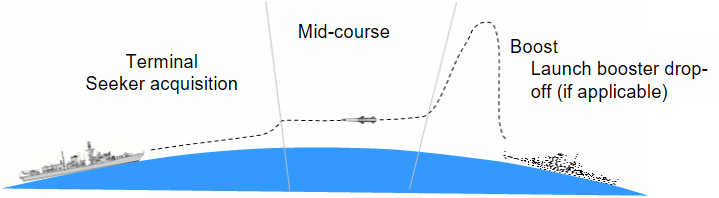
There are three phases of flight for an ASM, boost, mid-course and terminal, Figure 1 depicts the relevant phases for a surface-to-surface engagement. The phase of interest for the defensive coordination problem is the terminal phase. In this phase, the ASM seeker is searching for the target platform, locking on and, if applicable, executing manoeuvres and electronic protection measures, designed to counter defensive systems.
While the maximum range of ASMs varies, they typically break into short- and long-range, and are subsonic or supersonic. Solid rocket propulsion is often used for ASMs with short ranges; such propulsion units provide supersonic velocities, but generally limit the range. To provide extended ranges, many ASMs use subsonic turbojets, often this type of arrangement can be found on sea-skimming ASMs, this technology means the ASM will be slow, but does allow manoeuvres to be executed. To maintain a supersonic velocity but extend the range, often ramjet technology is utilised, however, this limits the manoeuvre capability of the ASM.
Some of the more modern ASMs use hybrid configurations, where through the mid-course a turbojet is used for subsonic flight. Once in the terminal phase the ASM is reconfigured to use solid rocket propulsion, which accelerates the ASM to supersonic velocities for the terminal phase while retaining a manoeuvre capability. Current and future ASM designs will have ever-decreasing signatures, with reductions in RF, EO, and emissions domains. Techniques to reduce RF signatures are similar to that utilised on aircraft, using faceting and radar absorbent material (RAM), especially on the control surfaces and propulsion inlets. The increasing importance of EO signature management will mean that the outer skin and the overall construction will require the use of materials that have a low emissivity, especially for supersonic ASMs.
To reduce the probability of detection of ASMs by a platform, it is highly likely that they will continue to utilise low-altitude trajectories with respect to the radar coverage—that is, sea skimming. This makes initial detection difficult and results in a delayed response time from the platform and hence hard and soft kill engagement are more stressing. The increased stress placed on engagements by terminal manoeuvres such as rapid acceleration, dogleg, weaving and corkscrewing, affecting hardkill more than softkill.
Modern ASM navigation is generally via inertial navigation systems (INS) along with satellite navigation systems (SNS). Such technology allows a number of ASMs to be fired from a single launch platform, to arrive simultaneously at the target platform from different azimuth bearings. Waypoint techniques used to support this are mature, but not prolific in ASM navigation.
Most ASMs use active RF seekers in the I or J band, normally horizontally polarised. Electronic surveillance measures (ESM) are able to detect these frequencies, however, there is an expectation that seeker frequency will increase to M-band, requiring ESM technology to follows. Milli-metric wave (mmW) is also an expanding area for seekers, with the logical transition to imaging capability, which could result in possible target classification.
Dual seeker technology is currently under development, essentially moving in to the multi-spectral guidance packages. There are two primary types of dual seeker, active and passive RF; and RF and EO (mainly IR). While the former are almost available, the latter should be available in the next two decades. About a quarter of ASMs are EO-guided. There are few older ASMs relying solely on IR seekers, it is unlikely that future ASMs would use IR exclusively. However, IR-imaging sensors are becoming increasingly viable as a seeker technology, as stated previously this could allow for the desired target classification capability. EO-guided ASMs are usually not supersonic due to the aerodynamic properties of the required domed nose cones.
Other guided ASMs are known to be in service that includes ‘man-in-the-loop’ methods to maintain targeting integrity. From a platform protection point of view, any passive guidance package will cause problems, primarily through lack of early detection of ASM emissions, requiring a high reliance on the platforms organic sensors and situational awareness to provide initial detection.
Anti-radiation missiles (ARM) are also passive, detecting and locking on to the defending platforms RF emissions. The prime weakness of such ASMs is the lack of frequency bandwidth. ARMs tend to be high divers in order to get a clean RF picture and hence they are more vulnerable to detection than sea-skimming ASMs, but tend to travel significantly faster than most sea skimmers. Generally, these types of ASM are supersonic during the mid phase (often using ramjet propulsion) and slow down during the steep dive in the terminal phase. There are few of these systems in service mainly from the Former Soviet Union (FSU).
Since most ASMs use RF guidance techniques, it is important to understand softkill methods that would disrupt the seeker resulting in the ASM missing its intended target. Softkill methods are based on two premises, the first being the understood physics in which the seeker operates—that is, noise jamming, and the second the design of the ASMs themselves—that is, skirt jamming. A number of softkill techniques including could negate unprotected ASMs:
- noise jamming, broad or narrow band;
- range gate pull off;
- velocity gate pull off;
- image jamming;
- skirt jamming;
- cross-polar jamming;
- cross-eye; and
- false target generation.
However, most contemporary ASMs employ electronic protection measures to mitigate these techniques. ASMs often overcome noise jamming by locking on to the source of the noise, on the assumption it is the intended platform. ASMs employ narrow range and velocity gates to reduce the effectiveness of range and velocity seduction techniques, which include chaff and inflatable decoys. Often ASM range gates are measured in the tens of metres. Good design implementation of the RF elements of a seeker will protect against image, skirt, and cross-polar jamming. False target generation, generates a number of targets that the ASM has to distinguish between them and the intended targets, this technique can easily be overcome by the incorporation of techniques such as Pulse Repetition Frequency Discriminator (PRFD).
Platform protection overview
The coordination problem can be explained in terms of survivability of a single platform. Figure 2 depicts the different levels of survivability versus time. It can be seen that if a platform is hit the capability of the platform is severely degraded. Hence, the only method of preventing such degradation is prevention by management of signatures and coordination of hardkill and softkill. Susceptibility is the first stage of platform survivability. This stage constitutes the primary area of the research. Hence, the coordination of the four primary elements, hardkill, softkill, RCS, and EO signatures are fundamental for the survivability of the platform.
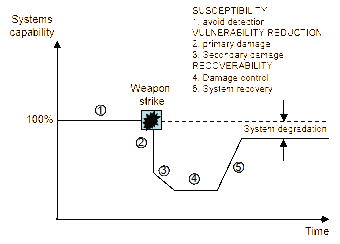
In order to achieve a level of susceptibility required to protect the platform, hardkill, softkill, and platform signatures and manoeuvre require suitable coordination. To achieve this, a comprehensive understanding of the interaction between the systems is required. Two elements exist in the single platform coordination situation. In the first instance, the interactions between hardkill and softkill and in the second instance these interactions with respect to the platform signatures and manoeuvre capabilities.
Single platform coordination
For a single platform, there are a large number of equipments competing for the available spectrum of the normal naval band designations. This competitiveness includes seekers from threats ASM and own missile seekers. As a result, there are interactions between all the various equipments present in such an environment. Figure 3 depicts the system interaction for a typical naval warship, hence, it is clear to see that the number of possible interactions i is given by:
![System interactions [1].](/journals/journal-of-battlefield-technology/volume-10/issue-01/assets/10-1-2-young/figures/figure03.gif)
where n is the number of candidate systems on a platform.
The possible interactions are divided in to three areas:
- Synergistic—interaction between equipments results in a positive influence.
- Neutral—interaction between equipment results in no mutual interference.
- Degraded—interaction between equipments results in a negative influence proving detrimental to platform survival.
The relationship between the differing system areas and the interaction are depicted in Figure 4.
![System interaction behaviours (HK—hardkill, SK—softkill, sig—signature) [2].](/journals/journal-of-battlefield-technology/volume-10/issue-01/assets/10-1-2-young/figures/figure04.gif)
For each of the interactions, there is a direct and indirect influence, examples of these influences are:
- direct:
- platform engaging a previous fired [defending] missile’s booster;
- close-in weapon systems (CIWS) engaging deployed decoys (chaff or ADR);
- chaff-attenuating fire control radars;
- platform jammers degrading ESM equipment;
- indirect:
- non-fatal damage to an ASM by hardkill resulting in unpredictable trajectory;
- unsuccessful intercept of threat by hardkill results in softkill being ineffective; and
- deployment of chaff influences the trajectory of a threat resulting in a deployed hardkill asset (missile) to be unsuccessful.
Platform interactions
In addition to considering platform-based systems, the layout and manoeuvre capability of an individual platform requires consideration. The practical design layout of a platform will more often than not result in blind arcs where a specific system cannot be deployed. In order to reduce the effects of layout limitations, the platform will be required to manoeuvre to ‘unmask’ the required system. Figure 5 illustrates arcs of influence for a platform—it can be seen the main influence is the platform signature. Hardkill and softkill have influential arcs but do not cover the full 360º and overlap on the platform beam. It is important that the arcs of influence are fully understood for each of the platforms in order to understand and plan effectively the coordination of the interacting elements.
Multiple platforms
While single platform coordination is challenging, multi-platform coordination is more challenging. Single platform coordination issues will extrapolated across multiple platforms. In addition, the primary aim of the combined platforms (hereon in known as a fleet), must be considered (that is, the sacrifice of a specific platform may be justifiable under certain circumstances). A number of aspects must be considered with respect to fleet-level coordination including:
- frequency management of the sensors (I-band is notoriously crowded); and
- electromagnetic interference.
The deployment of specific assets may cause unintentional influences. For example, the deployment of an ADR, transmitting similar emissions to the threat may result in other platforms attempting to engage the ADR. Other potential fleet level interference includes:
- Platform 1engaging Platform 2’s hardkill effect or separated booster.
- Platform 1 sensors attenuated by Platform 2’s deployed chaff.
- Platform 1’s jammers interfering with Platform 2’s sensors.
- The deployment of an IRD by Platform 1, results in the threat being seduced on to Platform 2.
Along with all these issues, the fleet needs to ensure enough integrity to maintain normal operations and sea keeping, while also considering the un-masking of specific platforms to allow for suitable deployment of systems against a threat.
Summary
This paper concludes the following:
- Modern ASM threats can be either subsonic or supersonic being powered by a variety of propulsion methods.
- ASMs can initiate high lateral acceleration manoeuvres, unless they are powered by ramjets, where the aerodynamic property of ramjets limits the manoeuvring capability of the ASM.
- ASMs can employ a variety of techniques for electronic protection measures to reduce the effectiveness of softkill techniques.
- ASMs use a variety of seekers for guidance purposes, specifically active and passive RF and EO, including IR and TV-guided ASMs.
- There are three results from hardkill, softkill coordination: synergistic, neutral and detrimental. The aim of this research is to identify how to make use of the synergistic results, while reducing the impact the detrimental effects.
- Coordination issues can be either direct or indirect.
- Platform signatures have a significant impact on the coordination of softkill and hardkill and therefore needs to be understood and managed.
- Each element of the coordination problem has an arc of influence around the platform, often these overlap, but specific systems may have ‘blind arcs’.
- The single-platform coordination problem is exacerbated for multiple-platform environments.
References
[1] Thé Liang and K. Liem, “Integrated Naval Air Defence, Coordinating Hardkill and Softkill”, International Defence Review, June 1992.
[2] Thé Liang, Getting the Act Together”, Jane’s International Defence Review, August 1995.