
Volume 9, Number 3, November 2006
A Framework For Managing Knowledge Gaps
- 1 School of Information Technology and Electrical Engineering, UNSW@ADFA, Australian Defence Force Academy, Northcott Drive, CANBERRA, ACT, Australia, 2600.
Abstract
This article provides a framework for managing knowledge gaps in a decision-making context. Understanding the concept of managing knowledge gaps is harder than understanding the concept of managing the knowledge, which is more tangible. Such a task is made simpler, however, by acknowledging the different sets of skills needed, allowing organisations to allocate, develop, or exercise appropriate processes (within recognised frameworks of content, strategy and infrastructure). Importantly, the adoption of a common framework, while not necessarily changing how business is conducted, allows knowledge managers to communicate clearly, removing ambiguity that may occur when using natural language. After discussing the contextual issues, this paper discusses the characteristics of content gaps, ways to express these gaps, ways to express the strategy gaps, and ways to express the infrastructure gaps. Finally, an example is presented in a commercial context.
Introduction
Knowledge management is a burgeoning field which, thanks to established practices, is relatively straightforward. Unfortunately, gaps will distort the validity of an enterprise’s knowledge, and management of these holes is currently conceptually more difficult than management of the knowledge itself.
A key to management is to define and measure the appropriate entities. This paper provides a framework for managing knowledge gaps, one that can be used to provide definition.
A broad literature search revealed extremely little on frameworks and terminology; little enough that the development of a useful framework can be considered a greenfield activity. Any discussions on knowledge gaps are usually at the macro level, discussing the differences in the general knowledge levels between the ‘haves’ and ‘have nots’ (however that may be defined in the context of the discussion).
The Australian Standards [2] and Australian Defence Force (ADF) Doctrine [4] embody collective wisdom on knowledge management. The doctrine also provides some insight into managing the gaps from a procedural perspective. However, any current discussions are distorted by the use and abuse of natural language—proponents cannot agree on the meaning and scope of terminology.
Haider [8] proposed a taxonomy based on categories of knowledge (physical capital, intellectual capital, relationship management, social capital, and cultural capital), although this is applied in the context of ‘organizational knowledge’. Braunstein [7] lectures on knowledge gaps within the framework of exploitation and exploration.
Both Haider’s and Braunstein’s approaches are not incompatible with the framework described in the paper. Haider’s taxonomical view is orthogonal, while the broad approach of Braunstein is refined by this paper’s proposal.
The framework herein uses content, strategy and infrastructure to support a wide range of uses, not just in terms of those organisations that want to enrich their own knowledge, but also for those organisations and entities that act as knowledge providers for a broader community. Nevertheless, prior to any meaningful discussion, knowledge gap management must be placed in the proper context, that of knowledge management, information and decision making (command and control). (In a military context, ‘decision making’ is a significant part of the ‘command and control (C2)’ function and the terms ‘decision-maker’ and ‘command’ (or ‘commander’) can be used interchangeably in this article.)
After discussing the contextual issues, this paper discusses the characteristics of content gaps, ways to express these gaps, ways to express the strategy gaps and ways to express the infrastructure gaps. Finally, an example is presented in a commercial context.
The knowledge management context
Before discussing the management of knowledge gaps, proponents must understand what knowledge management is, and the importance of the contextual environment.
As stated at the Canadian Royal Roads University website [1]: ‘Knowledge management (KM) is a relatively new term for a very old challenge. KM supports knowledge capture, creation, sharing, storage, retrieval, and applying this knowledge to progress towards organizational, community, or personal goals. We use KM strategies, perspectives, or tools to help with real-life problems and opportunities such as innovation, communications, decision support, and succession planning.’
The Australian Standard [2] acknowledges two principal benefits of undertaking knowledge management: to improve productivity and organisational efficiency, and to promote innovation.
Knowledge gap management (KGM) should be viewed as a conjunct to knowledge management (KM). KGM can be linked to decision-making, innovation and succession planning; the primary benefit of KGM is to ensure that enough knowledge is available for the effective conduct of a business or operation.
Environment
Any enterprise (and hence decision making) is conducted in some contextual environment; which may be defined and understood differently under different circumstances. Definition of this environment is very important in defining the bounds of any knowledge management system; the easiest to define is the physical environment although others may include a political, financial, or information element.
Importantly, these seemingly disparate environments both interconnect and overlap. The amount of influence an environment has on the decision-making process will depend on the proximity of connection. In recognition of human ability, any knowledge management system is unlikely to include aspects from environments without direct links.
The information context—information types
Having introduced Knowledge management, we now look at what constitutes knowledge. A full discussion of the knowledge spectrum is outside the scope of this paper, only the salient points to the management of knowledge gaps are listed.
The interim Australian Standard [2] defines the elements of knowledge management which are used in the context of the knowledge management framework, broadly consisting of people, processes, technology and strategies. The information environment consists of information, intelligence, knowledge, and intuition.
Information
Within the Australian Standard [2], information is defined as data (any manifestation in the environment, including symbolic representations that in combination may form the basis of information) in a context to which meaning has been attributed. Also contained within is the concept of ‘explicit knowledge’; knowledge that has been recorded as information in a document, image, film clip, or some other medium. This latter concept accords with natural understanding of available information.
Within the ADF context [4], information is defined as unevaluated, unprocessed data of any description that may be used in the production of intelligence. However, users of this definition must recognise a level of processing (and thus contextualising) necessary to make this information useable, for example documents may need to be translated or film needs to be developed.
Taking into account the necessary processing to make information useable, both the ADF and the Australian Standard concepts of information are sufficiently consistent, despite having a different emphasis. Neither, however, take the concept of information to the next level, with the addition of understanding or ‘meaningful conclusion’.
Intelligence
The ADF [4] defines intelligence as the product resulting from the processing of information concerning a potential threat, hostile or potentially hostile forces or elements, or areas of actual or potential operations. It is the result of a process involving the evaluation, analysis, integration and interpretation of disparate pieces of information, usually in conjunction with existing information and intelligence, to attempt to clarify a situation and produce meaningful conclusions, assessments and predictions in response to the decision-maker’s intelligence needs.
Intelligence, as a concept, has historically been viewed as a military- (or security-) related activity. Business intelligence, as an activity in the commercial world, is gaining popularity and the lessons learnt from military application can be applied easily in the new environment.
While a full description of intelligence and the processing cycles is outside the scope of this document, these processes are important in differentiating intelligence from other forms of information or knowledge.
Knowledge
Knowledge is defined in the Australian Standards [2] as a body of understanding and skills that is constructed by people. Knowledge is increased through interaction with information (typically from other people).
Knowledge covers more than intelligence, in that it conveys greater understanding. Intelligence does not necessarily guarantee broad understanding, although it is an important part of the decision-making process.
Intuition
The Australian Standard [2] defines tacit knowledge as knowledge that resides in a person’s mind and may include aspects of culture or ‘ways of doing things’. This is the knowledge store that is called upon when a person is asked for their ‘gut feeling’ or intuition. In this aspect, ‘intuition’ is merely using an inbuilt information (or intelligence) store. Within the decision-making processes, this ‘intuition’ is used as another facet of background information.
The decision making context—a systemic C2 paradigm
Knowledge management and knowledge elements are not ends upon themselves. They both serve, along with Knowledge gap management, to enable decision making in the enterprise.
A formal decision-making model is useful in the development of a management framework, so that elements of knowledge gap management can be mapped against business functions or systems.
In formulating this framework (see Figure 1), I used a systemic paradigm [5] extended and modernised from some earlier work by Clive Cooper [6]. While originating from military concepts and terminology, this paradigm clearly applies to all organisations; such mapping is a regular exercise for C3I students at the University of New South Wales at Australian Defence Force Academy.
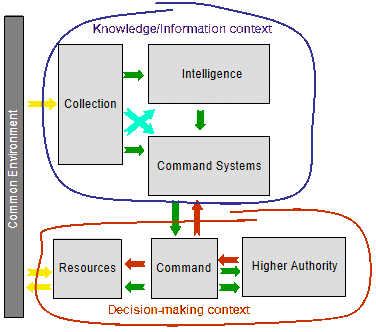
In summary, the paradigm can be seen in two key divides, the knowledge-management context (command support, collection, and intelligence subsystems) and the decision-making context (resources, the decision maker, and a higher authority). A further subsystem (communications—as partially indicated by the arrows) facilitates information flow between all of the other subsystems. A detailed description of the modernised paradigm is outside the scope of this paper.
Drivers
The reason for conducting business, whether in the military, government or commercial sense, is to have some effect on the contextual environment (as previously discussed). An aspect of this environment is the interactions (action and reaction) that occur that cannot be easily modelled within a traditional hierarchical C2 paradigm.
The system is driven and constrained by easily recognisable factors; although these factors will depend on the context and environment that the system exists within. Most of the factors will be expressed through the ‘higher authority’. Some examples are the need for effective resource employment, profits, ethical and moral issues. A consistent factor is the need for optimal decision making—although perhaps in some other contexts the need for innovation or succession planning will be visible.
Collection and intelligence
The collection and intelligence subsystems, important in the filling of knowledge gaps, support the decision maker through the command support subsystem.
The key concept of the collection subsystem is that this subsystem ‘samples’ the environment to obtain information. To that end, there is some ‘processing’ which takes the environmental data and places it in a context so that it is useable as information.
The intelligence subsystem plays an important role in the further placement of the information into a context. Intelligence, in itself, does not provide all knowledge, but (as defined earlier) provides some meaningful conclusions that can be used in the decision process.
Defining the knowledge gaps
As noted, the decision-making paradigm has, at its centre, a knowledge-management (command-support) subsystem. Ultimately, the purpose of this subsystem is to ensure the decision maker (or innovator or planner as the case may be) has the required knowledge to operate effectively.
But having the required knowledge also means recognising in a systemic fashion, the knowledge (and hence the underlying information) that is required. The Australian Standard [3] discusses mapping as part of the knowledge-management cycle.
Out of this mapping, the decision maker can identify where there is an inadequate understanding or where there is something the decision maker just does not know—the knowledge gap. The lack of understanding is most likely to be expressed as a lack of necessary data or information. In a tactically focused organisation, these gaps may be known as critical information requirements (CIRs).
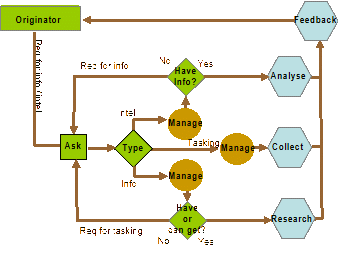
The CIRs become the driver for managing knowledge gaps. Usually the CIRs are unlikely to be answerable immediately and will lead to other activity to enable the gathering of knowledge, as demonstrated in Figure 2.
Content, strategy, and infrastructure
Ultimately, any gap has to be filled with content, in the form of information, intelligence or intuition. But the path to content acquisition is not necessarily easy, and strategies and infrastructure must be considered.
A strategy may need to be devised in order to obtain the information product to meet a content gap. In a mature organisation, many strategies will already exist; but for some organisations an entirely new paradigm may be necessary.
Having identified the need for content and an appropriate strategy to obtain that content, infrastructure may be needed to enact the strategy. Infrastructure will include communications, but would also include any supporting technologies, hardware, and possibly organisations.
The framework elements are heavily interrelated, but with a distinct hierarchy. Content needs strategy, which in turn needs infrastructure. In the other direction, infrastructure enables strategy which, in turn, enables collection of content
The following sections look at content, strategy, and infrastructure gaps in turn.
Content gaps
The content gap is the simplest (and yet most pivotal) of the knowledge gap functions and can only be filled by some sort of information product. The formality of the product will determine if the gap is filled with explicit or tacit knowledge; however, an effectively managed system will require some kind of formal product, thus filling the explicit knowledge base.
A content gap has two perspectives: that of the entity that has the content gap, and that of the entity (or entities) that can provide an information product to fill that gap. The provider is not necessarily within the requester’s organisation or enterprise.
Content gaps can be identified through their continuity as well as the related skill sets. The continuity perspective is usually the concern of the requester, although the provider can use this characteristic to better manager assets. The skills to fill content gaps exist within the provider and are generally outside the concerns of the requester.
One-off or ongoing
The content gap could simply be a one-off. In this case, the gaps are specific, with an identifiable temporal requirement. Conversely, the content gap type could be an ongoing gap, in that the information (or the context in which the information has meaning) is always changing.
Some ongoing gaps may be met at discrete intervals, in which case they can also be considered as recurring one-off gaps. The quarterly Business Activity Statement (BAS) from a company is an ongoing gap for the tax office, but one that is met at discrete intervals. Sometimes these recurrent gaps will also have a limited useful life, in that they may only be ongoing for a defined period.
Other ongoing gaps can only be met as circumstances allow. These gaps are most obvious in the conduct of an enterprise; the meeting of such a gap will trigger a decision point. Another characteristic of this sub-type is that the content will become available from sources within the environment which are outside the control of the decision maker (either directly or indirectly through the higher authority).
Skill Sets to Fill the Content gaps
From the perspective of a knowledge expert (provider), the most important characteristic of content gaps is the skill sets needed to fill that gap. The need to plan resources and organisational structure drives this importance. Two broad options exist, an information product can be collected, or it can be created (through generation or analysis).
Collection
Collecting is simply ‘hunting and gathering’. In some cases, the organisation must undertake specific activity to seek out the data. In other cases, the organisation may harvest the information from sensors which collect this data, inter alia, as a matter of course. While some processing may be necessary to make environmental data useable, the results of collection are clearly raw information.
As with real life ‘hunting and gathering’, the practitioner must be skilled appropriately. A keen knowledge of the environment as well as all methods of sensing the environment is necessary. In addition, the ability to coordinate the efforts to avoid duplication of effort or to avoid missing elements is needed.
Generation
Data may be generated as part of the organisation’s business; this is the role of the resources under the decision maker. The generated data forms part of the environment, but is not ‘collected’ in the same context as described earlier, as it already belongs to the enterprise.
Analysis
Analysts are the industrial flip-side to the ‘hunters and gatherers’ and take the information to add further value. In some circumstances, the resultant product may be viewed as merely refined information; in most cases, the results of such analysis can be considered as intelligence.
‘Analysis’ and the associated term ‘processing’ are words with distinct meaning. However, in natural language, analysts provide more value to the information by evaluating, analysing, interpreting and integrating. As such, the result of an analyst’s work is usually more of a complete processing effort than just analysis.
An important distinction must be made where the analysts are working with data produced from within the enterprise, instead of with data from the general environment. The term ‘intelligence’ implies, through natural language use, a level of secrecy or sensitivity; also reflected within the ADF definition of the word through the focus on the ‘adversary’. Thus, while analysis of internal data could be treated and valued as much as intelligence product, another term (perhaps plain ‘analysis’) should be used.
Intuition
Another important skill set requires the use of tacit knowledge or intuition. Within this skill set, no resources are allocated to the task, other than the human knowledge base from which information is provided. While the knowledge from a person can be valuable, good knowledge management is required to ensure continued value and also to ensure that such experience can be melded with other information or intelligence.
The knowledge contained within a person is based upon culture and environmental experiences that this person has ‘collected’. As such, this experience is used as information. Sometimes the person has evaluated that experience, providing a form of intelligence product. In either case, a full understanding of the value of the information product is important, as this experience will be used to make enterprise decisions.
Expressing the content gap
Identifying the previous sub-classes of content gap allows the gap to be clearly articulated. This is an important step that then allows for resources to be allocated to meet that gap, thus allowing the enterprise to achieve its aims.
Sometimes, information product that would satisfy the content gap may have already been collected or created. In this case, some validation would be required to ensure the product has not gone ‘stale’. The type of request is still important, as it pertains to the type of resources and skill sets used to obtain the information product initially.
The ‘question’
Any expression of a content gap is merely a question to determine the ‘who’, ‘what’, ‘where’, ‘why’, ‘how’, ‘when’, and ‘whither’ (or any combination of these). In most cases, the question will not be pointed towards a specific organisation or resource.
The requester is unlikely to know, or even care, whether the question could be formally identified as a request for information or a request for intelligence. On the other hand, the requested organisation must be very cognisant of the type of question, as this determines the resources and skill sets required to answer the question.
The question will not normally be asked when it is within an organisations power to allocate resources to meet the need. As such, requirements, requests for information and requests for intelligence are usually passed between C2 systems.
Request for information
Information, as discussed previously, results from collection or generation. As such, a request for information may result in the allocation of resources to generate the data, or to collect the data.
The term ‘request for information’, in its simplest form, is a request for a single piece of information, a simple answer to a simple question. The term may, however, be used to refer to ‘information’ as a collective noun without losing meaning.
Request for intelligence
Intelligence results from a degree of analysis (and related processes) to provide meaningful conclusions (usually focussing on the ‘why’ and ‘whither’ aspects). As such, a request for intelligence should result in the application of analyst effort.
Importantly, producing intelligence requires an adequate amount of information. Efforts to produce intelligence, therefore, are likely to result in requests for information or other intelligence.
A request for intelligence is likely to be brokered through the command support subsystem. The ability to meet this request is influenced by information already held with the command support subsystem and the fresh information collected from the environment.
Request for production
A ‘request for production’ may fit within either of the previous two categories, in that production will result in information product which is used as a base for some other decision-related process. The distinction between a request for production and a request for intelligence or information is that the end result is a tangible product that is likely to be on forwarded, rather than used directly by the requesting organisation.
Requesting intuition as content
In some decision-making circumstances (especially those that are time-critical) members’ experiences are likely to be drawn upon. Experience and intuition play an important role in the production of intelligence; such insights can provide valuable context. In this case, the intelligence is requested; the handling of intuition and experience is an internal enterprise consideration.
A ‘request for intuition’ is unlikely to be a formal request from external to the organisation, owing to the questionable nature of the information product provided. For this reason, a ‘request for intuition or experience’ is not considered to be part of the framework.
Requirements
Providers may or may not be able to answer requests depending on the resources at hand and the scope of the request. However, a providing organisation is unlikely to alter any sort of structure or resourcing base due to an external request that (ordinarily) cannot be met within the organisations charter.
A ‘requirement’ is simply a formal direction from a higher authority (as defined in [5]). The providing organisation has the option of requesting more appropriate resources if the requirement cannot be met within the current resourcing base. In addition, if a requirement is stated such that it is outside the providing organisation’s charter, then the providing organisation has the opportunity to confirm the change of direction. As such, requirements are limited to use with the chain of command.
The formalisation of the term ‘requirement’ is necessary, as both natural language use and dictionary definitions provide great scope for ambiguity (in that a requirement may be a formal obligation or an informal statement of need). Such ambiguity will result in confusion when practitioners are talking at cross purposes, when one is expressing a formal direction and the other is interpreting it as a mere desire.
Expressing the strategy gap
While the expressions to fill the content gap are generally communicated between decision systems, sometimes the organisation has the opportunity to directly use resources under its control. This is particularly so if the organisation brokers knowledge on behalf of other entities (such as intelligence agencies or research companies). In these circumstances, the decision maker may simply enact a strategy to obtain or create information.
Strategies usually differ from simple requests for information products in that they satisfy either ongoing requests and/or multiple requests, thus making more effective use of resources.
Sometimes that strategy has not been formulated or expressed. In this case, the requesting organisation cannot be steered to existing portals, and the request becomes recognised as a request for either tasking or operational service.
Request for tasking
A request for tasking is where an organisation is specifically requested to undertake some form of activity (usually to achieve specific results). The focus, in this case, is the requested organisation conducting the specified activity with specified resources.
Politics between organisations are important. An external organisation cannot (or perhaps should not) formally task elements of another organisation. Where such a request occurs, it will normally be provided under some euphemism (such as advisory tasking) ensuring the boundaries of C2 are recognised.
The content gaps and tasking mechanisms are all inter-related and hierarchical. A requirement will provide a driver to generate intelligence, which in turn will lead to requests for information and then, finally, requests to task assets to procure the information. Figure 2 illustrates this cyclic nature.
Request for operational services
An additional strategy to meeting knowledge gaps is the provision of some kind of service to meet an ongoing need. This service is normally a communications service, perhaps backed up by infrastructure or organisational efforts.
Put simply, a request for an operational service is where the requested organisation is asked to conduct activity in support of the requester’s operations. The scope of the request is the level of service, but is usually also bounded by time.
As with tasking (and unlike information and intelligence), operational services are usually enacted by the operational level resources, outside of the specialised knowledge management subsystems.
Expressing the infrastructure gap
Sometimes an organisation cannot meet a valid request for tasking, information or intelligence because the appropriate infrastructure is not in place. So, prior to enacting any strategies or tasking resources, the enterprise must develop the infrastructure.
Request for capability development
Ultimately, any request to develop infrastructure is a request to develop capability. The end result will be tools or processes to enable the flow of information product, not information product itself. However, this request is usually in response to an identified information need or knowledge gap.
This request is not intended to circumvent any project methodology, but is a supporting mechanism to link the creation of capability to identified requirements and knowledge gaps. Prior to creating capability, the requesters must be able to articulate the primary knowledge strategy and content gaps that this capability will meet. Without this pre-requisite information, the capability will be resources seeking a purpose, which is not an effective management strategy.
Summary of ‘expressing the gaps’
The following summarises the vehicles for meeting knowledge gaps:
- Content. The vehicles for expressing content gaps are requirements, requests for production, requests for information and requests for intelligence.
- Strategy. The vehicles for expressing strategy gaps, as an intermediate step to meeting content gaps, are requests for tasking and requests for operational services.
- Infrastructure. The vehicle for expressing an infrastructure gap, which will enable the enactment of strategies to meet content gaps, is a request for capability development.
Such requests may be ongoing or non-ongoing and the ability to have the requirements satisfied will depend on the relationship between the two agents (the requester and the provider).
The requesting organisation will most likely not know within which category their request would fall, and nor would they need to know; the ability to identify the means to fill knowledge gaps assists enterprises in managing resources and the skill sets.
Back to context
The recognition of the distinctions and nuances in this framework allow organisations to deploy high-level strategies or doctrine to achieve their business goals. Importantly, such distinctions can improve clarity of purpose, in turn improving business-level communication and understanding. In some cases, the organisation will be able to allocate specialisations where previously none could be readily identified.
The vehicles for knowledge-gap management can be expressed in terms of the decision-making paradigm discussed earlier. Providing political sensitivities are acknowledged, the flow of requests can be modelled, each form of vehicle within a specific context.
While the decision maker may have information needs, the decision maker may also act as a focal point for information needs (which this enterprise can ultimately satisfy) from either elements within the enterprise, or from external organisations.
Example
How does the above framework apply in the real world? I will use a commercial example to illustrate: a fast-food store (called ‘Joe’s’).
This example is worked around a key knowledge gap: ‘How does Joe’s profit affect the current commercial environment?’ This is a knowledge gap for many organisations within that environment: Joe’s, a competitor and also the local government.
The question to be asked is ‘What does it mean?’ The search for intent or meaning indicates a level of analysis (as in evaluation, analysis, interpretation and integration). In all instances, this would be categorised as a request for intelligence.
To answer the question, the provider must understand the environment (for the sake of this example it assumed that they do, else this will be another knowledge gap to highlight). Another key element would be the level of profit from Joe’s last year. This is an immediate example of how a request for intelligence or knowledge can spawn subordinate requests.
Let us now concentrate on the request to determine Joe’s profit level.
From Joe’s perspective, he can generate the figures, after enacting a strategy to store data over the last 12 months. Joe, having recognised the future potential knowledge gap, identified the information needed, the strategy to gather that information and also developed the infrastructure (such as a shop till) to gather that information.
From a competitor’s perspective (assuming this competitor has no access to Joe’s profit data), he must analyse other information (This example ignores the simple strategy that the competitor could just get the published information from the local government!). In this case, the competitor must put a strategy in place to count the number of customers, to monitor the deliveries and to assess the amount of waste (garbage). The competitor also needs a mechanism to turn this information into useful knowledge (intelligence). The infrastructure needed would include an analyst (for the final data) and collectors (such as other employees) to monitor the other information. This is a different example how a simple knowledge gap will spawn requests for content (intelligence and/or information), strategy and infrastructure.
Finally, from a local government’s perspective, they may simply pass a by-law that profit information is provided to their analysts so they can produce a yearly report. In this case, Joe would see this as a requirement, and put the appropriate infrastructure (which could be as simple as e-mail access or access to the local government web-site) in place. Alternatively, this can be seen as a request for an operational service—which would still engender the efforts to get the right infrastructure in place. The difference between the two is that Joe could offset the expense of the requirement against the local government (such as through tax offsets or rebates).
Conclusion
The management of knowledge gaps, driven by the desire to close them, can be achieved by identifying the resources and skill sets; which fall within the super-sets of ‘generation’, ‘collection’ and ‘analysis’. The vehicles to pass requests acknowledge the differences between the skill sets, and allow organisations to allocate appropriate processes.
These resources and skill sets are derived within the framework of content, strategy, and infrastructure. The framework is further divided into the appropriate request types.
Importantly, the adoption of a common and cohesive framework, while not necessarily changing what occurs, allows knowledge managers to clearly communicate and remove ambiguity that may occur when using natural language.
References
[1] Royal Roads Uni. Grad. Cert. in Knowledge Management site: http://www.royalroads.ca/programs/faculties-schools-centres/faculty-social-applied-sciences/information-society/ckm/, accessed 06 Aug 2005.
[2] Standards Australia, Australian Standard 5037(Interim):2003. Council of Standards Australia, February 2003.
[3] Standards Australia, Australian Standard 5037:2005. Council of Standards Australia, Not yet formally published.
[4] Australian Defence Force, Australian Defence Doctrine Publication 2.0—Intelligence (Draft).
[5] Dyer, A., Dyer’s C3I System. Apr 2004, unpublished
[6] Cooper, C., A Generic C3I System. C1994, currently accessible through http://journal-ci.csse.monash. edu.au/ci/vol01/cooper01/html/.
[7] Braunstein, Y. ‘Knowledge Links and Gaps’ (KM Lecture presentation), accessed 02 Oct 05 through http://www.sims.berkeley.edu/~bigyale/koethen/km/ppt/lecture5.ppt, June 2004.
[8] Haider, S. ‘Organisational Knowledge Gaps: Concept and Implications’. Presented June 2003 at DRUID Summer Conference 2003
http://www.business.auc.dk/druid/conferences/summer2003/abstract/HAIDER.pdf