
Volume 9, Number 2, July 2006
A Comparison Of Civilian And Military Networked Command And Control Systems
- 1 Department of Informatics and Simulation, Defence College of Management and Technology, UK, Cranfield University, Shrivenham, Swindon WILTS SN6 8LA, England.
Abstract
UK military command and control infrastructure is undergoing significant change due to the deployment of systems such as Bowman, introducing a network-enabled capability to support command. This paper reviews how other organisations operate in a networked environment, taking two comparators, one civilian and one military. The civilian comparator was the UK-based motoring organisation, the Royal Automobile Club (RAC), which supports its emergency rescue activities with a Customer Management System, comprising a Microsoft Access database that structures each emergency call and provides an automated response, the aim being to use resources efficiently whilst minimising response time. The military organisation was that of the French Army who have developed their digitised capability incrementally over a period of 20 years. Although there are major differences between RAC and the French military in mission and role, both have incorporated into their command structure a bespoke Information and Communication System (ICS), with resultant benefits in situational awareness, and fast and effective response. The advent of the UK Defence Information Infrastructure (DII) should provide these same benefits and more when it is fully implemented.
Introduction
It is widely acknowledged that current UK tactical headquarters (HQ) were designed and developed to operate under the banner of the Cold War. Considerable effort has been made to keep pace with the changing operational environment; however, this has been undertaken within existing resources.
UK Doctrine has continued to develop, and currently Defence Planning Assumptions (DPA), informed by the threat and the likely scales and concurrency of deployed operations, give guidance to the nature of future deployments. These are distilled into the Joint Higher Level Operational Concept (HLOC), [1,2], which in turn has driven the Future Land Operational Concept (FLOC), based upon the four ‘core concepts’, [3], of Agile Forces (AF), Effects Based Operations (EBO), Directed Logistics (DL), and Network Enabled Capability (NEC) [4]. FLOC relates to a balanced force deployed on expeditionary operations in an allied, coalition, multi-national, and joint context, with a core capability for high-intensity warfighting, operating over extended lines of communication both to and within theatre.
As well as the doctrinal driver, digitisation is a significant catalyst for change as a result of the recent introduction of systems such as JOCS, Cormorant, and Bowman. The enhanced capabilities that these systems provide will form the backbone of the transition to NEC, the key enabler of the FLOC concept.
The twin themes of doctrine and digitisation thus suggest the requirement for a fundamental review and analysis of the nature of future UK field HQs at divisional level, encompassing the roles and tasks expected of HQs, focussing on its outputs and the processes by which they are achieved. This analysis can then be used to inform the nature and structure of the HQ and the staff environment within which the processes are undertaken. This was the theme of a project conducted at the UK Defence Academy, the aim being to examine the nature of future field HQs, considering their agility, structure, and staff processes, including dispersed working, information manipulation and presentation, and to recommend how these issues might be taken forward. To assess how others approach the conduct of command and control, two organisations were considered, one civilian, the other military. The civilian comparator was the UK motoring organisation, the Royal Automobile Club (RAC); the military organisation was that of the French army. This paper summarises the findings of this comparison and relates it to the situation in the UK.
Fundamental NEC concepts and terms
NEC is the ‘key enabler’ for capability development, leading to Knowledge Superiority (KS), and contributing to decision superiority and decisive effect, based upon command judgement. KS requires accurate, timely and relevant information, (that is, Information Superiority (IS)), allowing commanders to make informed decisions and the force then to act decisively by seizing the initiative. For NEC to be effective, joint and multi-national interoperability of systems must be a key user requirement. JSP 777 [4] identifies the three key components of NEC as networks, information, and people.
Information Superiority is defined as possessing a greater degree of information about the battlespace than an adversary, being able to exploit that information more rapidly, and thus preventing the adversary from obtaining or exploiting information which would give combat advantage. IS leads to Decision Superiority (DS) which has as its component parts, Information Management (IM) and Information Exploitation (IX)
IM is the systematic planned acquisition, exploitation, stewardship and disposal of information (in both digital and analogue forms) in order to provide the right information in an appropriate format and a timely fashion for decision and staff processes. Information Exploitation is the sharing and use of information to support situation awareness, planning and decision making, and the co-ordination of desired effects [5].
French army experience of digitisation
As opposed to the UK ‘Big Bang’ approach to digitisation, the French developed their capability incrementally, beginning with a communications concept review in 1982 prior to their national defence review a year later. La Système d’Information pour le Commandement des Forces (SICF) [6] was the first step towards digitisation; a UNIX-based system was introduced into service in 1985. SICF is a land information system to aid the planning and conduct of operations at brigade level and above. It transferred to a Windows-based operating system in 1997 and has undergone constant development. It has been adapted for use by Belgium and Canada (where it is referred to as the LCFS [6]) and is manufactured by THALES, although the software rights are owned by the French military allowing competitive tendering for upgrades and direct military input. Hand-in-hand with this has been the development of the communications bearer systems, something which has been recognised as a key risk for the implementation of UK Defence Information Infrastructure (DII) [5]. Having introduced the higher-level information system, complementary systems for unit and sub-unit level are being introduced for use by SICF.
SICF system overview
The SICF system is a tactical information system, based on Windows 2000 with a full suite of Microsoft Office applications onto which SICF-specific applications are loaded. It is designed to support the planning process and current combat operations, although at present does not support real-time, automatic, position location and reporting. SICF is a trilingual (English, French, and German) system, fully compatible with NATO standards, including APP6A map symbology, APP9 and ADatP3 message formats. It has been designed to allow effective data transfer prior to change of command procedures and is based upon MIP protocols, Microsoft 2000 Exchange Servers, and eXtensible Markup Language (XML) formatting of data. This not only allows the efficient transfer of data but also provides a degree of interoperability with other coalition systems. Connectivity with the Internet can be achieved, although the necessary gateways to ensure the security of the system are not yet in place.
Collaborative working
The collaborative working tools are underpinned by a common file structure in operation across the French army. Collaborative working on an operation order is achieved by the document originator nominating, for each paragraph, a contributor from the HQ staff. Once the document configuration has been established, a calling notice is sent to contributors with a link to the operation order and a time for completion. Contributors can only access those paragraphs which they have been authorised to complete by the originator. Refreshing the message allows all participants to see the current state of progress of the document as a whole. On reaching the deadline the originator sends a stop message to end the collaborative session. Each paragraph has two fields, one for text, and a second for the attachment of reference documents or imagery held on the central web server. As yet SICF collaborative planning does not include an instant messaging or chat room facility to aid the process.
Situational awareness
The lack of a blue force tracker at the tactical level means that real-time situational awareness cannot yet be achieved, leading to a manual updating process, although this does reinforce the culture of maintaining the man-in-the-loop. Information is displayed in the form of overlays called tactical binders, sent via Microsoft Outlook or published onto the public workspace from which any user can access them. Users can subscribe to overlays, which give a visual alert each time that overlay is updated. File permissions govern which data can be updated and in order to aggregate data it must be copied by each user onto their own overlay. This can present a weakness if individual overlays are created, whereby copied information will not be updated when a subscribed overlay is refreshed. File permissions will not allow these overlays to be published, however, and this means that cells may be viewing out-of-date information. Relaxation of the file permissions would mean that information would be more immediately available to all, at the expense of a lack of control of the information flow. In the conflict between integrity of data and immediacy, SICF has opted for reliability. The current situation is displayed within the HQs and managed by the ‘Synthesis’ Cell, which is responsible to maintain the current picture.
Functional tools
SICF offers a wide range of fully integrated mapping, intelligence, logistic, battlespace management, and planning tools, available to all users. The mapping tools use raster, hypsometric or vector data, and enable individually tailored information to be highlighted. Distance measurement and intervisibility tools as well as path profile analysis and 3-D visualisation are available for the Intelligence Preparation of the Battlefield and allow individual staff to conduct preliminary analysis of the ground without expert geographic support. The intelligence toolset is once again available to all users, and is aligned with G3 applications, incorporating a collection plan, Commander Critical Information requirements management (CCIRM), enemy Course of Action (COA) analysis, war-gaming, and an automatic alarm facility should a specific enemy action be observed. Battlespace management is enabled in three dimensions, allowing war-game deconfliction of land and air assets, highlighting conflicts over time.
Logistic planning is fully integrated with G3 tools, supporting asset tracking and logistic demand. The most bespoke toolset is for planning, drawing on the collaborative working techniques mentioned above and presenting the staff with a step-by-step template of the planning process. At each stage the staff product is developed collaboratively and then published for all staff to see. In addition, information from each stage is carried forward to inform the next. Key tools such as the Commanders direction, Synchronisation Matrix, and Decision Support Overlay are available to all. Enemy and friendly COA can be compared, force ratios examined in detail, and war-gaming can be played using operational analysis tools.
The RAC approach
This section reviews the RAC approach to command and control within a commercial digitised environment, and their methods of increasing tempo through the use of decision-support tools to gain competitive advantage. The element of the business studied was that of RAC Roadside, which provides repair and recovery services to its members. In providing this service there are many similarities to the way in which the military operate. For example they require secure communications, situational awareness, asset tracking, tasking, and decision making based on the current situation. The RAC has 2.2 million individual members and a further 4 million corporate customers. They receive 1.4 million calls a year and attend on average to 2.6 million breakdowns a year. Members contact the RAC for assistance on average once every 2½ years, thus the interface with the customer is crucially important. In a competitive market, the customer wants a speedy and effective response. In this sense, the military concept of ‘tempo’ and using digitisation to increase tempo is an exact parallel. Additionally, the RAC needs to match the response to an incident so that resources are used efficiently and effectively and this parallels the military requirement that an incident needs an adequate and timely military response, making effective use of limited resources in the same way.
Customer interface
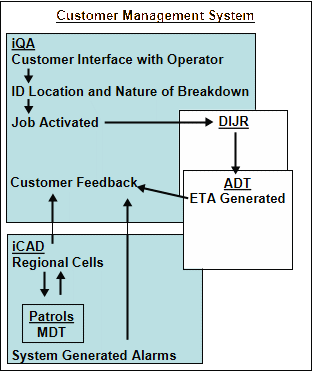
The guiding principle of the RAC customer interface, illustrated in Figure 1, is that the non-technical caller is handled by a non-technical operator, assisted by intelligent Question and Answers (iQA), a Microsoft Access Database with conditional links between fields related to key words entered. Through the use of this flowchart system no piece of information can be lost, vital to tasking the correct resource to the right place. The greatest challenge to the Operator is to identify the customer’s location, using a variety of means such as motorway telephones and marker posts, digital map data incorporating landmarks and points of interest, and access to mobile telephone network location data.
Tasking and despatch
The Customer Management System transfers the job request to despatch cells grouped by geographical area, assisted by the intelligent Computer Aided Despatch (iCAD) system which manages the breakdown to its conclusion. Jobs are filtered into four types ranging from fixing the vehicle at roadside, to removal of a damaged vehicle at a road traffic accident. Dynamic Intelligent Job Routing (DIJR) links the results from iQA to the best resource based upon an exceptions database, the results being passed to Automatic Despatch Technology (ADT) which filters and despatches the jobs to the patrol, many times before the operator has concluded the call with the customer.
ICS
Prior to 2001, RAC Roadside ran its own private radio network for both data and voice communications but, have now made the transition to the Transcom Mobitex packet switched messaging service, a narrowband data-only system. This displays tasking information on a Mobile Data Terminal (MDT), allowing patrols to communicate current status and task progress, exploited by the ADT in prioritising task allocation. This is backed up by mobile phones for voice. In areas with limited coverage General Packet Radio Service (GPRS) is being introduced, although there are concerns over the potential for data traffic to be delayed as voice retains priority over data on the GPRS network. As a final resort, patrols in the most remote areas are issued with Iridium satellite phones. Each patrol has a standalone laptop computer with an electronic technical library and diagnostic testing software, updated monthly. The aspiration is to use the GPRS system for remote web-browser access to the technical library through a central server. It is worthy of note that despite the hostile environment of the patrol van, the laptops are COTS products which have not been ruggedised. As items are damaged they are replaced, allowing for technical refresh and upgrade of equipment as items rarely remain current for longer than 12 months.
Common themes
Both case studies show a long pedigree of involvement with ICS, with a culture of incremental development. This started with the communications bearers, overlaid with an information infrastructure, completed by the software applications. User confidence was retained at each stage, initial user reluctance overcome by a series of iterations of demonstrated capability, leading to user familiarity and hence confidence. Both organisations began the process of digitisation with a fundamental internal review of processes and procedures, identifying where they were going and how they were going to get there. This is a dynamic process and continues throughout the transformation towards digitisation. Both organisations have recognised the benefits gained through standardisation, and the opportunities offered by digitisation have been identified and exploited. In the French HQ the creation of a ‘Reaction’ Cell ensures that fleeting opportunities are taken and not missed. RAC Roadside uses the ADT system to rapidly process patrol availability and recalculate the optimum deployment profile, the aim being to get the appropriate response to the customer within set time limits.
The French approach to force packaging applies not only to the fighting echelon but also to the command and control structure. Rigid standardisation ensures that this modular approach in terms of both infrastructure and personnel is successful. The SICF system itself has developed into a capable tool which closely meets the needs of the staff, with some genuinely potent collaborative applications. Even the French recognise that it is not yet the complete product and certain aspects will be more closely allied to NATO practice than UK HQs are used to, but it still remains a truly effective staff tool.
Software procurement
The French and RAC stand at opposite end of the spectrum with regard to the development of software applications. The rights to the SICF software are militarily owned, which gives a high level of control to its development. It is this responsive nature which has bred user confidence and demonstrated proven capability over the last 20 years. Competition is fostered by ownership of the code ensuring continued value for money as upgrades are required. The RAC on the other hand have used a commercially available system, which is in use by a number of other breakdown services worldwide. This results in best practice being shared around the organisations as software is upgraded to reflect competitive and technological changes. The UK approach occupies the centre ground whereby we cannot aim to own the rights to a bespoke software package with a limited budget. It is unlikely however that the software required by the UK will be in use with other countries thus effectively cancelling the benefits of the RAC position on the software spectrum.
UK information and communication services (ICS)
Having considered the French military and the RAC systems, this section reviews current and incoming UK ICS [8].
Cormorant has been designed to provide a communications capability to enable joint command and control of UK forces at the operational level. It is designed to be flexible and modular in its design with the ability to support small- to large-scale operations, bridging the gap between component commands and strategic systems. It is also capable of interfacing with satellite communications and commercial telephone networks.
Ptarmigan currently provides military trunk communications services. Whilst it was deployed successfully to support operations in Iraq, it is old and is reaching the end of its supported life. Furthermore it lacks strategic mobility (being mounted on a 4t truck chassis), is extremely manpower intensive and limits the passage of data to either 512 or 256 kbps, although in reality it is much less. It is due to be replaced by a combination of Cormorant and FALCON.
FALCON was planned to replace all current military trunk communications systems for the UK, exploiting similar technology to Cormorant, whilst being more robust and mobile in order for it to operate in lower level tactical HQs. Due to the high costs involved and the capability provided by Cormorant the project has currently been delayed and re-profiled within the Equipment Plan (EP).
Bowman is a complete radio system providing secure data and voice services over HF, VHF, UHF and a High Capacity Data Radio (HCDR), deployed from half-section up to formation level, including Corps HQ. The key components from a divisional HQ perspective are the Local Area Sub-system (LAS) which forms the heart of the system, and which will significantly impact on the fabric of future HQs. It replaces the current Clansman harness, Ptarmigan cabling within and between HQ vehicles, intercom cabling and the wide range of ad-hoc cabling required for currently fielded computer networks. The replacement for this array of cabling is a single information bearer with a data rate of 100 Mbps. Furthermore the LAS provides the connectivity between all communication systems within a vehicle and with non-Bowman systems. Hence future calls on Cormorant or FALCON will be made using the Bowman LAS. Bowman is managed by the Communications Management Information System (CMIS), responsible for the management of frequencies, data addresses, the LAS and the configuration of the interfaces to other systems such as SATCOM or trunk communications systems.
Bowman applications will use on a common operating environment of Windows 2000 Professional with all User Data Terminals (UDT) supported by a Battlefield Situational Awareness Module (BSAM), providing blue force tracking and a messaging service enabling the transfer of data including overlays between CPs. In addition UDTs will be supported by additional applications called Battlefield Information Systems Applications (BISA), the most common of which is the Common Battlefield Application Toolset (ComBAT). This provides planning, orders, logistic and geographic tools to support commanders and their staff.
The Joint Operations Command System (JOCS) provides a hardware infrastructure for use by Permanent Joint HQ (PJHQ) staff and the LCC. It has a Windows XP operating system, with MS Office applications and a UNIX-based web-browser, known as JOPWeb. This tool collates operational reports and returns, displaying the most current information through the Joint Operations Picture (JOP). 3 (UK) Division has adopted JOCS as its standard information system hardware for the HQ, whether it is in the LCC role or not.
It is worthy of note that the interface between the Bowman BSAM and the Joint Operations Picture (JOP) displayed on JOCS is not seamless and requires the e-mailing of information between the two, which must be then copied across onto the relevant system by the man-in-the-loop. This results in the information not being real-time, with the potential for manmade errors in terms of operator error or delay. It is intended to address this issue as part of Bowman ComBAT Infrastructure Programme (BCIP) [6].
Army Tactical Computer System (ATacCS) is a ruggedised, deployable computer system for use in HQs from corps to battlegroup level. It uses the Windows NT operating system and was intended to run the Army Command Support Application Suite (ACSAS), to provide a fully integrated package of applications. However, with the exception of the ARRC this has not been taken forward into general service.
Defence Information Infrastructure (DII) is intended to put an end to the plethora of stove-pipe computer systems that have entered into service over the years. It will achieve this by providing a computing infrastructure and services to enable the sharing of information and collaborative working, providing secure interfaces with other national, allied and civil systems, including the Internet. DII(F-D) is the operational, future, deployable capability within the DII project, using Cormorant, FALCON and Bowman as its communications bearer systems, with an Initial Operating Capability (IOC) of 2007.
Conclusions
Summarising the above, it can be seen that the French army have benefited from the long evolution of an integrated communication and information system, spanning more than twenty years. This evolution has kept pace with the advances of technology, resulting in a system that closely matches the requirement, which can be upgraded incrementally as required. The RAC system does not match that of the French army in terms of longevity. There are parallels however, in terms of the integration of the system into the role of the organisation to provide an emergency response to roadside incidents. Clearly, the mission and role of the RAC Roadside organisation is much simpler than that of a highly complex military force with its varied roles in peace and in war. There are useful similarities however in the need for timely and adequate response. The RAC system is designed to assist in the fast allocation of resources to meet a specific need, and the software and communications bearers are an integral part of this process. A military ICS seeks the same advantage through the process of digitisation and NEC. The situation in the UK military is a combination of legacy information and communication systems, with a rollout programme of their replacements. Once fully fielded, the DII should then provide the cohesion that is sorely lacking at the moment with inherently separate, stove-piped systems. It will also enable future progress along the same lines as the French model, following an evolutionary path rather than the ‘Big Bang’ wholesale replacement that is currently occurring.
References
[1] Joint Doctrine and Concepts Centre website, URL: http://www.mod.uk/DefenceInternet/AboutDefence/Organisation/AgenciesOrganisations/JDCC/JdccConcepts.htm.
[2] Starkey and Pepper; NATO Concept Development & Experimentation Conference, Calgary, November 2004. JDCC Paper. URL: http://www.act.nato.int/organization/ transformation/cde04presentations/3novconceptdevelopmentbo/starkey.pdf.
[3] Land Support Strategy website; URL: http://www.ams.mod.uk/ams/content/docs/sse/domain/land%20environ%20guidance/doctrine.htm.
[4] JSP 777 Edition 1. URL: http://www.mod.uk/DefenceInternet/ AboutDefence/CorporatePublications/Reports/OtherPublications/NEC/.
[5] Director General Information—Information Exploitation Documentation URL: http://www.cdma.mod.uk/suppinfo.htm.
[6] Ministere de la Defense armement website; URL: http://www.ixarm.com/-SICF,9355-.
[7] Public Works and Government Services, Canada Website; URL: http://www.pwgsc.gc.ca/ames/text/elect_lfcs-e.html.
[8] Royal Signals website; URL: http://www.army.mod.uk/ royalsignals/equipment/index.html.