
Volume 9, Number 1, March 2006
Use Of Bayesian Belief Networks For Enemy Course Of Action Assessment At The Tactical Level
- 1 Capability Analysis and Doctrine Branch, Army General Staff, PO Box 905, Trentham, Upper Hutt, New Zealand.
Abstract
Bayes’ Theory of conditional probability and efficient algorithms for probability computation together allow a probabilistic approach to expert systems known as Bayesian Belief Networks (BBNs). BBNs facilitate the graphical representation of complex problems and allow users to make expert predictions on the likelihood of a hypothesis in the absence of complete information. As such they seem applicable to the problem solving in the face of uncertainty that characterises enemy course of action (COA) assessment at the tactical level of war. In this paper, BBNs were constructed to reflect two distinct tactical intelligence problems, one based on conventional operations, and one based on peace support operations (PSO). Difficulties were encountered in quantifying the PSO BBN because the intelligence collection plan reflected a requirement to collect information on enemy capabilities as well as intent. Consequently, the BBN had to be modified. Overall, however, it was found that BBNs could be constructed to reflect the tactical enemy COA assessment problem. Nevertheless, it was found that the utility of such BBNs was limited, especially in the conventional environment, because of the likely requirement to modify quantification to reflect actual battlefield factors such as weather and terrain, even for the same set of COA. It was considered that the development of a library of BBN fragments prior to deployment could go some way to alleviate the problem, although mainly in the PSO environment with a slower operational tempo. On the other hand, the modification problem could be solved by making the BBN more general, allowing it to be used as a tactical indicator and warning tool, at least in the PSO environment.
Introduction
Until comparatively recently few expert systems used a probabilistic approach, because complex applications would require huge joint distributions to be specified and no algorithms were available that could efficiently compute the probabilities required when evidence was propagated. However, the application of Bayes’ theorem, with its conditional independence assumptions, reduced the joint probability burden. In addition, during the 1980s, efficient algorithms for probability computation were developed. As Coupé and van der Gaag report, Bayesian Belief Networks (BBNs) have now become widely accepted as “intuitively appealing probabilistic models that are highly valuable in addressing real-life problems in complex domains” [1].
Decision making in the face of uncertainty is a constant characteristic of military operations. The aim of this paper is to investigate whether a BBN approach is appropriate to the domain of enemy course of action (COA) assessment at the tactical level of war.
Bayes’ theory
Basic probability theory often deals with independent, mutually exclusive events. Bayes’ Theorem, by contrast, is based on the concept of conditional probability, where one event is regarded as being conditional on another. Thus, the probability of event B occurring given that event A has already occurred represents a conditional probability relationship and is expressed mathematically as:
Stated formally, Bayes’ Theorem provides the probability of the truth of a hypothesis, H, given some evidence, E, and is expressed mathematically as:
where:
P(H|E) is the posterior probability that H is true given E
P(H) is the prior probability that H is true
P(E|H) is the probability of observing E when H is true
P(E) is the probability of E occurring
For a propositional node, the hypothesis H is either true or false, so:
and:
Now the probability of the evidence, E, occurring can be expressed as:
Bayesian belief network structure
BBNs are represented qualitatively by Directed Acyclic Graphs (DAG). A DAG is made up of nodes and arcs. Nodes represent variables in the expert domain and may be deterministic or random. Deterministic variables may be described by functions, such as maximisation, while random variables are described by a probability distribution. The arcs in a DAG represent the probabilistic dependencies and independencies between variables. The direction of arcs roughly corresponds to causality, reflecting the way humans conceptualise relationships.
Nodes in a DAG can be connected in various ways, for example with serial, converging, or diverging connections. The simplest relationship between variables is a serial connection. In Figure 1, node A is a parent influencing its child, node B, which is in turn the parent of child node C.
Conditional probabilities would be required for P(B|A) and P(C|B). Using Bayes’ Theorem, evidence on either node A or C would update belief in the likelihood of node B. In addition, evidence on either A or C would indirectly update the other through the serial connection with B between them. However, if evidence on B is entered into the network, evidence on A will no longer affect C and vice versa. Thus, in the serial connection shown in Figure 1, A and C are separated by B.
There are various ways in which nodes can be separated, that is, in which communication between nodes can be blocked. “d-separation” is the term used to describe this, defined by Krieg as follows:
“Two variables A and B in a causal network are d-separated if, for all paths between A and B, there is an intermediate variable V such that either the connection is serial or diverging and the state of V is known, or the connection is converging and we have no knowledge of V and its descendents.” [2]
This relationship is illustrated graphically in Figure 2. There is a diverging connection between node A and its children B and C. If A is instantiated, then it d-separates node B from node C, because A blocks communication between B and C. Likewise, by virtue of the serial connection between them, node E d-separates D from F when E is instantiated. On the other hand, D d-separates B from C only while D and D’s descendants have no direct evidence. As soon as D or one of D’s descendants is instantiated, it induces dependency between B and C, which are then regarded as being d-connected. In summary, d-separation is used to represent conditional independence.

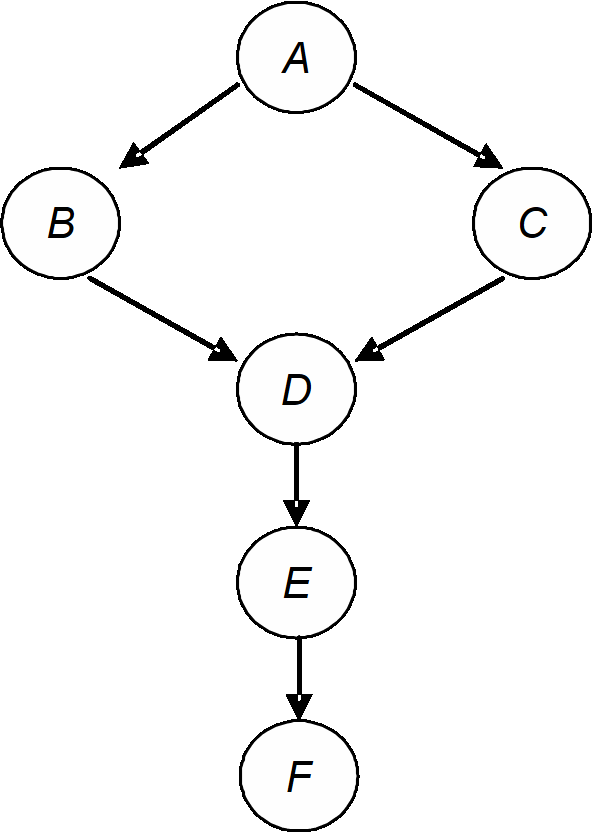
As information becomes available, it is entered into the network as an observation on a node. The network then propagates the evidence among other nodes in accordance with linkages, and updates belief in those other nodes in accordance with their probabilistic dependencies using Bayes’ Theorem. For a parent node, only a prior probability distribution must be defined. By contrast, for random nodes with several parents, a conditional probability table (CPT) must be defined for every possible combination of parent states.
Overview of the combat intelligence process
For the purpose of this paper, combat intelligence activities at the level of a battle group (BG) headquarters will be examined, where the role of the intelligence staff is to provide advice to the commander and staff on such matters as enemy doctrine, tactics, equipment, strengths and weaknesses, and possible COA.
Whatever the operation or level of war, intelligence support doctrinally follows a cycle consisting of four phases: direction, collection, processing and dissemination. Direction is initiated by formulation of the commander’s Information Requirements (IR), the key measure of effectiveness of the intelligence cycle. Intelligence staff will seek to satisfy IR by analysing the enemy, the situation and the battlespace. This information is then used to assist the process of determining what COA are available to the enemy. Once intelligence staff have decided what information they need to satisfy the commander’s IR, they prepare a collection plan, in which own or requesting higher-level sources and agencies (SANDA) are tasked/requested to collect various information. In the Collection Phase, the collection plan is implemented and modified as IR are satisfied or as the tactical situation changes and new IR are generated. In the Processing Phase intelligence is produced through the collation, evaluation, analysis, integration and interpretation of information obtained through the collection plan and assessments from higher and flanking formations. Of these activities, evaluation—the appraisal of information in terms of relevance, reliability, credibility and accuracy—is fundamental. Finally, the Dissemination Phase involves timely dissemination of intelligence in an appropriate format to where it is needed.
It will be remembered from discussion above that Bayes found a way of answering questions as to the probability of an earlier event given that some later event has occurred. The BBN hypothesis would be the possible enemy COA identified during the direction phase of the intelligence cycle. Combat indicators as per the collection plan would become nodes in the network. During the processing phase, the enemy picture would be built up as evidence provided by SANDA during the collection phase were propagated through the network.
Bbn construction
The construction of the BBN model may be broken down into four stages: qualitative, quantitative, verification, and validation. Refinement of the model would also take place, but is not dealt with in this paper. Detail of sensitivity analysis of the networks appears in a subsequent paper and is discussed in summary only here. [3].
For this paper, the Netica programme developed by Norsys has been used to build and manipulate the network. Two scenarios were developed: Scenario 1 involving a fictional conventional enemy, and; Scenario 2 involving the irregular SN militia in a Peace Support Operation (PSO). For each scenario IR were identified and a collection plan developed. The choice of scenarios allowed the examination of two different kinds of tactical intelligence problem.
Qualitative stage
Das suggests a layered approach to DAG construction, starting with root cause variables, which become level one nodes, or parent nodes [4]. Those variables directly influenced by level one nodes are then identified and designated as level two nodes, or child nodes, and so on.
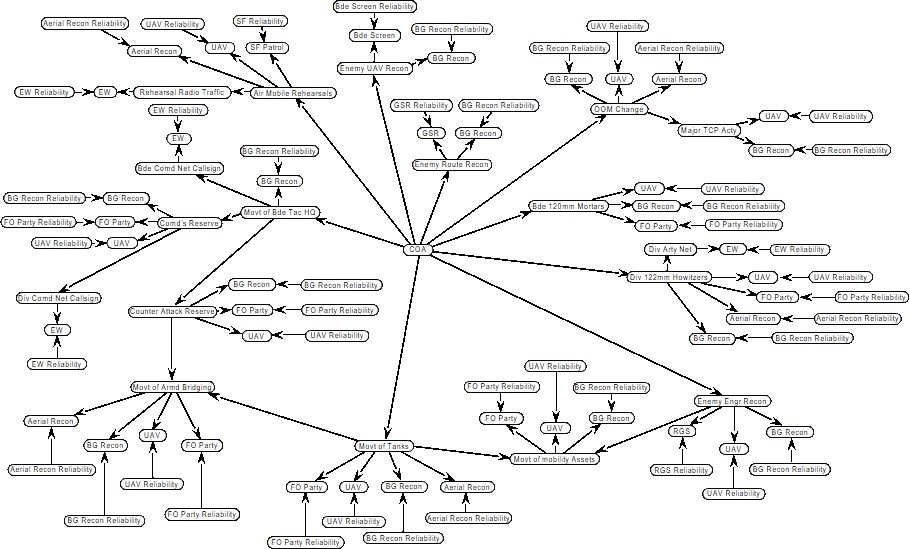
The DAG for Scenario 1 is shown in Figure 3. The enemy COA node is the only level one node in the network. It has four possible states reflecting the four possible enemy COA identified during the initial assessment of the enemy. Most combat indicators are level two child nodes connected directly to the level one COA node. This reflects the causal relationship such that the enemy’s choice of COA will determine the activities in which enemy forces may engage, the equipment used, and routes taken. A few combat indicators are level three child nodes. For example, movement of engineer mobility assets and of armoured bridges will be determined directly by the route taken by armoured elements and only indirectly by the COA chosen. Reports forwarded to the intelligence cell by SANDA assets form the third and fourth levels of nodes. They are all child nodes of combat indicators, since it is the presence of the combat indicators, which allows those indicators to be observed by SANDA assets, and not vice versa. SANDA nodes are also child nodes of a series of reliability nodes. These are included to reflect, but not replace, the fact that information received by an intelligence cell is graded according to reliability and accuracy before any analysis of it takes place. That is, the network must allow the probability of an event to be conditional upon the reliability of the asset reporting an observation of it. It will be noted that for all reliability nodes it is assumed that reliability is constant. This is a simplifying assumption, as reliability would actually change according to determinants such as weather, light, and vegetation. Thus, in a more complete network, SANDA reliability nodes would be child nodes of the determinants of the reliability of any particular SANDA asset. These additional nodes have been omitted in the interests of avoiding further visual complexity.
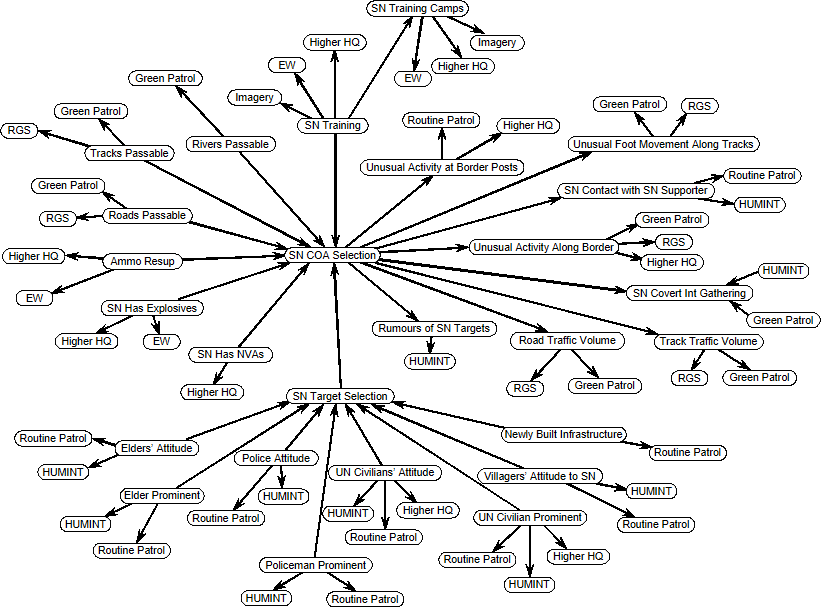
For Scenario 2, a DAG was constructed from the relevant intelligence collection plan, and is shown in Figure 4. As in the Scenario 1 DAG, the COA Selection node is the parent node of various indicator and sensor nodes. However, unlike Figure 3, the COA Selection node is not a root node, but rather is itself a child of various capability indicators. This is because, unlike the conventional scenario, some indicators in the PSO intelligence collection plan relate to SN capability, while other indicators relate to intent, reflecting the requirement to assess enemy capability in order to assess intent in this PSO scenario. For the sake of simplicity, R&S reliability nodes have been omitted in Figure 4.
Quantitative stage
The quantitative stage involves definition of joint probability distributions to reflect all the possible combinations of states of nodes in the network. There are generally two possible sources of probability distributions for a BBN—expert knowledge or data sets.
Thinking of a knowledge domain in terms of probabilities may not be familiar to an expert, however Hill gives three reasons why he believes it is “easy” for experts to think in terms of the probability distributions involved in a BBN: (1) the expert has to think about the probability distribution of only one variable at a time; (2) probability distributions are conditioned on the variables’ parents only; and (3) the conditioning events can be thought of as fixed scenarios [5]. The causal relationship represented by the arcs in the DAG also assists experts in determining probabilities because, according to the developers of Netica, studies have shown that people are better at estimating probabilities in the forward direction [6]. For example, in Scenario 1, an expert would have to answer the question: “If AA1 is the enemy’s main effort, what are chances that the brigade tactical HQ is on that route?”, which is more intuitive than answering the question structured in the reverse: “If the brigade tactical HQ is on AA1, what is likelihood that AA1 is the enemy’s main effort?”.
Another reason for using an expert for BBN quantification is that it is the expert’s knowledge that makes a BBN an expert system, so limiting expert involvement to structural relationships in the DAG may undermine the overall “expert” quality of the BBN. Furthermore, if an expert has been used to construct the DAG, then it may include implicit variables. If data sets are then used to derive probabilities without regard to these implicit variables, weaknesses may be introduced into the network.
However, there are a number of reasons why using expert knowledge may not be the best approach to quantification. First, the expert may be unavailable for the amount of time required to populate the probability tables of a large BBN [7]. Secondly, research has found that experts’ probability estimates are usually not well calibrated and are often subject to a number of biases, although this issue could be addressed during the modification stage [8].
However, while it is often possible to collect datasets in the medical domain, for example, it is generally not possible to collect enemy COA data in the military domain at the tactical level. This is because only generic elements of an enemy COA remain the same from case to case. The details usually vary widely depending on a variety of factors outside the enemy commander’s control, such as terrain, weather, higher-level support available, or imposed doctrine. It could be possible to use simulation to generate data sets. However, although frequency of events in multiple runs of a stochastic battle simulation could conceivably be used to compute probabilities for a BBN, the validity of that data would be limited to such an extent in terms of applicability that it would offer no benefit over using expert judgment, and indeed may actually involve more effort and resources.
A third approach to quantifying a BBN is to combine expert judgment and data. Coupé et al discuss an example of this approach [9]. Initially, a network is roughly quantified. Sensitivity analysis is then used to identify which variables have the most impact on the network output. The probabilities for these influential variables are then replaced with more precise estimates from an expert. This approach reduces the quantification burden placed upon the expert. Coupé et al found that “if, in a poorly-informed quantification, a limited number of highly influential parameters are replaced by more precise estimates, then the network gives predictions that are comparable to the network that is completely quantified with precise estimates” [9]. Although this approach it not explored here, sensitivity analysis described below illustrates how the BBN developed for this paper could be refined with respect to reconnaissance and surveillance (R&S) assets with most impact on updating the model’s hypothesis.
BBN for application to intelligence analysis at the tactical level of war can be expected to have to rely on quantification through experts defining CPTs. The BBN for this paper are illustrative only and have been built using probabilities derived from the author. Likewise, probabilities associated with the R&S asset reliability nodes were also estimated by the author, although it would be possible to study human and electronic R&S assets to determine reliability in various conditions.
A few examples will serve to illustrate how each BBN has been constructed quantitatively. From Scenario 1, the probabilistic relationship between a root node, COA, the lower level node, Brigade 120mm Mortars, and various R&S nodes, is replicated in Figure 5.
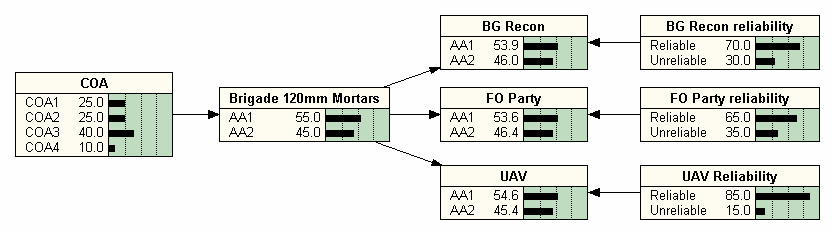
Table 1 shows the prior probability table for the COA node in Figure 5. Each COA state has been assigned a prior probability that reflects its likelihood. COA3 is the most likely COA, COA 4 the most dangerous, and COA 1 and 2 have the same probability of occurrence.
The CPT for the Brigade 120mm Mortars node appears as Table 2. If the enemy has chosen COA1, then there is an 80% chance that the brigade 120-mm mortars will move along AA1, and only a 20% chance that they will take AA2. For COA3, by contrast, the option where the enemy advances on two routes, there is a 55% likelihood that the mortars will use AA1 and a 45% chance that they will move along AA2.
The task of observing the movement of the brigade mortars has been assigned to three R&S assets: BG reconnaissance patrols, FO parties, and a UAV. The reliability of a report from any of these three is determined by their respective reliability node. Taking the UAV node as an example, its reliability probability is shown in Table 3.
The CPT for what the UAV may report given the route taken by the enemy mortars and given the reliability of the UAV is shown in Table 4. For example, if the enemy mortars are on AA1 and the UAV is reliable, then there is a 100% chance it will report observing mortars on AA1. On the other hand, if the mortars are indeed on AA1 but the UAV is unreliable, then there is only a 70% chance the UAV will accurately report observing mortars on AA1.
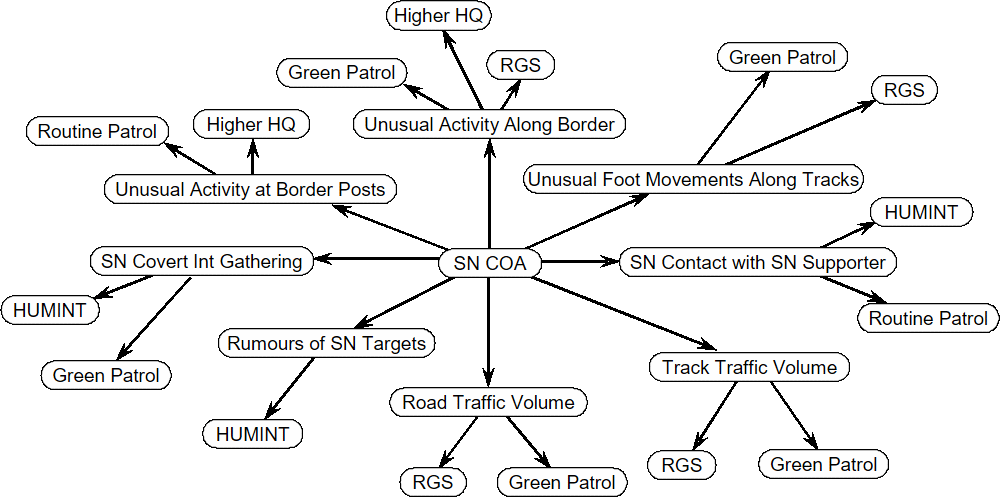
While quantification of the Scenario 1 DAG was relatively straightforward, quantification of the Scenario 2 DAG raised problems. The most obvious aspect of the SN militia DAG as developed from the intelligence collection plan is the large number of arcs going from capability indicators to the COA Selection node, indicating that variables such as track conditions, equipment holdings and training camps determine which COA the SN are capable of carrying out. However, the large number of nodes converging on the COA Selection node translates at the quantification stage into an unacceptably large CPT for that node. There are a few solutions to this problem.
If variables are binary, a noisy OR gate can be used “when any one of a set of conditions (parent variables) is likely to cause a certain event, and this likelihood is not reduced when other conditions in this set are activated. Each cause is considered separately, and the results are then combined using the logical or function” [2]. This is achieved by assuming the presence of an inhibitor, which prevents the updating of the child node even if a parent node is instantiated. So, instead of specifying the conditional probability distribution, only the inhibitor probability needs to be defined. Each parent node inhibitor is assumed to be independent, so if several parent nodes are instantiated at the same time, the probability that the child node remains uninstantiated is the probability of the inhibitor probabilities for the set of instantiated parent nodes [7]. For a noisy AND gate to be applicable, the parent nodes must again be binary, but this time they all have to be present for an event to occur. In the case of SN capability, even though the parent variables of the various COA capability nodes are binary, they do not necessarily constitute a COA capability on their own. For example, the condition of tracks is not necessarily the only determinant of night attacks; possession of NVA equipment could also be required. On the other hand, neither are all variables required for a capability to be present. For example, the SN may need passable tracks to attack a village elder (COA1), but, although ammunition resupply may enhance their capability (for example, make more attacks possible), it may not be necessary for a COA1 capability to be present. Making assumptions in order to satisfy noisy OR and noisy AND distributions would be too restrictive for the Scenario 2 application.
Secondly, the structure of the DAG could be altered. Changing the capability side of the DAG could be achieved by relaxing the assumption that the SN capability to undertake a particular COA is dependent on equipment availability. It could be assumed instead that, if the SN need a particular piece of equipment to carry out an attack, then they request it from their Country X military sponsor. In that case, equipment variables would be indicators of intent. So far so good, but changing the direction of other causality nodes feeding into COA capability does not make sense. So, changing the structure of the DAG will not solve the quantification problem.
The final solution, separating capability from intent in the DAG, is considered the best because, stated another way, the problem encountered in developing a BBN for Scenario 2 is a result of trying to separate analysis of capability and intent. While these can be combined in a DAG being used as an influence diagram, they must be separated out for quantification. This illustrates the point that an expert domain can be modelled through a variety of different DAG but not all will be efficient quantitatively.
The revised SN COA assessment DAG is shown in Figure 6. The structure now resembles that of the Scenario 1 DAG, with a SN COA root node and various levels of indicator nodes. Quantification now also resembles that of the Scenario 1 BBN in principle. Prior probabilities of the node SN COA reflect capabilities as assessed using another means. They also include an implicit variable, namely SN COA preference. This has been included because mere capability does not drive intent. Rather militia objectives also play a role. For example, it has been assumed here that the SN prefers to pursue COA3, perhaps because there is less risk and associated with attacking infrastructure.
Verification
Both BBNs were verified by instantiating nodes and observing whether the evidence was correctly propagated throughout the network, although only examples from the BBN for Scenario 1 is discussed here. Figure 7 shows a branch of the Scenario 1 BBN concerned with movement of the enemy tactical HQ.
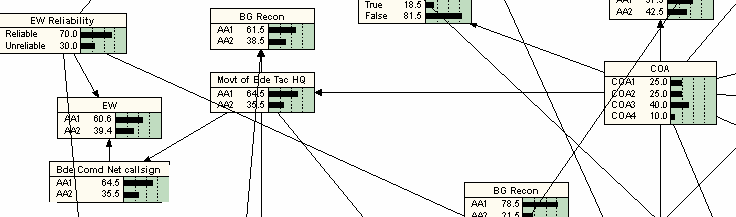
When an EW report advising of location of the brigade tactical HQ callsign on AA1 is received, the EW node in state AA1 is instantiated with the resulting updating of beliefs shown in Figure 8.
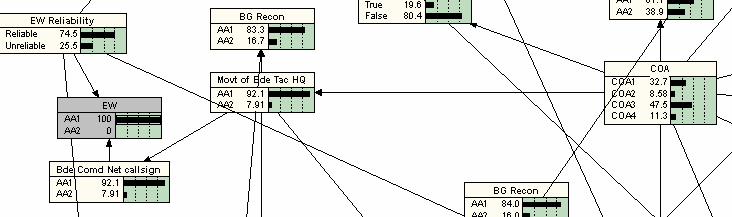
As expected, the COAs which use AA1 have become more likely. The likelihood of the enemy having chosen to follow COA 1 rises from 25% to 32.7%; the likelihood of COA 3 rises from 40% to 47%; and the likelihood of COA 4, the least likely COA, rises the least, from 10% to 11.3%. The likelihood of COA 2, which uses AA2 only, has decreased from 25% to 8.58%. This process is often described as “explaining away” an event with new evidence.
Since COA 3 was the most likely COA and it involves use of AA1, it may have been expected that the likelihood of COA 3 having been selected would increase more than that for COA 1 when the EW node was instantiated for AA1. However, whereas hard evidence in the form of an EW report has been used to instantiate the EW node, only soft evidence has been used to update other nodes as evidence has propagated though the network. Soft evidence is the term used to describe the modification of the hard evidence as it passes through the network. It is modified by the conditional probabilities of intermediary nodes. In this example, the prior probability of the brigade tactical HQ being on AA1 given COA 1 was 90% whereas given COA 3 it was only 80%. This difference reflects the fact that, although there is a possibility that the tactical HQ may move along AA2 in COA 3, the two route advance option, it is still more likely that it AA1 would be chosen as this would be the main effort approach route. So, due to the differences in conditional probability in the intermediary node, the overall likelihood of COA 3 increased less than COA 1, despite the prior probability of COA 3 being higher.
Validation
Validation of the model examines how accurately the network performs when compared with the real world. Norsys recommends grading a belief network using a set of real cases to see how well network predications match actual cases [6]. However, as was discussed above, in the enemy tactical COA assessment domain there is precious little data from real cases to use for model validation. It would be possible to validate a BBN using a historical case, but then the BBN itself would have to have been constructed to model that historical case and would not be transferable to another tactical situation. Data could be generated using a combat simulation model or war gaming. Such generation would be for a specific scenario and situation only, and would therefore be useful for validation of one BBN only. Given the number of BBNs that may need to be constructed to support the possible tactical engagements of an operation, such data generation could be extremely time-consuming. If a BBN had to be modified during an operation, validation using simulation-generated data would be unfeasible due to the tempo of the operation. Furthermore, generating data from a simulation model to validate a BBN model could conceivably introduce an unacceptable level of error into the process, for example, because of biases in the design of each model, or because of failure to take cognisance of assumptions underlying each model at each step of the way. In the face of the lack of real-case data, the two networks developed here have not been validated.
Sensitivity analysis
Sensitivity analysis revolved around varying evidence at selected nodes and observing the range of changes in posterior probabilities at the hypothesis node. Three methods of sensitivity analysis were used to examine the role of information and of sensor nodes.
Robustness analysis looked at the range of probabilities induced at the hypothesis node as individual sensor and information nodes were instantiated in their various states. The results of such analysis could be used to optimise R&S asset allocation, such that emphasis could be placed on collecting information that could have greatest impact on the hypotheses. In this way, unexpected and sudden shifts in posterior probabilities at the hypothesis node could be avoided. It was also found that robustness analysis could be adapted to incorporate the concept of threshold decision making, deriving the same resource allocation guidance to mitigate the effects of sudden changes in posterior probabilities on decision-making using network results.
Value of information analysis used reduction in Shannon Entropy to determine which nodes were most efficient at reducing uncertainty at the hypothesis node. Again, the results of this analysis could be used to guide R&S resource allocation, with emphasis on those variables which do most to reduce uncertainty in the hypothesis node. In a similar way, it was found that gain in belief updating analysis could be used to rank nodes in accordance to which perform best at updating belief at the hypothesis node.
Finally, sensor effectiveness analysis was performed. It was found that this method of sensitivity analysis could be used to optimise allocation of sensors to intelligence collection tasks, so that sensors could be allocated to those tasks they performed best.
Utility of bbns in this application
As an expert system, a Bayesian Belief Network has the advantage of making expertise available to a wide number of people. In a BG HQ a relatively junior or inexperienced officer may be expected to lead analysis in an intelligence cell, often having to rely on a training course rather than expertise when making judgments about enemy intentions based on available information. The utility of a BBN in this situation is obvious.
Any kind of military operation involves a huge amount of uncertainty and information is often patchy and confused. When key pieces of information are missing, the task of analysis is all the more difficult, especially when an analyst is attempting to assess an enemy situation manually. However, due to the presence of conditional and prior probability tables in the network, BBNs can make sense of available information in the absence of perfect information: “Their strength is that they are very robust to missing information, and will make the best possible prediction with whatever information is present.” [6]
Another advantage of a Bayesian approach to intelligence analysis at the tactical level is that it provides transparency to what is sometimes and obscure process. First, the graphical representation of the problem domain in the form of a DAG makes what is often an intuitive process more structured. Secondly, the updating of belief as evidence is entered into the network allows one to view how the enemy situation is developing using a logical approach. Thirdly, a BBN is a system that combines predictions with explanations of how and why a prediction was obtained. Commanders are far more likely to accept the results of an expert system if they can see how a conclusion was reached. Finally, as has been seen from the development of a BBN to support both scenarios here, it is possible to use standard intelligence products in the form of the intelligence collection plan to provide qualitative input to the BBN.
Despite these advantages, there are significant difficulties in using BBNs for tactical enemy COA assessment, due to the variety of factors at play at the tactical level of war, particularly in a conventional or mid-intensity scenario. For any particular type of operation, typical elements can be identified and represented in a DAG. However, prior and conditional probabilities underlying a BBN for particular type of operation can vary substantially from one enemy to another, depending on doctrine, tactics, order of battle (ORBAT), weather, terrain, and so on. Even for the same enemy, probabilities can be greatly influenced by such factors as terrain, weather, light conditions, and mission. Thus, a BBN that may look the same as another qualitatively can actually be quite different quantitatively. Furthermore, even BBNs that began the same quantitatively could require quantitative modification as the tactical situations changed. The intelligence officer on duty at any point of time will be unlikely to have either the technical or the expert knowledge required to competently modify the probability tables in a BBN. Even if personnel were available to modify the BBN as required, this is a time-consuming process, and it is doubtful whether the pace of operations at the tactical level would allow it.
A possible solution to this problem lies in the concept of BBN fragments. Das et al discuss this concept and note that: “since the information requirements and situation assessment needed on the battlefield cannot be fully anticipated beforehand, BNs [BBN] for situation assessment often must be modified and/or expanded to suit the situation for which they are needed. A method is needed for allowing novice users to easily expand BNs [BBN] in a doctrinally sound manner. Our approach to this problem allows users to concatenate previously defined, doctrinally sound subnetworks to form larger BNs [BBN] of relevance to the current situation.” [10] Using their BNet 2000 programme, Das et al show that a library of BBN fragments can be compiled, from which users can build a BBN to suit their need. A user chooses a node to expand and selects a required subnetwork. As a safeguard, BNet 2000 does not permit a user to select a subnetwork that does not logically link to the chosen node. Das et al claim that, “given the appropriate libraries of subnetworks, the user can construct complete BNs [BBN] without ever having to edit single nodes or their conditional probability tables” [10].
BBN fragments could be built to reflect a variety of prior probabilities, but it is hard to imagine that knowledge engineers and experts between them could foresee every possible set of circumstances that may attend a conventional or mid-intensity tactical situation. That is not to say it is not possible to build a library of BBN fragments which varied qualitatively and quantitatively, especially in the lead-up to an operation, but that limitations would have to be accepted, and the benefits of the tool would have to be weighed against the considerable effort that would go into developing the comprehensive BBN library required. On the other hand, in a PSO environment, especially if operations were relatively static and slow in tempo, BBN fragments would be a viable approach. In that case a library of fragments could indeed be developed. Moreover, if the operational tempo allowed it, there would be scope for reachback to an expert to add fragments to the library as the tactical situation in the PSO environment changed.
Moffat and Witty investigate a Bayesian approach to command and control for decisions being made by “high-level commanders” [11]. Similarly, Paté-Cornell and Guikema discuss the use of BBNs to assess the probabilities of various types of terrorist attack in order to prioritise countermeasures, with all the discussion based at the strategic level [12]. Instead of assessing likelihood of enemy COA in detail as is required at the tactical level, they use the network to assess likelihood of generic COAs. Thus, their tool becomes an indicator and warning (I&W) tool, rather than a specific COA assessment tool.
The problems encountered with development of the BBN for Scenario 2 illustrates the difference in the two approaches. The revised Scenario 2 BBN (Figure 6) deals with generic militia COA only. It essentially acts as an I&W tool to alert intelligence staff to the fact that the militia is planning something. Because the possible states in the SN COA node are all generic, the network can update belief and show a large difference between the COA 4 state (nothing planned) and the more active COA 1, 2 and 3, but it cannot distinguish greatly between COA 1, 2 and 3. If the network were to differentiate better between COA 1, 2 and 3, intelligence staff would have to develop a more specific intelligence collection plan to determine the specific nature of the possible COA in motion. This would require a new BBN, containing more specific COA statements and more sensitive indicators, with all the associated quantification and modification problems discussed above. Nevertheless, as an I&W tool, the network could be used to trigger and focus more detailed intelligence collection and analysis.
The final problem associated with using BBNs to assess enemy COA at the tactical level is the lack of means of model validation in the absence of a relevant database. Because the probabilities underlying tactical COA assessment can change so markedly from one case to another, it is unlikely any model would develop a track record of accuracy of predictions sufficient to count as validation. As a result, there could likely be a lack of confidence in the belief updating taking place in the BBN, if not among intelligence staff, then certainly among other HQ staff and the commander. To some extent, this lack of confidence could be mitigated by using the network alongside traditional intelligence analysis. However, if one cannot be sure a model produces accurate results, it would be difficult to justify expenditure of resources on developing and implementing it.
Conclusion
For this paper, two scenarios were created, one for a conventional operation and one for PSO. Using these two scenarios, intelligence collection plans were formulated. Making use of the Netica computer programme, a DAG showing nodes and their interrelationships was constructed for each scenario. The DAG were then quantified by applying prior and conditional probability tables. Verification of the BBNs was performed by instantiating nodes and ensuring the system behaved the way it was designed to. However, because of the lack of suitable datasets, it was found that validation of the models was not possible. If the networks were to be used to support enemy COA assessment on operations, the lack of validation could, at best, adversely affect confidence in the tool. At worst, the unvalidated BBN could produce ambiguous or incorrect results, undermining the advice given to the commander. Sensitivity analysis could be used to assist in R&S asset allocation to optimize their use in providing evidence and to minimize uncertainty at the root node.
While it was found that the BBN for the conventional scenario was fairly simple to structure and quantify, the PSO scenario presented some difficulties. This was because the supporting intelligence collection plan contained a mixture of capability and intent indicators. The causal relationship between capability indicators and the hypothesis node led to a level of convergence that made quantification untenable. Capability had to be separated from intent, so that the BBN was structured with the hypothesis node as a root node exerting causal influence on the various information nodes.
The utility of the BBNs was examined next. It was noted that the qualitative elements of the types of operation at the tactical level could be identified and used to build BBN for a wide variety of tactical COA. However, quantitative elements would be less easy to identify in advance, rendering probable the requirement for an expert to modify a network given an actual tactical situation developed. Not only would this undermine the benefit of developing the expert system tool, it is also probable that the tempo of operations at the tactical level would preclude timely BBN modification. While use of a BBN fragment approach could reduce the requirement for modification, it is unlikely to eliminate it in a conventional or mid-intensity scenario, although in a slower tempo, relatively static PSO environment, a library of BBN fragments is more likely to be a viable approach.
Finally, it was found that, just as has been shown to be the case at the strategic level, a BBN at the tactical level could be simplified and made more generic, minimising the requirement to modify the quantification of the BBN, and allowing the network to be used as an I&W tool. It is expected that this use would be appropriate in a PSO or low-intensity environment only.
References
[1] V.M. Coupé and L.C. van der Gaag, “Properties of Sensitivity Analysis of Bayesian Belief Networks”, Annals of Mathematics and Artificial Intelligence, Vol. 36, p. 323, 2002.
[2] M.L. Krieg, A Tutorial on Bayesian Belief Networks, DSTO-TN-0403, DSTO, Australia, 2001.
[3] A.J. Brosnan, “Sensitivity Analysis of Bayesian Belief Networks in a Tactical Intelligence Application”, Journal of Battlefield Technology, to be published in July 2006.
[4] B. Das, Representing Uncertainties Using Bayesian Network, DSTO-TR-0918, DSTO, Australia, 1999.
[5] J.R. Hill, “Comment”, Statistical Science, Vol. 8, No. 3, p. 258, 1993.
[6] Norsys Software Corp., Using a Bayes Net, URL http://www.norsys.com/tutorials/netica/secA/tut_A1.htm, 2003.
[7] K. McNaught, An Introduction to Bayesian Belief Networks, unpublished lecture notes, Cranfield University, Shrivenham, 2002.
[8] S. French and J.Q. Smith, “Bayesian Analysis”, in S. French and J.Q. Smith (eds), The Practice of Bayesian Analysis, Arnold, pp. 1–24, 1997.
[9] V.M. Coupé, N. Peek, J. Ottenkamp, and J.D. Habbema, “Using Sensitivity Analysis for Efficient Quantification of a Belief Network”, Artificial Intelligence in Medicine, Vol. 17, No. 3, pp. 223–247 November 1999.
[10] S. Das, R. Grey, and P. Gonsalves, “Situation Assessment via Bayesian Belief Networks”, Proceedings of the 5th International Conference on Information Fusion, Annapolis, Maryland, July 2002.
[11] J. Mofat, and S. Witty, “Bayesian Decision Making and Military Command and Control”, Journal of the Operational Research Society, Vol. 53, pp. 709–718, 2002.
[12] E. Pate-Cornell, and S. Guikema, “Probabilistic Modelling of Terrorist Threats: A System Analysis Approach to Setting Priorities Among Countermeasures”, Military Operations Research, Vol. 7, No. 4, December 2002.