
Volume 9, Number 1, March 2006
Measuring The Agility Of Networked Military Forces
- 1 Defence Science and Technology Organisation (DSTO) Fern Hill, Department of Defence, Canberra ACT 2600, Australia.
Abstract
Like other militaries, the Australian Defence Force (ADF) is committed to producing a more agile force in the next two decades. As the Enabling Future War Fighting: Network Centric Warfare document [1] states:
Introduction: what is agility?
Like other militaries, the Australian Defence Force (ADF) is committed to producing a more agile force in the next two decades. As the Enabling Future War Fighting: Network Centric Warfare document [1] states:
“Agility allows forces to cope with the unexpected ... NCW [Network Centric Warfare] is central [to agility] as it will enhance the commander’s situational awareness and therefore their ability to anticipate change.”
Agility has been defined as the combination of robustness, resilience, responsiveness, flexibility, innovation, and adapt-ation [2]. The US Army defines agility more simply as “the ability of friendly forces to act faster than the enemy” [3].
Other, richer, definitions of agility exist in a range of different communities, from business to aircraft design. The definition of agility presented here integrates several such definitions into a single coherent concept. In order to determine whether planned military projects will contribute to agility, it is necessary to have metrics which measure the agility of a force. This paper represents a step towards the development of such metrics.
The prototypical example of agility is a man standing on a road with a large truck bearing down on him, as in Figure 1. Agility in this scenario means the ability to see or hear the oncoming truck, and to run or jump out of the way before being run over. This example also shows that agility involves a trade-off between, on the one hand, situational awareness (at what distance does the man see or hear the truck?), and on the other hand, speed of movement (how fast can the man move out of the way?). Better situational awareness means that speed of movement is less critical, and vice versa. In this scenario, the man’s agility is also improved if he has additional response options, such as being able to fly out of the way.

Our prototypical example of agility serves as a metaphor for several levels of agility in the military universe: tactical/operational agility, organisational agility, deployment agility, sustainment agility, acquisition agility, and conceptual agility. In all of them, a military agency must avoid being hit by a metaphorical truck. The contribution of agility to mission effectiveness comes from flexibility in applying and directing force capabilities. Agility is complementary to two other factors contributing to mission effectiveness:
- Capability strength, which refers to the size of a capability, such as the number of hospital beds for a medical mission, or the number and size of bombs on a platform for a strike mission.
- Capability depth, which refers to the duration for which a capability can be sustained, determined by such factors as supplies of ordnance, fuel, and replacement personnel.
The ooda loop
Creating an agile force requires speeding up the so-called OODA (Observe, Orient, Decide, Act) loop shown in expanded form in Figure 2 (loosely based on [27]). The first part of the “Decide” step is the generation of several action options. In practice, this can be rapid, but possibly less effective, if only one option is generated and is then adapted to fit the situation (“fast and frugal” decision-making). However, if adapting this option to fit the situation is difficult, then the speed advantage of generating only one option is lost. The “Decide” step is in general slower, but possibly more effective, if several options are generated, and the best one chosen (“deliberate” decision-making). An agile force will be usable in a wide range of different action options, and hence can be used without the complexity of adapting an inadequate “best option.” Thus, an agile force both simplifies the generation of feasible options, and reduces the effort in adapting the selected option for use.
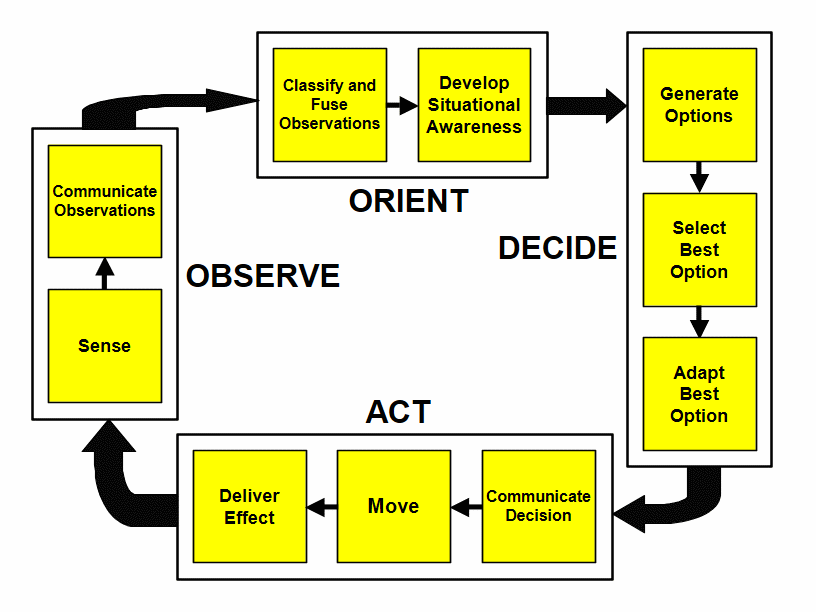
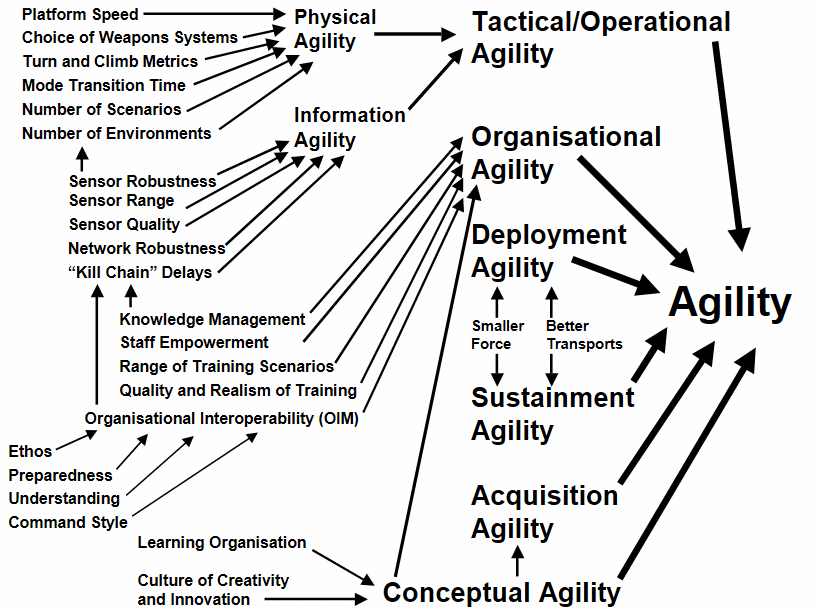
We distinguish six forms of agility, which are illustrated in Figure 3 and discussed further in the following sections.
Tactical/operational agility
Tactical/operational agility refers to the ability to respond to hostile entities on the battlefield, by engaging or avoiding them before they become a threat. This involves:
- The quality of the sensors perceiving the hostile entities, in particular their range and probability of detection.
- The quality of the “kill chain” between sensor and “shooter,” including the quality of the communication links in the chain and the efficiency of organisational processes for handling the sensor information and for decision-making.
- Platform capabilities, including platform speed, the time to switch modes of operation, and the range of options for which the platforms are useful.
Organisational agility
Organisational agility refers to the ability to respond to new kinds of threat by structural rearrangement. For example, the nature of the threat may require the complementary capabilities of units from different countries, such as specific technology from one country, and extensive local knowledge from another. Consequently, the force may need to reorganise to form several multinational teams. The ability to do this rapidly enough will depend on organisational interoperability levels [4]. These organisational interoperability levels will in general be different for intra-service, joint, coalition, and inter-agency operation.
Deployment agility
Deployment agility refers to the ability to transport a force to a (possibly unexpected) location. In general, deployment agility is increased by having larger, faster, more capable transport platforms, and also by having a smaller force composed of easily transported but powerful units. For example, in October 1990, the Europe-based US VII Corps, led by General Fred Franks [5], was directed to plan for deployment to Saudi Arabia. In February 1991, it began ground operations against Iraqi forces. The four-month delay was at least partially due to the sheer size of VII Corps (however, this example does illustrate organisational agility: the change in VII Corps’ mission meant that 60% of its European force was left behind, but additional forces, including a British armoured division, were incorporated).
In contrast, the US Marine Corps [6] is specifically configured for deployment agility, with lighter equipment, and specialised transport ships carrying onboard STOVL (Harrier) aircraft. The US Army is developing deployment agility with the Stryker Brigades [7], which use light armoured vehicles that are more deployable than, for example, Abrams tanks. Stryker Brigade Combat Teams can be air- or sea-deployed to trouble spots around the world in 5 to 14 days [7]. Such deployment agility generally implies a reduction in capability strength and capability depth, but for many missions the improvement in agility is worthwhile.
Sustainment agility
Sustainment agility refers to the ability of deployed units to carry out a range of possible actions without being constrained by logistics limitations. For example, the famous 1991 “hundred-hour” ground war in Iraq and Kuwait [5] could probably not have been significantly extended because of refuelling and other sustainment constraints. Sustainment agility is achieved by having a smaller, more fuel-efficient force, and by having a capable and well-coordinated logistics system which minimises wastage, delays, and misdirected items. Standardised spare parts and ordnance common to multiple platforms also contributes to sustainment agility.
Sustainment agility has progressed surprisingly little over the centuries. In the 19th century [8], a company of 100 men could be supplied for about six days with one horse-drawn wagon, during which time they would march approximately 150 km. A modern US Army tank company of 14 Abrams tanks could be supplied by one 14-kilolitre tanker truck for about four hours, during which time the tanks would also travel approximately the same distance. In other words, continent-wide ground operations have become much faster, but the associated logistics constraints on theatre size have changed little since Napoleon’s day.
Acquisition agility
Acquisition agility refers to the ability of Defence Departments to recognise future threats, to decide which capabilities are needed to counter them, and to acquire the necessary technology and train the required personnel before the threat becomes present. Acquisition agility requires effective strategic analysis, scientific research & development, and acquisition procedures, as well as the use of experimentation to train personnel even before technology is acquired. For example, Heinz Guderian [9] foresaw the need for armoured mobile land forces in 1928, and began training his troops using canvas mock-ups prior to the delivery of real tanks in the 1930s. Unfortunately for neighbouring countries, these tanks were ready to be used effectively in 1939. On the other hand, when then US Army Captain Charlie Beckwith [10] foresaw the need for a US unit with the counter-terrorism capabilities of the British SAS, his 1963 report took 14 years to turn into the formation of an active unit (Delta Force).
Conceptual agility
Conceptual agility is the closely related ability of Defence Departments and other organisations to “re-think” their goals and ways of working, to generate new missions, techniques, and doctrine, by means of innovation and reappraisal of current operations. Conceptual agility requires a learning organisation [11,12] which can adapt as a result of experience, as well as a culture of creativity and innovation. For example, the 3M Corporation has encouraged its staff to spend 15% of their time exploring projects of their own choice, as a means of nurturing innovation [13]. Similar support for innovation allowed the Lockheed “Skunk Works” to produce the U-2 spy plane, the SR-71 Blackbird, the F-117A stealth fighter, and F-22 Raptor [14]. Within the OODA loop, a creative culture (permitting multiple points of view) will simplify the option-generating part of the “Decide” step.
Australian Army doctrine has described such conceptual agility as battle-cunning [31]:
“Battle-cunning is the basis of ‘bottom-up’ innovation in the conduct of tactical land force operations. … The Army’s successful application of battle-cunning is the result of its emphasis on high-quality individual and small team training, combined with an organisational culture which expects innovation and initiative from soldiers and junior leaders, and the Australian cultural traits of pragmatism and anti-authoritarianism.”
This paper will concentrate on possible metrics for tactical/operational agility (considering physical and information aspects separately) as well as possible metrics for organisational agility, as shown in Figure 3. These are the forms of agility most relevant to Network Centric Warfare (NCW), and the other four forms of agility will not be considered further.
Physical agility metrics
Physical agility metrics for tactical/operational agility characterise the agility of platforms. The most obvious contribution to physical agility is platform speed. A fast-moving force contributes to agility by speeding up the “Move” substep of the OODA loop in Figure 2. Another important contributor is the number of different environments in which a platform can operate. For example, a tracked vehicle is generally slower than a wheeled vehicle on roads, but can operate in a wider range of off-road environments. For a force as a whole, the speed and range of environments are limited by the least-capable platform in the force. This was recognised by Guderian in his development of armoured manoeuvre warfare [9]:
“It was clear that the effectiveness of the tanks would gain in proportion to the ability of the infantry, artillery, and other divisional arms to follow them in an advance across country. We wanted lightly armoured half-tracks for the riflemen, combat engineers, and medical services, armoured self-propelled guns for the artillery and anti-tank battalions, and various types of tank for the reconnaissance and signals battalions.”
This range of environments influences the number of the course-of-action options to which the platforms can contribute. Table 1 shows some military environments and some of their characteristics. Also contributing to the range of options is the selection of weapons systems on the platform, such as anti-air, anti-surface, anti-submarine, and non-lethal.
Equally important is the number of scenarios in which platforms can operate: such as major combat, peacekeeping, humanitarian relief, and counter-terrorism. This will generally be measured in terms of a standard list of scenarios, such as the Australian Illustrative Planning Scenarios (AIPS) in Australia [15].
For aircraft in particular, turn and climb metrics are critical for tactical effectiveness. Agile aircraft which are able to turn and climb rapidly have a considerable advantage in combat manoeuvring. Table 2 shows some physical agility metrics for selected US Navy aircraft [16].
Finally, mode transition time is a key physical agility metric. This is the time required to switch a platform from one mode of operation to another. For example, the US Army M109A6 “Paladin” self-propelled howitzer has an into-action time of 45 seconds, compared to 6 minutes for the M198 towed howitzer [17]. Such a difference in agility can be critical, particularly in the presence of counter-battery fire. Mode transition time was also the key to the Battle of Midway in 1942 [18]. During the hour or so required to switch aircraft from ground-attack mode to anti-ship mode (replacing bombs with torpedoes), the Japanese carriers Akagi and Kaga were attacked by US Naval aircraft (and eventually sunk). Figure 3 summarises these physical agility metrics.
| Environment | Characteristics |
|---|---|
| Open country | Good visibility and mobility |
| Forest | Limited visibility and mobility |
| Urban warfare | Specialised equipment and training required |
| Littoral | Amphibious platforms and joint operations required |
| Blue water naval | Air warfare an issue |
| Submarine | Communications an issue when submerged |
| Night | Non-visible-light sensors required |
| Rain/snow/fog | Degraded operation of many sensors |
| NBC threat | Protective equipment required |
| Aircraft | Year | Max speed at altitude (km/h) | Max climb rate (m/sec) |
|---|---|---|---|
| F-3B Demon | 1955 | 1,000 | 60 |
| F-4B Phantom | 1961 | 2,500 | 140 |
| F-14A Tomcat | 1972 | 2,500 | 150 |
| F/A-18A Hornet | 1978 | Over 2,000 | 300 |
Although these metrics are essentially platform metrics, they can be extended to a force as a whole, generally by considering the least capable platform in the force.
Information agility metrics
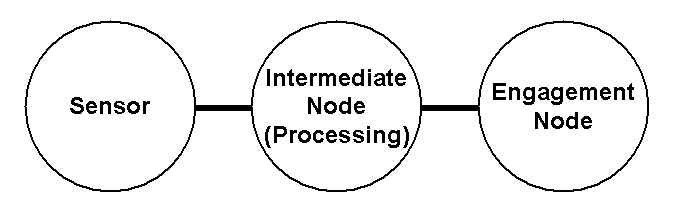
As indicated in the Introduction, physical agility can to some extent be traded off against information agility, which provides notification of threats. Information agility relates to the “kill chain” in Figure 4. The “kill chain” provides a physical implementation of the Observe-to-Act part of the OODA loop in Figure 2. The chain begins with a sensor, and the ability of this sensor to detect threats is determined by its range and probability of detection (the product of sensor area and detection probability provides a simple overall sensor quality metric). However, other sensor quality attributes such as accuracy are also important.
Good quality sensor information not only allows better decisions to be made, but can also assist decision-making because it may suggest tactical options, such as points of enemy vulnerability.
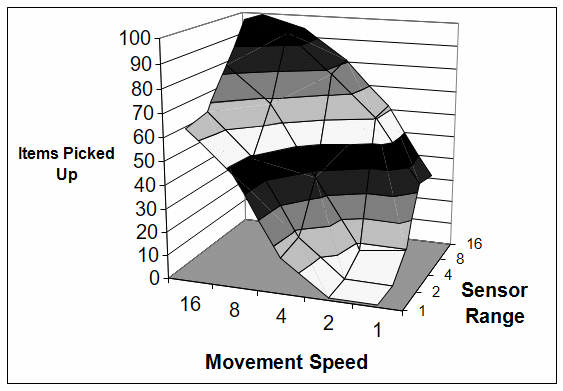
In a simple agent-based simulation experiment [19], where agents were required to locate and pick up items while under fire from a red force, mission effectiveness was as shown in Figure 5. These results show how information agility (in this case, sensor range) and physical agility (in this case, speed) both contribute to effectiveness at the tactical/operational level, and that the combination of the two can be particularly powerful. The nature of the balance between the two in real life can of course only be determined by experiment and experience.
The sensor at the start of the “kill chain” is connected by one or more communications links (with given reliability, bandwidth, and latency) and zero or more intermediate nodes (with given processing time) to an engagement node. The engagement node is responsible for responding to the threat, for example by being the “shooter.” In some cases, the engagement node is on the same platform as the sensor, in which case the communications links will be very fast. The important measure of the “kill chain” is the estimated delay in sending a message from sensor to “shooter,” taking into account:
- delays due to link bandwidth, latency, and technical limitations;
- delays due to transmission procedures;
- delays due to decision-making processes;
- delays due to untrusted information being ignored;
- expected retransmission delays due to link reliability; and
- expected retransmission delays due to misunderstanding of messages by human beings involved in intermediate nodes.
The FINC methodology [20] is one simple way of estimating “kill chain” delays. It also uses the quotient of the sensor quality and the estimated “kill chain” delay as a simple overall metric for overall sensor usefulness. When improving “kill chain” delays, it is important to seek significant delay reductions, and not simply minor improvements. Often, reducing the “kill chain” delay below some threshold will make available new tactical options, such as coordinated attacks.
Typically, the human element in “kill chains” is the dominant factor in delays, which are influenced by the number of intermediate (headquarters) nodes, the efficiency of headquarters procedures, and organisational interoperability levels (which we discuss in the next section).
An example of a less than successful “kill chain” occurred on 11 September 2001 [21], where the first indications of a hijack were noticed at 8:24. The North East Air Defence Sector (NEADS) was notified at 8:38, and at 8:45, the first impact with the World Trade Centre occurred, making the nature of the threat clear. At 9:38, fighter aircraft were launched from Langley Air Force Base, but did not reach Washington before the 9:40 impact of Flight 77 with the Pentagon. Only after this was the US Air Force authorised to shoot down unresponsive passenger aircraft, but it is not clear that these instructions were received and understood by fighter pilots. In this particular scenario, the “kill chain” involved the Federal Aviation Administration (FAA), NEADS, National Command Authority, and the US Air Force chain of command. Such a lengthy chain was simply incapable of a sufficiently rapid response to such an unprecedented threat.
In combat environments, network robustness also becomes important, and is a result of:
- resistance of communications links to jamming or other interference;
- resistance of intermediate nodes to attack; and
- the number of independent pathways from sensor to “shooter,” called the node connectivity, which has a positive impact on performance in simulation experiments [22].
Sensor robustness is also significant, and includes the resistance of sensors to jamming and deception, the number of alternate sensor modalities (such as radar, infrared, and visible-light), and the number of alternate sensor platforms (such as UAVs and aircraft). As well as providing more reliable information, sensor robustness also supports operation in different environments and scenarios.
Figure 3 summarises these information agility metrics, which combine with physical agility metrics to give a measure of tactical/operational agility.
Organisational agility metrics
At the organisational level, agility comes from the mix of skills in different organisational units, and the ability to reorganise so that different units can work together. The quantity and realism of training for staff and the range of training scenarios are an important part of organisational agility. Staff empowerment is also an important factor in organisational agility [23], since it allows staff to take quick action without waiting for explicit orders. The philosophy of mission command [24] is one way of empowering staff.
The factors contributing to conceptual agility (a learning organisation and a culture of innovation) also contribute to organisational agility. Knowledge management is critical for organisational agility, since inadequate handling of data and processes will not survive a reorganisation.
Finally, the ability of different organisational units to interoperate is an important aspect of organisational agility, and can be measured using the Organisational Interoperability Model, or OIM [4]. For each pair of units in an organisation, an OIM score from 0 to 4 can be calculated by finding the preparedness, understanding, command style, and ethos levels in Table 3, and then taking the lowest of these. The OIM is also useful in estimating “kill chain” delays due to misunderstanding [20].
The OIM level for an organisation as a whole would be the average OIM level over all pairs of units which were expected to work together. The OIM has been applied to the International Force in East Timor (INTERFET) in 1999/2000, and the average OIM level over 15 pairs of countries in that force was 0.5, or 1.2 if only pairings with Australia were considered [4]. The OIM is currently being extended to measure the ability to develop high interoperability levels at short notice [32].
A successful example of organisational agility in the business world was the 1 February 1997 Aikin Seiki fire [25], which destroyed Toyota’s only source of brake fluid proportioning valves. Dozens of Toyota affiliates were able to take over valve production in less than a week, due to a history of staff exchanges, information-sharing arrangements, effective management, trust between people, and a uniform ethos. A less-successful military example was the “Black Hawk Down” event in Mogadishu on 30 October 1993 [20,26], where differences in ethos and limited preparedness (OIM levels of 1 or 2 for some pairs of units) led to blue-on-blue incidents and a 55% casualty rate. Informal social networks also have an important role in organisational agility [30].
Discussion
Agility has been defined by the US Army [3] as “the ability of friendly forces to act faster than the enemy.” However, agility is more than simply speed, and the word “act” in this definition must be understood as referring to the entire OODA loop in Figure 2. Together with capability strength and capability depth, agility contributes to the effectiveness of military forces. We have briefly examined six types of agility: tactical/operational agility, organisational agility, deployment agility, sustainment agility, acquisition agility, and conceptual agility. For the physical and information aspects of tactical/operational agility, and for organisational agility, we have discussed characteristics which are desirable (and possible) to measure. Figure 3 summarises these candidate metrics. One key organisational agility metric is the Organisational Interoperability Model, or OIM [4], summarised in Table 3.
| Preparedness | Understanding | Command Style | Ethos | |
|---|---|---|---|---|
| Level 4: Unified | Complete: normal day-to-day working | Shared | Homogeneous | Uniform |
| Level 3: Combined | Detailed doctrine and experience in using it | Shared comms and shared knowledge | One chain of command and interaction with home organisation | Shared ethos but with influence from home organisation |
| Level 2: Collaborative | General doctrine in place and some experience | Shared comms and shared knowledge about specific topics | Separate reporting lines of responsibility overlaid with a single command chain | Shared purpose; goals, value system significantly influenced by home organisation |
| Level 1: Ad hoc | General guidelines | Electronic comms and shared information | Separate reporting lines of responsibility | Shared purpose |
| Level 0: Independent | No preparedness | Voice comms via phone etc | No interaction | Limited shared purpose |
Tactical/operational agility in particular can be obtained through physically more agile platforms, improved networking technology, and improved organisational interoperability and processes. The necessary balance of investment among these three kinds of agility is an important issue for nations implementing NCW.
We would expect more capable computers with better human-machine interfaces [29] to speed up the “Decide” step of the OODA loop through partial automation, and this would be reflected in shorter “kill chain” delays and possibly also faster mode transition times for some platforms. Improved networking should speed up the communication substeps of the OODA loop, and this would be reflected in shorter “kill chain” delays and improved network robustness. Worthwhile technology investments should produce quantifiable improvements in these and other agility metrics. However, non-technological human factors (including culture, training, and procedures) can potentially produce even greater improvements in agility, and must therefore not be neglected.
Acknowledgements
The author is grateful to Gina Kingston, Elizabeth Newton-Smith, and Ruth Gani for discussions on agility, and to Gina Kingston for comments on an earlier draft of this paper.
References
[1] Australian Department of Defence, Enabling Future War Fighting: Network Centric Warfare, ADDP-D.3.1, 2004: www.defence.gov.au/strategy/fwc/documents/NCW_Concept.pdf.
[2] D. Alberts and R. Hayes, Power to the Edge, CCRP Press, 2003: www.dodccrp.org/publications/pdf/Alberts_Power.pdf.
[3] US Department of the Army, Field Manual FM1-111: Aviation Brigades, 1997: www.cavalrypilot.com/fm1-111/toc.htm.
[4] T. Clark and T. Moon, “Interoperability for Joint and Coalition Operations,” Australian Defence Force Journal, Vol. 151, pp. 23–36, 2001: www.defence.gov.au /publications/dfj/adfj151.pdf.
[5] F. Franks and T. Clancy, Into the Storm: A Study in Command, Sedgwick and Jackson, 1999.
[6] T. Clancy, Marine: A Guided Tour of a Marine Expeditionary Unit, HarperCollins, 1997.
[7] A. Vick, D. Orletsky, B. Pirnie, and S. Jones, The Stryker Brigade Combat Team: Rethinking Strategic Responsiveness and Assessing Deployment Options, RAND Report MR-1606-AF, 2002.
[8] M. van Creveld, Supplying War: Logistics from Wallenstein to Patton, 2nd edition, Cambridge University Press, 2004.
[9] H. Guderian, Panzer Leader, Penguin, 2000 (English translation first published 1952).
[10] C. Beckwith and D. Knox, Delta Force, Harcourt Brace Jovanovich, 1983.
[11] P. Senge, “Building Learning Organisations” in Organisation Theory: Selected Readings, 4th edition, D. Pugh, ed., Penguin, 1997.
[12] L. Warne, “Understanding Organisational Learning In Military Headquarters: Findings From A Pilot Study” in Proceedings of the 10th Australasian Conference on Information Systems, Wellington, New Zealand, December, 1999: www.vuw.ac.nz/acis99/Papers/PaperWarne-026.pdf.
[13] 3M Company, A Century of Innovation: The 3M Story, 2002: www.3m.com/about3M/century/index.jhtml.
[14] B. Rich and L. Janos, Skunk Works: A Personal Memoir of My Years at Lockheed, Warner, 1994.
[15] A. McCarthy, G. Kingston, K. Johns, R. Gori, P. Main, & E. Kruzins, Joint Warfare Capability Assessment - Final Report: Australian Joint Essential Tasks Voume. 1, DSTO Report DSTO-CR-0293VOL1, June 2003.
[16] S. Wilson, Combat Aircraft since 1945, Aerospace Publications, Canberra, 2000.
[17] GlobalSecurity.org, US Ground Warfare Systems, web site, 2005: www.globalsecurity.org/military/systems/ground.
[18] G. Prange, Miracle at Midway, Penguin, 1983.
[19] A. Dekker, “Simulating Agility for Networked Military Systems,” unpublished manuscript.
[20] A. Dekker, “C4ISR, the FINC Methodology, and Operations in Urban Terrain,” Journal of Battlefield Technology, Vol. 8, No. 1, March 2005.
[21] J. Weisman, “Shoot-down Order Issued on Morning of Chaos,” USA Today, 16 September 2001: www.usatoday.com/ news/nation/2001/09/16/pentagon-timeline.htm.
[22] A. Dekker, “Simulating Network Robustness: Two Perspectives on Reality,” Proceedings of SimTecT 2004, Canberra, Australia, 24–27 May 2004: www.acm.org/ ~dekker/Dekker.SimTecT.pdf.
[23] Agility International web site: www.agility.co.uk/ai.html Version 5.5, December 2004.
[24] R. Leonhard, The Art of Maneuvre: Maneuvre-Warfare Theory and AirLand Battle, Presidio, 1991.
[25] D. Watts, Six Degrees, Vintage Press, 2003.
[26] M. Bowden, Black Hawk Down, Bantam Press, 1999.
[27] M. Fewell and M. Hazen, Cognitive Issues in Modelling Network-Centric Command and Control, DSTO Report DSTO-RR-0293, May, 2005.
[28] D. Lambert and J. Scholz, “A Dialectic for Network Centric Warfare,” Proceedings of the 10th International Command and Control Research and Technology Symposium (ICCRTS), MacLean, VA, June 13–16, 2005. Available online at www.dodccrp.org/events/2005/10th/CD/papers/016.pdf.
[29] L. Dong, R. Gani, and J. Hayward, Agility in C4ISR Emerging Technology, DSTO Technical Report, 2005.
[30] S. Atkinson & J. Moffat, The Agile Organization, CCRP, 2005: www.dodccrp.org/publications/pdf/Atkinson_Agile.pdf.
[31] Australian Army, The Fundamentals of Land Warfare, 1998.
[32] G. Kingston, S. Fewell, and W. Richer, “An Organisational Interoperability Agility Model,” Proceedings of the 10th International Command and Control Research and Technology Symposium (ICCRTS), MacLean, VA, June 13–16, 2005. Available online at www.dodccrp.org/events/ 2005/10th/CD/papers/158.pdf.