
Volume 9, Number 1, March 2006
Strategic Consequences Of Networking
- 1 Institute for Defense Analyses, 4850 Mark Center Drive, Alexandria, VA 22311-1882, USA.
Abstract
This paper explores the strategic consequences of networking a military force under the assumption that such networking would deliver the combat power increases claimed for them by the Network Centric Warfare doctrine. Because of the large difference in combat power likely to exist under this assumption between networked and non-networked forces, such an exploration requires non-linear models of war in which the protagonists adapt their behaviour to the vagaries of the ongoing battle. We show that even the simplest model able to account for adaptation displays the ability of a networked force to terminate the combat phase of war in relatively short order, but find that termination of combat does not lead to victory unless the surviving enemy force is rendered inert by other means than combat.
Review
Abstract. This paper explores the strategic consequences of networking a military force under the assumption that such networking would deliver the combat power increases claimed for them by the Network Centric Warfare doctrine. Because of the large difference in combat power likely to exist under this assumption between networked and non-networked forces, such an exploration requires non-linear models of war in which the protagonists adapt their behaviour to the vagaries of the ongoing battle. We show that even the simplest model able to account for adaptation displays the ability of a networked force to terminate the combat phase of war in relatively short order, but find that termination of combat does not lead to victory unless the surviving enemy force is rendered inert by other means than combat.
The doctrine of Network Centric Warfare promises both tactical as well as strategic advantages [1]. The conditions under which the tactical advantages could be realized have been discussed in a previous paper [2]. The strategic consequences will be summarized here under the assumption that all the potential tactical advantages described in [2] have in fact been realized.
According to this doctrine, widespread use of information technology would inevitably lead to what the proponents call “information superiority”, a state of affairs in which our side would benefit from a far more detailed picture of the enemy force than the enemy would be able to have of ours. From this position of superiority, our side would naturally come to understand the circumstances surrounding the battle at hand long before the enemy could do the same, and, aided by this “cognitive” superiority, our side should then be able to devise tactical operations that unfold at a significantly faster rate than the enemy reaction speed. This speed differential would succeed in confusing the enemy and paralyzing his will to resist. Under these circumstances, our side should easily be able to seize the initiative, dictate the course of military operations to the enemy, and thus end up destroying his forces in detail at minimum cost to us.
The strategic implication of this story line is that networking leads to war termination because the enemy can not adapt fast enough to the changing circumstances on the battlefield. To understand under which conditions these consequences would represent a strategic advantage, we must therefore develop a way of describing combat which captures the adaptive behaviour of both sides to a conflict. While a number of complex simulation models able to capture the adaptive character of war do exist, we shall avoid the excessive detail they tend to require by developing a simple model of our own. The simplest way to do that is to modify the basic Lanchester equations of combat by introducing in them a mechanism for either side to react to the course of the battle. Let us start with the following general coupled differential equations:
(1)
(2)
where B(t) and R(t) represent the generic combat powers of the blue, respectively, red side, β and ρ stand for their respective abilities to reduce the combat power of the other side, and E the engagement rate, is the probability that the two sides engage each other per unit time. As indicated, the fractional attrition rates β and ρ could, in general, depend upon the two levels of combat power described by B(t) and R(t).
We shall now assume that the engagement rate E is not a constant like it generally is in a Lanchester-type equation, but that it changes with time. Since what an adaptive individual does next is usually determined on the basis of what happened to him before, the engagement rate depends on the time t through the attrition rates, β(B(t−Δt),R(t−Δt)) and ρ(B(t−Δt),R(t−Δt)), that have occurred at time (t−Δt) and those attrition rates were driven, in turn, by the engagement rate that was itself based on attrition rates that occurred at time (t−2Δt). Therefore, in order to reflect the adaptive nature of the model, the engagement rate E(t) must satisfy a differential equation of its own:
(3)
where G(E) is a function of E(t), and possibly of β and ρas well, and whose form determines the specific model one wants to build.
To set-up this equation, we first recognize that the way the engagement rate changes with time depends on decisions made by both protagonists. Therefore, it would be reasonable to factor the engagement rate into two pieces, one each corresponding to one of the two sides:
(4)
Each of these two factors is under the control of the corresponding side to the conflict and each side uses his factor to adjust the degree of his engagement to fit his own perception of what is going on, much like one would turn a water faucet on and off to adjust the water flow. We further assume that each of these two engagement rates, EB(t) and ER(t), can change with time in two different ways: a short-term change reflecting adaptability to perceived changes in the tactical situation, and a long-term change reflecting adaptability to perceived changes in the strategic situation. We describe this by taking each engagement rate to be:
, (5)
where Ti(t) are the tactical factors and Si(t) are the strategic factors.
All that is left to do now, is to specify some simple choices for the various functional dependencies introduced above. We have done so in a separate paper to which the interested reader should turn for the details needed to carry out calculations [3]. The resulting differential equations, taken together with the differential equations for B(t) and R(t) described above, form a set of three coupled equations which are generally non-linear. Explicit solutions for these equations have been calculated in [2] and will be displayed from time to time during the narrative below.
There are four inputs to the model described there: the initial values B(0) and R(0) for the levels of combat power characterizing each side, and the capability that a unit on each side has to reduce the combat power of the other:
(6)
(7)
Their values determine in our model which of the two sides will end-up winning the confrontation. Thus, if:
(8)
the red side eventually wins, otherwise the blue side does. The values of λB and λR for which either side wins are represented in Figure 1 for a given value of R(0)/B(0).
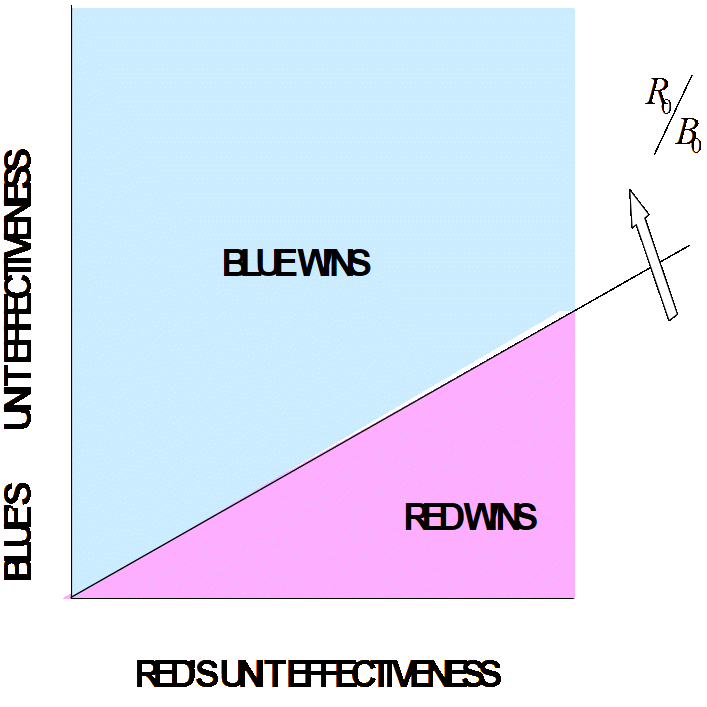
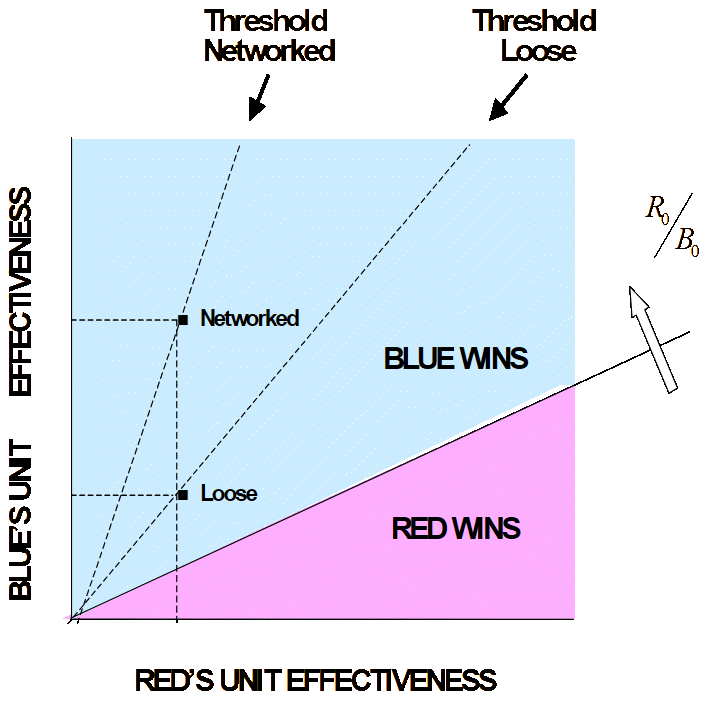
Figure 2. The change in initial conditions allowed by the networking of Blue Forces.
According to the figure, the larger Blue’s advantage in unit effectiveness, the smaller the value of B(0) with which the blue side can still win. Therefore, since networking of military units tends to increase unit effectiveness, networking should reduce the initial combat power Blue needs to win the battle over Red.
This inference is illustrated in Figure 2 which compares a networked to a non-networked situation. Indeed, as seen there, the increase in unit effectiveness made possible by the networking of Blue would allow one to move the threshold line separating the blue from the red region counterclockwise by reducing the initial blue combat power needed to just win the battle.
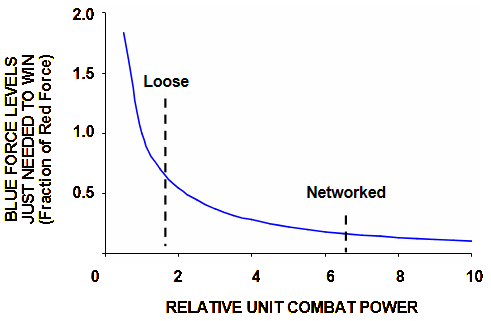
A more informative way of making the same point is shown in Figure 3 which displays the relative combat powers at the beginning of the war needed to just give Blue the victory in terms of the relative unit effectiveness’s of the two sides. Thus, if we were to have networked the blue force in such a way as to change our advantage in unit effectiveness from just below a factor of two to just above a factor of six, the corresponding ratio of initial combat capabilities will have decreased from slightly more than 0.60 to almost 0.25. In other words, just as we have surmised before, networking offers our side the ability to start the fight with significantly less forces than we would have needed otherwise.
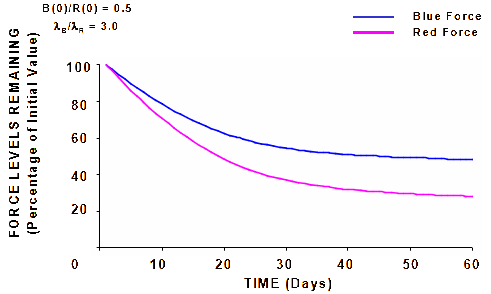
This reduction in required force levels that is made possible by networking allows us to set-up the psychological advantages of which the doctrine talks by starting the war quickly, well before our enemy has had time to fully prepare for war. In fact, let us assume that we start the war as soon as we have managed to bring into theatre one half the land forces our enemy has and that we network those forces to gain the unit effectiveness advantage shown in Figure 3. The corresponding draw-down in combat capability on both sides with time is shown in Figure 4.
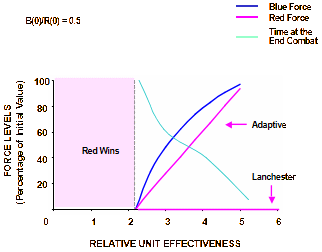
As Figure 4 indicates, both sides lose combat power as time goes on, just as one would have expected. However, Red seems to lose a lot more and a lot faster than does Blue. This would not be that surprising, seeing that Blue has the unit effectiveness advantage over Red, if it were not for Red’s advantage in initial combat power over Blue. To understand the mechanism that makes this reversal of expectations possible, let us notice that the draw-down does not go on forever; sooner or latter the combat power of each side levels off to a constant asymptotic value. This behaviour indicates that, unlike a Lanchester war, our war terminates before all forces on the weaker side have been decimated. Perhaps, therefore, the smaller force wins because the non-linear effects produced by the significant unbalance in unit effectiveness that favours it stops the war before the larger force has an opportunity to overcome the smaller one by sheer weight of numbers.
That this is what is really going on follows from Figure 5. This figure shows how the intensity of engagement, as measured by the engagement rate E(t), changes with time for a selection of values of the relative unit effectiveness advantage provided by networking. The larger the unit effectiveness advantage, the sooner does the war come to an end. Indeed, for small values of λB/λR the engagement rate oscillates with the vagaries of the tactical situation until the strategic factor eventually takes over and the war comes to an end. As λB/λR increases, the oscillatory behaviour is quickly overtaken by the strategic realization that the war is going visibly in favour of Blue and that, therefore, Red better terminate the engagement before all his forces are irretrievably lost. In an adaptive model of combat there is no room for the constant engagement rate which characterizes Lanchester models.
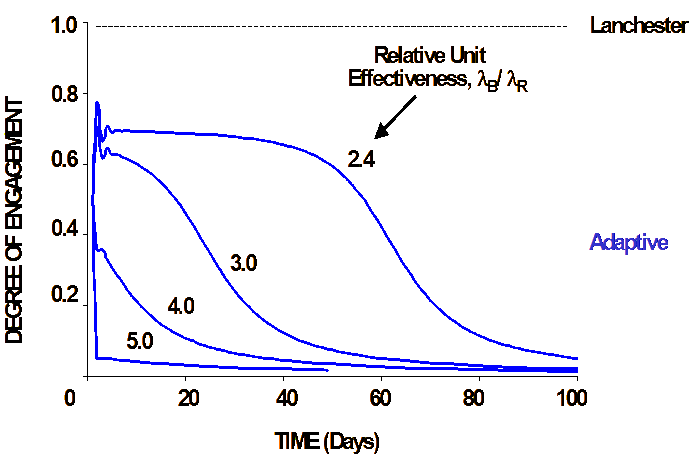
Since an adaptive player will thus stop the engagement as soon as the war begins to visibly go against him, the numerical advantage he might posses will avail him nothing. The key to victory in a battle where significant differences in unit effectiveness obtain is no longer, as in a Lanchester war, the relative advantage in the Lanchester superiority parameter, but rather the ability that the stronger side possesses to bully the weaker side into an early submission.
If, therefore, networking can lead the war to an early termination, the losses suffered on the battlefield will be quite limited. Unfortunately, as shown in Figure 6, that holds true for both sides, not only for the victor. This is in marked contrast with a Lanchester model, where, by virtue of a constant engagement rate, the victor always ends up by completely decimating the enemy force. In fact, the larger the unit effectiveness advantage made possible by networking, the larger the number of enemy forces surviving an adaptive war. This increase in the size of the surviving force with networking is a direct consequence of the fact that, as indicated by the green curve in Figure 6, the length of the war correspondingly decreases. Under the circumstances, political victory will follow military victory only if the surviving enemy force voluntarily accepts the will of the victor; otherwise, those forces may remain in being and, unless controlled, could challenge the victorious side again.
We thus find that a networked military force which would deliver all the tactical capabilities expected of it could indeed generate the strategic advantage claimed in the doctrine by starting and finishing the war much faster than a non-networked one could; a networked force, even a relatively small one, could thus create that state of “shock and awe” which the proponents of the Network Centric Warfare doctrine advertised before the second Gulf War. But, as it actually transpired in that war, the quick destruction of the enemy force does not necessarily lead to political victory. For that to happen, the defeated Army must surrender or be taken prisoner, and that is unlikely to happen in the kind of asymmetric war that appears to characterize the beginning of the 21st century. Because of this, Network Centric forces, while devastatingly effective in symmetric war, are largely ineffective in asymmetric war. The information technology that makes networking of military forces possible appears to have arrived too late to make any strategic difference in support of the security interests of the nation that possesses them.
References
[1] A. Kaufman, Strategic Implications of Distributed Networked Naval Force Capability (U), Institute for Defense Analyses (IDA) Paper P-3908, Unclassified, July 2004.
[2] A. Kaufman, “Critical Factors Affecting the Military Utility of Networking”, Journal of Battlefield Technology, Vol. 8, No. 3, November 2005.
[3] J. Buontempo, H. Potrykus, and A. Kaufman, “A Symmetric Adaptive Model of Combat”, Journal of Mathematical Sociology, Vol. 30, pp. 43–46, 2006.
Dr. Kaufman is a study director at the Institute for Defense Analyses in Washington, DC. Over the years he has worked on all aspects of naval warfare and is currently involved in studies of surface ship manning issues and of capabilities-based acquisition strategies.