
Volume 9, Number 1, March 2006
Factors Affecting The Dispersion Of Shotgun Pellets In Short-Range Combat
- 1 Cranfield University, Royal Military College of Science Shrivenham, Wiltshire, SN6 8LA, United Kingdom.
- 2 Ordnance Test Solutions Limited, Devizes, Wiltshire, SN10 2EU, United Kingdom.
Abstract
This study was designed to determine the extent to which aerodynamic interactions affect the pellet pattern from shotguns as this has considerable influence on their impact. After the characteristic separation of pellets was obtained from their probability densities, the detailed flow field was obtained using Computational Fluid Dynamics (CFD) analysis. The reported initial results illustrate the influence that the wake of preceding pellets has on the trajectory of trailing pellets.
Background
Experimental studies into pellet dispersion with range indicate the presence of non-linear effects. These arise mainly from combination of three factors: aerodynamic interaction between pellets, irregularities in pellet shape, and their rotation during flight. Difficulties in experimental techniques prevent detailed measurements, so only generalised data is available. In contrast, CFD methods provide extensive flow field information. Recent advancements in CFD now allow pellet cloud aerodynamics to be considered in more detail.
The CFD calculations determine the relationship between lift, drag and separation. This is further analysed in order to provide a relationship between the characteristic separation of pellets within the cloud and increasing range. In this way the effects on statistical extrapolation of pellet dispersion back to the muzzle can be assessed with respect to the extent and magnitude of longitudinal and lateral aerodynamic interaction between pellets. It should be noted that modern ammunition is further complicated by the presence of the 'cup wad' driving piston, the impact of which is not considered in this paper.
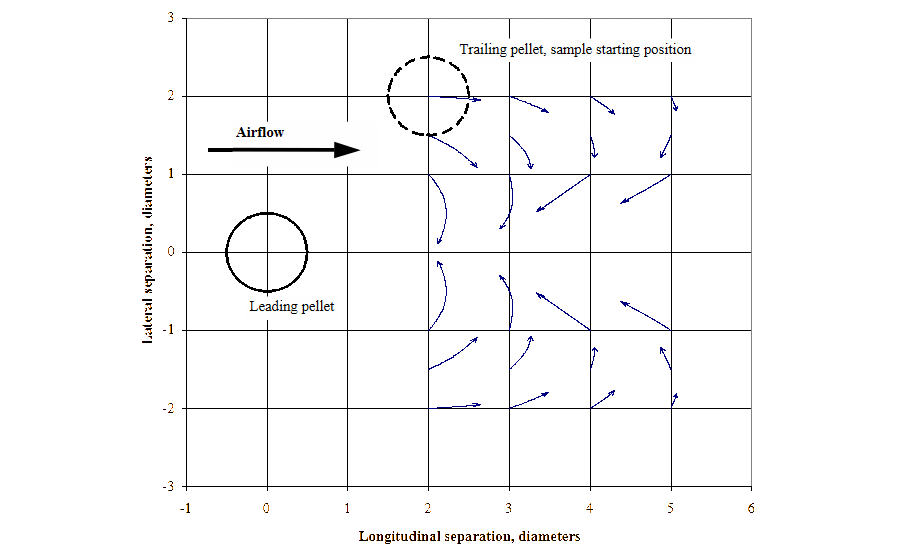
The key findings are summarised in Figure 8. This was achieved by first considering the practical conditions affecting the problem then, using data on shotgun performance, determining the characteristic separation of pellets in flight so that the subsequent CFD computations are dimensioned to model the typical mutual proximities between the pellets. The graphic result illustrates a leading pellet at the origin showing, for a variety of initial starting points, the path of a trailing pellet influenced by the preceding wake.
![Cut-away sketch of the shot column exiting cylinder (upper) and choked (lower) muzzles, with superimposed flash photographs of the resultant pellet dispersions at 1.2-m (4-feet) range [1].](/journals/journal-of-battlefield-technology/volume-09/issue-01/assets/9-1-2-szmelter/figures/figure01.png)
![Flash photograph of the dispersed pellets at 4.3-m (14-feet) range fired from a cylinder muzzle. Note transverse trigger wire. Also note the composite bow shock at the extreme right-hand side. [1].](/journals/journal-of-battlefield-technology/volume-09/issue-01/assets/9-1-2-szmelter/figures/figure02.png)
The CFD methodology we describe can be used to asses the aerodynamic tendencies for pellets from shotguns used in short-range combat or in sport shotguns. It is also applicable to other type of ammunition involving more than one flying object—such as petals in sabot discard, or submunitions.
Practical conditions and dominant factors
The muzzle velocity of shotguns is typically 400 m/s, corresponding to Mach 1.2, diminishing to about Mach 0.5 within a representative useful range of 40 m. This paper is primarily concerned with the aerodynamic interactions between pellets within the first 10 m of flight, during which the pellets are either marginally supersonic or transonic. Most shotguns possess a restriction in their diameter at the muzzle: this is referred to as a ‘choke’ and is used to modify the subsequent dispersion of the pellets in flight. Pellets are driven from a shotgun by a wad which acts as a piston. The wad has a low sectional density and so is soon lost from the ensemble of pellets by aerodynamic retardation. These features are illustrated in Figure 1.
Shotgun barrels are commonly choked barrels, and so the pellets will be less dispersed than that shown in Figure 2 for a cylindrical ‘unchoked’ barrel. With increasing range the dispersion will generally increase. It has been demonstrated [2,3,4] that the lateral distribution of pellets at range generally conforms to a Rayleigh distribution (independent orthogonal Gaussian). The longitudinal dispersion of the pellets in flight was also measured, but its variability complicates the assignment of a specific distribution function.
Compton, Radmore, and Giblin [5] present a stochastic model to enable prediction of the observed non-linearly increasing dispersion with range by the action of random forces. Although mechanisms for the randomising effect are discussed, these are expediently disregarded in the provision of a good fit to the observed data at useful ranges. A causative understanding requires evaluation of the three principal regions of effect: launch, pellet flight interactions, and asymmetric aerodynamics, described in turn below.
It is surmised here that the initial dispersion on launch from the muzzle is caused by the residual pressure exerted upon the rearmost pellets causing these to collide with and thus disperse preceding pellets. The presence of muzzle ‘choke’ imparts a longitudinal velocity gradient to the column of pellets thereby reducing the potential for the rearmost pellets to disperse those preceding. This intermediate ballistic effect is part of the launch process and there is evidence [1] that it is unlikely to have any influence beyond 1-m range. These semi-fluid processes at and just beyond the muzzle have yet to be confirmed.
Thereafter, the pellets are free from the influence of the gun, but mechanical and aerodynamic interactions are likely. This paper is concerned with estimating the subsequent characteristic separation distances between pellets and their aerodynamic interdependencies, especially at short range where pellets are in mutual close proximity. There are two issues related to pellets with near identical trajectories: one, that trailing pellets may suffer reduced aerodynamic retardation and so strike the precursors and, secondly, that the trailing pellets may establish stable positions in the wake of others. In sport shotguns, this latter possibility would undermine the ability for the ammunition to provide ‘clean kills’ against game, and may explain the frequent casual observation of adjacent or merged pellet strikes on test targets.
Lack of pellet sphericity and induced transverse spin are further mechanisms for disproportionate dispersion of pellets at range; these are probably the dominant causes of the effective stochastic mode of dispersion reported by Compton, Radmore and Giblin [5].
Proximity of pellets in flight
The requirement at this level is a fair estimate of the characteristic separation of pellets in the central region of the pellet cloud, and this can be obtained from their probability densities. A range of 5 m from the gun is considered representative of the region in which aerodynamic interactions of pellets may be of particular significance. The method employed here evaluates lateral and longitudinal pellet densities and uses this data to determine the average spatial void occupied by each pellet; the dimension of this void equates to the characteristic separation between pellets.
First, considering dispersion lateral to the trajectory, using right-handed orthogonal axes notation, the representative Gaussian dispersions in the lateral directions (x and z) are of similar mutual size, increasing with range. The peak probability densities at one special range can be calculated from a definition of shotgun choke [6] in terms of the percentage of pellets striking within a centralised 0.762-m (30-inch) diameter target at 36.6 m (40 yards). Taking a ‘half-choke’ gun as representative, this percentage pattern is 60%, giving a standard deviation, σx,z=0.2814 m at 36.6-m range. Taking the dispersion to grow approximately linearly with range, then at 5-m range σx,z=0.0385 m. Owing to the mechanical proximity of pellets, this extrapolation clearly cannot be carried to the gun muzzle, but is reasonable at 5-m range. The peak probability density occurs on-axis, being given by:
which at 5-m range gives a value of 10.362 m-1.
Compton [2] presents information on the longitudinal probability density with respect to time, dPy/dt of 3.3-mm diameter lead pellets over 20–50 m range. The peak of the time-dependent probability density is approximately inversely proportional to range, and this allows extrapolation back to 5 m range, giving a value of 748.5 s-1. Again, mechanical proximity of the pellets prevents this extrapolation from being carried to the gun muzzle.
Since:
and the velocity v at 5 m is typically 375 ms-1, then at 5 m ρy=1.996 m-1.
Now, having established representative values for ρx, ρy and ρz, the probable number, n, of pellets within a small volume, Δx,Δy,Δz is given by:
where N is the total number of pellets. If a=Δx=Δy=Δz is the dimension of a characteristic volume containing only one pellet, then:
The characteristic separation, a, at 5 m is thus:
which, for the 2.6-mm diameter pellets being considered, is approximately 10 diameters. At around 5-m range a significant minority of the pellets will be much closer than 10 diameters separation. At lesser ranges the pellets will tend to be closer together. With increasing range close proximity of some pellets (<10 diameters) will continue, but less frequently and varying with the differential motion within the pellet cloud. In this case it is therefore reasonable to consider aerodynamic interactions at separations of up to 10 diameters.
CFD model
The aerodynamics involved in this problem are complex and very challenging for numerical simulation. Difficulties result from the large number of irregularly shaped objects being in relative motion and embedded in a non-uniform viscous flow in which wakes and shocks are interacting. It is expected that the detailed modelling of this problem should be achievable using the solution of the fully time-dependent three-dimensional Navier-Stokes equations with dynamic trajectory prediction for every pellet. The trajectory prediction could be based on integration of surface pressures on each of the pellets. Such computations, if good accuracy is maintained, are prohibitively expensive. The three-dimensional numerical modelling of unsteady aerodynamics with moving bodies is rare and usually limited by simplifying assumptions—frequently those of axisymmetric flow or quasi-static approaches. It should be noted that some successful methodologies have been developed, such as for sabot discard and ejection of small segments into the wake of a flared projectile [7].
Due to the prohibitively expensive computation times, in this study only a two dimensional, unsteady inviscid flow solver has been used. This implies the omission of viscous effects and acceptance of differences between three-dimensional and two-dimensional flows. Also, rotation is neglected.
Results of a detailed investigation, conducted for pellet pairs over the scope of typical longitudinal and lateral separation has been analysed and an example of a multi-pellet configuration is presented. Only spherical/cylindrical shapes are considered.
In the presented work, the 2D Euler equations are solved by an in-house code based on cell-centred finite-volume discretisation in space, and multistage Runge-Kutta discretisation in time. The complexity of the geometry of mutually moving bodies has been resolved using triangular meshes. The mesh generation and regeneration is based on the advancing front technique. The moderate dynamic mesh and body movement during time dependent calculation utilises spring analogy concepts. When cells become too distorted the remeshing is performed automatically. The code has been validated for oscillating aerofoils and segmented projectile applications [8].
The trajectory prediction has been implemented directly within the flow solver. At a chosen time interval, lift and drag based on pressure integration are calculated for each pellet. The equations of motion are formulated in terms of the second order differential equations and are integrated using a three-stage Runge-Kutta scheme. The code is run dynamically. The trajectory prediction is used to derive mutual motion of pellets and alteration in the flow field angle of attack. It is followed by a dynamic mesh movement and remeshing as required.
Analysis scheme
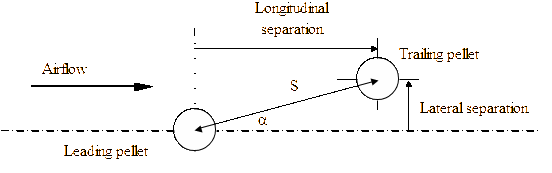
Although the CFD model utilised can cope with multiple projectiles, to simplify the evaluation of aerodynamic interactions of a pellet cloud as a whole, the scheme chosen considers the interaction of pellet pairs alone. The pellet cloud is divergent with range, but as least divergence is exhibited between adjacent pellets within the cloud, so the analysis scheme considers the closely separated pellets in each pair to be effectively on trajectories which are initially both parallel and of identical speed (Figure 3).
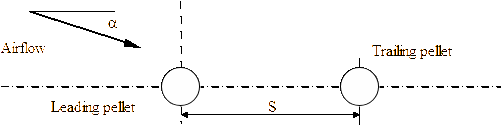
The computational reference frame is coaxial with the initial line through the pellet centres, with the airflow incident at an angle to the body axis (Figure 4). The computations are scaled relative to the distance between the distal faces of the spheres, and relative to the incident airflow of Mach 1.1 at ambient sea-level conditions. The pellets are 2.6-mm diameter, with mass based on the density of steel.
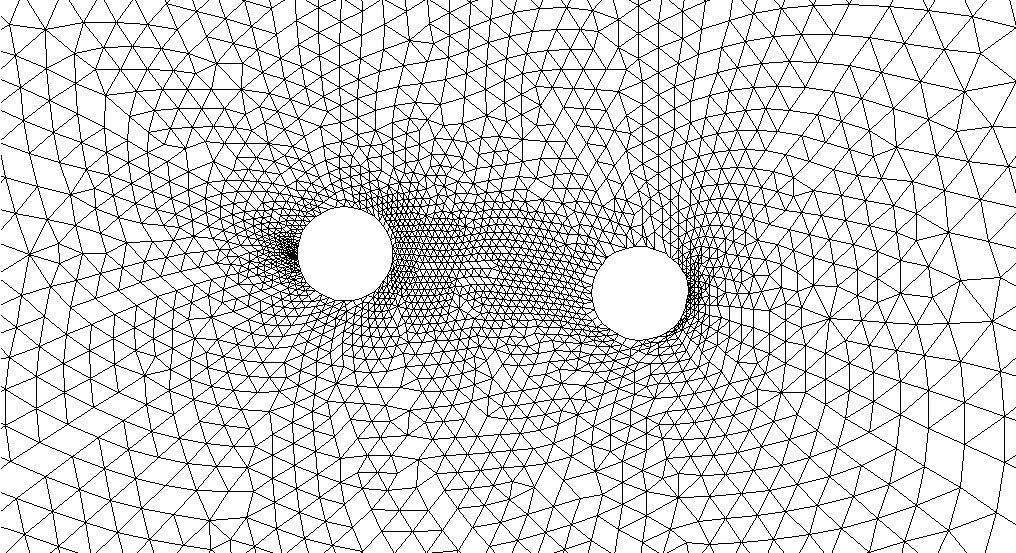
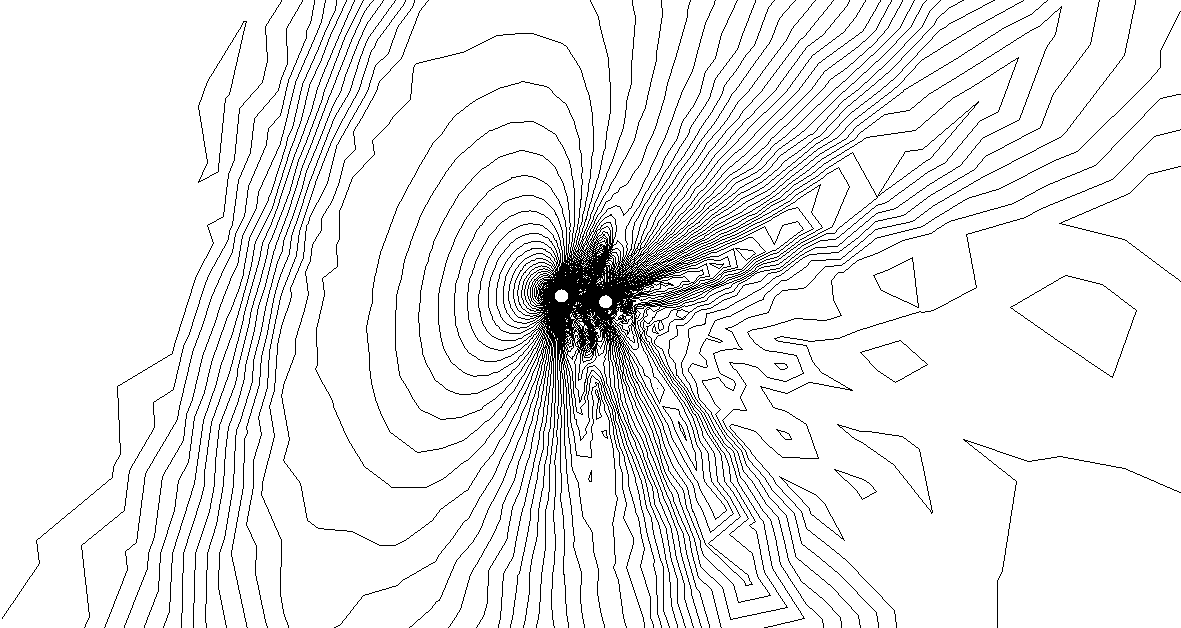
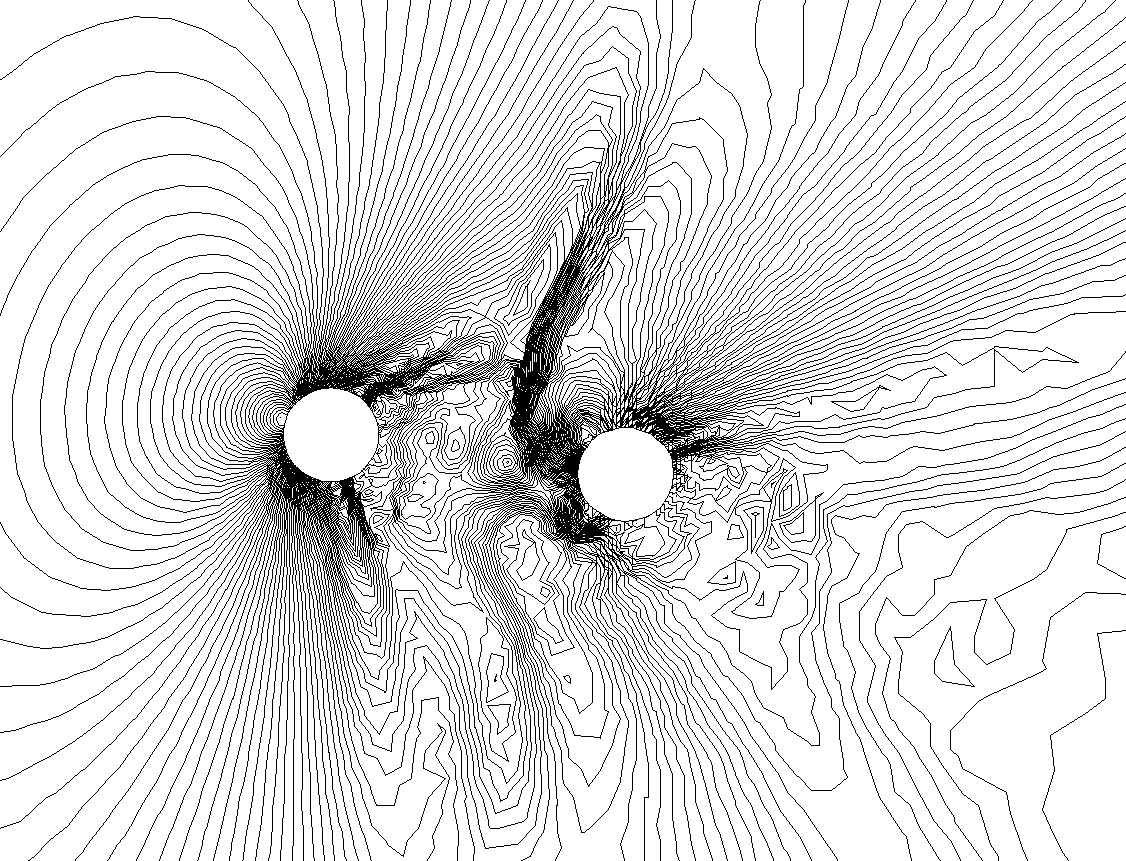
The CFD program executes 1,000 iterations to establish the steady-state conditions before the pellets are effectively released. Both pellets move relative to the reference frame under the influence of drag and lift, with corresponding distortion of the mesh. The extent of mesh distortion remained acceptable for all these computations. The CFD program continues with the unsteady-flow computations for typically 4,000 further iterations. Sample illustrations of the moved mesh and pressure contours during the unsteady calculations are shown in Figures 5–7; interaction between wake and shocks is clearly evident.
Analysis results
The output data for the displacement of both pellets was re-mapped relative to the free field airflow, so restoring the ‘wind axes’ reference frame. There occurred relatively little lateral deflection of the leading pellet due to the trailing pellet, and so the deflection of the trailing pellet was referenced to the leading pellet. The arrows in the Figure 8 show the computed trajectories of the trailing pellet relative to the leading pellet. The leading pellet is located at the origin of the plot (position 0,0). The origins of the arrows corresponds to each starting position of the trailing pellet, and the arrowheads show the position after a set time, illustrating the tendency for the trailing pellet to be drawn into the wake of the leading pellet, possibly inducing pellet collision.
Evidently the local variation in flow and pressure in the region to the side of the leading pellet enhances the retardation of the trailing pellet (see pellet starting from position 2,2). However, in the wake of the leading pellet, the lift on the trailing pellet causes it to be drawn further into the wake, and the reduction of drag enables it to close with the leading pellet. The general tendency for the trailing pellet to converge on the wake of the leading pellet suggests that the former will be laterally stable within the wake, although the pellet separation will rapidly close owing to the reduced drag acting on the trailing pellet. Although the computations were terminated before collision, it is expected that resultant collision can occur.
It is anticipated that the computed wake-effects on trailing pellet trajectories will have been over-estimated here by the use of the two-dimensional CFD model. The wake effects with spheres rather than transverse cylinders will probably be less significant, but there is sufficient indication from this initial investigation to warrant belief that aerodynamic interactions do significantly affect pellet dispersion, either as aerodynamic cohesive effects, or leading to collision and subsequent divergence.
The timescales of the processes need to be considered further to determine whether sufficient time is available for these potential aerodynamic or consequent mechanical interactions to be significant before the pellets are mutually isolated by the range-dependent growth in dispersion.
Conclusions
The significance of the aerodynamic interaction between pellet pairs was examined to assess the potential for aerodynamic effects to influence the dispersion of shogun pellet-clouds in flight. A number of simplifications were assumed: linearity of dispersion with range was used to extrapolate back to short range so as to determine a characteristic pellet separation; and the computational model of unsteady aerodynamics was two-, rather than three-, dimensional for improved speed of computation. Non-sphericity and spin of the pellets remains to be assessed. Despite these simplifications a first insight was made possible into the aerodynamic interactions within a shotgun pellet cloud.
The results indicate that the trailing pellet may be drawn into the wake of a preceding pellet, and the reduced drag may then allow collision with the preceding pellet. The aerodynamic effect therefore has a cohesive effect on the pellet dispersion, but consequent collision of pellets may then promote dispersion.
The unsteady-CFD technique has been shown to be a useful tool at this introductory level, and further modelling can potentially elucidate the consequence of pellet spin and non-sphericity, and also the interactions due to multiple pellets. Relevant three-dimensional CFD modelling is entirely possible, although the computational hardware demands are very much greater. The significance of mechanical interactions and other aerodynamic factors will require further investigation.
References
[1] E.D. Lowry, Aerodynamic Performance of Lead and Iron Shotshell Loads, Olin Corporation, Winchester Division, 1970.
[2] D.J. Compton, An Experimental and Theoretical Investigation of Shot Cloud Ballistics, Ph.D. Thesis, University of London, 1997.
[3] D.J. Compton and R.A. Giblin, “A Measurement System for the External Ballistics and Pattern Analysis of Shot Clouds”, Proceedings. 1st Conference on Non-toxic Shot, Royal Military College of Science (Cranfield University), pp. 33–55. 2 May 1996.
[4] D.J. Compton, R.A. Giblin, and P.M. Radmore, “Measurements on an Ensemble of Spheres in the Transonic Velocity Regime”, IEE Proceedings Scientific Measurement Technology, 1997.
[5] D.J. Compton, P.M. Radmore, and R.A. Giblin, “A Stochastic Model of the Dynamics of an Ensemble of Spheres”, Proceedings of the Royal Society, London, A 453, pp. 1717–1731, 1997.
[6] Eley diary, 1988.
[7] J. Sahu and C.J. Nietubic, “Application of Chimera Technique to Projectiles in Relative Motion”, Journal of Spacecraft and Rockets, Vo1. 32, No. 5, September–October, 1995.
[8] J. Szmelter and S. Abdullah, “Estimation of Components Relative Motion in Segmented Rods”, 18th International Symposium on Ballistics, San Antonio, 1999.