
Volume 8, Number 3, November 2005
Critical Factors Affecting the Military Utility of Networking
Abstract
This article is a first cut at quantitatively exploring the conditions under which the fundamental tenets of the Network Centric Warfare doctrine might be valid. It is based on a somewhat more extensive study of the subject published by the author [1] and covers three related topics: the situational awareness that is made possible by networking of battlefield sensors, the onset of cohesive behaviour amongst the human actors involved in operating networked systems, and the limits of human proficiency. The paper shows that the situational awareness obtained through the network is not automatically better than that obtained from individual sensors and identifies the conditions under which it might be; it shows how the cohesive behaviour is increased by the size of the networked community, by the quality of leadership controlling that community, and by the degree of individual proficiency with which members join the community; and it shows how recruiting, training, retention, and the quality of life will affect that individual proficiency. In the end, the article summarizes the various factors which must be addressed before the promise of networking can be realized.
Introduction
A great deal has been said recently about the benefits of networking a military force, but all of what has been said is largely qualitative and always hypothetical; one would be hard put to find any quantification of the supposed military utility of a net-centric way of war. In this article I will take the first step down this un-travelled path.
Like all travel in uncharted territory, my journey will be exploratory rather than exhaustive. Instead of trying to prematurely construct a detailed model of the military utility of networking, I will strive to identify those factors which control the degree of the utility realistically achievable in combat and provide just enough quantification to be able to judge which of them are likely to drive combat benefits.
Networking of military systems is expected to produce performance synergy, otherwise one would not bother to do it. This networked-enabled synergy can manifest itself in two different ways: an increase in system performance resulting from the data exchange with other like systems that is made possible by networking, and an increase in human performance resulting from the onset of a cohesive behaviour among the human actors involved in the operation of these systems made possible by communication through the network.
Data exchange: gaining situational awareness
Imagine we wish to gain an understanding of what happens on the battlefield. This information is usually obtained through the deployment of various sensor systems able to collect data about the enemy and the lay of his forces. The data collected by a sensor is a stochastic process from which the system processor generates a certain statistic characteristic to the sensor employed. That statistic is then compared to a predetermined threshold and if the statistic exceeds that threshold, the battlefield feature under observation is said to be present. Otherwise the feature is said to be absent. Although the process of gaining situational awareness would probably have to include identification and classification of the detected object in addition to mere detection, we shall only consider the simplest of all cases when detection was enough.
Because data collected by the sensor is of necessity stochastic in nature, there is only a certain probability that the information thus collected about the presence of the battlefield feature under consideration corresponds to reality. This implies that there is also a certain probability that the information does not. These two probabilities are the sensor’s probability of detection and the sensor's probability of false alarm, respectively. Specifically, the probability of detection measures the probability that the sensing system will ascertain the presence of some feature in the battlefield when that feature is actually present. The corresponding probability of false alarm measures the probability that the sensing system will ascertain the presence of that feature when the feature is not, in fact, present. These two probabilities represent performance characteristics of the sensor under consideration and depend both on the sensor’s construction as well as on the tactical and environmental circumstances under which it is employed.
When we join a set of such sensors into a network in which they are allowed to freely exchange data with each other, the network manager is possessed by a collection of stochastic bits of information each of which is provided to him by a sensor in the network. From this collection, he develops situational awareness about the battlefield. The situational awareness he builds out of these bits of information is therefore equally stochastic in character. Consequently, there exists only a certain probability that his surmise about the battlefield corresponds to the real situation on the ground. Clearly, unless that probability is larger that the corresponding probability resulting from the sensors alone, networking will have proved to be of very little value. We should therefore explore the conditions under which the probability that the manager’s surmise is correct exceeds the corresponding probability as provided by each sensor in isolation.
To accomplish this goal, we need to first quantify the process by which a network manager develops his situational awareness. Since the bits of information provided by the various sensors about any given feature in the battlefield need not agree with each other, a network manager must develop a set of rules for brokering between the sensors. A reasonable, though not necessarily practicable, way to do that would be to combine the information provided to him by all the sensors using a Bayesian statistical-inference technique. Specifically, imagine that p(YES) represents the prior knowledge available to the network manager concerning the presence of a given feature in the battlefield, and let there be a sensor employed to observe that feature. According to Bayes’ law, the state of knowledge available to the manager after the sensor has made its observation is given by:
(1)
where e1 symbolically represents the information provided by the sensor about the battlefield feature under consideration, p(e1|YES) is the conditional probability that the sensor will have produced information e1 given that the feature was in fact present, p(e1|NO) the corresponding conditional probability that the sensor will have produced information e1 given the feature was not present, and naturally
(2)
Imagine further, that a second sensor is employed to observe the presence of the same feature in the battlefield. Then, if e2 represents the information provided by this second sensor, the state of knowledge available about the feature after both sensors have spoken is:
(3)
and using Equation (3) for p(YES|e1), we get:
(4)
Now, let us agree that the network manager will take advantage of the information provided by these two sensors, if, and only if, he ends-up knowing more about the presence of the feature by virtue of that information than he knew before, that is if:
(5)
According to this eminently reasonable rule for combining the information provided by two sensors in a network, the network manager will conclude from the information provided him by the two sensors that the feature is present only if the following inequality holds:
(6)
Let us finally specify the information provided by the sensors by saying that both e1 and e2 represent threshold crossings by the statistics collected at the corresponding sensors. Then:
(7)
and:
(8)
Where pD1 represents the detection probability, and pFAi the false alarm probability, of the i-th sensor, leading to the following rule for deciding that the feature is present on the basis of both sensors having said that the feature was present:
(9)
A similar rule applies for the situation when the first sensor said YES and the second said NO; specifically:
(10)
Alternatively, when the first sensor said NO and the second sensor said YES, the applicable rule is:
(11)
and, finally, for the case when both sensors said NO:
(11)
Clearly, this rule-set can be generalized to encompass a network of any number n of sensors; it will provide one inequality for each of the 2n sample-paths one can form from a combination of YESs and NOs, and each such inequality will contain a factor of pFA/pD for all those sensors which have detected the feature, and a factor of (1–pFA)/(1–pD) for all those sensors which have not.
Figure 1 illustrates graphically how these rules would operate for the case of two sensors. Since we cannot represent four variables in a two-dimensional plane, we have fixed the performance characteristics of the first sensor to the values indicated and displayed those of the second. As shown in the figure, the network would decide on the basis of the first sensor alone if the characteristic performance parameters of the second sensor fell anywhere within the inner quadrangle; in that case, the second sensor is just not good enough to alter what the better first sensor said. By contrast, if the second sensor fell within the upper left corner, it would be so much better than the first, that its indication would be preferred to that of the first sensor. If the performance parameters of the second sensor fell within the other regions shown in the figure, the applicable rule would be the one indicated.
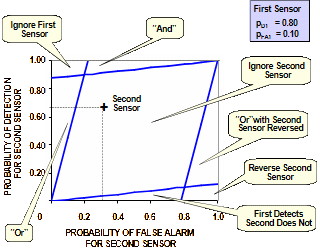
It is interesting to note what happens in the lower right hand corner. In this region, the second sensor would have a relatively small detection probability and an extremely high false alarm probability. It is not surprising then that the network manager would then use the information provided by the second sensor to indicate the opposite of what it actually says.
One can show that, if the network made its decisions according to these rules, the probability that the network will make the correct decision would always be larger than the corresponding probability that either of the two sensors alone would. But to follow the rules, we must know the sensor performance parameters pD1 and pFAi in terms of which those rules are written. However, since these depend on the range from the sensor to the feature being observed and on the environmental conditions under which the observation takes place, the actual value of the performance parameters cannot be known with absolute precision. Consequently, employment of the rules corresponding to these imprecise parameters would no longer ensure that the network was better than its components; the farther from actuality one’s estimates of the parameters get, the less sure one would be that the situational awareness obtained through the network was any better than the situational awareness obtained from either sensor alone.
The onset of cohesion
When systems are networked, the people involved in operating them are also put in touch with each other. As is their wont, humans that communicate with each other influence each other. Sometimes, that influence can lead to the formation of a cohesive group. When people understand and act as part of such cohesive groups, their performance is changed. In this section we shall try to quantify that change.
According to the Webster dictionary, a group of humans becomes cohesive when it gets harmoniously united by some common interest or emotional tie, or by a sense of social membership, while cooperatively playing down the animosities between them. Therefore, cohesive behaviour is obtained through a mechanism which balances the common goal that all members are striving to achieve against those individual features of those members which may lead to animosity amongst them. Specifically, when people are allowed to communicate with each other, they behave as if an organizing force generated by their peers was acting upon them, forcing them to align themselves to the common goal. To this organizing force, each member opposes a resistance expressing his degree of opposition to the common goal. When these two forces balance each other off, the organizing force of the common goal and the disorganizing force generated by member individuality, the group is as cohesive as it is able to be.
One can simply model this process by recognizing that the organizing force acting on each individual is larger the farther away that individual happens to be from full alignment with the common goal and by assuming the relationship to be a proportional one with proportionality constant . Similarly, the disorganizing force is bound to increase with the increase in the degree of alignment that the community imposes upon the individual under consideration and we shall assume that the relationship is a proportional one with proportionality constant g, much like a spring would push back the stronger it is compressed. The point at which balance between these two forces is achieved depends both on the features characterizing the individual members of the community through their initial degree of alignment and the constant of proportionality g, as well as on the quality of leadership that is driving them towards the common goal as characterized by the constant h.
Actually, for the relatively simple model described above, the equilibrium position depends only upon the ratio between these two constants. This “order-disorder” ratio expresses the relationship that normally obtains between the leadership and the individual as the network tries to achieve its natural level of cohesion. Indeed, by its very definition, the “order” constant h measures how well the influence exerted by the others “couples” to each member in the network. In other words, it measures, how much discipline that leadership is able to bring to the network and how much of the desire to attain the common goal it can inspire in each member. On the other hand, the “disorder” constant g reflects the individuality of the community members. Therefore, their ratio captures the balance between the community and its leadership.
Figure 2 shows, that, according to this model, networking does indeed increases the degree of cohesion between the humans it connects. It illustrates how the relative increase in alignment brought about by the network would vary with the size N of the community connected by it, if the order-disorder ratio was one tenth and the degree of initial alignment of its members spanned the values shown.
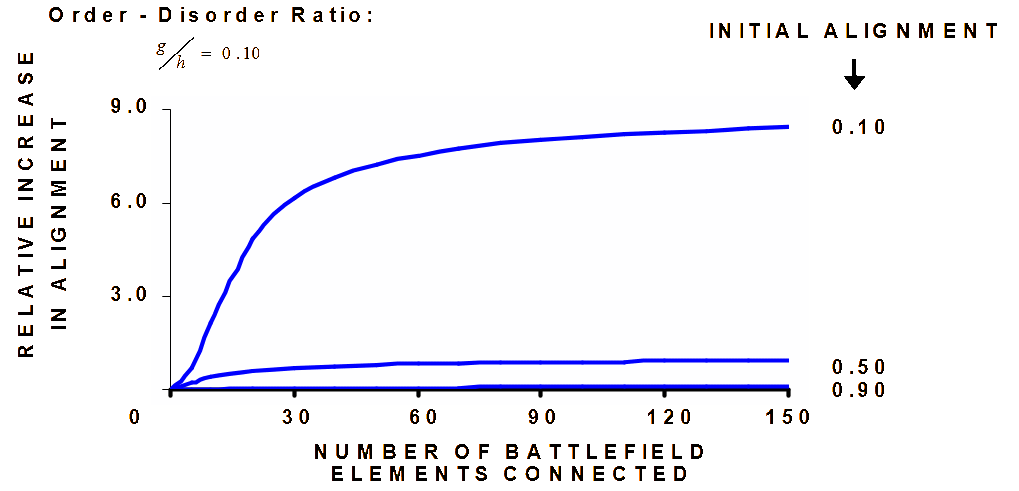
If the people connected by the network started with a low degree of alignment, the fact of networking would increase that degree of alignment significantly, even for relatively modest sized networks. As the number of elements connected increases, so does the relative change in cohesion, until the advantages of networking begin to level off. If, however, members started off with a naturally high degree of alignment to the common goal, the relative increase in cohesion provided by the network would, as one expects, be correspondingly decreased.
Depending of what we mean by the common goal, this model of cohesion can throw light upon a number of processes that are influenced by cohesive behaviour. In what follows, we will specifically address two of these processes: building a common understanding and executing synchronized action.
Influence of Cohesion upon Common Understanding
Let the goal consist in a desire to construct a common operational picture of the battlefield. The degree of alignment will then measure the extent to which each member of the connected community has bought into the common picture. That degree is depicted in Figure 3 as a function of community size and leadership qualities.
The curves shown in the figure represent constant relative increases in the level of common understanding attained by
each member of the community if they started with a level of alignment of 20%, the initial situation in which networking is expected to produce its most significant effects. For small values of the order-disorder ratio, reflecting inefficient leadership and undisciplined individuals, the figure suggests that it would take a relatively large community to develop a sizable degree of common understanding. Thus, for an order-disorder ratio of 0.01, it would take a community of 375 individuals networked together to attain a four-fold increase in the level of common understanding. By contrast, a better led and a more disciplined community, say one with an order-disorder ratio of 0.05, would not need to be any larger than 75 to attain the same increase in the level of common understanding. The values chosen for the order-disorder ratio carry no absolute operational meaning; they merely reflect the range of parameter variation over which the simple model considered here seems to lead to reasonably sized communities. Outside that range the model reaches diminishing returns.
Consequently, to take advantage of the beneficial effects of cohesion upon the collaborative debate preceding the attainment of a common understanding about the battlefield situation, one needs to provide the networked community with strong and effective leadership, one that would be able to guide the community towards a common view of things despite the natural human inclination for controversy. Otherwise, one would end-up either with a cacophony of disparate opinions, endlessly fighting each other, or a common understanding attained by the shear dictatorship of the most authoritative.
Influence of Cohesion upon Synchronization
If, on the other hand, we let the goal consist in a desire to synchronize the action of many, the degree of alignment each member of a networked community would attain, will measure that member’s level of proficiency in executing his assigned task. Figure 4 depicts the level of proficiency attained by people connected in a network as a function of the size and leadership composition of that community and of the degree of proficiency with which individuals joined the network. Specifically, it displays constant proficiency curves in a plane spanned by community size and degree of initial proficiency for a community with an order-disorder ratio of 0.01.
The curves shown, are visibly more vertical than horizontal in orientation, indicating that changing initial proficiency has more effect upon final proficiency than does changing the size of the community. Thus, to increase the proficiency of an individual from 0.1 to 0.80 by way of networking him into a community whose leadership capability is characterized by a high order-disorder ratio would require that the community number 47 members. By contrast, to attain the same degree of proficiency for an individual with initial proficiency of 0.70 would only require a community of 6 members, a seven-fold decrease. In striving for synchronized action, one should therefore pay considerable attention to the degree of proficiency with which the people involved arrive to the network, particularly since the size of the community involved cannot be easily changed.
Increasing human proficiency
Since initial proficiency is so important in attaining a high degree of synchronization, the question arises of just how much proficiency is, in fact, available, assuming that one is willing to spend sufficient time and money in recruiting, training, and retaining individual soldiers, sailors, marines, or airmen. In other words, just how perfectible are the human beings involved in military operations? To illuminate the answer this question, we must develop a means of quantifying the mechanism by which investments in recruitment, training, and in all those quality of life programs that contribute to retention, affect individual proficiency. We do that next.
When an individual has been assigned a given operational function to perform, he brings with him a certain level of proficiency concerning the tasks he is expected to perform. That level is the result of two competing processes that are constantly at work in his professional life: the process of learning the relevant skills while undergoing training, re-training, and while employing those skills in actual combat, and the process of forgetting them while otherwise occupied with activities that are totally unrelated to the maintenance of those skills.
To model this competitive process, let us assume that the individual emerges from whatever training school he has attended with some initial proficiency, and consider the change in proficiency that occurs in the interval of time between seniority s and (s+ds). The rate of change is the sum of two terms. The first term represents the increase in proficiency resulting from the amount of exercising done in ds and is proportional to the probability f that the individual was employing his skills during that time interval, and the
second term represents the decrease in proficiency that obtains in ds when the operator is not exercising his skills, and is therefore proportional to the probability (1–f) that the operator is otherwise occupied during ds.
The first term, representing the rate at which humans learn, naturally depends on the amount of time they have spend practicing; the more they practice, the faster they pick up any additional skill yet un-mastered until, of course, they have learned all they need to know, in which case any additional practice would return diminishing advantages. Given this diminishing returns effect, it would be quite reasonable to assume that the learning rate is inverse proportional to the time during which one is effectively engaged in performing one’s skills and directly proportional to the product of the current state of proficiency and the current shortfall in that proficiency, with proportionality constant α measuring the strength of the learning process.
The rate at which humans forget, on the other hand, naturally depends upon the amount of time an individual has been away from the exercise of his skills. Given the well documented exponential decay of knowledge with time, it would be quite reasonable to assume that the rate of forgetting is proportional to the time the individual has been away from his work and to his current state of proficiency with proportionality constant β measuring the strength of the forgetting process. Both α and β would, of course, have to be determined experimentally.
From the simple differential equation that results when we add these two rates together one can evaluate individual proficiency as a function of time for an individual with a specified history of military service, a history characterized by his initial proficiency, by the total amount of time he spends in the service before retiring, and by a specified training program. The manner in which the resulting proficiency depends upon operator seniority is shown in Figure 5 for a=15, f=0.1 and a number of different values for β.
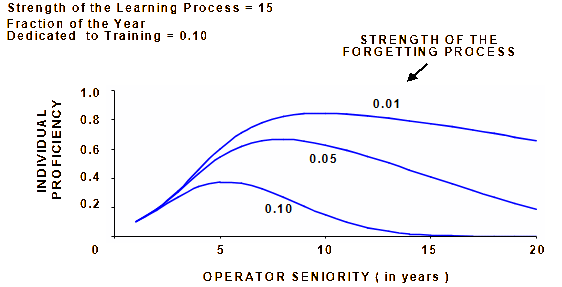
As expected in this simplified model, where we have lumped all periods of learning together into one continuous interval of time and all periods of forgetting into another, each curve begins by rising, an indication that the operator is increasing his proficiency early in his career despite the occasional forgetting, but eventually begins to decrease due to the cumulative effect of all the forgetting that took place during his professional life. A more detailed model would of course have to recognize that periods of learning are always followed by periods of forgetting and would lead to a proficiency that varied with time during each year in a manner similar to that shown in the figure.
In the previous discussion, we have derived operator proficiency as a function of his seniority. Since we cannot control the seniority of any individual that we assign to a given job, it would make sense to average this proficiency over the seniority distribution of operators performing the function at hand, a distribution which is easy to obtain from military records and which can usually be characterized by one parameter, the retention rateρ. The average proficiency thus obtained is what we were after when we started this rather long incursion into the modelling of human proficiency. Its value depends explicitly on a number of parameters that reflect the infrastructure programs involved in creating the skilled individual which concerns us. Thus, the recruiting program is reflected in the proficiency attained at the time of graduation from initial training, as well as in the empirical parameters α and β; the subsequent training program is reflected in the fraction f of each year spent in exercising his skills; and the various quality of life programs are reflected in the retention rate ρ to which they contribute. Figure 6 below shows how the average proficiency varies with the fraction of time spent in training for various values of the strength of the learning process measured by α, when the probability of retention is 0.8 and the strength of the forgetting process is β=0.05.
With the help of Figure 6, we should now be able to judge the extent of humans perfectibility. If perfect proficiency corresponds to unity on the vertical axis in the figure, then getting perfectly proficient humans to serve in the military would not be easy: the military establishment would have to be able to recruit only individuals with considerable natural ability to learn, to retain nearly everybody that joined, and to give every one of them the opportunity to hone their skills almost continuously throughout their professional life. Individuals that were recruited with lesser learning abilities, that have undergone less rigorous training programs, and that have tended to spend less time in the service, would display correspondingly lesser degrees of proficiency in ways quantified by our model.
Since, as we have said before, the ability to synchronize is driven by individual proficiency, the attendant ability to conduct synchronized operation will therefore be equally lessened. To attain to the degree of synchronization demanded by the high degree of common understanding potentially provided by a networked force, one must spend sufficient funds on those infrastructure activities that create the military personnel involved in both.
Critical factors driving military utility of networking
The degree of quantification provided in this article is hardly sufficient to provide a complete measure for the military utility of networking; additional detail would of course be necessary for that. Still, the simple models we have developed above are sufficient to identify the most important factors that would affect the degree of that utility. Let us recapitulate them.
First, there is the quality of information one has concerning the performance capability of the sensors employed in the network; since the rule set which ensures that the network outperforms its components relies explicitly upon these probabilities, one must know with relatively high precision how well each sensor performs in the actual situation. Specifically, one would have to know the probability with which each sensor in a network detected the relevant features in the battlefield, and one would have to know that sensor’s probability of false alarm. However, since the probability of detection usually depends upon the nature of the target, the distance from the target to the sensor, and the environmental conditions against which detections are made, and the probability of false alarm depends upon the statistical properties of the background -- all of which reflect the very situational awareness the network is trying to ascertain – the idea of using a network of sensors to understand the battlefield is fundamentally flawed. Therefore, the situational awareness provided by a network of sensors distributed throughout the battlefield is bound to be highly questionable.
Second, there are a number of factors affecting the onset of cohesion between individuals communicating with each other on the network. These factors concern two features of the human character: individuality and perfectibility. To reach cohesion between the individuals connected in a network one must be able to control their individuality, by which I mean man’s natural tendency to follow his on inclinations. This feature of human behaviour, expressed in our model by the constant g, are controlled in the military through a combination of inspiration and discipline. The quality of leadership commanding the network’s operation, as expressed by our constant h, must be able to forcefully employ these two processes in order to allow the common goal full play against a residue of human individuality. The better the leadership, the higher the resulting degree of cohesion and, therefore, the better the common understanding as well as the orchestrated action that is supposed to follow upon that understanding.
Quality leadership, while necessary, is however not sufficient. To attain a high degree of cohesive action, the individuals involved must also be highly proficient. That proficiency cannot be purchased directly on any market. The only way one can buy human proficiency is to spend money on those infrastructure activities that conspire to create proficient military personnel. These activities begin with recruiting. Not only do we have to recruit people with an appropriately malleable individuality, we must also increasingly focus upon their ability to quickly learn skills that require a significant degree of technical sophistication, as expressed by our constant α, and upon their ability to retain those skills for relatively long periods of separation from the job, as expressed by our constant β.
Once recruited, the individual member of the military must be appropriately trained. We have shown just how important the initial proficiency provided in training schools as well as the frequency f with which military personnel are allowed to exercise their skills are to the attainment of a high level of proficiency. It is equally important to point out that the exercising we are talking about here must be realistic to be of practicable value in maintaining the skill-set relevant to people that will be called upon to use them under the extraordinarily demanding circumstances of mortal combat, rather than under the relatively calm conditions of a trainer room.
Developing skills of such unique quality requires time. Therefore, retaining military personnel is equally important to the development of high levels of proficiency. Keeping people in the military is a complex undertaking which involves a large number of separate activities all aimed at improving the quality of life for both the individuals concerned as well as for their families. Things such as, professional satisfaction, career opportunities, remuneration, housing, day care centres, acceptable rotation schedules, and so on, are all involved. We expressed them all by one parameter, the retention rate ρ the personnel system is able to attain.
To quantify the military benefits of networking, one must be able to measure all the critical parameters mentioned above. Some of them, reflecting system contribution to operational performance we measure routinely; others, that reflect human contribution to operational performance, we are not. Thus we know the probability of detection of our sensor systems as well as their probability of false alarm, we control the frequency of operational training, and we measure the retention rate characterizing our personnel system. But we never measure the order-disorder ratio characterizing the dynamic tension between individuality and leadership, or the operational performance of individuals who have graduated from our initial training schools, or the learning and forgetting strengths characterizing the individuals we recruit.
But, in order to make intelligent decisions concerning the acquisition of information technology, one must know the military utility of that technology. Therefore, measurements must be extended beyond the performance of military systems to include human contribution to combat.
References
[1] Alfred Kaufman, "Strategic Implications of Distributed Networked Naval Force Capability", Institute for Defense Analyses (IDA) Paper P-3908, July 2004.