
Volume 8, Number 1, March 2005
The Science Of Command And Control (C2)
- 1 Systems Engineering and Evaluation Centre, University of South Australia, Mawson Lakes Campus, SA 5095, Australia.
Abstract
This paper addresses the question “what is the Science of Command and Control (C2)?” by first defining the three key perspectives that cover that which comprises C2, and by examining the system-level properties of these three perspectives in combination. The paper then analyses the concept of a ‘science’ of C2 by extracting the core components of a science: an organised body of knowledge and the process of acquiring that body of knowledge. In addition to these, the paper recognises the role that the application of the ‘science’ plays in advancing the state of understanding of C2. The paper then uses the definition of the science of C2 to formulate a general matrix for understanding C2 research programs. The paper closes by studying examples of extant research placed in this matrix. The result is a comprehensive definition of the science of C2 and a tool for understanding C2 research.
Introduction
Command and control (C2) is recognised as a key enabler of military capability. Whereas many of the fundamental concepts of C2 have not changed significantly for centuries, it is clear that ever-more sophisticated means can be brought to bear to augment the leverage provided by C2. What is lacking, however, is a rigorously defined framework for the systematic study of C2 as a means for advancing knowledge in this area. This paper is written in response to the question “what is the science of command and control?” and endeavours to present a coherent account of the constituents of the science of C2 that can be used, for example, by defence research establishments to identify their own laboratories’ coverage of the discipline, to determine areas of complementarity with allied laboratories, and to identify priority areas of C2 research.
The paper opens with an account of what is called the triad of C2: the three views that cover all of the definitions of the term. Armed with this definition, the paper moves on to discuss what the term ‘science’ means in the context of C2. It will be seen that the view presented here is that ‘science’ covers more than simply a nomothetic framework of ideas but also includes concepts and heuristics that have been derived from real-world practice and experience. Moreover, the paper seeks to further broaden the definition of science by declaring that the framework of ideas is inextricably linked to the methodologies used to establish the framework and apply it to an area of concern. Thus, for present purposes, it is argued that when scoping the science of C2, the methodologies used to create, improve, or in the most general English language sense ‘engineer’ the C2 triad must be included.
The paper proceeds by developing a framework for C2 research that sets each view of C2 as an area of concern and attempts to identify the science, that is the frameworks of ideas and the associated methodologies through which these are developed and applied to C2. The paper concludes by mapping some C2 topics onto this framework to illustrate its usefulness.
What is meant by ‘command and control’?
The simple three ‘view’ model
C2 has its own body of literature but extensive reference to C2 is also to be found in military history texts. From a study of this literature, the confusion surrounding the use of the
term C2 becomes very evident. Roman [1] confirms this state of affairs when he states:
“We are so familiar with the words ‘command and control’ that one may believe no problem exists. After all, these two words sound like a perfect marriage, giving the impression of equal weighting, value, and importance. While few would challenge this observation, there is little consensus on what “command and control” really means [1].”
This confusion is brought about by the lack of a simple model that would enable practitioners to develop a mutually agreed picture of C2. The absence of such a model is a root cause of this confusion. It is often difficult to discern exactly what issues the authors of articles are addressing when they write about C2 because their paradigm of C2 differs from that of the reader. Definitions of C2 differ from each other because views of the scope of C2 vary. This lack of an agreed model and lack of distinction between elements of the subject matter under consideration makes C2 the confusing topic that it has become. Paradoxically, the solution lies in the literature itself for, if a slightly abstract view is taken, it will be recognised that writers are associating three different meanings to C2. The generic meanings, explained in detail later, being attributed variously to C2 are:
- command arrangements;
- command; and
- command support systems.
The use of these three groups provides a valuable insight into how practitioners use and refer to the term ‘C2’. Once it is accepted that these are the three groups constantly referred to as ‘C2’, it soon becomes apparent which of the meanings is being used at any particular instance. It also becomes apparent that the three meanings of C2 are often used in combination, not only in conversation but also in definitions and in the literature. At times, a combination of several meanings may be used without necessarily distinguishing one from the other. This realisation removes a significant amount of misunderstanding and resultant confusion when the topic of C2 is discussed. Thus, the meanings can be thought of as views of the socio-technical system that is C2. The views are discussed below in greater detail to better explain the focus of each.
Command arrangements
Command arrangements provide for the need for unity of purpose and/or unity of command. Command arrangements describe ‘…the degree of operational authority between headquarters, formations, and units’ and are concerned with ‘…assigning missions and tasks for particular circumstances’ [2]. The NATO Code of Best Practice [3] refers to these as organisational issues such as the number of echelons or layers in an organisation; the span of control; pattern of linkages; and whether relationships are transitory or permanent. In an effort to assist mutual understanding, military organisations define what they consider to be suitable categories of command arrangements.
Command
A military force is generally a large and complex organisation with many individuals carrying out disparate functions over a wide geographical area. The management, leadership, and/or coordination of all this activity is what is often considered to be ‘Command’ leading to the second generic use of the term C2.
Command focuses on the person of the commander, as military operations are not run on a committee basis. The job of commanders is to ‘…lead, guide, and motivate their soldiers and organisations to accomplish missions and to win decisively. Command is the commander’s business’ [4]. C2 is ‘…fundamentally the business of the commander’ and it is the means ‘…by which a commander recognises what needs to be done and sees to it that appropriate actions are taken’ [5].
Reference [4] refers to command as being primarily an art where commanders ‘…formulate concepts, visualize a future state, assign missions, allocate resources for those missions, assess risk, and make decisions’. It is this characteristic of decision making that seems to be of particular interest to those concerned with C2. This is apparent in the significant proportion of the C2 literature that is taken up with what the commander needs in order to make decisions, the process of making decisions, the quality of such decisions, and how the decision is communicated throughout the force. This concern with decisions is seen through direct references to decision making as well as to associated topics such as overcoming uncertainty and time, communication of the commander’s intent, and achieving situational awareness. The frequent references to the cycle of Orientation, Observation, Decision, and Action (often referred to as the OODA Loop or Boyd cycle) are an illustration of this interest.
Command support systems
Command Support Systems include entities such as headquarters staffs, communications networks, doctrine, messaging systems, computers, maps and geographic information systems, software to solve algorithmic problems, standardisation agreements, procedures, control measures and data bases. The US Marines draft concept document on C2 for the Marine Air Ground Task Force, in making it clear that equipment is but a means to an end identifies equipment as a separate entity under the broad umbrella term of C2:
“Marines know that equipment is but a means to an end and not the end itself, our concept for command and control is not associated with any particular communications, data processing, or other technology. Rather, it provides a framework within which these technologies, as well as the other components of command and control support, will be judged [6].”
Reference [7] notes the separation of equipment from the notion of Command when he says ‘Far from determining the essence of command, then, communications and information processing technology merely constitutes one part of the general environment in which command operates’. The US definition of C2 [8] refers specifically to command support systems by noting that:
“Command and control functions are performed through an arrangement of personnel, equipment, communications, facilities, and procedures employed by a commander in planning, directing, coordinating, and controlling forces and operations in the accomplishment of the mission [8].”
Finally, reference [9] makes a similar distinction between ‘information system’ and ‘information technology’ when it states that:
“…fundamental ideas about information systems are not at all dependent upon the particular means through which they are realised. Nowadays computers are normally involved, but that is not really a fundamental part of the basic ideas about information provision. That this is the case makes it clear that IS is not the same as IT [9].”
What about ‘control’?
Reference [10] suggests that “command and control” has become a compound word and that attempting to break it down into separate meanings of ‘command’ and ‘control’ is pointless. It is akin to asking someone who has never heard of Elvis Presley to make sense of the separate words comprising the compound word ‘rock and roll’. What is clear, however, is that when ‘command and control’ is discussed, the speakers are talking about either command arrangements, command in the person of the commander, command support systems, or some combination of these three topics.
A case in point
To illustrate how these three topics are being used in combination, one need only consider the definition of C2 provided by [8], namely:
“The exercise of authority and direction by a properly designated commander over assigned forces in the accomplishment of the mission. Command and control functions are performed through an arrangement of personnel, equipment, communications, facilities, and procedures employed by a commander in planning, coordinating, and controlling forces and operations in the accomplishment of the mission [8].”
In this definition all three elements of the model can be identified, namely:
- Command Arrangements (assigned forces);
- Command (the commander); and
- Command Support Systems (that which is necessary to perform the C2 functions).
This pattern becomes evident when any reference is made to C2.
A holistic approach
The three meanings widely attributed to C2, in effect, represent the constituents of C2 but do not explain how these constituents come together to form a C2 system. A holistic approach suggests that C2 is a high-level, management activity, and that its function is the management of the assets assigned to a commander in pursuit of the stated objective. Reference [4] supports this notion by stating that C2 ‘… is the military term for management of personnel and resources’. Reference [11] takes a similar approach in saying that C2 is the ‘management of conflict’, although [12] would qualify this by saying that ‘Command is leadership as well as management’. A recurring theme in [7] is that C2 is both an art and management. (Reference [7] rejects the use of the term ‘Command and Control’ and prefers to use just ‘Command’.)
The idea that C2 is management finds support from [13] whose view that management is planning, organising, integrating, measuring, and developing people fits well with what is covered by the whole spectrum of the three elements commonly considered to make up C2. It is significant that, in his view, management is not a science but is a practice ‘… comparable to medicine, law, and engineering. It is not knowledge but performance’ (p. 26). He goes further in stating that:
“…it would be comforting to be able to speak of management as a ‘science’. But in fact we can only do harm by believing that management can ever fully be a ‘science’ [13].”
This paper asserts that a C2 system (Figure 1) is a complex socio-technical entity. Like all complex systems, a C2 system is characterised, in particular, by the existence, at the level of the integrated system, of properties, or behaviours, that are not present in any of the components. Similarly, these emergent properties cannot simply be explained as the logical sum of the behaviours of the components. It is only by bringing together the elements of command arrangements, command and command support systems that a C2 System emerges. In addition to the behaviours characteristic of these three components, the system as a whole has properties, and characteristics, that are present only as a result of the integration of the three components. These system-level properties represent the case of C2 as a management activity.
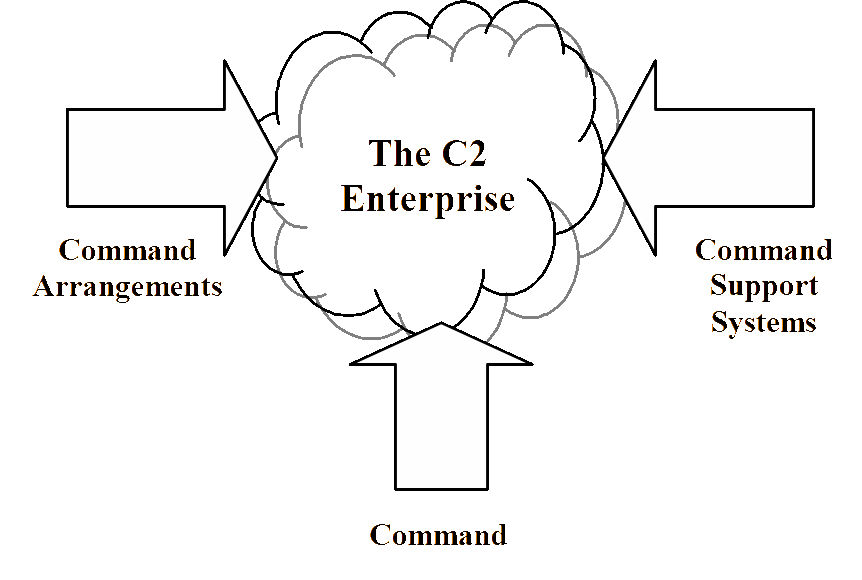
The three-view model of C2 is illustrated with the example of the RAF C2 System employed for the Battle of Britain in 1940. Appendix A, based on reference [9], describes not only the physical components of the system (the Command Support System) used by the RAF, but also operationalises the concept of Command in the Battle of Britain, as well as detailing the Command Arrangements applicable during the particular phase of the war. It is also interesting to note, as does [9], that the system, while an information system in the modern sense, and entirely effective in its purpose, involved the use of almost no information technology.
The broad, socio-technical characteristics of a C2 system dictate that any definition of the ‘Science of C2’ is concerned not only with the hard ‘science’ of the components—for example the science of communications that is realised in a Battlefield Command Support System (BCSS)—but also with the softer ‘art’ of architecting the whole C2 system. Reference [14] explains that the ‘art’ of architecting a system is complementary to the ‘science’:
“The art of architecting, therefore, complements its science where science is weakest: in dealing with immeasurables, in reducing past experience and wisdom to practice, in conceptualisation, in inspirationally putting disparate things together, in providing “sanity checks” and in warning of likely but unprovable trouble ahead [14].”
This notion of the art and the science of creating a complex system, like a C2 system, compels us to seek the broadest possible concept of the Science of C2. The next section examines prevailing definitions of Science and attempts to synthesise a working definition of the Science of C2 based on the three-view model presented in Figure 1.
‘Science’ in the context of command and control
The preceding sections have presented a three-view model of C2. Of particular importance in that model is the nature of the elements of the model, and the ‘system’ characteristics of the C2 system as a whole. The foregoing discussion on the views of C2 suggests that any attempt to define a ‘science’ of C2 will, by necessity, encompass a broad range of concepts, methods, philosophies, and ideas.
Any attempt to define the Science of C2 must, having established the nature of C2, then establish the boundaries of ‘science’ in relation to this area of concern. The following sections now examine a set of standard definitions of ‘science’ and then map these to the area of concern, C2.
Standard definitions of ‘science’
Establishing a definition for the word ‘science’ immediately encounters some philosophical hurdles. The word ‘science’ itself is derived from the Latin scientia meaning ‘knowledge’ [15].
- Dictionary definitions typically focus on two aspects of the meaning of the term. The first relates to the nature of the knowledge itself, for example: (a) ‘Systematic knowledge of the physical or material world’ [16], or, (b) ‘Knowledge—especially that gained through experience’ [17]. These definitions also highlight the physical or experiential nature of knowledge in the context of science.
The second aspect of the meaning of the term relates, in particular, to the process by which such knowledge is obtained, for example: (a) ‘The observation, identification, description, experimental investigation, and theoretical explanation of phenomena’ [17], or, (b) ‘Knowledge or a system of knowledge covering general truths or the operation of general laws especially as obtained and tested through scientific method’ [18].
The latter definitions, however, carry strong hints of the particular philosophical framework that underpins the manner of obtaining knowledge. There is a danger that definitions of science, of the kind listed, become confused, or blended, with definitions of ‘scientism’, which [15] defines as ‘the application of the scientific method’.
The scientific method, literally ‘the method that searches after knowledge’ [19], gained prominence in the 16th century with the work of, for example, Galileo and Copernicus [19]. The modern hypothetico-deductive method of research [20] captures the fundamental processes of the scientific method. [19], however, cautions that ‘not all research methodologies follow the steps…’
This discussion highlights two important facts that are relevant to the task of defining a Science of C2:
- The process by which knowledge may be gained in science is not limited to the scientific method, or to traditional hypothetico-deductive approaches.
- There are a number of possible philosophical frameworks that can underpin the concept of science.
Empirical definitions of science
The preceding notions of what constitutes ‘science’ can be tested against popular definitions of the terms as it is widely used in academic disciplines. Management Science, for example, focuses on ‘improving our understanding of the practice of management’ [21,22]. This suggests the existence of a body of knowledge (operated on by ‘understanding’) which can be acquired and extended (through ‘improving’), and, which is applied by some means (in ‘the practice of management’). Note that there is no stated restriction on the methods used to acquire the body of knowledge.
Political Science, by contrast, can be regarded as ‘the branch of social science that studies politics’ [23]. It can use a range of methods and tools to achieve this end, as well as ‘other scientific methods to gather facts and data that can be used to explain political phenomena’. This definition enunciates a body of knowledge (‘facts and data’) and processes for acquiring that body of knowledge (‘other scientific methods’) and also hints at the application of the body of knowledge (‘to explain political phenomena’).
Computer Science, finally, is ‘the systematic study of computing systems and computation. The body of knowledge resulting from this discipline contains theories for understanding computing systems and methods; design methodology, algorithms, and tools; methods for testing of concepts; methods of analysis and verification; and knowledge representation and implementation’ [24]. This definition highlights the body of knowledge, as well as methods for acquiring, and applying, the knowledge. The definition of Computer Science also highlights an important additional component of a science: theories for understanding the area of interest.
It may be concluded, from such empirical definitions, that any rigorous, systematic activity which seeks to acquire and apply a body of knowledge about a particular topic or field can be regarded (or, at least, is widely regarded) as a ‘science’. These definitions readily admit the possibility of a rigorous, systematic activity directed at acquiring and applying a body of knowledge about the field of Command and Control (C2). In other words, a ‘Science of C2’.
Philosophical frameworks and science
The philosophical foundations of a ‘science’ define the exact manner in which rigour is applied to the processes of acquiring and applying the body of knowledge for that science. For example, in Computer Science, it may be typical that the acquisition of the body of knowledge of computing systems and computation, and its application, are carried out within a general framework of a Popperian notion of science. That is to say, knowledge in Computer Science may be acquired by following the general dictates of the falsification and refutation of theories as expounded by Karl Popper [25]. Equally, Computer Scientists might choose to follow a Baconian notion of science [26], whereby knowledge is acquired and applied, and theories tested, by following a hypothetico-deductive [20] philosophy.
This discussion illustrates the need to distinguish between ‘science’ as a proper noun (Computer Science, Management Science, or the Science of Command and Control (C2)) and ‘science’ as a verb (the systematic, rigorous process of acquiring and applying a body of knowledge and testing theories in that body of knowledge). The latter may be conducted under the guidance of one of a number of schools of thought including, but not limited to, those of Popper [25], Bacon [26] and Kuhn [27].
A general definition of science
On the basis of the preceding arguments, the authors contend that it is now reasonable to propose a general definition of ‘Science’ as a combination of:
- an organised body of knowledge about a particular area of interest or endeavour;
- the methods used for acquiring that body of knowledge; and
- the processes and methods of applying the body of knowledge.
It is not, however, until a particular method is declared for acquisition and/or application of knowledge that it is possible to align a particular ‘Science’ to a particular philosophical framework.
A working definition of the science of C2
The general definition of Science can now be summarised, in relation to Command and Control (C2), in the following way:
The Science of C2 is therefore concerned with the organised body of knowledge about the three views of C2 (Command Arrangements, Command, and Command Support Systems) and the behaviour of the enterprise that they comprise, as well as the method(s) of acquiring that organised body of knowledge. Furthermore, the focus of the Science of C2 is on the application of the body of knowledge, and the application of the processes for acquiring that body of knowledge, to real-world problems.
The processes and methods of a science of C2
The method of conducting investigations, in natural science, based on the three principles of reductionism, repeatability, and refutation of hypotheses [28] that are concisely captured in the methods of experimental investigation, has been so successful as a process for acquiring organised bodies of knowledge that there is a strong tendency to see all science as quantitative and experimental in nature. As [9] points out, “Many people in many different fields make the unquestioned assumption that ‘research’ means the testing of hypotheses”. In defining a Science of C2, however, the authors have reinforced the view that there is a range of processes and methods that can be used to achieve the acquisition and application of the body of knowledge inherent in a science. Thus a choice can be made to adopt a ‘traditional’ approach to the Science of C2, relying on prevailing ‘quantitative’ approaches. The range and nature of the three views of C2 (Figure 1) suggest, however, that a broader approach to knowledge acquisition and application will need to be adopted to meet the needs of the field of command and control. While there is no doubt that many aspects of C2, and its consequences, are, indeed, measurable, the focus in this paper is on the methodological tools that can be applied to better understand the different views of command and control. Recognising the non-quantitative aspects of C2 is consistent with the concept of the ‘art’ of architecting the C2 system, in addition to the ‘science’, mentioned previously. While it may be appropriate to apply experimental methods, and a quantitative, hypothesis-testing approach to research in the area of Command Support Systems (for example to study the data rates across communications channels), there is little doubt that the process of acquiring an organised body of knowledge about the predominantly social, organisational and behavioural areas of Command and Command Arrangements is unlikely to be amenable to the same approach. As [9] reminds us:
“When we turn to human affairs, however, and to social phenomena, it is far from obvious that the same experimental hypothesis-testing approach applies. The methods of natural science, extremely productive in enabling external observers to discover the regularities of the natural universe, are exceptionally difficult to apply to human affairs [9].”
This reinforces the view that it is necessary, in defining the Science of C2, to look beyond entrenched views of what constitutes ‘science’, and adopt the broadest possible approach to the process of acquiring an organised body of knowledge about C2. This approach will seek appropriate qualitative and quantitative methods for the three areas of C2 that have been identified.
The science of C2
From the preceding discussion it is reasonable to conclude that the Science of C2 can be considered to cover all the sets of underlying ideas and relationships that apply to the ‘art’ and the ‘science’ of C2 and the methodologies that apply these to C2 issues.
This gives rise to the following definition:
The Science of C2 comprises:
(a) The organised body of knowledge of the management of military operations that encompasses command arrangements, command, and command support systems;
(b) The method(s) of acquiring that organised body of knowledge through a set of qualitative and/or quantitative disciplines that underpin the management of military operations across command arrangements, command, and command support systems; and
(c) The methods and processes to apply this body of knowledge to the creation and evolution of the socio-technical systems that underpin military operational management activities.
The next section presents a general framework, based on this definition, which can be used as a map of research activities in the field of C2.
Towards a coherent research framework that encompasses the science of C2
If the definition of the Science of C2, presented in this paper, is to serve as a mechanism for advancing the knowledge of Command and Control, it must be placed into a framework that is designed to facilitate systematic inquiry. This means that the concept of a Science of C2 must be mapped onto a research framework.
Research has many definitions, including:
“The systematic process of collecting and analysing data in order to increase our understanding of the phenomenon of interest [19].”
Checkland and Holwell [9], based on [29], provide a model of elements (Figure 2) relevant to any piece of research and necessary to achieve the systematic, rigorous increase in understanding defined by [19]. The model was developed to address ‘rational intervention in human affairs’ typical, according to the authors, of activities such as operational research, systems engineering, and systems analysis. The key characteristic of those areas of endeavour, shared with command and control, is that they:
![Modified elements relevant to any piece of research based on [9].](/journals/journal-of-battlefield-technology/volume-08/issue-01/assets/8-1-3-cropley/figures/figure02.gif)
“… face a more complex situation than that facing the natural scientist, who plays his game against nature’s unchanging phenomena: yet all hope to make use of the organized rational thinking which is characteristic of the whole intellectual enterprise which is natural science [29].”
Checkland’s [29] model is based on the lack of primacy, in disciplines such as operational research, systems engineering and, by virtue of its similar goals, command and control, of theory or practice. Checkland’s model represents a way of understanding the relationship between a body of knowledge, a way of applying that knowledge to a real-world situation and an identified area of concern for the case of activities that attempt to intervene rationally in dynamic human affairs. While Checkland [29] argues that it is equally applicable to natural science:
“For example, in the pharmaceutical industry in the 1980s, one definition of A [the area of concern] is the search for economy of experimentation in seeking useful drugs; quantum theory provides an F [framework of ideas/body of knowledge] well-tested in other fields of science; and modern sophisticated computer graphics a new M [methodology for applying the framework of ideas to the area of concern] in which models of molecular orbitals may be created and manipulated on the computer screen [29]”.
It is also possible to confine our use of the model only to those areas of concern, such as command and control, which show a clear dynamic, qualitative, ‘human’ element.
In the model a ‘particular set of linked ideas F (the Framework of Ideas) is used in a methodology M to investigate some area of interest A’ [9]. By mapping the definition of the Science of C2 onto this model we create a framework for understanding and directing programs of research in the field of C2.
Applying the Checkland model to the definition of the Science of C2 presented in this paper leads to the following:
- The Area of Concern (A) is Command and Control (C2);
- The Framework of Ideas (F) is the ‘organised body of knowledge of the elements of the management of military operations across the elements …’;
In this paper the authors suggest that the Methodology, M, is logically divided into two complementary components:
- The Methodology (M1) is the ‘methodologies and skills to apply this body of knowledge …’;
- A second, enabling Methodology (M2) is the ‘process of acquiring that organised body of knowledge …’
- The interrelationship between these four elements is shown in Figure 2.
Applying the modified Checkland model to each element of C2 (Command Arrangements, Command and Command Support Systems) results in a matrix shown in Table B.1 in Appendix B. The primary focus of the matrix in Table B.1 is the components of C2; however, the reader should not lose sight of the important system-level aspects of the C2 system.
The generic matrix developed in Table B.1 can be used to map the C2 research profile of any organisation. The table shows that an organisation can endeavour to expand knowledge (conduct research) across any, or all, of the three ‘views’ of C2, and that within each view, it is possible to expand knowledge in relation to: (1) the framework of ideas, or the organised body of knowledge, for that view; (2) the methodologies by which the organised body of knowledge of C2 is applied (M1); (3) the methodologies by which the organised body of knowledge is created or enhanced (M2).
For each element of research in Table B.1, and for each C2 ‘view’, the table gives general examples of areas of research and methodologies that are applicable. The entries in Table B.1 are not exhaustive.
Table B.2 of Appendix B shows a hypothetical example of the profile a Defence research laboratory. For reasons of confidentiality and security it is not appropriate to give a real example.
The terms in the matrix (Low, Medium and High) indicate:
- For M1 and M2: The current levels of research activity/focus for each of the defined views of C2, against the framework elements M1 and M2, for the organisation in question.
- For F: The maturity of the extant body of knowledge for each of the defined views of C2 in the organisation in question.
In other words, the hypothetical organisation described by Table B.2 has a high level of existing knowledge (a mature body of knowledge) of Command Arrangements, but a low level of existing knowledge (a weak body of knowledge) of Command and CSS. As a strategy, such an organisation might, therefore, be expected to either focus on research in its area of strength (Command Arrangements) or to endeavour to enhance its research in areas where its body of knowledge is deficient. Similarly, the hypothetical organisation in Table B.2 has only a low/medium level of research activity into the methods by which its body of knowledge of C2 is utilised (M1) across all three views, but a particularly strong focus on research activities (M2) aimed at building its body of knowledge relevant to Command Support Systems (CSS).
The Research Profile Matrix (RPM) is presented here as a tool for analysing the focus of research programs in C2 in a research organisation. It is built on a foundation of the definition of the Science of C2 and Checkland’s modified framework for research [9,29]. This must be viewed in a context of a resource-limited organisation’s capacity to conduct research across a number of areas of interest in C2. There is scope for extending the RPM to include an analysis of the different aspects of “building” the C2 system and “operating” the C2 system.
The Research Profile Matrix (RPM) is currently finding use in the C2 executive management group of the Technical Cooperation Program (TTCP) involving defence research laboratories from the United States, United Kingdom, Canada, Australia, and New Zealand.
The RPM contributes to the understanding of the Science of C2 in the following ways:
- It permits the visualisation of an organisation’s C2 research profile.
- It permits the exposition of strategic planning directions in a resource-limited environment.
- It expedites comparisons of C2 research profiles between laboratories.
- It can be used as an underpinning concept to inform a meta-methodology for developing C2 systems along the lines suggested by [30].
Summary and conclusions
In this paper we have defined Command and Control as a socio-technical activity that encompasses three aspects (Figure 1):
- command arrangements;
- command; and
- command support systems.
These three views are bound together to form a system for the management of military operations.
We have defined the Science of C2 as:
- The organised body of knowledge of the management of military operations that encompasses command arrangements, command, and command support systems;
- The process of acquiring that organised body of knowledge through a set of qualitative and quantitative disciplines that underpin the management of military operations across command arrangements, command, and command support systems, and;
- The methodologies and skills to apply this body of knowledge to the creation and evolution of the socio-technical systems that underpin military operational management activities.
We have developed a modified framework of elements of C2 research (Figure 2), consisting of:
- The Area of Concern (A) that is C2;
- The Framework of Ideas (F) that is our ‘organised body of knowledge of the elements of the management of military operations across the elements …’;
- The Methodology (M1) that is our ‘methodologies and skills to apply this body of knowledge …’;
- A second, enabling Methodology (M2) that is the ‘process of acquiring that organised body of knowledge …’
Finally, we have combined these in a C2 Research Profile Matrix (Tables B.1 and B.2) that can be used to understand the coverage of C2 research portfolios.
Acknowledgement
The authors gratefully acknowledge the support of the Defence Science and Technology Organisation (DSTO) in funding the research activity described in this paper.
| An Aerospace Battle Management System. The RAF C2 system for the Battle of Britain, 1940 | ||
|---|---|---|
| Command Arrangements | Command | Command Support Systems |
| RAF Commands as separate commands responsible to the Chief of Air Staff | CinC Fighter Command as operational commander responsible for air defence of UK | Chain Home (radar systems along channel coast) |
| Army Anti-Aircraft Command and RAF Balloon Command under op control of CinC Fighter Command | Group commanders as tactical commanders responsible for air defence in assigned areas | Chain Home Low (radar system to detect low flying aircraft) |
| Observer Corps under operational control of CinC Fighter Command | Sector commanders as tactical commanders responsible for air defence in sectors | Identification Friend or Foe (IFF) |
| Four Group commanders (**) under command CinC Fighter Command (****) | Squadron commanders responsible for tactical deployment of aircraft | Observers and listening posts |
| Sector Commanders under operational control of Group Commanders | Dedicated land lines connecting sensors and command centres (Post Office War Group) | |
| Establishment of Groups, and Sectors responsible for Wings and Squadrons throughout UK | Staff manning operations centres at operational and tactical levels | |
| Separate areas allocated for defence by aircraft and anti-aircraft artillery | Bentley Priory filter room | |
| Responsibility for activities allocated to various civil and military authorities |
| Elements of Research (Checkland & Holwell, 1998) | Domain: Military Command & Control (C2) | ||
|---|---|---|---|
| Area of Concern | Command Arrangements | Command | Command Support Systems |
| Framework of Ideas (the body of knowledge) | Politics, political science, organisational theory, diplomacy, systems thinking. | Cognitive sciences, decision theory, sociology, anthropology, military strategy and tactics (“The Art of War”), systems thinking, command philosophy. | Engineering science, computer science, doctrine, operating procedures. |
| Applied Methodologies (M1) (that support the application of the body of knowledge) | Interpretive: Political science, organisational design, soft systems methodology (SSM). | Interpretive & Functionalist: Enterprise framework practice, cognitive workflow analysis, information systems, command practice, ethnography, historical methods. | Functionalist: Systems engineering, communications science, systems architecting, DoD architecture framework (DODAF) practice, doctrine refinement. |
| Enabling Methodologies (M2) (that support the acquisition of the body of knowledge) | Interpretive: Organisational design & analysis, political science. | Interpretive & Functionalist: History, decision theory, ethnography, psychology, sociology, experimentation | Functionalist: ‘Hard’ science (quantitative, experimental), engineering science, information theory. |
| Area of Concern | Command Arrangements | Command | CSS |
|---|---|---|---|
| Framework of Ideas. (The Body of Knowledge: level of maturity, expertise, manuals) | Maturity of Knowledge: High | Maturity of Knowledge: Low | Maturity of Knowledge: Low |
| Applied Methodologies (M1). (Design: using ‘F’) | Research focus: Low | Research focus: Medium | Research focus: Medium |
| Enabling Methodologies (M2). (Research: building ‘F’, learning) | Research focus: Medium | Research focus: Low | Research focus: High |
References
[1] G. Roman, Essay on Strategy XIV, Institute for National Strategic Studies, National Defense University, Washington DC, USA [Online accessed 4 Jan 01], URL: http://www. ndu.edu/ndu/inss/books/essa/essacont.html 1996.
[2] ADFP6 1998, Australian Defence Force Publication, Operations Series, ADFP6, Operations, 2nd edition, Department of Defence, Canberra, Australia.
[3] COBP 1998, NATO Code of Best Practice for C2, [Online, accessed Dec 2000], URL: http://www.dodccrp.org
[4] D. Alberts and R. Hayes, Command Arrangements For Peace Operations, National Defense University, NDU Press Book, [Online, accessed 17 Jan 01], URL: http://www.ndu. edu/ndu/nss/books/capo/capohome.html, 1995.
[5] DP6 1997, US Marine Corps Doctrine Publication 6, ‘Command and Control’, US Marine Corps 4 October 1996, [Online, accessed 13 Jun 97], URL: http://ismo-www1.mqg.usmc.mil/docdiv/6/ch1.htm
[6] Concept paper 2000, Command and Control of the MAGTF, Draft US Marine Corps concept paper, [Online, accessed 11 Jan 01], URL: http://www.fas.org/spp/military/docops/ usmc/c2.htm, 2000.
[7] M. Van Creveld, Command in War, Harvard University Press, Cambridge, USA, 1985.
[8] JP1-02, DOD Dictionary of Military and Associated Terms, [Online, accessed 16 Jan 2001], URL: http://www. dtic.mil/doctrine/jel/doddict/index.html, 2001.
[9] P. Checkland and S. Holwell, Information, Systems and Information Systems, Wiley, Chichester, ISBN 0-471-95820-4, 1998.
[10] N. Sproles, “Dissecting Command and Control with Occam’s Razor, or, Ask Not What ‘Command’ and ‘Control’ Means to You But What You Mean by ‘Command and Control’, Australian Defence Force Journal, No. 155, July/August 2002.
[11] D. Hitchins, Command and Control—the Management of Conflict, [Online, accessed 8 August 2004], URL: http://www.hitchins.net/CandC.html, 2000.
[12] R. Falk, The Business of Management: Art or Craft?, Penguin Books, Aylesbury, UK, 1976.
[13] P. F. Drucker, Management, Pan Business Management, London, UK, 1977.
[14] E. Rechtin and M. Maier, The Art of Systems Architecting, CRC Press, Boca Raton, 1997.
[15] Collins Concise Dictionary, 5th Edition, HarperCollins, Glasgow, 2001.
[16] Random House Dictionary of the English Language, Unabridged Edition, 1967.
[17] American Heritage Dictionary, [Online accessed, 15 April 2004; URL: http://www.dictionary.com, 2000.
[18] Merriam-Webster Online Dictionary, [Online accessed 15 April 2004], URL: http://www.m-w.com/.
[19] P. Leedy, and J. Ormrod, Practical Research: Planning and Design, 7th Edition, Merrill Prentice Hall, New Jersey, 2001.
[20] U. Sekaran, Research Methods for Business, John Wiley and Sons, New York, 2000.
[21] Management Science Journal, Journal Mission, [Online accessed December 12, 2004], URL: http://mansci. pubs.informs.org/amission.html.
[22] W. Hopp, “From the Editor”, Management Science, Vol. 49, No. 1, January 2003.
[23] D. Resnik, “Some Definitions of Key Ethics Concepts” [Online accessed December 12, 2004], URL: http://www. scicom.lth.se/fmet/ethics_03.html.
[24] “Glossary”, High Performance Computing and Communications: Toward a National Information Infrastructure, Office of Science and Technology Policy, Federal Coordinating Council for Science, Engineering and Technology, 1994, [Online accessed December 12, 2004], http://www.hpcc.gov/pubs/blue94/section.6.html.
[25] K. Popper, The Logic of Scientific Discovery, 3rd Edition, Hutchinson, London, 1972.
[26] F. Bacon, “Advancement of Learning. Novum Organum. New Atlantis.” Encyclopaedia Britannica, Chicago, 1955.
[27] T. Kuhn, The Structure of Scientific Revolutions, 2nd Edition, University of Chicago Press, Chicago, 1970.
[28] P. Checkland, Systems Thinking, Systems Practice, John Wiley and Sons, Chichester, 1993.
[29] P. Checkland, “From Optimizing to Learning: A Development of Systems Thinking for the 1990s”, Journal of the Operational Research Society, Vol. 36, No. 9, pp. 757–767, 1985.
[30] S. Cook, E. Lawson and J. Allison, “Towards a Unified Systems Methodology for Australian Defence Systems-of-Systems”, in Proceedings and on CD-ROM of the International Council on Systems Engineering Ninth Annual International Symposium (INCOSE ‘99), Brighton, England, 6–11 June 1999, pp. 17–25.