
Volume 7, Number 3, November 2004
Modelling Shared Situational Awareness Using the MANA Model
- 1 Defence Technology Agency, Naval Base, Private Bag 32901, Devonport, Auckland.
Abstract
This paper introduces new features included in the widely used MANA Agent Based Distillation Model (ABDM). Particular emphasis is given to its communications and network modelling abilities, which allow the analyst to explore concepts and application of Network Centric Warfare (NCW). Two simple scenarios are used to demonstrate some of its abilities in this area. These involve the use of inorganic contact information to assist in the interception of a Red fleet at sea and for weapons targeting of distant agents. The ability to measure the effect of varying the parameters of a network in a particular scenario is demonstrated. Such abilities allow performance and cost-benefit studies to be conducted using this model. It is suggested that complex multi-node networks could be readily modelled in an ABDM like MANA.
Introduction
Currently much of the Intelligence, Surveillance, Targeting and Reconnaissance (ISTAR) performed by the military is based upon platform-centric systems. A key question of contemporary interest is the effect that moving to a network-centric capability might have on the ability of the military to perform its tasks. In order to inform the debate it is useful to use Operations Analysis models to help to understand the likely outcomes of making this change. Such modelling can be used to identify high-payoff areas, and also areas that might be negatively affected by the sharing of information via networking.
A new version of the widely used MANA model includes the ability to model the flow of situational awareness information between agents. Agents are able to react to such information as if they had obtained it by using their own organic sensors. This includes the ability to explore the possibility of targeting and firing weapons based upon inorganic contact information.
MANA
MANA (Map Aware Non-Uniform Automata) is an agent based distillation model (ABDM) with agents represented by advanced cellular automata [1]. The model was developed in 2000 in order to help answer questions of interest to the New Zealand Defence Force. At the beginning its strength lay in its flexibility and the simplicity of designing scenarios in it. Agents have capabilities like movement speed and firing range, they have personalities that cause them to be attracted or repulsed from other entities, and those abilities and personalities are able to change based upon particular events that occur during a model iteration.
MANA has been used in a range of studies up to now. These include maritime surveillance studies (for example, see [2]), studies of the fractal nature of combat data [3], and extensively in a range of studies carried out by the Project Albert International Team (http://www.mcwl.quantico. usmc.mil/divisions/albert/research/).
MANA version 3 is the most recent release of the model. It includes a new communications modelling facility, an extended range of weapons, extended movement algorithms and a wider range of states that can be entered and personality types that can be adopted. The simplicity of the original MANA version is still present for those who wish to use it as a sketchpad to develop concepts rapidly, while the new features provide a range of possibilities for more advanced modelling. MANA’s new communications modelling capability is the central focus of this paper.
Key features of the model
Event-driven state changes
Agents have more than 50 states that they can change into depending on events. Events include taking a shot, being shot at, refuelling, being refuelled, reaching a goal and contacting an enemy, either directly, or on a situational awareness map. When agents change states all of their properties and personality traits can change. Typical changes include a variation in the agent’s speed, their attraction towards enemy contacts, and the efficacy of their weapons. Agents begin in a default state and they return to this in the absence of an alternative after they leave their current state. Prioritisation of the state that the agent changes into on a given step is possible. This allows the analyst to specify a preferential choice of state when there are several possibilities in a single model step.
Situational awareness
Squads are used to organize groups of agents with homogeneous characteristics in MANA. Each squad owns a situational awareness (SA) map that retains a memory of all contacts seen by squad members. Each squad also maintains an inorganic map that holds a memory of contacts passed on from other squads via communications links. Contacts stored on each map are labelled as unknown (unclassified detections), friendly, enemy or neutral type as appropriate. Contacts persist on the map until a specified time, the “persistence time”, from initial addition of the contact to the map has passed.
Addition of particular contact types onto a SA map can be used to trigger event-based state changes. An agent can have particular personality traits that cause it to move toward, or away from, particular SA map contact types. Weapons fire can be targeted based upon SA map information.
Communications
Each squad can maintain a number of communications links with other squads. These provide conduits for the sending of contact information between squads.
Figure 1 shows the communications link set up window for a typical link specification. It is clear that the parameters of the link can be intricately specified. Communications messages (which consist of the contact’s type (friendly, neutral, and so on.), its location and the time of the sighting) can be passed off the squad’s local SA map, or they can be derived from information that has been sent from other squads. This allows for retransmission stations to be included in an information-sharing network.
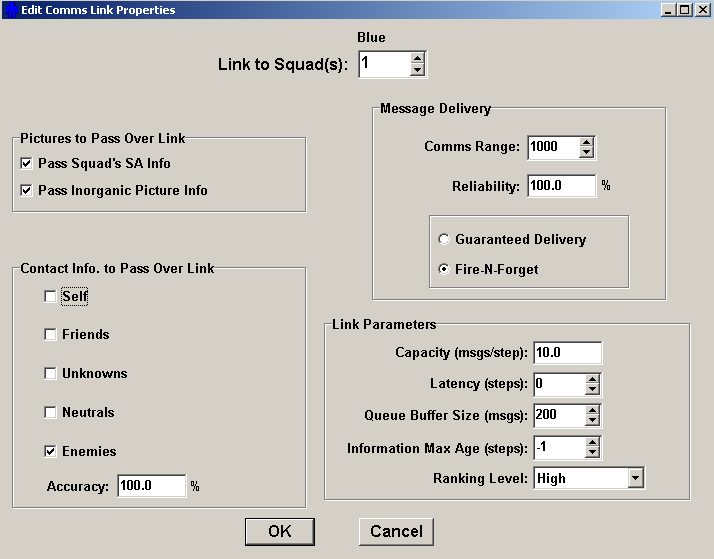
A first-in-first-out (FIFO) queue is maintained by each squad’s communications manager to allow contacts to be retained until the capacity of the link allows them to be sent. The sending of information can be either via a “fire and forget” mechanism or by “guaranteed delivery”. Under the “fire and forget” option messages are lost if a destination squad does not have an agent within the specified communications range. “Guaranteed delivery,” allows such messages to be held in a FIFO queue until an agent from the destination squad comes within range.
Weapons suite
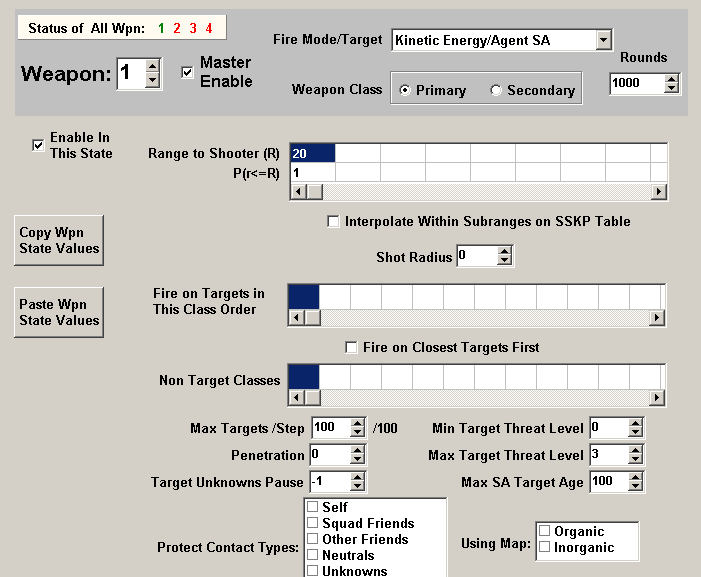
MANA provides a number of generic weapons. There are two main types: kinetic-energy (point-fire) and high-explosive (area-fire). Kinetic-energy (KE) weapons have a range-probability hit profile where range is measured from the shooter—handguns and machine guns are typical examples of such weapons. Conversely, high-explosive (HE) weapons measure their range for this profile from the target (blast centre)—mortars are a typical example. Weapons can be targeted off the agent’s immediate situational awareness, or off either of the situational awareness maps maintained by its squad. The location of targets obtained from the former is exact, while that obtained from the latter source(s) may suffer from spatial and temporal aggregation of contacts on the maps.
The weapons suite allows target prioritisation. It is also possible to specify that the weapon should not be fired if particular contact types (such as friends or neutrals) are likely to be killed (based on current situational awareness information). These features can be used to model particular rules of engagement.
For reference, MANA’s weapons property editor is shown in Figure 2.
Sensor modelling
Each agent has an ability to sense its environment. It has a specified detection range, within which other agents are detected, but not classified or identified. It also has a specified classification range-probability profile. Agents are classified as enemy, neutral or friendly contacts if a random test exceeds a set probability for classification at the given range. Classification range can be specified in a “cookie-cutter” style as for detection range, if this is appropriate. Agents that are detected but not classified are recorded as contacts of unknown type.
“Fuel”/interaction modelling
The MANA model includes a full suite of functions to deal with the provision and use of fuel. Fuel can assume one of two meanings in MANA. Firstly, fuel can represent the amount of energy an agent has to do their task. In that case it will generally decrease over time, except when the agent receives fuel from another agent via refuelling. Fuel can also be used as a surrogate to represent less tangible quantities such as courage or cowardice. In that case it can increase or decrease over time, or it can vary upon interaction with other agents. For example, if fuel is taken to represent courage then interaction with an enemy agent might decrease the fuel level, while interaction with a friendly agent could increase the fuel. State changes based upon the occurrence of a refuelling event can occur.
Comparison with other agent based models
The Pythagoras [4] and Crocadile [5] models are two contemporary models that have a number of features in common with MANA. They allow modelling of the effects of terrain, have the ability to trigger personality and capability changes in agents, and model the sharing of situational awareness. Each model has particular strengths and weaknesses relative to MANA. In Pythagoras communications are implicitly defined and weapons are not so advanced as in MANA. Pythagoras has some capability for modelling command and control structures, however, which MANA currently lacks. Crocadile, which is currently under development, is a slightly higher fidelity model than MANA, having the ability to model 3D terrain and to account for effects like acceleration on an agent. It has similar communications modelling capabilities to MANA.
Using the MANA model to study network centric warfare
A particular strength of ABDM is the ability to ask “What If?” questions. An example might involve determining the characteristics of the network between agents necessary to achieve a certain goal. The inclusion of a communications facility in MANA allows a wide range of Network Centric Warfare issues to be explored.
Illustrative scenarios
Scenario 1—guidance of a blue ship towards a red fleet using inorganic information from an aerial intelligence surveillance and reconnaissance platform
Figure 3 shows a simple example of using communications links in a MANA scenario. The three windows shown from left to right are: the main MANA window, the inorganic and the organic SA maps.
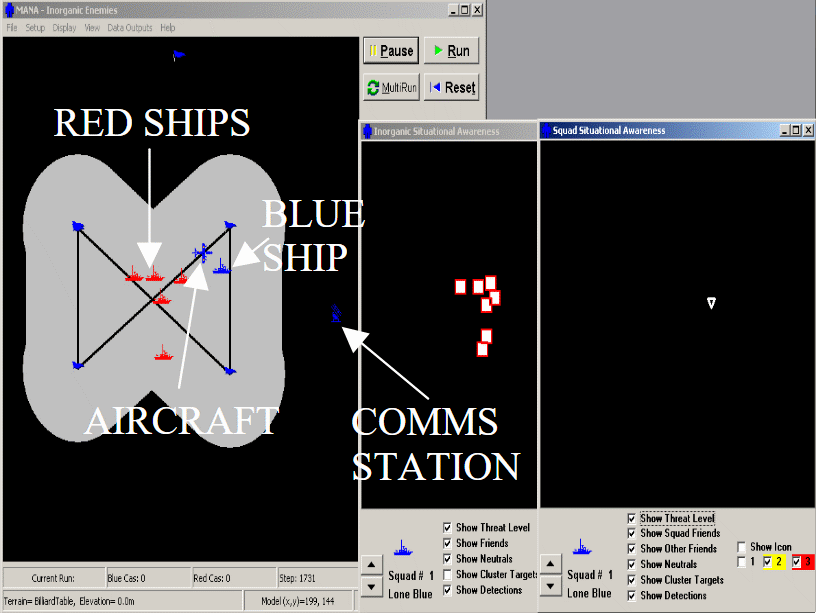
The scenario is set at sea and it shows a number of Red vessels (modelled as travelling at about 15 knots) situated in the middle of the screen; they have travelled there from the top of the screen. A Blue ship is waiting at the right-hand side (initially by the communications station); its job is to intercept and follow these ships, but it does not know where they will arrive from, or when; the ship has only very short-range sensors (capable of scanning the less than 1% of the total battlefield area immediately surrounding it) to assist it to find the fleet, and these are inadequate in the size of sea represented in the model. The vessel calls upon a reconnaissance aircraft to assist in its search. The aircraft flies a bowtie search pattern as shown; the sensor coverage of the aircraft at different points on its track is indicated by the light grey extended area about the black line (drawn at track centre). The aircraft has picked up all of the incoming Red ships at the time this snapshot was taken. It sends this information to a communications base station (shown to the right of the screen), and that station relays the information to the Blue ship. The default network settings used for each communications link in this scenario are shown in Table 1.
When this snapshot was taken the Blue ship had received inorganic information on the location of the incoming ships and it was moving from its initial position (by the relay communications station) to intercept; its speed was about twice that of the Red vessels. The two foreground panels show the situational awareness maps of the Blue ship. Its organic “squad” situational awareness map (far right SA map) shows that the only vessel it can sense organically is itself (upside-down triangle). The inorganic situational awareness map (middle window), containing data provided from the reconnaissance asset (sent via the communications base station) tells a different story—there, the positions of all of the incoming ships are denoted. (Notice that there are more contact “squares” in the inorganic picture than there are Red
| Bandwidth | 10 messages per model step |
|---|---|
| Latency | 0 model steps |
| Accuracy | 100% |
| Reliability | 100% |
| Range | ∞ |
| Information Sent | All classified contact sightings: Enemy, Friend and Neutral |
ships. This is caused by the fast motion of the Red vessels relative to the persistence time of the corresponding recorded contacts on the inorganic map. (A limitation of the model is its inability to form “tracks” from a set of contact positions that correspond to a single agent (or set of agents).) If it is assumed that the Red vessels have been uniquely identified then there is an option in MANA to remove such persistent “ghosts”. The model continued to run after this snapshot, with the search vessel moving towards, and then remaining with, the incoming vessels.
Studies can be done to demonstrate the value of connecting the output from ISR assets to a network to enhance the effectiveness of a force in achieving its objectives. It can be shown, in this scenario, that removing the base station, so that the Blue ship does not receive information from the aerial asset, causes the incoming fleet to never be intercepted and escorted. While such results are fairly obvious in this case, in a more complex system this kind of study can be very valuable for exposing the principle vulnerabilities in a network. It could indicate the weakest link(s) and suggest to the researcher an appropriate area to concentrate efforts whose aim is to harden the system against attack.
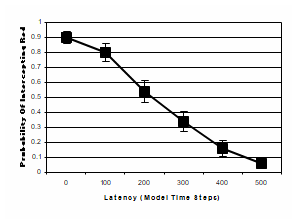
Parameters such as latency and bandwidth are also of great importance in setting up a network. For example, in this scenario the combined latency in the link from the aircraft to the communications station and that from there to the Blue ship was varied from 0 to 500 time steps (note that model time steps can be scaled to real time as appropriate). shows the strong relationship between network latency and one measure of effectiveness (MOE), interception probability. Such results allow the analyst to perform a risk analysis, where ultimately the cost of improving a network parameter like latency can be measured against the risk inherent in not improving it. For example, a large payoff (absolute increase in interception probability of 0.35) is obtained here when the latency is improved from 200 to 100 steps, but further improving the latency to close to 0 steps only yields a 0.10 absolute improvement in probability. Adding to this diminishing return, it may be that the cost of achieving a close to zero latency in the system is significantly higher than is that for the reduction from 200 to 100 steps.
Firing of weapons off inorganic contact information
Targeting weapons off inorganic contact information is difficult from the point-of-view of formulating appropriate rules of engagement and also from a purely technical perspective, with some weapons unable to be fired unless an organic sensor (such as radar) is tracking the target. If one assumes that these issues can be resolved in the future then it is interesting to ask what new questions and challenges could arise when one begins to have weapons platforms remotely cued by other agents.
Figure 5 shows a simple scenario that has been developed to demonstrate the potential of some of MANA’s communications features. A group of 15 neutrals are initialised at random positions within a rectangle centred in the bottom left corner. They move towards a waypoint directly upwards on the battlefield screen from these positions. A Red agent is placed in the midst of the neutrals and it follows them at twice their speed and in the same direction. A sensor agent has been placed close to the Red agent. The sensor agent has a communications link to a relay station, which then sends the contact information to the remote gun. The information content sent over the communications links can be set in MANA. Here, the possibilities of sending all classified contacts and then of filtering out neutral contacts are separately explored. The latency in each of the communications links is set at 100 time steps (200 time steps for total path) and the bandwidth is set at 20 messages/step. Otherwise the communication link parameters listed in Table 1 are also used for this scenario.
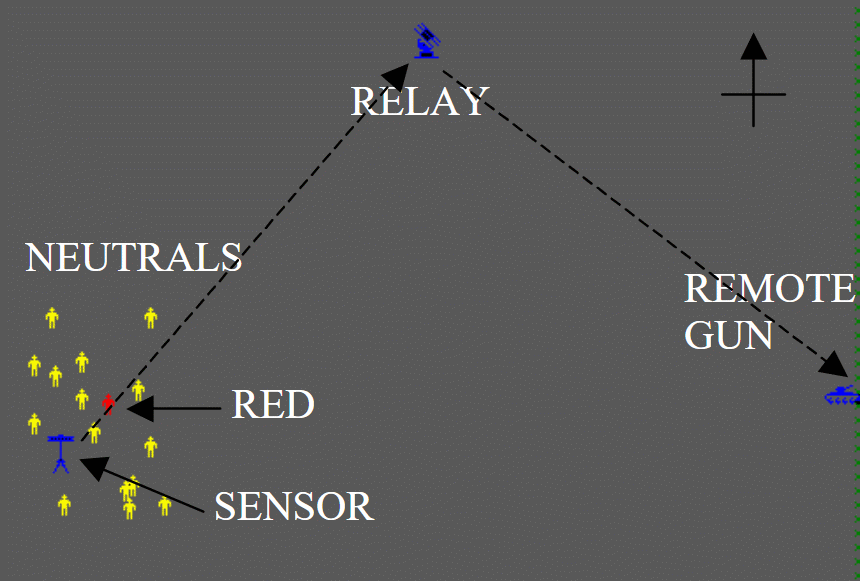
The remote gun agent has short-range organic sensors that are not capable of sensing any of the other agents shown in Figure 5. It must therefore rely on inorganic contact information. The gun is set such that it will not fire upon a target if it knows that there are neutral contacts within shot radius (four grid squares) of it. When it is safe to fire, the gun targets one enemy contact location on each time step until none remain. Ammunition is assumed to be limitless and there is no reloading or retargeting time allowed for the shooter, for the purposes of this demonstration.
Each data point on the following graphs represents the average from a set of 50 model iterations. Error bars correspond to the standard error in the average.
Figure 6 and Figure 7 show the probability of killing the Red agent (MOE 1) and the number of neutrals killed (MOE 2) respectively as the total latency on the two communications links is varied (each link was assigned half this total latency). Each of these figures shows two traces—one for the unfiltered contact information and the other where contacts corresponding to neutral agents are not carried.
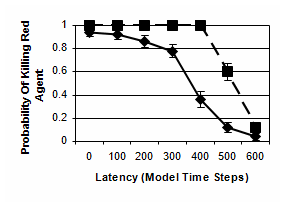
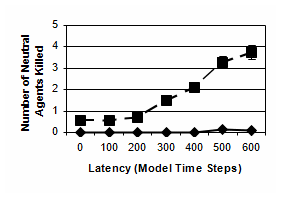
Figure 6 shows that when unfiltered contact information is sent, the probability of killing the Red agent decreases with increasing latency, with a gradual slope from 0 to 300 steps, and then with a steeper slope from 300 to 500 steps, and that there is a low probability of killing the Red agent for higher latencies. Removing neutral contacts from the information stream improves this MOE, with 100% probability of killing the Red agent being obtained for latencies lower than 500 steps, from which point the performance of the shooter decreases sharply, with 10% kill probability being found for a latency of 600 steps. Reference to Figure 7 helps to explain these results. There, in the case of unfiltered data, the number of neutrals inadvertently killed is close to zero until latencies of greater than 400 steps are encountered, and then a maximum of 0.1 neutrals are killed on average per iteration. Conversely, the number of neutrals killed steadily increases with latency when neutral location information is not available. Together these curves show that MOE 1’s better performance at greater latencies when the neutral contact information is filtered is at the expense of the safety of the neutral population, with the shooter being allowed to fire at the Red agent blind to the presence, close by, of vulnerable neutrals. Sharing neutral contact information lowers the performance of MOE 1, at any latency, but it markedly improves that for MOE 2. These changes are due to the increase in weapon targeting care when this extra information is available to the shooter.
Figure 6 and Figure 7 demonstrate the importance of having appropriate information content shared on a network, and in a timely fashion (particularly for accurate inorganic weapons targeting, which is shown to affect both the targets and non-targets that may be surrounding them). They show that it is often important to use more than one MOE to assess the outcome of an action.
Network parameters like bandwidth can also play important roles in the outcome of a situation. To explore this, parameter latencies of 100 steps were set for each of the communications links, the standard bandwidth of 20 contacts per step was set for the link between the relay station and the shooter, and the bandwidth between the sensor and the relay station was varied; all contact information was carried on the links. Figure 8 shows that for very-low bandwidths (less than six messages per step) the probability of killing the Red agent is reduced to between 20% and 40% from the 100% kill probability available when a greater bandwidth is available. This is because it is increasingly difficult to target the Red agent when positional data is held up by bandwidth constraints. (The sensor agent was set to send updated information every three time steps and the very limited bandwidth combined with the latency applied caused a large queue of increasingly obsolete situational awareness data to be accumulated such that the shooter always saw a historical picture, which was marginal for weapons-targeting purposes.)
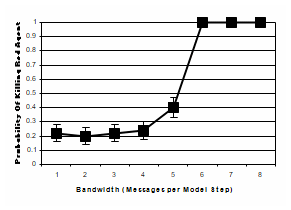
Figure 9 shows that the risk of accidentally killing neutrals is decreased when bandwidth is increased from one to between two and four messages per step. This risk reduction is caused by the shooter having better neutral population situational awareness. Increasing the bandwidth over this range does not change the probability of killing the Red agent (Figure 8); it is found to increase the time taken to kill that agent, as the shooter searches for a suitable opportunity to take a shot, however.
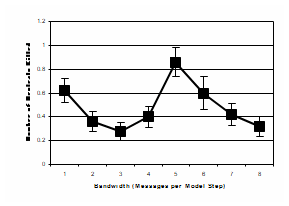
The risk to neutrals sharply increases when the bandwidth changes from four to between five and six messages per step. This is caused by the particular setup of the scenario. At such bandwidth levels the information flow is sufficient to provide the shooter with position information on the Red agent before enough information on the positions of surrounding neutrals has been received. This is supported by Figure 8, which shows a significant increase in the probability of killing the Red agent when bandwidth is changed from four to five messages per step, and a certainty of killing Red for higher bandwidths.
Increases in the bandwidth above six messages per step result in decreased risk to neutrals, and a certainty of killing red. For a bandwidth of 20 messages per step the risk to neutrals
is reduced to negligible, while the probability of killing the Red agent decreases to 85%, which is the optimal kill probability given the latencies assumed and if it is necessary to avoid any risk to neutrals. As with the latency study, Figure 8 and Figure 9 emphasize the need to develop appropriate MOEs for analysing problems involving situational awareness and its propagation.
Timeliness of situational awareness information is a paramount quality that depends on the specifics of the scenario being modelled. To demonstrate the difference a non-communications parameter can make to the perceived timeliness of the information, the movement speed of the Red agent was varied (upwards) from its original 0.02 grid squares/time step (a fixed network latency of 200 time steps was selected). Figure 10 shows how the probability of killing the Red agent changes with speed. This key MOE falls from close to 100% when the speed is less than 0.05 grid squares/step to about 10% when it increases to 0.07 grid squares/step; further increases cause the MOE to reach zero. On comparing Figure 6 and Figure 10 it is clear that the effect of increasing the agent’s speed is similar to that obtained by increasing the latency of the communications links independently of Red agent speed.
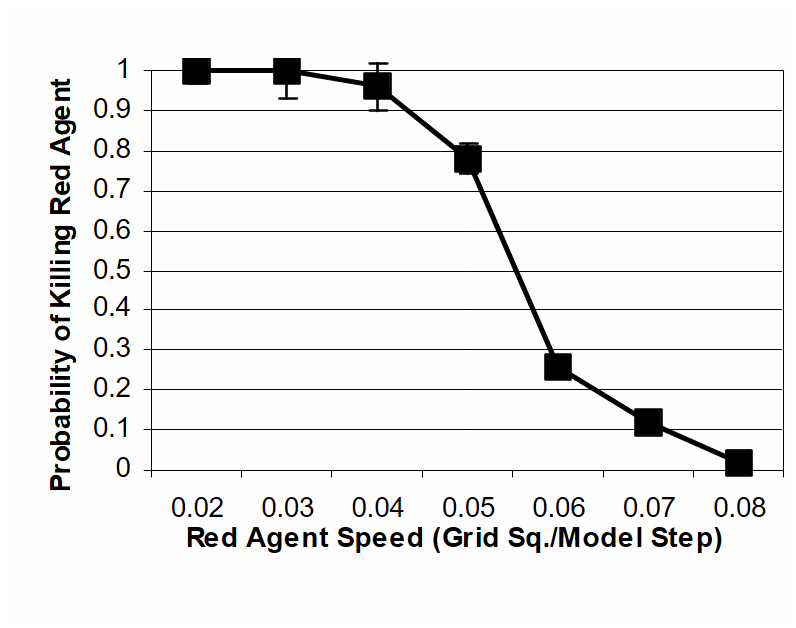
Results like those shown in this section can inform network designers on the properties required of a communications infrastructure to support operations. They can help guide cost-benefit studies and can identify trends like diminishing returns, where improving latency or bandwidth, for example, beyond a certain point might make little difference to the outcome of a particular scenario of interest.
Other methods of modelling network centric warfare
Agent based (distillation) models are not the only way of modelling shared situational awareness/NCW problems. For example, TTCP MAR AG-1 group has carefully studied a number of tactical situations to determine the effects of network enabling a force. They applied queuing theory to determine the benefits of networking in anti-submarine warfare and in maritime interdiction operations [6,7]. They also considered using queuing theory to model a swarm attack scenario, but it was they decided that it was not so appropriate owing to the large number of unknowns and the two dimensional nature of the problem; for the swarm attack question, MANA was successfully applied. Another approach that been has suggested for modelling NCW problems is to use Petri-Nets, which is a graphical language suitable for modelling systems that involve issues of concurrency and resource sharing [8].
Summary
This paper has shown that agent based distillation models (with MANA as a particular example) can be used to model the flow of situational awareness information and its use as an enabler for actions to be taken by the receiver. Some simple scenarios have been presented here to demonstrate aspects of this. The ability to vary the characteristics of the communications link parameters in those scenarios has helped to show the clear link between parameters like information timeliness and key measures of effectiveness like probability of killing the enemy.
It has been noted that it is often necessary to perform a multi-objective optimisation when studying the propagation of situational awareness information, and its use. By searching for the maximum in all appropriate measures of effectiveness the best parameter values can be found. Including monetary cost as one of the parameters to optimise (minimise) could be used to introduce a further constraint. This could have particular application in equipment acquisitions studies.
References
[1] M. Lauren and R. Stephen, “Map-Aware Non-Uniform Automata—A New Zealand Approach To Scenario Modelling”, Journal of Battlefield Technology, Vol. 5, No. 1, 2002.
[2] D. Galligan and M. Lauren “Operational Aspects of Imaging Radar System in Maritime Reconnaissance Aircraft”, Journal of Battlefield Technology, Vol. 6, No. 3, 2003.
[3] M. Lauren and R. Stephen, “Fractals and Combat Modelling: Using MANA to Explore the Role of Entropy in Complexity Science”, Fractals, Vol. 10, No. 4, 2002.
[4] E. Bitinas, Z. Henscheid, and L. Truong, “Pythagoras: A New Agent-based Simulation System”, Technology Review Journal, Spring/Summer 2003.
[5] M. Barlow and A. Easton, “CROCADILE—An Open, Extensible Agent-Based Distillation Engine”, Information and Security, Vol 8, 2002.
[6] R. Klingbeil, J. Shannon and G. Galdorisi, “Analysis of Network Enabled ASW Concepts of Operation”, The 2004 Command & Control Research and Technology Symposium (CCRTS), online at: http://www.dodccrp.org/events/2004/ CCRTS_San_Diego/CD/papers/271.pdf, viewed 17 August 2004.
[7] TTCP Technical Report, An Application of Queueing Theory to the Analysis of Maritime Interdiction Operations (MIO): The Impact of NCMW (Results from the TTCP MAR AG-1 October 2002 Workshop), TR-MAR-6-2003 Report, Nov 03.
[8] Kommunikation mit Automaten. Petri, C.A., Bonn: Institut für Instrumentelle Mathematik, Schriften des IIM Nr. 2, 1962, Second Edition:, New York: Griffiss Air Force Base, Technical Report RADC-TR-65-377, Vol. 1, 1966, English translation.