
Volume 7, Number 3, November 2004
The Potential of Smart Processing Systems in the Battlefield
- 1 Department of Aerospace, Power & Sensors, Cranfield University, Shrivenham, SN6 8LA, Swindon, United Kingdom.
Abstract
Computer systems in the past were significantly bulky and energy demanding. Nowadays, the computer systems have been considerably improved. Their reduced weight, volume, increased processing ability and robustness have allowed them to be included in the battlefield. Their use have allowed the inclusion of more sophisticated processing techniques which are not necessarily constrained to an “on” or “off” state. Smart processing methods and in particular the fuzzy logic methodology has allowed human knowledge in the form of simple rules together with several intermediate states to produce a range of states. The concept of smart or intelligent systems can simplify significantly the commanders’ decision making. This leads to faster response times from the commander and as a result could potentially increase survivability. This paper considers a smart tank concept in the battlefield. However, smart processing methods can be applied to a variety of battlefield systems. This paper outlines the basic principles of fuzzy processing systems as a complementary method of assisting the commanders’ decision making in the battlefield. The outline is followed by suggestions of how to model a particular tank sprocket electric drive sub-system within a tank. The smart processing method is not limited to the above example but intended to stimulate further application of the suggested method to a number of systems which require intelligent decision making in the areas of power and control.
Introduction
Today’s battlefield has become more demanding than ever and now include urban and rural areas as the norm. Coordination within the modern military hierarchy must be precise and delivered securely and accurately to the receiving end. Tank commanders, for example, need to rely entirely on their crew’s performance, hardware reliability and energy resources in order to be successful in their mission. This paper is primarily focused on future tanks, which incorporate a dual-sprocket drive system, which is electrically driven. Such futuristic combat vehicles will consist of an internal combustion engine and electric drive arrangement together with their associated subsystems. The selective use of either the internal combustion engine or the battery pack results in great advantages, such as silent-mode operation, with the inevitable increase of the number of hardware subsystems and control strategies. It is therefore important to have the ability to perform extensive computer simulations which will allow the detail analysis of the vehicle’s motion associated with the main and auxiliary power supplies and control systems. In most cases there is an expert who can predict qualitatively the various systems behaviour for a variety of inputs. The expert’s knowledge can then be mapped to an intelligence-based method such as fuzzy logic [1]. Prior to explaining the fundamentals of this methodology we outline some basic facts.
In the early 1960s Lofti Zadeh firstly used the word ‘fuzzy’ after being inspired by the research of Lukasiewicz multivalued logic [2]. In the late 1980s the rapid development of the computer systems allowed the accelerated development and prototyping of real fuzzy logic products. Since then a variety of systems that employ fuzzy logic have emerged such as consumer appliances , cars, mobile robotics [3,4], radio graphical diagnosis, dental diagnosis, multilayer incinerators, glass melting furnaces, water purification processes, failure analysis, unmanned helicopter control, human characteristics characterisation, oral instruction car control, financial market prediction among others [5].
Boolean logic is the simplest form of fuzzy logic, which allows a given state to be described as ‘on’ or ‘off’, ‘true’ or ‘false’. Boolean logic has been the fundamental building block for the digital computer and it forms the basis of Aristotelian logic. A real system such as an electrical drive system, for example, is not simply ‘off’ or ‘on’ but has intermediate grades which can allow the drive system to be ‘half on’ or ‘¾ on’ etc.
Smart systems [2] correspond to a family of methodologies which when combined result in an intelligent system. Fuzzy logic is the methodology, which is considered in more detail within this paper.
According to [5] the word ‘fuzzy’ denotes the characteristics of the phenomena that a fuzzy system theory describes and not the theory itself. Humans still today reason based on vague information and heuristics. The underlying motivation that triggered the rapid advancement of the fuzzy-logic theory is the need to represent and process imprecise concepts of information. Fuzzy systems are knowledge-based universal approximators. The fuzzy-logic methodology allows natural language statements to be used as means of describing, for example, a natural or man-made system. The methodology allows the systematic mapping of the user rules to basic equations. Depending on the input values a set of rules, at every time instant, will be active but at a different degree. The resulting fuzzy logic output will be a non-linear blend of the rule activation. For every time instant there must be at least one rule that is active in order to avoid singularities. The fuzzy logic rules can then be simulated on a digital computer and allow detailed predictions to be studied prior to prototyping, which reduces the risk of damaging the real system for extreme testing conditions.
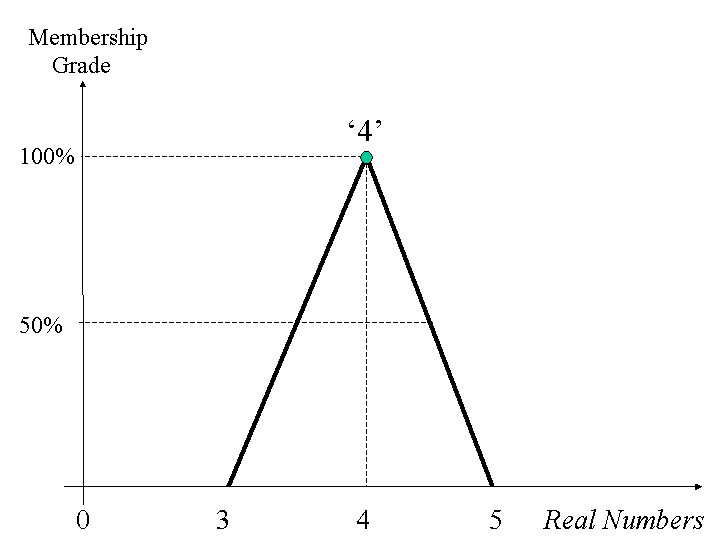
According to [2] “The fuzzy principle states that everything is a matter of degree”. A typical example is when we add 2+2=4 which implies that two and two when added result to a membership function called ‘4’. As a result the 2+2 belongs 100% to the membership function ‘4’. However, when we add, 2+1.8=3.8 the result belongs to the membership function ‘4’ but to a degree which in this case according to Figure 1 has an 80% membership to ‘4’.
Case study—an electric drive motion prediction
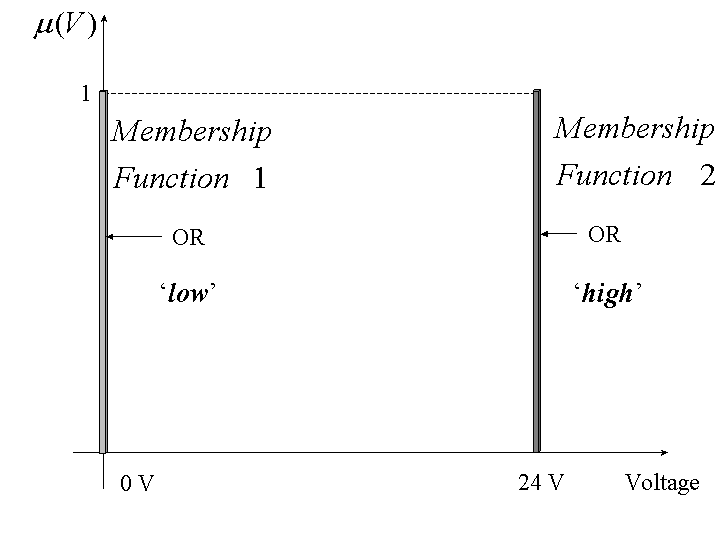
Future tank systems will rely even more on electrical drive systems for their motion. It is therefore necessary to have the flexibility of simulating such systems prior to prototyping. Hence the following case study attempts to briefly demonstrate the use of fuzzy logic (soft switching) as a modelling (or prediction) tool when compared to a hard switching strategy. For example, when the drive system is ‘switched-off’ no rotation occurs, however when rated armature voltage is applied to the drive system then its state is ‘fully on’. It would be desirable to achieve intermediate angular rotations simply by having means of controlling the armature voltage throughout the range between ‘switched-off’ to ‘fully-on’. Figure 2 shows the fundamental dual (or Boolean) state of control.
| Rule | Rule Description |
|---|---|
| 1 | IF the voltage is ‘low’ then apply Equation (1) |
| 2 | IF the voltage is ‘medium’ then apply Equation (2) |
| 3 | IF the voltage is ‘high’ then apply Equation (3) |
Figure 2 depicts two membership functions, ‘switched off’ and ‘fully on’, which allows only two modelling options and rapid changes between the ‘on’ and ‘off’ states without gradual (smooth) transitions between the two system states. The membership functions in Figure 2 are normalised to unity.
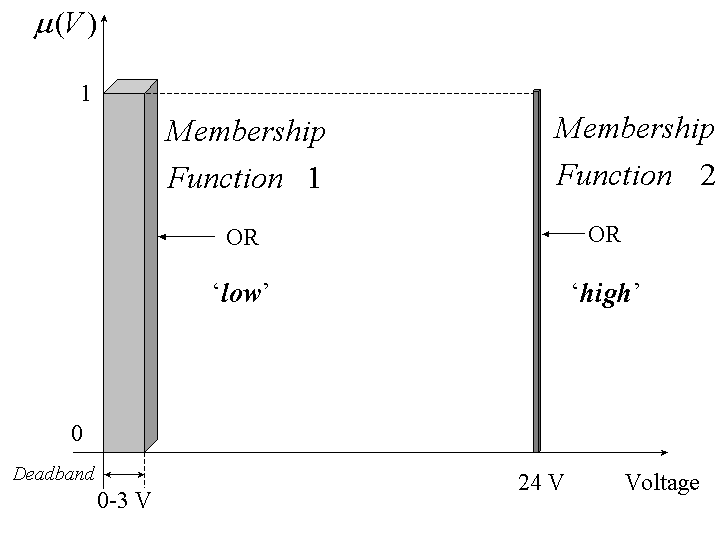
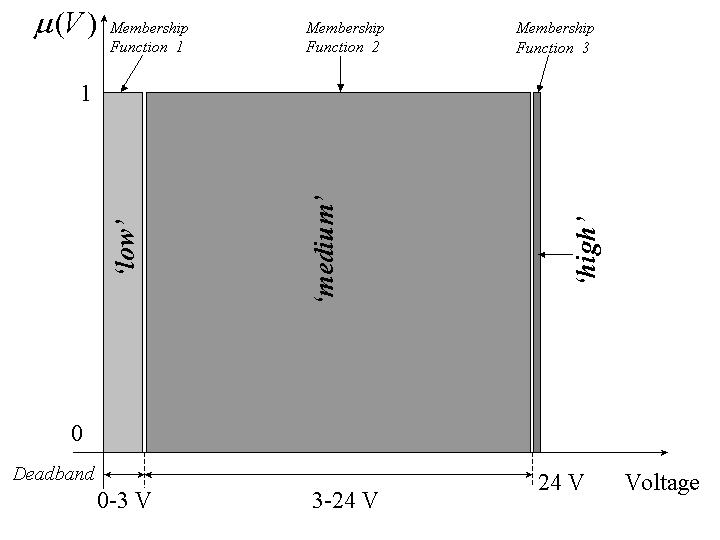
The drive system is in the ‘switched off’ state while the armature input voltage is between (0-3 V). This is due to the internal motor losses, which oppose any motion until the critical value for the specific drive system has been exceeded (3 V). Figure 3 allows the drive system to be either fully ‘on’ or fully ‘off’ without any possible intermediate states. This type of system modelling is defined as ‘hard switching’. In particular, Figure 4 consists of 100% membership functions, which cover the entire d.c. drive system armature voltage. Figure 4 is in effect a ‘hard-switching’ modelling method which although it describes the complete drive system voltage range, it does not allow smooth transitions.
‘The soft modelling approach’
Hard switching approaches have the advantage of triggering only one output equation or set of equations depending on the membership function triggering. For example, if the d.c. armature voltage is 12V then Figures 2 and 3 will produce no output simply because there is no membership function that will be activated. Figure 4 however will result to the membership function ‘medium’ to be triggered and as a result Equation (2) will only be triggered, while Equations (1) and (3) are inactive (see Table 1). Equations (1) and (3) do not contribute to the output equation.
Figure 5 consists of three triangular shaped membership functions. These have one point (their apexes) with a unity membership (belong to the set by 100%). When the armature
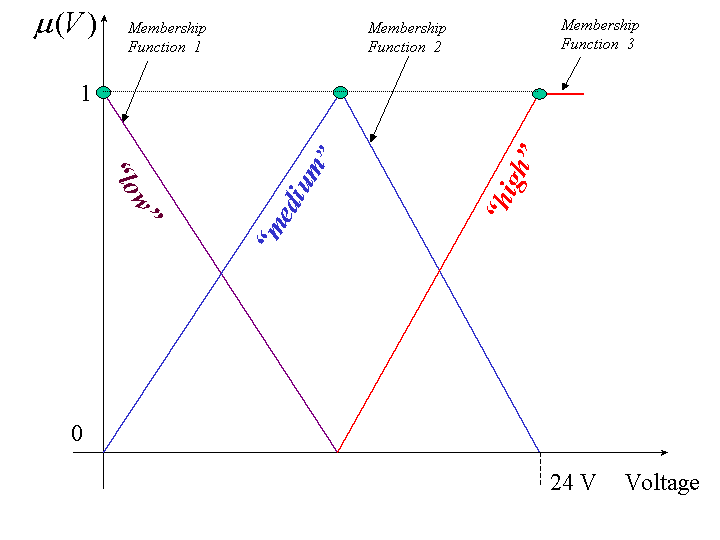
voltage is 0V then the membership function ‘low’ is fully active, that is ‘medium’ and ‘low’ do not contribute to the output. When the input voltage is 6V, then Figure 4 will only trigger the ‘medium’ membership function. The same figure will have equal membership (that is, unity or 100% membership) along the entire 3–24V. Figure 6 (soft switching) for the same 6V input will trigger equally with 0.5 α-cut two membership functions instead of one. ‘low’ and ‘medium’ will influence the output by triggering Equations (1) and (2) without any influence from Equation (3). Hence in this case rules 1 and 2, (Table 1), are active for the particular instant in time. As time evolves different combination of rules will be activated depending on the input values (sensor values). In some cases, although the same rules combinations, (nine in total), could trigger it will not necessarily result to the same final numerical results.
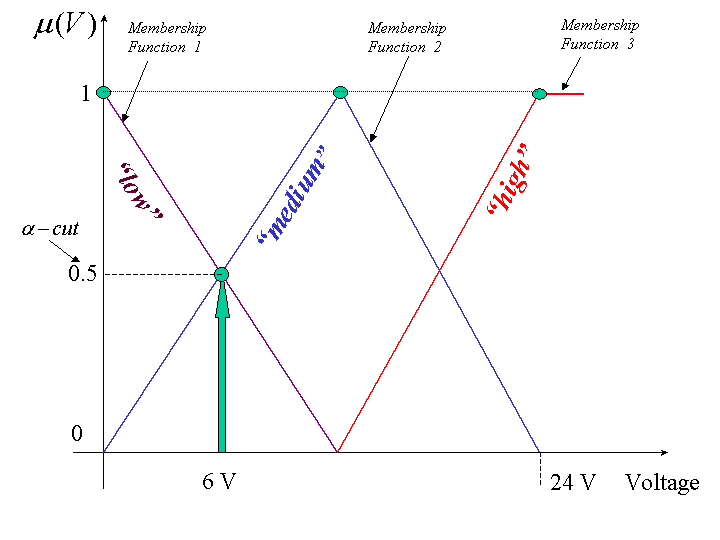
Depending therefore simply on the degree of membership rule one might have more influence over rule two. In particular, if the input voltage is 3V then membership function ‘low’ will have 0.75 (or 75% membership) to ‘low’ when compared to a 0.25 (25% membership) to ‘medium’.
Hence, for the later example, the drive system armature voltage is more ‘low’ than ‘medium’. The soft modelling approach (fuzzy logic) however as seen earlier allows us to systematically quantify the rule influence within the final result.
The three rules in Table 1 describe the drive system’s angular velocity, for example, over the entire drive system’s operational envelope. The general format of the Sugeno-type fuzzy logic rules is given next.
where:
i is the rule number (that is: 1,2,3…),
x1, x2 is sensor index
Ai1, Ai2 are the fuzzy sets for rule i and sensors 1 and 2
yi is of the form: yi = a1.x1 + a2.x2 + b
Every i-th rule in practice has jmax number of sensors which results for every time instance to the following rule firing strength, βi Equation (1).
(1)
The Sugeno-type fuzzy logic computation crisp output, (that is, a real number rather than a membership function), is given from Equation (2). The user defined rule base (Table 1), the rule firing strengths (Equation (1)) and the crisp computer output per sampling time (Equation (2)) are the main building blocks for a fuzzy logic system. In effect the fuzzy logic is a methodology that allows expert’s knowledge to be systematically converted or mapped to exact mathematical relations.
(2)
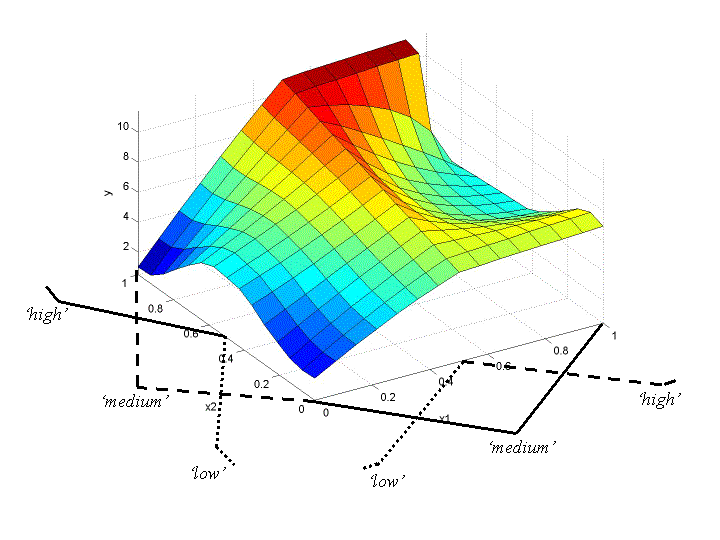
These can then be computed in either a PC desktop computer for prototyping purposes and then transferred to a micro-controller system or to a digital signal processor within the main tank itself for final tunning and tests. Figure 7 shows the final 3-dimensional nonlinear surface generated using nine 1st-order Sugeno fuzzy logic rules. The superimposed membership functions are normalised to unity. Nowadays computer packages allow the users to define the linguistic rule base and automatically obtain the application-dependent surface.
Future work—tank subsystems and fuzzy logic relevance
A tank vehicle consists of several electrical subsystems, which offer to the commander an increased number of options. During a battlefield scenario it is always important to fuse the information from the various instruments (for example, in a more compact and useful form) thus reducing the commanders’ effort in sensor reading and maximising the effort towards the successful completion of the mission itself. This paper triggers the possibilities for potential use of the
‘smart’ based fuzzy logic methodology. The technique itself naturally allows multiple sensors to be augmented in order to obtain a single readable and possibly more-effective reading. For example commercial vehicle engines are mainly based on a single sensor for determining the engine’s temperature. For the suggested multi-sprocket drive system the tank will need at least three lumped temperature sensors. These are required to sense the internal combustion engine and the electric drive temperatures. During the tank’s operation the commander and his/her crew will need to observe these readouts continuously among other tasks. By employing the fuzzy logic methodology, however, the three temperature sensors can simply be fused, fuzzy processed and produce a single engine health indication between 0% and 100%, thus allowing a simplified panel system.
Conclusions
Smart or intelligent mathematical approaches such as fuzzy logic have allowed the inclusion of degrees between extremes and allow the inclusion of uncertainties. In addition such approaches allow the inclusion of natural language in the design itself thus making the application of fuzzy logic a very natural process. The exponential growth of microprocessor systems has made it more feasible to incorporate the smart processing concept into civilian products and appliances. The authors have also applied the potential of fuzzy logic systems in defence-related applications and the results are very promising. The methodology can be used in a variety of systems and subsystems in ‘in-the-loop’ applications or in ‘advisory type’ of systems. The authors anticipate exploring in the future the potential of fuzzy logic in specific areas of interest.
References
[1] M. Sugeno and G. Kang, “Fuzzy Modelling And Control Of Multilayer Incinerator”, Transactions of Fuzzy Sets and Systems, Vol. 18, 329-346, 1986.
[2] B. Kosko, Fuzzy Thinking, Harper Collins Publishers, p. 101.
[3] J. Economou, A. Tsourdos, B. White and P. Luk, “Takagi-Sugeno Model Synthesis Of A Quasi-Linear Multiwheeled Mobile Robot”, International Journal of Systems Science, Vol. 34, No. 14-15, 15 Nov–15 Dec 2003.
[4] R. Colyer and J. Economou, “Soft Modelling And Fuzzy Logic Control Of Wheeled Skid-Steer Electric Vehicles With Steering Prioritisation”, International Journal of Approximate Reasoning, Vol. 22, pp. 31–52, 1999.
[5] R. Babuska, “Fuzzy Modelling: Principles, Methods And Applications”, in C. Boivento, C. Fantuzzi, and R. Rovatti, (eds), Fuzzy Logic Control-Advances in Methodology, World Scientific), pp. 187–220.
Dr Antonios Tsourdos is a lecturer at Cranfield University in Shrivenham, UK. His research interests include advanced nonlinear control and intelligent systems.
Dr Patrick Luk is the Head of Power and Drives Systems Group at Cranfield University in Shrivenham, UK. His research interests include intelligent machine design and control.
Professor Brian A. White is the Head of Department of Aerospace Power and Sensors at Cranfield University in Shrivenham, UK. His research interests among others include advanced and intelligent control systems.