
Volume 7, Number 3, November 2004
Design Trends in the Development of Large-Calibre Kinetic-Energy Rounds
- 1 Engineering Systems Department, Cranfield University, Shrivenham, SN6 8LA, Swindon, United Kingdom.
Abstract
This paper primarily reports on the development of tank ammunition working on the principle of kinetic energy to defeat armour. Evolution of armour-piercing, discarding sabot (APDS) into a long rod penetrator otherwise known as armour-piercing, fin-stabilised, discarding sabot (APFSDS) is explained. Frontal armour protection of the current armour is anticipated and the ability of current rounds to defeat it is compared. Design considerations and their limitations relating to current penetrators yielding enhanced penetration are discussed. Novel concepts to further increase armour penetration are also reported.
Introduction
A tank gun projectile is required to have a high muzzle velocity for better penetration. The chemical energy of the propellant charge is converted into the kinetic energy of the projectile. The impact velocity of this type of projectile lies in the region of 1 000–2 000 m/s.
The principle of the kinetic-energy form of attack depends on the kinetic energy dissipating over a small area for a projectile striking at velocities below 1 000 m/s. The energy divided by the area over which it acts is generally described by the term kinetic energy density which is used for comparing penetration potential of a projectile. Kinetic-energy projectiles are of two types, a spin-stabilised projectile, generally known as armour-piercing, discarding-sabot (APDS) and a long-rod penetrator type of round otherwise known as armour-piercing, fin-stabilised, discarding sabot (APFSDS), which has strike velocities greater than 1 200 m/s and has a hydrodynamic mode of penetration, in that the strength of material becomes less important and the densities of both the target and the penetrator material become important.
This paper will draw attention to some of the design and development trends in the kinetic energy projectile for direct fire (tank) guns.
Armoured piercing rounds
APDS are generally short and fat sub-calibre projectiles as shown in Figures 1 and 2 [1], and have a slenderness ratio (L/d) which is defined as the length of the projectile divided by the diameter, no greater than a factor of four. The shot is generally made up of tungsten alloy, which lacks ductility and toughness. The shot is supported in a cup-shaped discarding sabot. The sabot is gripped and located by means of a plastic driving band and weighs between 20 and 30% of the projectile mass as shown in Figure 2, while the projectile diameter is approximately 60% of the gun calibre. As the cup is supporting the shot, it is not subjected to high mechanical stressing during the launch as a result of setback. The acceleration force and differential inertial resistance to motion give rise to coupling stress at the contact interface (a mixture of shear and normal stress). The result of this action is to cause frictional shear gripping of the cylindrical surface of the projectile by the sabot and a push normal to its back end. In a typical round, the magnitude of these stresses is such that modest mechanical properties are ample and mostly aluminium or magnesium alloys have been used for sabot material because of their high strength to weight ratio.
![APDS shot with petal sabot [1].](/journals/journal-of-battlefield-technology/volume-07/issue-03/assets/7-3-2-hameed/figures/figure01.gif)
![APDS shot with pot and petal sabots [1].](/journals/journal-of-battlefield-technology/volume-07/issue-03/assets/7-3-2-hameed/figures/figure02.gif)
The APDS round is good against a lightly armoured vehicle made from monolithic steel or aluminium. The lack of shot toughness or ductility does not significantly degrade its penetration performance against the armour. Increasing the cobalt content in WC, however, leads to tougher penetrators. Most of these penetrators defeat armour by perforating or by plugging out a hole. As the typical velocities are lower than 1 400 m/s, the projectile is more or less non-deforming. The critical velocities for this type of projectile to perforate have been described using Krupp and Milne DeMarre equations and have been reported by Held [2]. Their typical penetration performance is approximately 120 mm of armour at a 60° angle of attack at up to 1 830-m range [3].
As the muzzle velocity increases, the stresses at the penetrator-target interface exceed the strength of the material, thus requiring a very hard material penetrator. For tungsten-alloy projectile velocities in the range of 1 100–1 400 m/s, the penetration phenomenon begins to exhibit hydrodynamic behaviour in the steel target. As the strike velocity continues to increase, penetration depends progressively more on material density and less on material strength. At very high strike velocities, in the region of 3 000 m/s and above, which can be achieved with shaped charges [4], hydrodynamic behaviour dominates.
Also the high kinetic energy density required for better penetration dictates heavier and smaller diameter rounds and, as a result, the development of a kinetic energy projectile has evolved from APDS projectiles to APFSDS projectile as shown in Figures 3 and 4. The projectile diameter has reduced and the length has increased giving the “long-rod” form. As a consequence, spin stabilisation has been abandoned and fin or drag stabilisation adopted. Being sub-calibre, they still require some sort of sabot. The maximum length of the long rod penetrator depends upon the ability of the penetrator to withstand the firing stresses and the available space behind the gun to stow and load the KE ammunition cartridge. The charge or cartridge envelope is dictated by the chamber length, in that suitable space for the ignition drive train to ignite the propellant is maintained. Hence, there is a limit to which the penetrator length can be extended. As a result improvement in penetration will most likely be achieved by increasing the penetrator muzzle velocity, by reducing the parasitic sabot mass or by increasing the penetrator density.
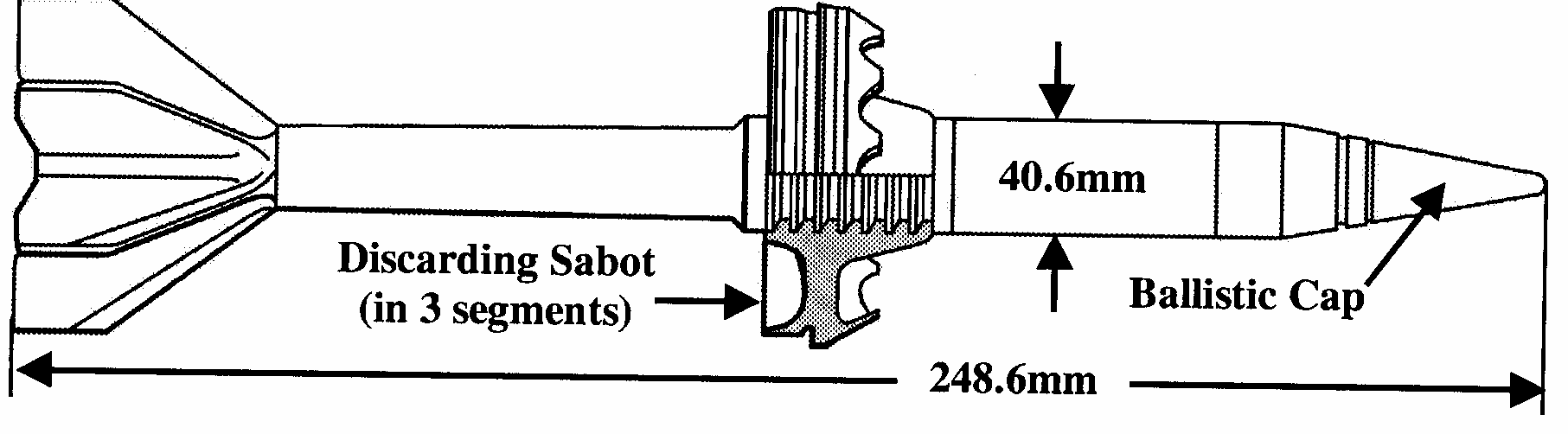
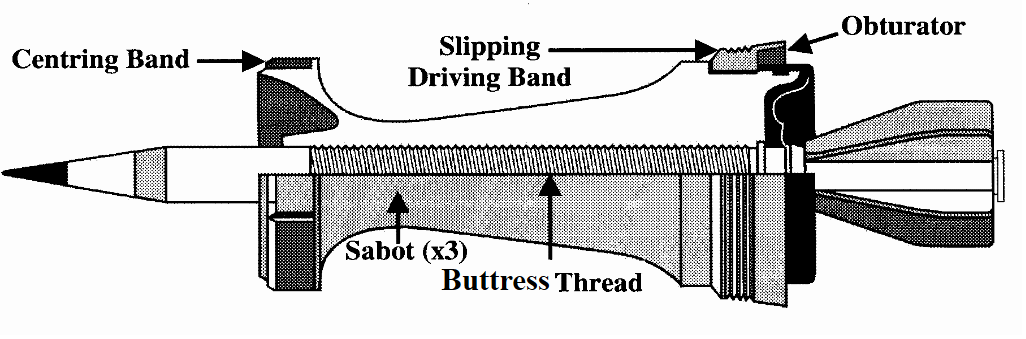
Soviet design
A penetrator is subjected to set-back stresses during launch. A typical penetrator design tends to keep the stresses during launch below the penetrator and sabot material strength. Hence the shape of the sabot depends upon the stress condition resulting from the projectile weight and the diameter. Earlier ring and now buttress thread profile is machined for effective support at the sabot-projectile interface. Due to high firing pressures, this interface experiences high shear stress. As a consequence, the Soviet design above uses high quality steel for both its projectile and ring sabot to maintain shear stress within the permissible limits. High strength coupled with comparatively large diameter allows the use of short and relatively light ring type sabot. To avoid in-bore yaw and to centre the projectile within the barrel, large bore-riding fins are fitted at the rear, yielding high drag during flight and, as a consequence, this design will have reduced strike velocity. To overcome this deficiency the projectile is fired at a comparatively high pressure using a large bore size barrel. Soviets were the first to serve their T-62 tanks with type 3BM-3, APFSDS [5] having a smooth-bore gun.
Western design
On the other hand, the penetrator in Figure 4 is manufactured using high density tungsten alloy, whose strength is lower than high-strength maraging steel material and density 2.5 times that of the steel. This requires a longer length of the projectile to be supported by the sabot: a longer sabot will increase the parasitic mass. Hence low-density material such as aluminium is used to keep the mass low. In addition aluminium sabots will require a large interface area to distribute evenly the shear stresses and also maintain them within its elastic limits. L64 was the first APFSDS developed for the UK’s 105-mm, L7 gun, while M735 was developed by the US, for their 105-mm, M68 gun. As a result of detailed stress analysis, such as finite-element analysis, the sabot weight of later designs has been reduced by removing some of the excessive material in the form of gussets. This weight saving allowed the designer to increase the penetrator length for a given mass.
By increasing the tensile and compressive strength of the penetrator material, a greater length of the projectile can be extended unsupported beyond the rear and front of the sabot. This leads to a smaller sabot, resulting in weight saving, or for a given energy provided by the propellant; the projectile velocity can be increased. Improvements in mechanical properties (that is, increase in strength whilst maintaining the ductility and toughness of the long rod penetrator) were observed by Doepker et al [6] through the replacement of iron with cobalt. An even better combination of mechanical properties has been developed by intermediate heating and swaging, which is a form of thermo-mechanical processing [7,8]. This extensive extrusion process elongates the spheroidal particles of tungsten. The increase in strength allows the penetrator to withstand a greater accelerating force during launch, leading to more weight efficient sabot and resulting in better muzzle velocity.
Anticipated armour protection
As reported by Walter [9], frontal armour is generally mounted at ± 30o to the horizontal plane and has an areal density, which is defined as mass per unit area, of typically 3.5 tons/m2 [10]. Most of the existing armour is manufactured using a combination of different materials to enhance protection and it is common to compare the protection level of such complex armour with that of rolled homogenous armour (RHA). It is usual to define an equivalent protection Em, which is the ratio of areal densities of RHA to that of the armour in question [11]. At present, this value for most of the Russian Federation armour is 1.5~2 [12] and this leads to an equivalent RHA thickness of 670~900 mm for typical heavy armoured vehicles as given in Equation (1).
(1)
Total RHA= 1.5~2×445= 770~900 mm of protection in terms of RHA.
Current muzzle velocities are in the region of 1 700 m/s. Due to air resistance, projectile velocity decreases in flight by approximately 60 m/s for every 1 000m travelled [13,14]. Thus for an engagement at a range of 3 km, the impact velocity will be approximately 1 500 m/s. Although hydrodynamic penetration is initiated at about 1 150 m/s only 65% of the fully hydrodynamic penetration is achieved. Clearly an increase in launch velocity would yield greatly enhanced penetration. The graph presented in Figure 5 [4,15] demonstrates the range in which the KE round operates and can be characterised by the Equation (2).
![Penetration (P) of RHA steel targets divided by the penetrator length (L) plotted against impact velocity (V), reproduced from [10] and [4].](/journals/journal-of-battlefield-technology/volume-07/issue-03/assets/7-3-2-hameed/figures/figure05.gif)
(2)
in which P is the penetration achieved and L is the penetrator length.
The factor λ varies from 0→1 as the velocity increases from 200 to 3 000 m/s. At an impact velocity of 1 500 m/s, λ = 0.65. At this velocity, for a W-Ni-Fe projectile, the penetration achieved would be approximately equal to the length of the penetrator [16]. The slenderness ratio (L/d) for a 77–900-mm long penetrator should then be around 28-30.
The Appendix shows some of the characteristics of KE rounds. It is clear that most 105-mm rounds have a muzzle
velocity in the range of 1 400~1 560 m/s and 120-mm rounds in the range of 1 370~1 790 m/s.
With the improvement in tungsten powder technology, the round diameter has reduced from 28 mm to ~19 mm for 105-mm bore, while for a 120-mm gun, the penetrator diameter has reduced from 27 mm to 22 mm giving slenderness ratios up to 30 or more. With the increase in penetrator length there is more susceptibility to bending and buckling during launch and flight. In fact it is reported that in widely spaced targets, the penetrator ruptures after passing through the first plate. To avoid unnecessary bending and rupture upon striking, one trend is to design and manufacture tungsten rounds encased in steel jackets [17]. The Swiss Ordnance in collaboration with the French-German Institute Saint-Louis (ISL) has in recent years been developing a technology base for the tungsten long-rod kinetic-energy (KE) penetrators having a steel jacket [18]. The designs are claimed to permit penetrators with length/diameter ratios as high as 40:1 to be fired at velocities of around 1 800 m/s, exhibiting minimal bending deflections after sabot separation and no tendency to rupture in multiple-plate armour arrays [19]. Further improvements under consideration are likely to include increased propellant quantity and or energy (this may reduce barrel life), the use of composite sabot and fin materials and novel non-homogenous penetrator designs (which are mentioned later in this paper). Nitrocheme [20] has developed a new type of surface-coated double-base propellant which is both energetic and burns at low temperature. Based on the above SCDB propellant, Rheinmetall has developed a Temperature Independent Propulsion System (TIPS) for their DM63 round. It is claimed to have better hit performance, and a reduced erosion by a factor of 2 and muzzle velocity variations by less than 60 m/s over the entire temperature range of –400 to 630 C [21].
The weight of both the penetrator rod and its assembly for some of the KE rounds has been given in column 4, of the Appendix. From the available data, it is safe to assume that the sabot is approximately 40% to 50% of the projectile weight and efforts to reduce its weight by using composite sabot has resulted in the US M829 projectile, thus increasing muzzle velocity for better penetration. The use of a combustible cartridge case (CCC) has kept the overall weight of the round low and similar to that of 105 mm, which is within sustainable human loader handling limits.
The depleted uranium (DU) penetrator has a higher density (18 600kg/m3) than a tungsten (17 200~17 600kg/m3) round and, as a result, it can penetrate 10% further in a typical armour. In addition, during penetration, high contact pressure results in thermal softening and adiabatic shear failure. The adiabatic shear failure is prominent in uranium penetrators, thus yielding better penetration [4,7]. On the other hand, in conventional tungsten-nickel-alloy, shear failures do not occur and a large mushroomed head occurs. The resulting achievement is a lower depth of penetration than that of the equivalent depleted uranium (DU). Moreover, DU burns due to its pyrophoric nature while penetrating, setting on fire any nearby inflammable material. Ingestion of heavy metal oxides may be a health hazard and therefore most countries avoid its use.
Currently available APFSDS rounds
US M735 round is regarded as first generation APFSDS round which replaced the APDS rounds [22,23]. M735 weighs 2.21 kg with diameter tapering from 30 mm to 10 mm. The penetrator consisted of a tungsten core in a steel body having comparatively large fins at the rear. At this stage there was a general move away from enclosing the penetrator in a steel casing. Hence, the L64 was a monobloc, one-piece penetrator, designed using a standard tungsten-alloy core by UK Royal Ordnance. The penetrator was manufactured using 90% tungsten, 7.5% nickel and 2.5% copper and had a diameter of 28 mm and a slenderness ratio of approximately 18. This projectile was propelled by triple-based granular seven-hole propellant. Later Royal Ordnance (RO) developed H6/62, in which the same propellant charge was used. This is regarded as a second generation round [24], in which the projectile assembly was completely redesigned using tungsten-nickel-iron, having a one-piece penetrator with a diameter of 25 mm. This round was 0.1 kg heavier than L64A4 round and was used as a basis for the 115-mm, BD/36-2 round developed by RO for the Egyptian Army. In the late 1980s, RO developed an Improved Weapon System (IWS) to enhance the performance of 105-mm L7 gun to match that of the 120-mm system. The ammunition for the IWS gun is known as T-2 ammunition. It included a combustible cartridge case crimped to a tungsten-nickel-iron round having a diameter of 28 mm and a slenderness ratio of 23. The tail fins were of steel giving low drag-velocity drop of 48 m/s per km.
The US developed M774, the second generation of 105-mm APFSDS rounds. The projectile assembly was 475.15 mm long having a monobloc DU penetrator. Following the M774, the penetrator length was increased and the sabot design was improved in the M833. Gussets were machined on the sabot in order to reduce weight yet maintaining its strength and rigidity.
Israel developed DM426, known as DM63 by the Germans, described as a third generation round. It is 620 mm long and weighs about 6 kg.
The US developed the M900 for their M1 tanks. It is known as a fourth generation round. It is a 711-mm long monobloc DU round and has a slenderness ratio of 30, which means that the penetrator diameter is comparatively small for this generation. It contains a 19-hole, low-vulnerability (LOVA) type propellant.
Presently, the German Army has adopted Rheinmetall’s DM53 LKEII tungsten APFSDS round as shown in Figure 6 [25] in combination with the 120 mm smooth bore L55 gun. The French Army uses the OFL120 F2, 120 mm DU round. It is fired from the 52-calibre, 120 mm smoothbore gun of the Leclerc tank [19]. The British Army’s 120-mm CHARM 3 DU APFSDS round will be fired using the 120-mm, high-pressure L30 rifled gun on board the Challenger 2 tank. Apart from the UK Army, India, Oman and some tanks in the Jordanian Army have 120-mm rifled guns. The US has the M829 120-mm, DU round fired from the M256 gun mounted on M1A1 Abrams. M829A1 was developed as a replacement to M829, and received the name Silver Bullet during operation “Desert Storm” [19]. It has a revised composite material sabot construction providing a 30% weight saving in the parasitic mass. This is the first in-service APFSDS to incorporate a composite sabot. UK does not have an in-service round having a composite sabot; however research by QinetiQ (formerly DERA) has investigated fibre-reinforced plastic composite for a sabot to be used in their electromagnetic gun projectile [26].
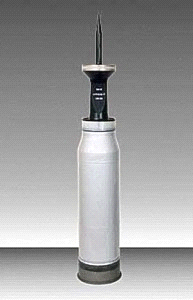
In the recent conflict in Iraq, although overall very little 120 mm sabot ammunition was used, the results were “devastating”. High-explosive anti-tank and multipurpose anti-tank were the preferred main rounds because they were more effective against buildings and bunkers [27]. Bofors and the Israel Military Industries (IMI) are developing an impact-fuzed HE round for the Swedish Army’s Leopard 2. Also, Rheinmetall’s main development effort is now focused on an improved high-explosive (HE) fragmentation round as shown in Figure 7, having both lateral and axial fragmentation patterns. The round will have a breech-set intelligent electronic time fuze which can be detonated above the target for maximum effect. It is claimed that the round will be able to deal with soft and semi-hardened targets, including those behind cover or in buildings, and its forward-projected fragments should also improve hit probability and lethality against helicopters [28].
![High-explosive round under development by Rheinmetall [27].](/journals/journal-of-battlefield-technology/volume-07/issue-03/assets/7-3-2-hameed/figures/figure07.png)
| Penetrator Material | Density | |
|---|---|---|
| W-C-Co | 14 250 kg/m3 | (87% WC) |
| W-Ni-Fe | 17 900 kg/m3 | (94% W) |
| W-Ni-Fe | 18 540 kg/m3 | (98% W) |
| DU-Ti | 18 600 kg/m3 | (99% DU) |
| DU | 19 000 kg/m3 |
A new fuzeless ammunition under development [29,30] and recently designed by Rheinmetall is known as Penetrator with Enhanced Lateral Efficiency (PELE). This round generates significant lateral effects in and behind the target without using any explosive agent. In principle it consists of a high-density cylindrical jacket filled with a low-density material as shown in Figure 8. During penetration, the low density filling is squeezed between the jacket and the crater. This induces a pressure rise causing dilation of the surrounding jacket and enlarging the crater due to final bursting of jacket material. The impact velocity of the penetrator and the material properties of both the filling and jacket influence this lateral effect. Rubber, polyethylene, GRP, aluminium and titanium have been studied as a filling material; while tungsten alloy has been used for the jacket.
![PELE principle [29].](/journals/journal-of-battlefield-technology/volume-07/issue-03/assets/7-3-2-hameed/figures/figure08.gif)
General discussion on current trends
Penetration performance can be improved by increasing muzzle velocity, penetrator length or density or a combination of these three parameters. The density of some of the materials suitable for penetrator use is given in Table 1. It is evident that, as we go down the table, density increases: however an increase in density is accompanied by a decrease in strength. As a result, the penetrator may not be able to withstand the high forces necessary to achieve high muzzle velocities. To improve penetration performance, clearly the trend is towards increasing projectile length. The table in the Appendix, shows that in the last 20 years, projectile slenderness ratio has increased from between 15 to 20 up to approximately 30. The average weight of the projectile assembly has remained approximately 6.7 kg and 7.7 kg for 105-mm and 120-mm projectiles respectively. This means that the diameter of the projectile must be reduced for the given mass, which is also evident from the Appendix. Reduction in cross-sectional area of the projectile means that it will experience higher stresses requiring greater sabot support. As a result, sabot design evolved from the ring or spool type to spool with a single ramp, followed by a double-ramped design. The use of composite materials has kept the overall penetrator assembly mass within limits. From the Appendix it can be observed that the sabot mass is approximately 50% of the projectile assembly weight. Hence the reduction in sabot weight will improve muzzle velocity. Moreover a smaller diameter will generate lower drag in flight for a given length.
The average handling weight of the complete 105-mm and 120-mm rounds has been 18 kg and 21 kg respectively, while for 115-mm and 125mm projectiles it is around 20 kg and 22 kg respectively. A 120-mm single piece having brass cartridge case ammunition would have a length of approximately 1.32m (dimension D in Figure 9). The use of combustible cartridge cases for 120-mm (Figure 9) and 125-mm guns has kept the increase in the overall weight of the round to minimal, which helped to avoid unnecessary crew fatigue. The overall round length is limited by the available stowage space in the bustle or within the hull—for example, for the current 105-mm and 120-mm rounds this has been around 900 to 1 000 mm as shown in Figure 9. Current NATO rounds have a longer penetrator extending into the cartridge case (dimension B in Figure 9); there is a limit to this protrusion as it will reduce propellant space and will require dense packing causing ignition difficulties. The UK and the former Soviet States use separate ammunition. The inert penetrator is stowed in the bustle, while the propellant is stowed in the hull. Separate ammunition permits charge incrementation. The T-series ammunition has an incremental propelling charge with the projectile assembly in addition to the main charge.
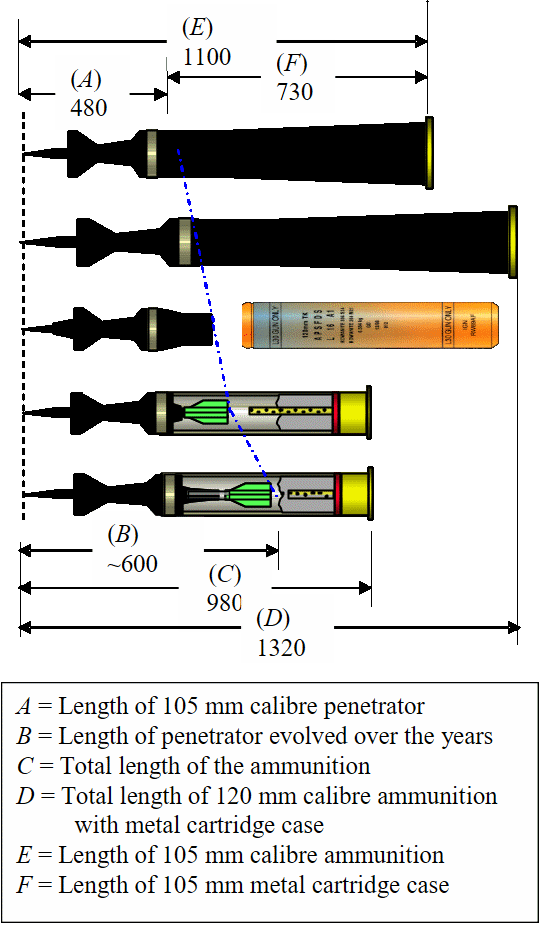
Increases in the muzzle velocity have been achieved by increasing the propellant mass, using more energetic propellant and/or increasing the loading density by shaping the propellant in a pie configuration, in that propellant discs are arranged around the primer tube and the penetrator. Propellant is perforated to regulate the burn rate. This method permits high loading density. It is claimed that it increases loading density by 25% [31]. A 10% increase in muzzle velocity has been claimed by reducing the parasitic mass. The Appendix shows that the muzzle velocity of 105-mm projectile has been boosted from 1 480ms-1 to 1 550 ms-1 while the 120-mm has increased from 1 560 ms-1 to 1 780 ms-1. On the other hand 115-mm and 125-mm projectiles have been fired at comparatively high muzzle velocities to overcome their performance deficiencies due to inferior material and high drag fins.
An APFSDS round is generally treated as the primary round for the tank; it is designed to defeat the frontal armour of an opposing tank. Historically, up to the 1980’s, 105 mm was the most common calibre. Its penetration performance shows that the expected protection of the armour likely to be met (T62, T64, and T72) was equivalent to approximately 350~400 mm of RHA. With the development of ERA optimised for KE attack, the protection level of such armour was enhanced to 450 mm and, as a result, recently developed rounds have been designed to penetrate 540 mm RHAE. The 120 mm calibre was adopted in the late 1980’s, and earlier 120-mm rounds had the ability to penetrate approximately 540 mm RHAE. The penetration ability of current penetrators has been increased to 600 mm RHAE and more, to counter the threat posed by the development of Soviet tanks throughout the 1980’s carrying modern armour with ERA. All such developments have been achieved by improving the projectile design, propellant and the launcher.
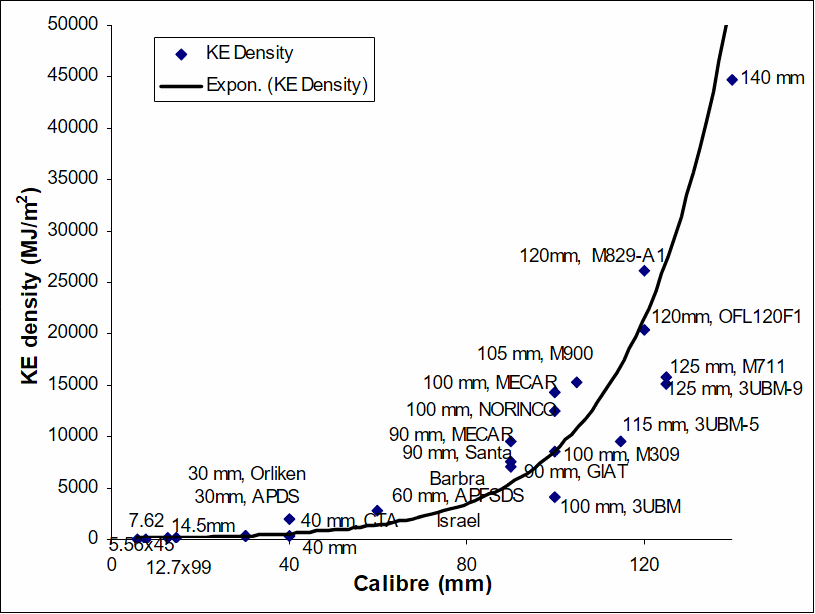
Historically, kinetic energy density has been used as a measure of penetrative ability of the KE round. Figure 10 shows that KE density has increased exponentially with the increase in calibre. This also demonstrates the significant advantage of sub-calibre or APFSDS round. Interestingly, if we glance at the ratio of projectile mass to the charge mass we will notice that, on average, for tank rounds it has been around 1~1.2. Allsop [32] has observed that sub-calibre cannon projectiles penetrate RHA equal to three times the calibre, while from the Appendix, it is noted that tank gun sub-calibre projectile has the ability to penetrate approximately five times the gun calibre.
Future trends
The graph presented earlier (Figure 5) indicates that the higher the velocity the more effectively the projectile will perform against RHA steel armour up to a limiting point. Similarly, projectile penetration increases with penetrator length (Equation 2).
One way to achieve high velocities is to use propellants that produce combustion products having a low mean molecular weight. A better strategy is to design a propellant specifically to produce a low molecular weight gas but with high force constant (impetus) and low flame temperature to avoid barrel erosion. Such an approach has resulted in the formulation of new propellants resulting in 15% increase in muzzle velocity [33]. However, conventional propellants are reaching their limits, and alternative means of propulsion to enhance muzzle velocity have been explored [34], such as the electro-thermal chemical means of propulsion developed by Rheinmetall for their 105-mm smooth bore guns [12]. In addition electromagnetic means of propulsion are also being explored [34].
Research on novel kinetic-energy penetrator design has been conducted, and the outcome has been that segmented rod penetrators have improved penetration per unit length. In addition to the segmented design, telescopic and segmented telescopic designs have also been tested. The telescopic design has demonstrated a large increase in performance in the monolithic target over the range of strike velocities [35–37]. Sabot design for effectively housing these novel projectiles is the main concern. The design of novel penetrators is based on lowering the average sectional density and increasing length. This effort by itself results in improved penetration even for a homogeneous projectile.
Conclusions
The performance of kinetic-energy rounds has been greatly increased by the use of materials having high densities such as tungsten or DU, increasing projectile length (slenderness), and the use of novel materials in the sabot such as composites, thereby reducing parasitic mass. To prevent excessive bending and projectile break up, jacketing can improve bending stiffness, allowing projectiles with high slenderness to be launched with high muzzle velocity. To enhance the penetration further, novel designs such as segmented and telescopic rounds are under study.
Acknowledgement
The authors would like to thank Mr Mike Bennett and Professor Richard Ogorkiewicz for their kind advice. They would also like to thank Dr Ralf-Joachim Herrmann, Dr Berthold Baumann, Dr Eckehard Bohnsack, and Dr K Kratzsch of Rheinmetall W&M for their presentations of their products. The authors would also like to thank Mr Keith Faulkner, and Rupert Pengelley of Jane’s publications.
| Appendix: ANTI-TANK KINETIC ENERGY AMMUNITION | ||||||||||
|---|---|---|---|---|---|---|---|---|---|---|
| Cal (mm) | Nomenclature | Round weight (kg) | Projectile weight (kg) | Propellant weight (kg) | Operating pressure (bar) | Muzzle velocity (m/sec) | Length (mm) | Diameter (mm) | Slenderness (L/d) | Penetration (mm) @ distance (m) |
| 105 | L64A4 APFSDS-T (W Alloy core) | 18.9 | 3.59/6.12 | 5.62 | 5110 | 1480 | 28 | |||
| 105 | H6/62 APFSDS-T (W-Ni-Fe) | 18.9 | 3.6/6.1 | 5.62 | 5110 | 1490 | 617 | 25 | ||
| 105 | APFSDS-T for IWS, W-Ni- Fe | 19 | 4/7 | 5095 | 1420 | 28 | 23:1 | 540@2000 | ||
| 105 | M426 APFSDS-T (D63 German) | 19.2 | 6.6 | 6 | 4400 | 1455 | 620 | |||
| 105 | M900 APFSDS-T, DU | 18.5 | 6.86 | 6.1 | 1505 | 711 | 30:1 | |||
| 105 | APFSDS-T Excalibur | 17.15 | 3.18/5.8 | 6.1 | 4140 | 1560 | 584 | 19.8 | 29:1 | 480@2000 |
| 105 | OFL MLE G1A (Tungsten) | 11 | 3.4 | 3.5 | 1475 | 875 | ||||
| 105 | OFL APFSDS-T | 13 | 3.8 | 3.9 | 1400 | 884 | ||||
| 105 | OFL G2 APFSDS-T | 18 | 6.22 | 5.85 | 1525 | 26:1 | 540@2000 | |||
| 115 | 3UBM-5 APFSDS-T | 22.5 | 3.9/5.39 | 6 | 1680 | 548.64 | 42 | 228@1000 | ||
| 115 | BD/36-2 APFSDS-T | 5.93 | 1600 | 520 | ||||||
| 120 | L15 APDS | 10.36 | 8.4 | 1370 | 355@1000 | |||||
| 120 | L23/26/27 APFSDS | 8/8.5 | 6.65 | 1534 | 512 | |||||
| 120 | OFL F1, W | 20.5 | 7.3 | 8.3 | 5800 | 1790 | 540 | 27 | 20:1 | 560@2000 |
| 120 | OFL F2, DU | 20.5 | 7.8 | 8.1 | 5600 | 1780 | 594 | 27 | 22:1 | 640@2000 |
| 120 | PROCIPAC, DU | 20.5 | 1780 | 30:1 | ||||||
| 120 | KE-W(E)/KEW-A1, DM43A1 | 19.5 | 4/7.2 | 7.6 | 5500 | 1740 | ||||
| 120 | DM53, LKE11A APFSDS-T | 21.4 | 8.35 | 8.9 | 5450 | 1670 | 745 | 550@2000 | ||
| 120 | 120 NORINCO | 22.0 | 7.4 | 9.85 | 5492 | 1725 | 655 | 25.2:1 | 600@2000 | |
| 120 | MECAR TK APFSDS-T | 20.0 | 7 | 8 | 1652 | 625 | 540@2000 | |||
| 120 | M829 APFSDS-T | 18.6 | 7.03 | 8.1 | 5100 | 1670 | 615 | 540@2000 | ||
| 120 | M829-A1 APFSDS-T PRIMEX | 20.9 | 4.6/8.165 | 7.9 | 5698 | 1560 | 684 | 22 | 30.4:1 | |
| 120 | M829-A2 APFSDS-T PRIMEX | 20.9 | 4.6/9.0 | 5800 | 1575 | 684 | 22 | 30.4:1 | ||
| 120 | M829-A3 APFSDS-T PRIMEX | 22.8 | 5660 | 1555 | 684 | |||||
| 120 | KE-W, TERMINATOR | 20.5 | 4.32/8.2 | 7.91 | 4966 | 1585 | 658 | 22 | 29:1 | 600@2000 |
| 125 | 125-1 APFSDS-T (NORINCO) | 23 | 4.03/7.37 | 12.1 | 1730 | 554 | 28 | 19.8:1 | 460@2000 | |
| 125 | 125-2 APFSDS-T (NORINCO) | 23 | 4.03/7.44 | 1740 | 554 | 26 | 600@2000 | |||
| 125 | 3BM32 APFSDS | 20.55 | 7.05 | 9.6 | 4600 | 1700 | 486 | |||
| 125 | 3BM9 APFSDS (STEEL BODY) | 19.7 | 3/5.62 | 9.98 | 4600 | 1800 | 410 | 44 | ||
| 125 | ZPS APFSDS-T (PRONIT) | 20.8 | 4.25/7.15 | 8.855 | 5700 | 1650 | 542 | 28 | 19.3:1 | |
| 125 | M711 APFSDS-T | 19 | 6.7 | 8.9 | 5700 | 1700 | 678 | 20:1 | ||
| 125 | M711-A1 APFSDS-T | 19 | 4.03 | 8.9 | 5700 | 1700 | 554 | 28 | 19.8:1 | |
| First figure in column "Projectile weight" indicates penetrator weight, | Source: Jane's Ammunition Handbook |
References
[1] Ammunition Handbook, Appendix-3A, Cranfield University [RMCS], 1992.
[2] M. Held, “A Tutorial on the Penetration of Kinetic-Energy Rounds”, Journal of Battlefield Technology, Vol. 7, No. 1, pp. 1-5, March 2004.
[3] R. Ogorkiewicz, Technology of Tanks, Vol. 1, Chap. 3. Jane’s Information Group Ltd, pp. 76–82, 1991.
[4] L. Magness, “Refractory Metals for Ordnance Applications”, 5th International Conference on Tungsten Hard Metal and Refractory Alloys, Loews Annapolis Hotel, Annapolis, Maryland, US, Vol. 4, pp. 41–58, 25–27 Sep 2000.
[5] 115-mm APFSDS-T3BUBM-5, www.Janes.com, date posted: 08 Aug 2002.
[6] S. Doepker, J. Mullendore, and J. Spencer, “A Comparison of W-Ni-Fe and W-Ni-Co Heavy Alloys”. International National Conference on Tungsten Alloys, 1992. A. Bose and R. Dowding (ed), Metal Powder Industries Federation, p. 273, 1993.
[7] L. Magness and D. Kapoor, “Tungsten Composite Materials with Alternative Matrices for Ballistic Application”, 5th International Conference on Tungsten Hard Metal and Refractory Alloys, Loews Annapolis Hotel, Annapolis, Maryland, USA, Vol. 5, pp. 15–23, 25–27 Sep 2000.
[8] I. Alexandrov, et al, “Microstructural Refinement of Tungsten by Severe Plastic Deformation”, 5th International Conference on Tungsten Hard Metal and Refractory Alloys, Loews Annapolis Hotel, Annapolis, Maryland, US, Vol. 5, pp. 27–233, 25–27 Sep 2000.
[9] Lanz, W, “140 mm Gun and Ammunition System”, RUAG Land Systems, Allmendstrass 86, CH-3602 Thun, Switzerland, AFV Symposium, RMCS, Cranfield University, Shrivenham, SN68LA, UK, 1998.
[10] R. Ogorkiewicz, “The Outlook for Tanks”, International Defense Review, 01, June, 2002, Date posted: 15 May 2002.
[11] R. Ogorkiewicz, “Advances in Armour Materials” Jane’s International Defense Review, Vol. 4, pp. 349–352, 1991.
[12] R. Ogorkiewicz, “Heavy Weapons for Light Vehicles”, Jane’s International Defense Review, 01 May, 2002, Date posted: 15 Apr 2002.
[13] Giat Industries, 105 mm OFL 105 G2 APFSDS-T, “Tank and Anti-Tank Guns”, Jane’s Ammunition Handbook, Date posted: 17 Feb 2003
[14] Rheinmetall DeTec 120 mm APFSDS-T DM 53 LKE II Round, “Tank and Anti-Tank Guns”, Jane’s Ammunition Handbook, Date posted: 07 Feb 2003.
[15] H. Hohler, and A. Stilp, “Long-Rod Penetration Mechanics”, High Velocity Impact Dynamics, J. Zukas (ed), John Willey & Sons, Inc, p. 365, 1990.
[16] M. Bennett, Direct Fire Guns, Defence Technology Lecture Notes, Cranfield University [RMCS], Shrivenham, SN6 8LA, UK, 1997.
[17] D. Gee, “Numerical Experiments with Jacketed Projectiles”, 21st International Symposium on Ballistics, Adelaide, Australia, Vol. 2, pp. 338–344, 19–23 April 2004.
[18] W. Lanz, and H. Lehr, “Crater Caused by Jacketed Heavy Metal Projectiles of Very High Aspect Ratios Impacting Steel Targets”, 16th International Symposium on Ballistics, San Francisco, CA, USA, Vol. 3, pp. 599–608, 23–28 Sep 1996.
[19] R. Pengelley, “Feature, Focusing Firepower for the Future”, Jane’s International Defense Review, Vol. 031/006, 01 Jun 1998.
[20] http://www.nitrochemie.com
[21] A presentation given to author by Dr K. Kratzsch, Rheinmetall W&M, Unterlus, 27 April 04.
[22] Jane’s Ammunition Handbook, Ninth Edition, T. Gander and C. Cutshaw (eds), p. 188, 2000–2001.
[23] P. Leonard, “A Bigger Foot Print”, Armor, pp. 11–13, Sept–Oct 1978
[24] Jane’s Ammunition Hand Book, Ninth Edition, T. Gander and C. Cutshaw (eds), p. 189, 2000-2001.
[25] http://www.rheinmetall-detec.com
[26] G. Foster, “Lessons Launched from the UK EM Gun Programme: A Projectile’s View,” 17th International Symposium on Ballistics, Midrand, South Africa, Vol. 2, pp. 83–90, 23–27 March 1998.
[27] T. Ripley, Jane’s Defence Weekly, 25 June 2003, Date posted: 19 Jun 2003.
[28] A presentation given to author by Dr Ralf-Joachim Herrmann and Dr Eckehard Bohnsack of Rheinmetall-Wm, Unterlus, Germany, 27 Apr 04.
[29] S. Kerek, “PELE-The Future Ammunition”, 21st International Symposium on Ballistics, Adelaide, Vol. 2, pp. 1134–1141, 19–23 Apr 2004.
[30] G. Paulus, P. Chanteret, and E. Wollmann, “PELE: A New Penetrator-Concept for the Generation of Lateral Effects”, 21st International Symposium on Ballistics, Adelaide, Vol. 1, pp. 104–110, 19–23 Apr 2004.
[31] Jane’s Ammunition Hand Book 2000-2001, p. 218.
[32] D. Allsop, Cannon Ammunition, MSc Lecture notes, Cranfield University, RMCS, Shrivenham, Swindon, SN6 8LA, UK.
[33] C. Woodley, “The Role of Gun Propellant Properties in Attaining High Velocities”, 21st International Symposium on Ballistics, Adelaide, Australia, 19–23 April, Vol. 2, pp 623–630, 2004.
[34] R. Ogorkiewicz, “In Search of Lighter, Smaller Electric Guns For Future Tanks”, International Defense Review, Vol. 32, No. 1, p. 63, 1999.
[35] J. Hyung, L. Minhyung and S. Bless, “Penetration Mechanics of Non-Homogeneous Projectiles”, 16th International Symposium on Ballistics, San Francisco, CA, Vol. 3, pp. 609–616, 23–28 Sep 1996.
[36] C. Brissenden, Performance of Novel Design KE Penetrator Design over the Velocity Range 1600 to 2000m/s, DRA Report, RARDE, Fort Halstead, Sevenoaks, Kent, UK.
[37] N. Lynch, C. Brissenden, and P. Shears, “Terminal Ballistic Performance of Two Novel KE Penetrators Shapes against Oblique Semi-Infinite RHA”, 18th International Symposium on Ballistics, San Antonio, Texas, Vol. 2, pp. 1011-1118, 15–19 Nov 1999.