
Volume 7, Number 2, July 2004
Organizational Culture—the Unexpected Force
Abstract
New technologies have transformed the battlefield, and are continuing to do so. Command and control in particular is a fertile area for novel technologies. However, command systems consist of more than just technology and hardware. The other vital element is the human beings who are to operate the equipment, and the physiological, psychological, and social factors that they bring with them to the system. This paper provides an overview of one particular human factor, organizational culture. ‘Culture’ is defined, its influence in contexts of change is examined, and two new conceptual terms (‘cultural drag’ and ‘cultural precession’) are described. This is followed by the presentation of a model of British Army organizational culture, which is used to assess issues in the Army’s impending change to the new technologies comprising ‘network enabled capability (NEC)’. Potential difficulties are identified, as are stratagems likely to mitigate them. It is proposed that it is better to ride the organizational culture that exists, and cannot change rapidly, rather than to confront it with change that will challenge it. Whatever the ultimate intention, it can be confidently predicted that sensitivity to organizational culture is more likely to result in more successful use of novel capabilities than inattention to it.
Background
New technologies have transformed the battlefield over the past twenty years, at an ever-increasing rate. In the land campaign of the Falklands War of 1982, for instance, air-to-ground precision attack was limited in practice to laser-guided bombs, thermal imaging was experimental, battlefield surveillance radar was bulky and difficult to operate, and tactical command and control was limited to VHF voice backed up by HF voice. Now, in contrast, precision attack can be easily achieved in most environments, thermal imaging has not only arrived, but is in its second generation, and battlefield surveillance radars are lighter, more reliable and can be used with ease. Perhaps most significant of all, command and control technologies are blossoming through the coming of the new capabilities that various nations’ ‘digitization’ programmes are providing. There is a general expectation that armies will not only be able carry out command and control better than ever before, but they will be able to do more and different things in the world of command and control.
Technologically, there seem to be few limits to what can be achieved in the future of battlefield command and control. But command systems consist of more than just technology and hardware, however beautifully engineered they are. The other vital element is the human beings who are to operate the equipment, and the physiological, psychological, and social factors that they bring with them to the system.
This paper provides an overview of one of these factors, but one that is often overlooked: organizational culture. The British Army is taken as the special case here, but any organization will face the same basic sociological challenges, manifested in their own particular way. Although the author has recently retired from over thirty years service in the British Army, this paper contains his views only and does not necessarily reflect official opinion or thought.
Organizational culture: a model
‘Culture’ is an often-used expression, but in many cases its meaning is at best only loosely defined. This has led to ambiguities and thus to misunderstandings, which this section seeks to correct, within the context of this paper at least.
The word ‘culture’ is often used in a vague way that suggests more knowledge and thought on the part of the user than is probably justified. This is particularly the case when the word is used in politics and the mass media, with such phrases as ‘there is a culture of secrecy in…’ ‘We have a culture of individualism…’ ‘There is a culture of dependency…’ and so on. Such usage contributes little to an understanding of the subject in hand. The test for such trivial uses is whether or not the word ‘habit’ or ‘attitude’ can be substituted for ‘culture’. In more rigorous social science usage ‘culture’ means much more, as we will now see.
In the simplest proper sense, it can be defined as ‘the whole range of human activities which are learned and not instinctive, and which are transmitted from generation to generation through various learning processes’[1] or, more succinctly, ‘all kinds of learned behaviour’[2]. Thus a baby will be born with a certain amount of instinctive knowledge but acquires culture in the process of his or her life experiences.
This highly general definition should be treated as the base case only. All more specific uses of the word should be prefixed with a suitable adjective. This leads to such expressions as ‘British culture’ or ‘Western industrial culture’, ‘middle-class culture’, or ‘Yanamamo Indian culture’, ‘British Army culture’ and so on.
‘Organizational Culture’ is a specific term to describe the customs, practices and attitudes of the people within an organization, but only while they are exercising membership of it. An organization such as a large retail company, for example, has an organizational culture for the work place, but its members do not live by that organizational culture when at home at the weekends.
There is a considerable body of literature on organizational culture, which offers many different definitions. One of the regular features of some of these definitions is that they put more stress on the attitudes that the management would like to see manifested in the behaviour of the workforce and less on the actual attitudes that are empirically observed, as confirmed by Hofstede:
- ‘…the US management literature rarely distinguishes between the values of founders and significant leaders, and the values of the bulk of the organization’s members. Descriptions of organizational cultures are often only based on statements by corporate heroes.’[3]
It is more realistic, therefore, and more useful for our purpose, for organizational culture to be treated as incorporating all the facets of human experience, attitudes, and expectations in the context of the organization. These facets should include those that go against its ‘vision statement’, corporate motto, or management policies.
Because culture is a human social entity, any of its manifestations are multifaceted and complex. Any particular culture is therefore hard to encapsulate in detail. Nevertheless, a useful general model of the culture of a generic human group was produced by Fons Trompenaars and Charles Hampden- Turner [4]. They say that any culture can be thought of as having three layers:
- Outer Layer: Artefacts and products (that is, tangible, observable aspects such as objects, language and behaviour).
- Middle Layer: Norms and values (that is, mental aspects in the minds of the members of the culture).
- Inner Layer: Basic assumptions (that is, the things accepted as basic ‘givens’ of life that cannot easily be challenged).
Hofstede has produced a similar multi-layered model with ‘practices’ in the outer layers and ‘values’ at the centre [5].
These ideas hinge on the concept that the deeper the ‘layer’ the more difficult it is to observe and articulate. This work integrates well with the work of Pierre Bourdieu on socially acquired ingrained attitudes [6] and expectations at the individual level and Anthony Giddens’s concept of ‘structuration’.
Bourdieu has reasoned that the large number of experiences which individuals go through in their lives are shaped by the culture in which they are immersed and are considered ‘normal’ in the society in question. These experiences in turn shape the individual’s expectations and inform his or her actions and interaction with other people into a set of ‘ingrained dispositions’. These actions and interactions in turn express and re-create the social influences that gave birth to them. Social structure is thus experienced, expressed, and re-created in a continuous cycle during the process of normal life in a way that is so deep-seated as to feel perfectly ‘natural’ and beyond question.
In much the same way, Giddens has described the process where cultural rules and expectations are naturally passed on, which he calls ‘structuration’. It is best thought of as a useful term to describe the process of the expression and reproduction of expectations and attitudes in the behaviour of individuals, who draw upon and act out the rules of their culture. This is an unconscious process produced by the simple experiences and actions of normal life [7]. Drawing on previous work by Goffman [8], he also describes in the concept of ‘frames’ the subsets of rules and expectations that individuals unconsciously use to make sense of activity and expectations in particular contexts [9].
The important common ground between these sets of ideas is that the behaviour of human beings is naturally informed by, and embedded in, sets of rules that are so deep that the actors are not aware of their existence. These rules form the ingredients of the deepest layers of culture.
For the purpose of this paper, a synthesis of these different concepts is proposed. The ‘culture’ of any human group can be modelled as consisting of three layers:
LAYER ONE is the surface layer, the observable elements that would form the raw data for social science research. We could divide these data into ‘artefacts’ and practices.
- ‘Artefacts’ comprise any observable resources that the human group or its members use or create. Such resources would include such diverse things as objects, clothing, and language.
- ‘Practices’ comprise what the members of the group do.
LAYER TWO is the attitudes and expectations that the individuals have which make them feel that the artefacts and practices are ‘right’.
LAYER THREE is the deep structure from which the attitudes and expectations (and thus the artefacts and practices) are generated, as described by Bourdieu’s ‘ingrained dispositions’ and Goffman’s ‘frames’.
All of such a culture is played out, reproduced, confirmed and developed, in the processes and practices of daily life, as captured by Giddens’ concept of ‘structuration’.
One of the potentially most important uses of such a model is that it gives a means of examining the processes of change in an organization. It is self-evident that there is a natural process of change as the members’ attitudes and expectations develop and evolve corporately (the process of ‘structuration’). However, when change is imposed on an organization, either by external events or by deliberate choices by the management the resulting activity probably will seem neither natural nor easily acceptable to the organization’s members. When change is desired by the management, either to increase efficiency or to cope with changing conditions outside, or both, the intention or hope of the policy makers in the organization is likely to be that artefacts and practices should change (LAYER ONE), and nothing more. However, much, if not all, attempts at organizational change result in pressures for change in all three layers. Such changes tend to be resisted by the work force because they cause disturbances in their naturally felt ingrained dispositions (LAYER THREE).
When deep-seated attitudes, expectations, norms and values are disturbed by imposed change, conceptually, two different processes often take place, named in this paper ‘cultural drag’, and ‘cultural precession’.
‘Cultural drag’ uses an analogy from aerodynamics. Where an organizational culture is not structured to adjust quickly and easily to new conditions (a very common situation), the members of the organization tend to adapt at a slower rate than expected. There is, as it were, a natural slowing force in the processes of achieving change.
An illustration is provided by a case in which I participated in the 1990s. A large military organization had recently had a network installed between the computers in individual offices. The commander declared that the organization would now change its way of communicating routine documents: it would become ‘paperless’, with all internal mail being electronic rather than paper. However, paper consumption went up dramatically rather than declining. How did this happen?
- It turned out that the preferred media for business interaction between the members of the organization were the formal face-to-face meeting, and the informal office call. On such occasions they carried paper copies of the relevant documents, discussed them, annotated them, and subsequently filed them. They did not connect the change in the delivery means of the documents with any need to change these systems of personal interchange or the use of paper files. The creation of paper versions of the electronically circulated documents, therefore, felt natural and necessary to them. Furthermore, their production via the individual printers was so easy that staff produced as many copies as they thought they might need to do their business, including duplicates as back-ups. In this respect, therefore, they carried on previous practice with the added bonus of easily acquired extra copies.
- An important confounding factor was that previously the bulk of the (paper) mail had been produced double-sided on centrally-administered photocopiers, but the individual printers with each computer did not have that capability. This doubled the paper-consumption of documents over one page.
- Many individuals, used to dealing with paper, felt uncomfortable dealing on-screen with the novel (to them) system of electronic mail. They therefore printed most of it out, even if it was comparatively trivial.
- Assessment. The commander had wanted to change behaviour (Layer One). However, he had made no allowance for the embedded attitudes and expectations concerning the use of paper as a vital component of the preferred means of communication and receipt of information, a Layer Two issue. The apparently anomalous increase in the use of paper was therefore the result of cultural attitudes that were manifested as a lack of willingness fully to embrace change.
‘Cultural precession’ uses an analogy from gyroscopes. When a force for change is applied to the organization, members’ behaviour moves in a different, usually unexpected, direction.
This process is illustrated by an early exploration of digitization by the British Army on an exercise a few years ago. A piece of experimental digitized equipment was issued to a unit in the field. Some of the military personnel took readily to it (‘confident operators’) while others remained self-confessed ‘luddites’. The human-computer interface was not particularly intuitive, and individual equipments were also subject to failure in the rugged conditions of use in the field. However, it was felt that the luddites could learn to operate it effectively, even if it took longer for them than for the confident operators. It was therefore not unreasonably expected that the number of confident operators would increase during the exercise. In fact, the number of confident operators declined, and the number of luddites increased [10].
- When this counter-intuitive outcome was investigated it was discovered that if the equipment ‘went wrong’ when being manned by a luddite (a not uncommon occurrence), the person on duty would go to get someone who knew how to sort out the problem (a confident operator). This meant in practice that confident operators were being roused from their beds during their rest periods and being prevented from resting. As a result, to prevent themselves being, as they saw it, unfairly messed about, a substantial proportion of them ‘forgot’ how to make the equipment work and became luddites.
- Assessment. The purpose of the trial had been to explore the increase in efficiency provided by the digitization of some of the command and control equipment (Layer One). However, no allowance was made for the principle among the soldiers that work and discomfort should be as evenly shared as possible. This is a deeply felt issue which can be assigned to Layer Three. When manifest unfairness was perceived, the soldiers restored the situation by rejecting the technology and ‘discovering’ that they did not know how it worked after all.
In using the terms in practice, there are occasions where it is not possible to assign an apparently anomalous element of behaviour strictly to either cultural drag or to cultural precession. There are other occasions where the processes appear to overlap or coincide. The terms are therefore presented here as conceptual models, analytical tools rather than exclusive empirical categories. Their main purpose is to provide a language with which to address some of the behavioural consequences of imposed organizational change, including, in passing, the well-documented failures of nearly 70% of attempts at radical organizational transformation under the technique called ‘business process re-engineering’ [11].
In summary then, those contemplating organizational change should attempt at an early stage to identify issues from Layers Two and Three. If successful, they will be able then to use them as a guide to creating a change policy that has a reasonable chance of avoiding, or at least minimizing, cultural drag and cultural precession. Such an approach is much more likely to be successful than any attempt to push change through without consideration of the workforce’s organizational culture.
The military context
Unlike members of business organizations, Service personnel exercise their organizational culture for a substantial proportion of their daily lives. In the regimental situation it amounts to near total immersion, particularly on operations. This puts their organizational culture is in a special category. This situation has been described by Goffman as characteristic of a ‘total institution’, where the members lead ‘an enclosed, formally administered round of life’ [12].
It is all the more important, therefore, that we seek to understand military organizational culture in the face of the radical technological change that is in the air. It is widely assumed that new battlefield technologies are going to revolutionise battlefield tactics, techniques and practices: but what will the cultural consequences be?
We will take the British Army as an illustrative case. After a perforce very brief summary of the key points of the British Army’s organizational culture we will examine potential implications for the arrival of the new digitization technologies that are expected to provide a new ‘networked enabled capability’ (NEC) for command and control.
The organizational culture of the British Army has been captured primarily by five bodies of research. John Hockey [13] looked at the world of the infantry private soldier, Reginald von Zugbach examined the operation of the power and prestige system amongst the officers and between regiments and corps [14], Norah Stewart looked at unit cohesion in the Falklands War, Paul Killworth examined hierarches (formal and informal), boundaries and construction amongst privates, NCOs and junior officers [15], and I have constructed a model encompassing the life of the whole unit [16]. Although all of these pieces of work provide their own illumination on the subject, we will take my model as the basis for the rest of this paper as it provides the most suitable way to address life at unit level holistically. We will begin with a brief description of the model.
The top level of this model is the characterization of four separate bodies of ideas, rules, and conventions of behaviour (‘social structures’) that inform soldiers’ lives at regimental duty. The four structures comprise sets of basic rules and conventions, written and unwritten, on formal behaviour, informal behaviour, the practical matters of soldiering, and the sense of belonging. The latter is a complex structure embracing the individuals’ particular regiments and corps and the series of progressively smaller groups into which they are subdivided (groups from many hundred strong to less than five). These ‘social structures’ are set out in Figure 1, with useful keywords that summarise principal preoccupations within each structure.
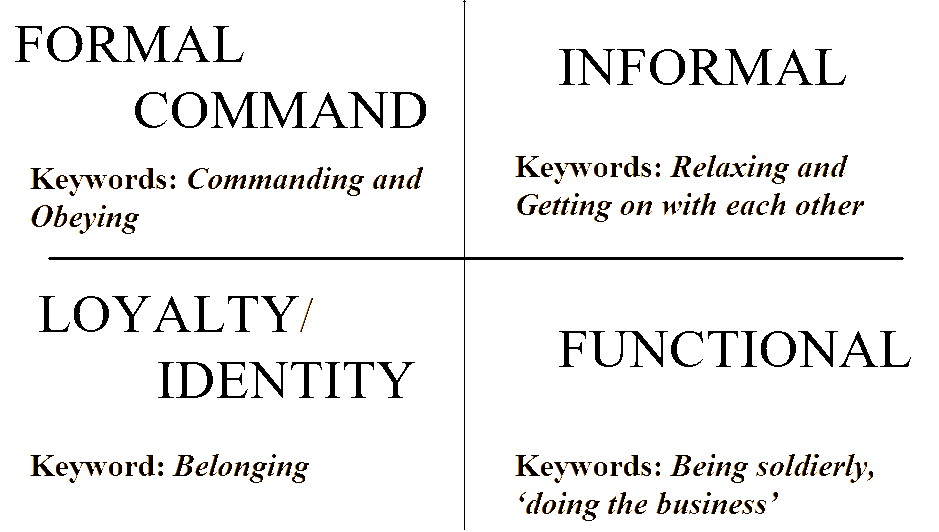
In the model, these ‘social structures’ are called respectively the ‘formal command structure’, the ‘informal structure’, the ‘functional structure’ and the ‘loyalty/identity structure’. In any one context, only one of these social structures predominates, though the context can change rapidly, causing a rapid change from one predominant structure to another. However, in his or her daily progress a soldier (that is to say, any member of a unit regardless of rank) will visit all of these social structures. Indeed, if life becomes marooned in less than all four, morale, operational effectiveness, and sometimes discipline, all decline.
There are two sub-models that are important to this paper.
The first captures the pattern in informal relationships. Although at first it might be thought that informal relationships would not be subject to rules and conventions because by their very nature they are informal, this is not the case. Such relationships tend to cluster into classes that can be typified as follows, using terms (in italics) selected specifically for the model and used rigorously as bounded technical terms in this paper:
- ‘Close friendship’, consisting in a durable relationship that transcends the military environment, where there is a large measure of trust and respect between the parties and few barriers to discussion of highly personal matters. It is rare and special, recognisable when it occurs but not a vector for commonplace interaction within the unit.
- ‘Friendship’, a less intense relationship that is frequently found to exist between soldiers within the ‘informal structure’. It can have all the appearance of ‘close friendship’, in that individuals constantly seek each other's company, will help each other if they are in trouble, and will be prepared to share almost anything if the need arises. However, it falls short of the depth and intensity of the other relationship. It is essentially a peer-relationship.
- ‘Association’, in which two soldiers separated by rank distance wide enough to exclude ‘friendship’ between them will come into regular contact and will form an informal bond of mutual trust and respect. This bond falls short of ‘friendship’ as defined above, but is nevertheless an important mechanism in the informal structure. It is therefore a warm and trusting relationship of people of unequal rank.
- ‘Informal Access’, by which it is recognized that each individual has a right to speak informally and without a formal appointment with others who are structurally distant (notably superiors in the chain of command), in the absence of an existing relationship of ‘association’.
- ‘Nodding Acquaintance’, describing a relationship where the parties know each other by sight, but not necessarily by name, and they acknowledge each other's existence and common participation in the same segment of the formal command structure. The relationship may remain as it is, or it may grow into any one of the others listed above.
This typology of relationships is laid out in Figure 2, which shows the array of informal relationships open to an individual, ‘EGO’, who is of particular rank but who has some subordinates and some superiors within the unit.
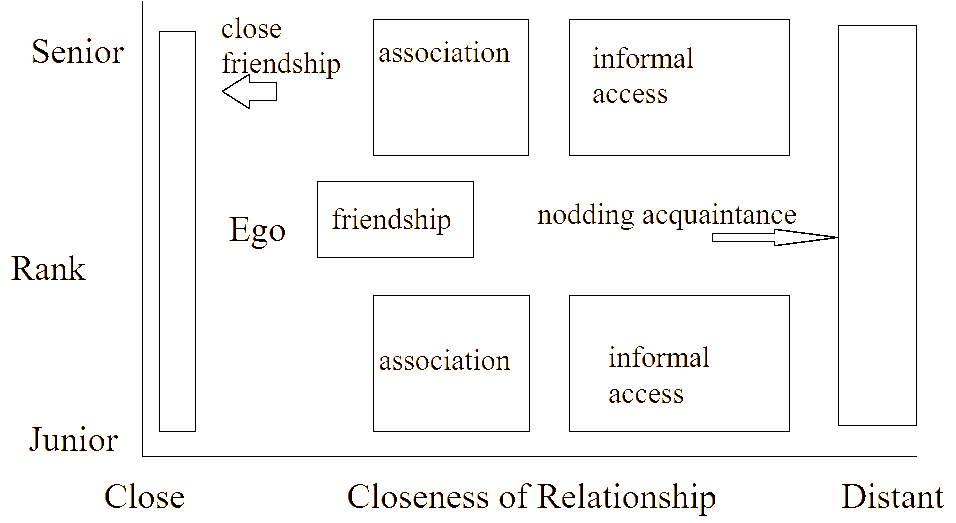
There are strong indications that the likelihood of one individual trusting another is related to the closeness of the relationship. Unquestioning trust may be assumed between ‘close friends’, whilst those in ‘informal access’ will be less generous in bestowing it. Where individuals have not met before and have no pre-existing informal relationships (not even ‘nodding acquaintance’, significant trust is unlikely. In passing, it may be noted that this is not the case in the organizational culture of Air Crew in the Royal Air Force: they routinely trust their lives and their aircraft to air traffic control operators whom they have never met.
The second sub-model addresses attitudes to formal rules, and the conditions under which such rules may be bent or broken. In Asylums, Goffman differentiates between behaviour among mental patients that strictly conforms to the formal rules, and behaviour that bends or breaks the rules to make life more comfortable. He calls the former ‘primary adjustments’ and the latter ‘secondary adjustments’. As in much of his work, these observations are widely applicable, in this case to any disciplined or rule-defined environment. The British Army is no exception, though there is an interesting extra element in the area of secondary adjustments.
Notes to Figure 2:
1. The diagram is drawn on 2 axes:
a. Vertical axis, relative seniority. Any point on the axis is senior in rank to any point below it and junior to any point above it.
b. Horizontal axis, closeness of the relationship. The further to the left, the stronger the relationship, and vice versa. Each of the boxes in the diagram has a horizontal dimension which corresponds to various degrees of closeness on the horizontal axis of the diagram. On the principle that a line consists of a very large number of points, this incorporates a range of closeness or distance in any of the relationships which allows for a high degree of variety.
2. Soldiers’ personal informal relationships fall within the boundaries of the diagram.
3. The boxes summarise the various relationships available to EGO, the effects of relative rank, and the relative closeness or intensity of the relationships.
4. The gaps between the boxes have no significance apart from separating them on the page to make the model readable.
It is reasonably clear when an individual is conforming to the rules and when he or she is not. However, some breaches of the rules are taken more seriously than others, the degree of seriousness being defined by those in authority. To differentiate between them, I have modified Goffman’s characterization. ‘Legitimate secondary adjustments’, occur when the individual’s immediate superior approves of or ignores the deviation from the rules, and ‘illegitimate secondary adjustments’ occur where the superior will take action if he or she becomes aware of the activity.
For our purposes, it is simply important to note that there are established informal social mechanisms in the British Army by which individuals bend or break formal rules. This activity takes place without disturbing the normal fabric of life, and is controlled by informal practices in the chain of command. In essence, there is flexibility in the social system that may be hard to predict.
The final element in this necessarily brief summary of British Army organizational culture is an all-pervading idea of ‘superiority and inferiority’. This is manifested, for example, in two common ways. First, there is rank. Although in many situations little overt fuss is made of differences in rank there is an endemic respect for formal superiority. This is encapsulated, for instance, in the military proverb that ‘tactics is the opinion of the senior officer present’, and in the assumption that the value of the opinion expressed is directly related to the rank of the person expressing. This latter observation was made by Richard Holmes in the context of First World War Generalship [17], but the fact that it still applies today reminds us of the deep roots and longevity of elements of the Army’s organizational culture. Secondly, there is the idea of ‘being the best’. Any individual can, and does, find reasons why he or she is superior to, or ‘better than’ almost any other individual. If the other is of higher rank, then the first might consider that the other belongs to an inferior part of the unit or the Army. If the other belongs to a more prestigious part of the Army then the individual can usually find reasons why this prestige is undeserved and why their part is in fact in some way better.
Network enabled capability
The new digitized command and control structures, the technological foundations for NEC, will confer many and varied enhanced capabilities on the British Army in the context of war-fighting. It seems that among the most significant are expected to be:
- A very large increase in available information. Such information of itself confers no advantage, but rather it is the turning of that information into increased situational awareness by the interaction of the human beings and equipment that will make the principal difference.
- A capacity rapidly to reconfigure command and control teams. This capacity includes, for example, the facility to ‘reach back’ to other headquarters, perhaps in another continent, for vital input, and the handing-off of staff functions or problem-solving to remote teams. It will also permit the commander to remain in close touch with the operational and planning staff while being physically remote from them, and more senior commanders in the home country to have as much detail as, and sometimes more than, field commanders in theatre.
- The ability to reconfigure responsibility for, and execution of, command and control. This means that the best placed commander, of whatever rank, can be put in a position to run the battle, regardless of his formal span of command.
- A marked increase in tempo, arising from the enhanced capabilities. Slicker command and control with more and better information will enable commanders to outpace the enemy’s decision/action cycle. This will contribute to dislocation of his command apparatus and the achievement of rapid effect with less need for attritional clashes of arms.
We must remember, however, that these four new capabilities are going to have to pass through the filter of organizational culture as they are turned into practice. And this organizational culture cannot change as rapidly as the technology. A crucial factor in the resulting operational effectiveness will therefore be the attitudes and expectations of the human beings who will be at the heart of the system of systems.
It would be foolhardy to pretend that all the emergent properties resulting from the introduction of digitized capabilities can be forecast by considering what is known of the organizational culture of the British Army. We should admit that there are bound to be surprises along the way. However, some things can be predicted by using of the models outlined above.
We begin with the increase in available information. Information in itself is not particularly useful until it has been turned into ‘knowledge’ in the minds of the people who are going to use it to comprehend the situation and make decisions. This transformation will be affected, perhaps profoundly, by the attitudes and expectations arising from their organizational culture. Furthermore, when the ‘knowledge’ of one group or individual is passed on to others, it can only be considered as ‘information’ from the point of view of the next recipient(s) and its perception is subject once again to the effect of organizational culture [18].
Currently, information is passed within Army organizations both formally (by voice, data, or on paper) and informally (through the personal relationships between soldiers). Frequently, unauthorised but effective means are used within organizations (‘legitimate secondary adjustments’). Individuals in the system have expectations of, and attitudes to, the next potential recipient which are at least partially influenced by their regimental/corps loyalty and identity. This may affect a decision as to whether or not to pass on particular items of information. None of these aspects will change in the NEC era. It would be a mistake therefore to assume that increasing the flow of information will of itself provide a step change in the effectiveness of military organizations.
As far as reconfiguring teams is concerned, to a certain extent the Army is used to the processes involved, under the military heading of ‘grouping’. Sub-units (and sometimes smaller elements) are grouped with others, headquarters exchange liaison officers, and new ad hoc formations are created. The major novelties that NEC will confer as far as reconfigurability is concerned are, first, that ‘grouping’ of units and headquarters can be very rapid and second that the new command and staff teams can be ‘virtual’. Indeed, commanders and staffs can be linked electronically without ever meeting. However, as we saw above, trust in the Army flows best where there is an existing and warm informal relationship. In the absence even of ‘nodding acquaintance’ trust is by no means guaranteed.
With respect to increasing the flexibility of command and control, it may be predicted that the basic assumptions of hierarchy and the intellectual superiority of senior officers may provide practical limits to this flexibility. Culturally, for example, we are not ready for a sub-unit commander to take control of a brigade, however suitably situated he may be to run a significant part of the battle.
As for increasing tempo, the benefits can only be garnered if commanders and their staffs are capable of sustaining their functions in the new higher-tempo environment. At brigade level at least, the time available for them to sleep is currently shortened by the assumption that only they can take the key decisions. This assumption is strongly influenced by the cultural paradigm of the position of the commander as the person who is wisest and knows the most. This means that in practice commanders and their key staff sleep as little as possible, and only after they have worked themselves into a highly fatigued state, a state where decision making is often impaired [19]. If the tempo is to increase further, then this cultural paradigm will have to be faced and a novel alternative found [20].
So what?
If these four areas are addressed pessimistically, then, having taken British Army organizational culture into account, the following may be predicted as the results of cultural drag and cultural precession:
- Individuals will not make the most of the new capabilities for circulating information.
- Virtual teams will not flourish because of basic lack of trust between the members who do not know each other and have not yet met.
- The capacity for flexible command and control will in practice be subordinated to the culturally based assumption of the basic legitimacy of hierarchy. Flexible command and control might be made to appear to take place but in reality the commander will be most unlikely to yield control. Subordinate commanders and staff will generally wish to please the commander and want to subordinate themselves to him. This will make them reluctant to exercise the independent, peer- rather than commander-coordinated action (‘self-synchronization’) that high tempo situations may demand and that new equipment will permit.
- Increased tempo will not be operationally effective because commanders and key staffs will not be in a mental condition to exploit it, and more junior individuals will be unwilling to take high level decisions.
However, there is no need to be pessimistic. The key to success will be to recognize that organizational culture is an important influence and then to make plans to introduce new capabilities in harmony with it. Instead of ignoring it, and letting the clashes lie where they fall, it may well be possible to design new systems and practices to take account of it.
For example, taking the four areas discussed above, the following activities will all be beneficial:
- Ensuring that information flow is designed to take account of the ‘social structures’ in the Army. For example, it could be harmonized with culturally defined expectations by aligning it with the deeply based assumptions of hierarchy an authority, and provision could be made for complementary communications channels running via existing informal relationships.
- Wherever possible, allowing members of virtual teams to meet each other before deployment, or during earlier phases of the operation. Where that is impossible, the deployment of liaison officers from remote elements should be considered, to act as a human interface.
- Designing new more flexible command and control practices within the hierarchical assumptions of the existing system. For example, each reconfiguration of command, including direction to self-synchronize within specified time and space boundaries, should be at the express order and by permission of the senior commander. Such action would harmonize with the current system of delegating Operational Control, Tactical Command and Tactical Control [21].
- Reinforcing headquarters with extra senior staff, rather than the current practice of reinforcing in most cases with junior staff. This could extend to duplicating all key staff during operations to create two evenly-weighted shifts [22]. However, attempts to duplicate command would not be acceptable. There must still be a single commander, and particular measures need to be worked out to allow him or her to rest while retaining ultimate control over what takes place.
In simple terms, it is better to ride the organizational culture that exists, and cannot change rapidly, rather than to confront it with change that will challenge it. Whatever the ultimate intention, it can be confidently predicted that sensitivity to organizational culture is more likely to result in more successful use of novel capabilities than inattention to it.
References
[1] J. Beattie, Other Cultures: Aims, Methods and Achievements in Social Anthropology, London: Routledge and Kegan Paul Ltd, 1966, p. 20.
[2] L. Mair, An Introduction to Social Anthropology, Oxford: Clarendon Press, 1965, p. 7.
[3] G. Hofstede, Cultures and Organizations: Software of the Mind; Intercultural Cooperation and its Importance for Survival, London: HarperCollins, 1994, p. 183.
[4] F. Trompenaars and C. Hampden-Turner, Riding the Waves of Culture: Understanding Cultural Diversity in Business, London: Nicholas Brealey, 1997, pp. 20–27.
[5] G. Hofstede, op. cit., p. 9.
[6] See, for example, P. Bourdieu, Language and Symbolic Power, Cambridge: Polity Press, 1991.
[7] A. Giddens, The Constitution of Society: Outline of the Theory of Structuration, Cambridge: Polity Press 1984, pp. 24–25.
[8] E. Goffman, Frame Analysis: An Essay on the Organization of Experience, Harmondsworth: Penguin Books Ltd., 1974.
[9] A. Giddens, op.cit., p. 87.
[10] D. Rooney, and G. Croften, Presentation to DERA Centre For Human Sciences, “BATUS Warfighting Experiment 2001”, November 2001. The experiment report is D. Rooney, G. Crofton, J. Howe and B. Reason, BATUS Warfighting Experiment 2001: BIG PICTURE 2, QINETIQ/ TLS/ CONSULT /CR020001/1.0, 2002.
[11] Y. Malhotra, “Business Process Redesign: An Overview”, IEEE Engineering Management Review, Vol. 26, No. 3, Fall 1998 (http://www.brint.com/papers/bpr.htm).
[12] E. Goffman, Asylums: Essays on the Social Situation of Mental Patients and Other Inmates, Harmondsworth: Penguin Books Ltd, 1968, p. 11.
[13] J. Hockey, Squaddies: Portrait of a Subculture, Exeter: University of Exeter, 1986.
[14] R. von Zugbach, Power and Prestige in the British Army, Aldershot: Avebury, 1988.
[15] P. Killworth, Culture and Power in the British Army: Hierarchies, Boundaries and Construction, PhD Dissertation, Cambridge: Cambridge University, 1997.
[16] C. Kirke, “A Model for the Analysis of Fighting Spirit in the British Army”, in H. Strachan (ed.), The British Army, Manpower and Society into the Twenty-First Century, London: Frank Cass, 2000, pp. 227–241 (in which the diagrams in this paper were first published); C. Kirke, Social Structures in the Regular Combat Arms Units of the British Army: A Model, PhD., Cranfield University, 2002; C. Kirke, “Postmodernism to Structure: an Upstream Journey for the Military Recruit?”, in E. Holmes and T. McConville (ed.), Defence Management in Uncertain Times, London: Frank Cass, 2003, pp.139–155.
[17] E. Holmes, unpublished lecture script, “Red Tabs and Dugouts: British Generalship in the First World War”, 1995.
[18] See, for example, J. Sanger, The Compleat Observer? A Field Research Guide to Observation, London: The Falmer Press, 1996, for a discussion of the effects of culture on perception.
[19] See for example A. Nicholson, and B. Stone, Sleep and Wakefulness: Handbook for Flight Medical Officers, Second Edition, NATO Advisory Group for Aerospace Research and Development, 1987, pp. 63–69.
[20] See R. Anderton-Brown, R. Clements, D. Poole, T. Young, Mitigating Information Overload in Formation Headquarters in a Digitized Army, MA Dissertation, Cranfield University (Royal Military College of Science), 2003, for a considered examination of these issues.
[21] MOD, Army Doctrine Publication Volume 2: Command, 1995, Chapter 4.
[22] R. Anderton-Brown, et. al., op. cit.