
Volume 7, Number 2, July 2004
Evaluating Numerical Approaches in Explosion Modelling Using a Surface-Laid Mine
Abstract
Within the mine-blast research community, there is an increasing desire to enhance the efficiency and efficacy of mine-resistant vehicles, albeit in a cost-effective way. An approach that mirrors this requirement is presented in this paper. The explosion of an antitank mine is modelled and analysed by using the non-linear dynamics analysis software, AUTODYN. The initial simulation setup consisted of a hemispherical charge laid on a ‘perfectly reflective’ plane. Two equations of state for explosive products were studied, with the first one being the commonly used empirical equation of state, Jones-Wilkins-Lee (JWL). The second study applied the ideal gas equation of state, often used for simplification in complicated models. The mesh sensitivity study was carried out. Two parameters of blast waves, namely maximum pressure and specific impulse, are evaluated and compared with accessible experimental data obtained from CONWEP. Consequently, an explosion of a mine laid on sand was modelled using JWL EOS and blast parameters were compared with the previous model.
Introduction
It is estimated that up to 60 million mines lay strewn in some 70 countries all over the world. Approximately 26 000 civilians are killed or maimed every year in minefields [1]. The medical, psychosocial, environmental, and economic impacts inevitably scale up further tension and armed conflict in the affected areas. In mine-affected countries, scarcity of adequate medical services, safe water and food has led to dependency on the international community for humanitarian and development assistance. Mine contamination of infrastructure disrupts relief supplies from reaching their intended destination. Therefore, appropriate transport for successfully negotiating minefields must be developed in order to make international assistance more far-reaching and cost-effective.
In addition, the military aspect of the mine threat cannot be omitted in this domain. In World War II, 20% of tank casualties were attributed to mines. In Vietnam, US armour casualties attributed to mines increased to 70% and French forces lost about 85% of tanks in Indo-China [2]. In the more recent conflicts, US military losses attributed to landmines were 59% in Persian Gulf War and 60% in Somalia [3].
In recent years, some initiatives have been undertaken to study and understand mine blast and loading behaviour in order to enhance the design of vehicles used in mine-affected zones. This study is split into experimental and numerical approaches, whose results are often complementary to the others. The two approaches can be summarised in brief as follows:
Experimental activities. Experiments have been conducted to investigate the response of a vehicle subjected to a mine explosion in order to (i) analyse the gross motion and damage to the vehicle, (ii) to assess effects on occupants (iii) and to evaluate attenuation materials [3–6]. These experimental results have led to design proposals, such as deflector plates fitted under the wheel wells and fuel tank placed in the rear section. Experiments, studying explosion output, have shown that mine deployment and soil compositions have significant effect on the magnitude of vehicle loading. The most severe loading is obtained from explosion of mines buried in cohesive soil, such as clay [7–9].
Numerical simulations. The finite element method is widely used in defence related engineering analyses, such as high-velocity impact and penetration. In preliminary works, explosion was implemented in simulation using empirical formulae [10,11]. Recently, bespoke numerical procedures have been developed which allow the study of the explosion process from the initiation of explosive charge [12–14].
In conventional use, a mine is generally laid above, flush with, or buried in soil (commonly categorised between sand and clay). Upon initiation, the detonation wave propagates through the explosive material, generating high pressures and temperature in the detonation products. These products expand violently, forcing the surrounding material (soil and air) out of the occupied volume and create a pressure shock-wave propagating through the surrounding material in all directions from the charge. As soil is pressed out forming ejecta, the detonation products break through the surface. Soil gains kinetic energy and moves upwards. After impinging on the target, soil falls back and forms the apparent crater surface.
It is to be noted that the detonation products expand to a scaled radius of about 0.8 m.kg-1/3 [15], where scaled distance is defined as Z=R/W1/3, R [m] is the distance from charge centre and W [kg] is the TNT equivalent charge mass. The whole of the compressive wave propagates in air beyond a scaled radius of 1.6 m.kg-1/3. Hence analyses focusing up to this region must take into account both the explosive products and air.
This paper reports on the initial analysis of a mine explosion phenomenon using the latter approach. An explosion of an anti-tank mine laid on the ground surface was analysed using commercially available software AUTODYN to evaluate the feasibility of an equation of state for explosive products and optimum cell size.
The remainder of the paper is organized as follows. The next section covers the rudiments of explosion process modelling in some detail. Subsequent sections discuss the simulation framework proposed and the numerical results obtained from the simulation runs. The paper concludes with discussion of results.
Explosion process modelling
Explosions are numerically described by a general system of equations, derived from the laws of conservation of mass, momentum, energy, supplementary equations, and material models for the explosive products, surrounding soil and air. Supplementary equations express detonation theory, such as the Chapman-Jouguet equation [16,17]. Material models play an important role in linking stress to deformation and internal energy. The explosive products and surrounding air are sufficiently modelled using an equation of state (EOS). An equation of state expresses a relationship between the pressure p, specific volume v and temperature T, that is: p=f(v,T). Additional components are needed for modelling soil. These components are termed as strength model and failure model in AUTODYN [18]. Strength model formulates material resistance to shear and is represented by yield criterion. Yield criterion relates transition between elastic and plastic regime. When a critical value of a flow variable is reached, material fails. This is modelled using a failure model that expresses tensile strength limit which material can withstand.
High explosives. High explosives are modelled using an equation of state for explosive products that can be classified into two types as follows:
- Equations of state without explicit chemistry are based on experimental data for a particular composition from which the formulae are derived.
- Equations of state with explicit chemistry contain individual EOS for component molecules and rules for their combining to give an EOS for any composition.
The particular application, the required accuracy and the method of solution are the main factors that influence the decision of the choice of appropriate EOS for explosive products.
The cylinder expansion test was developed to derive the Jones-Wilkins-Lee (JWL) empirical EOS for explosive products [19]. In this test, a copper tube containing explosive is detonated, and the cylinder wall acceleration caused by the explosive products expansion is recorded with a high-speed camera until the cylinder has expanded to about three times the original diameter. The resulting empirical equation is a pressure-volume relationship that is independent of temperature. The JWL EOS is widely used in mine blast calculations, because it is easy to program. It is implemented in codes, such as LS-DYNA and AUTODYN. It is argued that “JWL fit to a cylinder test may be useful for describing that particular cylinder test, but it will not be useful for describing anything else” [20]. It is because of this that the current work was conducted to evaluate the validity of the JWL EOS in the analysis of mine blast. The JWL equation is implemented in the AUTODYN software in the form:
(1)
where A, B, R1, R2 and ω coefficients depend upon the composition of the explosive. The variable V=v/v0 is the expansion of the explosive products and E [J.m-3] is the detonation energy per unit volume.
Air. The surrounding air was assumed to be an ideal gas whose equation of state is in the form: p=(γ –1)ρ where γ is the adiabatic exponent, ρ is the density and e is the internal energy.
Sand. Laine et al. [21] derived the complex model for sand having dry density of approximately 1 574 kg.m-3 and average water content of 6.57%. The sand model consists of compaction EOS with theoretical maximum density of 2641 kg.m-3, granular strength model and failure criteria was defined as the hydro-tensile limit with a minimum pressure value: pmin= –1×10⁻³ Pa
The results obtained by numerical modelling are compared with experimental data obtained from CONWEP [22]. CONWEP is a software program that features a collection of conventional weapons-effect calculations. The collection is based on experimental data of spherical air burst and hemispherical (rigid) surface burst of TNT charges. A relationship between blast parameters and scaled distance is developed and implemented in the code. Hence, it is possible to obtain maximum overpressure and specific impulse data for a particular explosive at a given scaled distance.
Setup of model
The explosive content of an anti-tank mine varies between 1.5–10 kg [23]. Most vehicles have a ground clearance which ranges between 200–600 mm [24]. A numerical model was therefore established which used a hemispherical TNT charge of mass 10.19 kg, and the resulting blast wave parameters at stand-off distances between 200 to 800 mm were examined.
A two-dimensional axi-symmetric model was developed in AUTODYN to investigate the effect of:
- Rigid surface—a solid boundary with a perfect reflection.
- Sand surface—the charge was placed on a sand surface which utilised Laine’s sand model [21].
Throughout the study, the terms rigid surface model and sand surface model will be used to denote the preceding definitions, respectively.
For a rigid surface model, two equations of state for explosive products, namely Jones-Wilkins-Lee and ideal gas EOS, were analysed. While cell sizes of 5, 3, 1, 0.5, 0.1 and 0.05 mm were used to study the mesh sensitivity.
A sand-surface model was run only using JWL EOS for explosive products.
Results
Effect of EOS and mesh sensitivity
In the study, two blast wave parameters (maximum overpressure and specific impulse) were evaluated for different stand-off distances using the JWL and ideal gas EOS. Different mesh sizes were used for each combination of the aforementioned setup. The numerical results obtained, were compared with empirical data from CONWEP. It is to be noted that CONWEP is unable to provide data for scaled distances below 0.18 m.kg-1/3. Therefore, the maximum overpressures and specific impulses at scaled distances below this value were evaluated by extrapolation.
Investigation of the influence of equations of state on blast wave parameters was conducted in the rigid surface model. Maximum overpressure at a particular scaled distance for the various mesh sizes was evaluated for both EOSs and is graphically illustrated in Figure 1. For the models using the ideal gas EOS, it was observed that cell size had little influence on the magnitude and shape of the blast wave, therefore results of a model with 3-mm cell size were depicted in Figures 1 and 2. Comparison with CONWEP showed that maximum overpressures were underestimated by 30–50% at distances exceeding 400 mm, as shown in Figure 1. The CONWEP data below 400 mm (shown by the dashed line in Figures 1 and 2) were extrapolated and therefore were ignored in this comparison. The specific impulse results over the same range were in closer agreement with CONWEP. Plots of specific impulse are presented in Figure 2.
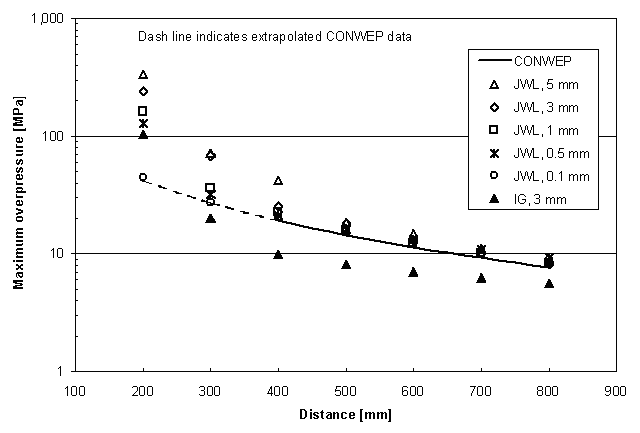
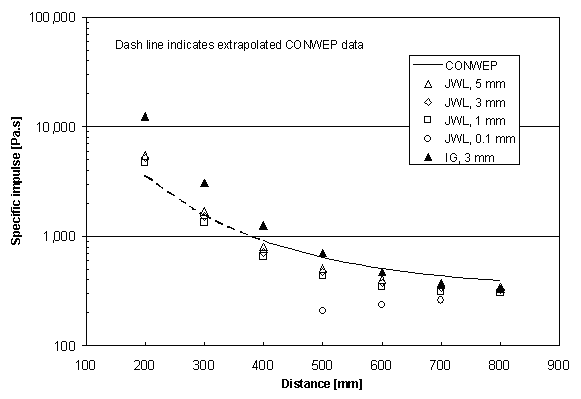
Results obtained using the JWL EOS were observed to be highly dependent on mesh size. For the largest cell size, maximum overpressures were eight times higher than the fine mesh analysis at a distance of 200 mm. It was also observed that for cell sizes of 0.1 mm and 0.05 mm, maximum overpressures were convergent and comparable with CONWEP data over the whole range considered, including the extrapolated region. Interestingly, opposite trends were observed with respect to the specific impulse. Fine meshes resulted in the greatest underestimation of specific impulse (up to 70%), while coarser meshes predicted specific impulses only 25% lower at distances exceeding 400 mm. Refer to [25] for a detailed analysis.
Surface analysis
To study the surface effect, a rigid and a sand surface, is modelled in this paper. JWL EOS was used for a sand surface model. Since mesh size of 3 mm and 1 mm gave the same trend for both the rigid and the sand surface models, the discussion below focuses on the 1-mm mesh size.
Overpressure-time histories extracted from the analysis of the rigid and sand surface models are shown in Figure 3. The time histories were recorded at distances from 200 mm to 800 mm with an increment of 100 mm. It was observed that overpressure-time histories are largely coincident. A tabulation of the maximum overpressure and specific impulse against scaled distances for various mesh sizes considered are presented in Table 1.
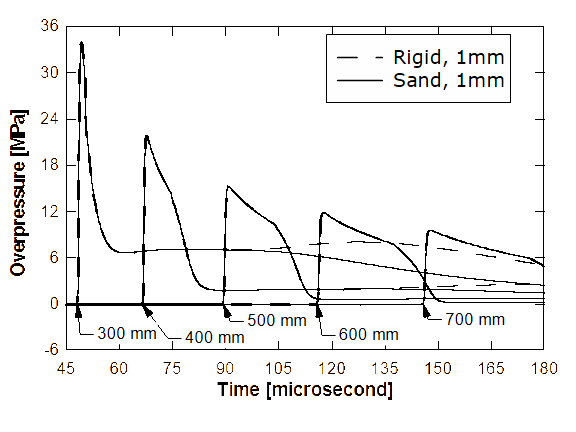
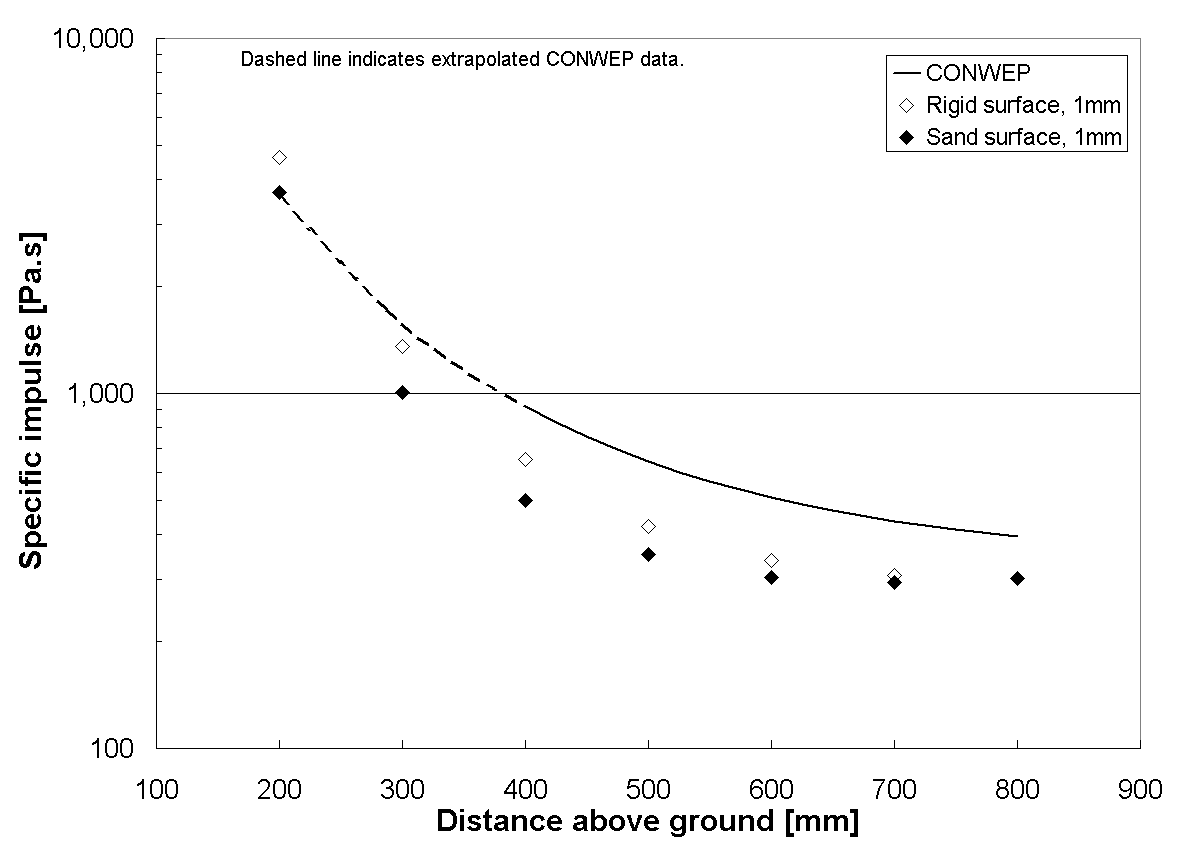
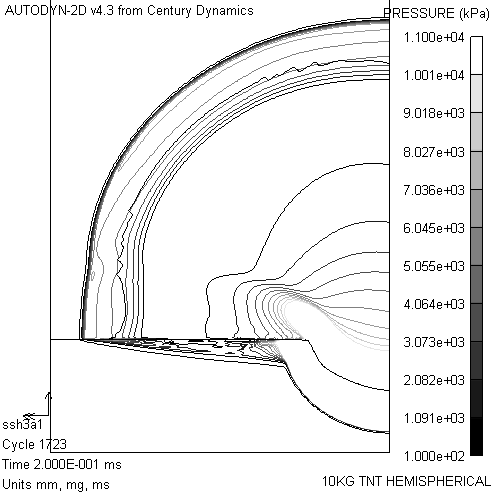
It was observed that the type of surface within the region considered did not influence the maximum overpressure and time of arrival. The magnitude of specific impulse was less in the case of the sand surface model (see Figure 4). The highest decrements of approximately 23% were noted at distances of 300 mm and 400 mm. This was because of the fact that some of the explosion energy was consumed by sand compaction and crater formation. At distances greater than 600 mm, the difference in the magnitude of specific impulse is not significant. The process of propagation of shock wave through air and sand is illustrated in Figure 5. The region of highest pressure is in the adjacent crater area.
| Stand-off [mm] | Scaled distance [m.kg-1/3] | Maximum overpressure [kPa] | ||||
|---|---|---|---|---|---|---|
| CONWEP | Rigid 3 mm | Rigid 1 mm | Sand 3 mm | Sand 1 mm | ||
| 200 | 0.092 | 41,650 | 256,675 | 136,141 | 245,534 | 137,268 |
| 300 | 0.138 | 27,090 | 57,443 | 33,987 | 58,820 | 33,982 |
| 400 | 0.184 | 19,150 | 28,432 | 21,808 | 28,619 | 21,975 |
| 500 | 0.231 | 14,420 | 16,684 | 15,307 | 16,679 | 15,362 |
| 600 | 0.277 | 11,360 | 13,421 | 12,055 | 13,418 | 11,925 |
| 700 | 0.323 | 9,230 | 10,204 | 9,647 | 10,162 | 9,599 |
| 800 | 0.369 | 7,667 | 7,993 | 8,032 | 7,916 | 8,027 |
| Stand-off [mm] | Scaled distance [m.kg-1/3] | Specific impulse [kPa.ms] | ||||
| CONWEP | Rigid 3 mm | Rigid 1 mm | Sand 3 mm | Sand 1 mm | ||
| 200 | 0.092 | 3,586 | 5,415 | 4,551 | 4,512 | 3,687 |
| 300 | 0.138 | 1,572 | 1,536 | 1,316 | 1,227 | 1,008 |
| 400 | 0.184 | 917 | 669 | 634 | 534 | 499 |
| 500 | 0.231 | 644 | 424 | 421 | 357 | 353 |
| 600 | 0.277 | 509 | 353 | 340 | 319 | 304 |
| 700 | 0.323 | 437 | 332 | 311 | 314 | 293 |
| 800 | 0.369 | 396 | 335 | 308 | 326 | 300 |
Discussion
For both the EOSs investigated, it is observed that the numerical results converge with CONWEP data, as the distance from the charge centre increases. The model that used the ideal gas EOS does not agree with the blast wave parameters of CONWEP at close-in distances. This is due to the fact that the blast wave parameters are highly influenced by the explosive products. Therefore, it was decided to omit the ideal gas representation from future studies.
Results obtained from the JWL EOS model are not satisfactory in all the regions observed. Fine meshes give comparable maximum overpressures and the most underestimated impulses, whereas large cell sizes result in pressure overshots at close-in distances and specific impulses that are 25% lower than CONWEP data. Huntington-Thresher [26] concluded from his experimental analysis that CONWEP overestimated the specific impulse by 20–25%. Taking this into consideration, specific impulses predicted by the model using JWL were in good agreement with experiments.
The surface type did not influence maximum overpressure and time of arrival. The difference is in the specific impulse. The sand surface model predicted about 23% lower impulse in the near region than the rigid surface model. This effect is consistent with the energy dissipation into soil for compaction (plastic deformation).
Conclusion
Incident overpressures and impulses were calculated for a mine using a range of cell sizes and two different equations of state for the explosive products. Simulations led to the conclusion that the ideal gas equation of state is not suitable for modelling an explosion at close range. The JWL equation of state, although superior in some respects, also fails to give satisfactory results in the whole range of interest of this study. The surface type influences the near region. Although time of arrival and maximum overpressure were not affected, specific impulse decreased up to 23% for the sand-surface model at observed distances.
Further numerical and experimental investigations are planned in order to study close-in explosions and the interaction of blast with the surrounding soil. These investigations should reveal the influence of soil and blast loading on target structures from a detonating mine.
Acknowledgment
The authors wish to acknowledge technical support from Professor M. Braithwaite. They also wish to thank to Cranfield University and Mr R. Machen of Alvis Vickers Limited, UK for financially supporting this work.
References
[1] O. Schlein and A. Lagalée, “Global Landmine Crisis: The Problem”, http://www.landmines.org/GlobalCrisis/TheProblem/ TheProblem-all.htm, 2000.
[2] C. Sloan, Mine Warfare on Land, Brassey’s Defence Publisher, London, 1986.
[3] R. Bird, “Protection of Vehicles Against Landmines”, Journal of Battlefield Technology, Vol. 4, No. 1, Mar 2001.
[4] S. Nell, “Test and Evaluation of Landmine Protected Wheeled Vehicles”, 9th AFV Symposium, Shrivenham, UK, 2000.
[5] N. Alem and G. Strawn, “Evaluation of an Energy Absorbing Truck Seat for Increased Protection from Landmine Blast”, Technical Report, U.S. Army Aeromedical Research Laboratory, Alabama, USA, Jan 1996.
[6] S. Holland, “The application of the TABRE Attenuation System to Vehicles for Enhanced Underside Blast Protection”, 10th European AFV Attack and Survivability Symposium, Shrivenham, UK, May 2001.
[7] D. Bergeron and J. Tremblay, “Canadian Research to Characterise Mine Blast Output”, 16th International Symposium Military Aspects of Blast and Shock, Oxford, UK, Sep 2000.
[8] D. Bergeron, R. Walker and C. Coffey, “Detonation of 100g Anti-personnel Mine Surrogate Charges in Sand: A Test Case for Computer Code Validation. Technical Report SR668, Canada, Oct 1998.
[9] M. Held, “Momentum Distribution of Anti-tank Mines”, 20th International Symposium on Ballistics, Orlando, USA, Sep 2002.
[10] K. Williams and K. Poon, “A Numerical Analysis of the Effect of Surrogate Anti-tank Mine Blasts on the M113”, Technichal Report DREV TM-2000-007, Canada, Mar 2000.
[11] A. Gupta, “Modeling and Analysis of Transient Response in a Multilayered Composite Panel Due to Explosive Blast”, 20th International Symposium on Ballistics, Orlando, USA, Sep 2002.
[12] L. Laine, O. Ranestand, A. Sandvik and A. Snekkevik, “Numerical Simulation of Anti-tank Mine Detonations”, 12th APS Topical Group Conference on Shock Compression of Condensed Matter, Atlanta, USA, Jun 2001.
[13] Q. Cheng, C. Lu, X. Tan and C. Tham, “Response of a Box Like Structure to Near-by Explosion”, International Symposium on Defence Construction, Singapore, Apr 2002.
[14] G. Fairlie and D. Bergeron, “Numerical Simulation of Mine Blast Loading on Structures”, 17th International Symposium Military Aspects of Blast and Shock, Las Vegas, USA, Jun 2002.
[15] P. Vávra, Teorie výbušnin, Pardubice: Univerzita Pardubice, 2002.
[16] J. Henrych, The Dynamics of Explosion and its Use, Amsterdam: Elsevier Scientific Publishing Company, 1979.
[17] W. Ficket and C. Davis, Detonation, University of California Press, 1979.
[18] AUTODYN-2D User documentation, Century Dynamics, UK, 1998.
[19] B. Dobratz and P. Crawford, LLNL Explosive Handbook: Properties of Chemical Explosives and Explosive Simulants. Technical Report UCRL-52997-Chg.2, Lawrence Livermore National Laboratory, California, USA, Jan 1985.
[20] Ch. L. Mader, Numerical modeling of explosives and propellants, CRC Press LLC, p. 256, 1998.
[21] L. Laine and A. Sandvik, “Derivation of Mechanical Properties for Sand”, 4th Asia-Pacific Conference on Shock and Impact Loads on Structure, Singapore, Nov 2001.
[22] CONWEP, US Army Engineer Waterways Experiment Station, Vicksburg, December 1991.
[23] K. Colin, Jane’s Mines and Mine Clearance 1997-98, Coulsdon, UK, 1997.
[24] P. Gudgin, Armour 2000, London, UK, 1990.
[25] D. Fišerová, A. Hameed, T. Rose, J. Hetherington and S. Procházka, “Systematic Study of Simulated Mine Explosion using AUTODYN”, 6th International Seminar on New Trends in Research of Energetic Materials, Pardubice, Czech Republic, Apr 2003.
[26] W. Huntington-Thresher and I. Cullis, “TNT Blast Scaling for Small Charges”, 19th International Symposium of Ballistics, Interlaken, Switzerland, 2001.