
Volume 6, Number 3, November 2003
Potential Shortcomings of Selected Media Access Control Protocols for Wireless Ad Hoc Networks
- 1 Defence Science and Technology Organisation, DSTO C3 Research Centre, Fernhill Park, Canberra, ACT, 2600, Australia.
Abstract
An increasing desire for mobility for data users has encouraged wide-scale deployment of wireless networks, in particular using an approach of peer-to-peer multi-hop networks. In such networks, each node potentially acts as a data terminal as well as performing a relay function linking terminals that do not have a direct connection. This paper focuses on the Media Access Control (MAC) function of the Data Link Layer. It discusses the requirements of MAC in a wireless network and identifies four fundamental assumptions in many protocol designs that, if not true, may impact on protocol performance. A discussion of some well-known MAC protocols seeks to illustrate and clarify wireless ad hoc network MAC issues. Detailed examination, with particular attention on two of the assumptions, is then made of two attractive hybrid schemes called CATA and AGENT that have recently been proposed. The examination shows that the behaviour of AGENT is somewhat more robust.
Introduction
An increasing desire for mobility for data users has encouraged wide-scale deployment of wireless networks in the civilian domain as well as the military. In the civilian domain many such wireless networks are based on fixed infrastructure into which mobile users connect. Cellular mobile networks are examples of such networks. While such an approach has some application within the military, of potentially greater utility (and increasingly of interest in the civilian domain) is a concept of peer-to-peer multi-hop networks. In such networks, each node potentially acts as a data terminal as well as performing a relay function linking terminals that do not have a direct connection.
Radio frequency spectrum becomes the scarce resource that must be shared between the terminals in the network. In terms of the OSI communications stack, this sharing is carried out by Layer 2 (Data Link Layer) with its Media Access Control (MAC) function.
The rest of this paper is organised as follows. The first section discusses the requirements of MAC in a wireless network. It identifies four fundamental assumptions in many protocol designs that, if not true, may impact on protocol performance. Two contentionless MAC protocols are discussed in the second section followed by a discussion on contention based protocols—this seeks to illustrate and clarify wireless ad hoc network MAC issues. Detailed examination, with particular attention on two of the assumptions, is then made of two attractive hybrid schemes that have recently been proposed.
Requirements on a wireless MAC
For most mobile wireless networks, radio nodes employ a single antenna for transmit and receive. Accordingly it is easier to implement half-duplex networks (that is, a node can transmit and receive, but not simultaneously). Thus a wireless node cannot simultaneously monitor the channel and transmit. Consequently, it is impossible for a transmitting node to detect collisions (that is, the presence of multiple nodes transmitting simultaneously). By contrast, in wired networks transmitters can monitor the medium and detect distortions to the transmitted data caused by collisions. A wireless system, typically at the MAC layer, needs to implement some mechanism to detect, or avoid, collisions.
Leaving aside the half-duplex constraint, for wireless systems the collisions may not be apparent at the transmitter location. In the end, it is reception at the receiver(s) that determines whether a transmission suffered collision. There will be occasions when two nodes that have no direct communications capability to/from each other have their transmissions colliding at the receiver(s). This is the so-called ‘hidden station’ problem. Regardless of whether the interferers are hidden or not, an ideal wireless MAC would not only detect such collisions, but also seek to prevent them from happening. This is the ‘two-hop’ challenge, in that nodes that are separated by two hops must be prevented from transmitting simultaneously if the intermediate node(s) are intended recipients of one or both of the transmissions.
Because wireless transmissions can potentially be received by multiple nodes there may be value in having a MAC approach that supports broadcast/multicast transmissions. One-to-one transmissions are called unicast and while unicast data transfer can be supported over a broadcast medium, sending data intended for multiple stations over a unicast transmission is inefficient (requiring broadcast traffic to be transmitted multiple times). Nevertheless, the issues of reliability of connection and collision avoidance might lead to MAC protocols based on unicast transmissions.
Mobile nodes make up the networks of interest. Thus the network topology is subject to continual change. The mobility of the nodes and the nature of the terrain dictate the rate of change in the topology. The MAC protocol of the network must be capable of coping with the rate of change in the topology.
An ideal MAC protocol ensures that all nodes receive a fair share of the transmission resource. The concept of fairness is open to interpretation in that a fair allocation may not be equal if nodes have differing traffic requirements, including in the military environment, differing precedences.
The concept of fairness leads on to the concept of Quality of Service (QoS). Different applications have different requirements on the network including source to destination delay (latency) and latency variation (jitter). These can be impacted strongly by the nature of the MAC and so it may be a requirement on the MAC to provide differentiated services for differing applications.
Moot MAC design assumptions
In developing MAC protocols there are four fundamental, although debatable, assumptions typically made:
- uni-directional versus bi-directional links,
- topology dynamics,
- capture effect, and
- vulnerability to hostile action.
It may be counter-intuitive, but in real wireless networks, the wireless path performance (for example, the loss in signal power or the extent of signal distortion) between two node locations may be asymmetric. By asymmetric we mean that path performance transmitting from a given node A to given node B may be different to that experienced when sending from node B to node A. If asymmetry is indeed experienced in a network, it may have an impact on the effectiveness of MAC protocols that were conceived with an assumption of symmetrical links.
When the nodes of a wireless network are mobile there is potential for the network topology to change and the MAC layer is required to account for this change. To ensure efficient use of the wireless spectrum, the MAC protocol is likely to seek maximisation of the ratio between the transmission of user data and signalling exchanges. This would improve the probability that the topology would remain static during the period of signalling mini-slots but cannot provide any guarantees of stability of the topology. Moreover, if a protocol requires the retention of state, then even longer term changes in the topology might lead to non-uniform understanding of the state. For instance, if the protocol called for a specific act to establish and disestablish connections, then a topology change during the connection might lead to stations being unaware of a disestablishment.
Depending on the nature of the wireless terminals a phenomenon called capture effect may occur. This effect is experienced where two transmissions of slightly different signal strengths collide at the receiver(s) but the manner of processing in the receiver(s) mean that the stronger signal is successfully recovered without interference from the weaker signal. In some circumstance this capture effect can improve network performance, but the disguising of collisions can have peculiar impacts on MAC protocols that rely on accurate collision detection.
Protocol design in the civil world seeks to cope with unintentional interference. All nodes are assumed to be co-operating to maximise the performance of the network as a whole. In the military environment an adversary may seek to exploit characteristics of networks, including MAC protocols, to disrupt network operation.
Current contentionless schemes
Time division multiple access (TDMA)
TDMA is discussed in general texts such as Tanenbaum [1]. Access to the medium is broken up into time slots synchronised across the network and each station is allocated a time slot or slots according to a schedule known across the network.
A key advantage of this scheme is that access delay is deterministic so latency and other QoS parameters can be guaranteed. A key disadvantage is that nodes with no traffic continue to be allocated time slots leading to wastage of network resources.
Spatial reuse TDMA (STDMA)
In the case of ad hoc networks there may be scope for multiple transmissions to be made simultaneously in the one time slot. Provided nodes are separated by more than two hops, transmissions in a single time slot do not collide. STDMA seeks to increase performance by allocating more than one node to each slot (using fewer slots than the number of nodes in the network) and/or allocating more than one slot to each node. There are two fundamental approaches. The first seeks to determine the minimum number of time slots per cycle and allocates a particular time slot to each node (see for instance [2]). The second dedicates a slot to each node and then seeks to allocate additional slots to nodes without causing interference (see for instance [3]).
STDMA shares advantages with TDMA along with potential for improved capacity. Nevertheless, the allocation problem is a difficult one, especially if a distributed/autonomous approach (that is, a common schedule independently determined by each node) is sought. The challenge is even greater with dynamically changing network topologies.
Evolution of contention-based schemes
When traffic is uneven or bursty (typical of many data networks), the non-contention schemes are inefficient. An alternative approach is to allow nodes to compete or ‘contend’ for the channel. Busy stations will contend more often than idle stations and resource utilisation is potentially greater.
ALOHA and slotted ALOHA
The first protocol of this type is ALOHA and is discussed in general texts such as Tanenbaum [1]. In this protocol nodes initiate transmission whenever they have traffic to send. Collisions inevitably occur and some detection mechanism is required to indicate the need for repetition. At low network utilisation the protocol provides timely access and efficient transfer; but as network load increases collisions increase and the protocol breaks down. (The performance of ALOHA reaches its maximum when the offered traffic is half the physical channel capacity and network throughput is approximately 0.18 of the channel capacity.)
Slotted ALOHA divides time into slots that are synchronised across the network. Nodes commence any transmission only at the start of a slot, eliminating partial collisions. Throughput is exactly double the original ALOHA.
Carrier sense multiple access (CSMA)
Also described fully in [1] is the CSMA protocol, which modifies the original ALOHA by requiring nodes intending to transmit to sense the carrier before transmitting. (The original ALOHA did not have this additional control as it was intended for satellite access with large delay between transmission and reception.) Performance is improved with the extent being determined by how persistent a node is in seeking transmission opportunity. The protocol is better suited for wired networks (where hidden stations do not occur) as carrier sensing at the transmitting node can accurately identify network activity.
In wired networks CSMA can be extended to incorporate collision detection (CSMA/CD) with further improvements in performance. For wireless networks, the protocol is extended to incorporate collision avoidance (CSMA/CA). With collision avoidance nodes do not transmit immediately that the medium is identified as idle (risking two nodes simultaneously transmitting at the end of an active period). Instead a random delay is introduced to reduce the opportunity for collision—the hidden station effect still applies.
Multiple access collision avoidance, wireless (MACAW)
Carrier sense seeks to prevent collision—but by itself is ill-suited to wireless networks because of the hidden station problem. Fundamentally, it is the state of the channel at the receiving node that determines if a collision will occur. The MACA protocol, later fine-tuned as MACAW (see [4]), introduced a handshaking process between transmitter and receiver. A request to send (RTS) from the intending transmitter precedes, if appropriate, a clear to send (CTS) from the receiver. The CTS then indicates to any hidden station/potential interferers that a communication is in progress. Collisions should then occur only between signalling (RTS/CTS) packets. Note that the RTS/CTS exchange is appropriate only for unicast transmissions.
IEEE 802.11
IEEE 802.11 (see [5]) is becoming a major force in wireless LANs. It operates in two fundamental modes: an ad hoc mode where nodes are all peers and an infrastructure mode where an Access Point (AP) provides access to wired infrastructure. The MAC for 802.11 has two approaches. The Distributed Co-ordination Function (DCF) is used by all nodes when in ad hoc mode and most nodes in infrastructure mode. It is basically CSMA/CA. In infrastructure mode only, a point co-ordinator, generally the AP, centrally controls access to the medium via the Point Co-ordination Function (PCF). PCF divides time into a contention period when DCF is used to access the channel, and a contention free period when nodes are polled (based on bids made during the contention period). The protocol also supports an optional RTS/CTS (similar to MACAW) generally only used for larger packets. Amongst other changes the emerging extension to the standard, IEEE 802.11e [6], provides multiple (QoS) queues at the sending node and preferential access to the channel for high priority traffic. This is an attempt at supporting differentiated QoS on WLAN, but works best in infrastructure mode.
Floor acquisition multiple access with non-persistent carrier sensing (FAMA-NCS)
FAMA-NCS (see [7]) acknowledges the utility of the MACAW RTS/CTS exchange, but recognises the possibility that hidden nodes initiating RTS might collide with a CTS and be unaware of this occurring. To ‘acquire the floor around the intended receiver’, the receiver’s CTS is extended in length compared with the RTS signal. This seeks to ensure that any hidden node will always hear at least part of the CTS and thus be aware that the channel is busy.
Hybrid schemes
Hybrid schemes seek to maintain the deterministic QoS features of contentionless schemes but also to have the simpler management and dynamic load sharing of contention schemes. The two protocols to be discussed here are somewhat similar and share the following characteristics:
- They both seek to support broadcast transmissions.
- Time is broken into TDMA frames to provide some determinism in data flow latencies. The frames are slotted to reduce the possibility of collision.
- Synchronisation of nodes to frame and slot boundaries is required. For ad hoc networks, timing beacons from a central co-ordinator are not appropriate and some other mechanism, undefined in the protocols, will be required.
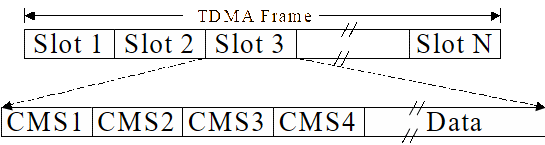
- Each slot has a period of signalling followed by a period when data is transmitted. This period of signalling is itself split into four parts (for the purposes of this paper called control mini-slots as per the earlier of the two schemes discussed here). The frame and slot structure is depicted in Figure 1.
- Some control mini-slots are contention free in that access to these mini-slots is guaranteed to specific nodes.
- Some control mini-slots are under contention so that nodes can contend for access to unused data slots.
- The RTS/CTS signalling is extended to include signalling to explicitly deter potential contenders or intending transmitters (‘busy tone’). The protocol logic makes inferences from noise received during collisions.
- The various approaches to back off in event of collision available to contention schemes are applicable to the contention aspects of these two protocols.
Collision avoidance time allocation (CATA)
The CATA protocol [8] is described in the state diagram in Figure 2. With CATA the number of slots in the TDMA frame is not directly determined by the number of nodes in the network, but in general, is increased with increasing numbers of nodes in the network. Slots are not dedicated to any node—all allocations are via reservation requests. Once a node successfully captures a time slot, it can retain that particular slot in the frame until data transfer is complete. This provides for deterministic latency once the path/link is established.
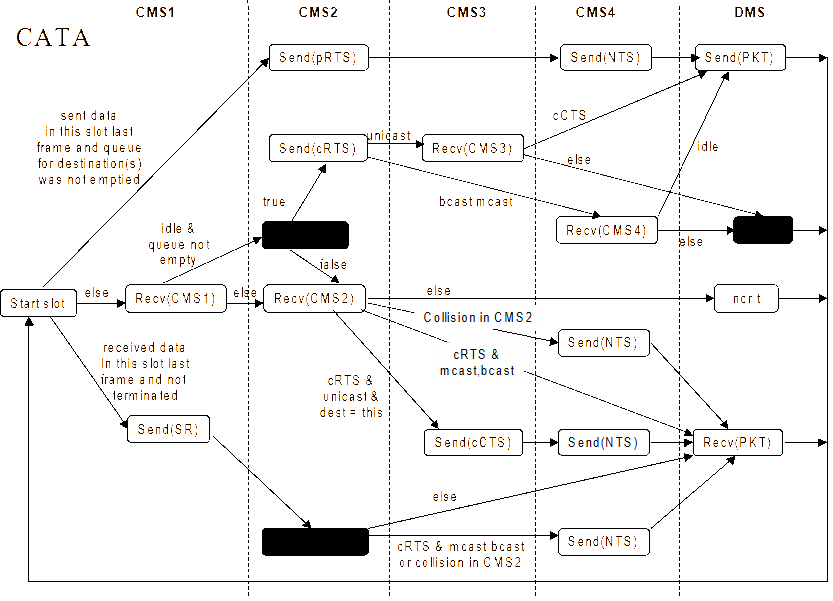
There is an implicit trigger in state changes crossing the dotted lines of the onset of the relevant mini-slot time. Note that [8] assumes non-persistent transmission policy, but the state diagram has been supplemented with an exponential back-off algorithm as used in the second protocol (AGENT). ‘decr t’ decreases probability of contention to reduce probability of further collisions after a collision. ‘incr t’ restores contention probability when nodes are idle. The shaded states in the lower half of the diagram are not explicitly per the specification but are not contrary to the thrust of the protocol and would assist in operation when propagation changes during the signalling period. The ‘p’ and ‘c’ prefixes to RTS and CTS are to discern between the signalling of (temporary) slot owners/priority users and contending users. Send(PKT) incorporates a reservation termination message when queue for destination(s) is emptied.
CMS1.
- All nodes that received data in the equivalent slot during the previous frame send a Slot Reservation (SR) packet as a ‘busy tone’ in CMS1.
CMS2.
- Nodes that successfully captured the equivalent slot during the previous frame (temporary ‘owner’) send an RTS packet as a ‘busy tone’. This is intended to collide at neighbours of the temporary ‘owner’ with any RTS packets sent by contender neighbours of the receivers.
- Contending nodes who heard silence in CMS1, and who themselves are not to receive data, send unicast or broadcast/multicast RTS.
CMS3.
- All nodes that were involved in data exchange in the equivalent slot during the previous frame remain silent.
- If a unicast RTS is successfully received in CMS2, the receiving nodes send a CTS packet.
CMS4.
- Nodes that successfully receive a broadcast/multicast RTS or hear silence in CMS2 remain silent. Otherwise, they transmit a Not To Send (NTS) packet.
- Nodes that successfully captured the equivalent slot during the previous frame (temporary ‘owner’) send an NTS packet as a ‘busy tone’.
- Contenders for broadcast/multicast that hear silence in CMS4 can infer success and transmit data.
An adaptive generalised transmission protocol (AGENT)
AGENT is described in [9] and is a minor adaptation of ABROAD described in [10]. AGENT might be described as similar to ‘CATA with dedicated slots’. The number of slots in the AGENT TDMA frame is equal to the number of nodes in the network. Each slot is assigned to a pre-determined node and ensures guaranteed minimum service and deterministic maximum latency. Fixed slot allocations might limit the application of AGENT for generic civilian use, but may not unduly constrain private networks such as a military situation. Signalling is used by nodes to gain access to time slots that are unused because the ‘owner’ has no traffic or is distant (that is, more than two hops) from the contender. The protocol is described in the state diagram in Figure 3 (note terminology from CATA is generally used rather than that of AGENT).
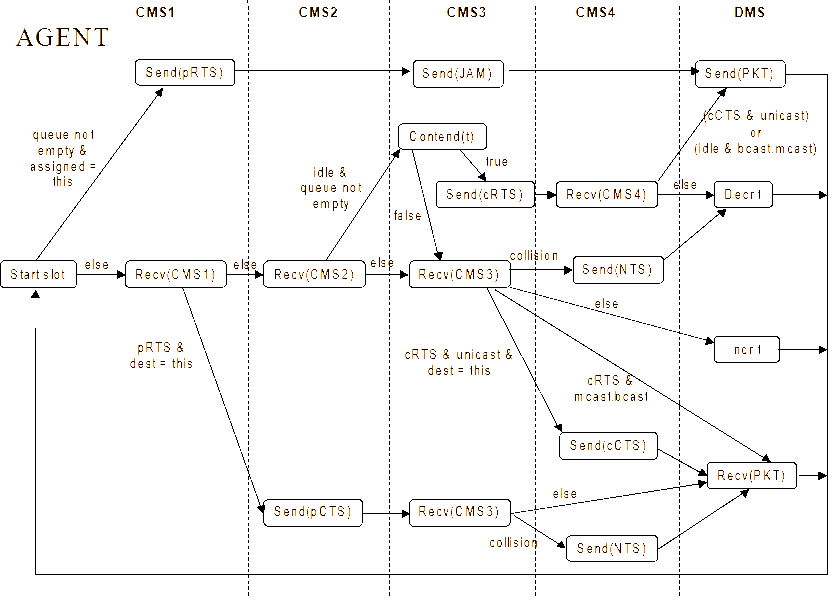
The state diagram has one substantive change from the pseudo code provided in [9] in that the sending of NCTS (NTS) in event of collision in CMS3 should occur in the main body of AGENT() as per the action in PASSIVE(). This is as per the textual description and has been confirmed via [11].
CMS1.
- ‘Owner’ nodes send an RTS if access by them is required in this frame.
CMS2.
- If RTS is successfully received in CMS1, the intended receiving nodes send a CTS. Note that in the case of broadcast/multicast this may collide. This collision is irrelevant as the transmission is intended as a ‘busy tone’ to all neighbours (potential interferers) of the intended receiving nodes.
CMS3.
- Contending nodes that heard silence in CMS1 and CMS2 send unicast or broadcast/multicast RTS.
CMS4.
- Nodes that successfully receive a unicast RTS in CMS3 send a CTS. Broadcast/multicast RTS packets are not responded to.
- Nodes that detect a collision of RTS in CMS3 transmit a NTS packet.
- Unicast contenders that hear the corresponding CTS in CMS4 can infer success and transmit data.
- Broadcast/multicast contenders that hear silence in CMS4 can infer success and transmit data.
Analysis of CATA and AGENT
The authors of [8], [9] and [10] discuss the correctness of the protocols under the assumption that all links are bi-directional and capture does not occur. The protocol analysis also implicitly assumes that there are no nodes actively seeking to disrupt the process and that the wireless topology does not change during the signalling process.
Effect of uni-directional links on protocols
While radio path loss between two sites should be the same regardless of which direction is being considered, this is insufficient to guarantee symmetry in links. Another two determinants are transmitter power, which may be not uniform across nodes, and most significantly for wide area communications, local noise. In military wide area mobile ad hoc networks nodes tend to be associated with a wide variety of military units dispersed with links of the order of tens of kilometres. Accordingly, noise at the receiver may be substantially different.
Most data communications protocols assume bi-directional links (to carry acknowledgements etc) so uni-directional links are failures as much as situations where both directions fail. More subtle impacts of uni-directional links are on signalling. Analysis of these impacts is reserved for a later paper.
Effect of topology dynamics
While the protocol papers have not defined the length of the control mini-slots as compared with the data mini-slot, the AGENT paper suggests data packets of 512 bytes and “control packets” of 32 bytes. If a channel rate of 1 Mbps was assumed then the signalling mini-slots would be complete in about 250 µs and topology dynamics are likely to be insignificant.
However this analysis needs to be revisited for military networks since:
- Link performance requirements are likely to drive the channel rate down to perhaps 512 kbps.
- A guard time is required for each mini-slot transition to allow for node to node radio transmission time. If a maximum network diameter of 300 km was planned, then each mini-slot transition would require a guard time of 1 ms.
The consequence is that signalling mini-slots may take up to 6 ms—the likelihood of topology change in this longer period and analysis of the impacts on CATA and AGENT are reserved for a later paper. Furthermore, that would make each slot 14 ms total. If there were 100 stations on the network this would define a 1.4-s frame length. For most real-time applications, packets are produced at a regular interval unrelated to the MAC frame interval. If, by chance, a packet arrived immediately prior to the allocated slot then MAC induced latency would be zero for this packet—by contrast if a packet arrived just after the allocated slot then MAC induced latency would be 1.4s. On average across the packets of many application instances latency would be 700 ms with equivalent jitter. With a de-jitter buffer in place, latency would be at least 1.4s. Such performance would make interactive services very difficult, especially if the path was multi-hop.
In the case of CATA, a node can retain a captured slot in the frame until data transfer is complete, and so sender and receiver(s) are independently holding state. The likelihood of topology change in the slot holding period and analysis of the impacts on CATA are reserved for a later paper.
Effect of capture on protocols during normal operation
CATA
CMS1—SR. Capture has no impact on operation as any activity in CMS1 suppresses a potential contender.
CMS2—RTS. An RTS is sent by on-going ‘temporary owners’ to jam any contending node RTS. When capture effect applies, this jamming may not occur. Nevertheless, to some extent the action by the ‘temporary owner’ is redundant as potentially interfering contending nodes should have heard the SR in CMS1 and suppressed contention. Of more concern is when the timeslot is free for contention:
- Capture has no impact on unicast mode RTS. If a node captures an RTS intended for itself, then data transfer could succeed in the face of contending transmissions without interference. If an RTS not intended for itself is captured suppressing one intended for it, then data transfer would not have succeeded anyway.
- The impact of capture rather than collision on an RTS in broadcast/multicast mode is problematic. The protocol requires nodes to send NTS in CMS4 in event of a collision in CMS2. In the absence of an NTS in CMS4 broadcast/multicast nodes will transmit their data believing all their neighbours will successfully receive the transmission.
CMS3—Unicast CTS. There are two potential situations:
- Beneficial—capture at a unicast contender of a CTS intended for the contender suppresses another CTS not intended for it—this would otherwise be seen as a collision and would have deterred transmission.
- Deleterious—capture at a unicast contender of another packet suppresses a CTS intended for it—the transmission is unnecessarily suppressed as it could have proceeded since the receiver successfully received the RTS. While this situation reduces network performance, such suppression of the contender would also have occurred without capture effect as a collision would have occurred.
CMS4—Multicast NTS. Capture of NTS has no impact on operation as any activity in CMS4 suppresses a potential contender.
AGENT
CMS1—Slot Owner RTS. This is only issued by the slot owner—no impact of capture effect as no chance of collision.
CMS2—CTS. Capture has no impact on operation as activity in CMS2 is intended to suppress a potential contender.
CMS3—Contention RTS. Similar effects to CATA CMS2. A JAM packet is sent by the slot owner to jam any contending node RTS. When capture effect applies, this jamming may not occur. Nevertheless, to some extent the action by the slot owner is redundant as potentially interfering contending nodes should have heard the CTS in CMS2 and suppressed contention. Of more concern is when the timeslot is free for contention:
- Capture has no impact on unicast mode RTS. If a node captures an RTS intended for itself, then data transfer could succeed in the face of contending transmissions without interference. If an RTS not intended for itself is captured suppressing one intended for it, then data transfer would not have succeeded anyway.
- The impact of capture rather than collision on an RTS in broadcast/multicast mode is problematic. The protocol requires nodes to send NTS in CMS4 in event of a collision in CMS3. In the absence of an NTS in CMS4 broadcast/multicast nodes will transmit their data believing all their neighbours will successfully receive the transmission.
CMS4—Contention CTS/NTS. With capture effect it is unlikely that an NTS will be sent. There are three potential situations in CMS4:
- Beneficial—capture at a unicast contender of a CTS intended for the contender suppresses another CTS not intended for it—this would otherwise be seen as a collision and would have deterred transmission.
- Deleterious—capture at a unicast contender of another packet suppresses a CTS intended for it—the transmission is unnecessarily suppressed as it could have proceeded since the receiver successfully received the RTS. While this situation reduces network performance, such suppression of the contender would also have occurred without capture effect as a collision would have occurred.
- Capture at a broadcast/multicast contender has no impact on operation as any activity in CMS4 suppresses a potential contender.
Possible remediation
The similarities in protocol interaction of CATA and AGENT result in the similarity in vulnerability to capture effect. While unicast linking occurs as per the protocol design, the reliability assuredness of broadcast/multicast sought via the NTS mechanism has been lost. For general communications, the maintenance of reliability can be made the responsibility of the transport layer permitting the MAC layer to remain unreliable. Protocols, such as ad hoc network connectivity advice, may need to re-consider the asserted broadcast/multicast reliability of CATA and AGENT.
AGENT has one significant advantage over CATA in that broadcast/multicast can be guaranteed in each node’s assigned time slot.
Protocol vulnerability to hostile action
The threat of some aspects of Electronic Warfare such as jamming and intercept is the same for ad hoc wireless networks as for more conventional wireless communications. The purpose of this part of the paper is to examine what additional vulnerabilities might be introduced specifically by the use of CATA or AGENT as MAC protocols. The key threat is that of denial of service.
CATA
CMS1—SR. Any transmission in CMS1 will suppress contenders.
CMS2—RTS. An adversary can reduce service available to legitimate users by capturing transmission opportunities by sending bogus RTS. Adversary transmissions might also collide with legitimate RTSs. Any collisions, or apparent collisions would ensure broadcast/multicast-suppressing NTS in CMS4.
CMS3—Unicast CTS. An adversary may be able to jam unicast CTS from successfully being received and suppress the unicast transmission. The intending unicast transmitter and receiver would be less aware of the action than overt jamming of the data transmission itself.
CMS4—Multicast NTS. Any transmission in CMS4 should suppress broadcast/multicast successful contenders.
AGENT
CMS1—Slot Owner RTS. An adversary intrusion into CMS1 would not impact the performance of the slot owner. Adversary transmissions distant from the owner will suppress contention access to the slot if the adversary RTS appeared to be genuine. Collision in CMS1 would appear suspicious, as it should never occur.
CMS2—CTS. Any transmission in CMS2 will suppress contenders.
CMS3—Contention RTS. An adversary can reduce service available to legitimate users by capturing transmission opportunities by sending bogus RTS. Adversary transmissions might also collide with legitimate RTSs. Any collisions, or apparent collisions would ensure broadcast/multicast-suppressing NTS in CMS4.
CMS4—Contention CTS/NTS. Any transmission in CMS4 should suppress broadcast/multicast successful contenders. Such transmissions could also collide with a unicast CTS.
Possible remediation
The protocol vulnerabilities allow potential exploitations that can be summarised as:
- false indication that a time slot is already committed,
- an adversary gaining control of the time slot via RTS, and
- generation of contention collisions.
In the case where an adversary would seek to participate in network signalling to disrupt the network, the intruding node would need to produce protocol packets that looked legitimate. As a counter-measure, the MAC protocol should implement mechanisms such as authentication as a barrier to masquerading. Note that this authentication would have to be a one-way mechanism, not a challenge-response form, to support multicast/broadcast. Such an authentication process might include secret spread-spectrum codes (frequency-hopping or direct-sequence). More capable authentication will provide confirmation of the node identity in addition to confidence that the transmitter is a legitimate member of the network. Care will need to be taken to ensure that adversary attempts to playback earlier traffic can be detected.
To an adversary the use of noise has the advantage that the interfering packet does not need to comply accurately with protocol format and authentication. The noise burst in a control mini-slot may be interpreted as a collision of legitimate control packets. Any anti-jamming mechanisms put in place to avoid overt jamming of the data mini-slot will aid in reducing this vulnerability. For instance if spread-spectrum (frequency-hopping or direct-sequence) was applied, the jamming signal would have to be spread at a sufficiently high power across the entire band to be considered noise. If the physical channel provides capture effect, excessive attempts by an adversary to use noise to emulate collisions can be detected.
AGENT has an advantage over CATA in that operation on the allocated time slot should be less liable to protocol exploitation. The advantage of the pre-allocated slots arrangement is that this information is shared before the network starts up and does not have to be transmitted over the network with the possibility of interference/spoofing, and so on.
Conclusions
Wireless ad hoc networks are becoming of significant interest for military mobile data networking. Appropriate MAC protocols are required for effective capacity sharing in such networks. Two attractive hybrid schemes, bringing the advantages of contention and contentionless systems were examined in detail, especially in respect of some underlying assumptions of the protocol designs. The behaviour of CATA and AGENT are quite similar and so exhibit similar potential shortcomings in respect of a failure of the underlying assumptions specifically RF capture and an active disruptive station in the network. The extent of the difficulties and potential remedial actions have been described.
Since AGENT provides for permanent allocation of capacity to each node, its behaviour is slightly more robust than that of CATA. In addition, since CATA requires some retention of state, there may be an additional weakness when used in dynamic topologies. Within a pure peer-to-peer ad hoc network, a hybrid MAC scheme offers an advance over earlier approaches. Of the two examined here in detail, AGENT would appear to be the better choice.
References
A. Tanenbaum, Computer Networks, Third Edition, : Prentice Hall International.
I. Chlamtac and , “A Spatial-reuse TDMA/FDMA for Mobile Multi-hop Radio Networks”, IEEE INFOCOM, , March 1985.
A. Ephremides and T. Truong, “Scheduling Broadcasts in Multihop Radio Networks”, IEEE Transactions on Communications, Vol. 38, No. 4, April 1990.
V. Bharghavan, A. Demers, and L. Zhang, “MACAW: A Media Access Protocol for Wireless LAN’s,” ACM SIGCOMM ’94, September 1994.
IEEE 802.11 WG, Reference number ISO/IEC 8802-11:1999(E) IEEE Std 802.11, 1999 edition International Standard [for] Information Technology-Telecommunications and Information Exchange Between Systems—Local and Metropolitan Area Networks, 1999.
IEEE 802.11 WG, Draft Supplement to International Standard [for] Information Technology-Telecommunications and Information Exchange Between Systems—LAN/MAN Specific Requirements, IEEE 802.11e/D2.0 November 2001.
J. Garcia-Luna-Aceves and C. Fullmer, “Performance of Floor Acquisition Multiple Access in Ad-Hoc Networks”, Third IEEE Symposium on Computers and Communications, ISCC '98, , July 1998.
Z. Tang and J. Garcia-Luna-Aceves, “A Protocol for Topology-Dependent Transmission Scheduling in Wireless Networks”, IEEE WCNC, September 1999.
A. Myers, G. Zaruba and V. Syrotiuk, “An Adaptive Generalized Transmission Protocol for Ad-Hoc Networks”, ACM Journal of Networks and Applications, 7-6 December 2002.
I. Chlamtac, A. Myers, V. Syrotiuk and G. Zaruba, "An Adaptive Medium Access Control (MAC) Protocol for Reliable Broadcast in Wireless Networks", IEEE International Conference on Communications, ICC, , June 2000.
Email correspondence between author and G. Zaruba on .
Acknowledgement
The author acknowledges collaboration with Dr Ian Grivell and Ms Raymee Chau in the development of the AGENT and CATA state diagrams.