
Volume 6, Number 3, November 2003
The Use of Electric and Hybrid-Electric Drives in Military Combat Vehicles
- 1 Consultant to Department of Aerospace, Power and Sensors, Cranfield University, The Royal Military College of Science, Shrivenham, Swindon, SN6 8LA, United Kingdom.
Abstract
The paper describes how electric and hybrid-electric drives are being applied to military combat vehicles and discusses the advantages (and disadvantages) of their use in both tracked and multi-wheel vehicles. Details are then given of a number of demonstration vehicles which have been developed using this technology. Vehicles employing hybrid-electric drives are seen to be of particular importance in the modern battlefield. It is concluded that electric drives will play an increasing role in future vehicles and that it will be difficult to meet some design and operational requirements without them.
Introduction
The use of electric drives in military combat vehicles is far from new—in fact, the very first tanks deployed in World War I used electric motors to drive the tracks. However, in those tanks the drives consisted of commutator-type series dc motors with resistor controllers, and the high weight and volume of these drive systems, together with their poor reliability and low efficiency led to their rapid replacement by mechanical systems. Since then, there have been periodic attempts to incorporate electric drives into military vehicles but it is only since the 1960s, with the development of high-power semiconductor switching devices, that any real progress has been made. During that time, high-energy permanent magnets based on rare-earth materials and the ubiquitous microprocessor have also been developed and these have led to new generations of brushless electric drives with sufficiently high power densities and reliability to make them directly applicable to military combat vehicles. In the last ten years, there has been considerable activity in this area both in and the and a number of interesting vehicles have been developed.
The provision of electrical power
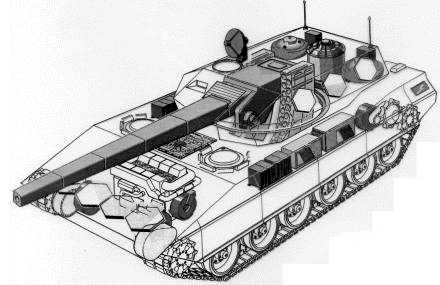
The ultimate aim is the ‘all-electric’ vehicle (AEV) in which prime power is derived from a fuel cell [1], with all vehicle systems then driven electrically. Fuel cells with an output of 1 MW (about the power required for a main battle tank) operating on hydrogen, already exist with a stack volume of around 1m3, but the provision of raw hydrogen within a military vehicle is problematic. Unfortunately, at present, the more desirable alternative of deriving the hydrogen from conventional fuels using a reformer, introduces an unacceptable additional volume penalty, and present-generation vehicles therefore all employ an engine-driven generator to provide electrical power. Such vehicles are called ‘more-electric’ vehicles (MEVs), derive prime power from a conventional engine and transfer this to the wheels or tracks via an electric transmission system. A ‘see-through’ illustration of a tracked MEV is shown in Figure 1, where not only the engine/generator unit and sprocket motors of the electric transmission system may be seen, but also the proliferation of other electrical equipment likely to be present on a modern combat vehicle. In hybrid-electric vehicles a second source of electrical energy is required and this is usually a battery bank, although other sources including flywheel generators and supercapacitors [1] are also under consideration.
Advantages of electric transmission systems in tracked and multi-wheel vehicles
The modern battlefield is heavily populated with sophisticated surveillance equipment which can detect the visual, acoustic and thermal signatures of vehicles down to very low levels. In such a situation, therefore, survival depends to a large extent on ‘seeing the enemy before they see you’. However, combat vehicles are also required to have high mobility so that they can operate in difficult terrain with a good ‘dash’ capability when they need to move quickly from one operational area to another. Since such vehicles may be required to travel long distances on highways, low fuel consumption is also an important consideration. High reliability is, of course, a fundamental requirement of all vehicles used in combat conditions. These conflicting requirements are difficult to satisfy in practice and electric transmission systems are seen by many as offering an optimal solution to the problem. Amongst the reasons for this are the following:
- Since the major components in an electric transmission system are connected by flexible cables rather than the rigid shafts of a mechanical system, they provide flexibility in the placement of the components of the drive system. The result is a smaller, lighter vehicle which presents a lower signature and has improved mobility.
- They result in lower fuel consumption since the engine is de-coupled from the wheels or tracks and can therefore always be operated on the most efficient part of the fuel map.
- In a hybrid arrangement, with a substantial battery bank connected into the driveline, they allow the use of a smaller engine since peak transmission power demands can be supplied by a combination of engine/generator and battery power. The use of a smaller engine further enhances fuel consumption and further reduces vehicle size and signature. The vehicle can also be driven ‘silently’ for short periods on batteries alone and can operate for extended periods in a ‘silent watch’ condition, both of which are particularly useful features when engaged in surveillance activities.
- They allow the use of re-generative braking which is useful both for slowing down the vehicle and also when steering tracked vehicles.
- They offer improved reliability and maintainability and, therefore, reduced through life costs.
- They can provide the increasing demand for electric power of the other systems in MEVs.
For multi-wheel vehicles, the advantages of electric drives already discussed also apply, but there are a number of additional advantages, some of which can be appreciated by reference to Figure 2, which shows alternative driveline arrangements for an 8-wheel vehicle with drive to each wheel (usually described as an 8×8 vehicle). The lower two diagrams show the arrangement of a typical mechanical driveline, in this case an ‘I-drive’, and the upper two diagrams an electrical arrangement with motors in the hubs.
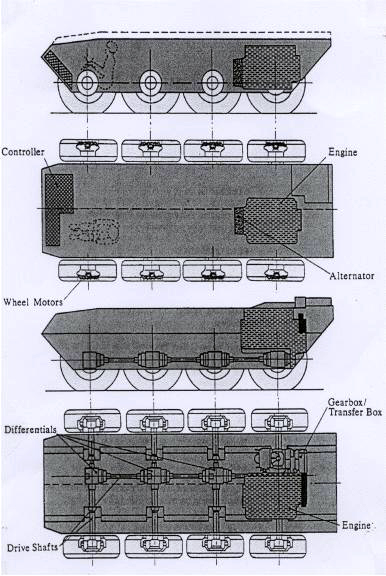
In Figure 2, the mechanical complexity and bulk of the mechanical drive, due to the multiple shafts and differentials, are immediately apparent and these have a significant effect on the overall design of the vehicle. In practice it is necessary to extend the armour shell under the vehicle and also to incorporate a floor above the driveline and these requirements tend to limit ground clearance and to increase the overall height of the vehicle, respectively. Severe constraints are also imposed on the siting of the engine/gearbox unit as this is connected to the rest of the transmission by rigid shafts.
For the electrical system shown in Figure 2, however, it may be seen that the drives to the wheels are external to the vehicle, thereby removing the constraints of the mechanical system and allowing the height of the vehicle to be reduced. Furthermore, the engine/alternator unit can be placed virtually anywhere within the body shell allowing the internal space to be utilised to the optimum. It is argued by some that the externally-mounted motors of Figure 2 are vulnerable to battle damage, operate in an extremely aggressive environment and have an adverse effect on ‘ride’, since they increase the unsprung mass of the wheel stations. These arguments are all true and mean that this arrangement may not be suitable for all types of vehicle. However, alternative drive arrangements are possible in which, for example, the motors can be mounted inside the hull adjacent to the wheel stations with drives to them via short shafts or live trailing arms and these designs retain many of the advantages of the hub-motor arrangement while avoiding most of the disadvantages.
A major advantage of the use of electric drives in a vehicle of the type shown in Figure 2 is the ability to monitor and control the speed and torque of each individual wheel continuously and very precisely. This means that advanced anti-lock braking systems (ABS) and traction control systems (TCS) can be incorporated, giving improved off-road mobility and good on-road handling at high speeds. In this context, it may be seen from Figure 2 that neither the mechanical nor the electrical arrangements include conventional (Ackermann) steering, using instead, skid-steering in which vehicle rotation is produced by differential speed variation of the wheels on opposite sides of the vehicle. Skid steering has the advantages of allowing pivot turns to be performed, particularly important in some military scenarios, avoids mechanical steering linkages and the wheel intrusions into the hull which are necessary with Ackermann steering.
Whilst skid steering has been used in wheeled vehicles with mechanical drives, such systems tend to suffer from directional instability at high speeds due to the relatively long time constants in the driveline control paths. However, electrical systems have a much more rapid response and it is possible to incorporate advanced control techniques and so eliminate the stability problems at high speeds.
Disadvantages of electrical drives
It would be unfair to consider only the advantages of electric drives in military vehicles and the following are some of the attendant disadvantages:
- The technical risk present because electric drives are so far unproven in real combat conditions.
- The high cost of some system components. This is particularly true of the drives for tracked vehicles, which are specialist components with a high rating, but less so for multi-wheel vehicles where it may soon be possible to use commercial-off-the-shelf (COTS) components.
- EMC and RFI problems associated with switching high voltages and currents in the interior of a vehicle packed with electronic equipment. This means that careful attention must be paid to filtering, screening, shielding and cable routeing.
- The high volume and weight of the power electronics due to the temperature limitations of present generation semiconductor components based on silicon. This problem will be greatly eased with the introduction of devices based on silicon carbide [2].
Demonstration vehicles with electric drive systems
Since the 1960s, a number of demonstration vehicles, both tracked and multi-wheeled, have been developed with electric drive systems which have, so far, used either permanent magnet or induction motors under flux vector control and many lessons have been learned [3]. In all cases the motors are highly rated, run at high speeds, and, in most cases, use oil cooling, as does the associated power electronics. In tracked vehicles and skid-steer multi-wheel vehicles the drives may be required to deliver up to twice rated power for short periods during aggressive manoeuvres. Much of the early work on these vehicles was done in the , starting with the application of induction motor drives to an M113 tracked armoured personnel carrier (APC) [4]. The motors used were run at speeds up to 15 000 rev/min and achieved impressive power densities, even by today’s standards. A later, hybrid-electric version of this vehicle, with a lead-acid battery bank and composite tracks has been largely responsible for the recent intense interest in the hybrid-electric arrangement. This vehicle has spawned development programmes in the for a number of vehicles both tracked and wheeled. These include 6×6 [5] and 8×8 [6] wheeled vehicles with hub motors and conventional/skid steering, a Bradley Fighting Vehicle and a High-Mobility Multipurpose Wheeled Vehicle (HMMWV). The heaviest vehicle with electric drives known to the author is a 50-tonne tracked vehicle [7], the motors for which are rated at 500 kW, but with a short-term rating of almost twice this figure.
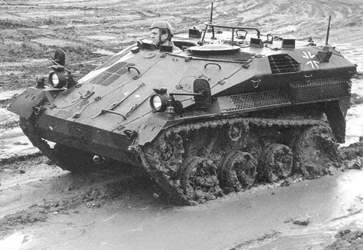
In Europe, much of the development work leading to demonstration vehicles has been carried out in Germany, where an 8×8 wheeled vehicle with hub motors has been produced as well as an electrical version of the Marder tracked APC [8]. In a recent programme on a light tracked reconnaissance vehicle (Wiesel) [9], shown in Figure 3, the tracks are driven by externally-mounted ‘sprocket’ motors in order to evaluate the ability of such an arrangement to withstand the aggressive environment in which they have to operate under battlefield conditions. This vehicle has been very successful and has brought home a further advantage of vehicles with electric drives which is that, once at their destination, they can also be used as portable power supplies. The use of such vehicles might therefore result in a reduction in the requirement for convoys of trucks towing trailer-mounted generator sets with the consequential improvements in logistics that such an arrangement could bring.
All the German projects, as well as some of those in the , use a drive system consisting of purpose-designed permanent magnet motors and generators employing multiple power-electronic converters. These drives have been developed by a specialist German company and give exceptionally high power and torque densities [10].
The hybrid-electric version of HMMWV [11], shown in Figure 4, is worthy of further discussion since it demonstrates very clearly many of the benefits of the hybrid arrangement. In its standard form, this vehicle uses a 6-litre diesel engine and an automatic transmission with drive to all four wheels. In one version of the hybrid-electric form, this engine has been replaced by a 1.9-litre, turbo-charged Volkswagen automotive engine/generator unit supplying electrical power to four brushless dc motors mounted inboard, with each motor driving a wheel through gearboxes which replace the original differentials. Supplementary electrical power is provided by a bank of advanced lead-acid batteries.
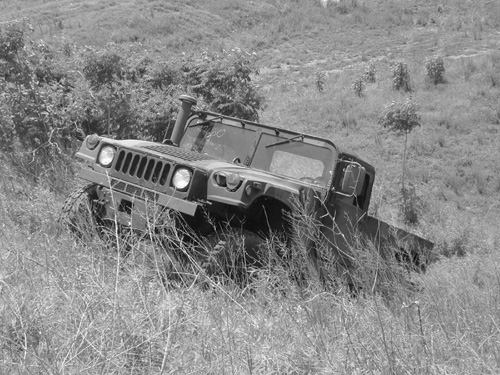
The enhanced performance obtained with the hybrid-electric system may be judged by the following test results, in which Figures in parenthesis are those for the standard vehicle:
- Acceleration: 0–80 km/h in 7s (17–20s).
- Maximum speed: 135 km/h (105 km/h).
- Fuel consumption: 6–7 km/l (3–3.5 km/l).
- Hill climbing: Climbs a 60 % slope at twice the speed of the standard vehicle.
- Emissions: Reduced from those of a truck to those of a small economy car.
- Range: 600 km in hybrid mode, 32 km in electric mode.
It is claimed that in quantity production the cost of the hybrid-electric version will be no higher than that of the standard vehicle.
The hybrid-electric version of HMMWV has been so successful that it is now the subject of intensive further development which involves, amongst other things, the use of up-rated engines and batteries, and also different drive configurations [12].
In the , a further hybrid-electric vehicle has recently been developed which presents some particularly interesting technical problems. The vehicle is a Reconnaissance, Surveillance and Targeting Vehicle (RST-V) [13], and is intended for the US Marine Corps. This 4×4 vehicle is required to be air-transportable in a V-22 helicopter, but if it is to satisfy the specified load-carrying capacity, the wheelbase becomes too wide for it to enter the aircraft. The solution to this problem is to employ a suspension system which can be folded in, while still retaining limited mobility, when loading the vehicle, and unfolded after it has been unloaded when it reaches its destination. It is difficult to conceive how such an arrangement could be implemented without the use of an electric transmission system.
In the , the main activity has been the development of hub-mounted electric drives for application to high-performance military and civilian off-road vehicles [14]. However, very recently there have been two interesting developments. The first of these is a reconnaissance vehicle called Lancer, shown in Figure 5. This 18.5-tonne hybrid-electric vehicle, which is the result of a collaborative project between the and the , uses Li-ion batteries for energy storage, high-speed induction motors for the sprocket drives and wide band tracks. The vehicle has excellent performance and mobility when operating on engine and batteries, and the use of band tracks means that, on batteries alone, it is virtually silent from around 30m. Whilst it is not intended that this should be other than a technology demonstrator, the technologies employed are directly applicable to the UK Future Rapid Effects Systems (FRES) and the US Future Combat System (FCS).
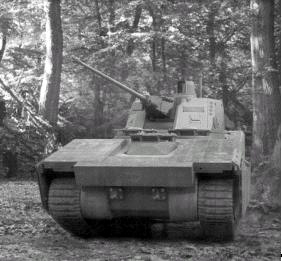
Another recent development in the is a new MoD Hybrid Electric Drive (HED) Evaluation Programme which aims to study future applications for HEDs in a wide range of vehicles including armoured, un-armoured, wheeled and tracked vehicles. It is intended to produce a number of demonstrators, the first of which will be an 18-tonne, 6-wheel vehicle expected to be running by late 2004.
Concluding remarks
The power densities of modern electric drives have reached a level where these drives are now applicable to military
combat vehicles and examples have been given of their use in a number of demonstration vehicles. It has been shown that there are many advantages (and some disadvantages) to the use of electric transmission systems, including the ability to incorporate additional energy storage in hybrid-electric arrangements. In view of the multiple modes in which hybrid-electric vehicles can operate, they can be expected to play an increasingly important role on the modern battlefield. Indeed, the demands of the modern battlefield and the design configurations of some future vehicles may be such that they preclude the use of mechanical drivelines and electric transmissions may represent the only way forward.
References
[1] R. Mallant and B. Plomb, “Fuel Cells and Supercapacitors for the AECV; R & D Activities at ECN”, Proceedings of 4th International AECV Conference, Noordwijkerhout, Nederlands, January 2002.
[2] J. Palmer, A. Agarwal, , J. Richmond, and R. Singh “An Overview of Silicon Carbide Power Device Development at CREE”, Proceedings of 4th International AECV Conference, Noordwijkerhout, Nederlands, January 2002.
[3] R. Rosenfeld, “Lessons from Electric Vehicle Technology Development”, Proceedings of 4th International AECV Conference, Noordwijkerhout, Nederlands, January, 2002.
[4] R. Hare and A. Loss, “Electric Drives for Modern Combat Vehicles”, International Defense Review, 3/1990, pp. 307-310.
[5] R. Ogorkiewicz, “Electric Drive-GDs Novel EVTB”, International Defense Review 10/1990, pp. 1161-1162.
[6] “Advanced (AHED) 8x8 Vehicle Program”, Proceedings of 4th International AECV Conference, , January 2002.
[7] R. Ogorkiewitz, “Electric Tank Treads with More Torque, Less Noise”, International Defense Review, 2/1996, pp. 49-51.
[8] R. Ogorkiewicz, “Electric Transmission Progress in ” International Defense Review, 2/1992, pp 153-154.
[9] R. Ogorkiewicz, “Electric Drives Take New Forms” International Defense Review, 1/1999, pp. 33-37.
[10] P. Ehrhart, A. Jean-Jacques and F. Deibel, “Upgraded Electric Propulsion Systems for AECV”, Proceedings of 4th International AECV Conference, Noordwijkerhout, Nederlands, January 2002.
[11] K. Winters and G. Khalil, “Testing Experiences with a Hybrid Electric HMMWV”, Proceedings of 4th International AECV Conference, Noordwijkerhout, Nederlands, January, 2002.
[12] S. Doudna and T. Shaw, “Hybrid Electric High Mobility Multipurpose Wheeled Vehicle, the Road to Production”, Proceedings of 4th International AECV Conference, Noordwijkerhout, Nederlands, January 2002.
[13] “Application of Advanced Systems in The Marine Corps Reconnaissance, Surveillance and Targeting Vehicle”, Proceedings of 4th International AECV Conference, Noordwijkerhout, Nederlands, January 2002.