
Volume 6, Number 3, November 2003
The Effect of Ceramic Type on the Performance of Ceramic-Faced Metallic Armour
- 1 Cranfield University, Royal Military College of Science, Shrivenham, Swindon, Wiltshire, SN6 8LA, United Kingdom.
Abstract
Depth-of-penetration tests are used to compare a number of different ceramic types when impacted by tungsten and tungsten-carbide-cored ammunition. These results are then compared to ballistic limit test results on commercial armour systems incorporating the same set of ceramic materials and using high-hardness steel or aramid composite backings. The depth of penetration test are shown to broadly predict the performance of the ceramics when subsequently used in practical armour systems although penetrator erosion is also shown to be a significant factor which needs to be taken into account.
Introduction
There is an increasing demand for armour on previously un-armoured vehicles and increased armour protection on light armoured vehicles. Most in-service light armoured vehicles use rolled homogeneous steel armour, high-hardness steel or aluminium alloys to protect against artillery fragments and soft-cored ammunition from light weapons. More recent requirements often include protection against hard-cored projectiles and larger-calibre weapons
Increasing the protection level of such systems can follow a number of approaches; typically these are appliqué armour packs of steel, ceramic-faced composite, or complex armour. These may be used in combination with spall liners within the vehicle. Appliqué systems can be stand-alone armour systems or they can rely upon the base armour as an integral part of the protection solution.
A number of studies have shown that ballistic performance of ceramic-faced armour scales to some extent with hardness of the ceramic. It has also been shown that the ceramic must have a hardness that is significantly greater than that of the projectile [1]. For steel-based projectiles, which are common in light armour-piercing ammunition, alumina-faced armour has sufficient hardness to achieve adequate performance. However tungsten-carbide-cored ammunition has a hardness level equal to or greater than some alumina compositions [2]. Therefore, where such hard-cored projectiles are a threat there is a need to choose the correct ceramic material.
This paper describes the characteristics of an integrated armour system consisting of ceramic tiles bonded to a high-hardness steel armour. The selection process for ceramic type is described and the system is compared to similar composite-backed systems.
Ceramic type
Three ceramic materials were tested: a 95% alumina, a 98% alumina and a reaction-sintered silicon carbide. The basic properties are given in Table 1. It should be noted that a proprietary reaction-sintering route was used to produce the silicon carbide. This represents a simpler and potentially cheaper production method than conventional hot-pressed silicon carbide, but produces a slightly lower strength and hardness.
Ballistic tests
The depth-of-penetration (DoP) technique as described by [3] was used to measure the performance of the armour materials. In this method a test projectile is fired into a block of metal of density ρB and the depth of penetration PB is recorded. A ceramic tile of thickness tC and density ρC is then placed against a similar block and the residual depth of penetration PR of a similar projectile is recorded. From these measurements it is possible to derive a number of indices of ceramic performance. In this work the following indices have been used: the mass efficiency factor (MEF), and the calculated critical ceramic tile thickness (tcrit) to just defeat the projectile.
(1)
(2)
The backing block was an aluminium 7039 alloy having a hardness of HV 120. The ballistic tests used two types of ammunition: 7.62×51mm AP FFV and 0.50” Saboted Light Armour Piercing (SLAP). Salient details of these rounds are given in Table 2.
| Property/ Type | FFV 7.62×51 AP | 0.50” SLAP |
|---|---|---|
| Manufacturer | FFV-Bofors | Olin-Winchester |
| Projectile mass (g) | 8.4 | 26.9 |
| Core mass (g) | 5.91 | 23.0 |
| Core length (mm) | 20.15 | 37.5 |
| Core diameter (mm) | 5.59 | 7.7 |
| Core material | W-11Co-5C-0.5Fe | W-8.5Ni-3.5Fe |
| Core hardness (HV30) | 1250 | 505 |
| Core density (g/cc) | 13.4 | 17.7 |
| Muzzle velocity (m/s) | 947 | 1179 |
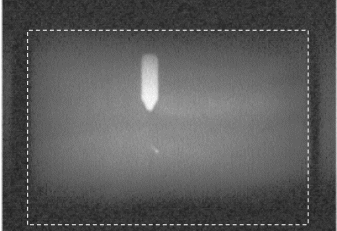
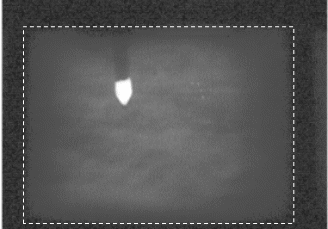
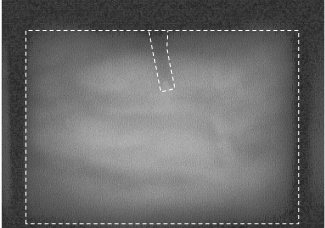
Backing blocks were examined by X-radiography from which depth-of-penetration was measured and projectile damage was assessed. Radiographs of backing blocks for FFV tests on each of the three ceramic types are shown in Figures 1, 2 and 3. The results of the DoP tests are summarized in Table 3. All data is the average of three tests.
| Target | Depth of penetration (mm) | MEF | Tcrit (mm) |
|---|---|---|---|
| 7.62×51 FFV | |||
| Backing block | 40 | ||
| 95% Alumina | 25 | 1.3 | 13 |
| 98% Alumina | 23 | 1.3 | 12 |
| Silicon carbide | 11.5 | 2.3 | 7 |
| 50 SLAP | |||
| Backing block | 86 | ||
| 95% Alumina | 68 | 1.10 | 45 |
| 98% Alumina | 44 | 1.56 | 16.5 |
| Silicon carbide | 43 | 1.67 | 16.8 |
There is relatively little difference in performance between the two alumina grades against the FFV round, whilst the silicon carbide performs somewhat better. The 95% alumina caused only minor damage to the tip of the core whilst the 98% alumina induced fracture of the core such that only about one third of the penetrator remained. The silicon-carbide armour completely shattered the projectile so that no substantial portions were visible in the backing block.
Against the SLAP round the 95% alumina performed relatively poorly whilst the 98% alumina and silicon carbide are equally better. All the ceramic types extensively deformed the penetrators. The diameter of the hole in the block was greatest in tests on silicon carbide, but less so for tests on 98% alumina and lesser still for the 95% alumina. Although the degree of deformation was not significantly different it appeared to take place earlier in the penetration event as the ceramic hardness increased.
Ballistic system tests
For comparison purposes tests were performed on commercial armour systems in which the same set of ceramic materials were used. The first set of systems, ARMOURMAX™ is a commercial armour system utilising ceramic tiles in a composite/elastomeric sandwich element bonded to steel backing. The thickness of the ceramic and steel were varied according to the threat. In this case the rear layer was a Compass B555 high-hardness steel (HHS), which has a hardness of HV 464. This is representative of an armour system in which the ceramic layers are directly bonded to an existing metallic armoured vehicle hull so that the rear face of the armour is part of the vehicles load-bearing structure. Results of tests against ARMOURMAX™ are summarised in Table 4. As ARMOURMAX™ is designed as a system for upgrading high-hardness steel the mass effectiveness data has been calculated both against (RHA)[4] as is common practice, and also against B555 high-hardness steel armour [5].
A further set of trials used ARMOURTEK™, a commercial system using a polymer composite backing. This is representative of an appliqué system which would be added as a removable panels to an existing armoured or soft-skinned vehicle. Such armour can be optimised for maximum ballistic efficiency but serves no structural function. Ballistic performance data for ARMOURTEK™ is given in Table 5.
Discussion
From the DoP tests it can be seen that the relative performance of the ceramic types is as might be expected 95% alumina then 98% alumina with silicon carbide better still. The lower-grade alumina performs relatively poorly as its hardness is of the same order as that of the FFV penetrator. Figure 4 shows a plot first proposed by Orgorkiewicz [2] and extended with data in the present work.
![Areal density of armour as a function of ceramic facing hardness for 7.62 ball, steel-cored AP and FFV projectiles (after Ogorkiewicz [2]).](/journals/journal-of-battlefield-technology/volume-06/issue-03/assets/6-3-1-horsfall/figures/figure04.gif)
The data point for 95% alumina with FFV at muzzle velocity has been extrapolated from ballistic limit velocities at 4-mm and 6-mm ceramic thickness. Hard-core projectiles such as the FFV are shown to require harder ceramic layers to give good protection. Providing that the ceramic is significantly harder than the projectile then efficient protection is achieved, but further increases in armour hardness offer little advantage.
The ranking of DoP results is reflected in the trials on ARMOURMAX™ armour. However the relative performance of the ceramic types is not well predicted. The DoP results show that for the FFV threat similar performance is obtained from the two alumina grades with the silicon carbide having being almost twice as good in terms of DEF or critical tile thickness. However the results for the ARMOURMAX™ system show the higher-purity alumina to be comparable to the silicon carbide, a result only shown with the SLAP threat in DoP tests.
Although the DoP of the FFV round was similar for the 95% and 98% alumina ceramic the degree of projectile damage was markedly different. The 98% alumina resulted in substantial damage to the penetrator that was not observed for impact on the 95% alumina.
It may be that the DoP into the relatively soft backing block is less sensitive to the residual projectile mass than the high-hardness steel. The steel backing used in ARMOURMAX™ may be more effective at preventing penetration of the relatively badly eroded projectile so that the 98% alumina performs better.
The critical tile thickness required to just stop the penetrator has been used as one performance measure. The calculated tcrit for the FFV penetrator was 7 mm of the silicon carbide. When an 8-mm tile was tested penetration averaged just 0.5 mm in four tests and was in practice due to tile fragments being pressed into the backing block. The tcrit measure appears to be indicative of the thickness required in an armour system. Although its quantitative use is probably limited, it is a relatively intuitive measure which can be more readily appreciated than some of the common ballistic efficiency factors.
The alternative to a direct-bonded ceramic on steel armour system is to use a separate composite appliqué system. Such an armour has optimum ballistic efficiency but serves no structural function. Table 5 shows comparable data for ARMOURTEK™, an Aramid composite-backed ceramic armour. Data is shown for an optimised system with the same ceramic tiles as ARMOURMAX™ (8-mm thickness) on a 6.5-mm Kevlar backing, the total areal density of the system is 39.5 kgm-2.
It can be seen that for a given threat the areal density required in a composite-backed ceramic system such as ARMOURTEK™ is about 50% of that for steel-backed armour such as ARMOURMAX™. Therefore the composite-backed system appears to offer a more efficient solution. However this ignores the parasitic mass of both the armour-support structure and the vehicle structure which performs no ballistic function.
The advantage of a system such as ARMOURMAX™ is that the armour backing performs both a structural and ballistic function. Traditional vehicle designs codes can be used and the technological risk is therefore limited. An additional advantage of a steel-backed system is that it can be produced using an existing vehicle armour to which only the ceramic layer need be applied. It therefore offers a weight- and cost-efficient solution to up-armouring existing light armoured vehicles.
Conclusions
Depth of penetration tests have been used to predict the performance ranking of silicon carbide and two grades of alumina ceramic armour. The ranking of these materials is shown by the DoP test, however more detailed information including the degree of projectile erosion is required to produce a true reflection of the target/projectile interaction. The results of DoP tests using semi-infinite backing blocks can be used to predict the relative performance of such ceramic materials when used in commercial armour systems such as ARMOURMAX™ which have relatively thin backings.
An armour system consisting of ceramic tiles bonded to a high-hardness steel backing has been demonstrated to offer significant weight saving over a steel armour. Such a system is shown to be less weight-efficient than a composite-backed system but offers significantly lower technological risk in new or improved armoured vehicles.
References
[1] C. Anderson, V. Hohler, A. Stilp, and J. Walker, “The Influence of Projectile Hardness on Ballistic Limit Velocities”, Proceedings of the 16th International Symposium on Ballistics, San Francisco, pp. 279-288, 1996.
[2] R. Ogorkiewicz, “Ceramics Enhance Armour Survivability”, International Defense Review, Vol. 9, 1996.
[3] C. Anderson and B. Morris, “The Ballistic Performance of Confined Al2O3 Ceramic Tiles”, International Journal of Impact Engineering, Vol. 12, No. 2, pp. 167-187, 1992.
[4] From specification Mil-A-12560H(MR).
[5] From specification Mil-A-46100C.