
Volume 6, Number 2, July 2003
Centralisation and Decentralisation in Network Centric Warfare
- 1 Defence Science and Technology Organisation (DSTO) Fern Hill, Department of Defence, Canberra ACT 2600, Australia.
Abstract
In this paper, we examine the spectrum of choices between organisational centralisation and decentralisation in the presence of emerging trends in communications, information-processing, and sensor technologies. These technologies are important drivers in the current move towards Network Centric Warfare (NCW), and raise the question: should the new networks being developed be used to enable greater centralisation, or greater decentralisation? We reduce the choice to six basic questions (covering issues such as facilities, information availability, communications, and time constraints), and examine how the answers to these questions are impacted by technological change. Our analysis suggests that most new technologies can support both centralisation and decentralisation. As a result, over coming decades, the choice will be increasingly determined by a purely theoretical question, namely the possibility of a “global optimum”. This in turn is based on characteristics of the air, maritime, and land environments, with a global optimum more likely in the air and maritime environments, and less likely in the land environment.
Introduction
Within the military sphere, as in business, a consensus has developed over many decades regarding the relative benefits of centralisation and decentralisation [1]. Some decisions have proven best handled by a senior general in a central headquarters. These decisions are typically those where a global optimum is required, that is a “best possible” solution based on the entire “big picture.” Making high-level centralised decisions is usually called “planning.” Other decisions have proven best handled by tactical warfighters: pilots, soldiers, and naval personnel. These have generally been short-term urgent decisions. Yet other decisions are handled somewhere in between these extremes. However, this consensus must be re-evaluated in the light of the emerging trend towards network centric warfare (NCW).
NCW is the military equivalent of e-business. It involves taking advantage of a network linking information sources (sensors), information users (shooters), and information transformers/planners (command-and-control nodes). In the words of Alberts et al [2]:
“We define NCW as an information superiority-enabled concept of operations that generates increased combat power by networking sensors, decision makers, and shooters to achieve shared awareness, increased speed of command, higher tempo of operations, greater lethality, increased survivability, and a degree of self-synchronization. In essence, NCW translates information superiority into combat power by effectively linking knowledgeable entities in the battlespace.”
| I | Where are the facilities for decision making located? |
|---|---|
| II | Is a global optimum necessary? |
| III | Is a global optimum possible? |
| IV | Where is the necessary information for decision making available? |
| V | Within what timeframe must decisions being made? |
| VI | What communications infrastructure is available? |
Six key questions
In order to select a balance between centralised and decentralised decision making for a particular task in an NCW environment, we pose six key questions (Table 1). These questions cover the practical and theoretical reasons for making centralised or decentralised decisions, and the constraints on communicating those decisions to the tactical units executing them.
We now consider these (inter-related) questions in detail.
(I) where are the facilities for decision making?
A central headquarters is often well-equipped with facilities for decision making. Located in a relatively safe rear position, staff are free from the distractions of ordnance flying past their heads. Increased space allows more staff to deal with complex decisions, and allows better information management, with maps on walls, TV screens, and computers readily available.
As an example, an AWACS (Airborne Warning and Control System) aircraft is currently the best place to make decisions about overall deployment of a team of fighter aircraft (Figure 1). Flying to the rear of the main battle, and protected by a fighter escort, the AWACS staff are free from the tactical distractions suffered by fighter pilots. An AWACS aircraft such as the Boeing E-3C has room for 17 surveillance and control staff, and a large number of computer displays. In contrast, an individual fighter pilot does not have the time or the facilities to deal with the “big picture” of air combat (there are additional reasons for using AWACS aircraft, and we touch on these later in relation to questions II to VI).
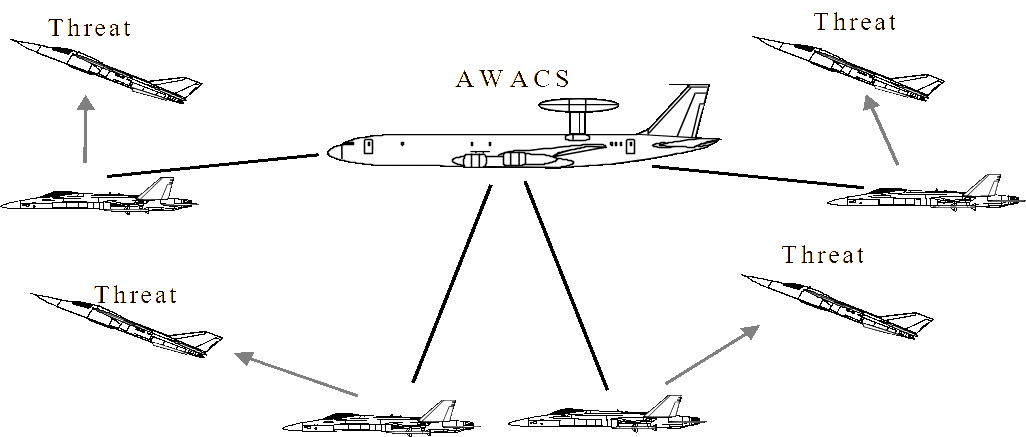
However, computer technology is slowly changing this situation. Computers deployed in tactical units can manage large amounts of information. In the future, intelligent software will automate many headquarters functions traditionally performed by human personnel, such as updating information on maps, handling messages, checking availability of resources, and so on. This will permit more decentralised decision making, since the smaller the number of staff required, the closer to the tactical level we can move decisions.
Using computers to improve the management of information at the tactical level is partly dependent on improved user interfaces. Staff at the tactical level often have both their hands and their eyes occupied with critical activities. This means that improvements in voice recognition, speech synthesis, and natural language processing may be necessary for the effective use of computers at the tactical level. On the other hand, requiring people to process both visual and audio information may risk information overload, unless computers become more effective at automatically prioritising information.
The availability of well-trained staff able to make decisions in centralised or decentralised locations is also an important factor. For this reason, special-forces personnel, who are required to make important decentralised decisions, receive extremely high levels of training [8].
(Ii) is a global optimum necessary?
Some problems can be solved by allowing multiple tactical units to individually optimise their “piece of the puzzle”. Other problems require a centralised decision that takes into account the entire “big picture”. Experience with computer algorithms for difficult problems [6] indicates that solutions calculated in a distributed fashion, such as by genetic algorithms or neural networks, can be quite good, but not as good as a centrally calculated global optimum. For example, air defence of a naval task group requires the best possible assignment of threats to weapons systems, and this must take into account the “big picture” of all target priorities and all weapons systems capabilities. Failure to do so may result in serious loss of life. Similarly, centralised control of air engagements with an AWACS aircraft offers significantly better performance than individual action, and an AWACS aircraft is recognised as a “force multiplier” for this reason.
However, it should be emphasised that to speak about a global optimum implies the existence of a clearly formulated problem, with extensive and accurate information about the elements of the problem. This can sometimes be achieved in the air and maritime environments, but is more difficult in the chaotic land environment. As Moltke once wrote [17]:
“In war with its enormous friction, even the mediocre is quite an achievement.”
The ability of platforms to continue functioning in the air and maritime environments is also largely determined by the laws of physics. In contrast, the ability of an army unit to continue functioning is much more heavily influenced by moral factors, which are more difficult to measure [17].
(Iii) is a global optimum possible?
Notwithstanding the desirability of a global optimum in many cases, it may not always be possible. In some cases, a centralised decision is no better than the local optimum obtained by decentralised decision making. In other cases, the problem is too complex for a global optimum to be calculated.
To illustrate this, consider a collection of targets where the global optimum requires selecting and prioritising the top ten threats, and the degree of threat depends on synergistic effects, such as multiple threats to the same friendly platform. In this case, the global optimum requires evaluation of each combination of possible targets to engage. If each possible combination takes one nanosecond to evaluate (a blindingly fast speed), the total decision times will be as per Table 2.
| Number of Targets | Decision Time |
|---|---|
| 1 | 1 nanosecond |
| 2 | 2 nanoseconds |
| 5 | 0.1 microseconds |
| 10 | 4 milliseconds |
| 20 | 11 minutes |
| 50 | 14 months |
| 100 | 2 000 years |
The exponential growth illustrated in Table 2 indicates that, even with much faster computers or more sophisticated search strategies, a global optimum will always be impossible for more than 100 or so targets. The land environment, with many targets, will therefore always require a substantial amount of decentralised decision making about which targets to engage. The clutter of obstacles and terrain in the land environment further restricts the possibility of a global optimum, and reinforces the need for decentralised decision making.
(Iv) where is the necessary information available?
In many situations, the best place to make a rapid high-quality decision is the place where sensor information is collected. For example, an AWACS aircraft has a powerful radar on the same platform as the command-and-control staff, and bandwidth constraints would make it difficult to transfer the detailed real-time radar data to any other location. Consequently, decisions are best made on the AWACS aircraft.
In a strict hierarchy, where information is passed “up the chain”, the first place that a fully integrated situation awareness picture appears is the central headquarters, and this supports centralised decision making. However, a networked (peer-to-peer) organisational architecture makes it possible to build an integrated situation awareness picture in each tactical unit before the central headquarters has the information, and this supports decentralised decision making. This is because it is usually preferable to make a decision in the place where the integrated situation awareness picture first appears.
In other cases, information is only available at the tactical level, and decentralised decision making is the only option. Units operating under radio silence, and special forces [8] deployed in hostile territory are two examples.
Information about staff morale is one category of information that is available at the tactical level, but is difficult to pass on to a central headquarters. Morale and other human issues can often not be understood unless the commander “looks in the eyes” of his troops, and for this reason the best commanders have made great efforts to gain such information at first hand. General Fred Franks, the highly successful US VII Corps commander in the Gulf War, puts it this way [5]:
“The main thing was that I wanted to get my subordinate commanders’ sense of what was happening, and then give them my own sense and tell them what I wanted them to do in the next twelve to twenty-four hours. When I was there with them, I could look them in the eye and see if they understood what I wanted. That way, there could be no ambiguity in orders… By being up front, you gain immediacy. But you also gain something else: Soldiers are getting hurt, wounded, killed in action. Commanders shouldn’t be staying in their command post. They should be out and around the soldiers, where they can be feeling the pain and the pride, and where they can understand the whole human dimension of the battle. That way of operating has practical, tactical consequences. It will better inform commanders’ intuition about what to do; it will suggest alternate courses of action that will accomplish their mission at least cost of their troops.”
In contrast, Adolf Hitler in his bunker at Vinnitsa, guided mostly by his memories of World War I trench warfare, was completely unable to make appropriate decisions about the conduct of his Russian campaign, approximately 1 000 km away. In the words of historian John Keegan [9]:
“Radio did not bring to the Führer’s headquarters all the other information of an immaterial but much more important kind—the look of the battlefield, the degree of heat and cold, the variation in intensity of enemy pressure, the level of noise, the flow of wounded backward, the flow of supply forward, the mood of the soldiers, to be judged by the expression of their faces and the tone of their answers to questions—which only a man on the spot would gather.”
The improvement of communications technology permits some of this information to reach a central location, and one-on-one videoconferencing with the troops may substitute for the physical presence of the commander, but even with these tools it is difficult for a commander in the rear to get a true feel for what is happening at the front.
Another historical example is German air defence in World War II after Allied radar countermeasures became effective [12]. Where information on the target of Allied bombings was available, a centralised form of ground control codenamed Wilde Sau was moderately effective, even when using single-seat fighters, since they could engage visually over the target, aided by searchlights. In the absence of such information, a decentralised strategy called Zahme Sau was more effective. This combined loose ground control with two-seat fighters visually searching the night sky, and calling in reinforcements when Allied bombers were found. In both cases, decisions were best made at the location where information was available.
(V) time constraints
In some circumstances, centralised decisions are ruled out by time constraints. The time taken to pass a centralised decision to the tactical units that will carry it out can sometimes be prohibitive. This time delay is often due to a combination of bandwidth limitations (discussed in the next question) and human processes for verifying, collating, and otherwise manipulating information. Because it reduces such delays, decentralisation is often appropriate for rapidly-changing situations. For example, when Heinz Guderian introduced the military doctrine later known as Blitzkrieg (for its fast-moving combination of motorised ground forces and Stuka strike aircraft), he was forced to combine this with Auftragstaktik (directive control), a policy of designating an objective and point of main effort [7,10,11], while decentralising other decisions. Directive control, or mission-oriented command, has become an important aspect of doctrine for many military forces.
In contrast, the serious casualties suffered by US forces in Mogadishu on 3 October 1993 [13] were partly due to centralised decisions on the route the US convoy should take through the city. These decisions were made on the basis of high-quality overhead imagery, but the time delay in communicating instructions led to disaster.
In general, the time constraint is derived from the sensor range divided by speed of target engagement—that is, the time between seeing a target and being killed by it. This time constraint is therefore likely to be most stringent in environments with poor visibility: forested, mountainous, and urban terrain. These environments are therefore likely to require a substantial degree of decentralisation.
(Vi) communications infrastructure
We have already mentioned communications infrastructure in relation to previous questions. Communications infrastructure affects the availability of information in centralised or decentralised locations (question IV). It also affects the distribution of decisions to the tactical units which will execute them. Orders are generally more compact than the information on which they are based [15], and so generally require less bandwidth. However, when communications links are absent or unusable (for example, with operations under radio silence), decentralisation is necessary. For much of history, naval forces have operated in a highly decentralised fashion for this reason, with each captain having considerable autonomy.
Where communication permits, a greater degree of control can be vested in a fleet or carrier group commander. However, without appropriate communications, centralised control of a fleet is impossible. This was demonstrated by Admiral Isoroku Yamamoto at the battle of Midway, where centralised control of the 88-vessel Japanese fleet proved ineffective, due to a combination of geographical separation and an attempt to maintain radio silence [14].
Improved communications technology can eliminate decentralisation where this has been forced by the inability to disseminate orders in time. However, by making information available in a wide variety of locations (question IV), improving communications infrastructure can support both centralisation and decentralisation.
A simulation experiment
We investigated some of these issues in a simulation experiment (partially based on the SCUDHunt game of [4]). The experiment involved a 4×4 grid containing four randomly located missile launchers (see Figure 2).
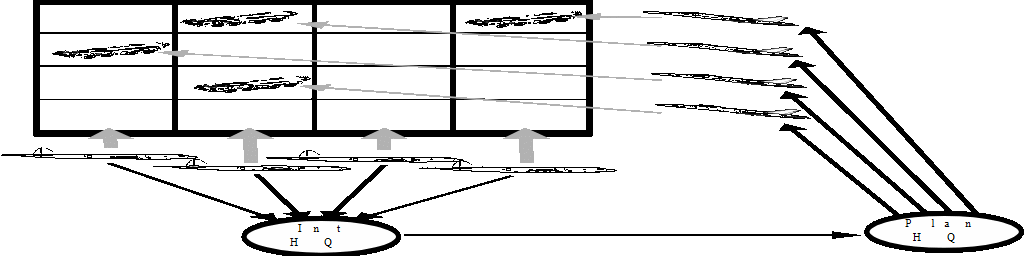
Four surveillance aircraft fly along the columns of the grid, in an attempt to locate the missile launchers. When the missile launchers are located, four strike aircraft are dispatched to destroy them (each strike aircraft can destroy only one launcher).
The experiment varied sensor quality (so that the surveillance aircraft may provide more or less accurate information), and tempo (so that the launchers may avoid strike by moving either rapidly or slowly to safe locations after detection). The experiment is described in more detail in [3].
A variety of organisational architectures were examined. In the centralised architecture (Figure 2), information from the surveillance aircraft was integrated in an intelligence headquarters, and then passed to a planning headquarters which assigned the strike aircraft to targets. This was contrasted with several variations of decentralised architectures, where four independent headquarters each “owned” a column, with control of one surveillance aircraft and one strike aircraft dedicated to that column.
Limited communication was possible between the independent headquarters (Figure 3). The performance of each architecture was examined under varying combinations of sensor quality (ranging from poor to good) and tempo (ranging from fast to slow).
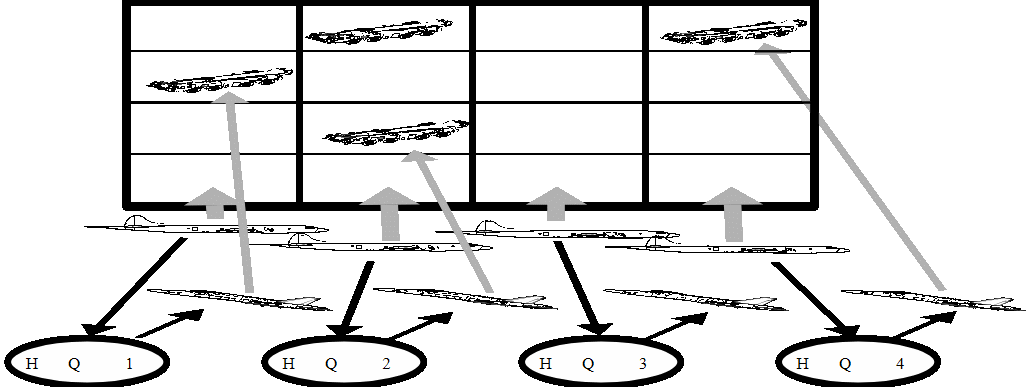
The decentralised architectures were assumed to respond more quickly. However, where multiple targets occurred in the same column, the decentralised architectures left some strike aircraft unused, and hence some targets untouched. In other words, the global optimum of using all four strike aircraft effectively was only obtained with the centralised architecture.
This experiment was thus designed so that a global optimum was necessary (question II). However, where sensor quality was poor, a global optimum was not possible (question III), because centralised and decentralised decisions were of equally poor quality, and therefore decentralisation was preferable because of its speed advantage. When tempo was high, time constraints did not permit centralised decision making at all (question V).
The experimental data confirmed this analysis (see Table 3, or for a more detailed discussion, see [3]). The centralised architecture out-performed the distributed architectures only when tempo was slow, and sensor quality was fair to good.
| Sensor Quality | ||||
|---|---|---|---|---|
| Poor | Fair | Good | ||
| Slow | Centralised Arch. Best | |||
| Tempo | Moderate | Decentralised Architectures Best | ||
| Fast |
The impact of technological change
If we consider the impact of new technology in the light of our six key questions, some interesting patterns emerge. Table 4 shows how improvements in communications, information-processing, and sensor technology can either support centralisation (C), or decentralisation (D), or both. The numbers 1 to 5 in the table refer to the points below.
| Question | Comms | IT | Sensors |
|---|---|---|---|
| I Facilities? | D (1) | ||
| II Global Optimum Necessary? | |||
| III Global Optimum Possible? | C (2) | ||
| IV Information Availability? | C, D (3) | C, D (4) | |
| V Time Constraints? | C (5) | C (2) | |
| VI Comms Infrastructure? | C (5) |
1. As indicated in our discussion of question I above, intelligent software can automate many decisions, as well as improving information management, and this supports decentralised decision making. Better cockpit avionics, laptop computers in tanks, and fully automated precision guided weapons or unmanned combat air vehicles (UCAVs) are possible examples.
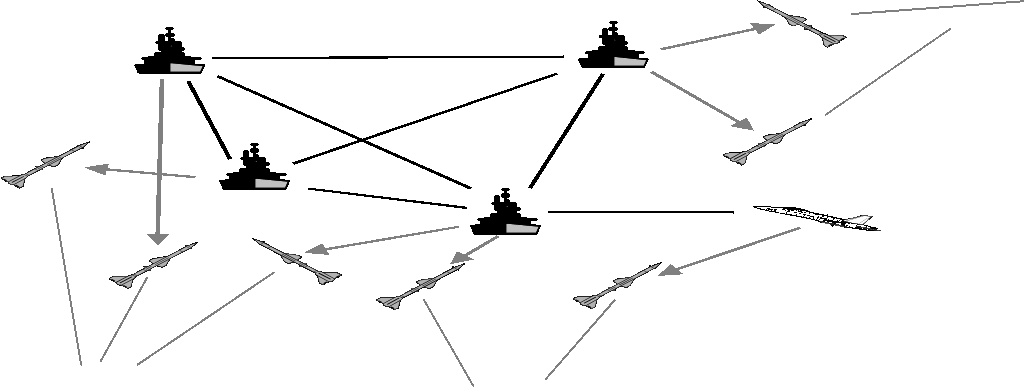
2. Improvements in hardware speed and software intelligence can rapidly find global optima for more difficult problems. For example, improved computer technology will eventually make it possible to “fight” a fleet as a unit in the way that a Combat Information Centre (CIC) currently “fights” an individual ship. In the ultimate development of what is known as cooperative engagement [18], targets can be prioritised and assigned to the weapons systems best capable of destroying them, in a way that globally optimises fleet protection (see Figure 4). This may mean that two ships each engage missiles aimed at the other, because the character of their weapons systems makes that the optimal choice.
3. Improved communications technology can make information available in both central and decentralised locations. Technology such as global broadcast satellite systems can pass centrally collected information (such as imagery) to tactical units, supporting decentralisation. On the other hand, videoconferencing may allow the National Command Authority or senior generals to talk directly to tactical personnel, even going so far as to personally authorise a private or corporal to fire the first bullet in politically charged circumstances.
4. Similarly, improved sensor technologies can make information available in a way that supports either centralisation or decentralisation. This includes sensors themselves, such as improved infrared devices; sensor platforms, such as uninhabited aerial vehicles (UAVs); and sensor data analysis, such as multi-spectral image processing.
5. Improved communications technology facilitates fast transfer of centrally produced orders to tactical units, and allows execution to be monitored using such tools as videoconferencing and handheld digital cameras. This can make centralisation possible where time constraints (question V) or the absence of communications links (question VI) have previously ruled it out.
Notice that all these technologies can support both centralisation and decentralisation, and that question II (regarding the necessity of a global optimum) is the only question not impacted by technological change. This is because question II is essentially theoretical in nature.
As technology improves, we would expect the technology-related constraints to become less binding, while the theoretical constraints remain equally important. This means that over several decades, as technology improves, the theoretical constraints will increasingly dominate the issue of centralisation and decentralisation. These theoretical constraints are question II (regarding the necessity of a global optimum) and the theoretical component of question III (regarding the possibility of a global optimum), and these depend on the nature of the tactical situation.
In the air and maritime environments (in contrast to land), global optima are often feasible and necessary for survival. More complete information is available, especially with improved sensors, there are generally fewer targets (less than 100 or so), and there is no terrain for targets to hide behind. Consequently, improvements to technology will increasingly drive a tendency toward centralisation in these environments.
On the other hand, global optima are not feasible in the land environment. To quote Storr [15]:
“Conceptually, the number of possible outcomes resulting from enemy contact is huge, and probably beyond our capacity to comprehend. Every single interaction—of infantryman, tank and gun—could have several results. The possible permutations of all such interactions are innumerable.”
Forested, mountainous, or urban terrain restricts the ability of sensors to acquire information [16], and creates tactical situations where rapid response is necessary, even if the response is not perfect [15]. Together with the infeasibility of global optima, this suggests that a high degree of decentralisation (that is, directive control, or mission-oriented command) will continue to be appropriate for the land environment, in spite of technological change.
Conclusions
We have posed six key questions (Table 1) for selecting a balance between centralised and decentralised decision making, and discussed several examples where one or the other is preferable. We have also looked at the impact of advances in communications, information-processing, and sensor technologies, and showed that these can support both centralisation and decentralisation, depending on the circumstances.
However, as technology improves, we can expect that the choice will be increasingly dominated by our question II (necessity of a global optimum) and by the theoretical component of question III (possibility of a global optimum). For optimal engagement of less than 100 or so targets in the relatively uncluttered air and maritime environments, centralisation will increasingly give the “knowledge edge,” and improvements in technology will increasingly facilitate centralisation. This trend includes improvements in air battlespace management, and cooperative engagement of threats in the maritime environment.
On the other hand, in the more complex and cluttered land environment, where global optima are not (and never will be) possible, technological change will support better and faster decentralised decisions. The degree of decentralisation will depend on the details of terrain, with flat open desert terrain permitting some centralisation, and forested, mountainous, or urban terrain forcing more decentralisation. Equipped with improved sensors, laptop and palmtop computers, and sophisticated software, future ground troops will engage in a dramatic improvement on Blitzkrieg. Fast, high-quality decentralised decisions will give a speed advantage over opposing forces, defeating them before they are able to plan a response.
As improvements in technology gradually eliminate technological constraints, the choice between centralisation and decentralisation will therefore eventually be determined by the nature of tactical problems in the air, maritime, and land environments themselves.
Acknowledgements
The author is indebted to Ed Kruzins and Elizabeth Newton Smith for discussions on NCW; to Julia Loughran and Marcy Stahl for discussions on SCUDHunt; and to Carlo Kopp for bringing Wilde Sau / Zahme Sau to the author’s attention. Carlo Kopp, Clive Walmsley, Bernard Colbert, Martine Dekker, Jon Bell, John O’Neill, Bill Blair, the Editor-in-Chief, and an anonymous referee also provided helpful comments on the paper.
References
[1] C. Handy, Understanding Organizations, Penguin, 1993.
[2] D. Alberts, J. Garstka and F. Stein, Network Centric Warfare: Developing and Leveraging Information Superiority, (US) Department of Defense C4ISR Cooperative Research Program Publications Series, 1999. Available online at http://www. dodccrp.org/Publications/pdf/ncw_2nd.pdf.
[3] A. Dekker, C4ISR Architectures, Social Network Analysis and the FINC Methodology: An Experiment in Military Organisational Structure, DSTO Report DSTO-GD-0313, January 2002. Available online at http://www.dsto.defence.gov.au/ corporate/reports/DSTO-GD-0313.pdf
[4] P. Perla, M. Markowitz, A. Nofi, C. Weuve, J. Loughran, and M. Stahl, Gaming and Shared Situation Awareness, Center for Naval Analyses Report CRM D0002722.A2, November 2000. See also http://www.scudhunt.com/.
[5] F. Franks Jr and T. Clancy, Into the Storm: A Study in Command, Sedgwick and Jackson, 1999.
[6] T. Cormen, C. Leiserson, and R. Rivest, Introduction to Algorithms, MIT Press, 1990.
[7] R. Leonhard, The Art of Maneuvre: Maneuvre-Warfare Theory and AirLand Battle, Presidio, 1991.
[8] R. Neillands, In the Combat Zone: Special Forces Since 1945, Orion, 1998.
[9] J. Keegan, The Mask of Command: A Study of Generalship, Pimlico, 1999.
[10] H. Guderian, Panzer Leader, Penguin, 2000 (English translation first published 1952).
[11] H. Guderian, Achtung–Panzer!, Cassell, 1999 (German original first published 1937).
[12] A. Price, Instruments of Darkness: the History of Electronic Warfare, MacDonald and Jane’s, 1977.
[13] M. Bowden, Black Hawk Down, Bantam Press, 1999.
[14] G. Prange, Miracle at Midway, Penguin, 1983.
[15] J. Storr, “Command and Control Within the Land Component,” Journal of Battlefield Technology, Vol. 3, No. 1, 2000.
[16] D. Bowley and S. Brewer, “Australia’s Regional Environment Blunting the Knowledge Edge?” Australian Defence Force Journal, Vol. 150, September/October 2001.
[17] M. van Creveld, Command in War, Harvard University Press, 1985.
[18] W. Perry, R. Button, J. Bracken, T. Sullivan, and J. Mitchell, Measures of Effectiveness for the Information-Age Navy: The Effects of Network-Centric Operations on Combat Outcomes, RAND, 2002.