
Volume 5, Number 1, March 2002
A Description of the Strategy to Task Technique and Example Applications
- 1 Both authors are with Cranfield University, RMCS Shrivenham, Swindon, SN6 8LA, UK.
Abstract
The Strategy to Task Technique (STT) is an approach used to develop low-level, often system-specific, requirements for a system or capability through a process of decomposition. The approach, which is often implemented by using the Quality Function Deployment technique as an enabler, begins by utilising high-level statements of requirement, typically national strategic goals, and then mapping responses against these requirements. The responses are generated by using authoritative sources such as doctrine publications. The STT approach has been used on a number of projects and in particular lends itself to capability analysis at a high level. The paper describes the STT technique, including several examples. Some pitfalls and guidelines for its application are also briefly discussed.
Introduction
The Strategy to Task Technique (STT) is an approach used to develop low-level, often system-specific, requirements for a system or capability through a process of decomposition. The technique originated with the US Air Force and the RAND Corporation and was first shared widely in a paper published in 1989 [1].
The approach is now widely used within the US, by government and industry. It has been employed on defence acquisition programmes; the Joint Strike Fighter is a notable and recent high profile example. STT is less widely employed (at least knowingly called STT) in the UK or Europe. Several applications of STT for defence systems analysis and capability analysis have been completed within the UK, within major defence contractors and by Cranfield University at the Royal Military College of Science. The Cranfield experience is based on industrial applications and research examples, as well as a recent MSc-level project.
Strategy to task outline
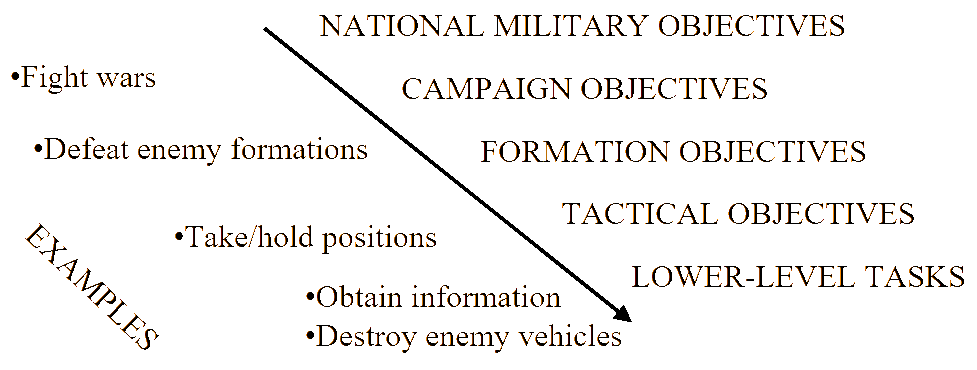
The STT process, illustrated in Figure 1, is a method of deriving specific tasks from a set of high-level requirements, usually set at the level of national military/political goals. Starting from the high-level requirements the process cascades these down through several layers to arrive at the lower-level tasks. Authoritative sources, such as military doctrinal publications, are used to provide a response at each level as to how the requirements will be met and the process is followed until a level is reached appropriate to the particular problem being studied.
As an example, Figure 2 shows the decomposition process used for an artillery analysis completed using the Quality
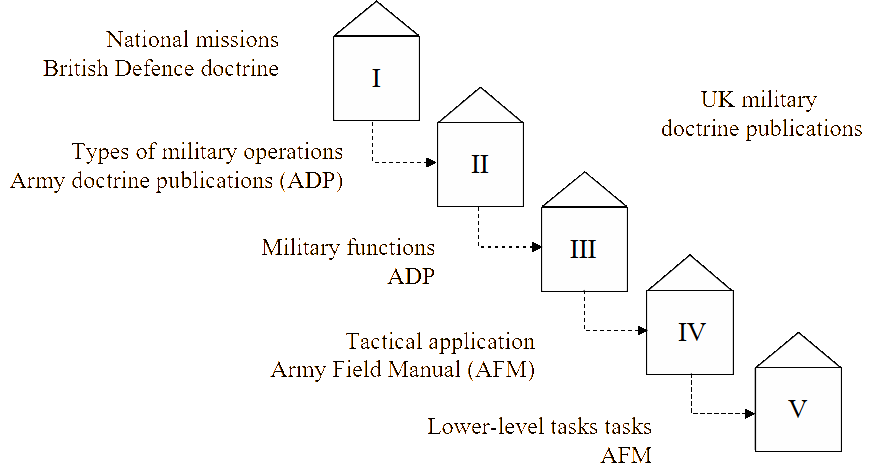
Function Deployment (QFD) technique. The figure includes the sources used (in this case UK Military Doctrine publications).
As shown in Figure 2, the process was initiated by evaluating the Military Missions of the UK Armed forces given in high-level publications outlining British Defence Doctrine. The next level set of activities (intended to meet the requirements of the top level missions) was obtained from parts of the British Army Doctrine Publications documents (this was used for two layers). The bottom two layers were created by using British Army Field Manuals as a source.
This process was followed to the level that was appropriate to the artillery systems in question; that is to the level that described the low-level tasks for artillery or indirect-fire elements. At this level the elements of the artillery systems themselves could be assessed against the requirements in order to determine their relative importance as implied by the cascade of assessments stemming from the very highest level.
The sources used to establish requirements and responses (at all but the lowest level) in the artillery example were UK Military Doctrine publications. However the approach may use any authoritative sources and those used to date by the authors include:
- UK Military Doctrine Publications;
- Army Doctrine Publications,
- Army Field Manuals, and
- Concept Papers,
- UK Maritime Doctrine Publications;
- UK Joint Essential Task List;
- MoD Equipment Capability; and
- US Military Doctrine Manuals.
Quality function deployment outline
A more detailed example of STT analysis is given later in this paper, but before a full analysis can be described the precise mechanisms for completing the decomposition process need to be considered. The original published concept for STT outlined the overall architecture of the method, but did not provide any specific approach for carrying out the decomposition. The authors of this paper have utilised the Quality Function Deployment (QFD) method for this purpose in all applications of STT. It is described briefly here.
QFD, which originated in the Japanese Automotive Industry, is now a widely accepted method of flowing requirements from the general to the specific. It is now widely understood, adopted and employed by governments and industry in the US and Europe. QFD is a translation of the Japanese ideograms for Quality, Function and Deployment. Although not a clear translation, its title does sum up the elements and origins of the process quite well. The process is aimed at identifying the requirements for a piece of equipment or other system to satisfy ‘customer’ needs, perceptions and goals, and then through a process of analysis identifying the correct and most effective and efficient responses to deploy to satisfy these requirements. It supports the planning of the allocation of resources to a requirement, analyses alternatives to identify the best options, identifies any areas of conflict in the responses to the requirements and permits comparative evaluation of complete systems, subsystems and even competitor systems. It is, however, a relatively simple and often judgemental process.
QFD is frequently used as an initial tool for the analysis of options and may be used to structure projects and provide easily assimilated summaries of situation and status as a function of time.
QFD is a structured process for articulating requirements (in QFD terms “WHAT” you wish to do) and then identifying how they will be satisfied (in QFD terms, “HOW” you will do it).
The approach allows the quantification of the relationships between the WHATs and the HOWs. QFD was originally created to capture requirements flow from the general to the specific and as such is well suited to the STT approach.
The first step in the QFD process is to define the requirements, or WHATs. The next is to define the responses to these requirements, or HOW it is proposed to meet the requirements. Usually this is completed by addressing each WHAT in turn but might also simply be populated by a list of pre-generated options for consideration.
The contribution by each HOW to meeting each WHAT is then scored and recorded in a matrix, or QFD house. Often this is done with a three-point (1, 3, 9) scale where 9 indicates a high contribution to meeting the requirement and 1 is some contribution. This scale is useful as a driver for completing the matrix and avoids the problem of over-population of the matrix, which might happen if a longer scale were used. In addition, the authors have sometimes used (with extreme care) negative as well as positive numbers in the matrix to indicate where a HOW might have a damaging effect on achieving a particular WHAT.
Simple score summing gives an indication of the importance of each of the HOWs. If the WHATs are weighted then these weightings may also be used. Finally the total scores for the HOWs may also be normalized using simple or proportionally modified schemes to give weights summing to 1 or 100. Fuller details of this scoring and weighting process can be found in the paper by Vance [4].
A further element is a Cross Contribution ‘roof’ of the QFD house, which permits comparison of the HOWs. Any responses that are incompatible or add to risk may easily be identified and also HOWs that are mutually beneficial may be spotted.
Finally, the method permits evaluation of complete solutions or systems. For example the HOWs might be grouped or combined into system solutions and the overall effectiveness of these solutions in addressing the requirements may be assessed. Thus solution options may be quickly ‘designed’ by grouping promising HOWs and may be compared with each other and also with competitor systems, if appropriate. Further details on QFD and its effective use are found in Cohen [5].
Stt applications and discussion
In the experience of the authors, the principal application of STT has been:
- to derive requirements for military systems;
- to assess equipment (system and subsystem) options, often as technology options, against the requirements; and
- to derive a prioritised set of the most appropriate system options for meeting the requirements.
These have often indicated promising system concepts that have then been subjected to further analysis and evaluation using detailed engineering and operational analysis approaches.
The outputs have also included prioritised and weighted requirements that are useful outside the STT analysis for the clarification of published user requirements, the derivation of functional requirements, and the evaluation of competitor options.
Requirements and system evaluationworked example
This analysis was completed by one of the authors (Smith) as an example of how to use UK naval doctrine to attempt to derive requirements for naval systems. The work was aimed at identifying requirements ultimately for a future submarine system, but the example has been modified to be more generically applicable. The aim of the example is to clarify the process and also to provide some elements of the authors’ experiences in practices that facilitate the process. The example is included for illustrative purposes, uses unclassified sources and is only worked through a limited set of levels. A more-complete exercise would require further decomposition to lower, more-detailed sets of tasks and would probably use more sensitive material. Figure 3 gives the hierarchy used for the analysis together with the sources accessed.
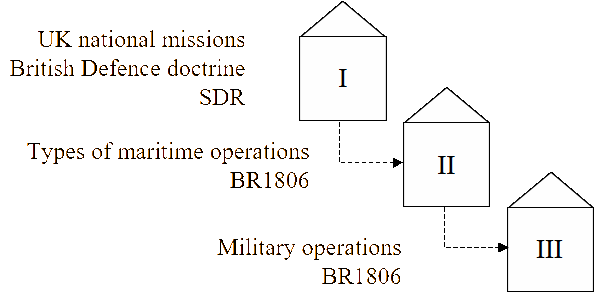
The aim was to generate a set of putative requirements for tasks that a future naval system (for example a ship, aircraft or submarine) might be required to support. The initial phase involved identification of appropriate sources that should be utilised. The approach taken was to start with the set of high level missions as given by the UK government as the set of missions which the armed forces should be able to undertake. These missions are found in a number of sources, but the most accessible to a wide audience is the Strategic Defence Review papers from 1998 [2].
The next step was to establish the best source for determining how the armed forces (or the elements of the armed forces relevant to the analysis in hand) might respond to these mission requirements. In the UK various Joint Doctrine and single-service doctrine publications exist. For this example the highest-doctrine (BR1806) [3] was adopted. For a more detailed analysis, with further layers, more sources would be required. Clearly, if the aim of the analysis had been to examine a different system a different set of sources would have been required. The choice of sources is perhaps the first element of subjectivity in this form of STT analysis.
In this example, using the UK Defence Missions, a QFD Matrix was initiated with the eight missions forming the WHATs on the left side of the matrix. In the absence of any other guidance and as a starting point, these were weighted equally. The source chosen (the British Maritime Doctrine publication) was then examined to derive the set of responses (or HOWs) appropriate to addressing the set of requirements (missions/WHATs). This process was subjective and was based on interpreting the source documentation.
Finally, once this set of responses had been generated, the importance of each in addressing the eight missions was scored using the 1, 3, 9 scale described earlier. The results of the analysis so far are shown in Figure 4. Note that the overall contribution of each response is calculated and given at the foot of each column. The raw score is the sum of the cell entries multiplied by the relevant row weighting. In this case, these have then been normalised.
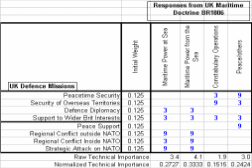
The matrix shown in Figure 4 thus represents the top-level QFD house illustrated in Figure 3. The next step was to generate and complete the second-level matrix. The responses (HOWs) from the top level become the next set of requirements (WHATs) in the next level matrix. Their weightings were simply the normalised scores from the foot of each column in the top-level matrix. The appropriate source was examined to extract, using judgement, the responses to these requirements. In this example the source remained the British Maritime Doctrine publication and, in this case the responses were often simply section or paragraph headings. Once the matrix was generated, scores were assigned as before and the matrix completed as shown partially in Figure 5.
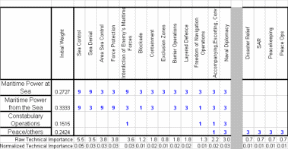
For this example the decomposition then stopped. A set of statements had been derived from the doctrine manual giving a set of requirements, which a naval system or systems would be required to provide. Further, these requirements had weightings to indicate their relative importance.
As illustrated in Figure 6, five hypothetical candidate naval systems were then evaluated against these requirements. This step in the analysis is purely for illustration, so the five candidate systems were not defined in any detail. The approach was simply to score the ability of each candidate system to contribute to meeting each task. Calculation of the scores (using a 1, 3, 9 scale as before with the HOWs) gives a simple measure of the relative ability of each of these systems to meet the weighted requirements. As well as a
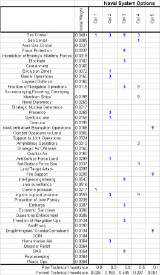
numerical output the matrix at this level also provides a clear picture of the coverage of a system against the requirements, since gaps in the matrix indicate where there are requirements that a system does not address at all. It could be that another system does score against these requirements whilst missing others that the first system addresses. This leads to some indication that a combination of the two systems might be appropriate.
Another approach could be to examine naval subsystem options against their ability to contribute to meeting the requirements. The set of requirements in this example are probably not sufficiently detailed to permit comparison of say, three radar subsystem options, or several weapon system options, but if further decomposition was completed a set of requirement statements would be derived against which these options could be assessed. This would provide gross indications of the relative importance of, for example, radars versus weapons on a platform, but would also assist in identifying which options in these categories appeared to offer most benefit, thus supporting the generation of complete candidate solutions.
Stt for capability analysis
Research has commenced at RMCS into the use of STT for the derivation and analysis of Defence Capability Requirements. It is widely felt that there is scope for further methods (especially in the UK) permitting analysis of defence capability and in particular of the means of meeting future capability requirements. STT provides a method that potentially can produce and refine capability requirements, prioritise them and permit the rapid and imaginative generation and initial assessment of options.
The potential weakness in the approach is the judgmental element, but it is felt that this is actually particularly appropriate at a high level as a means of ensuring the required expansive and imaginative approach.
Other strengths are, again, the in-built audit trail of the method brings as well as its transparency, which allows rapid understanding and comprehension of its workings by all stakeholders.
Stt for doctrine analysis
Since many applications of STT have used doctrine publications, the authors believe that the method has potential for analysis of the publications themselves, in terms of their flow from level to level, their completeness and their logical construction. When employing the official publications for an STT analysis it is often very enlightening (and frustrating) to discover gaps and inconsistencies. The use of STT therefore holds some promise for ensuring consistency and completeness, particularly between publication levels.
Discussion
Clearly throughout the STT process there is subjective judgement: the choice of sources, the choice of responses from these sources and the scores in the matrices are all subjective. The authors’ recommendation is that this process should utilise an appropriate set of experts to identify the sources, the sets of responses themselves and the scores. One extreme implementation is for a single analyst to complete the whole exercise and then seek review by subject matter experts. This is an efficient approach, but is prone to delay because of the necessary revisions and modifications.
The other extreme would be to convene panels of experts for each step. This might be more authoritative but is expensive. The recommendation is that a combination of the two approaches works best, with off-line analysis conducted by a single analyst and then review panels convened to accept/validate the work. Because of the judgmental nature of the process, there is unlikely to be a unique, comprehensive and definitive set of outputs. If this is recognised and the technique is regarded as a problem-structuring framework, providing guidance and direction rather than highly accurate numerical outputs, it is not necessary (indeed it is misleading) to invest too much time and effort in trying to get a single definitive answer by using expert panels at every step.
A strength of the approach in all cases has been provided by the use of authoritative published sources. Although subjective judgement is required, it is the use of official, recognised source material, and the ease of showing a full audit trail from these sources to the matrix elements and the scores, which has provided the confidence for senior decision makers to utilise the tool and the outputs confidently.
Some attempts have been made to evaluate the validity and robustness of the approach. Two packages of work have been completed (although not published externally to the organisations concerned) which utilised differing hierarchies to establish low-level requirements. One piece of work utilized UK sources: military doctrine sources and a military task hierarchy, to produce two different hierarchical structures for the decomposition of the problem. These were used to judge the value of a number of systems (the same set of systems in both cases), producing results from the two hierarchies with similar priority orders. In another piece of work, a UK/US system was analysed using STT based separately on UK and US source documents (doctrine publications). The outputs, in terms of requirements, the assessment of the importance of subsystems and the efficacy of concept solutions, between the two nationally based assessments were extremely consistent.
Using the QFD approach to implement the STT decomposition process enables the production of quantitative output, which can be perceived as both an advantage and a disadvantage. The use of numbers enables a more objective approach to the analysis and in particular makes it possible to carry out some meaningful sensitivity analysis. However, the quantitative output should be treated with caution and not given more credence than it deserves. Helpful guidelines for utilising the QFD approach have been produced by Vance [4].
Overall the strengths and weaknesses of STT are much the same as those of many so-called “soft” analytical methods. The use of hierarchical decomposition and the production of a set of weights are common features of many multi-criteria methods used to study complex and messy problems with multiple objectives and involving a number of different stakeholders. Such methods are generally acknowledged to provide a means of structuring and exploring the problem situation, learning about your own and others values and judgements and can lead to the identification of an agreed way ahead. However, it is important that these methods are not used in the wrong way by insisting on following a process through to an “answer”. If the stakeholders/experts feel that the process has dictated the output rather than producing results reflecting their views, then the method has not achieved its aim.
Summary
The STT method is a simple and rapid, but extremely powerful, approach that has proved to be most beneficial in the early development phases of weapon-system projects. It enables the adoption of a structured approach to explore extremely complex and messy management problems and it is used in US government and industry projects. It also holds promise for other areas as well, including particularly defence capability analysis.
References
[1] G. Kent, A Framework for Defense Planning, RAND Corporation Report No R-3721-AF/OSD, August 1989.
[2] The Strategic Defence Review White Paper, London: House of Commons Library, Research Paper 98/91, October 1998.
[3] British Maritime Doctrine, BR1806, 2nd Edition, Naval Staff Directorate D//NSD 2/10/1, London, The Stationery Office 1999.
[4] S. Vance, “QFD Quicksand”, Proceedings 61st MORSS, June 1993.
[5] L. Cohen, Quality Function Deployment: How to Make QFD Work for You, Addison-Wesley, 1995.