
Volume 5, Number 1, March 2002
Map-Aware Non-Uniform Automata (MANA): A New Zealand Approach to Scenario Modelling
- 1 Both authors are with the Defence Technology Agency, Private Bag 32901, Devonport Naval Base, Auckland, New Zealand.
Abstract
New Zealand’s Defence Technology Agency (DTA) has developed a model to explore new methodologies for modelling warfare. The model, Map-Aware Non-Uniform Automata (MANA), is based on the ideas of complexity science, and is intended to capture at least some of the non-linear dynamics inherent in actual combat. It does so by treating the many “intangible” aspects of combatant behaviour in terms of simple rules subject to a stochastic process. It is evident by examining the model that even simple rules lead to complex behaviour. The simple nature of the model allows both rapid parameter space exploration and experimentation with co-evolving tactics, yet it has enough sophistication to produce realistic looking behaviours and tactics. This paper discusses the model and its philosophy.
Introduction
Origins
Map-Aware Non-Uniform Automata (MANA) was designed by the Operational Analysis Section of the New Zealand Defence Technology Agency (DTA), as a result of limitations experienced with the other models available through the America Britain Canada Australia (ABCA) agreement, namely CAEn and Janus. While these models purport to be detailed, highly physics-based and rigorous, it becomes immediately clear that they are quite limited once one starts to try to analyse the value of things such as situational awareness, command and control, the informational edge that enhanced sensors provide, and the personalities of the protagonists.
This is principally because these aspects can only be represented within these two standard models in an arbitrary way. Furthermore, the behaviour of the entities within these two models is largely pre-potted. It is difficult to get the entities to behave in a way that is realistic, particularly if circumstances change from run to run.
MANA is based on two key ideas:
- that the behaviour of the entities within the model (both friend and foe) is a critical component of the analysis; and
- that highly detailed models are often too focused on irrelevant aspects to be useful for determining robust force mixes which survive under a wide range of circumstances.
DTA is not alone in this frustration with the array of conventional combat models available. We have been collaborating in this work with several groups, including Australia’s Defence Science and Technology Organisation (DSTO) Land Operations Division and the US Marine Corps Combat Development Command’s Project Albert [1] initiative. Our mutual aim is to develop models and tools for better describing complexity on the battlefield and exploring the associated parameter spaces.
Emphasis on behaviour
Although entities in the MANA model are assigned behavioural characteristics, it is not intended to be able to describe every aspect of a military operation. There is no inbuilt “intelligence” which determines the plan to which the MANA entities work. Consequently, careful thought must be given to setting up a scenario, with a clear idea of which aspect of warfare the scenario is addressing.
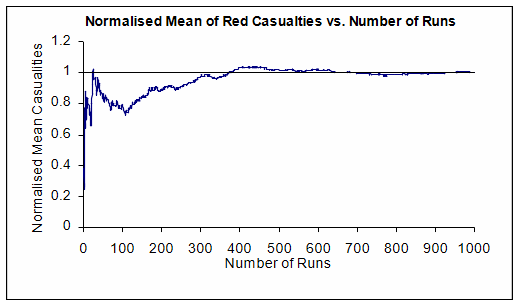
Though such an approach may seem pre-potted, the non-linear nature of the model ensures that, regardless of the modeller’s preconception, a startlingly large number of outcomes are possible even for moderately complicated scenarios. This leads to a much greater likelihood of extreme cases being generated by the model, so that a much larger number of runs are needed to generate robust statistics. For example, CAEn is typically run by ABCA countries 30-odd times per parameter set, and typically generates approximately normal probability distributions. By contrast, a relatively simple MANA scenario (like that shown in the following section) takes around 600 runs to settle to a robust estimate of the mean, as Figure 1 shows. This demonstrates the dramatic change in the nature of the analysis once entity behaviour is taken into account.
Furthermore, for many MANA scenarios the distribution of outcomes exhibit a “fat-tail” of extreme results [2]. That is to say, the distribution of results is not a nice bell-shaped curve. This seems to fit well with real-life experiences, where on a patrol, for example, most of the time things run smoothly, but occasionally the patrol gets caught in an awkward position and a disaster occurs.
Such a range of outcomes is characteristic of complex adaptive systems, and occurs even with quite simple rules of behaviour. This seems to us to be the real breakthrough of complexity theory (that is, high-payoff analytically for a relatively simple model).
Since simple rules are sufficient to achieve this outcome, it is pointless to make the behavioural rules more complicated than absolutely necessary. At the same time, if even simple rules produce complicated and unpredictable behaviour, then what hope is there of relating observed behaviour back to specific aspects of a complicated rule set? The more detailed a model, the more obscure its workings, a problem that is compounded if the user is not the model designer.
Obsession with detail
This last point is particularly important, as it represents a significant shift in mindset. It is fair to say that there remains a school of analysts who only find comfort in dealing with the highly detailed, predictable and well-validated aspects of models. Because of their predictability, these aspects are often treated as being more “real” than less certain or predictable aspects. Furthermore, there is an assumption that putting these well-defined components into a model will lead to a completely accurate description of the real world.
Our viewpoint is that model validation is only possible in the sense that the details of isolated portions of the model can be well described. However, it seems to us impossible to claim that a model is a valid representation of all aspects of real life. The difficulty is that adding evermore detail to a model does not necessarily improve its ability to reproduce reality, if in reality the complex interplay of various factors is what determines the outcome.
Weather is a particularly interesting example of this, because weather data display power laws characteristic of complex systems. But these power laws cannot be convincingly explained by the Navier-Stokes equations beyond phenomenological arguments [3]. However, there are very simple “fractal” models of weather that are capable of producing artificial data indistinguishable from the real thing [4]. These models contain almost no physical processes at all (fractals are objects that possess structure on all scales, and usually display scaling similarities, such that they look the same regardless of how close one “zooms” in on the object [5]).
We argue that for such complex systems, understanding the physics of isolated aspects offers virtually no insight into the dynamics of the system as a whole. Consider, for example, how much use modelling in great detail how a transaction is made on the stock market is to understanding why market crashes occur.
The difficulty with complex systems is that the number of parameters is so large that the only reasonable way of tackling these problems is via stochastic models. The problem can then be simplified to one of identifying models that produce the correct behaviour, and behaviour that reproduces the statistical patterns observed in real data. For such a model, the detailed “mechanics” of the entities is far less important than the global patterns that emerge as the result of their many interactions.
The MANA model
AGENT-based models
MANA is an example of an Agent-Based Model (ABM). ABMs have the characteristic of containing entities that are controlled by decision-making algorithms [6]. Hence an ABM combat model contains entities representing military units that make their own decisions, as opposed to the modeller explicitly determining their behaviour in advance.
MANA falls into a subset of these, called cellular automaton (CA) models [7]. CA models have their origin in physics and biology. The famous Ising model of magnetic spin alignment is an example of such a model in physics, while Conway’s “Game of Life” [8] is an example of a CA model designed to explore biological ideas.
MANA and other CA models are often called complex adaptive systems (CAS), because they exhibit properties such as:
- they cannot be analysed by decomposition into independent parts;
- global behaviour “emerging” as a result of many local interactions;
- agents interact with each other in non-linear ways, and “adapt” to their local environment; and
- they contain a process of feedback that is not present in the current generation of combat models.
Structure
MANA was coded in the Delphi programming language, and makes extensive use of the object-oriented method. Delphi was chosen for the pragmatic reason that our project programmer was experienced in this language. As it turned out, the time Delphi saves the programmer by providing many basic features of a Windows environment allowed the model to be rapidly developed.
The parameters within MANA can be divided into three basic types. The first, the personality weightings, determine an automaton’s propensity to move towards friendly or enemy units, towards its waypoint, towards easy terrain, and towards a final goal point.
The second type, constraints, acts as conditional modifiers to this process. The Cluster parameter “turns off” the automata’s propensity to move towards friends above some maximum cluster size; the Advance parameter prevents an automaton from moving towards their objective without a minimum number of friendly units accompanying it; and the Combat parameter determines the minimum local numerical advantage a group of automata require before approaching the enemy.
A final set of parameters describes the basic capabilities of automata, such as weapons range, sensor range, movement rate, single-shot kill probability, defensive factor, stealth, and maximum number of simultaneous targets that can be engaged. The automata also possess the ability to communicate the position of enemy automata to other friendly automata.
The MANA parameter set so far described at least superficially bears a strong resemblance to the widely distributed ISAAC model [9]. However, there are critical differences that we believe lead to much more interesting and realistic behaviour.
MANA allows a greater range of triggers to cause a change in an entity’s personality. For example, a contact with an enemy, a shot being fired, reaching a goal point, and becoming injured may all change an automaton’s personality.
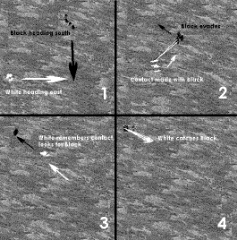
MANA also places greater emphasis on global interactions, by providing each side with a “memory map”, which is used to mark the locations of enemies. The entities thus react to both enemies they see and enemies they “remember”. An application of this is shown in Figure 2.
The final feature is an extra and settable level of Brownian randomness. MANA entities use a penalty function to rank possible moves, based on their personality rules. If several moves have a similarly low penalty, a move is chosen at random from the best moves. A “movement precision” parameter sets how wide the margin should be for accepting similarly good moves. By introducing this randomness we are notionally representing small differences in the personality, or “mood”, of the automata. Although the importance of this feature may not be immediately obvious, and is not discussed in great detail here, it does play a role in producing more realistic-looking behaviour.
Limitations
The current version of MANA has plenty of drawbacks. For example, MANA is not designed to examine careful formation fighting. Though entity formations occur within MANA that bear strong resemblance to formations likely to be used in the real world, they usually will not keep to a particular formation for long. Nor do the entities within MANA always behave in a sensible manner. They often exhibit actions that might be described as “mistakes”.
However, this is also part of the point of MANA. Rather than having heavily pre-potted behaviour representing one way of doing things, we can explore many different ways of doing things quite quickly (due to the simplicity of the model). It is useful to be able to ask which kinds of formations appear to produce the best results, and what are the consequences of making certain kinds of mistakes? Very rigidly constraining the behaviour of entities immediately rules out many interesting possible outcomes.
There will be questions where maintaining a formation may be critical. Our attitude to questions for which MANA is unable to represent key aspects is that new features are relatively easy to add to the model, due to its object-orientated design and the friendliness of the Delphi programming environment.
Some other groups we are aware of take a different approach. They seek to build a model capable of adding behaviour rules at will. However, the generality strived for by these groups leads to modelling platforms which resemble high-level programming languages themselves. This is due to the great difficulty associated with adding rules that may be quite different from the existing ones. Our view is that in order to make these changes, it may be just as easy to alter the code directly as it is to alter extremely complicated behaviour rules which resemble code.
Many future developments are planned for MANA, and a second version is well underway. It will include better representation of different types of weapons, including indirect and area weapons; more complicated command and control rules; better representation of factors in crowd dynamics; and terrain and line-of-sight representation.
Applications
Landscapes versus point estimates
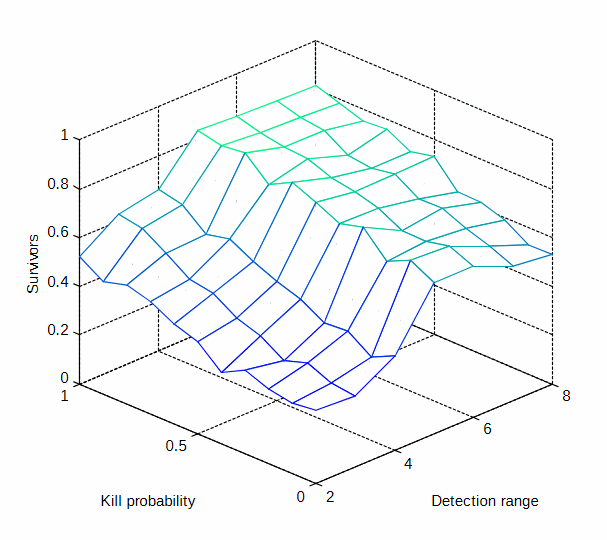
One of the key philosophies behind the MANA model is that it allows rapid and systematic exploration of the parameter space. This allows us to build broad parameter landscapes from which it is possible to identify the most critical elements in a scenario [10]. This was illustrated in our earlier paper in this journal [11], which explored the value of sensors versus weaponry in a reconnaissance environment [12]. One such landscape from that report is shown in Figure 3, which illustrates the relative impact of increasing a reconnaissance vehicle’s firepower as opposed to sensor performance.
It also allows the exploration of co-evolving situations [13]. That is, for a given scenario, an enemy that initially performs poorly may be able to change its tactics to greatly improve its performance, or alternatively, nullify the effectiveness of some new piece of equipment. In return, the friendly force may change its tactics to try to improve performance, and so on. MANA’s simplicity allows rapid iteration of such evolution.
This contrasts with the approach of very detail-centric models. The detail inherent in that type of model not only increases the computational expense, but also dramatically prolongs the set-up time. This makes it impractical to rapidly explore the parameter space of the model, and hinders efforts to explore co-evolving situations. In effect, the extra detail ties the model to a so-called “point estimate”. That is, a very small area of the parameter space is examined, and the modeller tries to convince his/herself that that point represents a known force’s performance with high fidelity.
However, we contend that if enough of the parameter space can be mapped, it is not even necessary to have high-fidelity validation of the model entities. What we are really interested in is areas of high-payoff in the parameter space, so that it is only necessary to understand whereabouts a given force and set of tactics lies relative to those areas. Exactly where the force lies is only important if it is near the boundary of a steeply improving region of the space.
Traditional point-estimate approaches narrow the modeller’s view of the parameter space to the extent that it is impossible to tell of the existence of nearby high pay-off areas in the landscape.
Apart from parameter space mapping, another technique to find high pay-off areas is to examine the behaviour of the “extreme” cases that MANA produces to see what the highest pay-off tactics are, and what kind of things lead to disaster. These outliers have the potential to provide the greatest insights into the strengths and vulnerabilities of a force or set of tactics, and lead us to high pay-off regions of the parameter space.
Complexity theory
One of the key features of MANA is that it is suited to the study of warfare as a complex adaptive system. Such systems generate “emergent behaviour”, that is, unexpected behaviour on a large scale as the result of multiple interactions on the smallest scales of the model [14].
Given MANA’s ability to produce behaviour of this type, it is important to realise that some effort must be made to actually exploit it. That is to say, any given scenario will not automatically behave like a complex adaptive system just because MANA happens to be a cellular automaton model. This seems to be somewhat of a problem with demonstrations of automaton models, which often display behaviour that is well described by the Lanchester first-order differential equation of combat, for example. However, when properly exploiting the model’s complexity, its behaviour is far too complicated to be described either by such a differential equation, or its stochastic equivalent.
MANA appears more suited to exploring complex battlefields than early versions of ISAAC, for example, because its rules allow more realistic-looking behaviour, in particular, greater emphasis is placed on “global” rules. Ironically, though such global rules make MANA much less like a traditional cellular automaton model, the behaviour of the model produces much more convincing emergent behaviour.
An important aspect of the MANA work, then, is determining just what kind of rules need to be in such a model to generate emergent properties.
Broadly speaking, emergent behaviours appear to be related to the way entropy grows in the distribution of the entities in the model. It appears to be associated with periods where the model data display fractal-type distributions, such that the entropy of the system is neither minimal nor maximal (since the data display spatial and temporal correlations), and depends on the resolution at which the model is examined. This is typically characterised by the model entities displaying actions such as splitting into groups, swarming, dispersing, and other behaviours that radically rearrange their distributions to produce “bursts” of action.
This is the type of statistical property that can be sought from the model data as evidence that the model is exhibiting the self-organised patterns associated with complex systems.
Summary
The MANA model represents a significant shift in the analysis methodology for DTA. It not only places much heavier emphasis on the behaviour of the combatants than our other models, it favours simplicity over detail, allowing much faster exploration of tactics and parameter spaces.
By building up a picture of the parameter landscape, we hope to gain a better appreciation for the high-payoff areas of the parameter space, while at the same time, the emphasis on behaviour allows us to explore questions related to operations other than war, command and control, and the use of sensor systems in a dynamic environment.
At this point, it is worth considering the meaning of Mana. Mana is a Maori word which when applied to an individual or group associates to them an aura of respect and authority. This also happens to be a key concept in the way the New Zealand Army conducts its business. In peacekeeping, the NZ Army attempts to win the hearts and minds of the locals. The cooperation of the local inhabitants reinforces the security of the NZ forces, and in turn the environment as a whole. It creates security through mutual trust and understanding.
At the same time, by maintaining the highest professional standards and commitment to duty, the Army demands respect from its enemies. This makes it much more prudent for its adversaries to avoid the risk of a confrontation. Some of these ideas are explored in a DTA report [15].
MANA is one of the few models that allow such concepts to be explored. Thus it seems fitting that NZ should seek to produce such a model in preference to the more firepower-centric models characteristic of Cold War thinking that are still being used in the US and Europe.
References
A. Brandstein, “Operational Synthesis: Applying Science to Military Science”, Phalanx: The Bulletin of the Military Operations Research, Vol. 32(4), No. 1, 1999.
M. Lauren, “Fractal Methods Applied to Describe Cellular Automaton Combat Models”, Fractals, Vol. 9, 177-185, 2001.
A. Tsonis and J. Elsner, “Chaos, strange attractors, and weather”, Bulletin of the American Meteorological Society, Vol. 70, No. 1, 14-32, 1989.
M. Lauren, M. Menabde, A. Seed, and G. Austin, “Characterisation and Simulation of the Multiscaling Properties of the Energy-Containing Scales of Horizontal Surface-layer Winds”, Boundary-layer Meteorology, Vol. 90, pp. 21-46, 1999.
B. Mandelbrot, The Fractal Geometry of Nature, W.H. Freeman and Company, New York, 1983.
R. Axelrod, The Complexity of Cooperation: Agent-Based Models of Competition and Collaboration, Princeton University Press, 1997.
A. Ilachinski, Cellular Automata: A Discrete Universe, World Scientific Publishing Company, 2001.
E. Berlekamp, J. Conway, and R. Guy, Winning Ways for Mathematical Plays, Academic, 1982.
A. Ilachinski, “Irreducible Semi-Autonomous Adaptive Combat (ISAAC): An Artificial-Life Approach to Land Warfare,” Military Operations Research, Vol. 5, No. 3, pp. 29-46, 2000.
G. Horne, “Beyond Point Estimates: Operational Synthesis and Data Farming,” in Maneuver Warfare 2001, US Marine Corps Command Development Command, 2001.
M. Lauren and D. Baigent, “Exploring the Value of Sensors to a Recce Unit Using Agent-based Models,” Journal of Battlefield Technology, Vol. 4, No. 1, pp. 44-48, 2001.
M. Lauren, Exploring the Recce-Counter Recce Scenario with ISAAC, DOTSE Report 171, NR 1349, Defence Operational Technology Support Establishment, New Zealand, 2001.
M. Leonardi, “Coevolution: A Decision Making Approach,” in Maneuver Warfare 2001, US Marine Corps Command Development Command, 2001.
M. Waldrop, Complexity: The Emerging Science at the Edge of Order and Chaos, Simon and Schuster, New York, 1992.
M. Lauren and R. Stephen, Modelling Patrol Survivability in a Generic Peacekeeping Setting using ISAAC, DOTSE Report 177, NR 1358, Defence Operational Technology Support Establishment, New Zealand, 2000.